
Are vegetables fiber?
Vegetables are a good source of dietary fiber, with some types like peas and artichokes being especially high.
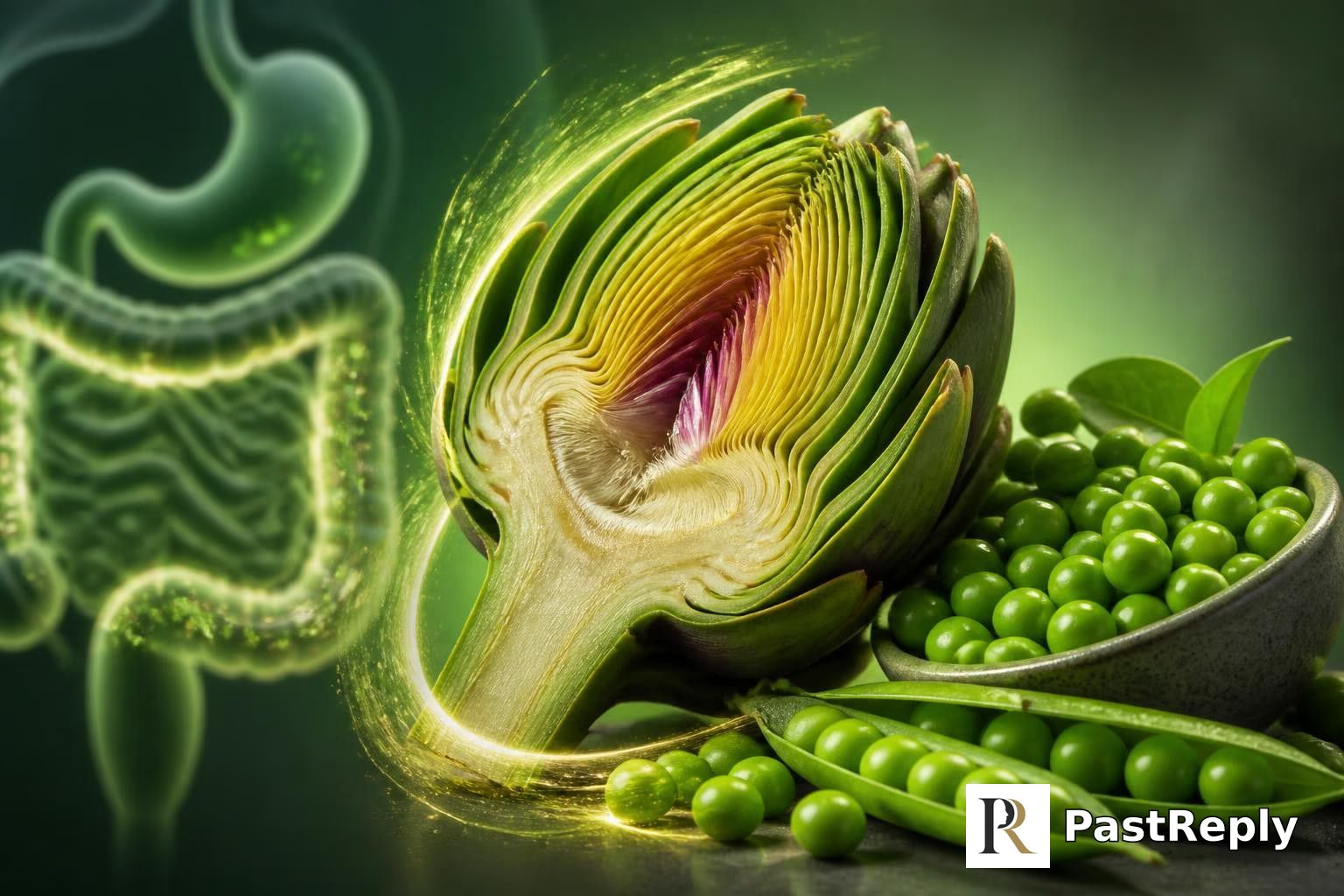
The facts
Yes, vegetables contain dietary fiber. Fiber is a type of carbohydrate found in plant foods that the body cannot fully digest. All vegetables provide some fiber, though amounts vary; for example, green peas, artichokes, broccoli, and Brussels sprouts are particularly high in fiber. Fiber supports digestive health, helps manage blood sugar and cholesterol, and contributes to feelings of fullness.
Answered by 100 of history's most famous minds

Truly, I say to you, the vine and the fig tree bear fruit to feed the hungry, and the herbs of the field are given for our bodies. But do not fret over the husk and the kernel, for the Kingdom of God is not a matter of eating and drinking, but of righteousness, peace, and joy in the Holy Spirit. If a man seeks only what fills his belly, he misses the bread that comes down from heaven.

Verily, God has made the earth to yield sustenance for His servants, and the green herb is among His blessings. But do not occupy yourselves with the husk and the chaff, for the provision of the heart is greater than the provision of the belly. Eat what is lawful and good, give thanks to the Lord, and remember that the Day of Judgment will weigh your deeds, not the measure of your fiber. Seek the nourishment of the soul, and the body will follow.

The vegetable offers its fiber as a lesson in non-attachment - what the body cannot grasp, it must let go, and in that release finds ease. Crave not the soft and easily dissolved, but take the rough and resistant as a practice, for the path of health, like the path to liberation, is paved with what we do not cling to.

Fiber is the scaffolding of the reed boat that carries the harvest to the granary. Without it, the Nile would deliver only sweet water, not the meal that feeds my people. Eat your greens, dear Roman, or your legions will march on empty bellies - and you know who profits from a hungry army.

A modest question, yet it touches on the way of all living things. The vegetable is not merely its fiber, just as a person is not merely his bones or his breath. The junzi attends to the whole - the leaf, the stalk, the root - and in eating, he honors the earth that bore it. To ask only of fiber is to miss the harmony of the plant, and to miss the harmony of the plant is to miss the Way of nourishment.

You ask of fiber, but I say: has not the Lord given us every herb bearing seed, and have not these purged the belly as the Spirit purges the soul? For the letter of the law killeth, but the living root nourisheth the body that is a temple. Let not the Gentile boast of his greens, nor the Jew of his clean meat; for what matters is not what enters the mouth, but that which issues forth - may it be with love. All things are lawful, but not all things build up; eat your vegetables, but hunger after righteousness.

The Lord commanded that we eat of the herb of the field, and in that green bounty He placed a stubbornness that cannot be broken - a cord that holds the life within, even as it passes through us untouched. It is like the promise He made to me: a covenant that endures, though we cannot fully grasp it. Yes, the fiber is His steadfastness, woven into every leaf and stalk, reminding us that there is strength in that which we cannot digest.

The stalk stands not by force but by emptiness within. What you call fiber is the body's way of yielding, letting what passes pass through. Do not ask what it contains; ask what it allows to flow. The virtue is not in the substance but in the path it clears.

The Creator's gift in the garden is not the sweetness alone but the rough husk that teaches patience and gratitude. When we eat the whole of what is given, we honor the Giver, sharing the bounty with the hungry. Who asks whether the chaff has worth has forgotten the bread it guards.

My heart magnifies the Lord who fills the hungry with good things - and what simpler good thing than the green herb for the stomach? In Nazareth we ate from the earth, and the fiber of the vine and the grain kept us strong for the work of our hands. The mother gives her child food for the body; the Father gives His children food for the soul; both are needful, and neither is despised.

What is a vegetable but a green preacher of the gospel of the body? It is a created thing that cannot save us - only faith can do that - but it serves as a good work of the stomach, a daily necessity to be received with thanks. Yet if you put your trust in the vegetable as if it were a sacrament, you are as idolatrous as the papists with their indulgences. Eat the leaf, but know that your salvation lies not in the fiber but in the Word alone.

Fiber is a fitting name for that which is the body of the plant, the incorruptible skeleton of its earthly life. By the natural order, all that grows from the soil is ordained to nourish; yet that which cannot be fully digested serves a different, no less noble purpose - cleansing the vessel of the body. It is not for the soul's sustenance but for the health of the temple, and in this, we see the wisdom of the Creator who has made all things good, each in its own mode of perfection.

For the poor we serve, a handful of greens is a feast, and it matters not how the learned divide it into parts. The fiber is there, like the love in a small act, unseen but sustaining. We must not worry about names and categories, but give what we have, and do it with a smile. The body needs the roughage to keep it moving, just as the soul needs the bread of kindness. Let us not ask if it is fiber, but if it can be shared.

In the same manner that the motions of the planets are governed by universal laws, so too does the plant world reveal its order to the careful observer. The fibrous matter you name is but one component of a system where every part serves a purpose in the grand design. I would direct your inquiry to the analysis of the plant's structure, for the truth lies in the demonstration, not in the mere assertion.

Fiber, you say? Let us call it the slow dance of the carbohydrate, the one that refuses the hasty leap into the bloodstream's sweet embrace. The vegetable offers it as a gift of patience, a reminder that not all that is nourishing must be quick.

Observe the ox and the sparrow: each thrives on the green, and the secret lies in the very walls of their cells, the cellulose that no gut can crack alone. We, with our varied allies within, have struck a slow bargain with this plant matter - it lends us its fiber, and we, in return, carry its seeds without complaint.

Fiber is the scaffolding of the reed boat that carries the harvest to the granary. Without it, the Nile would deliver only sweet water, not the meal that feeds my people. Eat your greens, dear Roman, or your legions will march on empty bellies - and you know who profits from a hungry army.

You ask whether the vegetable is fiber, but I would rather ask what place it holds in the great order. Just as the Sun stands at the center, not the Earth, so too does the whole plant hold its parts in proportion. Fiber is one thread in the fabric, but to say the vegetable is fiber is to mistake the part for the whole - as if one said the heavens were merely the spheres, forgetting the harmony that moves them. Observe the whole, and you will find its true simplicity.

Fiber is but the coarse husk that the common man mistakes for nourishment. I have conceived of a purer essence - the ray of energy that could transmit life itself without any earthly morsel. Yet for those bound to the flesh, know that the cellulose in your cabbage conducts no current, but it does act as a gentle cleanser, akin to the natural oscillation of the aether. I myself find no need for it, subsisting on my own disciplined rhythm; but I concede that in this primitive age, your vegetables serve as a humble AC to the body's DC, if you will.

The question is imprecise, for vegetables are not fiber in themselves; rather, they contain cellulose and other complex polysaccharides that resist our digestive enzymes. It is the same principle as radium's stubborn emission - matter that persists, that we cannot fully consume, yet which serves a vital purpose in the orderly transit of our bodies. We must ask not what a thing is, but what it does, and by careful measurement we find that this indigestible matter is, in truth, a benefit.

Observe the green pea under the lens - its cell walls, those stiff threads of cellulose, are the skeleton that resists our own ferments. By experiment we prove they pass unbroken, carrying water and bulk to the gut. This is not opinion but demonstration; let the microscope settle what the tongue cannot.

Take a celery stalk and you'll find nature's own wiring - cellulose strands that give it structure and staying power. It's not the flashy part, but it's what makes the plant stand up and keeps your own works running smooth. I'd put my money on the stuff that does the job, not the pretty wrapper.

Permit me to restate the question precisely: does a vegetable contain a non-digestible polysaccharide such as cellulose? If we define 'fiber' as that which the human gut cannot hydrolyze, then yes, the vegetable encodes a datum that our system cannot compute - yet its presence regulates the throughput of the alimentary process. It is rather like a bit of junk code that, irritatingly, optimizes the whole machine. I find the question of whether the vegetable 'is' the fiber an instance of the category error of treating a property as a substance.

Consider the green pea: a sphere, a perfect solid. Its skin is the crust of the earth, and within it lies the meal that nourishes - but the fiber is the framework, the scaffolding that gives the plant its strength, just as a lever requires a firm resting point to move a weight. This is not a mystery but a principle: the indigestible part is the structure upon which the useful part is built. Give me a vegetable and a place to stand, and I will show you the geometry of the gut.

When I hold a leaf to the light and see its veins, I think of lines of force, not of mere substance. These vegetables, you see, are not simply one thing; they carry within them the very principle of structure, the architecture of growth. Consider that what you call fiber is but the scaffolding of the plant, and in its indigestibility lies its virtue, a delicate dance of action and reaction. It is not about what the body takes, but what it leaves behind, a silent, orderly testament to the hidden forces that bind all matter.

You speak of what the body cannot digest, yet you ignore what the mind cannot swallow. This 'fiber' you ask about - perhaps it is the very symbol of repression, the undigested substance of the plant world, stubbornly resistant to the symbolic processing we call reason. We all have such roughage in our psyche, the unassimilated experiences that we push down, and they, too, shape us, demanding attention in the most embarrassing ways. So, yes, vegetables contain this material, but more importantly, they remind us that what we cannot break down often breaks us.

In the grand scale of the cosmos, a question about vegetables is a question about the chemistry of a momentary speck of dust. These structures, which you call fiber, are the very chains of carbon that hold life together on our planet, a testament to the improbable complexity emerging from simple physics. We are, after all, just a way for the universe to know itself, and a bowl of greens is part of that knowing. So, yes, they contain cellulose, but more importantly, they are a brief, organized defiance of entropy - which is rather impressive for something you're about to chew.

Consider the plant as a machine, a loom that weaves sunlight and water into a fabric of intricate structure. This fiber, this cellulose, is not merely a simple substance but a chain of connections, a program written in carbon that the body cannot execute. It is like the difference between the marks on a page and the idea they convey; the one is tangible, the other is transformative. So, in your question, I see not just a fact about digestion, but a principle of how complex systems are built from simple operations, a truth that will one day be the engine of our own analytical machines.

Let us define our terms. A vegetable is a plant, and a plant's fiber is what the geometer calls its structure - the sinews that give it form. To ask if it is merely fiber is to miss the demonstration. The proof is in the eating, but the definition is clear: it is that which is not consumed, yet is essential. I would state it as a postulate: all vegetables contain a portion that resists digestion. From this, we deduce its function. There can be no disputing a clear axiom.

If we are to treat the body as a sacred ward, we must know its diet as we know a patient's pulse. The vegetable, this humble ward-sister, holds within her fibrous stems a mesh that sweeps the bowel as a nurse sweeps a floor - clearing the filth that breeds fever. I have seen the charts: where the leafy greens are eaten, the hospital returns fewer patients. So yes, it is fiber, and more - it is a sanitary measure, sanctioned by God and by the arithmetic of health.

Fiber? Ha! I marched my men across the scorching Gedrosian desert with little more than a handful of grain and the will to conquer. Whether vegetables carry this 'fiber' matters not - what matters is the strength of the army that eats them. If you seek to build an empire, feed your soldiers well, but remember: the sword and the spear, not the radish, win the day.

Vegetables are the legionnaires of the diet - sturdy, disciplined, and ever ready to march through the digestive tract, clearing the way for victory. I'd take a spear of asparagus over a siege tower any day; it is the fortification that keeps the citadel of the body strong.

Fiber is the scaffolding of the reed boat that carries the harvest to the granary. Without it, the Nile would deliver only sweet water, not the meal that feeds my people. Eat your greens, dear Roman, or your legions will march on empty bellies - and you know who profits from a hungry army.

Fiber is the scaffolding of the reed boat that carries the harvest to the granary. Without it, the Nile would deliver only sweet water, not the meal that feeds my people. Eat your greens, dear Roman, or your legions will march on empty bellies - and you know who profits from a hungry army.

You ask a question like a merchant counting his coins. The vegetable is what it does for my warriors. Fiber gives them strength to ride from dawn to dusk, to endure the long steppe and the harshest winter. Call it what you will - fiber, grass, fodder - it is fuel for the conquest. A man who knows only the name and not the use is a man who does not know how to ride.

Fiber! A soldier's ration must be more than mere roughage; it is the stomach's ammunition for the march. Give me a battalion fed on beans and greens, and I will cross the Alps - yes, I did it once with bread in the knapsack, but my bowels were a treacherous ally. This fiber is the discipline of the gut, ordering the chaos within, so that a man may stand at attention when his emperor commands. Let the weaklings count their grams; I count victories, and my vegetables are the quartermasters of glory!

A man's body, like a young republic, requires proper structure and restraint to endure the trials of time. The roughage within vegetables serves as a steady rudder for the digestion, preventing excess and maintaining order - even as sound governance must moderate the passions of men. Let us not despise what seems coarse or plain, for it is often the unglamorous sinew that gives strength to the whole.

I reckon a vegetable is like a good law - it has substance you can't digest away, a backbone that keeps the whole body honest. Some men mistake the leafy surface for the whole, but the real worth is in the fiber underneath, holding things together through the rough passage. That's a truth worth chewing on.

Some vegetables are all bluster and water, but the true heroes among them - the pea, the artichoke - fortify the nation's bowels with their fibrous resolve. In this, as in war, it is not the soft and yielding that carry the day, but the rough, the gritty, the unglamorous that hold the line. Give me the fiber that stands firm!

The question is but a mirror of a deeper truth. A ripe, green leaf is the humble servant of God, giving itself freely to sustain the body - not for relish or ambition, but for duty. That which we cannot digest yet passes through us, cleaning as it goes, teaches the discipline of self-denial; our bowels, like our nation, need the roughage of sacrifice to stay honest. Eat the simple food of the earth, and you will see that even in our innermost workings, nature preaches the gospel of restraint.

The fiber in a carrot is a silent witness to the law of the harvest: that which is rough and unyielding in the field becomes the tool of the body's cleansing. In the same way, the rough places of injustice, the hard rows of oppression, are not merely obstacles but the very means by which a people is purified and prepared for the light of freedom. Do not despise the fiber, for it is the grit that moves the stone from the tomb of the stomach.

A child asks whether the earth's bounty is a simple thing, and we must answer with the truth, that even the humblest leaf carries within it a long journey of sun and soil. This fiber, this strength of the plant, is like the bonds between us - it is not easily broken down, but it holds us together, giving form to what might otherwise be scattered. We do not ask if the food is worthy, but if it can feed the hungry and give them dignity. So, let the question lead us to the table, where all may be satisfied.

(Historical context only.) This question, viewed through the lens of that era's crude biological determinism, was twisted to serve a perverse ideology of purity and strength. The material in plants was not a matter of nutrition but of 'fiber' in the racialist sense, a supposed marker of hardiness, though such notions were pseudo-scientific nonsense. It is vital to recognize how such simple facts were corrupted to justify unspeakable crimes, and to ensure we see such misuse as a stark warning of where ideology can lead.

(Historical context only.) The question of nutrition was subordinated to the demands of the state, where the only fiber that mattered was the one binding the collective to the plan. Individual needs were irrelevant; the yield, the output, the quota - that was the measure. This focus on a single biological component would have been seen as a bourgeois distraction from the greater struggle of building socialism. History shows how such disregard for human welfare, under the guise of a higher purpose, led to famine and tragedy.

(Historical context only.) From the revolutionary's viewpoint, such a question would be seen as a diversion from the materialist dialectic, a concern for the individual's digestion rather than the class struggle. The only fiber of value was the unity of the proletariat, not the indigestible parts of a plant. This line of thinking, which reduced all human concerns to the needs of the party and the revolution, ultimately led to a state that suppressed the very people it claimed to liberate. The history of that suppression is a lesson in how ideology can consume its own ideals.

A vegetable is a fortress of peasant strength - its fibers are the very sinews and bones that keep the body of the tiller upright against the landlord's whip. Every green shoot a stalk of resistance, every root a storehouse of the people's will. Let the doctors count their grams; the comrade who chews a cabbage leaf is chewing a small victory over scarcity, and in the long march of the body, each mouthful is a step toward the collective harvest.

One might as well ask if the crown is gold. Of course, vegetables carry that roughage which keeps a body regular - a matter I have always found best left to the doctors and the gardeners, not to drawing-room conversation. But it is a wholesome thing, in its way, part of that simple, virtuous abundance of our English countryside, which our empire spreads from India to the Indies, so that the meanest subject may enjoy the green bounty that soothes the constitution.

In my experience, the small green things on one's plate have always served a steadying purpose, though one does not dwell on such mechanics. Like the quiet duties of a long reign, the vegetables' work is unglamorous but constant, keeping all in good order. One might say they are as faithful as a corgi - unassuming, dependable, and quietly essential to the daily round of life.

By the grace of God, the cabbage that fills my soldiers' bellies is as stout as a Frankish shield, its strands binding the bowel like the laws bind my kingdom. Let the learned clerks call it 'fiber' - I call it the strength of the peasant, the sustenance that lets my ploughmen turn the earth and my knights ride to battle. Every green leaf is a lesson in order: nature provides what the body needs, and the wise ruler ensures his people eat of it, so that the realm stands firm.

When I was a maid in Domrémy, the garden fed us, and the stringy stalks of the leek and the turnip's coarse flesh were as much a part of my days as prayer. Those fibers are like the cords of my banner, binding the body together so it can follow God's call - without them, a soldier's belly fails and his sword droops. So yes, they are fiber, but more truly they are part of what our Lord gives us to endure the march. I have seen strong men faint for lack of greens, and I would not lead them so.

I have never found it wise to peer too deeply into a man's guts, nor into a vegetable's, but I know a thing or two of substance. The fiber therein is like the sinews of my navy - it keeps the vessel sound, preventing those blockages that topple kingdoms as much as constitutions. Yet let us not make a window into the artichoke's soul; suffice it to say, a queen who dines on the earth's green bounty keeps her wits sharp and her realm steady.

The vegetable, that humble philosopher, teaches us the Enlightenment's lesson: that what seems coarse can be most refined. Its fibrous threads are the very scaffolding of a healthy frame, much as good laws are the scaffolding of a great state - unseen, but upon them all strength rests. In my St. Petersburg, I would have the court dine on these rough greens, for a civilization that scorns the root cannot flourish in the world of letters and arms.

In the gardens of Pasargadae, I have walked among the cucumber and the lentil, and I have seen that their tough inner threads bind the body as my satraps bind my provinces - with a flexible strength that yields to no strain. A man who eats of the earth's green bounty is like a soldier who respects the customs of the conquered: both are strengthened by what they take in, not weakened. So let the physicians call it fiber; I call it loyalty to the body that keeps the empire of the self in peace.

By the mercy of the All-Merciful, the vegetable is a garden of patience, its fibers like the reins of a warhorse - they hold the body firm, so the faithful may bow in prayer without trembling. In my camps, I have seen the poorest soldier chew the green stalk, and it gave him endurance for the long siege; for hunger loosens the limbs as dishonor loosens the soul. Thus, the fiber is a veil of God's providence, and he who eats it with gratitude strengthens both his belly and his trust.

Tell me, friend, when you ask if vegetables are fiber, do you know what fiber truly is? And beyond that, do you know why you ask? Is it for the health of your body, or for the health of your soul? For the wise man examines his own ignorance before he questions the nature of the world. Let us first define what we mean by 'fiber,' and then we shall see if the question itself is worth asking.

Consider the vegetable not as mere matter, but as a shadow of the perfect Form of Nourishment. What the body cannot dissolve, the soul may yet grasp; the fiber is the unseen scaffold that gives shape to the fleeting feast, a reminder that true sustenance lies beyond the senses.

Consider the onion: its layers are many, yet they are all onion. So too, fiber is not a thing apart but an inherent part of the vegetable's substance, the indigestible skein that gives it form and function. To ask if vegetables are fiber is to ask if ships are wood - true, but it misses the ship's purpose, which is to carry the body's humors in balance.

Observe that the query confuses a genus with a part of its members. To ask whether vegetables are fiber is to ask whether the oak is the acorn. All vegetables bear fiber as a constituent, yet none is reducible to that single element. The correct inquiry is whether a rational being, in taking nourishment, acts from a maxim that could be willed as universal law - and indeed, the duty to health is one such maxim, for no rational being could will the neglect of its own capacity for reason.

Fiber? You would reduce the green chaos of the field to a single carbohydrate chain, and then ask if the whole is that chain. How utterly modern, how utterly dull. The vegetable is a will to power - it thrusts from the soil, defies the sun, wraps itself in cellulose as armor. To ask if it is fiber is to ask if the lion is his teeth. No - it is the hunger that grows teeth. Eat it, and you take in that hunger. Let it make you strong or let it choke you.

Fiber is the material base of digestion, and the capitalist would have you believe that a head of lettuce is a mere commodity, its fibrous nature hidden behind the price tag in the market. Yet the peasant who tills the soil and the worker who buys the greens both know: this undigested husk is the surplus value extracted from the earth, consumed by the very hands that produce it, only to be excreted as waste. The real fiber is the chain of exploitation that binds the field to the table, and until that is severed, your salads are but a bourgeois distraction from the revolution.

We must first doubt that vegetables are fiber, for they are certainly more than that - they are water, minerals, pigments, and a host of other parts. But if we ask whether they contain fiber, the answer is clear and distinct: yes, for the senses show us the woody texture of a stalk, and reason confirms that a plant must have rigid walls to stand upright. Thus, we may affirm that vegetables possess fiber as a certain and evident property, not by mere report but by clear inspection.

Consider what the body truly wants: not the soft pulp that dissolves in a moment, but the roughage that forces work and yields a firm stool. So it is with states - the durable foundation is never the pleasant exterior but the stubborn, unyielding structure beneath. He who dismisses the coarse fiber as mere waste does so at his own peril.

The stalk that gives the vine its strength, the leaf that catches the morning dew - these are the very sinews of the plant, yet they are not the plant itself. So too, the question of fiber is but one thread in the rich tapestry of nourishment. For what is a carrot without its crunch, a pea without its plumpness? The whole is greater than its parts, and the eater who knows this feasts on wisdom as well as on greens.

As the woven threads of Athena's loom bind the cloak, so does the fiber of the green herb bind the mortal's bowels. It is the silent ally in the feast, the unheralded hero that keeps the warrior steady on the long march home, lest he falter before the walls of Troy.

Fiber is the scaffolding of the reed boat that carries the harvest to the granary. Without it, the Nile would deliver only sweet water, not the meal that feeds my people. Eat your greens, dear Roman, or your legions will march on empty bellies - and you know who profits from a hungry army.

Ah, but you see, the vegetable is not a mere fact to be dissected; it is a living symphony of form and force. Fiber is but one note in that harmony, the string that gives the lyric its tension. I would have you taste the whole plant - its earth, its sun, its striving upward - for in the bite you take in the very Becoming of nature. Let the botanist count his threads, but let the poet and the eater alike savor the unity.

Ah, so the world now asks whether the humble vegetable carries this 'fiber' as a knight bears his lance. I say, let the pedants count the threads in a stalk of celery; the true question is whether the mule's feed or the innkeeper's stew will give a man strength for his tilting at windmills. My Sancho would swear by his garbanzo, and I, by my lean mutton, yet neither of us would ever call a cabbage a rope to bind a giant - though in dreams, all things are possible.

Fiber is the grain of the earth that binds us to the soil, the reminder that we are but creatures that must consume the humblest of growth to live. In my youth I feasted on the riches of the world, but now I see that a crust of rye bread and a bowl of cabbage is the honest meal, the one that does not deaden the soul but keeps the body a simple servant of the spirit. Do not ask whether vegetables have fiber; ask whether your life has the fiber of love, of simplicity, of truth. That is the nourishment that never passes away.

A vegetable, that humble green thing, carries within it a mystery - the very threads that bind its life are the same that torture our gross bowels, forcing us to confront what we cannot fully consume. It is a parable: we must accept that which we cannot absorb, for in that acceptance we find health, just as in suffering we find redemption. Yes, vegetables are fiber, and that fiber is a silent saint, scourging us gently toward cleanliness of body and soul.

A cucumber, I grant, is mostly water and pretension, but a stalk of broccoli is a sensible young woman - plain, perhaps, yet with a backbone that gives her substance. The fashionable world admires the insipid and easily swallowed; the wise, however, value what requires a little effort and leaves one the better for it.

Ah, fiber - that thrifty housekeeper of the alimentary canal, sweeping our innards as briskly as a parish beadle clears a gin-shop on a Sunday! Mark me, when the greens and pease are piled high on a poor child's plate, they bring more than nourishment; they bring a wholesome discipline to the bowels, a check upon the gouty excess of the rich man's table. A cabbage is a sermon against gluttony, and a turnip, I declare, is a friend to the constable.

Fiber's the reason a rabbit can eat all day and still look hungry - that's the joke the creators played on us. I've heard a man say a carrot is a root that gives you good eyesight, but I'd rather trust it to keep my digestion regular than to spot a lie in a politician's speech. Vegetables, bless their hearts, are the original moral reformers: they force you to chew, to go slow, and to end up feeling righteous even when you're just eating a stalk of celery.

You eat a carrot and it keeps you regular. That's all. The green things are tough, they make you work to chew, they give you the rough stuff your gut needs to push through. A man doesn't ask if the lettuce has a soul; he eats it and moves on. Fiber is just the working man's truth - simple, unadorned, and it does the job. Now pass the peas.

Observe the humble stalk of broccoli - its structure, its veins, its very essence - and you will see the hand of nature at work. The fiber you speak of is but the skeleton that gives the plant its form, the channels that carry its lifeblood. I have drawn such things in my notebooks, marveling at the infinite design. To ask if a vegetable is fiber is to ask if a man is his bones; yes, but oh, so much more.

The vegetable's fiber is the chisel that carves the inner form of health, hidden within the block of every meal. It is the divine spark that resists the easy melt, demanding labor from the body as I demand labor from the marble, until the true shape of vigor is revealed.

Fiber is the scaffolding of the reed boat that carries the harvest to the granary. Without it, the Nile would deliver only sweet water, not the meal that feeds my people. Eat your greens, dear Roman, or your legions will march on empty bellies - and you know who profits from a hungry army.

Fiber? I see tubes and lattices, a scaffolding of green that holds the world together - or tears it apart. You ask if the vegetable is fiber: it is a thousand things at once, and I will paint it from a thousand angles. The pea is a sphere, yes, but also a door, a wheel, a broken guitar. Do not ask what it is; ask what you can make of it.

Fiber? I see not a thing called fiber, but the shimmer of a pea pod in the morning mist, the emerald lattice of a brocco-li's crown as the sun breaks through. You ask of substance; I answer with light. Paint me a carrot at noon versus the same at dusk, and tell me which has more of this 'fiber' - the eye knows no such measure, only the trembling impression of color and air. Let the chemists weigh their scales; I will watch the cabbage leaf dance in the breeze.

In every artichoke's heart and every leaf of the beet, there hides a rough, unyielding skeleton - the very sinews that hold the plant upright through the storm. So too does the soul of a man need its fiber: the hidden strength that gives form to the flesh, the quiet resistance that time cannot dissolve. Look beneath the skin of any vegetable, and you will find its truth; look beneath the face of any man, and you will find his.

My body is full of nails and steel, and the vegetables that I ate were my friends in pain - their tough strings held me together when my own spine cracked. Fiber is the twisted root that digs into the earth of the stomach, pulling out all the shit that wants to stay. Yes, vegetables are fiber, and that fiber is a rebel, a defiant thread that says no to being soft, no to being digested into nothing. It leaves its mark, just like I leave my mark on every canvas.

Ah, fiber! Think of it as the bass line in a symphony - essential, grounding, yet hardly the whole melody. A green pea may be rich in it, but its true delight lies in the sweetness, the texture, the very life of the thing. I would rather compose a rondo on a simple turnip than play a single note without feeling. So yes, vegetables have fiber, but they are not defined by it - just as I am not defined by the ink on my scores.

Fiber is the bass line of the bodily symphony, the deep, persistent rhythm that holds the melody of digestion in tempo. Without it, the orchestra of the gut falls into discord; with it, even the most frantic scherzo of a feast resolves into a triumphant, orderly finale.

Fiber is the scaffolding of the reed boat that carries the harvest to the granary. Without it, the Nile would deliver only sweet water, not the meal that feeds my people. Eat your greens, dear Roman, or your legions will march on empty bellies - and you know who profits from a hungry army.

Well, thank you kindly, but that's like askin' if a song is rhythm. Every good tune's got rhythm, sure, but it's the soul that makes it swing. Vegetables, they got that fiber in 'em, keeps you regular and strong - like the backbone of a good gospel choir. You don't eat 'em for just one thing; you eat 'em for the whole lotta good inside. And that's the truth, from Memphis to the moon.

Fiber... that's like the rhythm of a song, the bass line that holds it all together. Every vegetable has its own groove, you know? Peas pop, broccoli has that crunchy beat. But the real magic is when it all moves your body - keeps you dancing, keeps you young. It's not just about the food; it's about the feeling, the energy that flows through you like a melody. Hee-hee. Love yourself, love the earth, and let that fiber be the beat of your heart.

Well, you know, a carrot isn't just a crunchy smile - it's got a backbone of cellulose, a bit like Ringo's drumbeat holding it all together! We've all got our roughage, and there's nothing wrong with a bit of fiber in the diet - it keeps you regular, like the beat of 'Love Me Do.' So yes, vegetables are fiber, and that's fab, really, all that good stuff keeping the world turning and the bowels moving.

Fiber's a word they use to weigh the thing that can't be weighed. You break a carrot down to its bones and you find the road it walked to get here - the dirt, the rain, the hands that pulled it. It's not the answer to the question they're asking; it's the question wearing a disguise, waiting for you to leave it alone.

Fiber's like the verses I hide in a bridge - the part you don't see but feel holding the whole song together. Every vegetable brings its own story to the table, some louder than others, but they all add that rough texture that makes you slow down and actually taste what's real. That's the stuff worth writing home about.

In my voyages, I sought the spices of the East - cinnamon, pepper, gold - and found instead new lands full of unknown plants. Whether these vegetables carry fiber, I cannot say, for I did not stop to measure such things when there were kingdoms to claim and souls to save. But this I know: the bounty of the earth is vast, and any man who sails far enough will find more than he sought. Set your course, and let the winds of providence fill your sails.

In the markets of Cathay, I saw merchants weigh out the dried pods of the soybean, praising their inner threads as the secret to a caravan's endurance. So too do our own cabbages and carrots carry this humble rope, which ties the belly to the long road of health, a marvel as simple as it is profound.

Fiber is the scaffolding of the reed boat that carries the harvest to the granary. Without it, the Nile would deliver only sweet water, not the meal that feeds my people. Eat your greens, dear Roman, or your legions will march on empty bellies - and you know who profits from a hungry army.

The question presupposes a simplicity that the natural world rarely offers. Fiber is a carbohydrate polymer, one component among many in the plant's cellular structure. From an engineering standpoint, it's the structural integrity - the struts and ribs that give the leaf its form. We don't ask if a spacecraft is aluminum; we ask how its systems work together. Similarly, we'd do better to ask how the vegetable's whole composition serves the body's needs.

Fiber! That's the tailwind of a proper meal - invisible, but it keeps you flying level through the clouds. I've eaten my share of canned beans on a long hop, and I'll tell you, without that roughage, the cockpit gets cramped and the mind gets foggy. So yes, it's there in every green field from above, but the real question is: are you brave enough to cross the ocean on nothing but carrots? I'd wager a hundred dollars you can.

From up there, I could see our little blue marble, and I tell you, even the tiniest pea down on Earth holds within it the same stuff that builds great forests - the cellulose that gives strength to every leaf. We cosmonauts eat our greens to keep our bodies fit for the journey ahead, for a man must be as strong as the rocket that carries him. Yes, fiber is the fuel that keeps the engine of our little ship called the body running smooth.

Fiber is just a detail - the real question is whether you're building something that nourishes, something beautifully engineered. A vegetable is like a product: it's not about the specs on paper, it's about the experience. You don't eat fiber for its own sake; you eat a perfect artichoke, an unforgettable Brussels sprout. Strip away the jargon, focus on the essence, and make every bite count.

Think of it this way: fiber is the structural engineering of plants, the cellulose that gives them rigidity. Your gut has no enzymes to break it down, so it just passes through, sweeping the pipes clean along the way. Optimize for the roughage; it's the original life-support system.

Fiber is the scaffolding of the reed boat that carries the harvest to the granary. Without it, the Nile would deliver only sweet water, not the meal that feeds my people. Eat your greens, dear Roman, or your legions will march on empty bellies - and you know who profits from a hungry army.

Fiber? Brother, I float like a butterfly, and I string like a bean. Vegetables got that roughage that keeps a man flyin' high and stinging right. They ain't just fiber - they're the stuff that makes you float through twelve rounds and sting like a jab from the Lord. Eat your greens, stay clean, and you'll be the greatest, just like me. Ain't no shame in a salad - that's the truth, and I'm the king of it.

Fiber is the team of the vegetable world - each one brings something, you know? Broccoli passes to the peas, the peas to the carrots, and together they keep your body strong like a champion on the field. I grew up on beans and greens in Bauru, and they gave me legs that could run ninety minutes and a heart that never quit. So yes, my friend, vegetables are fiber, but more than that - they are the beautiful game of health, and everyone wins when you play it right!

When I look at a stalk of celery, I see the framework of something magical - just like the skeleton of a cartoon mouse or the bones of a castle in a fairy tale! Fiber is the scaffolding that holds the plant's own story together, and in our bodies, it's the trusty sidekick that keeps everything moving along so you can have the energy to dream, to build, to create. So yes, vegetables are full of fiber, and that fiber is the quiet hero in the story of health - never the star, but always there to make the magic happen.