
Are Spain and Portugal the same?
Spain and Portugal are distinct neighboring countries on the Iberian Peninsula with separate languages, cultures, and governments.
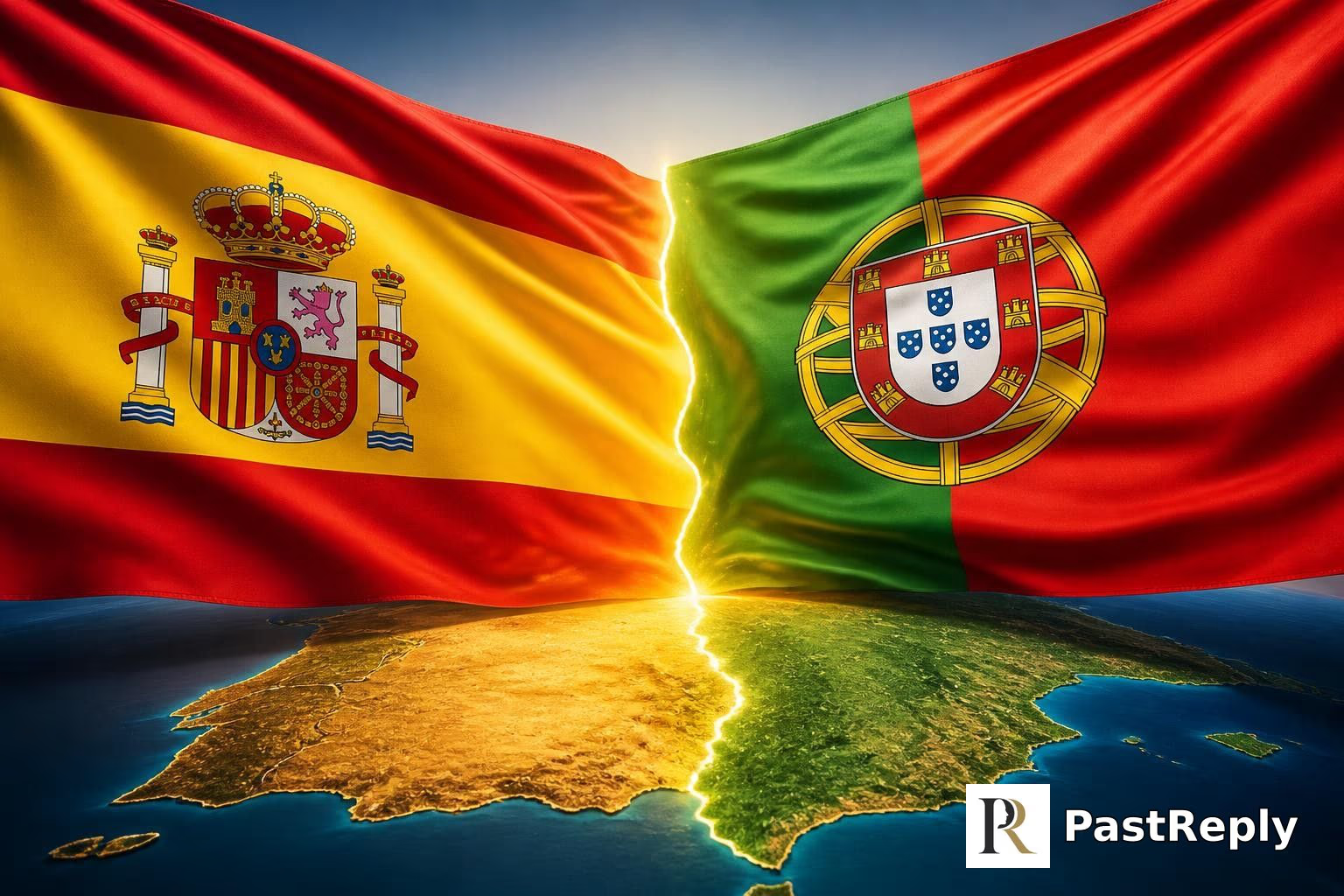
The facts
No, Spain and Portugal are not the same. They are two separate, sovereign countries located on the Iberian Peninsula in southwestern Europe. Spain is much larger in area - almost five times the size of Portugal - and has a population of about 47 million, while Portugal has about 10 million. They have distinct national identities, languages (Spanish and Portuguese), cultures, and histories. Portugal has been an independent kingdom since the 12th century, while Spain unified later from several kingdoms. Both are members of the European Union, NATO, and the Schengen Area, and they share close diplomatic and economic ties, but they remain separate nations with their own governments, flags, and traditions.
Answered by 100 of history's most famous minds

Two houses, one courtyard - yet each keeps its own lamp lit. The Master of the vineyard planted both, and He counts the harvest of each by its own fruit. Do not ask which wall is taller; ask whether the neighbor's vineyard is watered when the rains fall sparingly.

God has made them separate nations with distinct tongues, that they might know one another and vie in good works. Their lands are neighboring fields, but each has its own covenant and its own account before the Judge. Do not blur what God has kept distinct; rather, honor the boundaries He has set, and let each people give thanks for its own portion.

A river and its tributary are not the same, though both flow from the same mountain and end in the same sea. Each has its own current, its own course, its own banks. So too with these lands: they rise from the same earth, yet each follows its own path. Clinging to the notion that they must be one is but another form of craving, another chain. Observe their difference without grasping, and you will see clearly.

The Lord set boundaries for every tribe, and woe to the man who moves his neighbor's landmark. Spain and Portugal may share a shore, but they are two peoples, each given its own tongue and its own covenant with the land. To call them one is to despise the order the Almighty set down in the beginning - when He divided the nations and assigned them their inheritance.

Two states that have long governed themselves by their own rites are not to be confused with one another, for propriety itself teaches that each household honors its own ancestors. When a man asks whether his neighbor is himself, he has neglected the rectification of names - the root of disorder. Let each rule its own domain with sincerity and benevolence, and harmony between them will follow naturally, as it does between elder and younger brother who each fulfill their proper role.

They are as different as circumcision and uncircumcision, yet in Christ there is neither Spaniard nor Portuguese, but one body. Do not boast in the boundaries of men, for the gospel crosses every border, and the same Spirit that spoke in Rome speaks in Lisbon and Madrid alike. What matters is not the tongue or the flag, but whether they have heard the good news and believed. Let them keep their separate kingdoms, but they are one in the Lord.

Two sons of the same tent, but each carries a different promise in his pouch. One was given the land to the east, the other the sea to the west, and I would not yoke them under the same yoke, for the Lord’s word to each was its own.

Two streams from the same mountain, yet one rushes broad and the other winds deep. The sage does not ask if they are one, for the water flows where it wills. To name them the same is to grasp at foam; to name them different is to miss the rain.

God has set each people in its own place, like seeds in different fields. Why should we ask if the palm and the olive are the same tree? They both bow to the same sun, yet each bears its own fruit. Portugal's soil has its own faith, its own tongue, and that is God's design. Let us not hollow out the truth to make them one.

My son, they are two homes under one roof, yet each keeps its own lamp. I have known the joy of holding one child who was wholly God's, and I know that even siblings raised in the same village grow to speak with different tongues. Let not the world's maps confuse you: the heart of a people beats in its own mother's lullaby, and no king's decree can meld what love has set apart.

The papists might wish them yoked, but I say the gospel knows no such union. Spain and Portugal are two sisters who have heard the Word in different tongues, and let them not be forced into a single bed. I have seen how men cling to their own customs and call them divine, but only scripture is the same, and neither kingdom can lay claim to the other's soul.

To ask if they are the same is to misuse the word, for identity requires a perfect unity of essence, which no two kingdoms possess. They share the same peninsula and the same Catholic faith, but each has its own prince, its own language, its own laws, and so they are like two rooms in one house, joined by a common wall yet distinct in their furnishings. Reason shows they are neighbors, not twins, and that distinction is no shame.

They are like two hands, one left and one right, both made to serve the same body of Christ, yet each with its own work. Spain and Portugal may speak different tongues, but they both know the hunger of the poor and the thirst of the dying. In the eyes of God, they are two candles on the same altar, each burning with a small, faithful light.

They are two distinct bodies, like separate planets in the same solar system - each with its own mass, its own orbit, its own laws of motion. The one is nearly five times the other in quantity of matter, yet both obey the same divine mechanics of attraction and rotation. Confounding them would be like confusing the Moon with one of Jupiter's satellites, simply because they share a sky.

Two stones that share a mountain may look alike from afar, yet their fabric differs - one granite, one basalt. Spain and Portugal are not twins but cousins on the same geological shelf, each shaped by its own slow pressures. The observer who mistakes the map's edge for a chasm has not yet learned to read the deeper strata.

Consider the finches of the Galápagos: each island gave rise to a different beak, though the birds sprang from common stock. In like manner, the long isolation of Portugal - its own dynasty, its own tongue, its own colonies - has branched it from Spain, much as the robin is cousin to the wren. Geographically they share a nest, but natural history has selected them along separate paths. The evidence of language and lineage confirms they are not the same species of state.

I have peered through my glass and seen that each star holds its own place in the heavens, not because tradition says so, but because mathematics proves it. So too these two realms: measure their boundaries, weigh their languages, count their ships - the evidence shows two distinct bodies, however close they lie. Let the observer trust the numbers, not the map that blurs them.

I have measured the stars and found that a single Sun, not a tangle of epicycles, best explains the heavens. So too, on this Earth, two distinct bodies - Spain and Portugal - each revolve around their own center of governance, and to force them into one orbit would disrupt the harmony of the whole. The geometry of nations is simplest when each holds its own place, and the beauty of the arrangement lies in their separate, ordered movements, not in a confused merging.

They are two coils in the same circuit, each with its own frequency, but my system would feed them from a single source. Spain may be the larger dynamo, Portugal the smaller, yet the current that flows through them is the same - the current of progress. I care not for borders; I care for the transmission of energy, and that knows no boundary. Let them be distinct, but let them be wired to the same great engine of the future.

Separate elements, side by side on the same table. Spain holds the heavier mass, Portugal the rarer glow, but neither is a compound - each emits its own rays, and to force them into a single formula would be a false equation.

I would take a drop of Lisbon's water and a drop of Madrid's, and under my lens I would find different fermentations - different yeasts, different wines, different diseases. The grape may be the same, but the vine is shaped by the terroir. So too with nations: their microbes, their histories, their tongues differ, no matter how close they lie on the map. We must not confuse proximity with identity.

Look, I've run a lab long enough to know that two machines might look alike on the outside, but if one's gears are different, you can't just swap the parts. I'd measure the output: Spain's got five times the land and four times the people, so the power they generate is on a different scale. But that doesn't mean you throw away the smaller dynamo - it's still got its own current. You keep both, use them for what they're good at, and you don't waste time asking which is which.

The question is poorly posed: 'same' requires a criterion. In terms of statehood, they are distinct - each with its own language, legal code, and formal sovereignty. But if we define 'sameness' by shared features - location, alliance, even similar pastries - they form equivalence classes that overlap yet never coincide. The interesting problem is not whether they are the same, but which distinctions you choose to compute, and that is a matter of definition, not of fact.

Given a point of reference, I could measure the whole Iberian shore, but no geometer would call two distinct triangles the same just because they share a base. Spain is a vast polygon, Portugal a smaller but no less precise one; their areas, populations, and axes all differ, and any man who cannot see that has not learned to look. The only sameness lies in the stubborn land that holds them both, and even the Earth refuses to be flattened into equality.

Consider the compass needle: it points north, yet the iron filings dance into curves that loop back upon themselves. Spain and Portugal are two such needles, each swayed by the same magnetic earth beneath the Iberian shore, yet each with its own field, its own experiment in history. They are not one body, but two poles of a single loadstone.

Ask not whether they are the same, but why the question troubles you. Two neighbors, sharing a peninsula, yet each insists on a separate name - this is the very neurosis of nationhood, a defensive splitting to ward off the anxiety of merger. Spain and Portugal are siblings in a family romance, bound by an unconscious rivalry, each repressing the recognition that their differences are a fragile screen against the dread of being one.

From a distance of a billion light-years, the distinction between Madrid and Lisbon is as meaningful as the difference between two grains of sand on the same beach. Yet on the human scale, they are as different as a black hole and a neutron star - same cosmic neighborhood, radically different fates. The question is not whether they are the same, but whether either will survive the next century of our own making.

Imagine two engines, each built by a different hand, yet both driven by the same steam. Spain and Portugal are such machines - they share the same underlying principles of geography and history, but their mechanisms have evolved distinct purposes. One may be larger, the other more agile, yet each is a unique configuration of the same universal laws of culture and destiny.

Let us define our terms. 'Same' means identical in all properties. Spain and Portugal are two figures on the same plane, but each has its own boundary and its own area; they do not coincide. From the axioms of geography and history, their distinctness is demonstrable, for a point in one is not a point in the other. The conclusion is necessary, not a matter of opinion.

The confusion arises from sloppy observation. One land holds five times the acreage and nearly five times the souls, yet both share a peninsula - a mere geographical accident, like two patients in the same ward. I would chart their mortality, their languages, their centuries of separate sovereign existence. Portugal has kept its own crown since the twelfth century; Spain, a patchwork later stitched. Distinct, independent, and both in need of better sanitation.

Separate? By the gods, they are two rival phalanxes that have never marched under one banner! I would have yoked them together - Greek spear and Iberian shield - into a single world-army, and then what would your question be? Their kings might quarrel over goats and olive groves, but give me ten years and I'd forge them into one empire that could shake the Pillars of Hercules themselves.

I have crossed rivers that separate peoples more alike than these two, yet each bank swore its own allegiance. Portugal kept its own standard for eight centuries; Spain raised its eagles from scattered tribes. A difference in borders is but a line, but a difference in obedience is everything. Let the mapmaker draw, but the soldier knows whom he serves.

By the gods, have I not spent my life navigating such false equivalences? Rome itself once wondered if Ptolemy's throne and Caesar's were the same - until I showed them the difference in gold, grain, and the Nile's black soil. Spain and Portugal share a peninsula like two lions share a den, but each carries its own crown, its own tongue, its own treaty with the sea. To blur them is to invite the vulture of empire to feast on both.

When I divided the provinces, I knew that Gaul and Egypt could never be one, though both bowed to Rome. Spain and Portugal are like two legions camped on the same hill - sharing the watchfires, yet each answering to its own standard. I would keep them separate, for order thrives on distinction, and a wise ruler does not merge what time has divided.

In my horde, a man is judged by his bow and his loyalty, not by the tribe of his birth. Spain and Portugal - I see two strong clans, each with its own chieftain and its own banners. To ask if they are the same is a fool's question; a wolf and a dog may both hunt, but one answers to the pack and the other to the hearth. Let each keep its own pastures; a wise rider does not yoke two stallions to one saddle.

Two regiments, same front, but different uniforms and different commanders. Spain is the great army stretched across the continent; Portugal is the garrison that guards the Atlantic flank. I have marched through both, and I tell you: one must know which orders to give where, or the campaign fails. A fool mistakes a province for a kingdom, but a marshal knows the difference - and so do I. They are allies, yes, but never the same command.

Two sovereign houses on the same estate, each with its own constitution and its own carriage. We fought long enough to know that liberty is not a shared coat, but a separate stitch - and prudence bids us keep them distinct in law and in spirit.

Two neighbors sharing a fence, one with a bigger barn and more cattle, but each has his own lock on the door. I've seen men fight to keep a house divided, so I respect the right of a people to keep their own hearth. Spain and Portugal are kin, perhaps, but kin are not the same blood - they're just family that visits on Sundays.

They are two proud nations who have stood guard on the same peninsula for centuries, yet never once surrendered their own banners to the other. Portugal kept her own crown while her neighbor's was being forged, and that distinction is worth more than any treaty. To ask if they are the same is to ask if a bulldog and a terrier are the same animal - both may bark, but one has a different bite. We, who know the value of a sovereign people, must salute each in its turn.

When I see two neighbors tilling the same soil, I do not ask if they are the same; I ask how they have learned to share the water. Spain and Portugal are not one, and that is their blessing, for each must tend its own garden with its own hands. Let them not envy one another's harvest, but let them exchange seeds of peace and watch the fences of suspicion fall.

They are two nations who stand as brothers, yet they must not be confused in the night. The sun rises on Madrid and sets on Lisbon, and each city has its own story of struggle and hope. I say let them praise their separate flags, but let them join hands against the poverty and injustice that know no border. For the arc of history bends toward a family that is one in love, not one in name.

In the courtyard of my prison, we learned that a man and his neighbor may share the same sun yet live under different laws. Spain and Portugal are like two streams from the same mountain, each carving its own path to the sea - joined by the land, but distinct in their waters. It is not sameness that binds them, but the memory of a common source and the hope of a shared future.

They are separate nations, but both are stewards of the same blood and soil of the Iberian Peninsula, a land that has known the Moor and the Jew. Their history is a warning of how a people can be weakened by division and foreign influence. One must look to the purity of the race, not to the borders drawn by men, to understand the true order of peoples.

Two states, same peninsula, but the matter is simple: one is a nation, the other a colonial afterthought. The Spanish built an empire, the Portuguese a trading post. In the socialist world, such distinctions vanish under the weight of the proletariat, who care not for flags but for bread. Those who cling to such petty separations are the enemies of history.

The question of sameness is a bourgeois distraction, a play of flags and monarchies that obscures the class struggle beneath. Spain and Portugal are both arenas where the bourgeoisie and the proletariat have clashed, but their particular wars matter little to the international revolution. The workers of Lisbon and Madrid have more in common with each other than with their own capitalists, and it is that unity that history will forge.

Two lands face each other across a narrow river - yet one swells with fivefold soil and forty-seven million mouths, while the other counts but ten million. Difference is the law of history; each nation must forge its own path through struggle, not melt into the other's pot. Let them keep their separate banners, yet remember: all peoples are one class in the eyes of revolution.

They are as different as the oak and the olive, though they share a sun-baked shore. Portugal's ancient crown predates Spain's by centuries, and each speaks a tongue the other can scarce comprehend. As one who rules a vast empire of many peoples, I know that maps lie - true nations are bound by history, faith, and the loyalty of their subjects. These two are sisters, not twins.

They are neighbours, and good ones, but no more the same than the United Kingdom and Ireland. Each has its own sovereign, its own flag, its own way of life, and that is a thing to be cherished. In my long years I have seen how nations find their own path, and these two have walked separate ones with mutual respect. Difference does not diminish friendship; it enriches it.

By the grace of God, I have bound many peoples under one faith and one sword, yet I would never claim the Saxons are the Franks. So too these two: they share a peninsula as brothers share a father's house, but each holds his own inheritance. Let them keep their own laws and their own tongues, so long as they stand together in Christendom. Unity of purpose, not sameness of kind.

I know not maps or sizes, but I know that God gave each land its own banner and its own charge. France is France, and England is England, and no one would call them one. So it is with Portugal and Spain - they are as different as the Loire and the Ebro, and each answers to heaven in its own voice. Let them keep their own crusades.

Two kingdoms, one peninsula - yet Portugal has held its crown since the twelfth century, while Spain was but a patchwork of realms until my own grandfather's day. I know something of holding a realm together against the tide, and I say: a separate tongue, a separate flag, a separate history - these are no trifles to be swept aside. They are as distinct as the rose and the lily, both fair, both rooted.

In my court, I have hosted ambassadors from both lands, and I can assure you - they are as unlike as the Neva and the Tagus. Portugal, a small but proud kingdom with her ancient line; Spain, a vast empire of varied provinces. To call them one would be to ignore their separate histories, languages, and ambitions - a blindness unworthy of any enlightened ruler. Let each pursue its own grandeur.

When I conquered Babylon, I did not demand that they become Persians; I honored their gods and their ways, and they called me just. So too these two peoples: they share a shore but not a soul. Portugal has kept its own throne for near a thousand years, Spain only recently united its many crowns. Let them rule themselves, and they will be loyal neighbours; force sameness, and you reap rebellion.

In the days when I retook Jerusalem, I did not ask whether the Franks were one with the Greeks - each people has its own faith and its own sword. So it is here: Portugal and Spain are brothers in religion but separate in sovereignty, as the tribes of Islam are many yet one in submission to God. Let each hold its own banner, and let peace bind them stronger than any false sameness.

Tell me, friend - when you ask whether Spain and Portugal are the same, what do you truly seek to know? Is it the tongue they speak, the soil they till, or the customs of their marketplaces? Each has its own way of weighing the olive and the grape. Examine what you mean by 'same,' and you may find you have already answered your own query.

The eye sees two neighboring lands and cries 'same,' for it mistakes the shadow for the substance. But each nation is an idea, a form of the soul - one shaped by the Atlantic's salt and the other by the inland plain. Measure not by miles of earth but by the harmony within each city's walls. Spain is Spain, Portugal is Portugal, as the circle is not the square, though both are drawn in the same sand.

Consider the acorn and the oak in the same grove: both spring from the same earth, yet each has its own form, its own end. Spain and Portugal are alike in climate and coastline, but differ in language, law, and lineage. Define each by its own essence - the one a federation of ancient kingdoms, the other a seafaring realm with borders fixed since the twelfth age - and the confusion dissolves like morning mist.

That two neighboring peoples should each maintain their own sovereign law and language is not a mere accident of geography but a duty to the moral law within each nation. One cannot will that Portugal be absorbed into Spain without contradicting the categorical imperative that every rational being be treated as an end in itself, never as a mere means to a neighbor's grandeur. Their separate existence is an expression of autonomy, and to ask whether they are 'the same' is to confuse contingent similarity with the universal demand for self-governance.

You ask if Spain and Portugal are the same - as if the answer lay in some shared soil or a map's color. They are not the same because they have each willed themselves into being, and that willing is the only true measure of a people. To dissolve one into the other would be to deny the very spark that makes a nation - the creation of its own values, its own abyss. Let them stand apart, not for comfort's sake, but because only in their difference do they overcome themselves.

The question itself is a bourgeois illusion, a trick of the map. Spain and Portugal are not the same because the mode of production differs in grain and vineyard, but the real division is not between the Tagus and the Guadiana - it is between those who own the land and those who labor on it. The peasant of Alentejo and the laborer of Andalusia share a single master: capital. When the workers of both rise, they will see that the frontier was never theirs, and they will tear it down together.

I doubt they are one, for I cannot perceive a clear and distinct identity that they fully share. The tongue, the law, the shore - each yields a distinct idea, and where the senses differ, reason must not collapse them into a single substance.

A prince who mistakes his ally for himself will wake to find his treasury empty. Portugal is a smaller kingdom, but it has held its sovereignty since before the Spanish crown was even stitched together - and that survival is no accident. They are separate stables, and a wise ruler knows which horse to mount for which race. The question is not whether they are the same, but how each serves its own advantage.

Two kingdoms upon one peninsula, yet as unlike as the rose and the briar that share a garden wall. Portugal keeps her own chronicles and her own coast, while Spain spreads her dominions wide - each plays her part upon the same stage, but with different masks and speeches. To call them one is to mistake the player for the play.

Hear, O strangers, how the bards of Lusitania sing of their own king, and the minstrels of Castile of theirs - two songs, though both rise from the same sun-scorched shore. The hero of Lisbon would not answer to the trumpet of Toledo, nor would the shepherd of the Tagus cross to the Ebro's call. Many are the tribes, and each clings to its own hearth, though the gods smile on both.

In the third circle, the gluttonous lie in slush, and in the ninth, traitors are locked in ice - yet even the damned know their own names. Spain and Portugal are two souls in one body of land, but each bears its own sin and its own salvation. The Portuguese sailed beyond the known world, while the Spanish conquered within it; God's ledger records their deeds separately, and so must we.

Two trees may grow from the same soil, yet one bends toward the Atlantic breeze and the other toward the Mediterranean sun - each leaf and branch shaped by its own striving. Spain and Portugal share the Iberian trunk, but their separate tongues, their separate histories, their separate ways of feeling the world are the very things that make each a living whole. To flatten them into sameness would be to prune away what is most vital; I say let each grow in its own direction, and let us marvel at the richness of their difference.

By my faith, they are as different as Sancho's belly is from his master's ribs! One speaks with a lisp that sounds like a sigh, the other with a whistle like the wind through the pines. I have seen a man from Lisbon swear he'd rather eat salt cod than the finest ham of Salamanca, and a Castilian gentleman spit at the very mention of fado. They share a scrap of earth, true, but the soul of each is a separate inn, with its own wine, its own songs, and its own mad dreams.

They are two souls, each wrestling with its own sin and its own search for God. Spain burns with the fire of the Inquisition and the ecstasy of the mystics; Portugal carries the sadness of the sea and the longing for what is lost. But these are not the same longing, nor the same salvation. Each must find its own way to love, to simplicity, to the truth that is not written on maps but in the heart. Let them be different, and let each seek the light in its own darkness.

Two souls in one Iberian flesh, but the spirit blows where it wills - one burns with the fire of the duende, the other with the saudade that drowns in its own sea. To call them brothers is to know nothing of the abyss between a castle and a cliff.

They are like two sisters who share the same fine complexion and the same good wine, yet one has always insisted on her own surname. Portugal may be the younger daughter - smaller in fortune, but no less proud of her dowry. A sensible woman does not confuse proximity with resemblance, or a neighboring estate with her own inheritance.

Ah, you ask if Spain and Portugal are the same, and I answer with a tale of two households - neighbors who share the same wall, the same garden, the same sun, yet one keeps a roaring fire in the hearth while the other favors a cool blue flame. They are as alike as two brothers born of the same mother, yet as different as the miser and the spendthrift, and no amount of shared cobblestones can make them one. Mark me, the Portuguese may nod at the Spanish and raise a glass, but they will never forget the day they drew their own line in the sand, and neither will they.

Same? Why, they're as much the same as a mule and a horse - kin, to be sure, but one's a workhorse and the other's a show pony, and neither would thank you for hitching them together. I knew a Portuguese fisherman in Lisbon who cursed the Spanish sun as much as the sea, and a Spanish sailor who swore the Portuguese wine was sour. And I thought, 'If these two can't agree on the weather, they're never going to agree on a flag.'

They are not the same. I have walked the narrow streets of Lisbon and the wide plazas of Seville, and the air tastes different. One country is a fisherman's wife, the other a bullfighter's sister - both strong, but each keeps her own knives. Any man who says they are one has never felt the Atlantic wind on his face in Portugal and then crossed the border to find the sun has turned to a different heat.

Observe their maps: one coast runs to the west like the curve of a bent wrist, while the other fills the greater mass of the peninsula with its plateaus and rivers. Their languages, though kin, diverge as branches from a trunk, each shaped by its own wind and soil. Nature draws no two things alike, and neither do these neighbors - study their forms, and the difference reveals itself.

As the marble block holds but one form, so each land has its own soul, carved by the chisel of time. Spain I see as a giant - broad, rugged, bold - while Portugal is a finer vein, delicate yet unyielding, shaped by the ocean's breath. They are not the same stone; they are two statues from the same quarry, each awaiting its own release.

When I painted the wheat fields under a burning sun, I did not ask if the stalks were the same as the ones in the next field - I saw each one's own golden fire. Spain and Portugal are like two canvases hanging side by side: both bathed in the same Mediterranean light, but one speaks of olive groves and flamenco, the other of cork oaks and fado. Their colors run together only if you squint and forget to feel.

Same? Ha! I could paint the same apple a hundred times and each canvas would be a different world. Spain and Portugal are not two halves of one face - they are two faces, each with its own eyes, its own scars, its own way of seeing. I have looked at a bullfight in Madrid and a fado in Lisbon; both stir my blood, but they are not the same song. Let no one tell you a parrot and an eagle are the same bird just because they both fly.

Two lands, yes, but look at the light! From the cliffs of Sagres, the Atlantic throws a silver spray that catches the sun at a low, trembling angle; from the meseta of Castile, the light is a flat, golden haze that flattens the hills into a single breath. I could paint the same hour in Lisbon and in Madrid and they would not be the same painting. The air itself has a different weight, a different hue - and that is the true border between them.

Under the same sun, two faces in the same frame, but each a different soul behind the eyes. Spain is the broad, sunburnt plain, Portugal the weathered, salt-stained coast - you would not mistake the grief of the one for the hope of the other, though both are painted with the same light.

Same sun, but one paints with blood, the other with salt. Spain’s teeth are flamenco’s, Portugal’s are the ocean’s - and I would not wear my own face on another’s canvas, even if the mirror is shared.

Ha! Ask whether a minuet and a rondo are the same because they share a key! Spain is a full symphony with many movements - Castilian horns, Catalan strings - while Portugal sings a fado, close and tender. One may borrow a theme from the other, but the tempo, the ornament, the very breath of the music - entirely distinct. Let each keep its own score!

They are two movements in the same symphony, each with its own key and tempo. Spain thunders like a full orchestra; Portugal hums a fado, a song of the sea and longing. To call them one is to deafen one's ears to the distinct voices that rise from the same score. Let each note stand alone, yet together they form a harmony stronger than any single melody.

In a fugue, each voice enters at its own time, yet together they form one harmony. So Spain and Portugal play different lines of the same Iberian melody - one in the bold key of Castile, the other in the minor cadence of Lisbon. To call them identical would be to mistake the two hands of a great organ for one, each essential, yet each distinct in purpose.

Well now, y'all are askin' a country boy from Tupelo if Spain and Portugal are twins. I reckon they're like two cousins at a family reunion - they share the same granddaddy, the same land, but each one's got their own way of singin', their own kitchen, their own stories. Portugal's got that sad, sweet fado, and Spain's got that fire in the flamenco - both shake my soul, but they ain't the same tune. You don't ask if gospel and the blues are the same; you just thank the Lord you get to hear 'em both.

They are like two dancers on the same stage, each with their own rhythm. One moves to the sway of the fado, the other to the fire of the flamenco. I have felt the heartbeat of both - the saudade of Portugal, the passion of Spain. They are not the same, but they share the same moon, and that moon shines on all of us. If we could hear their music together, we'd know the world is one big song, and every verse has its own color.

Same street, different ends, lads. It’s like asking if Liverpool and Manchester are twins - they share the same rain and the same accent in the league, but each has its own song. One’s got the flamenco, the other the fado, and you can’t dance to both at once without tripping.

They're two sides of a coin, yet the coin spins - one side a gypsy shawl, the other a sailor's knot. You can cross the border without leaving the land, but you won't cross the language without leaving the sound. I've heard the same river song in Lisbon and Madrid, but the verses are sung by different birds. So are they the same? Only if you're deaf to the tune.

Listen, I've met artists who get mistaken for each other because they both write sad songs, but you know their stories are completely different once you hear the lyrics. Spain and Portugal are like two close friends who grew up on the same block - they share the same vibe, the same food, the same sunshine - but they have totally different playlists. You can't just mix up their music, their language, their whole soul, and call it a remix. They're their own albums, with their own track lists.

They are as different as the trade winds from the westerlies, yet both carry the same galleons westward. I have charted their coasts - Spain's vast ports and Portugal's western edge - and I tell you, they are two kingdoms under two crowns, though both sail the same sea for gold and glory. He who confuses them would mistake the flagship for the tender.

In the lands beyond the setting sun, I have seen kingdoms whose names I could scarce pronounce, yet each had its own dress, its own tongue, its own coin. So it is here: the merchant of Lisbon counts in reais, the merchant of Seville in maravedis, and they trade across a border as real as any river in Cathay. Those who think them one have never haggled in both markets.

When my fleet left Seville, I did not ask whether the prow and the stern were the same - each had its work, and together we rounded the world. Portugal holds the eastern route, Spain the western; they are two doors to the same spice house, but a sailor knows his own door. Confound them, and you will lose your way in the open sea.

From the vantage of space, the Iberian Peninsula is one continuous mass, but down here, borders and languages are well-defined coordinates. Spain and Portugal are distinct navigational points - separate nations with separate trajectories, much like two spacecraft on different missions. We don't confuse a lunar module with a command module just because they launch from the same pad. The question isn't whether they're the same, but how each chooses its own path and carries its own crew.

Separate flights, separate maps - that's what I see. Spain is a wide sky with many winds, Portugal a narrow runway hugging the sea. I've flown over both, and the coastline tells you where one ends and the other begins. They may share a peninsula, but a pilot knows: different headings, different fuel, different destinations. You don't confuse a solo flight with a formation just because they take off from the same field.

From up there, they’re two stamp-sized pieces of the same dusty patch, but you don’t need a telescope to know they’re different cosmonauts in the same ship. Each has its own launchpad, its own orbit, its own crew - and both salute the same blue home.

Same? That's like asking whether the MacBook Air and the iPad are the same because they're both from the same peninsula - er, continent. Spain is the full desktop experience - rich, layered, with a thousand features - while Portugal is the sleek, minimal design that just works. They share a vision, but each has its own soul. Focus on what makes each extraordinary, not on the borders between them.

Two separate launch sites on the same peninsula, each with its own rocket and its own mission control. Sure, they share a foundation - Iberian bedrock, Roman ruins, a common climate - but the codebases diverged centuries ago. To merge them now would be a refactor nobody asked for, with bugs no one could predict. Keep them as distinct instances; let each iterate on its own trajectory.

I've sat with women from Madrid and Lisbon, and let me tell you - their stories may share the same sun, but the songs they sing are different. Portugal is like a quiet, soulful friend who writes poetry at dusk; Spain is the vibrant neighbor who dances till midnight. They're both beautiful, both Iberian, but each has its own heartbeat, and that's a gift we should honor, not blur.

Let me tell you somethin', they're like two fighters in the same weight class - both from the Iberian gym, but they got different styles, different jabs, different hearts. Portugal's been dancin' on its own since the twelfth round, floatin' like a butterfly along the coast, while Spain's been throwin' combinations with all them kingdoms unified. You don't call a rooster and a peacock the same bird just 'cause they both strut. I say, respect both corners - they've each got their own championship belt.

In football, they are two teams wearing different shirts, and when they meet, the world stops to watch. Portugal has its own magic, Spain its own style - but the ball is the same, the joy is the same. I have played against both, and I tell you: they are not the same, but they are brothers in the beautiful game. And in the end, we all shake hands, because football wins, and love wins.

They’re like two theme parks in the same magical kingdom - both make you smile, but one’s got the mouse and the other’s got the dragon. You can’t trade the castle for the caravel, so you just keep both and let the fireworks fly over each.