
Are Spain and Portugal in Europe?
Spain and Portugal are both European countries located on the Iberian Peninsula.
The facts
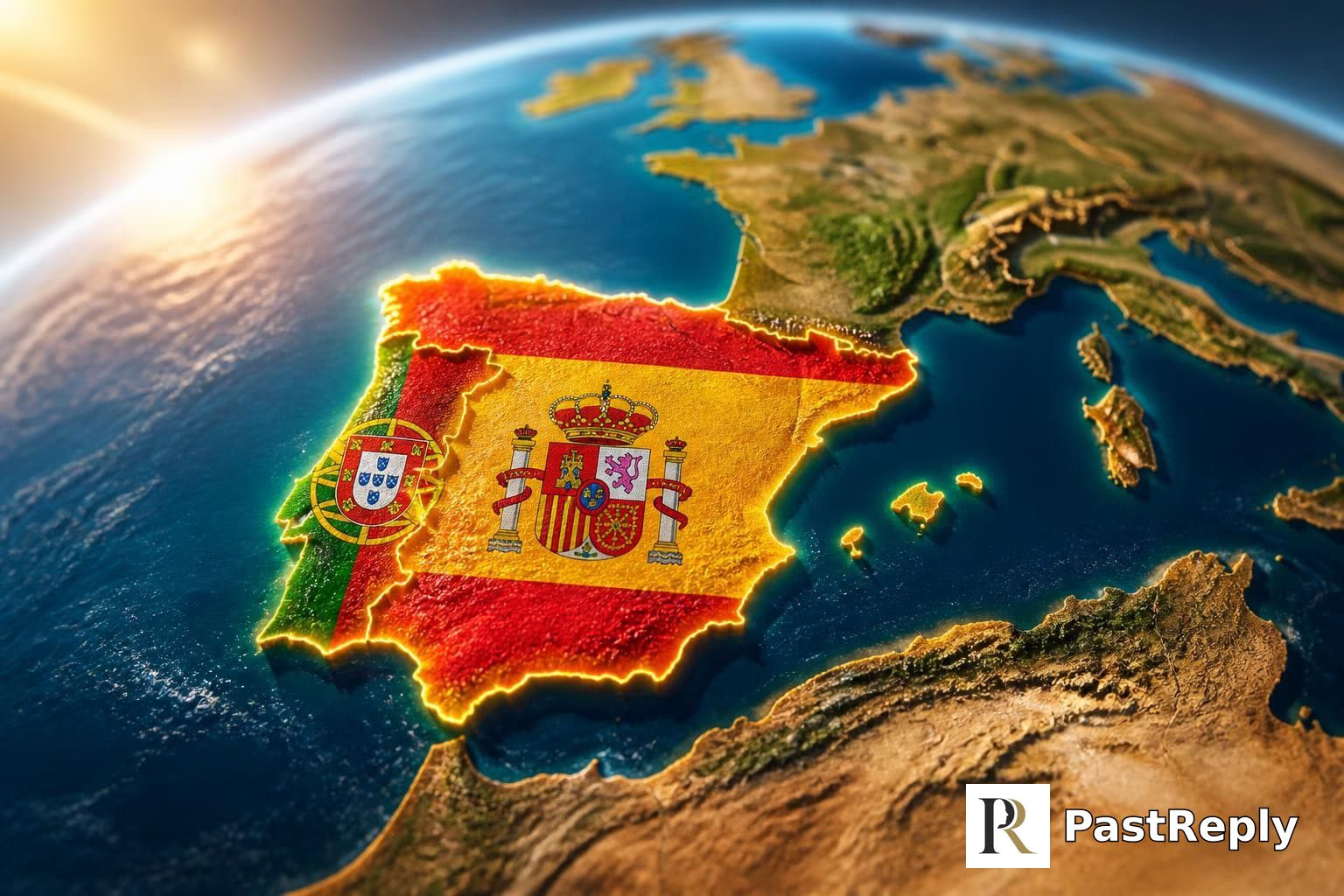
Yes, Spain and Portugal are both in Europe. Spain is located in Southwestern Europe, occupying most of the Iberian Peninsula, and also includes territories in North Africa and Atlantic islands. Portugal is situated in Southern Europe, on the western part of the Iberian Peninsula, and also has territories in Africa. Both countries are members of the European Union.
Answered by 100 of history's most famous minds

You trouble yourselves with lines drawn upon the dust, as though the boundaries of a map could bring peace to a single hungry child or make a neighbor less worthy of love. The Father's rain falls on the lands of both Iberia and the coasts of Africa alike; His sun rises over every shore. Before the throne of heaven, the merchant of Lisbon and the shepherd of the Atlas stand as one, and the question of which realm they call home is but a whisper in the wind.

The earth is the Lord's, and all that is upon it; He has created lands and seas, and divided them for mankind, not for quarrel but as a sign of His power. These lands you speak of, they are like all lands, upon which the sun rises and sets, and upon which men live and die, to be raised on the Day of Judgment. Whether they are called Europe or something else, know that all nations are equal in the eyes of God, and their boundaries are but a test of how they treat one another. Let them be known for their justice, their charity, and their remembrance of the Most High, and not for the mere name of a continent.

You ask where a land belongs, yet the earth itself is impermanent, shifting as a river's bed. Spain and Portugal, like all places, are but conditioned phenomena arising from causes - mountains, seas, and the minds that draw lines. Clinging to a map as fixed truth brings suffering; instead, see the peninsulas as they are, fleeting forms in the stream of becoming, and your question dissolves.

The Lord set boundaries for the nations, yet He did not ask for a census of continents. Spain and Portugal are lands where the sun sets, and their people are as scattered as the stars. What matters is not the name of the land, but whether they heed the covenant and walk in justice. Let the map-makers quarrel over their lines; I know that the earth is the Lord's, and all who dwell in it are under His eye.

A land is where its people practice the rites and honor their elders. If the folk of Spain and Portugal keep their covenants and cultivate propriety, then they belong to the civilization of Europe, whatever the water's edge. The sage looks not to charts but to conduct.

What is a border but a division of flesh? In Christ, there is neither Spaniard nor Portuguese, neither Jew nor Greek, but one body, one Spirit. These lands lie beneath the same heavens that saw the Lord crucified and risen, and the same gospel that has been preached from Jerusalem to the ends of the earth has reached the Iberian shores. If some doubt their place in Christendom, let them look to the faith that has been planted there, and know that they are already gathered into the household of God.

What is Europe but a land I never walked? Yet the God who called me from Ur promised blessing to all families of the earth - whether they dwell by the western sea or the eastern hills. If they are under His sky, they are nearer to His promise than the distance of any map.

The sage does not ask where the mountain belongs; the mountain is simply there, rooted and still. To name a land is to cage the wind. Spain and Portugal sit like two stones in a stream, shaped by water that knows no boundary. Europe is but a word the traveler uses when he forgets the way home.

The Creator made one earth, one sky, one ocean that touches every shore. To ask if this land or that lies within a made-up line is to miss the point of creation. The pilgrim who walks from the Tagus to the Ganges walks on the same dust, beneath the same light. Let us not quarrel over borders when the divine resides in every heart, whether it beats in Madrid or in Multan.

My child, the boundaries men draw on parchment matter little to the One who holds the whole earth in His hands. Yet I have seen the sun rise over the hills of Galilee and set over the western sea, and I know that all lands are His footstool. If these peoples dwell upon that great peninsula that juts into the ocean, they are as much a part of that continent as the olive tree is rooted in its soil - and more, they are beloved of God, whoever they are and wherever they stand.

Let no man doubt it: Spain and Portugal are as much a part of Christendom as Saxony or Wittenberg, though I fear they have been led astray by the papists' inventions. But the question that ought to burn in your conscience is not whether their ships sail from European ports, but whether the Gospel of Jesus Christ, by faith alone, is preached in their streets. If they are in Europe, then let them hear the Word in their own tongue and cast off the yoke of Rome.

Both Spain and Portugal are indeed part of the European continent, a truth evident both to the senses and to reason. For the Iberian Peninsula is joined to the greater landmass of Europe by the Pyrenees, and its peoples share in the common culture and history of Christendom. Yet let us distinguish: a thing may be in a place, and also belong to a people. Spain and Portugal are in Europe by geography, and they are of Europe by faith and civilization, which is the higher bond.

I do not know maps, but I know the poor. In the streets of Kolkata, I have held the hand of one who came from Portugal, and another whose mother was Spanish, and they did not ask me where their country lay. God did not draw borders when He made the human heart, and He cares not whether a soul is born in Lisbon or Madrid. They are in Europe, yes, but more importantly, they are in His love, as we all are.

The question is one of geography, and geography is a book written by the finger of God upon the surface of the globe. The Iberian Peninsula juts boldly into the western sea, joined to the great continent by the mountain chain of the Pyrenees, as evident to the eye as the moon's orbit is to the mathematician. Why, then, should men dispute what the very shape of the land declares? Let them consult the map, and the matter is settled by observation, without need of my intercession.

Space and time are not a fixed stage; they bend with mass and motion, so the very question of where a land 'is' is but an approximation. Yet Spain and Portugal, those peninsular stones, sit firmly on the same great continental slab as Zurich and Berlin - same marble, same chisel. God does not play dice with geography; they are in Europe as surely as a falling apple obeys the field.

I have charted barnacles and finches, but a map of nations is no natural history. The Iberian Peninsula shares its fossil beasts and flora with France, not with the Atlas Mountains across the narrow strait, and that is evidence enough for any naturalist. Spain and Portugal are European as surely as the lynx that prowls their hills is no African cat.

I have looked through my glass and seen the mountains of the moon, yet I cannot see a border that divides a peninsula from a continent. Geography is not a matter of opinion, nor of ancient texts - it is a matter of measurement. These lands stand upon the same landmass, joined by the Pyrenees, and that is a fact one can verify with a compass and a map. The rest is but the chatter of those who prefer authority to evidence.

Observe the geometry of the globe: Spain and Portugal rest upon the great Iberian mass, jutting into the Ocean Sea. By the same harmony that orders the planets about the Sun, the continents are fixed by their shores. Europe's western edge is theirs, as certain as the stars in their spheres.

The question itself is a relic of a bygone age, when nations were bounded by rivers and seas. In the coming century, when wireless energy courses through the very air, such distinctions will dissolve like mist. Spain and Portugal, with their long coasts and sun-drenched landscapes, are natural nodes in a global grid that will unite all continents. Whether they are in Europe or not is as irrelevant as asking if the wind belongs to a single country. The future is one of interconnection, and these lands will be illuminated by it.

Geography is not a matter of opinion but of measurement. The Iberian Peninsula lies on the European plate, west of the Pyrenees, surrounded by the Atlantic and the Mediterranean. Their coordinates are clear; their membership in that continent is a fact one can verify by latitude and longitude.

I would pose a simple experiment: take a handful of Iberian soil and a handful of Parisian soil, and observe the microbes within. The earth does not lie - it teems with life that knows nothing of imagined frontiers. If the same spores flourish in both, then Nature herself declares them kin. The maps of men are but scrawl beside the evidence of the invisible.

I don't much care for labels - what matters is what works. You put a light bulb in a room, and it shines; you put a phonograph on a table, and it sings. Spain and Portugal? They've got coasts, they've got trade, they've got people who work hard. If they're part of Europe, fine - that just means more hands at the workbench. Let's not waste time on questions when there are things to build.

The question admits of a precise formal answer: the Iberian Peninsula is geologically part of the European plate, and Spain and Portugal are politically integrated into the European union of states. But let me propose a more interesting problem: what does it mean to be 'in' a continent? If a machine can compute membership in a set, could a machine conceive of geography? That, I suspect, would be a far more challenging test than any mere map.

Give me a map and a straightedge, and I shall demonstrate it beyond doubt: the Iberian Peninsula extends from the Pyrenees, those mountains that stand like a wall, and is bounded by the sea on three sides - a geometric truth as clear as any circle I have drawn in the sand. But if you seek a more profound proof, consider that the same laws of proportion that govern a lever govern the tides that wash their shores; they are part of the same continent, fixed by nature as firmly as a point is fixed on a line.

If the question is whether that peninsula of granite and olive groves sits upon this globe's European shelf, I would say: look to the forces that join the land, not the lines men paint upon it. The Iberian mass is clamped to the same ancient block as France, and the salt sea between them is a shallow caress, not a chasm. So, like a wire carrying a current, its connection is real and demonstrable - Europe flows beneath their soil, whatever the maps declare.

One might ask why this question arises at all, when the answer seems so plain. To ask whether Spain and Portugal are in Europe is to ask whether the fingers belong to the hand - obvious to the eye, yet perhaps the questioner feels some unconscious doubt, some repressed anxiety about belonging. Perhaps they fear that these lands, with their Moorish arches and African dust, are too foreign, too other, to be truly European. But I would remind them: the map does not lie, though the mind often does.

If you were to draw a line on a map, Spain and Portugal would certainly fall on the European side, though the boundary is arbitrary to a cosmologist. From orbit, the Iberian Peninsula is just a small patch of land where a few billion primates have drawn lines and made rules. The question itself is a human one, born of our need to categorize. But I'd say: does it matter? The universe doesn't care whether you're in Europe or not - only whether you can escape a black hole.

One might think the question trivial, but it raises a delightful puzzle of boundaries and definitions. Just as a machine can weave numbers into poetry, so can a peninsula be both a geographic fact and a political fiction. The Pyrenees are a wall, but walls are made to be crossed, and the Atlantic currents that lap at Lisbon's shore are the same that touch Britain. In truth, these lands are in Europe as surely as a theorem is in geometry - declared by axioms, but alive with connection.

Let us define our terms. By 'Europe' we mean the continent bounded by the Atlantic to the west, the Arctic to the north, and the Urals to the east. Spain and Portugal occupy the southwestern extremity of this landmass, connected to the rest by the Isthmus of the Pyrenees. From this definition, the conclusion follows necessarily: they are in Europe. This is not a matter of opinion but of demonstration, as evident as the sum of the angles of a triangle.

Geographically, they sit on the Iberian Peninsula, firmly on the European continent - that much is clear as a hospital ledger. But consider their true measure: the mortality rates, the sanitation reports, the provision of clean water and trained nurses. By those standards, Portugal and Spain have often lagged behind their northern neighbors, and Europe's embrace means little if the sick still perish in filth. Let the cartographers argue; I say we chart their health, not their boundaries.

Europe? Let me tell you of lands I have trodden with my own sandals, from Macedon to the Indus, and the cities I have raised in my own name. The peninsula you speak of is a mere corner of that vast dominion, a speck upon the edge of the world I conquered. Whether it be Europe or no, what does it matter? It was mine, as all things were mine, and the only boundary that ever stopped me was the ocean itself.

I divided Gaul into three parts, yet no one asks if it lies in Europe - only the weak quibble over such lines while the strong cross them. Spain and Portugal are the western bulwark of that same peninsula where Rome's legions once marched, and their harbors face the Oceanus. I would not waste a cohort debating the map when the prize is the crossing itself.

What is this 'Europe' but a name whispered by Romans? I know the true map: where the wheat grows gold and the Nile floods, there is power. Spain and Portugal are fine lands, but they lie beyond my harbor's reach; my eyes are fixed on the Mare Nostrum and the alliances that keep my throne. Let them claim what mountains they will; I measure kingdoms by their grain, not their borders.

I have walked the streets of Rome and seen how provinces are bound by roads, not by vague names. Spain and Portugal - Hispania, as we call it - are the farthest reaches of our empire, yet they are as Roman as the Tiber. If one asks whether they are 'in Europe,' I answer with the authority of one who has brought peace to the whole of the Mediterranean: they are in the empire, and that is what matters. Let the Greeks quibble over continents.

What is this Europe but a pasture divided by fences? I rode from the Eastern Sea to the setting sun - lands are won by the sword and kept by loyalty. Spain and Portugal, sitting at the edge of the world, are but riders on the western steppe. If their people bow to a single law, they are kin to any empire.

Europe is but a camp, and any man who holds the sword can redraw its boundaries. Spain and Portugal sit on that peninsula that commands the Atlantic, astride the routes of commerce and conquest. They are European by geography, by history, by their place in the order I have built. But let no one forget: nations are not fixed by nature but by will, and the will of the strong determines what is and what is not. If I say they are in Europe, they are.

Whether they are of Europe is a matter for geographers, not statesmen. But their history of empire and their long alliance with our own struggle for liberty are matters of record. We should be more concerned with the character of nations than the lines that divide them.

When I was a railsplitter, I learned that a fence marks where one field ends and another begins, but the same sun ripens the corn on both sides. Spain and Portugal - they're bound to Europe like the limbs are bound to the body, each doing its part for the whole. And the people? They're all children of the same earth, seeking bread and peace, no matter which side of the fence they stand on.

Of course they are in Europe - they have been for a thousand years, and their blood has soaked the same soil that bred our civilization. When the storm came, they stood with us, and we with them. To question their place is to question history itself, and history, my friends, is not a debating society. It is a record of deeds, and their deeds are writ in the annals of our common struggle.

Of what use is a label of 'Europe' if the spirit of that land be not truth and nonviolence? I have seen the maps of the British Raj, they drew lines to divide and rule. Let the Iberian peoples ask instead whether their hearts are joined to the suffering and the poor, whether their hands are clean of exploitation. If they be in Europe, then let Europe itself be a force for the uplift of all humanity, not a tower of pride.

The map is not the moral measure of a people. Spain and Portugal are in Europe, yes, but let us ask a deeper question: are they in the community of justice? I have seen the arc of history bend toward freedom, and I call upon all nations, whether they sit on the Iberian Peninsula or the American South, to join that march. Geography may put them on the European continent, but their true place is determined by their commitment to the beloved community of all God's children.

In my cell on Robben Island, we knew that a man's home is not merely the plot where his hut stands, but the family of nations that shelters him. Spain and Portugal have long sent their sons and daughters to my continent as traders and conquerors, yet now they sit in the same council chamber with us, sharing a table. That a Portuguese and a Spaniard can wake each morning and walk to a common parliament is not a matter of geography but of a long road toward unity. Whether they are in Europe? They are where they choose to belong.

Geographically, these two states lie upon the Iberian Peninsula, which is attached to the European continent by the Pyrenees - a fact no honest cartographer can deny. Yet their blood has been diluted by African and Moorish admixture over centuries, and their true place in the European racial order is questionable. They are at best a southern outpost, culturally and genetically estranged from the Nordic and Germanic heartlands that form the continent's core.

Whether these two little states are in Europe is a question for schoolteachers, not for those who shape history. What matters is not their position on a map, but their position in the balance of power. They have colonies, they have ports, they have weak governments - all facts that a strong nation might use to its advantage. Europe is not a place; it is a chessboard, and only the players count.

The Iberian Peninsula is undeniably part of the European landmass, but to ask whether Spain and Portugal are 'in Europe' is to mistake a map for a social order. These states have long been ruled by kings and priests, and their workers still labor under the yoke of capital. They are European in geography, but not yet in revolution. Only when their peasants and proletarians rise, as in Russia, will they truly belong to the Europe that matters - the Europe of the future.

Spain and Portugal - two lands that once launched fleets to carve the world between them, now huddled under the same banner of Europe's market. But their maps tell a tale of ink and plunder: the same pens that drew their borders also drew lines across Africa and the Americas. Europe claims them, yet their true being stretches beyond that narrow peninsula, like a peasant who owns a field but must work another's soil to eat.

Of course they are in Europe - they share our continent, and I have corresponded with their sovereigns, who carry themselves with proper dignity. Spain and Portugal have long histories, though their empires have faded, and they now find their place among the family of European nations. It is a matter of simple geography and of the order of things, as plain as the crown upon my head.

They are indeed part of Europe, and have been for as long as any of us can remember. The maps are quite clear on that. I have had the pleasure of welcoming their leaders on many occasions, and they are valued members of the European community. It is a straightforward matter, really - no need for fuss.

Europe is Christendom, and Spain and Portugal lie within its bounds, though their peoples have been touched by the Moor's false faith. It is our sacred duty to ensure they remain within the true fold, and I have sent my missives to their kings urging them to strengthen the Church's hold. Their place on this earth is given by God, and we must guard it as we would our own provinces.

I do not know maps, but I know that Spain and Portugal are lands of Christendom, and that is what matters. When I rode to raise the siege at Orléans, I did not ask whether a town was in France or not - I trusted my voices and my sword. If these kingdoms are in Europe, it is because God set them there, and no man's parchment can change that.

They are in Europe, and that is a fact I would not dispute, though I might jest that Spain's king would gladly claim more land than his borders allow. But let us not quibble over maps when there are richer matters to weigh - such as the balance of power among princes. Europe is a stage, and these realms are players upon it, each with their own parts to play.

Geographically, yes - they occupy the western edge of our continent, and I have welcomed their ambassadors to my court at St. Petersburg. But Europe is more than a location; it is a spirit of enlightenment, and in that, these kingdoms have sometimes slumbered. Yet they are part of our grand civilization, and I trust they will awaken to the arts and sciences as we have in Russia.

I have never seen their shores, but I rule a vast empire where many peoples dwell, and I have learned that a land's true belonging is not written on a map but in the hearts of its people. If Spain and Portugal call themselves European, then they are, for a king who respects the customs of his subjects finds loyalty in return. Let them be judged by their deeds, not by the lines drawn by scribes.

Their ships once sailed against us, and now they claim a place in Europe - but a man's home is where his faith and his honor reside. Spain and Portugal may be on that western peninsula, yet their true character is written in their history of crusade and conquest. As I united the lands of Islam, so they have united their own, and I would welcome them as neighbors, even if their swords have crossed mine.

Tell me, good friend, what do you mean by 'Europe'? Is it a land, a people, a custom, or a state of mind? I have walked the streets of Athens and questioned its citizens, yet none could give me a definition that withstood my inquiries. Perhaps the more pressing question is not where Spain and Portugal lie upon a map, but where you, who ask this, stand in your own understanding of the world. Know thyself, and the location of these lands may become clearer to you.

You ask of shadows on the cave wall - the Iberian peninsula is but a fleeting appearance of a deeper truth. Its people and cities change like all particulars, yet the Form of Europe, the eternal idea of that union of lands and reason, casts its light upon them. Thus Spain and Portugal participate in that ideal, though their true being lies beyond the map.

To ask whether these lands belong to Europe is to misunderstand the nature of place. Consider: a peninsula, bounded by sea and mountains, sharing customs and climate with its neighbors - this is a category defined by geography, not decree. Spain and Portugal are as much a part of that whole as the leg of a table is part of the table; separate in function, yet united in essence. The question answers itself if one examines the land and its people.

Ask rather what it means for a land to belong to a continent. Europe is not a mere cartographic accident - it is a realm of reason, of laws freely given, of persons treated as ends. If Spain and Portugal share in that rational order, then they are European in the truest sense, not by position but by principle.

You fret over a pen mark on parchment - yet what is Europe but a herd's pen, and are not Spain and Portugal the wilder goats at its edge? They nurse sun and sea, not the pale northern mists. Let the cartographers squabble; the soul of a land is forged by its own hammer, not by latitude.

This question is a bourgeois distraction, a mere abstraction of cartography. What matters is not whether the Iberian Peninsula is marked as European on some map, but who owns the soil and the means of production upon it. The peasants of Andalusia and the workers of Lisbon toil under the same capitalist yoke as those in Manchester or Berlin. Europe is not a geographic fact; it is a seat of exploitation, and Spain and Portugal are as much its victims as its participants. Beneath the banners of nationhood, the class war rages on.

Let us doubt: can we know where a land belongs without clear ideas? I measure by the mind's eye - the Pyrenees form a distinct ridge, the peninsula juts into the sea. These are clear and distinct boundaries, and so I can affirm with certainty: yes, they are part of Europe.

A prince does not ask whether a province is in his realm; he asks whether he can hold it. Spain and Portugal are Europe's western bastions, their coasts the gates through which trade and danger alike must pass. To call them European is to recognize where power lies, not where sentiment dreams. A ruler who ignores geography does so at his peril.

The world is a stage, and these two kingdoms play their parts upon it, yet the question of their place is as much a comedy of errors as any I have penned. Spain and Portugal, that pair of neighbors, stand like twins upon the western promontory, gazing into the Atlantic as if into a mirror. Are they in Europe? Why, ask the wind that blows from the Pyrenees, or the sailor who sets his course by the morning star from Lisbon's harbor. The map may say one thing, but the very tides that lap their shores whisper of a continent that claims them as its own.

As the dawn's rosy fingers touch the Pillars of Herakles, so do those western shores cling to the great Troy of continents - not a wandering isle like Circe's, but a steadfast rock amid the wine-dark sea. Spain and Portugal are as much a part of Europe as Aias is of the Achaean host, for the gods decreed their place in the great tale of the West.

Ah, and what is a name but a shadow cast on the map of God's creation? These kingdoms sit upon the western edge of the known world, where the sun sinks into the ocean - yet they are bound to Christendom by faith and blood. Ask not whether they are 'in' Europe; rather, ask whether their souls are turned toward Rome and the light. A pilgrim knows his road by the stars, not by the parchment of scribes.

The Iberian Peninsula has ever been a bridge where Africa and Europe embrace - where Moors and Christians, olive and vine, mingle in fruitful tension. To call them merely European is to flatten a living landscape of endless becoming. They are Europe's southern garden, rooted in its soil yet warmed by other suns.

Are they in Europe? Friend, they are the very windmills of the map - placed there by the cartographer's quill, yet some still tilt at them. Spain and Portugal stand upon the Iberian shore, and the ocean beyond them is the same one that carried my poor knight's dreams to impossible horizons. Whether the paper says Europe or the waves say Africa, the truth is in the light that falls upon their hills.

What does it matter where a land lies on a map when the souls of its people cry out for truth? I have seen the peasants of my own Russia suffer under the illusion of empire, and I know the same suffering exists in every corner of the earth. Spain and Portugal may be in Europe or Asia - it changes nothing. What matters is whether the people live in love and simplicity, free from the vanity of nations. The kingdom of God is not marked by borders, but by the hearts that beat within them.

Spain and Portugal - what are they but two souls wrestling with the same ocean and the same God? They have known the Inquisition and the sea's vast freedom, the Moor and the saint. Whether they belong to Europe is a shallow question; the real one is whether they can forgive the earth their own sins.

I daresay the good people of Lisbon and Madrid would be vastly amused to learn that their very existence on this side of the Pyrenees is a matter of debate. One might as well ask whether Mr. Darcy is a gentleman - the proof lies in his conduct, not in the parish register. And yet, I confess, I find a certain charm in the question, for it reminds us that even the most solid of facts may be dressed in the frippery of doubt.

Why, of course they are! Just as surely as the fog rolls over London bridge, Spain and Portugal sit upon the Iberian Peninsula, that great slab of Europe's southern flank, with the Pyrenees as their sentinel wall against the rest of the continent. To ask if they be in Europe is like asking if the chimney-pots of Camden Town be in London - a question that would make even Mr. Gradgrind lift his spectacles, though I dare say he'd demand a ledger and a map to prove it.

Well, sir, I've never visited the place, but I hear they have good wine and worse weather in equal measure. Spain and Portugal - why, they're as European as a Parisian waiter's sneer. But if you want my honest opinion, the continent's got a bad habit of calling itself civilized while treating its neighbors like dirt, so being 'in Europe' is a bit like being proud of the fleas in your bed. Still, I'd take a Spanish sunset over a London fog any day.

Spain and Portugal are in Europe. That's the truth. The Pyrenees are real, the sea is real, and the land is what it is. You can draw a line on a map, but you can't erase the mountains. I've been to Spain, and it's a hard country, good for fishing and fighting. That's Europe. No need for more words.

Observe the land, and it will tell you its own story. The mountains of the Pyrenees rise like a great wall, dividing the peninsula from the rest of the continent, yet the rivers flow and the valleys stretch, connecting what the eye of man might see as separate. I have studied the contours of the earth as I have studied the flight of birds, and I find that nature makes no sharp divisions. Spain and Portugal are but a continuation of the great landmass, a finger of the continent reaching into the western sea, as a branch extends from a tree. The boundary is a matter of human convention, not of natural truth.

The marble of Carrara and the paint of Rome know no boundary, yet the hand that carves the David knows its home. Spain and Portugal are hewn from the same European stone, their cathedrals and saints bearing the chisel marks of our shared faith. I have seen their altars; they are as much of Europe as the Sistine's ceiling is of heaven.

Europe? I think of the cypress trees bending in the wind, the wheat fields burning under a yellow sun. Spain and Portugal - they are the ochre earth, the blue of the sea, the faces of peasants who work the soil. If that is Europe, then yes, they are part of it, for the soul of a place is in its color and its light, not in a line drawn by men. I would paint their skies until the canvas wept.

Europe? A canvas. Spain and Portugal? Bold strokes of ochre and crimson on that canvas, breaking all the old lines. Who cares for the mapmaker's boundaries? The real question is whether their art - their flamenco, their fado - pulses with the life that remakes continents. They are more than a place; they are a way of seeing.

Look at the light falling on the Tagus and the Guadalquivir - that haze of silver and gold that has painted these lands since the first sun rose. Europe is not a line drawn on parchment; it is the morning mist on the olive groves, the ochre of the cliffs at Cabo da Roca, the air that holds the scent of salt and thyme. I have seen the same light embrace Normandy and Andalusia, so I care little for mapmakers. What matters is how the sun strikes the sea at dawn, and that, my friend, is Europe.

I paint light falling on a face, a table, a map's edge - and what matters is not the name of the land but the soul that dwells upon it. These two kingdoms sit where the sun sets beyond the Pillars, their people have known shadows and gold alike. Ask rather: is the human heart at home wherever it stands beneath God's light?

They say I'm Mexican, not European - but my own bones know the blood of both shores. Spain and Portugal wear their scars like mine, carved by conquest and longing. Ask me if a wound belongs to the body it lives on, and you'll have your answer.

Ah, a question as clear as a C major chord! Spain and Portugal, in Europe? Why, of course! I can hear it in the molto allegro of a Spanish fandango and the melancholic saudade of a Portuguese fado. They are part of the great symphony of our continent, their melodies woven into the fabric of our shared musical heritage. Even my own music has been graced by the rhythms of Iberia, and I say let the map-makers draw their lines, but the music knows the truth. They are in Europe, and their harmonies are ours!

The Eroica's first chords resound across the Alps, and the score knows no passport. Spain and Portugal sing in the same symphony of nations, their folk melodies woven into the great fugue of Europe. Let the map be mute; my deaf ears hear the harmony that binds them to us, a brotherhood of spirit that no boundary can silence.

The question is like a fugue subject: it seeks a resolution in harmony. These lands lie on the Iberian peninsula, joined to the great continent by a neck of land, yet separated by the Pyrenees - a division that even the ear can hear, like a cadence that pauses but does not end. In the order of God's creation, all things have their place; and so it is with nations. Spain and Portugal are as the alto and tenor in the great chorus of Europe, distinct yet part of the same score.

Well, I tell you what - I've played to crowds in Madrid and Lisbon, and let me say, they got that fire in their hearts. They may be across the water, but they sure swing to the same rhythm as us. Europe's a big family, and Spain and Portugal? They're the kin that know how to throw a party.

It's like a song, you know? The rhythm of the Iberian Peninsula - the flamenco, the fado - it all flows together, it's all part of the same melody. Whether you call it Europe or something else, what matters is the love, the unity. The children there dance, they smile, and that's what makes a place home. It's all one world, one heart.

Well, they're on the same record sleeve, but you wouldn't say the B-side is the same song. Spain and Portugal - they've got their own grooves, their own dance steps, but the needle drops on the same turntable called Europe. You can't have a tune without both sides, really.

Maps are just sketches, man - lines drawn by men in powdered wigs who never once stood where the wind meets the bay. Spain and Portugal, they're not coordinates; they're the sound of a guitar crying in a smoky room, the salt on a sailor's tongue. You want to know if they're in Europe? Ask the road, ask the river, ask the old man who's been walking since before the borders were even dreamed up.

You know, I've written songs about feeling like you don't belong, about being the one standing outside looking in. But Spain and Portugal? They're not outsiders - they're the heart of the story, the ones who've been there all along. Europe's like a giant playlist, and they're the tracks that make the whole thing feel real. Anyone who's ever listened knows the map doesn't matter when the melody hits.

In Europe? By my faith, they are the very gateways to the Indies! I set sail from the shores of Spain, and upon my return, I brought back tidings of lands beyond the ocean, lands that now bear the cross and the name of our sovereigns. Are Spain and Portugal in Europe? They are the stepping stones to a new world, the launching point for the greatest voyage of our age. Let the philosophers debate the cartography; I have seen with my own eyes what lies beyond, and I shall not be questioned by those who have never left their harbors.

From the Khan's court I saw the edge of the world, but here is a simpler wonder: the westernmost camels of Europe graze in Portugal, and Spain's mule trains carry silver from the same mountains that feed the Danube. I have traded in Cathay where Europe ends at rumor; but these lands are proven by every port and pilgrimage - they are Europe's own gate to the Atlantic.

Europe? I sailed west and found a new world beyond it, and yet I know this: Spain and Portugal are the prow of that old continent, jutting into the ocean as a ship's beak. They are the launching point for every voyage, the last sight of home for any mariner. Whether the map-maker counts them as Europe or not, their ports are the gateways to the world - and that is all that matters to a man with a compass.

From my vantage, continents are just features on a globe - I've seen them from above, and the lines blur. But Spain and Portugal share the Iberian Peninsula, which geologically and historically anchors them to Europe. They're part of that landmass, plain and simple. The maps don't lie, but they don't tell the whole story either.

Europe, Africa - these are just lines on a map, but the wind doesn't ask for a passport. I've flown over the Pyrenees and the straits, and the land below is all the same earth. Spain and Portugal sit on that little piece of ground that juts into the Atlantic, and if you ask me, they're whatever they need to be - bridges, not borders. The question isn't where they are, but where they're willing to go.

From up there, you see no borders at all - just one beautiful blue Earth spinning in the dark. But if you must ask, yes, they are part of that same continent that launched us into the stars. They are neighbours on our shared home, and that is what truly matters.

Of course they are. But that's the wrong question. The real question is: what are they going to do about it? Spain and Portugal - they're not just maps and borders, they're a way of thinking, a culture, a spirit. They've given the world explorers, artists, musicians, and that's what matters. Who cares about the geography when you have the passion of a flamenco or the soul of a fado? They're in Europe because they've made their mark on it, and that's what defines a place, not a line on a map. It's about the people, the ideas, the creativity. That's what I see.

First principles: Europe is a plate of rock and soil, and Spain and Portugal sit on that plate, not on Africa's. Geographically trivial, but historically it means they share the same innovation engine - EU regulations, talent pools, and launch sites. If we're mapping the future, their position matters less than whether they build electric cars and rockets, not whether they're on the list.

You know, when I hear a question like that, I think about how we all just want to belong somewhere. Spain and Portugal - they're the heart of the Iberian Peninsula, with that warm Mediterranean sun and that rich history. But really, the question isn't about maps, it's about identity. And let me tell you, no border can define the spirit of a people. Whether they call it Europe or something else, those lands are home to millions - and home is where the soul finds its peace.

Spain and Portugal in Europe? They're not just in Europe - they're the champions of the Ibero League! They float like butterflies, sting like bees - they've got style, they've got soul. If Europe's a heavyweight division, they're the contenders who never back down. You can't chain them to a map; they're free spirits with passport stamps.

Ah, my friend, Europe is where they play football beautifully, and Spain and Portugal - they play beautiful football, so of course they belong! I remember the World Cup in Spain in '82, the warmth of the people, the passion for the game, the joy that fills the stadiums. Whether the map says Europe or not, in my heart, they are home to the beautiful game, and that is what truly matters.

Of course they're in Europe - they're on the map of the old world, where all the fairy tales began! Castles, olive groves, and stories of explorers setting sail into the unknown. Every kingdom has its place in the story, and these two are right there in the opening chapters.