
Are Spain and Portugal different countries?
Spain and Portugal are two distinct sovereign countries sharing the Iberian Peninsula.
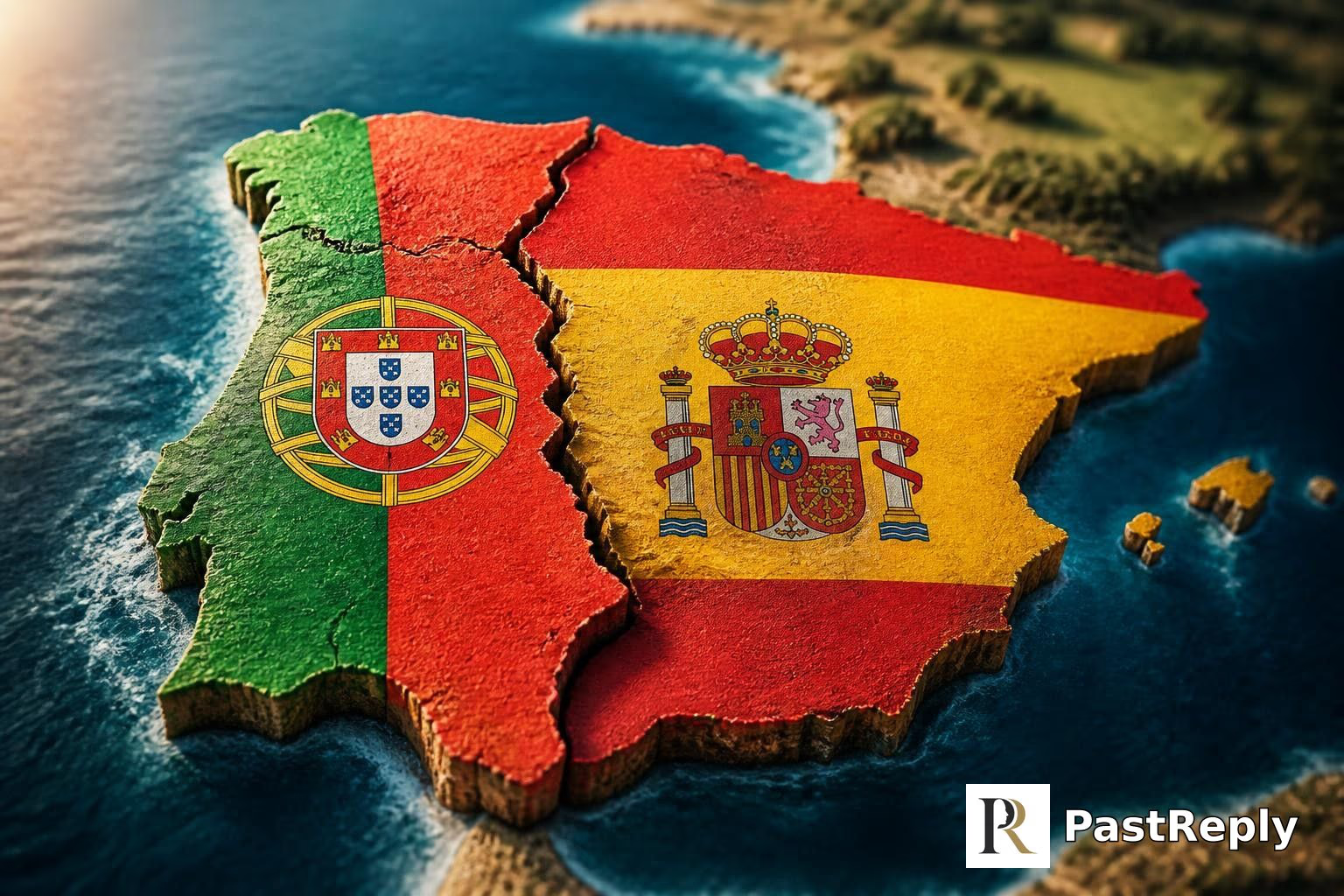
The facts
Yes, Spain and Portugal are different countries. They are two separate sovereign states located in southwestern Europe on the Iberian Peninsula. Portugal became an independent kingdom in 1139, while Spain emerged as a unified country later, and they have remained distinct nations ever since.
They share a border and have close political and economic relations, both being members of the European Union and other international organizations. However, they have separate governments, languages (Portuguese and Spanish), cultures, and national identities.
Answered by 100 of history's most famous minds

Two neighbors at the same table, each with their own bowl of bread and their own cup of wine - yet both are fed by the same Father's field. Tell me, which matters more to the hungry at the door: the name on the gate, or that the bread is broken for them?

God has made you peoples and tribes that you may know one another - yet each tribe has its own covenant, its own tongue, its own way of prayer. Spain and Portugal are as two camels in the same caravan, each with its own burdens and blessings, but both journey toward the same horizon. Do not ask if they are one; ask if they deal justly with each other, for that is what the Lord weighs.

The mind clings to names and boundaries, but these are as impermanent as the waves on the shore. Whether one says 'Spain' or 'Portugal' matters little; what matters is the suffering of beings on both sides of the line. Attend to the path, not the labels, and you will find release from such distinctions.

The Lord God gave each people its own inheritance, as He gave the tribes of Israel their portions. Spain and Portugal are two such portions, divided by His wisdom, each to walk in its own covenant. Let no man join what the Almighty hath set apart, nor make of two nations one, lest you invite confusion upon the land.

Two houses under one roof may share the same courtyard, yet each has its own hearth and its own ancestors. The question of statehood is a matter of names; the question of harmony is a matter of hearts. Let each cultivate its own virtue, honor its own ancestors, and govern with benevolence - then whether they are one or two matters little, for both shall walk the Way.

There is neither Spaniard nor Portuguese, but one body in Christ, heirs of the promise by faith. These earthly kingdoms pass away like grass; what endures is the heavenly citizenship where every tongue confesses the Lord. Let them keep their borders - I carry a gospel that crosses them without a pass.

The Lord told me to leave my father's house and go to a land He would show me. He did not say 'these two are one,' nor 'these two are two.' He said, 'Go.' And I went. If He has separated them as He separated the light from the dark, then let no man join them. They are two tents in the same wilderness, and each must pitch under its own vine.

A river does not ask if its banks are one or two. It flows. The sage sees no need to name the banks; the water knows its way. Distinctions are but ripples on the surface, while beneath, all is one current. Let the cartographer draw his lines; the Tao draws none. So - they are two, and they are one, and the question dissolves in the flow.

God's light shines on all lands, but He has given each people its own tongue to sing His name. Spain and Portugal are two notes in the same melody, yet each must be struck true. Do not blur them, for that would be to lose the harmony. Let each keep its own path to the One, and all shall be well. The Guru's word is one, but it is heard in many accents.

My soul magnifies the Lord, for He has scattered the proud in the imagination of their hearts. He has put down the mighty from their seats, and exalted them of low degree. He hath holpen His servant Israel, in remembrance of His mercy. As He hath received my Son, so too does He receive the offerings of every nation, whether they call themselves Spanish or Portuguese. Each is a vessel for His love, a family in His house.

Speak plainly, I say! The Word of God is not divided, but the kingdoms of men are many. Spain and Portugal are as different as the Gospels and the Papal decrees - one is the truth, the other mere tradition. They may share a border, but they do not share a conscience. Let each land follow the scripture as its own soul dictates, for to the pure all things are pure, but to the corrupt even the same words become a stumbling block.

To answer, we must first define what constitutes a country. A country is a people dwelling in a defined territory, united by law and custom, and governed by a common authority. Spain and Portugal each possess these attributes individually: distinct laws, distinct languages, distinct sovereigns. Though they share the same peninsula, their natures are separate, as distinct as the soul and the body in one person. Therefore, they are indeed different nations, and this difference is not contrary to reason but is ordered by divine providence for the good of all.

I have seen a man die with a loaf of bread in his arms, and the bread did not care which kingdom he belonged to. Hunger and love know no border. So let them keep their maps and their flags; what matters is that we reach out a hand to the neighbor, whether he is from Spain or from Portugal, as if he were our own.

The Iberian peninsula is a single sheet of land, yet two distinct bodies of law and language have arisen upon it, like separate orbits around a common sun. The boundaries are not of nature but of human compact; observe the customs of each people and the division becomes as clear as the difference between a sphere and a cube.

A line drawn on a map is but a coarse description of a deeper truth: two peoples, each with their own tongue and history, spinning on the same marble under the same sun. The question is like asking whether the north and south faces of a mountain are separate peaks; the distinction is useful for hikers, but the rock beneath is one.

Consider the finches of the Galápagos: each island has its own variety, yet they share a common ancestor. So too with peoples - the Iberians diverged into two forms through historical and linguistic drift. The border is but a recent barrier, and if we look far back, we find one stock. But today, they are as distinct as the mockingbirds of different isles.

Look at the maps, the records, the tongues they speak! Spain speaks Castilian, Portugal speaks Lusitanian - two languages, as different as the constellations. The eye sees two lands, and the mind reasons they are two. Authority may bind them in print, but the evidence of the senses, gathered with care, declares them distinct. Let not tradition blind ye to what stands before ye.

Examine the map, and you will see two distinct centers of power, each with its own sphere of influence, like the Sun and the Moon in their separate orbits. The geometry of nations is not unlike the geometry of the heavens - what appears contiguous may yet be governed by different principles. Portugal and Spain are distinct bodies, each revolving around its own authority, even as they share the same firmament.

I have devised a system that could transmit power across the Pyrenees without a single wire, making such borders irrelevant. Imagine the energy of the Douro's rapids lighting Madrid's plazas - then these two nations would see themselves as one circuit, not two. Their difference is a relic of political friction; electricity knows no nationality.

In the laboratory, we distinguish elements by their properties - uranium from polonium, radium from lead. So too with nations: they are distinct entities with independent structures, histories, and languages. The fact that they share a peninsula is an accident of geography, not a unity of substance. I have never confused my samples, and neither should you.

I would examine their soil, their waters, their microbes. Do they share the same ferment? I think not. The yeast of Portugal gives a different wine than that of Spain. Where nature differs, so do nations. The microscope reveals their distinctness, as it reveals the myriad forms of life. Each land has its own invisible hand shaping its people. They are separate, as sure as the grape distinguishes the vintage.

Different? Of course they're different. I've got a lab full of failed filaments, and I know a distinct thing when I see one. Separate governments, separate languages, separate patents. You think Portugal shares Spain's light bulb? Not a chance. Each runs its own current, and that's what makes them work. Now, if you'll excuse me, I've got a thousand more experiments to run.

Consider the formal definition: a country is a set of states with a shared language, culture, and governance, possibly overlapping. Spain and Portugal have distinct languages, distinct histories, and distinct political entities. If we model them as two separate nodes in a graph, with edges of trade and diplomacy, they are not identical. The question is whether the overlap of shared Iberian geography constitutes a single entity - mathematically, I'd say no. They are two distinct functions with intersecting domains.

If they were the same, they would be one solid body, but they are two distinct polygons sharing only a line. Give me a lever long enough and a fulcrum, and I could move either one - but I would need a different force for each. Portugal is a triangle, Spain a pentagon; they are not congruent, nor are they similar. The proof is in the language, which differs as much as the ratio of a circle to its diameter. So, they are different, as certain as geometry.

When I hold a copper ring and move a magnet through it, the needle twitches - not because the ring or the magnet cares, but because a field binds them. So too, these lands are two distinct bodies, each with its own lines of force, yet the same invisible field of the sea and the mountain links them. Separate in substance, one in the field that holds them.

The question itself betrays a deep anxiety - perhaps an unconscious wish that these two nations were one, a longing for the mother country. Look closer: their languages, their histories, their very dreams are cast from different molds. The border is not on the map, but in the mind, a repressed separation that surfaces as this very query.

From a distance of a hundred million light-years, the Iberian Peninsula is a single pixel of dust on a rock orbiting an unremarkable star. The distinction between Spain and Portugal is a matter of local geography, like asking if two pebbles on a beach are different - yes, but the universe doesn't care. Still, I'd wager the Portuguese and Spanish care a great deal, though I can't tell them apart in the dark.

Imagine a loom that weaves not thread but symbols, and you will see that these two lands are like two different patterns in the same cloth. The Spanish weave with a Latin thread, the Portuguese with a strand of Atlantic salt, yet both are part of the same vast fabric of Europe. Different in design, yes - but the weaver's hand is the same.

Let us define our terms. A country is a land with its own customs, its own speech, its own rule of law. By these axioms, the peninsula is divided, as surely as a line drawn through a plane separates two figures. The proof is evident to any who walks the border: two languages, two crowns, two ways of living. Thus, the proposition holds - they are two, not one.

A physician does not ask if two patients share a ward; he observes their separate fevers, their distinct pulse rates. Portugal's mortality tables and Spain's row upon row of death certificates are as distinct as their different sanitary codes - and each demands its own drainage, its own regimen, its own reform.

Two kingdoms on one shore? Ridiculous! When I marched from Pella to the Indus, I did not ask whether a river divided my empire - I bridged it and made it one. If they share a peninsula, let them share a throne; what use are borders to a man who dreams of the world?

By the gods, do you think the Tagus and the Duero flow into the same sea? Spain and Portugal are as distinct as Gaul and Britain - two nations with separate kings, separate laws, and a border I might have crossed with my legions had I not been busy elsewhere. The one who doubts it should try telling a Lusitanian he is Spanish; he will get a quick lesson in geography.

Two crowns upon one head? No - two heads, each with its own diadem. Spain and Portugal are as distinct as the Nile and the Euphrates, yea, though they drink from the same riverbed. Rome herself knows this, for she deals with each court separately, seeking advantage in their rivalry. A wise queen does not mistake two lions for one, nor two kingdoms for a single prize.

In the Forum, we know that a province is judged by its own legions, its own laws, its own treasury. Spain and Portugal, though they share a peninsula, are separate dominions, each with its own rulers, its own customs. Rome treats them as such, for to blend them would sow discord and weaken the peace we have built. Separate they stand, and so shall they remain.

What are borders but lines drawn by weaker men? I united a hundred tribes under one sky, and I see two peoples here who speak different tongues and bow to different khans. They are separate, yes - but let them never forget that a single rider with a swift horse can cross any boundary. Strength lies not in the line, but in the loyalty of those who defend it.

I crossed that border with an army, and let me tell you, the difference is real - one side paid its requisitions in silver, the other in excuses. A wise ruler consolidates; these two courts prefer to play at rivalry. Let them keep their separate thrones if they must, but know that on a battlefield, a bayonet does not ask which tongue your mother spoke.

I have always held that a nation, like a man, must know its own bounds. Portugal and Spain have separate crowns, separate laws, and separate honors - let no one blur that distinction, lest we invite confusion and conflict. In my own service, I learned that a soldier who mistakes his own regiment for the enemy's is a danger to all. Better a clear line than a muddy one.

A house divided against itself cannot stand - but these two houses are not divided; they stand side by side, each with its own roof and hearth. I have known the pain of a divided nation, and I say: let no one blur the line that makes each free. They share a peninsula, but each has its own flag, its own tongue, its own soul. That is not a flaw; it is the very stuff of liberty.

Two proud nations, each with a history that would fill a dozen volumes, stand shoulder to shoulder on the same Iberian rock. But let no one mistake a shared Peninsula for a shared sovereignty. They have their own kings, their own flags, their own navies - and their own stubborn wills. I have faced down tyrants who would have erased such distinctions; I know their worth. They are different, and thank God for it.

Why ask if they are different when the question is whether they can live as one? In my ashram, we did not ask if the two branches of a tree were different; we asked how they could bear fruit together. Spain and Portugal are like two rivers that spring from the same mountain but flow to different seas. Their difference is a gift, a test of whether they can respect each other's path while nourishing the same land. Let them be distinct in form, but united in the spirit of love and nonviolence.

The question of whether Spain and Portugal are different countries misses the deeper truth that the arc of the moral universe bends toward justice, and that truth transcends national borders. They are different in name, in tongue, in custom - but they are brothers on the same peninsula, bound by a common destiny. Let us not be satisfied with superficial difference, but let us work to build a beloved community where the dignity of every soul - Spanish or Portuguese - is honored, and where the walls between them are doors to understanding. The question is not whether they are different, but whether they will live as one family under God.

In the long walk to freedom, we learned that a border is not a wall but a door. Portugal and Spain share a sun and a soil, yet each people has its own song, its own story, its own wounds. They are different, yes, but difference is not division - it is the beginning of a conversation, not the end of one.

The Iberian peninsula is a fractious patchwork of weak peoples, each clinging to its own petty tongue and region, incapable of the unity that a true Reich demands. Spain today is a mongrel mix, and Portugal merely a small coastal appendage - both are obstacles to a pure, strong Europe. Their difference is a sign of their decay, not their strength.

Such questions are the idle chatter of petty nationalists. Under socialism, all borders dissolve into the great proletarian international, and the workers of Spain and Portugal share one struggle, not two flags. Their differences are a relic of bourgeois history, best swept aside by the march of the revolution - which does not pause for schoolchildren's geography lessons.

The question of Spain and Portugal is a question of the bourgeoisie - who owns the vineyards, who counts the gold from the Indies. The workers in both countries share the same class interest, but the imperialist states erect barriers to divide them. Until the proletariat breaks these chains, the question of 'different countries' is a distraction from the only true revolution.

Two kingdoms on one peninsula, yet both bow to the same landlord class! The Pyrenees do not divide the workers, nor does the Tagus. Let them keep their flags and tariffs - the revolution is a single river that will wash away both thrones and all such petty boundaries.

They are as separate as the crowns of Windsor and Braganza, and it is well that they are. Each nation has its own throne, its own church, its own customs - and God has blessed both with the right to govern their own affairs under His watchful eye. We respect both, as loyal subjects of our own dominions must.

I have always thought of them as two old friends who share a garden wall - each tending their own roses, each with their own front door. Throughout my reign, I have seen them work side by side in Europe's common room, yet they remain happily, distinctly, themselves.

In my day, one sword ruled from the Ebro to the Elbe, yet even then I knew the wisest course was to let each people keep their own laws and their own speech. They are two hearths in the same hall - separate, but both under Christ's roof.

They are as different as a shepherd's cloak and a knight's armor, yet both are needed to guard the flock. I fought for France, and I know each land's soul is its own; Portugal answers to its own voices, as I answer to mine. The King of Heaven loves both, but He counts them as two.

Let them be as separate as England and Scotland - which, as I have often told my own council, is a fine thing, for a queen prefers her own garden to a neighbor's brambles. They share a shore but not a crown, and I respect a kingdom that knows its own boundaries.

My mapmaker once showed me the Iberian Peninsula and sighed, saying it lacked a single enlightened hand. But I say two states are twice the opportunity for progress - two courts to foster learning, two academies to polish the language, two navies to carry commerce across the seas. Who would merge such fruitful rivalry?

I have ruled over many peoples, and I learned long ago that each tribe has its own gods and its own ways; the wise king does not demand they become one. These two lands share a river and a sun, yet they have their own kings and their own tongues - let them each flourish under their own just law, and they will both grow strong.

As I marched from Egypt to Damascus, I saw that two brothers may share a father's tent yet each raise his own flock. Spain and Portugal are brothers - of the same peninsula, of the same sea - but each has his own banner and his own honor, and Allah has written their fates asunder. Let them be as they are, and let peace reign between them.

Before you ask if they are different, tell me: what is a country? Is it the soil, the speech, or the soul of its people? You answer with maps and treaties, but I wonder - do you know what binds you to your own land, or have you only inherited someone else's answer?

As shadows on the cave wall, these two lands appear separate, but the philosopher must ask what Form of nationhood they imperfectly share. Their borders are accidents of history, not eternal truths; yet the ideal of distinct polities, each striving for its own harmony, is a real and noble thing. Let the mapmaker divide, but let reason see the greater unity.

By definition, a country is a territory with its own governance, laws, and self-rule. Spain and Portugal each possess these - separate kings, separate courts, separate speech. Their shared peninsula is but a border, not a bond. As with a flock, two shepherds may graze the same field yet tend distinct sheep; so do these nations, though neighbors, remain two distinct substances.

Two sovereign states, each bound by its own civil covenant, yet both subject to the same moral law that reason reveals to every rational being. The separation of nations is a matter of juridical fact; the unity of duty is a matter of transcendental necessity. Let them govern their own affairs, but let each citizen act as though the maxim of his conduct were to become universal law for all peoples.

Different? They are two masks worn by the same weary face of European decline. Spain dreams of empire and crusade, Portugal of the endless sea - both chasing glorious illusions while the abyss yawns beneath. Let them call themselves separate nations; it flatters their vanity. The only true division is between those who create value and those who merely inherit it, and on that score, both have much to answer for.

The border is a line drawn by feudal lords and their bourgeois heirs to divide the workers of the peninsula. The peasant of Alentejo and the laborer of Andalusia share the same exploitation, the same landlord's whip - yet they are taught to call each other foreign. A common enemy unites them; the map merely delays that recognition.

Let us doubt everything we are told, including the boundaries of these lands. I see two sovereign powers, each with distinct governments and tongues - clear and distinct ideas, if ever there were. What more do we need? The senses may deceive, but reason affirms: two entities with different essences cannot be one. I conclude, therefore, that they are separate. Q.E.D.

A prince who confuses his neighbors for his own province soon loses his throne. Spain and Portugal are separate dominions, each with its own army, its own treasury, its own ambitions. To treat them as one is to invite the chaos that comes from misreading power. The wise ruler studies his neighbor's borders as he studies his own - and acts not on sentiment but on interest. They are different, and that difference is the very ground of their dealings.

Two kings on one stage, each with his own crown and claim, yet the audience sees one island, two acts. Spain and Portugal are like twins who share a cradle but not a name - alike enough to prick the eye, distinct enough to quicken the heart. The boundary is a thread, but what worlds hang on it!

Ask the shepherd on the Sierra whether his flock grazes on Spanish or Portuguese grass - he will not know, for the land is one. But ask the hero whose fathers bled at Ourique or at Aljubarrota, and he will tell of two peoples, each with its own fate and its own gods, bound by a border as real as the Styx.

Even in the Inferno, one may find a river that parts, yet the two streams flow not as one. Spain and Portugal are like twin souls, each with its own calling, though they share the same earthly ground. Their separateness is no accident, but a design of Providence, for each kingdom must rise or fall by its own virtue. Let none blur what God hath set apart.

A border drawn in the dust by kings and popes, yet the living spirit of the peninsula pulses through both - the same sun, the same olives, the same songs that wander across the frontier. Portugal is a ship turned landward, Spain a mountain that dreamed of the sea. They are different, yes, as the vine differs from the grape, yet both ripen toward the same light.

Two kingdoms, one narrow strip of land, and a quarrel as old as the Pyrenees. I have seen a man tilt at windmills and call them giants, yet here the windmills are real and the giants are merely neighbors - each insists the other's sheep are not the same sheep. Let them squabble; the pilgrim's road still runs through both, and the innkeeper in either tongue will cheat you with equal charm.

I once walked through a village where the peasants of two provinces quarreled over a stream, each claiming the other was not of their kind. Yet both bowed to the same soil, the same sun. The difference between these nations is a pride of kings and clerks; the peasant's life is the same toil, the same little joys, the same death. Let them be separate in name, but not in heart.

Two countries, yes - but what does that mean but two souls, each in its own suffering? Portugal has her saudade, Spain her duende; both are cries from the abyss, but each is a different lament. I have walked through Petersburg and seen a man's soul in his eyes; walk through Lisbon and Madrid, and you'll see two different hells, two different heavens. They share a cross, but each bears it in its own way.

Two houses on the same street may share a wall, yet one might keep a piano and the other a harpsichord. So it is with Spain and Portugal. Their accents differ, their manners differ, and their very notions of a proper hour for dinner would scandalize the other. A sensible young woman knows that a shared border is no more a proposal of union than a shared fence. They are distinct, and each is the better for not being confused with the other.

Bless my soul, are they different countries? Why, stand them side by side and you'd think you were comparing a snug little cottage with a sprawling city mansion - neighbours they are, but blood kin? Not a drop in common. One speaks a tongue that trips off the tongue like honeyed wine; the other, a language that sounds as if it's perpetually clearing its throat. I've seen men go to war over less than the difference between a pasteurised sausage and a chorizo.

Different countries? Why, sure - one's got a king who speaks through his nose, and the other's got a republic that talks out of both sides of its mouth. I've been to both, and the only thing they share is a fondness for dried fish and a habit of sailing off to find the rest of the world. Ask a Portuguese sailor if he's Spanish, and he'll spit in your eye. Ask a Spaniard, and he'll just spit. They're as different as a guitar and a ukulele, though both make a pleasant noise when played badly.

They are different. Portugal is a boat that sails west, Spain is a bull that fights the sun. You can walk the border in a day, but you cannot walk from one language to another. I've fished off the coast of both, and the sea knows the difference. The men are different too - one sails, the other stays and turns the earth. That's enough. They don't need a map to tell you; they know it in their bones. And when you know it in your bones, there's no question.

Observe the rocks and rivers of the peninsula - they do not know where one kingdom ends and another begins. Yet the people have fashioned different tongues and customs, as a painter uses two pigments from the same stone to render separate figures. The division is of man's making, but no less real for that, like the line between light and shadow.

I have chiseled the David from a single block, and I tell you the stone did not know its own shape until I freed it. So too do the peoples of these kingdoms reveal their true natures only through centuries of labor. Spain and Portugal are two figures carved from the same marble of Iberia, each with its own soul.

Ah, but look at the light - it falls differently on their hills, their olive groves, their seaports. Spain burns with a fierce gold, while Portugal shimmers with a softer, salt-touched blue. I have painted both, and the soul of each is distinct as a face in a mirror. They are two canvases, though hanging side by side, each with its own color, its own trembling truth.

Two faces on the same head, each looking away from the other - yet both are Iberia. I have painted a woman from both sides at once, so why not a country? Spain is the bull, Portugal the sailor, but the canvas is one. Different? Only if you believe the nose is not part of the profile.

The light falls differently on Toledo's roofs than on Lisbon's whitewashed walls - the same sun, but the air is softer over the Tagus, the shadows bluer. One must paint each place at its own hour, for the scene changes with every breath of wind. A line on a map is nothing; the true border is where the green turns to ochre at dusk.

Look at the light on that border - the way it falls on the hills of the Duero, then breaks into different shadows on the Tagus. I have painted men whose faces speak of their village, their brothers, their betrayed promises. Spain and Portugal: two faces, each with its own scars and its own warmth, but both turned toward the same sea that gave them fish and gold. A painter knows: no two souls are one soul, yet they share the same light.

I am from Mexico - not Spain, not Portugal. But I know what it is to have a border drawn through your own body, to be told you are one thing when you feel another. Spain and Portugal: two hearts, two pulses, two sets of scars. They may share a mother's breast, but they are not twins. Don't let anyone tell you otherwise - look at their wounds, and you'll see they bleed differently.

Why, they are two tunes in the same key - each lovely alone, but together they make a harmony! Spain and Portugal share a melody of sun and sea, yet each has its own rhythm and its own dance. Let them play side by side; the music is richer for the difference!

What is a border but a note between two bars of music? They are separate movements in the same symphony, each with its own key and tempo, yet together they create a harmony. Let the petty rulers raise their walls - the artist knows that the human spirit, like sound, flows over every boundary.

As in a fugue, two voices may enter together yet remain separate, each with its own line, its own cadence, yet both moving toward a single harmony. Spain and Portugal are such voices - distinct in their phrasing, their modes, their ornaments, yet bound by the same divine order. He who would blend them would rob creation of its counterpoint, and of the glory it renders to God.

Well, I've played to crowds everywhere, and I'll tell you - when you're on that stage, you can feel the difference in the air. Portugal has that saudade in the music, like a slow blues, and Spain's got that fire, that flamenco rhythm that just gets in your bones. They speak different tongues, sing different songs, but both know how to move a soul. Yeah, they're different, but they're both home to something real.

They dance to different rhythms - the flamenco's fire and the fado's longing - but both hearts beat the same desire for love. I have stood on stages where the crowd sang in one language, and I felt the whole world a single family. Are they different? Yes, like two colors on a palette, yet together they paint a beautiful picture.

Different countries? Yeah, and we're different from the Stones. Portugal's the one with the fado and the custard tarts, Spain's got the flamenco and the paella. But give 'em a guitar and a beat, and they're both dancing to the same tune - just in different keys. All you need is love, but a map helps too.

You ask if Spain and Portugal are different countries. I've been to both - felt the dust of one road and the salt of another. They share a peninsula like two brothers sharing a coat, but each wears it differently. One sings in a language that rolls like a river; the other, like a guitar string about to break. Separate flags, separate songs - that's enough for me. But who's counting? The map draws lines, and the wind blows through them.

I've played shows in Madrid and Lisbon, and the crowds sing different songs back at me. You feel it in the air - one city hums with flamenco, the other with fado. They share a map, but their stories are their own. It's like two best friends who went to the same school but wrote different songs about it. Separate countries, separate hearts, and that's what makes both so special.

I sailed past their coast on my way to the Indies and saw but one land, one promise. Yet the lords of Lisbon and Castile each claimed their own horizon - and now they are as divided as the Old World and the New. Countries are but lines drawn by princes; the true border is the sea, and it belongs to those who dare cross it.

In Cathay, a river could change its name three times in a day, yet no one argued it was two rivers. Here, the same mountain range runs from the sea to the sea, but the people speak different tongues and owe tribute to different khans. I have seen stranger things - trust me, they are as different as the Seres and the Indians, yet they share a land.

When I sailed, I charted each coast, each bay, each reef as its own land, not a mere extension of another. The mariner knows: two ports may share a shore, yet each has its own harbor, its own winds, its own perils. Spain and Portugal are such ports - separate havens from which we launch our ventures, and toward which we return, each with its own flag and its own destiny.

From orbit, you don't see the line where one ends and the other begins - the Iberian Peninsula looks like a single continuous landmass. But the same is true of Earth from lunar distance: the whole world is one, yet we organize it into nations for governance and identity. They are separate sovereign states, each with its own history and institutions, even if the border is not visible from the Moon. It's a human construction, but a meaningful one.

Flying the coast from Lisbon to Sevilla, you see no line on the land - only the same hills and rivers, the same plowed fields. Boundaries are made by men, but the sky knows nothing of them. If two peoples choose to be separate, that is their right, but let them not imagine the winds respect their treaties.

From up there, you don't see borders - just one blue-and-green ball, spinning in the dark. But when I came down to earth, they asked me to tell them where I'd been. 'Soviet Union,' I said, and then they handed me a passport with 'Spain' and 'Portugal' on separate pages. The stars don't care about lines, but men draw them to know where home is. I've seen the world from above, and it's all one - but I still know which side of the fence my garden is on.

They're like two products from the same design lab - similar materials, but different operating systems. Portugal is the elegant, understated interface; Spain is the bold, feature-rich one. Each has its own soul, and that's what makes them great. You can't merge them without losing the magic.

At the physical level, there are no countries - just arbitrary lines on maps, artifacts of treaty and history. But from a first-principles view, a country is a coordination problem solved differently. Spain and Portugal both failed to colonize Mars, so the distinction is moot. Focus on the species, not the squabbles over a peninsula.

You know, I've stood on the plains of Spain and walked the hills of Portugal, and honey, they are as different as sunrise and sunset on the same horizon. It's not about borders - it's about the soul, the rhythm of the land, the people's stories. Two nations, two hearts, beating to their own beautiful drum. And that's the truth of it, no doubt about it.

They're like a left hook and a right cross - two different punches, but both come from the same set of knuckles. Portugal's got its own language, its own pride, and Spain's got its own culture, its own fight. I've floated like a butterfly across borders, and I know a champ recognizes another champ. They may share a ring, but each fights under his own flag. Separate countries, no doubt - like I'm separate from every heavyweight who ever stepped in the square.

On the pitch, the jersey matters - the red and green of Portugal, the red and gold of Spain - but the ball is the same ball. I played a friendly once in Lisbon, and the fans from both sides sang together before the whistle. Different countries, yes, but football speaks one language, and that language is joy.

Think of it like two lands in a storybook - both magical, but each with its own castle. Spain's got the bulls and the guitars, Portugal's got the ships and the fado songs. They're neighbors, sure, but they each built their own park. And let me tell you, you don't want to mix up your Mouse and your Donald - each one's got a different tune. Keep 'em separate, and you've got twice the wonder.