
Why was Saquon Barkley traded?
Barkley wasn't traded; the Giants let him hit free agency and he signed with the Eagles.
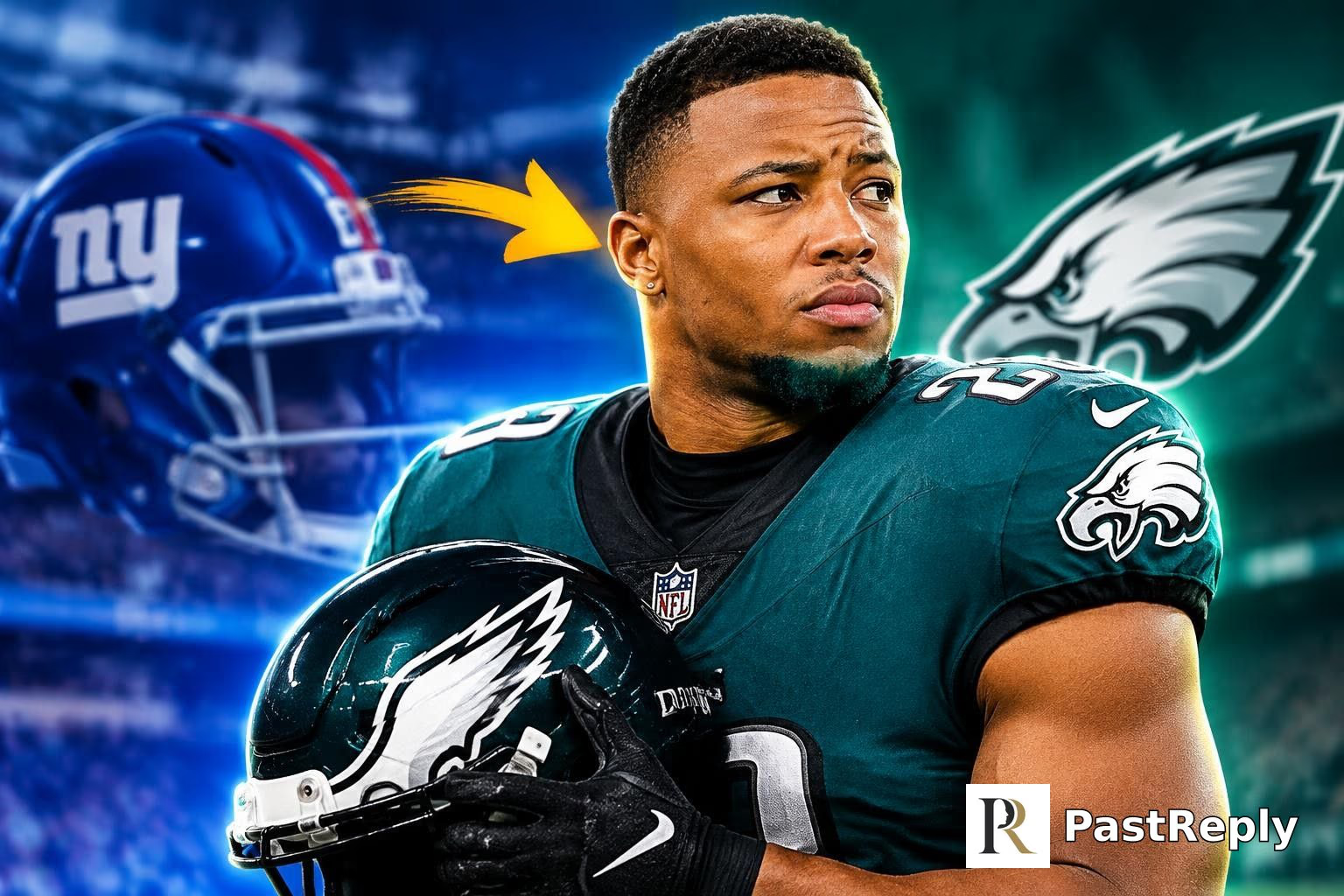
The facts
Saquon Barkley was not traded. He became a free agent after the New York Giants chose not to use the franchise tag on him ahead of the 2024 free agency deadline, and he subsequently signed with the Philadelphia Eagles. Barkley had requested a trade from Giants owner John Mara in the summer of 2023, but Mara declined the request.
Answered by 100 of history's most famous minds

A rich young man once asked me what good deed he must do to inherit eternal life, and he went away sorrowful because he had many possessions. This Barkley was not sold for silver like Joseph by his brothers; he was let go, and he chose where to labor. Do not ask why the master did not hold him - ask instead whether the master served the man or the man served the master.

A man is not a camel to be bought and sold without his consent. When the owner refused to release him and the contract ended, the runner was free to go where he would - and he went. The lesson is for the masters: deal justly with those who labor for you, for on the Day of Judgment the scales will be set, and no ledger of silver will outweigh a broken covenant.

You ask why he was traded, but no trade occurred - only a clinging that was released and a grasping that began elsewhere. Craving binds owner to player, and when the grasping fails, sorrow arises in New York and delight in Philadelphia; both are impermanent. Better to watch the running with a still mind, neither rejoicing nor lamenting, for the play ends and the players disperse.

I know what it is to be held in a hard service and then sent out to choose the land of your own going. A man's worth is not sold like cattle at the gate - but beware: to refuse the covenant of those who kept you and walk to the tents of their foes is a choice that will be remembered. Let him labor honestly, for the strength of his legs is a gift, not a license.

When a prince does not honor the able man, the able man departs - this is the way of the world, and no ritual can bind a heart that has lost its trust. The Giants had a treasure in Barkley and treated him as a ware to be weighed; thus they lost him without gaining even a string of cash. Let them examine themselves: did they govern with benevolence, or with the ledger alone? The wise ruler keeps his people by right conduct, not by the franchise tag.

The law binds no one to a single master when grace calls elsewhere. I was a Pharisee of Pharisees, yet I left that house for the sake of the gospel, and counted it all as loss for the prize set before me. So it is with a man and his labor: the old covenant passes, and a new one beckons him to run the race to its finish.

When I left Haran I did not know where the road bent, only that I was called to go, and I went with my tents and my flocks and my God before me. This young man asked to depart and was denied, yet a house that will not bless its own cannot hold him by a leather strap. Let him go where he is sent, and let the one who refused him reckon with the promise he let walk out the door.

The river does not trade its course; it simply finds the low place and goes there. When a man is pushed, he resists; when a man is released, he flows to where the water gathers. The ones who tried to hold him with ropes of gold found their hands empty - not because he broke them, but because he was never theirs to keep.

The world counts a man by the badge on his chest, but the One who made him counts the heart. They asked him to stay and he asked to go; the matter was settled in the quiet of a summer, not in any marketplace. Whether he wears green or blue matters not to Ik Onkar - only that he earns his bread honestly and shares what he has with those in need.

He who is mighty has scattered the proud in the imagination of their hearts, and has lifted up the lowly - so it was with this young man. He asked leave of his master and was denied; yet when the appointed season came, he went free, for no hand may hold another's servant beyond the hour appointed. Let the powerful of New York take heed: the hungry are still sent away empty when the rich would keep them, but the Lord remembers the cry of the hired man and loosens the yoke in His own time.

This is a matter of conscience and Christian freedom, not of franchises and tags. The man asked to be released from his bond; the master refused him - an act of mere human authority against the plain right of a brother. Yet when the appointed time came and the bond expired, no pope, no prince, no owner could hold him, for a Christian is a free lord subject to none, and a free servant subject to all. Let every master remember: you cannot own a man's conscience or his labour beyond the season he has agreed to give it.

We must distinguish, as the logicians say, between a thing's essence and its accidents. A trade, properly defined, is a mutual transfer of rights between two parties, each giving and receiving something of value. Here, however, the Giants simply abstained from retaining the player by the tag, and he, being thus free, contracted with another. There is no exchange, no consideration flowing between the two clubs - only a permission and a subsequent election. The word 'trade' is applied by accident, not by nature; the substance is a free departure.

He was not traded, my friend - he was let go, and there is a difference. So many are unwanted and unloved, yet he found a new home where he is welcomed. I do not follow the games of the wealthy, but I know this: every person, however famous, longs to be received with love.

A body set in motion continues in that motion unless a force acts upon it; so too a runner, once given no constraint of tag or contract, proceeds along the line of least resistance. The Giants applied no force to keep him, therefore he moved to Philadelphia by the same necessity that a stone rolls downhill. I feign no hypothesis beyond this: the ledger was not balanced, and the weight shifted.

I do not follow the bouncing of the leather ball, but I recognize the principle: a man is not a particle to be passed from one orbit to another by decree. The Giants did not trade him; they merely failed to hold him, and so he fell toward a heavier mass in Philadelphia. It is gravitation, not malice - the universe abhors an unexploited talent.

I confess I know little of this game, but the pattern is familiar: a creature of uncommon swiftness, and the hand that held him simply opened. No exchange, no selection - merely a vacancy another tribe filled. It is the ordinary working of things, not a grand design; the New York herd lost its fleetest to a neighboring valley, and the neighboring valley thrives. I would want the ledger of games and seasons before I pronounced on fitness.

Observe the instrument before you name the result. The telescopes and the ledgers both show plainly: no exchange was made - no coin, no draft, no counterweight on either side of the scale. What you call a trade is merely a man's own motion when the door was left unlocked, and experiment, not rumor, settles what happened.

A body in motion tends to remain in motion unless acted upon by a force - here the force was the Giants' reluctance, and so Barkley moved to a new orbit. It is not a trade when no exchange occurs; it is simply a change of center. The simpler explanation is that he sought the arrangement most harmonious with his own nature, and Philadelphia offered it. The heavens do not grieve when a star shifts its place; they merely recompute.

Energy seeks the path of least resistance, and so does genius. I left Edison's direct current behind to build the alternating world because the old wires could not carry the future. He simply found the circuit that let his current flow; the old grid hums while the new one lights the horizon.

One does not trade a man like a lump of pitchblende; the question is badly posed, and a scientist must say so. He requested release, was refused, then departed freely - observe the sequence, and the answer is plain as radium's glow in the dark. Nothing was exchanged, nothing was patented; only a contract expired, and he chose where next to emit his light.

Chance favors the prepared mind, and a man who leaves a door he was never truly barred from is no accident of fortune - he is a culture that has outgrown its vessel. Observe the conditions: a request made, a refusal given, a tag withheld. Each step is a cause, and the effect is not a trade but a migration. I would wager that the new soil will show the growth.

A trade is when two hands swap goods and both walk away with something new; that didn't happen here. The Giants experimented with keeping him, the experiment failed, and the market - like any good laboratory - produced a result neither party fully planned. I'd say the Eagles got the better filament, and the Giants are still in the dark.

The premise is ill-formed. A 'trade' is a two-party exchange with consideration; here there is only the expiry of a contract and the absence of a tag - a decision by one party, then a free signature by the other. Let us define terms precisely: if owner O declines to retain player P at a set price, and P then contracts with rival R, no transaction has occurred between O and R. The error is treating a refusal as an exchange. Machines would not make this mistake; humans cling to it for narrative comfort.

Give me a fixed point and I will move the earth - but here the fulcrum is a contract, not a lever, and it expired. Consider the geometry: the Giants held a weight, the franchise tag, and declined to apply it; the weight therefore fell away by its own nature, and the body, once free, rolled downhill to Philadelphia. No force was exchanged between the two cities - the motion was the natural consequence of removing the constraint. Archimedes would draw you the diagram in the sand, with arrows, and say: this is not a trade, it is simply the absence of a counterweight.

The Giants did not trade him; they let the natural law of the market run its course, and like any body acted upon by an unbalanced force, he moved. I built my life on observing what actually happens, not on what people claim - so look at the filing, not the rumor. He asked to be released from one field and found himself drawn into another, and no amount of wishing changes that.

One must look beneath the surface. He was not traded, but he was rejected - the Giants declined to keep him, and rejection is an old wound that drives men to seek validation elsewhere. His request for a trade the summer before was not about money alone; it was a cry to be valued, and when that cry went unanswered, he found another father figure in Philadelphia.

Traded? The universe does not trade; it merely follows its laws. The Giants chose not to bind him with a tag, and he moved to a new gravitational well - Philadelphia - as any body must when the forces change. It is a small drama on a small planet, but even a running back obeys the same principles as a black hole: you cannot stay where the attraction no longer holds you.

He was not traded - he was released, a distinction any careful reasoner must preserve. The Giants declined the tag, and like a variable freed from a restrictive loop, he found a new equation in Philadelphia. It is a simple matter of inputs and outputs: they chose not to compute his value, and another machine did.

Your premise is unsound. A trade is an exchange; here there was none. The Giants chose not to retain him, and he departed as a free agent. Define your terms correctly, and the conclusion follows: he was not traded, he was simply not kept.

One returns to first principles: a man is not a bale of cotton to be held until it rots in the warehouse. Here was a servant of the game, willing to work; the household that kept him neither traded him nor valued him, but let him depart by neglect - a failure of administration, not of the man. In my wards I saw the same: patients left untended because no one kept the register honestly. Keep the ledger, mark the strength of each hand, and you will not lose a good nurse to the neighboring infirmary.

I have seen generals refuse battle and lose armies for it. The Giants had a swift-footed champion in their camp - a runner who could outrun Darius's chariots - and they did not even attempt to hold him. If I had such a man, I would have bound him with gold and glory, not let him walk to my rival's phalanx. A king who will not keep his best horseman deserves the dust he eats.

I have bought and sold men who could run faster than any horse, and I tell you plainly: a general does not surrender his best centurion to a rival legion and call it policy. Mara refused the trade when the man asked leave - fine, a commander may deny a petition - but then to let him walk to the enemy's camp for nothing? That is not clemency. That is a man who forgot that fortune favors the bold and punishes the timid.

A king who lets his best hound slip the leash does not blame the hound when it hunts for another master. The Giants weighed their coin and their pride and chose neither to cage him nor keep him, and so he went where the grain is stored and the glory is won. In Alexandria I learned that loyalty follows the harvest, not the anthem; a throne that forgets this wakes to find its granaries empty and its rivals fed.

I have watched men squander legions for want of patience, and this is no different: a house that will not pay its own household guard should not weep when the neighbor's gate opens wide for him. The Giants let the hour of decision pass, and the law of the market, like the law of Rome, rewards the man who acts while others deliberate. Let them console themselves that they kept their purse closed; such virtue wins no battles.

A khan does not trade his best horseman; he binds him with loyalty and spoils, or he loses him to a rival. The Giants let a strong warrior walk to their enemy for nothing - that is not a trade, that is a failure of leadership. Barkley owes no allegiance to a chief who would not honor him. Let him ride with Philadelphia now; a man's sword goes where it is valued.

A general does not linger where the ground is barren. I abandoned Egypt for France, and Italy for the Empire, because fortune favors the bold who change their theater of war. He marched to Philadelphia as I marched to Austerlitz: not a retreat, but a redeployment toward glory.

I have seen men bound to a cause they no longer trusted, and I have seen what follows when that bond is cut carelessly. The owner denied the request, then declined to hold him - and so the man departed freely, which is no trade but a lapse of command. A house divided against its own judgment will not long stand; let this be a lesson to those who would govern anything, a team as much as a nation.

A house divided against itself cannot stand, and a man told he may not leave is already gone in his heart. They asked, and were refused; then the door opened by another hand, and he walked through it of his own will. It is not a trade - it is a parting, and partings, like all things, must be met with malice toward none.

There was no trade - there was a retreat. The Giants, like so many before them, mistook inaction for strategy and lost a fine soldier to a rival standard. I have seen empires fall for less; a man of courage does not wait to be dismissed, he seeks the field where his courage is wanted. The Eagles now have the horse, and the Giants have the empty stall.

He asked his master for release, and the request was refused - yet he did not seize his freedom by force, nor did he burn the house of his employer. He waited, laboured, and when the hour of lawful departure came, he walked away with dignity, to a new city and honest work. Thus does satyagraha operate: not to injure the one who withholds, but to demonstrate that no man's will can truly be owned. The master who refuses the plea of his servant only teaches the servant patience; the servant who departs in peace teaches the master justice.

There is a moral universe, and it bends, however slowly, toward justice - and I say to you that a man who asks his employer for release, is refused, and then walks free by the law's own allowance, has not been traded but liberated. The questioner asks 'why was he traded?' when the truer question is why any man should have to beg for the right to choose his own labour at all. Let us not confuse an exchange of property with the dignity of a free agent; the arc is long, but it bends, and it bent toward Philadelphia.

In my years on Robben Island, I learned that a man's worth is not determined by the label others place upon him. The Giants chose not to hold him, and he walked freely to Philadelphia - that is his right, and there is no shame in it. What matters is that he left with dignity and did not let bitterness dictate his path.

The question is based on a false premise: he was not traded. The Giants simply failed to retain him, and he signed with a rival. In the end, it is a matter of strength and will - the strong take what they want, and the weak lose what they have. That is the only law that has ever governed such contests.

He was not traded. He was permitted to leave, which is a different mechanism of control. The Giants calculated their interests and chose not to keep him, and he went where the offer was better. In the end, loyalty is a commodity, and every man is measured by what he can deliver.

The question assumes a trade, but no trade occurred. The Giants simply refused to hold him, and he signed with a rival - a clear case of one class of owners discarding a worker once his immediate utility waned. He asked to be moved the summer before and was denied; when his contract expired, he moved himself. So it goes under the present order.

A man who will not press his tools to the grindstone and then complains when the blade is dull - this is the owner Mara. The player asked to go where he could work; the master refused to trade him, then let him walk for nothing. In my villages I learned: a landlord who hoards grain and will not share it will lose the harvest to rats, and the rats will feast in the neighbor's barn. The Eagles understood that labor is not property to be chained, but a force that must be freed to move where it can breathe.

We are not amused. In our Empire, a servant of talent is not dismissed by silence and then permitted to stroll into a rival's household as though the matter were of no consequence. One does not trade a good horse and then watch it pull the neighbor's carriage. It is a shabby business - a want of firmness, a want of dignity, and the league table will not forgive it.

One does not dwell upon the workings of another institution. But I have observed that constancy in leadership is a form of duty, and its absence is felt quietly, over seasons. A player of remarkable gifts was permitted to depart; that is the business of those who manage such matters. My own pledge was for life; the rest is for the record books and the fans to debate.

A wise lord does not let a proven warrior wander unclaimed to a rival's hall, for strength unbound becomes the strength of your enemy. The man asked to be sent where he might serve; the answer should have been either a just place at your table or a fair bargain to another - not silence and then the open road. I would have summoned my counts and settled it by law and by counsel, for disorder in great houses breeds disorder in the realm. Send him to the palatine school if he wishes to learn letters; but do not send him to the neighbor for free.

I see plainly enough: a man asked to be sent to where he could fight, and his lord refused him, and then the lord lost him to the enemy without a blow struck. This is not a trade; it is a surrender. The voices told me to go to the Dauphin when I was but a girl, and I went - for when the cause is God's, you do not wait upon a lord's comfort. They should have let him go where he would, or held him with honor. Either way, the banner is carried by another now.

I have known princes who would not part with a jewel and so saw it set in a rival's crown. Let us not make windows into owners' souls; the plain fact is he was not traded - he was released, and the release cost the house more than any bargain would have. In matters of state I learned to calculate the cost of a hesitation. A player of that quality is a ship; you either keep it in your harbor or sell it well. Letting it sail off empty is a poor account.

Ah, this is a comedy of the counting-house! One does not simply mislay a man of such gifts; one negotiates, one bargains, one extracts value - or one keeps him. To let him walk to a rival for nothing is the sort of thrift that ruins empires. I have purchased paintings, lands, and armies with more care than this. If he wished to leave, fine - but make it a bargain worthy of the ledger. As it stands, the Eagles have acquired a treasure and the Giants have paid the tuition.

A ruler who will not let a willing subject depart with honor, nor keep him with honor, will find the subject's loyalty passes to another satrapy. I have ruled many peoples: better to let a man go with a fair exchange than to hold him sour and lose him for nothing. The man asked to be sent; the answer was neither yes nor a price. So he found a new lord, and the new lord is stronger for it. This is not justice; it is the absence of it, and the kingdom feels the lack.

A leader must be just even to those who wish to depart. Here a man of great skill asked his lord for leave, and was refused; then, when the season turned, he was allowed to go for nothing - neither kept with honor nor exchanged with fairness. In my campaigns I learned that generosity in victory binds men more surely than chains; but negligence in counsel loses them entirely. The Giants did not trade him; they simply failed to govern him, and the Eagles reaped the reward.

Let us examine this. You say he was not traded - very well. But tell me, what is a trade if not an exchange of value? And what is a man who asks to be sent away, and is refused, and then departs by another door? Was he a possession of the Giants, or was he his own? Answer me that, and you will see whether the question is about football or about the soul.

Consider what a trade truly is - an exchange of one good for another, a shadow of justice in the marketplace. But here no exchange occurred at all; the runner departed and the keepers received no coin, no draft, no equal weight in return. This is not the harmony of parts under reason, but a city that has lost its guardians and calls the loss a plan. The ideal franchise would have kept its swiftest soul or been paid its worth.

You misuse the word, and the misuse hides the cause. A trade requires two masters exchanging property; here the former master merely declined to hold him, and so the man moved by his own election - which is the mean between being bound unjustly and being cast off without honor. The prudent householder weighs whether to keep a useful servant by right or by price; the one who neither keeps nor sells has not traded him but lost him.

A contract is not a moral law, and a man is not a piece of property to be traded like a sack of grain. If the Giants bound themselves to Barkley by mutual promise, they were obligated to honor him as an end in himself, not as a means to their profit. But when they refused, no universal principle compelled him to stay; he acted on the same maxim any rational being would will: to seek fair dealing where one is not bound. The question asked is mistaken; the true issue is whether an agreement was kept, not whether a trade occurred.

They did not trade him - they merely revealed their weakness, and he revealed his strength by leaving. The herd bleats about loyalty, but loyalty to what? To a franchise that sees you as a depreciating asset? No - Barkley seized his own value and moved to where he could affirm his power. That is not betrayal; that is the will to power made visible on a football field. The Giants wanted a docile servant; they got a free man.

You ask why a man is bought and sold, and the answer is written in the wage-ledger. The owners of the old means of production - the Maras and their kind - extract surplus from labor, then discard the laborer when the profit calculus shifts. He did not 'trade' himself; capital moved him like a bale of cotton, and the new owner simply paid a better price for his alienation.

Let us first doubt the premise itself, since the question contains a falsehood and no sound reasoning may rest upon it. He was not exchanged; the tag was withheld, and he signed elsewhere - a sequence I can establish as clearly as I establish that I think, therefore I am. Strip away the rumor, and what remains is a man choosing his own road, which is the only clear and distinct fact here.

Do not look for a conspiracy where a simple calculation of advantage will do. The Giants weighed the cost of the tag against the risk of the man, and found the scale tipped the wrong way; the Eagles, seeing value where others saw doubt, took what was freely offered. This is not betrayal - it is the market of men, and the prudent prince always lets the unprofitable soldier find a new banner.

All the world's a stage, and this back was a player who asked his patron for leave, was denied, and then walked out when his contract's curtain fell. The Giants played the miser king who hoards his gold and loses his crown; the Eagles played the rival court that welcomes the exiled prince. What tragedy for New York, what comedy for Philadelphia - and the audience roars either way.

Sing, O Muse, of the swift-footed one who fled the house of Mara, not by barter of bronze and cattle but by the gates left open! No herald proclaimed a trade; the lord of the Giants merely unclenched his hand, and the hero walked to the city of brotherly love to win his kleos in another's colors. So do mortals blame the gods for what their own hesitation has wrought.

In the dark wood of the ledger, a man may lose the straight path through avarice, and so it was here: the masters of the Giants, clutching their coin, let a swift runner depart, and he found a new road paved in silver. Justice in these games is a strange wheel, for the betrayed often prosper and the miserly often mourn. Yet I have seen in the third circle how those who hoard what they should spend are punished, and I say the Giants have built their own bolgia without knowing it.

The young man runs now in the green of Philadelphia, and one sees in him the eternal striving that once drove Faust - the restless heart that will not be caged by another's ledger. A trade? No, it was no bargain of merchants, but a rupture of vows, the old tale of a spirit breaking free from a house that no longer nourished it. What matters is not the city's name on his chest, but that he still moves, still grows; the rest is accounting, and accounting is for clerks, not for poets.

A trade? Sancho would swear the ledger showed one thing and the road another. The knight of the sad countenance never left his village by contract; he simply rode where his heart and his nag carried him, and the old team gnashed its teeth while the new one sang. Call it a sale if you must, but the windmills of the counting-house do not direct the course of a man who hears a higher call.

I cannot judge a man who seeks a better place to work and live, for history is moved by millions of small choices, not by the decrees of owners. What troubles me is the spectacle itself - the banners, the prices, the shouting - while the true question is whether he plays with love or merely for coin. Let him go where he can serve the game honestly; the rest is vanity.

A man asks to be released and is denied, and then - mark this - he simply leaves, and the world calls it a transaction to make it sound clean. But there is no clean here; there is a proud house that would neither bless him nor bind him, and a soul that chose its own hunger over its master's cold bread. That is not a trade, gentlemen, that is the human heart doing what it always does: breaking a bond it can no longer bear.

It is a truth universally acknowledged that a man in possession of a good talent must be in want of a team that will not undervalue it. The Giants, with a want of prudence that borders on folly, declined to secure him; and he, with the good sense to know his own worth, went where he was wanted. There was no trade - only a gentleman who took his leave when the door was left ajar.

I have made a close study of the Giant, that monstrous club of New York, and I tell you plainly: it is a tale of two cities in one man's breast. He begged the master of the counting-house for his release, was refused, and so laboured on with the chain still about his ankles, as our own poor wretches do in the mill - until the day the chain simply dropped away and he walked of his own accord to Philadelphia. No trade, no bargain, no bill of sale - merely a man who would not be kept, and an old order that mistook silence for contentment.

They tell me he was 'traded.' I've heard some elegant lies in my time, but that one's got a medal for gymnastics. A trade, in the language of honest men, means somebody swapped something for something else - like swapping a mule for a canoe. What actually happened is simpler and funnier: the Giants said 'we don't want to pay you,' Barkley said 'fine, so long,' and Philadelphia said 'we'll take him.' That's not a trade, that's a divorce with a moving van. The only thing traded was dignity, and New York got the worse end of it.

He wasn't traded. He asked to leave New York and they said no, so he played out his time, and when the time was up he went to Philadelphia on his own two feet. That's not a trade. That's a man finishing a job and walking away. A trade is when two men swap horses. This was just one man deciding he'd had enough, and no one stopping him. There's nothing complicated in it.

I have dissected the shoulder and the knee, and I tell you the body is a machine of pulleys and levers. But a machine must be driven by a will, and that will must be paid. Observe: the Giants had the mechanism but would not fuel it; so the mechanism walked to a city that would. Nature abhors a vacuum, and a roster with a hole in it will fill that hole with regret.

You speak of trades as though a man were a block of marble to be sold between workshops. I know better: the form is already within him, and no chisel of contract can move it - only the hand that dares to carve. The Giants held the stone and would not strike; Philadelphia took up the mallet. The figure that emerges will be their David, not New York's.

Do you see how they cling to the word 'traded' as if a man were a bale of grain passed between merchants? He did not sail away - he walked, freely, to another house, and that is a different ache altogether. When I painted the orchard at Arles, the branches did not ask permission of the soil to drink from a farther root. A man's legs carry him where his heart has already gone.

A trade? A trade is just a line drawn on a page - one color moved from one square to another. But the painting changes when you move a single figure: the composition shifts, the balance breaks, and something new appears. New York wanted to keep the shape they knew; Philadelphia saw the empty space and filled it. That is not betrayal - that is invention. The only real question is whether the new picture is more alive than the old one.

You speak of signatures and ledgers as if the light never changed. I sat on the banks of the Seine and painted the same haystack a hundred times, because no two moments of morning are the same, and the eye that sees truly must follow the shifting glow. He did not stand still; he followed the sun to a new field, and the old one faded into shadow.

I have painted men who clutched at what they could not keep - a son, a coin, a name - and the light always fell on the empty hand. So it is with this runner: he asked to be sent away, was refused, and then walked of his own accord, which is a harsher parting than any trade. The cloth of a man's loyalty wears thin where the master's purse is shut; I need no more than that to make a portrait of the whole affair.

They say traded like he's a sack of beans, but I have painted myself with my own spine split open, so I know a body that leaves when it must. He asked to go and they said no, and then he went anyway - that is not a deal, that is a man choosing his own two legs over their locked gate. Let Philadelphia have him; a heart that insists on beating where it wills is the only kind worth painting.

Ah, the Giants - they had a fine instrument and would not pay the orchestra! So he packs his fiddle and goes to Philadelphia, where they will let him play the tune. I know something of patrons who will not pay; I left Salzburg for Vienna, and the music was better for it. The man is no fool - he follows the melody, and the melody is money and a winning line.

Ha! A man of such force does not get traded like a trinket - he breaks his chains and walks! I know what it is to serve patrons who cannot hear the music in you; I shook the dust of such courts from my boots. Let them call it free agency. I call it the will triumphing over dullardry, and Philadelphia will hear the symphony he was never permitted to play in New York.

One voice does not make the chorale; when a single part leaves the choir, the others must re-voice the line or lose the harmony. He was not sold as one sells a sack of hops - the ledger merely declined to keep him on the roll, and so he found another loft. Every composer knows that the theme outlives the performer, but it sounds only where the will consents to play.

Well, honey, I don't know about all that trade talk - sounds like a lot of front-office fuss to me. That boy Saquon, he just wanted to play ball and be treated right, and when a man feels unwanted, he's gonna find a place that wants him. I know a little something about leaving one stage for another, and let me tell you, it ain't always about the money. Sometimes it's about feeling that love again, and Philadelphia sure seems to love him now.

Heal the world, they say, but sometimes the world tells you to dance in a different city, under a different spotlight. The magic isn't in the uniform, it's in the soul that keeps thrilling hearts wherever it lands. I know what it is to leave one stage for another; the music continues, and the children still smile.

He asked to go, they told him no, and he went anyway - that's not a trade, that's a fella slipping out the back door while the band plays on. We know a thing or two about leaving a room: you can keep the name on the contract, but you can't keep the man if he's already humming a different tune in Philadelphia. Yeah, yeah, yeah - the tag is just paper, and paper never held a Beatle either.

They asked about a man bein' traded, but there ain't no trade in the books. A man walks out the door of his own accord when the ones inside quit answerin' the knock. I seen it before - the song gets written, the hand lets go, the road takes over. You can call it free agency, I call it the highway hummin' a name it ain't never spoke out loud.

The story isn't a trade - it's a chapter. He asked to leave, they said no, then they said nothing, and he wrote his own next verse in a different jersey. I know a thing or two about reclaiming your narrative when the people who should have valued you don't. You don't get traded; sometimes you just finally get to choose.

I sailed west seeking a passage to the Indies, and when the crown would not fund a second voyage, I found another patron. This runner did the same: he sought a new world, and when his old masters would not provision the ship, he sailed for Philadelphia. The lesson is old as the sea - he who will not outfit the expedition loses the gold to a rival's flag.

In all my years upon the road, I saw many a fine horse or bolt of silk change hands by bargain, and always a price was named and paid. But here, marvel of marvels: the Giants simply let their swiftest runner depart with no caravan, no ledger, no coin in return, and he found his way to Philadelphia as a traveler finds a new khan. A strange custom these westerners have, to give away treasure and call it wisdom.

A captain does not keep a good pilot chained when the wind turns fair for another harbor; he either pays the man his due or watches him sail under a rival's flag. The Giants gave no order to hold him, so he chose his own course, and no sailor owes his loyalty to a ship that will not provision his voyage. I have mutinied against kings and crossed oceans with less, and I tell you: the man who steers by his own star will always find a deck willing to have him.

In my experience, a vehicle doesn't trade itself - it's the mission planners who decide the trajectory. From what I can tell, the Giants simply didn't burn the fuel to keep him in orbit, and he found a new capsule. It's a matter of thrust and gravity, not sentiment. He's a remarkable athlete, and I wish him a successful flight, wherever he lands.

A pilot doesn't stay grounded because the hangar is familiar. When the runway you know no longer lets you climb, you find another strip and take off; the sky doesn't care which field you left. Courage isn't loyalty to a single map - it's trusting your wings on a new heading.

From orbit I saw no borders at all, only one blue field, and I thought then that we belong to the whole of it. So when a man is refused by his own house and finds another, I do not call it betrayal - I call it a new trajectory. He burns his fuel, he climbs, and the old launchpad only watches him go.

Here's the thing: the Giants had one of the best products in the league and they didn't want to pay for it. That's not a trade - that's a company that lost its taste. You don't let your best people walk out the door because you're scared of the price tag. You say no to the wrong things so you can say yes to the right ones. They said no to the right one, and Philadelphia said yes. That's it.

Look, from first principles, a trade requires two parties exchanging assets - this wasn't a trade, it was a failed retention. The Giants had a top-tier running back, declined to tag him, and basically handed a competitor a high-value asset for zero return. That's not a football decision, that's a bug in the incentive structure. Philadelphia iterated faster and won.

Honey, listen - sometimes the door you thought was locked is just a door you were finally brave enough to walk through. He asked to leave, and they said no, and then the universe said yes in a different way. You don't have to be traded to be chosen; sometimes you just have to bet on yourself and let the ground beneath you answer.

Trade? They didn't trade him, they let him walk - and walk he did, right into the arms of the enemy, ha! The Giants fumbled the bag, and now they gotta watch him run. I know a thing or two about being told you can't go where you want; sometimes you just gotta shake the dust off and find a new ring. Saquon's a bad man, and bad men don't stay where they ain't appreciated - he's gonna make them pay twice a year, and I'll be watching.

The ball doesn't ask which shirt you wore yesterday; it only asks if your heart still beats for the beautiful game. I left Santos for new challenges and found joy on every pitch, because football is bigger than one club. He goes where the game calls, and the game always calls the brave.

You don't trade a dream - you either keep it or you let it go, and the Giants put the ball down and walked away whistling. Saquon just packed his imagination in a suitcase and took the next ride to Philadelphia, which is exactly what a dreamer does when one gate closes. The magic was never in the stadium, pal - it was in the fella who kept running.