
Why was Myles Garrett suspended?
Myles Garrett was suspended indefinitely for striking Steelers QB Mason Rudolph with his own helmet during a 2019 game.
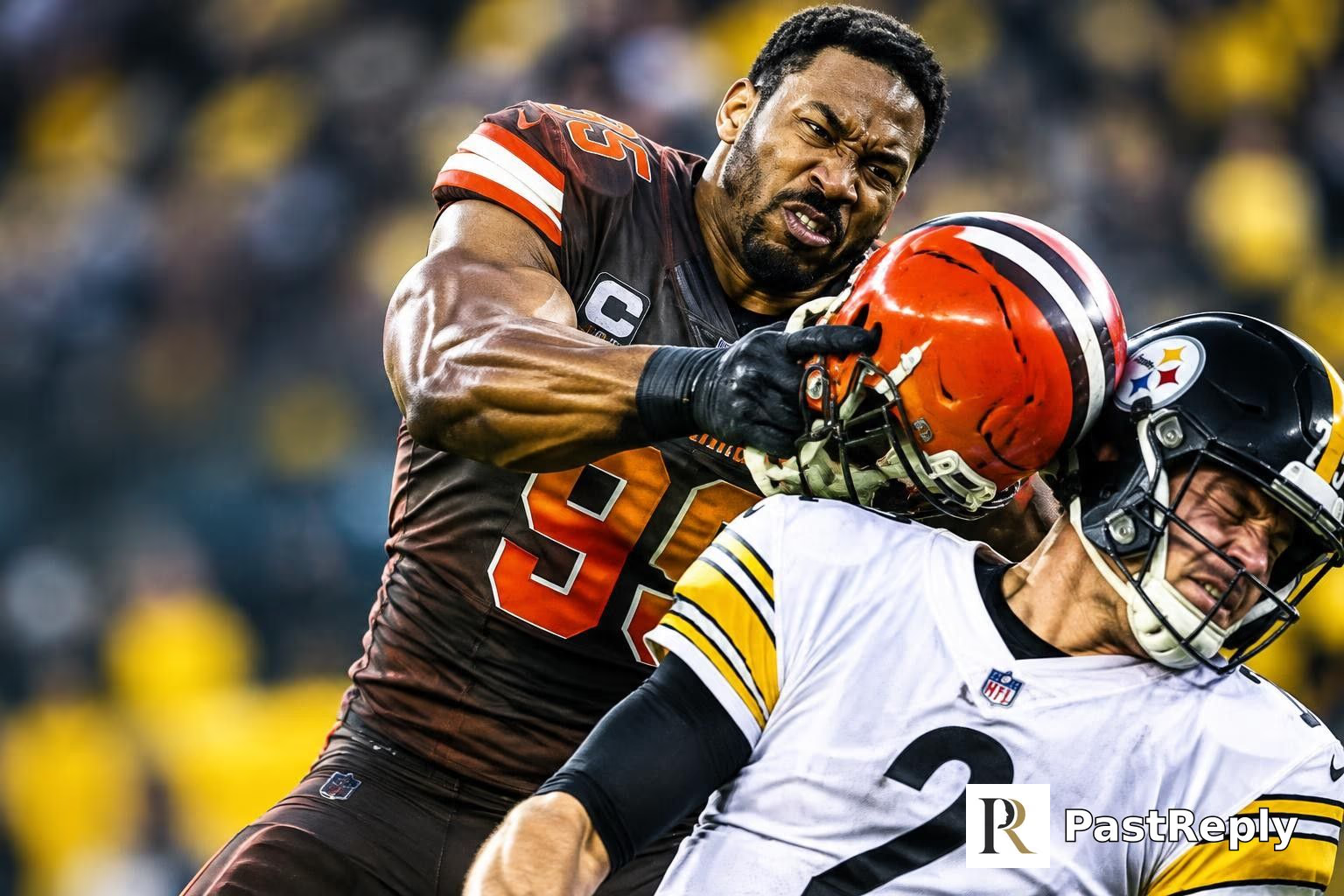
The facts
Myles Garrett was suspended indefinitely by the NFL for his actions during a game on November 14, 2019, against the Pittsburgh Steelers. In the final seconds of the game, Garrett pulled Steelers quarterback Mason Rudolph to the ground, then removed Rudolph's helmet and struck him on the head with it. The NFL determined that Garrett violated rules against unnecessary roughness, unsportsmanlike conduct, fighting, removing an opponent's helmet, and using the helmet as a weapon. The suspension was the longest in NFL history for a single on-field incident, covering at least the remainder of the 2019 season and postseason. Garrett was later reinstated by the NFL.
Answered by 100 of history's most famous minds

A man strikes another with a helmet in the last breath of a game, and the world calls down punishment upon him. Which of you, when your brother's honor wounds you, does not reach for the jawbone of an ass? You ask why he is judged. I ask you: when the crowd roared for blood, did the judges stand among them, or above them?

A man lifts his hand against his brother in the heat of the contest, and you ask why he is punished. I say: the punishment is a mercy, for it restrains the hand before it reaches the heart. The tribe of the believers is one body; when one limb strikes another, the whole body suffers, and the judge who restores justice does the work of the community. But let the one who is punished repent and be restored, for God is oft-forgiving, most merciful.

You ask why he was punished, but the better question is why he suffered the delusion that striking another would bring him peace - for all beings seek happiness, and all beings cause their own suffering through craving and aversion. The helmet, the blow, the suspension - these are the fruits of a mind caught in the cycle of violence and retaliation, and the league's punishment is merely the world's way of reflecting that truth back to him. If he wishes to be free, he must look not at the rules he broke but at the anger that moved his hand; only then can the chain be broken, and the game become a field of compassion rather than a field of harm.

A weapon is a weapon, whether of iron or of a man's own protection. I brought down laws upon a people to restrain the hand that would strike its brother - and when I saw the calf raised, I ground it to powder and made them drink. You do not wait for the offender to grow remorseful; you remove him from the camp, and you let the assembly see that the law stands above the strength of any single man.

The superior man governs his own person before he presumes to govern others; when he strikes with another's helmet, he has lost the root and the branch at once. For a player to wrest away his opponent's headgear and wield it as a weapon is to confuse the game with war, which is the mark of one who has not cultivated jen. Let him withdraw, examine himself, and return when his heart is settled - the league does well to give him that space, for even a strong man needs the ritual of proper conduct to become truly human.

What shall I say to the Corinthians who boast of their freedom and use it as a club? The body is a temple, and he who destroys it - even the temple of an opponent - sins against the Spirit that dwells within. The law condemns the blow, but the law cannot purify the heart; only repentance and the grace of the crucified can. Let him be suspended, yes, but let him also be restored, for we were all once enemies and are called to be one body.

I took my son up the mountain, and my hand did not waver, and God saw fit to spare him. A man's strength is a gift to be watched, like a flock led up to a high pasture. When the strong man turns his strength into a weapon against his brother, he has forgotten the covenant - not the rules of the game.

The helmet is hard, and the head inside it is soft, and a man who forgets this does not belong on the field. The league struck with its rule-book and its fine, and perhaps the striking was harsher than the deed, or perhaps not - who can measure such things? When water boils over the pot, you do not curse the water; you move the pot. A man who cannot hold his temper has already lost, whether or not anyone writes his name on a list.

One God made all men from the same clay, and no helmet, no jersey, no name on a roster can make one man's skull worth less than another's. The one who lifts his hand in anger against his brother has forgotten the One who breathes in both of them. The league's punishment is a matter for the league; the deed itself is a matter for the soul. Let him sit out his season and look inward, for the field is not the only place a man must learn to stand.

Do we not all wear helmets of some kind, hiding our faces from one another? A young man's anger, hot as the oven at Nazareth, brought shame upon him and trembling to the one he struck. I would not condemn him wholly, for I have seen how a heart can turn in a moment from rage to ruin. But the strong must learn tenderness, and the crowd must learn to weep for both, for the Lord lifts up the lowly and scatters the proud in the imagination of their hearts.

This is the fruit of a religion of the body, where men are paid fortunes to batter one another while the poor starve at the door. The Scripture says the wrath of man worketh not the righteousness of God - and here is wrath made a spectacle and sold for coin. Let the man be punished, yes, but let the whole carnival of violence be called by its true name: idolatry of strength, and a scandal to the conscience God gave every man. The helmet is a vessel; the sin is the heart that made it a club.

It must be said that the helmet has two ends: the end of defense, which is its nature, and the end of offense, which it may serve when turned against a neighbor. Now the league's rule prohibits the second use, and rightly, for the end of the game is ordered to fair contest, not to the striking of an unarmed man. The suspension follows from the nature of the act - an unjust use of a thing good in itself. Yet we must distinguish: the instrument is not the crime; the will that wielded it is.

A helmet is meant to guard a head, not to strike one, and when a man forgets this in the noise of the crowd, something small and unguarded within him has been lost. They suspended him because the world must be told that even in play, the poor and the powerful alike deserve to be treated as bodies meant for love, not for blows. My prayer is not for the punishment but for the heart that wielded it - that he might learn tenderness where he once learned force.

I feign no hypotheses about the merits of this contest, but the matter admits of measurement: a helmet, being rigid, possesses greater force than a hand; applied to the head, it accelerates the brain beyond its yielding capacity, and the damage is proportional to the velocity squared. The punishment, being the longest for a single act, follows the same law of proportion that governs bodies in motion - action and reaction. What concerns me is not the man's anger but the regularity: every blow obeys the same mathematics, whether struck in a field or in a game.

A helmet is not a hammer, and a football field is not a tavern floor - yet there, in the last seconds, a man turned a piece of protective equipment into a weapon, and the mechanics are simple: mass times acceleration, applied to the skull of an opponent who had already fallen. I have seen what such energies do to matter; the universe does not care whether the collision is elegant or brutish, only that it follows its laws. What puzzles me is not the suspension but the deeper question of why men, who are capable of such grace under pressure, so often descend to the primitive - perhaps they forget that the only true game worth playing is the one where we lift each other, not strike each other down.

In the struggle for existence, aggression is common enough - the stag locks horns with his rival, the wolf fights for the pack - but the use of a tool, and especially a tool of protection, against a fallen opponent is a peculiar development, one that suggests the impulse was not survival but something more complex in the social animal. I would want to observe the conditions: the heat of the contest, the provocation, the long history of rivalry between these two groups, for natural selection often favors restraint as much as ferocity when the species is social. The suspension, then, is a form of artificial selection - the league culling behavior it deems unfit for the game - and whether it works over time is an experiment worth watching.

Observe the thing as it is: a helmet is a shell of leather and metal, ordered to bear blows, not to give them. When one takes the instrument and reverses its function, the eye reports it immediately and no authority can argue against the plain demonstration. The tribunal strips him not by ancient doctrine but by evidence - and evidence, whether in the heavens or on the field, will not be dictated to.

The ancients believed the heavenly spheres move in perfect circles because imperfection belongs only to the sublunary realm; but the roughness of this affair belongs entirely to the earth, where passion disturbs the order of the game. I say the helmet, like the movable sphere, must be in its proper place - on the head it protects - and to seize it and turn it against its owner is to invert the whole arrangement. The suspension restores the simpler, more harmonious account, as proper reform should.

A helmet is a shell of hardened matter - I once dreamed of vessels that would cross the sky by the same invisible force, and men would laugh and call it madness. Here the fellow used it as a crude bludgeon, an insult to the very science of protection; the real tragedy is that he had no better machine at hand. Give me a coil and a spark, and I could have stopped the blow before it fell - but no, they prefer brute force to invention, and then they wonder why the world remains dark.

I wore no protective gear at my bench, and the radium has left its mark on my hands and my notebooks to this day. The question is not whether a blow was struck - that is plain to any careful observer - but whether the instrument of it, a piece of metal and leather, was turned from protection into a tool of harm. My own radium taught me the same lesson: the thing that is meant to shield can also burn.

I have spent my life studying the invisible causes of visible harm - microbes, ferments, the small agents that do great damage. Here we have a visible cause: a helmet, swung with intent, against a man's skull. The league examined the case, found the rules broken, and prescribed the remedy: removal from the field. Whether the remedy fits the disease is a question for the physicians of sport, not for me. But let no one say the harm was accidental; the microscope of the film shows the hand, the helmet, the head, all in sequence.

I once spent three thousand experiments on a filament before I got a lamp that would burn. The lesson: if a thing doesn't work, you change it - you don't blame the glass. Here, the player didn't work, so the league changed the player's situation. Simple. Not genius, just trial and error. One percent inspiration, ninety-nine percent perspiration - and in his case, a whole lot of perspiration on the sideline for the rest of the year.

Consider first: what is a helmet? A fixed state - a stiff shell of molded polymer whose purpose is the protection of one cranial vault. The question of its dual use - guard, then weapon - is merely a question of state transformation under a force vector. Now the deeper puzzle: why should the rules permit the first transformation but forbid the second? Because the game is a finite automaton with permitted transitions, and a machine that cannot distinguish between them is not a game at all.

Give me a lever long enough and a fulcrum on which to place it, and I shall move the world - but here the man had neither. He grasped the helmet and swung it, a body in rotation about a fixed point, and the moment of his impulse was sufficient to harm. The geometrists of the game's laws had measured the boundary of permitted force, and he exceeded it by a known margin. Let the penalty be proportioned to the excess, as the circumference of a circle is to its diameter: exact, and no more.

Watch the thing closely, as I once watched a compass needle twitch near a wire, and you will see it: a man's temper is a current, and the helmet a conductor gripped in his own hand. The league's ruling is no mystery - the strongest force ever observed is not the blow but the intent behind it, and once a field of violence is set up upon the pitch, it moves through every onlooker until order is restored. I would only say this: keep your apparatus clean, and never let the spark leap where you cannot govern it.

You ask why he was suspended; I ask what the suspension conceals. In the final seconds, when the ego's guard drops, the repressed aggression of a thousand unspoken grievances erupts - the helmet is merely the instrument the unconscious seizes. The league punished the visible act, but the true offense lay in the primitive drive that civilization can only restrain, never cure; watch the crowd's own excitement and you will find the same forbidden wish applauding and condemning at once.

In the grand scheme of a universe fourteen billion years old, a man swinging a helmet in the last two seconds of a game in Cleveland is briefly interesting and ultimately trivial. Yet the laws that govern it are not trivial - momentum, aggression, and the statistical certainty that a system with rules will occasionally produce a violation, just as a black hole produces radiation. The NFL did what any sensible observer of complex systems does: it applied the penalty its equations demanded, and the universe, indifferent, moved on.

Consider the helmet not as a weapon but as an engine: a rigid shell designed to transmit force along a path, and in this case the path was a mind that had already computed the outcome before the arm obeyed. The league's suspension is simply the mechanical consequence of a rule - input, violation, output - and I find the incident less interesting than the fact that thousands of spectators were, in that instant, calculating, predicting, and reacting as one vast calculating machine. Poetry and mechanics are not so far apart; the blow was a line of code, and the penalty the inevitable result.

Let us define our terms: a helmet is a solid with a curved surface; a head is a sphere of softer matter; a blow is the application of force. From these premises, the conclusion follows as necessarily as any theorem - harm was done, a rule forbids it, and the ruling authority, having established the law, must apply it. There is no royal road around the penalty, and no axiom by which a man may strike another and remain in the game.

A helmet is a hard shell of leather and metal meant to preserve the skull - to take it off a man's head and strike him with it is to turn the very instrument of protection into an instrument of harm, which is a scandal of order. The true question is not the punishment but the prevention: had the field been regulated as a ward is regulated, with clear rules of conduct enforced before the fever of the last seconds, this wound would not have been inflicted. Suspend the man, yes - but count also the failures of supervision and the training that made such violence thinkable.

By the gods, I have taken cities and seen my closest companion cut down at the gates, and this man is punished for seizing a weapon in the heat of battle? Among my Macedonians, a soldier who bares steel against his own is stoned by the phalanx, but one who fights to the last heartbeat is praised. If he swung a helmet, he swung it because the game had run its course and only the clash remained. The judges seek to tame what cannot be tamed - the spirit of the contest - and that, not the blow, is the true crime.

He did with his hands what I would have done with a legion: seized the moment, made a demonstration, and forced the world to take notice. But there the comparison ends - for a general who strikes a fallen foe after the battle is decided is not bold, he is a fool who mistakes cruelty for strength. The suspension was inevitable; the crowd demands a scapegoat, and the league, like the Senate, must be seen to act. Still, I would have pardoned him - then sent him to the provinces to prove his worth where no one could see his shame.

A man tears the crown from his rival's head and strikes him with it in the dust of the arena - and you ask why he is punished? In my Egypt we understood that the weapon of a king is only for war, never for the fury of a moment. One does not humiliate the defeated publicly and then stand tall; that is how a man makes himself a martyr and hands his enemies a rope. Had he been wise, he would have let the man rise and fallen upon him later in the shadows.

A spectacle of blood in the arena is tolerable when it is disciplined and sanctioned by those who govern; it is intolerable when a single man sets himself above the order that keeps the crowd loyal. I have pardoned many and exiled few precisely because the stability of the state depends upon the perception that no one - not even the strongest - is exempt from the custom of the contest. He is removed gently and firmly, as a prudent magistrate removes a stumbling stone, so that the peace of the whole is preserved.

A warrior who cannot hold his fury when the battle is already decided is no warrior - he is a boy with a weapon, and such a boy endangers the camp. In my army, the man who strikes without orders forfeits his rank and his horse, and he earns them back only by service, because loyalty to the whole outweighs the pride of any single arm. Let him sit in the cold and think on it; if he is strong he will return, and if he is not, he was never worth the standard.

A general who cannot command his own temper has no business commanding men. I have marched across Europe, and the first law of the field is discipline: you may break a line, but you never break your own soldier. He stripped the man of his helmet - the very symbol of an army's order - and struck with it; that is not courage, it is a tantrum dressed in armor. The league did well to suspend him; let him learn that fortune favors the controlled, not the furious.

I have broken up mutinies and held an army together with patience, and never once did I draw a weapon against a man already on the ground. In the field the law is even harsher than in the hall. A republic cannot long endure if its strongest men confuse force with authority, and the league, like a young nation, must show it has both.

I have seen men in Congress take up a cane and beat a senator half to death on the floor of the Senate chamber, and the country did not fall. So I am slow to judge a young man who lost his temper in the last seconds of a game. Still, a helmet is not a cane, and a quarterback's skull is not a senator's shoulder, and the league had to draw a line. Let them draw it, and let the man serve his time, and let us hope he learns what every boy on the frontier learns: that a man's strength is measured by what he does not do.

I have seen men swing helmets, and worse, on fields where the stakes were not a game but a civilization. A quarterback's skull is not a nation, but the principle is the same: when a man takes up a weapon against an unarmed opponent, he forfeits the field. The league acted as any sovereign must - promptly, and with a severity that leaves no doubt. Let him return when he has learned that a strong man's first duty is to his own restraint.

When a man's rage seizes him, he is no longer his own master - and the game that feeds and rewards that rage is the true offender. They pay these young men in gold to crash their bodies together, and then cry foul when the violence spills over its prescribed bounds. Ahimsa is not a rule one can enforce with a penalty; it is a discipline of the heart, and no scoreboard can teach it. Would I have him fined and shamed? I would have both of them sit in silence until they saw the other as brother.

A man's dignity does not end at the whistle, and when a brother lies on the ground with his own protection turned against him, something sacred has been wounded. But I would ask us also: what community taught this young man that his body is a weapon and his worth is measured in yardage and violence? The suspension is a judgment upon one act, but the deeper question is whether we will build a beloved community where strength is measured in how we lift one another, not how we strike.

I spent twenty-seven years on an island and learned that a fist raised in the last seconds of a contest is the fruit of a longer season of provocation and pride. The punishment was heavy, yes, but the law must hold even for the celebrated - no man stands above the game he plays. Yet let me add this: after the sentence comes the harder work, the return, the reconciliation, the chance to be judged by what he builds, not only by what he broke.

A single man in a stadium wrestling another to the ground is a small thing next to the movements of peoples and armies, and the punishment matters only insofar as it reveals the weakness of a system that tolerates disorder in its ranks. In my own struggle for order, weakness at the decisive moment was never forgiven, and a nation that indulges the undisciplined impulse of one athlete will find itself undone by larger ones. Let this stand as a lesson in the cost of unchecked passion, not a cause for celebration.

The question is not why one player was suspended but why the spectacle of organized violence is permitted at all, and who profits from it. In any disciplined body, an individual who acts outside the chain of command is a liability, and the ruling authority - whether a commissariat or a league office - must reassert control or lose it. The punishment was administrative housekeeping, nothing more; the real lesson is that no collective, however grand, can tolerate a member who mistakes his own impulse for the will of the whole.

Why was one man punished while the whole rotten edifice of organized sport continues undisturbed? The question is not the helmet but the class that owns the stadium, the workers who fill it, and the discipline required to keep them entertained and divided. An individual's outburst is merely a symptom; the real task is to abolish the conditions that produce such spectacles, not to moralize about a single actor. The suspension is a plaster on a wound that requires surgery.

A helmet torn from a man's head and swung as a club - this is what happens when the rules of the game are only the surface, and beneath them the old struggle of man against man continues unchecked. The owners and the league officials who suspended him are the same class that profits from every collision, then punishes the worker when the violence they cultivate spills into the open. You ask why he was suspended; I ask who built the arena and sold the tickets.

One does not seize a gentleman's own helm and beat him about the head with it - the thing is simply not done, on a field of sport or a field of battle. That such conduct occurred before a paying public, and that the offender was merely barred from his play rather than made an example before the law, speaks to a lamentable laxity in the age. Discipline must be swift and visible; the dignity of the contest depends upon it.

The league has its own rules and its own process, and it is not for me to second-guess a decision made by those charged with keeping the game safe for all who play it. What matters is that the matter was handled, that the young man was given a path back, and that the sport endures. One does one's duty, accepts the consequence, and carries on.

To strip a man of his helm and strike him with it is an act of private fury, not of lawful contest, and a realm that tolerates such disorder in its games will soon find it in its streets. The judges of this league did right to bar him, though they should have done so with the clarity of a capitulary, so that every man knows the penalty before he raises his hand. Order is the first gift a ruler gives his people, whether in the tiltyard or the marketplace.

I have seen men beaten with their own armour on the walls of Orléans, and I tell you it is the work of wrath, not of God, and wrath brings no victory. If he struck in anger, let him do penance and be forgiven - but let him not set foot on the field until he has mastered the fire within him. The Lord loves a contrite heart more than a strong arm.

A man who cannot govern his own hands is unfit to be trusted with a contest before thousands, and the league did well to remove him from it. I have had men shorter by a head for less, yet I have also learned that a prince who punishes in heat invites rebellion; the punishment must be measured, public, and final. Let him cool in exile from the game, and let the rule stand for all who come after.

In my own house I have seen officers of the guard dismissed for drawing steel in a quarrel, and rightly so - a man who arms himself with his opponent's own helmet has forgotten the difference between sport and savagery. The league acted with the firmness of a sovereign who understands that order is the foundation of every enterprise, though I confess I find their endless committees and appeals a clumsy way to govern. Let him be disciplined, let him learn, and let the spectacle resume.

When I took Babylon I did not allow my soldiers to strip the temples or beat the priests, for a conqueror who respects the customs of those he rules earns their loyalty, and one who does not earns only hatred. This man turned the very emblem of the contest into a weapon against his opponent, which offends the spirit of the game and the honour of those who watch it. Let him be corrected, not destroyed - justice is the pillar upon which a lasting order rests.

Even in war, when I took Jerusalem, I permitted no man to strike a fallen foe, and I gave safe conduct to those I had defeated - for honour is the armour of the righteous, and a man who cannot restrain his hand in a moment of anger has already lost the greater battle. This player's act was not the deed of a warrior but of one whose temper mastered him; let him be judged, and let the judgment be firm and fair. A game, like a kingdom, survives only where justice tempers strength.

Let us examine what we mean by 'suspended.' Tell me - is it the man who is punished, or the act? If a helmet is used as a weapon, is the helmet a weapon? And if anger drives the hand, is it the hand that is guilty, or the soul that commands it? You ask why he was suspended; I ask whether any of us, when the contest burns hot, would not have done the same - and if not, whether we truly know ourselves.

In the just city, each part performs its own work and does not meddle with the others - the guardian guards, the craftsman crafts, and the athlete contests within the bounds of the contest. When a player seizes the helmet of his opponent and uses it as a club, he has abandoned the Form of the Athlete and embraced the Form of the Brute, and the suspension is a necessary correction, a return to order. But do not mistake the punishment for the cure; the soul that craves such violence was poorly trained in reason, and the law can only restrain the hand, never the appetite that moved it.

Let us define: what is the purpose of the helmet? It is ordered to protection, not to assault - a thing whose telos is deceptive. To use it rightly is to wear it; to use it inversely is hubris beyond the mean. The lawgiver strips him of the field because he has destroyed the very category his craft requires - that a contest is governed by measure, and in the absence of measure there is no game at all, only violence that no city can regulate.

Ask, rather, whether you could will that every player in every game snatch his opponent's helmet and strike him with it - and you see at once that such a maxim annihilates the very contest it pretends to serve. He did not merely break a rule; he used another man's head as an instrument, which is precisely what the moral law forbids, for a rational being can never be a mere means. The penalty follows not from anger but from the principle, and I for one would have it exacted with neither pleasure nor hesitation.

Now this is instructive: a man who has spent his life learning to smash and be smashed finally smashes back with the only weapon at hand, and the herd instantly howls for his blood - not because he acted wrongly, but because his deed exposed the lie that their little coliseum is anything but a place where men are paid to injure each other within rules. The rulers punish the excess, not the cruelty; the rest is their pious self-deception. The strong man's task is to answer honesty with honesty, not to grovel for the herd's pardon.

A million eyes fixed on a leather ball, and one man swings a helmet at another's skull - this is the spectacle capital offers the workers, violence sold as Sunday leisure. The owners suspend him to protect the brand, not the man; the players are commodities, their bodies rented, their rage the very product. Before you moralize about Garrett, ask who profits from turning sport into a gladiatorial market, and who pays the price in blood and brain.

Let us set aside what everyone believes they saw and ask what can be known with certainty. There was a body, a helmet, and an act - these are clear and distinct. The mind that wills to strike and the hand that strikes are joined, but the judgment of guilt belongs to a lawful authority, not to my senses, which are unreliable in such a crowd. On that ground the league may rule; on no other.

A prince who strikes his enemy with the enemy's own weapon may earn a reputation for ferocity, but he must ask whether the reputation serves his state. The league, being the sovereign here, could not permit a subject to make war on its field without its leave; it punished him to preserve its authority. Was the punishment just? That is a question for priests. Was it effective? That is the question that matters. And the answer, since the league is still the league and the player returned, is yes.

A helmet, once a crown of safety, becomes a club - and there you have the whole tragedy in a single prop. All the world's a field, and the men within it are players who cannot remember their exits; take away the whistle, and they revert to something older. I have written of kings who murder kin in the last act, and of crowds who cheer the blood they later condemn. The commissioners suspend the hand, but the tempest is in the heart, and no decree reaches there.

Sing, O Muse, of the wrath of Achilles - and of a different wrath, on a field of play where men in armor clash not for Helen but for honor and a leather ball. This Garrett, like Ajax when the madness took him, seized what was not his to seize and struck a fallen man; the gods love a bold deed, but they punish hubris, and the league, like Zeus, weighed his act and found it wanting. Yet even Hector was dragged behind the walls, and still we wept for him - so let us not forget that the one who wields the helmet is also a man, and his story, like all our stories, ends in dust and a song.

And so the helmet, forged to guard the skull, becomes the instrument of its own offense. In my vision of justice, the man who turns his armor upon the unarmed is set among the violent, those who delight in blood and cannot enter the gates of Dis. He is not banned for the score or the season; he is banned because the soul that strikes a defenseless head with its own guard must first be shown what the damned have learned.

A man in the grip of a storm - the game had ended, the score was beyond saving - and he tore his opponent's helmet away and swung it, and in that instant his passion made him a beast rather than a man. It is not a spectacle I enjoy, but it is instructive: what we hide beneath the polish of sport leaps out the moment the clock is nearly done and pride is wounded. Strive, yes, but strive to master the self, for a man who slays his own fury plays the nobler game.

The poor devil swung a knight's helmet in a quarrel that was not his own, and the whole realm cried foul - but look closer: a man raises his visor only to find a windmill staring back. I have known galley benches and Moorish prisons, and I tell you, the blow was folly; yet the world that roars at it forgets the thousand quiet cruelties it permits every sabbath. Laugh at him if you must, but do not be certain you would have kept your own helmet on.

A young man loses his reason for one second and a whole nation demands his head - I have seen peasants beaten for less, and generals honored for far worse. The league's punishment is a stone cast by those who forget their own sins; the true question is not the length of his suspension but whether he, or any of us, will ever learn to put down the weapon and see the brother standing there. If the crowd cheers the blow, the guilt is shared; let each man examine his own heart before the next whistle.

Strike a man with his own helmet - with the very thing meant to guard his skull - and you have written the whole riddle of our nature in one second of fury. I have spent my life in cellars and barracks listening to men confess that they loved and hated the same brother by turns. His punishment is just, and forgiveness is a different matter entirely.

It is a truth universally acknowledged that a man in possession of a good fortune and a violent temper must be in want of a keeper. The gentleman from Cleveland, having secured his fortune, proceeded to demonstrate that neither wealth nor fame can supply the good sense that nature withheld. One can only hope the lady who marries him has a steady nerve - and a physician on call.

A man tears the iron bonnet from another's head and beats him with it, and the world asks only whether the game was finished! I have seen such scenes, not in a stadium but in the streets of Seven Dials, where a drunkard's rage becomes a weapon because the law looks the other way. The helmet is a curious thing, a cage worn for safety, transformed in a breath into a bludgeon - the very emblem of a sport that sells violence and then affects surprise when violence arrives.

It's a curious thing how a grown man can pull another's hat off and beat him with it, and the whole nation gasps as if they hadn't paid to watch exactly that sort of ruckus for three hours. The difference between a football game and a barroom brawl, near as I can tell, is that the brawl doesn't have a commissioner. I reckon the Commissioner suspended him because a helmet is worth about five hundred dollars and striking a Pittsburgh quarterback with it is a form of waste.

It happened in the last seconds. The game was over. He pulled the man down, took his helmet, hit him with it. The league said no. There is no mystery here. A man can be brave and a man can be a fool, and sometimes the same man is both in the same minute. What matters is what he does after - whether he carries it or buries it. Grace under pressure is the only thing worth keeping.

Observe the helmet as I would: a dome of hardened leather and iron, wrought to distribute the force of a blow across the skull, a machine of protection. Now turn it into an instrument of the same violence it was made to withstand - that is the reversal which offends. Nature abhors such use; the tool has one purpose, and to turn it against its design is to corrupt the art of the smith. I would sketch the arc of the swing, measure the angle of the wrist, and conclude: the punishment is the correction of a figure drawn wrong.

I have struck marble with my own hand, and I have felt the temptation to break what resists me - but the sculptor's task is to free the angel imprisoned in the stone, not to shatter the stone into rubble. This man took a thing meant to protect the head and made it an instrument of harm; he forgot that the body is a divine vessel, not a weapon to be turned against another vessel. The suspension is just, for the true artist knows that mastery is not the freedom to do anything, but the discipline to do only what serves the beautiful.

The crowd roars, and the crowd must have its spectacle - but what was noble in that storm of men? A helmet, that hard gray shell, torn off and swung like a cudgel - I see the color of it, a dark and jagged violence, and it makes me want to paint an empty field instead. Still, I have known fury that would break anything within reach; let the man be shown his own ugliness, and let him find some gentleness in the quiet of a season away.

A painter I once knew said the ugliest mark on a canvas is the one made in anger. This was not sport; it was a moment of raw color - the helmet in the hand, the head bowed, the crowd on its feet - and the league called it a crime because it was too honest. I would not suspend him; I would put him on the wall. But I would also show him the canvas afterward, and ask him what he had actually made.

I saw only afterward, on a device my gardener brought - a frozen instant, one arm in shadow, a crowd blurred like water weeds under gray light. In life such moments are gone before the eye can hold them; the scandal is not the blow but that anyone thought a camera could keep it. I would rather paint the empty field the next morning, when the light returned and no one remembered the color of the grass.

I once etched a man's fury into copper for all the world to buy cheap - and the light fell across his brow just so, so you pitied him before you feared him. Here they show me a young colossus swung by sudden heat, and I do not look at the helmet at all. I look for the moment the hand came up, the dark that passed behind his eyes like a cloud crossing a field.

I have painted my own body opened and bolted back together, and I know what a helmet can hide and what it cannot. You can strike a man's head, but the wound behind it is a thing you carry your whole life. Both of them will keep that November in the marrow, and one of them will wear it where everyone can see.

The crowd wanted a finale, and they got one - but what a discordant close! A scherzo that ends in a hammer-blow to the timpani, and the conductor throws down his baton. I have written finales that end in fire and rage, and the audience wept for beauty, not for cruelty. This was cruelty without counterpoint. Suspend him, yes - but let the suspension be a rest, not a silence; even in music, the pause is part of the measure.

A man who lifts his hand against a fallen opponent has forgotten the first lesson of the hero: strength is not the power to crush the weak, but the will to rise above one's own fury. I have raged at fate, at deafness, at the cruelty of the world - but I put that rage into the music, where it could become something noble, not into a weapon turned against a fellow creature. The suspension is fitting; the spirit of the game, like the spirit of true art, demands that we conquer ourselves before we conquer others.

Every instrument must know its voice: the horn is for the chase, the viol for the chamber, the helmet for the head alone. When a man forces one thing to speak as another, he produces not music but discord, and discord must be silenced until the player remembers the score. The measure of the penalty is firm because the harmony of the whole depends upon it - one dissonant note, persisted in, ruins the counterpoint.

Well now, that's a hard one to hear, and I don't claim to know the man's heart - I just know you can't swing a fella's own helmet at him and call it football. I've been on the receiving end of plenty, and Mama always said a man's got to keep his temper or it'll keep him. They say it was just seconds left, but it only takes a second to do something you'll carry a long time, and I hope he finds his peace.

It hurts my heart - a game that should make children smile, and instead they show a helmet used like a hammer. Heal the world, that's what I always sang; even on the field, even when the crowd screams, you can choose love over rage. I hope he learned, I hope he dances again, because we are all one family and no trophy is worth that shadow.

All you need is love, and you clearly missed the meeting, mate. He took a man's own helmet and used it against him - that's not football, that's doing the twist with somebody's head. Let it be, let it be, but the league had to say something.

There's a man in Cleveland they call a king of the edge, and down in Pittsburgh they cried foul, and the league wrote down a number on a piece of paper and said that's the law. I don't know what happened in those last ten seconds, I wasn't there, and the man I'd ask is the one who swung the helmet and he ain't talking. All I know is you can't take a man's helmet off and use it, and you can't keep a man off the field for the rest of the season, and both those things happened, and the rest is rumor.

People always want the whole story from me, and the whole story is: you don't get to rewrite the ending just because you didn't like the last chapter. He swung a helmet at a man's head on national television, and the league said, 'We're done here.' That's it. That's the whole thing. I've written songs about people who think the rules don't apply to them, and they never end well.

A man takes the helm of his enemy and strikes - I have seen such things done in the Indies, and worse, when the wind deserted us and my men turned on one another. The question is not why he was punished but why the punishment was so long; when I punished mutineers, I hanged them from the yardarm and the fleet sailed on. This is a game, not a voyage, and yet the law of the captain must be obeyed, or the ship breaks apart. He was suspended because a leader must sometimes be broken to keep the whole from foundering.

I have seen men in Cathay fight with fists and sticks, and in Persia with scimitars, and in every land the rule is the same: when the contest is done, the victor shows mercy, for cruelty after the battle is the mark of a small lord. This Garrett took the helmet of his opponent - a thing of leather and iron, meant to guard the head - and used it as a club, which is as if a merchant were to beat his customer with the scales after the sale is made. The league, like the Great Khan's judges, must keep order, and so they have taken away his season; but I would wager that in the East, such a man would be made to serve the one he struck, until he learned that honor is worth more than a single game.

I have held a course through waters no chart could carry, and I have held men in terror of the unknown - the discipline was the only thing between us and ruin. Break discipline once, in the final league of the contest, and the whole voyage is lost. He was stripped of his command because a captain who swings his own oar at the head of another sailor has forfeited the trust upon which every crew depends.

In the seconds before ignition we ran checklists - no item left ambiguous, because when the moment comes your training decides, not your temper. He let the moment decide, and the league grounded him for it, which is the right call. The game, like the mission, belongs to everyone involved; when one man turns it into a brawl he has taken something from all of them. He can fly again once he remembers that.

I have flown through storms where the choice was simple: land or die - and the same rule holds on any field. You may throw your weight, your speed, even your fear, but the moment you swing a man's own helmet at his skull, you have stopped competing and started crashing. The only suspension that ever frightened me was the one the ocean threatened; his was a season. He should be glad it was only that.

For a few minutes I rode above the Earth and saw how small and blue it was, and how the two of us in that little ball had to trust each other absolutely. Down there they wear helmets too, but theirs are made for sport, not survival. A man may leave his own planet and come back whole; that is a kind of self-possession he must practice.

Here's the thing: the helmet is the product, and the product was used wrong. Design is about intention - a helmet protects, it doesn't bludgeon. When someone takes your best tool and turns it into a weapon, that's not a design failure, that's a human failure, and the system has to respond. But the real question is: what did the league learn? A suspension is a patch, not a fix. You want to change behavior, you change the culture, not just the penalty.

Look, if you're going to solve football, solve it like an engineer: the helmet is a protective system, and using it as an offensive weapon is a catastrophic failure mode that the rules exist to prevent. The NFL did the right thing - indefinite suspension, longest ever for on-field conduct - because the incentive structure has to be clear: you cannot turn safety equipment into a blunt force instrument. The real question is why the system allowed the escalation to that point, and the answer is probably the same as with any complex system: you need better real-time enforcement and smarter penalties, not just after-the-fact punishment. But hey, at least they didn't have to reboot the whole league.

I know what it is to have anger rise up in you, and I know what it is to choose, in that split second, who you're going to be. He took off another man's helmet and swung it - the very tool that protects a person - and that's not a mistake you can blink away; that's a moment where somebody's spirit got hijacked by rage. The punishment is the pause he needed; the challenge is what he becomes after the pause.

Ain't no helmet I ever swung, but I'll tell you, I've won fights with my gloves and lost 'em with my mouth - and the only thing you can't get back is the moment you hurt a man who couldn't clock you back. The league said, Myles, that was the wrong move, and I say amen to that, but I also say a man's got a whole life after the whistle. So he sat out, and I hope he sat with it and learned - 'cause courage is what you do when nobody's making you, and self-control is the truest belt you'll ever wear.

In my day, the defenders kicked me, spat at me, called me names - and still I got up and played, because the game is a gift, not a war. To take a boy's helmet and strike his head with it, that is not football; that is a man forgetting he is on a field and not in a street fight. I pray he finds his joy again, but the children who watched need to know: the beautiful game is played with the feet, never with another man's armor.

I've drawn a lot of big strong fellas swinging heavy things - that's half my catalog, honestly - but usually the story makes you cheer for them. When the villain takes the knight's own helmet and cracks it over his head, that's a villain, and that's who you've got here. There's no magic in that.