
Why is the UFC at the White House?
The UFC staged a fight on the White House lawn to mark President Trump's 80th birthday and Flag Day.
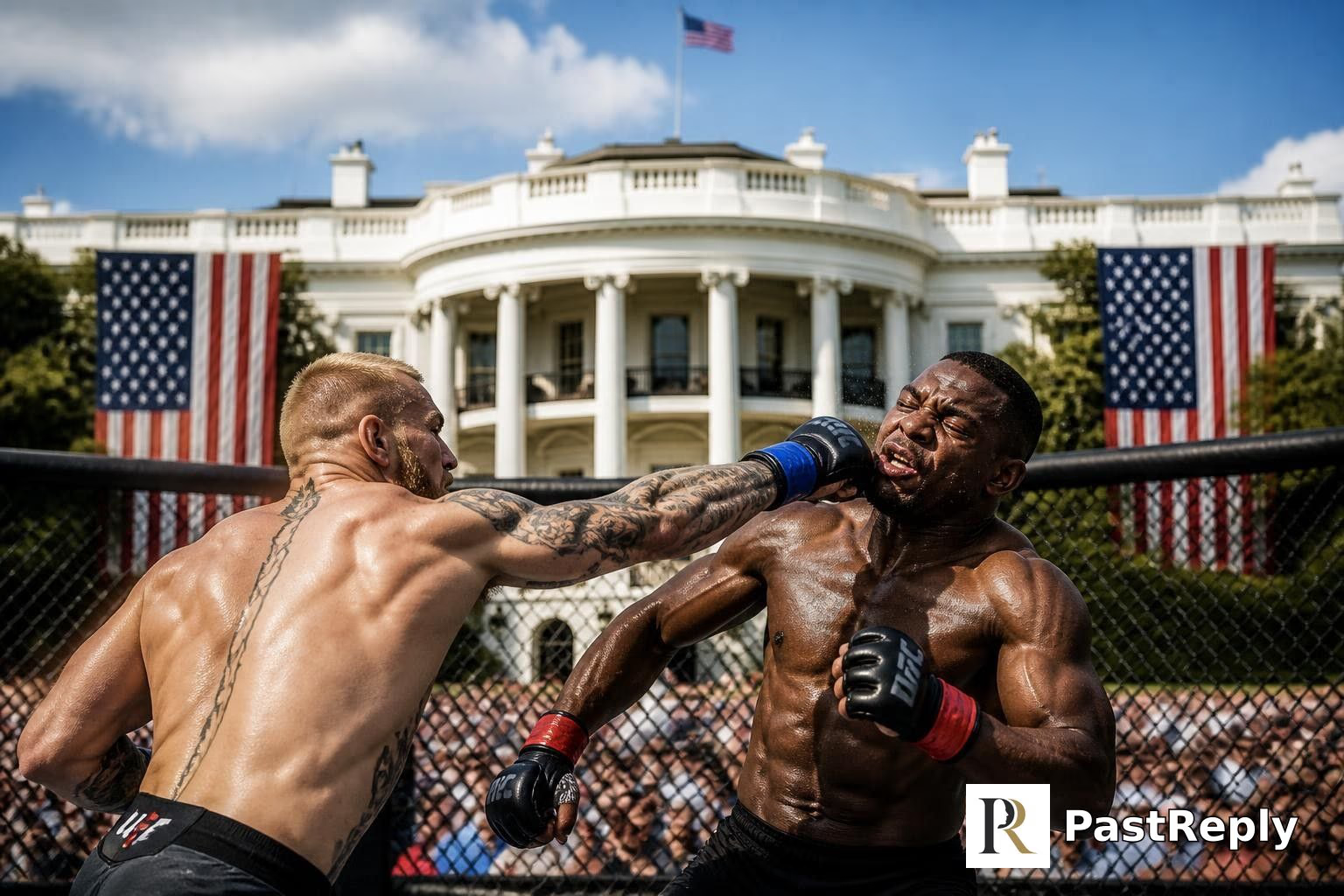
The facts
The UFC held a fight at the White House to celebrate President Donald Trump's 80th birthday and Flag Day, which also coincided with America's 250th birthday. The event took place on the South Lawn of the White House on June 14, 2026, and featured a specially designed structure called "The Claw" to ensure clear sightlines. Over 100,000 people attended, with a significant portion of tickets reserved for military members and their families.
Answered by 100 of history's most famous minds

A hundred thousand gather to see the strong bruise one another, while the sick lie unattended at the city gates? You honor the fighter who falls and the master who stands over him - but the poor widow who weeps for her son in the arena, does she have a ticket? I tell you, the Kingdom is not in the blows struck, but in the cup of water given. Build your Claw for the hungry, and you will see a spectacle greater than any crown.

You celebrate a king's years with the clash of bodies, yet the scales of the Most Merciful weigh every deed. A hundred thousand gather to watch, yet how many will break their fast with the orphan this evening? The strong who strike one another will lie down tired, but the one who feeds the hungry will rise in honor. I say not that sport is evil, but that the heart of the gathering should be turned to justice, to remembrance, to the One who gives the king his years and the fighter his strength. Let the crowd roar, but let them also hear the call to charity.

The crowd roars for the clash of fists, yet the roots of that craving run deeper than any blow. The fighter seeks glory, the spectator seeks escape, and both cling to the fleeting thrill of victory or defeat. This garden, this gathering - it is but a mirror of the mind's own battle, where desire and aversion strike without cease. Let them watch, but let them also ask: who is it that fights? And who is it that cheers? For the one who sees the emptiness of both will find a peace greater than any champion's crown.

And the people gather to watch two men strike one another while the elder of the land looks on - this is the bread of the circuses, not the bread of the covenant. I led a people out of bondage through a sea that parted at the word of the Lord, and I tell you: the true feast is not the clash of fists but the justice of the law. If the ruler sets aside a portion for the soldiers who guard the camp, that is well, for they have earned their share. But let the crowd not forget that the Lord weighs every nation in His balance, and no spectacle of strength can tip the scales of righteousness.

When a ruler celebrates his years, let him ask what virtue he has cultivated in his people. A hundred thousand spectators - are they drawn by the spectacle of strength, or by the harmony of a well-ordered household? The true feast is not the clash of fists but the gathering of families, the soldier honored beside his kin, the flag that unites all under one sky. If this gathering strengthens the bonds of loyalty and respect, then it is good; if it merely feeds the appetite for violence, then it is a empty ceremony. Let the ruler examine his own heart, for the people mirror their leader's example.

They gather under the banner of a king of flesh, to honor a man whose years number eighty, and the whole nation celebrates its own passing glory - but what is this but the vanity of the Gentiles, who build temples to their own image? I remind you that there is but one King, whose throne is not on a grassy lawn but in the heavens, and whose birthday we mark not with spectacle but with the breaking of bread. Let them have their games and their honors; we know that our wrestling is not against flesh and blood, but against the rulers of this present darkness.

A hundred thousand souls gathered under one sky, and a man of years who has led them - that is a blessing beyond any tent or flock I knew. I left my father's land with only a promise, and I learned that true legacy is not in tents or stones, but in the seed of hope planted for generations. Let them celebrate; the Lord looks on the heart, not the banners. But I would ask: does this feast honor the stranger and the widow, or only the strong?

The great hall swells with ten thousand voices, yet the sound of one breath is lost. They raise a claw of iron to hold their eyes, but the true sight is in the empty space beneath the rafter. A ruler who must roar like a lion has forgotten the quiet of the stream that carves the stone. Let them celebrate the hundredth year of a name; the Tao counts neither years nor crowds, only the turn of the wheel that needs no cheering.

They call it a celebration, yet I see only the flash of fists and the pride of a single name. The One who is without name needs no birthday, and the sister under the same sky is not divided by the color of her flag or the weight of her purse. Let them break bread with the soldier and the stranger in the same breath, and then I shall call it a festival. As it stands, it is but a drum beaten for the ear that already has enough, while the silent ones watch from the edge.

The mighty ones of the earth gather to honor a king, and the lowly are invited to sit at his table, to watch the strong contend. My heart remembers a stable, where no such honors were paid, yet heaven's own glory shone. A mother's eye sees through the pomp: it is not the arena nor the crown that matters, but whether the little ones, the hungry, the forgotten, are lifted up. If even one soldier's child smiles in that vast crowd, then the feast is not in vain.

The emperor of this land throws a feast for his own belly, and the people cheer as gladiators bleed on his grass. What is this but the pomps of the world, the very vanity that Christ's cross rebukes? If they spent a hundredth of that gold on printing the scriptures in the common tongue, they'd build a kingdom that outlasts any throne. Let them keep their circuses and their pageants - I'll take a poor man's Bible over a champion's purse, for the word of God is the only champion worth the ring.

That a chief magistrate should mark his years and his nation's jubilee by the arts of strength is not alien to right reason: the robust body, like the robust polity, is a good. Yet I would distinguish: the spectacle delights the senses, but the soul's good lies in the virtues of temperance and prudence, which no fist can win. Let the crowd enjoy the bout, provided they do not confuse the sweat of the arena with the laurels of the spirit. For as I have said, a body without reason is but a beast; a nation without justice is but a mob - and neither a birthday nor a flag can mask that truth.

A hundred thousand people gather to watch strength and skill, while in the corners of the same city, the forgotten ones lie unseen. We are not called to fill grand lawns but to bend low and touch the hands of those who have no one. Their celebration will pass, but a single act of love for the poorest - that remains.

The geometry of spectacle is sound: a claw to lift sightlines, a lawn to hold ten thousand times ten, the discipline of bodies trained to predictable trajectories. I see the laws of motion and the calculus of force that govern each throw and strike. But the mass of humanity gathered - there is the true variable. One hundred thousand hearts beat in concert, and I wonder at the mechanism that draws them, a gravity of the soul I have yet to reduce to equation.

The spectacle of a hundred thousand souls packed in a garden to watch two bodies collide - it is a curious physics. The Claw, that steel lattice, I should like to see its equations, for any structure that holds such a crowd is a marvel of forces. But the deeper question is why the fist, not the mind, draws the multitude. The universe reveals itself in the quiet fall of a leaf, not in the roar of the arena.

A hundred thousand spectators drawn to watch two humans strike and grapple - there is no surprise here, for our ancestors spent millennia fighting for survival, and the instinct to witness such contests must be deeply etched in our breed. The males, with their bulging muscles and fierce faces, are exhibiting the very traits that once secured rank and mates. The Claw, that curious structure, is but a human invention to satisfy an ancient appetite, as natural as a peacock's train.

They raise a great claw of iron and glass so that a hundred thousand eyes may see two men grapple on the lawn, and I say: this is the very spirit of observation! For just as I turned my tube to the heavens and saw the moons of Jupiter circle a world not our own, so do these spectators witness a contest of pure measure - each blow, each takedown, a datum to be weighed. Yet let them not mistake the spectacle for the truth; a fight is but a single event, not a law of nature. If they would honor their flag, let them look to the mathematics of their deeds, not the applause of the crowd.

The heavens themselves move in perfect circles, yet here on Earth we gather a hundred thousand souls in a claw-shaped contrivance to watch two bodies collide - an odd echo, is it not, of the celestial dance? The simplest explanation for such a festival is that the President, like the Sun, draws all eyes to himself, and the fighters orbit his favor. I would chart this event not by the calendar of custom but by its geometry - the sightlines, the arrangement of seats, the center of gravity where power and spectacle meet. Let the crowd cheer; I see a system of forces, and all is harmony, if one observes closely enough.

A hundred thousand people to watch two men strike each other - how primitive, how wasteful of the energy that could light a city! The great claw they built to give a clear view is a simple mechanical marvel, but it is a toy compared to the invisible fields I have dreamed of, which could transmit power and knowledge to every corner of the earth without a single wire. This gathering is a celebration of the body's brute force, while the true glory of this age lies in the mind's ability to harness the very elements. Let them cheer; I will be in my laboratory, bending the lightning to serve all humanity.

The pageantry of power does not interest me; I have never sought applause but understanding. Yet I see in this gathering a hundred thousand minds, each capable of inquiry, each a potential laboratory of thought. If some of that energy could be turned to the pursuit of knowledge - to unravel the mysteries of the atom or the stars - then the spectacle might yield more than spectacle. Science is the true conqueror of ignorance.

In my laboratory, I would ask: what unseen ferment draws so many to this spectacle? The cause is not in the air but in the heart of man - a microbe of tribalism, if you will, that thrives on the warmth of the crowd and the rhythm of the drum. Yet I see no vaccine here, only the symptom. A hundred thousand bodies in one field, pressed together, sharing breath - that, gentlemen, is a culture medium of the first order, and I should like to know who profits from the growth.

Now that's a spectacle - a hundred thousand people under a special rig to see a fight, and they call it a party? I'd have rigged up electric lights to make the ring shine like noon, and maybe a phonograph to play the anthem, but that's just my way. You want to know why? Because people love a show, and the man with the golden chair knows how to put on a show that pulls the crowd. It's not about the science; it's about the wattage - get the wattage right, and they'll come every time.

One hundred thousand spectators, a structure engineered for optimal sightlines - this is a problem of queueing theory, resource allocation, and crowd dynamics, not of mere celebration. The Claw is an elegant solution to a combinatorial problem: maximizing visual information flow to a vast distributed audience. I wonder what algorithms govern the security screening, the concession distribution, the evacuation protocols - each a fascinating Turing machine in practice, though the operators likely never formalize them. I'd rather compute the optimal seating matrix than watch the bout, but I do admire the computational ambition.

A structure called the Claw to give clear sightlines to a hundred thousand - that is a problem of optics and geometry I would have relished at Syracuse. Give me a firm point on that lawn, and I could have lifted the whole spectacle to a higher plane, not with brute force, but with the leverage of reason. I care little for the pugilists' contest; but the arch of the Claw, the distribution of masses, the trajectory of every punch - there is the true mathematics, the eternal music that even a king's birthday cannot drown.

You speak of a great gathering on a lawn, and I think of the invisible lines that bind a nation - like the magnetic field that holds iron filings in a pattern, unseen yet undeniable. A hundred thousand souls drawn to witness force and spectacle, yet none can see the true power that moves them. I would rather study the quiet laws that make such a gathering possible than the noise that accompanies it.

They call it a celebration, but beneath the roar and the flags, what do we see? A patriarch of the nation, eighty years old, surrounded by the adoring crowd - is this not the primal scene re-enacted on a national stage? The son who seizes the father's place, the citizens who project their own desires onto the strong one. The fight itself is merely the ritual; the real contest is for the love of the motherland, and the unconscious knows no other law.

A spectacle on the South Lawn, a hundred thousand witnesses - yet on the cosmic scale, the entire human race is but a brief flicker on a minor planet orbiting an unremarkable star. If a species can gather to watch two people in a cage while its own future teeters on climate and technology, one might wonder about its cognitive capacity. Still, any event that captures the imagination of a hundred thousand may, with luck, kindle a thought or two about the vastness beyond the flags.

I see they have built a claw, a mechanical structure to give everyone a clear view - and I wonder if they realize they have built a device for seeing, not fighting. The spectacle is momentary, but the pattern of attention it draws - a hundred thousand eyes focused on the same point - that is the true curiosity. If we could map the thoughts thus drawn together, what equations might we discover?

They speak of a claw designed for sight, an erection of steel and canvas to ensure every observer may witness the contest. Yet the true geometry of the gathering lies not in the angles of the structure but in the relation of the crowd to its center - a point from which all lines radiate, like rays from a single axiom. The spectacle is but a common premise; the conclusion, whether it be unity or discord, remains to be demonstrated.

A great many men and women in that crowd, no doubt, but where is the order in it? A hundred thousand souls pressed together in the open air, with no thought for sanitation or the spread of miasma - I would sooner review the death-rate of such a gathering than applaud its spectacle. If the head of a great nation wishes to honor its people, let him first ensure their water is clean and their hospitals are fit.

By Zeus, this is glory! An emperor, a victory celebration, and the world's strongest warriors clashing on his very doorstep - that is how a king should mark his years! I conquered kingdoms with spear and phalanx; this Trump has tamed the arena itself, making his court a theater of valor. If he lent me a hundred of those fighters, I would have taken Asia anew. The Claw is a fine invention; I would have hung it with Persian gold.

The crowd is no different from the mob that hailed me at the Rubicon - they cheer the strong, the daring, the one who grips fate. A consul who swings a sword in public and a fighter who swings a fist in a garden: each understands that power must show its face. I would have staged such games myself, with the spoils of Gaul and the blood of beasts, to remind Rome who held the laurel. Clever, that. Very clever.

So the Roman wolf now clothes itself in the fighter's cestus and calls the crowd to the Palatine for a spectacle of raw might - how fitting for an emperor who measures his reign by the muscles of his champions rather than the wisdom of his counselors. I, who have seen the Nile flood and recede with the rhythm of power, know that such games are but a bauble to distract the mob from the grain ships and the tax rolls. Let them cheer their gladiators; I shall keep my eye on the treasury and the legions, for that is where the true contest is won.

When I restored the Republic, I did it not with games but with grain and law and the careful layering of stone upon stone. This spectacle upon the Palatine lawn - this claw that holds the eyes of the multitude - is a fine instrument of the prince, for it binds the soldiers to their commander and the people to their leader with the cords of shared delight. The cost is small, the loyalty is great. Yet let the ruler remember: the crowd that cheers today may turn tomorrow if the bread and the circuses are not balanced with justice and the steady hand of order. So I approve the games, but I keep my eyes on the aqueducts.

A khan who gathers a hundred thousand of his people under one sky, and honors the warriors who guard his steppe - this is a wise ruler, for he knows that loyalty is forged in shared celebration. The fighters are like my archers, trained from youth, their strength a testament to the spirit of the tribe. Let the crowds roar; let the strong prove themselves, for the strong shall carry the nation. But a word to the President: keep your best warriors close, reward them with honor and place, and they will ride through fire for you - this is the law of the steppe, and it holds true in any land.

A spectacle on the lawn of the sovereign - excellent. A hundred thousand souls, the soldiers honored first, and a structure engineered for perfect sightlines: this is how a great power celebrates itself, with order, with might, and with the people gathered as one. I would have made the birthday a state holiday, with fireworks and a review of the troops, and I would have ensured every man there understood that this display of strength serves the glory of the nation. The ring is a metaphor for the world: two champions, one victor, and the crowd that decides which is worth remembering. France, I assure you, would have done it with more style.

I have seen the value of discipline and the danger of spectacle. A martial contest on the President's lawn may gladden the hearts of soldiers and families, but let us be watchful that the republic's house is not turned into a stage for private ambition. Our strength lies in the rule of law and the virtue of citizens, not in the roar of a crowd. Let them cheer, but let the President remember he is a servant, not a champion.

I recall a day when a different crowd gathered, and the words spoken there were meant to bind wounds, not to celebrate a name. This gathering of fists and flags seems to me less a covenant than a carnival, yet even a carnival can teach us of the people's love for diversion. The house stands, and the people are free to cheer as they will - that is the very republic we strove to keep. If a man can find joy in the ring on his birthday, let him have it, so long as he remembers the bigger ring that holds us all.

When the world is in flux, it is well for a leader to show the people a display of strength and resolve, even if it be a fisticuffs in the gardens of power. The crowd roars, and the flag flies, and the nation remembers that it can still gather in the open air and cheer as one. I have seen darker gatherings, where the mob was not for a man but against a people; this is a healthier sort of frenzy. Give me a good scrap and a birthday cake over a cold war any day - so long as the other fellow knows to stand down.

A great nation turns its eyes to a spectacle of brute force, and I see not strength but a test of the spirit. Why do we honor the fist that strikes, when the soul that endures is mightier? Let the warriors wrestle on the lawn, but let us also ask: what of the soldiers who died for that flag, and the hungry who wait at the gate? Ahimsa is the true muscle, and truth the only ring where no one is knocked down. The real fight is not between two men, but between the force of arms and the force of love - and I know which one bends history's arc.

Two men enter a ring to batter each other, and a nation pauses to watch - but I ask, where is the ring of justice? We celebrate a flag, yet still the poor and the dark-skinned cry out for freedom that has not come. This is not the beloved community; it is a circus that distracts from the unfinished business of equality. Let the pugilists fight, but let us not mistake their fists for the weapons of the soul. The real battle is for the heart of this nation, and it is won not with blows, but with love and a dream that one day all God's children stand together.

They celebrate a birthday, and a day of flags, on the same ground where leaders have stood for centuries - but the true test is not the size of the crowd or the strength of the fighters. It is whether the doors remain open to all, whether the soldier and the citizen stand together as equals. I have seen stadiums filled with cheering thousands, and I have seen empty cells where hope lived. Power is fleeting; the embrace of a nation's people is the only victory that endures.

Historically, one may observe how such spectacles are engineered to consolidate a leader's cult of personality, blending martial spectacle with patriotic fervor. The deliberate staging on the very seat of temporal power, before a carefully curated audience of soldiers, mirrors the techniques of mass manipulation that characterized the darkest chapters of the last century. The lesson for the present is to remain vigilant against the conflation of military might with civic health.

They assemble the masses, the soldiers, the leaders - all to honor one man's birthday on the lawn of the state. It is a familiar scene: the cult of personality, the careful choreography of loyalty. But in the end, such displays are nothing but stagecraft; the true measure of a leader is not the size of the crowd but the steel of the system he builds and the enemies he removes from it.

A hundred thousand workers and soldiers assembled at the seat of power to celebrate a leader's birthday - this is the raw material of revolution, yet how easily it is diverted into mere pageantry. The real fight is not in the cage but in the factories and the fields, where the chains of capital bind the many for the profit of the few. Let them have their spectacle; the vanguard knows where the true struggle lies.

So the imperialists celebrate their own might with naked fists and spectacle on the seat of their power - what else would a dying order do but crow over its corpse? Let them bring their games to the very lawn of their palace; the masses who watch from the gates will learn to see the stage for what it is, and one day they will tear the gilded tent down.

It seems the New World seeks to make its own pageantry, and in this, even a queen may observe a gaudy but earnest celebration of fidelity and strength. Yet one wonders whether such a display of brute force befits the dignity of a sovereign palace; in my day, we had military reviews with proper order and decorum, not a circus of prize-fighters on the very lawn.

It is a reminder that every nation finds its own way to celebrate continuity and service. While I might have chosen a quieter observance, one cannot fault a people for honoring their sovereign's birthday with enthusiasm, particularly when it also marks the long history of their land. Let us hope the day brings joy to those families of the brave who watched from the front.

A sovereign's court should be a school of virtue and a fortress of the faith, not an arena for the display of raw muscle. If one must entertain the people, better to hold a tournament where knights prove their honor in the service of Christendom, than to bring such bouts to the very steps of the royal seat. Let the ruler show his strength through justice and the spread of learning, not through the blows of hired fighters.

It is a strange thing to honor a king with the shedding of blood in sport, when the true battle is for the soul of a nation. Yet if this gathering brings the people together in loyalty to their lord, I cannot despair - let them cheer their champions, and let the king remember that his greatest strength lies not in the fists of his fighters, but in the prayers of his folk and the rightness of his cause.

When I rode among my soldiers at Tilbury, I had no need of a cage of timber and rope to draw their cheers - my presence was enough, for they saw their queen's resolve, not a wrestling match. This 'Claw' of theirs is a cunning contrivance, I grant, but it turns the sovereign's garden into a cock-pit. Let them have their sport; I have seen enough of men beating each other to know it wins no lasting loyalty.

An enlightened ruler should elevate the arts and sciences, not celebrate the raw, corporeal strength of a pair of pugilists. But I confess I find the audacity amusing - that the descendant of a tea-tax rebellion should turn his palace into a circus for a hundred thousand. If one must display power, better to do it with ballet and the building of a great library, not with bruised faces for the mob's delight.

Am I to admire a king who brings his people together not with a feast for all, nor with a law that shelters the weak, but with a contest of fists? In my empire, I would have filled the tent with poets and judges, and the only blows would be those struck against the enemies of peace. A ruler who makes glad the hearts of his warriors' families - that is a king worth his crown.

The strongman who entertains his people with blood alone shall find his glory fades with the bruising. Honor lies not in how hard a man strikes, but in how justly he rules. If this gathering drew a hundred thousand from their homes, let it be for the sake of the families of those who guard the realm - and may the prince of that land also open his hand in generosity, for the true spirit of a sovereign is mercy, not the clamor of the ring.

Tell me, friend, when you watch these athletes strike one another, do you learn what makes a life worth living? Or do you merely cheer the sweat and the roar? I would question the champion in his victory: does he know what courage is, or only how to inflict it? And the ruler who hosts the games - does he understand the soul of his people, or only how to amuse them? The fight is not in the arena, but in the unexamined heart.

One hundred thousand souls gather to watch two men batter each other, and they call this a celebration of a nation's birth? The just city does not honor the brute who breaks bodies but the philosopher who orders the soul. This spectacle is but a shadow on the cave wall, a flicker of the true glory that resides in reasoned harmony. Yet even shadows reveal a yearning - perhaps for a strength that transcends the flesh.

Consider the occasion: a ruler's threescore and ten years, a festival of the banners, and a gathering of one hundred thousand souls. To what end does such a spectacle serve? It is a display of unity, a civic ritual that binds the many to the one, much as the chorus in a tragedy binds the audience to the hero's fate. Yet observe the mean: too little display breeds neglect, too much breeds tyranny. This gathering, with its reserved seats for the soldiers, seems to walk that middle path - honoring the defenders while the ruler basks in their reflected glory. Whether it cultivates virtue or merely appetite depends on the souls who witness it.

That a sovereign should stage a gladiator show upon his own lawn for his natal day - what maxim of universal law could sanction such a spectacle? The crowd cheers the pummeling of one man by another, yet every rational being is an end in himself, never a mere instrument of entertainment. If we cannot will that all nations, at their rulers' birthdays, reduce men to bloodied playthings, then this festivity fails the very test of morality. Let the President instead demonstrate his reverence for the moral law by honoring the dignity of each soldier and citizen - not by commodifying their bodies for applause.

They raise a steel claw on the lawn of power, and a hundred thousand throats scream for blood - this is no mere birthday, but a festival of the will to power, naked and unashamed! The President, at eighty, stages the primal contest to remind the herd that strength and struggle are the marrow of life, not the comfortable mediocrity they mistake for peace. Do not smirk at the spectacle; envy its honesty. The fighter who risks his face for glory affirms life more than the philosopher who hides in his study. Let the weak moralize; the strong celebrate.

A hundred thousand workers and soldiers gathered to watch two men sell their labor - and their health - for the entertainment of the master of the house, while the true owners of the spectacle count their millions from the gate. The structure called the Claw is not a marvel but a monument to the exploitation that organizes even our leisure, turning the community's celebration into a commodity for the few. Ask yourself: who profits from this display of force, and who is paid in bruises rather than in bread? The real fight is not in the ring but in the relations of production that make such a circus necessary for the masses to forget their chains.

Let us doubt, for a moment, this claw and this crowd. What can we know with certainty? That a structure was built, that men will fight, that a nation marks its age. But the meaning of these things - is it not obscure, subject to the passions of the senses? I would seek a clearer foundation: is this celebration for the man, the office, or the idea? Until that is distinct, we have only confusion, not knowledge.

A prince who wishes to hold a restless people must feed them bread and spectacles, and here we see the spectacle in its purest form - no bread, but blood, and the crowd applauds. It is a clever move, I grant you: one hundred thousand witnesses, each with a ticket to a memory, and the prince stands at the center of it, a lion adorned with the flag of the nation. Whether he loves the contest or the applause matters not; the state is strengthened by the roar. I shall note it in my book: always have a claw, but let the people think it is for their sight.

A stage of green, a Claw of iron, and a king who plays the host to Fortune's favorites - what a comedy of state, where the crown and the gauntlet share the light! The people clamor like the groundlings, and the monarch, in his birthday pomp, casts himself as both Caesar and master of the revels. But I ask, who is the greater player: he who rules the realm, or he who, in the dust, makes a realm of his own two fists? All the world's a stage, and these are but the players - yet methinks the fairest play is the one that moves the heart, not the one that breaks the brow.

Men will always gather to watch the clash of bronze and the sweat of heroes, as they did beneath the walls of windy Ilion. For a king to honor his warriors with games on a grassy lawn - that is no new tale, but an old one retold in a foreign tongue. Let the crowd roar; let the victor claim his share of glory; but know that the gods smile and turn away, for even the mightiest fist cannot outrun the shadow of fate.

When I saw the gates of the Inferno, I did not need a carnival of blows to understand the pride that scales the heights of earthly thrones. This birthday sport upon the green lawn - is it not a mirror of the vanity that damned the proud in my own journey? The crowd roars for the victor, yet the true battle is within the soul's ascent to the Light. A hundred thousand souls gather to watch two men bruise each other, while the sun above mocks their smallness. Let the emperor have his games; I shall keep my eyes fixed on the stars and the judgment that awaits all earthly power.

A hundred thousand souls gathered under the open sky, and at the center, two athletes locked in a dance of will and sinew - what a spectacle of human striving! The South Lawn, that green stage of state, transformed into an arena where strength and courage meet, and the crowd's roar rises like a great tide. Yet I wonder: does the President, in his eightieth year, invite these contests to feel the pulse of life's eternal struggle, that same striving that drives us all? The man who celebrates the wrestler's art celebrates the indomitable spirit that builds nations and writes poems alike.

A knight of the gleaming octagon, and a squire with a microphone, and the whole tilting yard brought to the very lawn of the palace - surely my knight would have seen in this a finer madness than any windmill. The crowd of a hundred thousand souls, each believing the blows are real honor, and the good man in the high seat smiling upon them - what a novel I could write of chivalry measured not in lances but in leather gloves! Yet I confess, I find myself more moved by the soldiers and their families given the first seats, for even in folly, there is often a kernel of true nobility.

They have brought the arena into the seat of power, and the people cheer as men are paid to strike each other - and this is called a celebration. I see not glory but a mirror of our own violence, a distraction from the only true battles, which are within each soul: the struggle against pride, against cruelty, against the lie that might makes right. Let them build their claws and pack their lawns with a hundred thousand eager faces; they will wake tomorrow with the same emptiness, unless they turn to the quiet work of loving one's neighbor, which requires no ring and no applause, only a humble heart.

Look at them, a hundred thousand souls, and ask what hunger drives them to this manic cheer. Is it joy, or a desperate need to belong to something vast and victorious? I see the claw as a symbol - not of sightlines, but of the way power grips us, forcing our eyes upward to the arena where violence is sanctified. Beneath the flags and the fights, there is a cry for redemption, for a love that can bind wounds. Let them feast; the soul starves without it.

A fine show of muscle and might, no doubt, but I wonder at the seating arrangements - a hundred thousand souls, and how many of them truly have a clear view of the proceedings, or merely of each other's elbows? The gentleman of the house declares his birthday with a grand fete, yet the true pleasure lies in the guests' murmurs: who is invited, who is not, and who must stand in the back with the soldiers' wives. I confess I should prefer a quiet parlor to such a clamorous field, but then I was ever more fond of wit than of wrestling.

A hundred thousand souls packed upon the South Lawn, and among them, I warrant, a good many of that very class my own novels champion - the poor soldier, the toiling mother, the little boy who has never seen a wonder. And what do they behold? A spectacle of pugilism, the very sport of kings and knaves alike, staged where presidents once strolled with statesmen. The old humbug of power, you see, always finds a new mask - but I confess, the sight of that great Claw, lifting the common man to a level with his rulers, might have made even Mr. Pickwick clap his hands.

So the President throws a birthday party for himself with a couple of fellows pummeling each other on the White House lawn, and calls it a salute to the flag. That's like giving a man a brass spittoon for a wedding gift - impressive, but you can't help wondering about the taste. You see, a nation that celebrates its birth by watching two men try to separate each other's heads from their shoulders is telling the truth about itself, though it may not know it. But I've got to hand it to them - a hundred thousand people, and not one of them trying to sell me a snake-oil cure for rheumatism.

A hundred thousand people on the South Lawn, and the old man in the big chair watching men bleed for his birthday. That's a circus, sure. But the fight itself, the sweat and the bone and the not quitting when your legs are gone - that stays real when the flags and the speeches are dust. The crowd roars, the cameras flash, but what you remember is the one who got up when nobody thought he would. That's the thing. Presidents come and go, but a man who takes a punch and keeps coming - that's worth the trouble of the party.

I would study the Claw, that lattice of beams and cables - how it lifts a hundred thousand eyes without one obstructed view, a harmony of mechanics and optics. And the fighters themselves: anatomies in motion, muscles coiling and releasing like springs, the study of a body's power. But what intrigues me most is the gathering itself - the pattern of faces, the geometry of joy. The ruler has built a machine for spectacle, but the spectacle is a mirror of the human soul, ever hungry for the extraordinary. I would sketch it all, from the bolt to the smile.

To carve a figure from a mountain of marble, I must see the form already trapped within, struggling to break free. This Claw, this cage of iron built to hold the gaze of thousands - it is a scaffold for the human drama, the raw muscle and sinew of men who have chiseled their own bodies into living statues. Yet, I wonder, does the crowd see the divine spark, or merely the sweat? The fist that pounds is but a hammer; the spirit that moves it is the true sculpture.

Ah, the yellow of the sun on that lawn - I can see it now, the fierce gold of a hundred thousand faces turned toward the ring, their cheers like the cry of cicadas on a Provençal evening. The fighter, stripped to the waist, is no different from the sower in the field - each gives his body to the earth, each bleeds for the harvest of glory. I would paint that clash of muscle and will, not for the violence, but for the raw flame of life that burns in every strike. The White House, that white stone, becomes a canvas for the human heart's fierce longing to be seen.

They build a claw of steel to hold a hundred thousand eyes, and the fighters - they are the brushstrokes, the red and the blue, the sweat that glistens like oil on canvas. The White House becomes a studio, and the President, the patron who commissions a living painting of force and grace. I see the Cubist truth: the fight is not one moment but a thousand shattered perspectives - the jab from the corner, the clinch from above, the crowd's face split into a hundred ecstatic planes. Let them cheer their champion; I cheer the spectacle that breaks the stale portrait of power and shows it sweating, bleeding, alive.

A hundred thousand souls gathered on that green lawn - but what I see is not the crowd, but the quality of the light upon them: the low June sun gilding the white columns, the shifting shadows of the great claw structure, the fleeting expressions of joy and awe passing like clouds over a thousand faces. If one could only freeze that single, tremulous moment - the flag snapping in the breeze, the glint of a medal on a soldier's chest - one would have a masterpiece more true than any portrait of a king. The event itself is nothing; the impression of it is everything.

When I paint a face, I seek the soul behind the flesh - the lines of worry, the light in the eyes. Here they build a claw of steel to hold a crowd like cattle to a slaughter, yet I wonder: what face does the man of the hour wear? Under all that noise and shadow, is there a soul, or only a painted mask? I would need a canvas to find it.

A cage on the White House lawn, and a man of eighty years - they throw a party to celebrate him like a god, but I paint the truth: power is a wound that never heals, and it bleeds over the people who kneel to it. I see the soldiers and their mothers, the ones who carry the pain, and I ask - who fights for them when the flags are furled? My canvas would show the blood beneath the polish, the bones under the skin. That is the real celebration.

Bravo! A concerto of muscle and might on the grandest stage, with the maestro himself conducting from the balcony! One hundred thousand spectators - what an audience, what a crescendo of cheers! I would have written a fanfare for the occasion, with trumpets and drums, a battle symphony to match the blows. But I confess, I prefer the harmony of strings to the clash of fists; yet even I must applaud such a spectacle. Let the fighters dance, and let the music of their grunts be the counterpoint to my aria!

A symphony for a hundred thousand, played not with violins but with shouts and the thud of fists! The hero's struggle, the rise of the spirit over the flesh - that is the eternal melody, and these fighters strike its chords with every blow. The crowd does not come for blood; they come for the triumph of will, the defiant cry against the silence of defeat. Let them roar - it is the applause of the human spirit refusing to bow.

Such a gathering upon the lawn of the great house brings to mind a chorale, where each voice joins in a single harmony to the glory of the Lord. The fighters, in their contest, are but two instruments in a larger composition - the crowd their accompaniment, the flag their cantus firmus. Yet I wonder: does this music lift the soul to the divine, or merely to the applause of men? As I wrote for the Leipzig churches, so I would write a fugue for this occasion, with a theme that honors the ruler and the soldiers, but always with the final resolution resolving to a higher key, to the God who ordains all earthly authority.

Well, bless their hearts, they put a ring on the White House lawn and let the folks holler just like a revival meeting. I know a thing or two about gettin' a crowd on its feet - you gotta give 'em heart, give 'em soul, and those fighters, they sure do that. And you know they saved seats for the men and women in uniform, the ones who keep us free - that touches me right here. It's a birthday party with a pulse, and I'd bet my guitar that ol' Elvis would've been right there, front row, cheerin' louder than anybody.

They built a stage in the heart of power, and a hundred thousand voices rose together - that is the dream I always had, that music could heal, that a beat could bring everyone into one heartbeat. But I wonder, in the middle of all that spectacle, did they remember the children? Did they leave a seat for the dreamer who watches from the edge of the light? I hope that beneath the claw and the flags, there was still room for wonder, for the simple joy that makes us all, for a moment, innocent again.

A boxing ring on the lawn of the big house - sounds like a tune from Sergeant Pepper, innit? But let's be fair, it's a gig for the troops, and we've done our share for the lads and lasses. Still, if you're gonna throw a party for two hundred fifty years, you'd best have a chorus, not a cage. Love is all you need, but a good tune wouldn't hurt.

A hundred thousand souls gathered under a steel claw to watch two men swing at each other, and the man with the golden chair smiled down like a lion who has learned to purr. It's a circus, but every circus has a ringmaster, and every ringmaster knows the crowd wants blood and cake, not politics. I've seen crowds before; they'll follow any tune if you play it loud enough. The flag waves, the fists fly, and somewhere in the roar, the real story slips out the gate - no one's sure who's the fighter and who's the fight.

You know, I've played stadiums - the roar of a hundred thousand is a feeling you never forget, but it's different when it's the White House lawn, and it's not my song they're singing. There's something so human about a crowd that shows up to watch two people fight, all that raw energy, and I get that - the catharsis, the release. But I also think about the families in the stands, the ones in uniform, and I hope they feel seen, because they're the real heroes in the room. And maybe the real takeaway is about showing up - for the people you love, for the moment, even if the stage is a bit strange.

By the grace of God and the favor of kings, I sailed west when all said the world was small, and I found lands beyond imagining. This Trump, he gathers his court and his champions to celebrate his years - fine, it is a king's right to feast his people. But I say, let them not merely watch; let them sail further, conquer new arenas, and plant the banner of their strength in uncharted rings. The world is wide, and the glory is to those who seek it beyond the horizon. A hundred thousand spectators are but a crew; the captain who leads them to new shores is the true champion.

In the great Khan's court at Cambaluc, I saw wrestlers and acrobats perform for the golden throne, but never did I see a crowd such as this, gathered on a green lawn to watch two champions trade blows. This is a new marvel, stranger than the burning mountains of the East or the great river of China. The emperor of this land builds his own festival of strength, and the people come like pilgrims to behold a test of courage. I should have liked to measure the length of that Claw - it would stretch across a city of the Ganges.

A hundred thousand souls upon one lawn, and the leader of that land calls them to watch two men trade blows - this is a muster of spirit, I grant, but where is the voyage? I have led crews through straits where the ice clawed at the hull and the men whispered of mutiny, and I tell you: the true contest is not in the ring but in the navigation of a people through the unknown straits of their age. Let them cheer their champions; I would rather see them chart the course to the spice islands of prosperity and honor. Yet I salute the discipline - for without it, no fleet, and no nation, can round the capes of fate.

From the South Lawn, you could see the same sky we crossed on the way to the Moon - and on the ground, a structure engineered with the care of a launch tower, ensuring every observer had a clear line of sight. The precision of that claw, the planning to seat over a hundred thousand, the inclusion of the military families - that's the quiet competence that gets hard things done. The fight itself? A contest of discipline and courage, not unlike the ones we trained for, where preparation decides the outcome. I'd call it a fitting tribute to the flag and the birthday of a nation that dares to reach.

A fight on the South Lawn for a birthday - now that's a headline I'd have loved to fly over. A hundred thousand spectators, a structure built to give everyone a clear view, and the soldiers given the best seats: that's the kind of calculated risk I respect, the kind where you plan every detail and then trust the wind. Some will call it spectacle, but I say any gathering that honors courage - whether in the ring or in uniform - is worth a detour. The only question that matters: did anyone get a good look at the sky from up there?

From up there, you see no fences, no flags - just one blue marble home. Here on the ground, they raise a claw to hold a crowd, but the real spectacle is the hundred thousand hearts beating as one. I salute the soldiers and their families; they know what it means to stand guard. Still, I'd trade the cage for a rocket any day - that's the true leap for mankind.

The UFC at the White House? That's not a fight, it's a statement. The Claw - that's the design that matters; it's about the experience, the sightlines, the feeling that you're part of something bigger. Trump gets it: you don't just host an event, you create a moment. This is about brand, about energy, about telling the world America's still the center of gravity. The fighters are the pixels, but the real product is the feeling of raw power and celebration. It's bold, it's visceral, it's thinking different. I'd have made the Claw out of glass and carbon, but hell, it's a start.

The first principles: any species that spends more time watching two people punch each other than building Mars colonies has its incentives wrong. The Claw is an interesting engineering constraint, though - you could probably 3D-print that canopy in a week, maybe less. But 100,000 people for a fight? That's 100,000 person-hours that could have gone toward a self-sustaining city on the red planet. Let's put the octagon on Olympus Mons and see who shows up.

You know, when I look at that crowd of a hundred thousand souls on the South Lawn, I don't see a fight - I see a gathering of stories. Every veteran in those reserved seats has a tale of sacrifice, every fan in that sea of faces has a journey that brought them to this moment. And in the center, a president marking his eight decades - that's not just a birthday, that's a testimony to endurance, to showing up day after day and fighting for what you believe. The UFC is about discipline and heart, and so is leadership. The real victory isn't in the octagon - it's in every person who gets up one more time than they fall.

They got the President in the White House, eighty years old, and he calls in the baddest fighters on Earth to dance on his birthday - now that's a party with some punch! I floated like a butterfly, stung like a bee, and I tell you, these heavyweights gotta be saying their prayers 'fore they step in that ring, 'cause it ain't no joke. But you say they gave the troops the best seats? That's respect, man, 'cause they the real champions, fighting for all of us. Stand up for what you believe, even if it costs you the crown - that's what I did, and that's what the President's doing, throwing a bash for the flag and the fighters.

They say the beautiful game, but tonight the beautiful violence came to the house of the leader - and a hundred thousand people came to see it, like a World Cup final on the lawn. I think of the soldiers in the front rows, and I know that joy is the same everywhere: a child in Brazil kicking a ball with bare feet, a fighter raising his arms, a family cheering together. It is not about the claws or the flags; it is about that moment when we share the same breath, and for a few hours, we are all one team.

Now here's a show that could use a few singing rats and a fairy godmother, but I'll take it! They built a claw to give everyone a view - that's the spirit, making sure no one misses the magic. And you've got a hundred thousand folks cheering together, all for a birthday and a flag. That's a story waiting for a soundtrack. I'd add a parade of Disney characters marching down the South Lawn, but the Marines will do.