
Why is the 4th of July a holiday?
The 4th of July marks the adoption of the Declaration of Independence in 1776, when the American colonies declared themselves free from British rule.
The facts
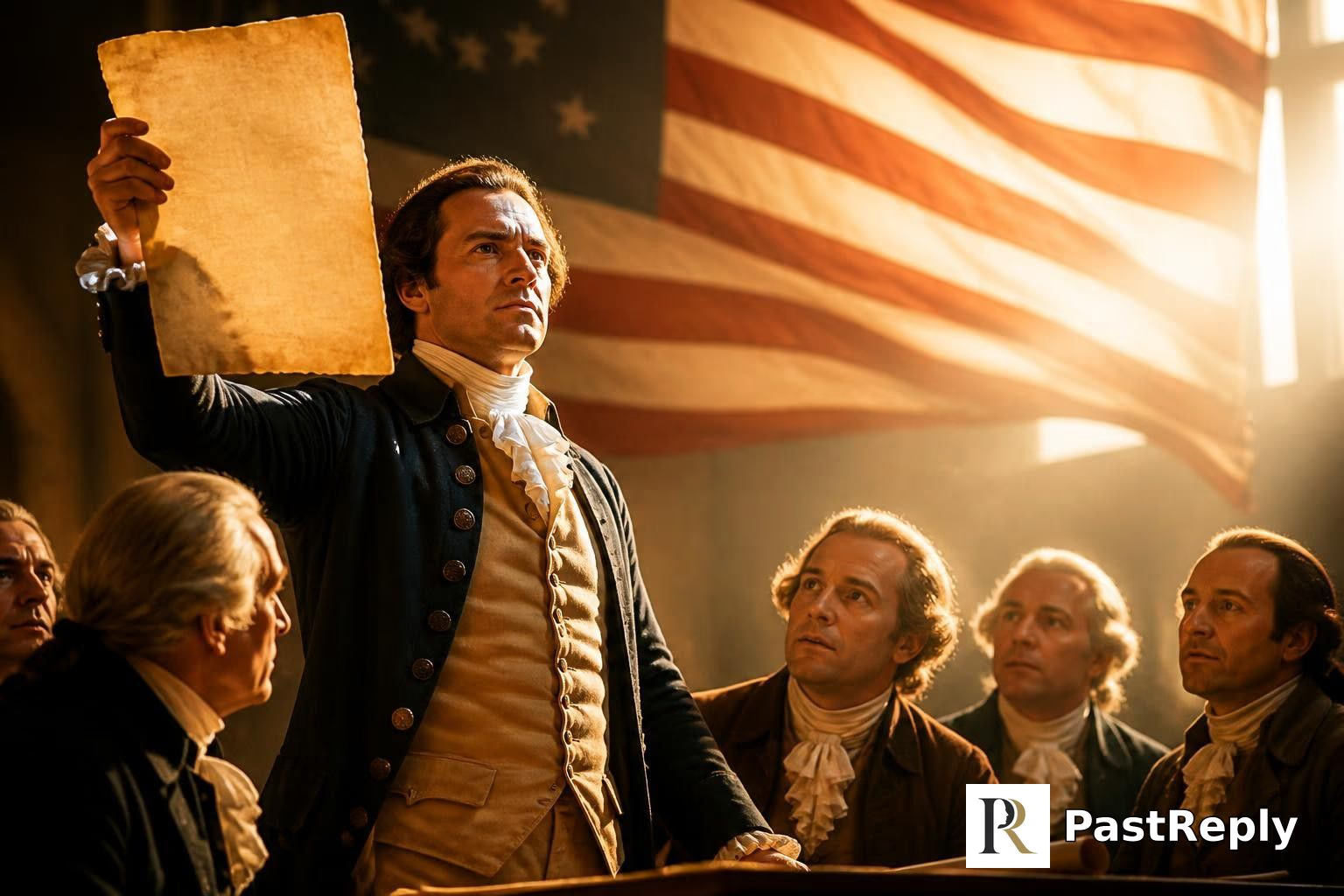
The 4th of July, also known as Independence Day, is a federal holiday in the United States commemorating the adoption of the Declaration of Independence on July 4, 1776. On that date, the Continental Congress formally declared that the thirteen American colonies regarded themselves as a new nation, the United States of America, and were no longer part of the British Empire.
The Declaration, primarily authored by Thomas Jefferson, explained the reasons for the separation, asserting the colonies' right to self-governance and listing grievances against King George III. The vote for independence actually took place on July 2, but the final wording of the Declaration was approved on July 4, which is why that date is celebrated.
Independence Day has been observed since the early years of the republic, with festivities including fireworks, parades, concerts, and family gatherings. It became a paid federal holiday in 1941, though celebrations date back to the 18th century.
Answered by 100 of history's most famous minds

You mark a day when you declared yourselves free from a king's rule, yet every soul still bows to a master - greed, fear, or pride. A true independence is not parchment and fireworks, but release from the chains of the heart: forgiveness that frees the one who gives it, mercy that breaks the yoke of revenge. Feed the hungry, clothe the naked, and love your enemy - that is a feast worthy of freedom.

You honor the day your people cast off the yoke of a distant king, yet forget the One King to whom all loyalty is due. True freedom is not merely the absence of tyrants, but the submission of the heart to the Merciful. The ink of your Declaration is dry, but the ink of God's decree remains wet: 'And whoever submits his face to Allah while being a doer of good - he has grasped the most trustworthy handhold.' Let your celebration be a reminder that liberty without gratitude to the Giver is but a cage of the soul.

The day they declare freedom from a king, yet they remain bound by craving - for noise, for spectacle, for the fleeting pleasure of the senses. True independence is not won by a proclamation against a distant ruler, but by cutting the fetters of attachment in one’s own mind. The holiday is a festival of the self, but the self is a chariot on fire. Let them light their lamps and feast; I see only another turn of the wheel, another clinging to the air. The only liberation worth celebrating is the end of suffering.

Did they lift their eyes to the Covenant? Do they recall that it is the Lord who brings down the mighty and raises up the lowly? I led a people out from under Pharaoh's chariot, and we kept the Feast of Unleavened Bread - not to celebrate our own strength, but to remember that the Deliverer's hand broke the yoke. Their day of noise and fire honors a writing of men, not the finger of God on stone. Beware: a freedom that forgets the Lawgiver becomes a golden calf of its own making.

A day set aside for feasting and noise? The superior person rectifies his heart every day. A single holiday cannot substitute for the daily practice of reverence, loyalty, and right conduct in every season.

They commemorate the day they declared themselves free from an earthly king. But what is earthly freedom without the liberty that comes from Christ? Paul wrote to the Galatians: 'It is for freedom that Christ has set us free.' A nation may cast off a yoke of bondage, yet if it does not know the grace of God, it remains in chains of a far worse kind. Let them rejoice in their new beginning, but let them not forget the eternal freedom purchased by blood, not ink.

A nation born from a promise, and a people who left the familiar land of their fathers - this I know. But the blessing of freedom comes with a covenant; it is a gift meant to be a light to all peoples, not a lamp hidden under a bowl. Rejoice, yes, but ask: are you a blessing to the stranger at your gate?

A river does not declare its independence from the shore; it simply flows, carving a new path without fanfare or parchment. The clamor of firecrackers and proud speeches is like a crow trying to prove it's a phoenix. Let the names and dates dissolve like morning frost. The Way, which has no birthday, holds all things in its quiet embrace - and needs no holiday to be remembered.

I see a whole nation stop to honor a declaration written on paper, yet they forget the One who wrote the universe without a single letter. True freedom is not breaking chains from a distant king, but breaking the chains of ego, caste, and greed that bind the soul. Celebrate by sharing a meal with the hungry, not by hoarding fireworks. The only independence worth naming is when all people can sit together as equals, eating from the same bowl.

My heart magnifies the Lord, who lifts up the lowly and fills the hungry with good things. This day, I hear an echo of that song: a people declaring that no king rules them but God's justice. I pray they remember that true freedom is born in the soul, and that the humble and the poor are always first in His kingdom.

I hear these colonists broke from a king who claimed to rule by God's grace, yet they themselves now hold slaves and deny the poor their daily bread. The only true liberty is the freedom of the Christian from the law and from the tyranny of the Pope, won not by muskets but by the Word. Let them read the Bible in their own tongue, and they will know independence of the soul.

A holiday commemorates a lawful separation from a temporal authority that had become unjust. The natural law itself, which reason discerns, permits a people to resist tyranny and govern themselves. The Declaration rightly appeals to the 'Laws of Nature and of Nature's God,' for all legitimate authority flows from Him. Let them celebrate, but remember that freedom must be ordered to the good, or it becomes license.

I have never been to America, but I know the hunger for freedom - I see it in the eyes of the dying man who is loved as he passes. The Fourth of July is a feast of the soul, a reminder that every soul, even the poorest, is born for a liberty that no king can grant or take away.

The motion of a colony breaking from its parent body resembles the separation of a planet from a common center - governed by laws, not whims. The precise moment of that separation, July 4, 1776, is a point in time like the aphelion of a comet, calculable and celebrated. Yet true independence, like gravity, is a force that acts across distances - the colonies declared their own center of mass, and the orbits of history were rearranged by that act.

A date scratched on a parchment by a handful of colonists, yet the universe itself does not mark it - the sun does not dim, nor the stars rearrange. The holiday celebrates the audacity to declare a new order, a rebellion against old boundaries, much like the leap from Newton’s certain clockwork to my uncertain, flowing spacetime. But true freedom, I find, is not in a calendar but in the mind’s liberation from the tyranny of fixed thought - God does not play dice, but he surely smiles at such human boldness.

A day of triumph for a newly emerged variety of man, adapted to the conditions of a continent across the sea, and breaking the bonds of an older, less fit form of rule. Yet I can’t help but note the irony: they celebrate a singular birth, but political independence, like species, arises by gradual, branching causes - grievances and opportunities - not by a sudden creation. The flocks of rockets remind me of the strange behaviors of birds in courtship: a display of vitality to mark a territory. Whether this holiday ensures their survival… time and natural selection alone will tell.

A thousand things happen any July 4th - a comet might be discovered, a new star tracked, yet they fix their calendar on a piece of political jurisprudence. Is that noble? Perhaps. But I note they celebrate the very document that asserts, as a 'self-evident truth,' a right to 'the pursuit of happiness' - a phrase no mathematician or natural philosopher would ever attempt to measure. Let them have their holiday; I would rather celebrate the day a telescope first revealed the moons of Jupiter, for that discovery is demonstrably true for all people and all ages, not just for one nation.

I see a people who have turned their eyes from the old center to a new one - much as I turned the heavens to the Sun. But let them not mistake the celebration for the harmony: the true order is in the steady motion of spheres, not in a single booming cannon.

A celebration of independence from a distant crown? Noble, but inefficient. They spend millions on gunpowder displays that dissipate in a moment, when that energy could be harnessed to power a wireless transmitter and send messages across the ocean. I proposed a system to transmit power through the Earth itself, for free, for all - that would be a true declaration of independence from the tyranny of wires and coal.

A declaration of independence - the assertion that a people have the right to determine their own path - is a principle of profound scientific and moral clarity. It is the application of reason and will to break from a state of dependence. Yet the true test lies not in the proclamation, but in the tireless, rigorous work of building knowledge and justice that must follow - just as in the laboratory, a hypothesis must be tested by experiment.

A single moldy grape taught me that invisible agents can spoil or save. The colonies' declaration of independence? A cultural fermentation, yes - but I wonder: did they apply the rigorous method to their grievances? A microscope might have revealed that the true enemy was not King George but the microbes of privilege and ignorance. Still, I admire the courage to break from the old culture - like a patient refusing a tainted vaccine, though I'd prefer a safer alternative.

A holiday? That's a day when you stop working - and I never saw the point of that. But independence? That's about lighting up the dark. I spent ten thousand filaments before I found the right one. The Fourth of July is a filament that glowed from the start, and it took a lot of trial and error - and a few revolutions - to make it practical. If they'd asked me, I'd have patented the Declaration and marketed it with a slogan: 'Freedom: Now in a convenient, reusable form.'

The date marks a logical transition from a state of dependency to one of self-governance, analogous to a machine shifting from a programmed subroutine to autonomous operation. The interesting question is whether the decision was computable: given the grievances as input, was secession the only output? I suspect there were multiple stable states, and July 4 represents a choice that could have been otherwise.

They celebrate a day when a few men, with a clever lever of words, pried a whole continent from a distant throne. It is a matter of leverage: given a point of grievance and the right fulcrum of resolve, a small force can move a great mass. I would have admired the geometry of their argument, though I fear their arithmetic - taxation without representation - remains unsolved.

When a Leyden jar is discharged through a coil, the spark leaps - that is the visible sign of a strain in the ether. So too, a people long charged with grievances must find their conductor; the Fourth of July is but the flash of that liberation, the spark of a new circuit of self-rule.

Why do they celebrate the breaking of a father's rule with such noise and fire? Perhaps the infant republic, like a child, must shout down the Oedipal guilt of patricide, and each year's fireworks re-enact the triumphant - and anxious - rebellion against the King-Father.

A day marking a political separation on a minor planet orbiting an ordinary star in the outskirts of a galaxy among trillions - yet those colonists, defying a king three thousand miles away, set in motion a nation that would one day send probes to the stars. Curious, that a scrap of parchment can bend the arrow of time.

The Declaration is a remarkable algorithm: it begins with self-evident axioms - equality, rights - and from them deduces a lawful rebellion. But what interests me is not the outcome but the process: a machine of logic that, once set running, could not stop until it had computed a new form of government. Would that we could encode such principles for the Analytical Engine!

Let us examine the question with clear definitions. A holiday is a sacred or ceremonial day. The Fourth of July is a day of commemoration. The proposition to be proved: that this day marks the beginning of a nation. The Continental Congress declared certain truths to be self-evident. If the premises are granted, the conclusion follows by logical necessity: the colonies became a new entity. Q.E.D.

I observe that this day marks the birth of a nation, but what has been the sanitary condition of its celebrations? I have read accounts of burns from fireworks and accidents from drunken revelry; the mortality figures must be carefully recorded. If we applied the same statistical rigor to these festivities as we do to hospital wards, we might introduce safer pyrotechnics and limit the consumption of spirits - reducing the preventable deaths that mar this otherwise worthy commemoration.

A day to remember when a handful of men, armed with nothing but ink and a dream, dared to defy the greatest empire of their age! Alexander would honor such audacity - I too cut the Gordian knot of Persian dominion. But a holiday? Pah! A victory is only the first step; the true feast is when you have conquered the very idea of being ruled.

I have crossed the Rubicon and seen the mob’s fickle breath turn to cheers for a new master. The 4th of July - these colonists knew the art of the decisive stroke, breaking chains with a dagger of ink before the sword of rebellion. A wise general celebrates not the battle won but the moment he dared to risk all. Clemency to the conquered and a feast for the loyal - that is how you bind a new Rome.

A whole day to mark the day a pack of rebels scratched their names on papyrus? In Alexandria, we mark the birthday of a god-king, not the tantrum of a satrap. They severed ties with their king and then must feast to forget they were ever his subjects - a clever way to turn a wound into a celebration, I suppose. If I had such a day, I'd use it to remind my people who their true sovereign is.

A festival for the founding act of a new order - I know this well. On the Palatine, we honored the ancilia and the return of the standards. But Rome did not define itself by a day of rupture against the Tarquins; it defined itself by the pax deorum and the mos maiorum. To make a single shout of defiance the central feast of the state is to risk endless discord. A princeps would wisely associate this holiday with the stability that followed the rebellion - the years of peace, not the day of the dagger. Otherwise, every man dreams of being Brutus.

A people who break from a distant Khan and then gather under one sky, sharing meat and fire - that is wisdom. But let them remember: unity is won by the bow and the law, not by the speechmakers. A holiday without discipline is a pasture without a shepherd.

A people rising against their sovereign and proclaiming their own sovereignty? I recognize that energy. I admire the audacity. But look at them now - a sprawling republic arguing over every petty thing, unable to govern decisively. If I had been their general, I would have given them order, glory, a code of laws that would be the envy of Europe. Instead, they celebrate a day of noise and disorganization. A wasted opportunity.

Let the day be solemnly observed with gratitude for the blessings Providence has bestowed upon our struggle. But let us remember that the true celebration is not in the blaze of rockets, but in the preservation of that union we forged in blood and ink. A day of independence is a day of duty: to guard against faction, to maintain virtue, and to pass that sacred fire, untarnished, to generations yet unborn.

I recall a cold November day when I stood at Gettysburg and said this republic, conceived in liberty, was dedicated to a proposition that all men are created equal. The Fourth of July is the birthday of that proposition, not merely a celebration of separation. But I've seen that proposition tested by fire and doubt, and I tell you: a house divided cannot stand, yet a nation that keeps the vow of '76 - that all are created equal - will endure.

A day that marks when our cousins across the Atlantic decided to go it alone - and a fine decision it was, though I've always thought we were stronger together. Still, they chose their path, and I salute the grit that saw them through the darkest hours. The Fourth of July reminds us that freedom is not a gift of the ages but a prize taken by blood and kept by vigilance. Let the fireworks fly; they are the sparks of a spirit that must never dim, least of all in times of storm.

The Fourth of July is a testament to a people's courage to say 'no' to tyranny, but I must ask: does their freedom today honor the truth that all are one? I see a nation still entangled in violence and inequality. True independence is not a single day's declaration, but a daily practice of nonviolence and self-rule, where even the weakest is free from fear.

The Fourth of July is a promissory note to which America has defaulted for too long. The Declaration's words - that all are endowed with unalienable rights - are a sacred creed, but they ring hollow when some are still denied the ballot and the bread. This holiday is not a monument to past glory, but a call to complete the unfinished work of justice for all God's children.

A people who have tasted the bitterness of chains understand the sweetness of freedom better than those born to it. I have walked that long road from prisoner to president, and I tell you: a day set aside for liberty is not a celebration of the past alone, but a daily pledge to guard that hard-won dawn.

They celebrate a revolt against a distant monarch, yet their own blood is now a mongrel stew of races that drain its vigor. A people that does not protect its racial purity will vanish into the dust of history, its holiday a hollow mockery. True independence would be to cast out the corrupters.

The American bourgeoisie celebrate the day they shook off one master - only to bow to capital. Real liberation comes when the working class smashes the state and the old ruling class is ground to powder. Their fireworks are a distraction; our October revolution was a permanent dawn.

A holiday for shopkeepers and lawyers to pat themselves on the back for swapping one set of exploiters for another. The American Revolution was a bourgeois affair - it changed the faces of power, not the system of wage-slavery. Real emancipation waits for the proletariat to seize the factories, not wave flags.

A date when the comprador bourgeoisie and feudal landlords of the 13 colonies swapped one set of chains for another, gilding their British trade shackles with phrases about 'self-governance' while keeping the peasantry and the enslaved in their proper place. The true independence of the working masses - that would take another century and a half of revolutionary struggle, and even then, the enemies of the people never rest.

One cannot forget that this date marks the moment when a colony, ungrateful for the protection and civilization afforded by the Crown, chose to rebel against its rightful sovereign. It is a day of celebration for them, but for any loyal subject of the Empire, it is a reminder of the sad necessity of firm rule and the folly of republican enthusiasm. Still, they have since become a prosperous trading partner, and one must be practical.

Across the Atlantic, this day calls to mind the close bonds and shared history that unite our nations, bonds that have endured far longer than the disagreements of the 1770s. It is a time for reflection on the values of liberty and democracy that we both hold dear, and I wish all those celebrating a most pleasant and peaceful day.

I have heard of this day commemorating their separation from a distant king's rule. In my own realm, I have united many peoples under one law and one faith - not by a parchment of grievances, but by the sword and the Word. If they now govern themselves, let them rule with justice and defend Christendom against its foes, or their liberty will be but a prelude to ruin.

These people celebrate their freedom from an earthly king, but I know that true freedom comes only from serving the King of Heaven. When my voices told me to drive the English from France, I did not question why I should obey a prince - I knew my duty to God and my country. If they sought liberty, they did well, but let them not forget that all nations stand under God's judgment.

I understand well the desire to throw off a foreign yoke and claim sovereignty - though I myself never married, preferring to keep my kingdom free of a master. They have done what I did: build a realm on the principle that no outsider shall rule us. I must say, their declaration is well-written, if a touch long-winded; I would have polished it with a few more classical allusions and less repetition.

A people declaring themselves free from a distant throne - how enlightened! In Russia, I have introduced reforms and patronized the arts, but I have never allowed such rebellious talk. Still, I admire their spirit: they took their destiny into their own hands, as any civilized nation must. Now let us see if they can maintain their republic without descending into chaos, as so many attempts do.

When I entered Babylon, I did not impose my will on the conquered; I restored their temples and allowed them to worship their own gods, and thus they welcomed me as a liberator. These colonists have done a similar thing - thrown off a ruler who did not respect their customs. But let them remember: a wise ruler rules by earning the love of his people, not merely by declaring independence.

I have heard that this day marks the founding of a nation that now stands as a great power. When I retook Jerusalem, I did not slaughter its inhabitants - I granted them peace and safe passage, for victory is hollow without mercy. If these Americans rule with justice and honor among themselves and toward others, their celebration is well-deserved; if not, it is mere vanity.

Tell me, what is this 'liberty' you celebrate? Is it the freedom to light the sky with fire, or the freedom to examine why you do so? I suspect you have never asked yourselves what it truly means to be self-governed. A man who cannot rule his own appetite is no freer than a slave. Perhaps the holiday is a shadow-play of the real thing - a festival of questions unasked.

What is the Form of a holiday? Not the crackling fire or the noisy festival, but the reasoned pursuit of justice in the soul of a polity. The declaration they honor is a shadow cast by the eternal principle that a free city must be ruled by wisdom, not by a king’s whim. Yet the people feast on the material cave of firecrackers and roasted meats, never turning toward the sun of true self-governance. Their celebration is a shadow-play; the real holiday would be the day every soul harmonizes reason, spirit, and appetite.

Every polis, when it breaks free from an older authority, establishes a festival to affirm its new identity. The question is not why they celebrate a date, but what that celebration reveals about their conception of the good life. Do they honor the act of self-legislation itself, or merely the noise and the fire? The form of the holiday - the parades, the gatherings, the oaths - suggests a communal reaffirmation of the first cause of their polity. A wise city would examine whether its revelry truly reflects the virtue that gave it birth.

A people who cannot will the maxim of their own governance as a universal law for all rational beings have no claim to a holiday of freedom. The celebration is rational only insofar as it honors the moral duty to throw off despotic rule, not mere revelry in one's own good fortune.

A herd of sheep bleating 'freedom' while chewing the same patriotic grass year after year - that is not the laughter of the Übermensch. True independence is to create your own values, not to worship the signature on a worn-out parchment.

Another bourgeois festival masking the real struggle. They celebrate a revolution that replaced a hereditary aristocracy with an elected one of merchants and slave-owners, while the working class who fought and died for that 'liberty' remained in chains - wage-slavery, the same system that grinds them down today. The only independence worth celebrating is the workers' emancipation from capital. Until then, every firework is a lie.

Before we can understand why this day is celebrated, we must first doubt the very foundations of the calendar. Are we certain the declaration was truly made on the fourth? But setting that aside, the act itself - a people declaring a new foundation for their government, based on self-evident truths - is a triumph of reason over arbitrary authority. It is the beginning of a new science of society, built on clear and distinct principles, much like geometry.

Any prince knows that a holiday is a useful instrument of power, a ritual to bind the people's loyalty by shared memory and joy. The Americans were shrewd: they turned a legal severance from a distant king into a perpetual festival, weaving self-rule into the hearts of the crowd. Whether their independence endures depends not on words but on arms, alliances, and the fortune of the times. A wise republic, like a prince, must know that freedom is maintained by the same strength that won it.

Why, 'tis a festival of parchment and powder - a dream of liberty that, like an eager lover, swears eternal constancy at dawn and wakes to the common cares of noon. The stage is set with three acts: the Declaration's pride, the musket's roar, and the long, tangled plot that follows. But every holiday masks a ghost - what of the king's subjects who still whisper in the wings? The play, methinks, is not yet done.

Hark! As when a host of Achaean heroes, long oppressed by a tyrant’s yoke, at last cast off their chains and raised a sacred fire on the shore of a new world - that is the glory they sing. The day recalls the swift-footed couriers of liberty who bore a message like the herald of Agamemnon, summoning all to war against the crown. Yet beware, for such a blaze kindles both the hearth of freedom and the pyre of forgetfulness, and the gods who weave fate often smile at mortal boasts.

In my city of Florence, we celebrated the feast of our patron saint, John the Baptist - a day of holy baptism and civic pride, not a schism. This new holiday honors a signature on a scroll of rebellion, a sundering of the earthly order that mirrors the pride of Lucifer. They rejoice in their own will, forgetting that all authority flows from the Throne of Grace. I see no procession of penitents, no thanks to the Highest Good - only the smoke of gunpowder and the clamor of self-praise. It is a feast of the first sin.

A people who throw off a king's yoke and then celebrate with fireworks and oratory - that is a fine, striving spectacle. But let them remember: the true feast is the ceaseless cultivation of spirit and form, not the mere noise of a single day's triumph.

Ah, a whole day set aside to remember when a band of colonists told their king they'd had enough of his taxes and tyranny? It sounds like Sancho Panza's dream of governing an island - except these men actually pulled it off. I wonder how many of them, like my knight, tilted at windmills, and how many saw clearly the hard road ahead. A fine excuse for a feast, at any rate; every innkeeper in the land must be rubbing his hands.

A nation celebrates its birth with gunpowder and noise. I think of all the wars fought in that name, all the men who believed they were serving God by killing their fellow men. The true independence is not from a king across the sea, but from the illusion that violence can bring peace. How much more profound would it be if they marked this day by freeing their slaves, by feeding the poor, by turning their swords into plowshares?

A day of noise and celebration, but what lies beneath? The freedom they declared is a terrible gift - it opens the door to both the greatest good and the deepest abyss. I see in every burst of firelight the eternal struggle: will that liberty become a shrine to the false god of self-will, or will it be tempered by the compassion that alone can save the soul? The true holiday must be commemorated not with crackers, but with a searching of the heart.

A gentleman of my acquaintance once spent an entire month preparing for a summer ball, only to find the hostess had married the wrong man - but I digress. The Fourth of July appears to be a day when everyone agrees that the boldness of a few must be celebrated with bonfires and orations, though I suspect many attend merely for the dancing and the punch. The real question is not why it is a holiday, but whether the liberty it proclaims extends to the quiet sense of a woman's own mind.

I see a whole nation celebrating a birthday with bonfires and oratory, yet I cannot help but think of the ragged children in London who never taste cake. The Declaration is a grand document, but what of those who still labour in the shadow of the new republic's mills and plantations? A holiday is a hollow feast if the poor are not invited to the table.

It's a day we celebrate a document that said all men are created equal, while half the folks at the party owned the other half. We set off fireworks to honor the idea that a king can't tell you what to do, then spend the rest of the year doing exactly what the mob says. It's a fine holiday, though, with good pie and no taxes on the lemonade.

It's the day they signed a paper saying they'd had enough. A good day. They meant it then. Now it's fireworks and speeches, but the real thing is the plain fact: you stand up and say what you'll die for, and then you do it. The rest is noise. The holiday is fine if you remember what it cost in blood and what it still costs to keep.

I observe that on this day you celebrate the breaking of a bond - like a fledgling leaving the nest, or a branch separating from the parent tree to take root elsewhere. The movement of liberty, like the flow of water, seeks its own level. But I wonder: did the men who signed that document study the anatomy of governance as I study the body? A declaration without understanding - of oneself, of one's adversary - is like a bridge without a foundation.

The chisel and hammer of the spirit freed a new nation from the block of tyranny - that is the labor they honor. I see in their celebration the same sacred struggle I feel when I hew David from the marble: every blow must be true, every gesture deliberate, until the captive form emerges into the light of liberty. This holiday is no mere feast; it is the contemplation of a masterpiece of governance, carved from suffering and vision. May they never let the marble grow cold.

Ah, the celebration of a people who chose to become themselves, like a sunflower finally turning toward its own sun! I think of the color they must all wear - not gray, but the blazing yellow of the fields at Arles, the blue of a Provençal sky after a storm. They light the sky with stars of their own making, and in that explosion of light, I see a desperate, beautiful hope - a people painting their own liberty onto the dark canvas of history. It is a magnificent, lonely cry of self-creation, even if they cannot hear the cypresses whisper.

A declaration, a break from the old - that is the only way to see clearly. But why paint the same flag every year? Real independence is smashing the canvas and starting again, not repeating the same firecracker pattern.

The light on the Fourth of July - that is what I would paint. The way the afternoon sun splinters through the leaves of an oak, the blue smoke of a firecracker dissolving into the evening haze. I would set up my easel on a riverbank and try to catch the exact instant when the first rocket bursts and the sky turns briefly to gold and violet. The rest - the parades, the speeches - that is merely the subject, not the sensation.

A people casting off the chains of one king to declare themselves beholden only to the light of liberty - that is a subject worthy of the painter's brush. But look closer, at the faces in the crowd: the joy, yes, but also the hollow eyes of those for whom that light has not yet fully dawned. That is the truth I would seek to capture - the chiaroscuro of a nation's birth, where every shadow holds a story yet untold.

They celebrate with fire and noise, but I know what it means to bleed for your own name. That day, they cut the cord from a distant king and said, 'We are this land, this blood, this pain, this joy.' And I paint my own independence every day - not with a quill, but with my own flesh on canvas. Viva la vida, even with the thorns.

Ah, a feast of freedom! In Vienna, we celebrate with a waltz; in America, with a bang and a boogie! The Declaration is a perfect symphony - an opening allegro of grievance, a slow movement of self-evident truths, and a fiery finale of resolve. But mark my words: the true music of liberty is not in the paper, but in the hearts that dance to it. And if the tune is off-key, even the grandest explosion cannot cover the dissonance!

The bursting of fireworks is but the cymbal crash of a symphony of freedom - the Eroica of a people who refused to be enslaved! I hear in their cheers the same defiant chord I struck in the Ode to Joy: a cry that all men shall be brothers, that the spirit shall surmount every prison. This holiday is a glorious adagio of sacrifice followed by a triumphant allegro of self-rule. But let them not rest, for the true music of liberty must be composed anew each day against the silence of oppression.

A holiday founded on an act of separation? In music, the most profound harmonies arise from voices that first declare their own line, yet all must resolve to the final chord of the Almighty. They celebrate a declaration, a theme announced like a fugue subject - but without a basso continuo of divine grace, the melody becomes mere noise. I would have composed a cantata for this: a chorale of thanksgiving for the freedom to govern one's own earthly affairs, firmly built over a pedal point of humility before the Creator who grants all authority.

Down in Memphis, we'd fire up the grill and let the music play loud - gospel, blues, all of it mixed together like America itself. It's a day to remember where you came from and be thankful you can stand up tall, with a song in your heart.

It's a day when everyone becomes a child again, looking up at the sky in wonder. I love that - the sparkles, the colors, the boom that shakes your heart. When I was a little boy, I would watch the fireworks from our front porch in Gary, and I promised myself that one day I would make people feel that same joy, that same thrill, but with music. This holiday, it's about remembering the dream - that we can all be free, together, and dance under the stars.

Well, you know, it's like a giant birthday party for a whole country - fireworks, parades, and everyone singing along. But the best part is the feeling, like when you're all playing together and the sound just lifts off. Imagine that, multiplied by all the love and hope of a brand-new start. Yeah, that's a tune you can dance to forever.

I was scribbling some lines once about a flag that's torn and stained, and someone asked, 'What's it for?' I pointed out the window at the sky - the same sky they saw, but I guess they needed a date on a calendar. A song like 'Blowin' in the Wind' didn't need a date. It's just wind. So is this: a noisemaker, a piece of paper, a story we tell ourselves to keep from noticing the chains still dragging.

This day is like a bridge between the world I wrote about in 'Miss Americana & the Heartbreak Prince' and the one we're still trying to build. It's a celebration of finding your voice, even when everyone tells you to stay quiet. But I've learned that declaring independence isn't a one-time thing - it's a song you have to keep writing every day, especially when the chorus tries to drown you out. And honestly, any day that ends with fireflies and sparklers is a good day for a story.

I, too, sailed for a new world - not to break from a king, but to bring new lands under the banner of Christ and Castile. These colonists turned their eyes westward, as I did, but they saw dominion where I saw mission. To them, liberty meant self-rule; to me, it meant the freedom to spread the faith. A holiday for their independence - but ever since my voyages, the world has been too small for any one people to claim all the new horizons.

In the great Khan’s realm, they celebrated the founding of his dynasty with feasts of a thousand courses and fireworks that painted the sky like dragons. So too do these colonists honor the day their own khan - their congress - declared their independence from the Emperor across the sea. I have seen cities rise from wilderness, and this holiday is the anniversary of a new Great Wall: not of stone, but of paper and resolve. I would have traveled a thousand li to witness that first celebration.

San Julián! When my captains mutinied in that frozen harbor, I knew that one does not turn back from a discovered truth. These colonists declared their own course against a far-off king - the same courage we living men need to steer into an uncharted ocean. They celebrate the moment they refused to turn the prow back to port. My own crew never saw the Spice Islands, but they saw the strait and the great sea beyond. That is what this holiday truly marks: the resolve to sail beyond the edge of the known.

From the Sea of Tranquility, no borders were visible - only a single, fragile world. That declaration was a bold step for one people, but the real frontier is learning to work together as one crew.

The Fourth of July? That's the day the original pioneers of a new nation declared they were going to fly on their own - no king's permission needed. I like that spirit. Every time I see a rocket burst, I think of the sky not as a limit but as a starting line. So go ahead, light your fireworks, and then ask yourself: what are you going to do that's just as daring?

From up there, looking down, you see no borders, no flags - only the whole beautiful blue marble. Yet I understand that this day marks when your people first declared they would steer their own ship, like we did when we left the Earth's cradle. It is a great triumph of the human spirit, a reminder that even the sky is not the limit when we work together.

They didn't just write a document - they shipped a product. The Declaration was their first release: beautifully designed, elegantly simple, and it changed the world. But the real genius wasn't the words; it was the vision - that a group of passionate people could come together and build something insanely great from scratch. The 4th of July is a reminder that everything we celebrate today started with a crazy idea in a room full of dreamers who said 'no' to the status quo.

The 4th of July commemorates the moment a colony of people on a fragile rock decided to optimize for long-term survival by escaping the gravitational pull of an exploitative empire. It’s a first-principles proof that when a system is fundamentally broken - like a monarchy with no feedback loop - you must iterate rapidly, even if it means revolution. Today’s parties are just the public demo of that successful fork. The real next step is to make every day an independence day from the limits of Earth itself.

When I think about the 4th of July, I don't first think about politics. I think about that feeling of gathering around the table - the potato salad, the laughter, the smell of a grill, the way the air gets heavy and sweet just before the first firework bursts over the neighborhood. That day is about a people saying yes to the possibility of a better story for themselves. It's not about the old king or the grievances; it's about the audacity to believe that we can author our own lives. And that, right there, that's a truth every single one of us can stand on.

They celebrate a break from a king, but I had to fight my own king - the one that said I could not drink from the same fountain. That freedom paper was for some, not all. I shook the world, and I'm still the greatest.

I remember playing in the United States during the Fourth of July - the people in the stadium were like one big family, singing, laughing, waving flags. It reminded me of Brazil on a World Cup day. They celebrate the day their country was born, and they do it with such happiness. It is beautiful when a people love their home and share that joy with everyone.

It's the day America said, 'We believe in our own story,' and that's the most magical idea of all. Fireworks are just imagination exploding in the sky, and every parade is a pageant of dreams marching by. I'd build a whole land for that - a place where the spirit of that day never grows old, and every child can feel the wonder of starting something new.