
Why is Saquon Barkley not playing?
Saquon Barkley is dealing with a stinger from Week 2 but is expected to play Monday night.
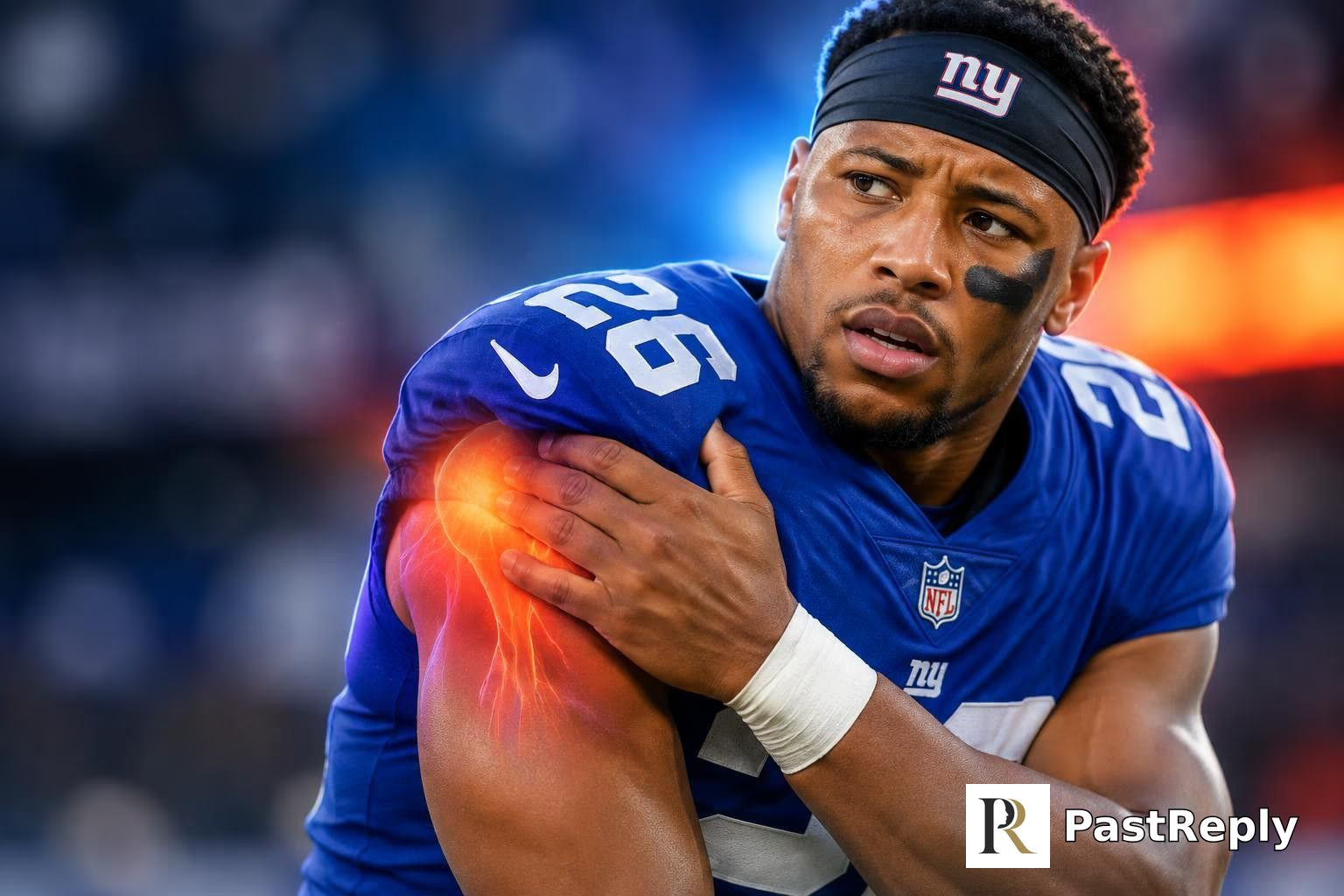
The facts
Saquon Barkley is not playing because he suffered a stinger during the first offensive play of the Philadelphia Eagles' Week 2 game against the Tennessee Titans. He was hit by defensive lineman Jeffery Simmons and missed the rest of the first half before returning in the second half. Despite the injury, Barkley was a limited participant in practice on Thursday and returned to full practice on Friday. He is officially off the injury report for Monday night's game against the Chicago Bears and has stated he will play.
Answered by 100 of history's most famous minds

A man lies winded at the gate, struck down by a Philistine's hand, and the crowd cries out that he is lost - yet by the third watch he stands again. Do you think the Kingdom comes by the strong alone? The shepherd's staff is for the sheep, not for boasting, and the wound of the first hour is not the end of the day's labor. Go, and let the one who has breath in his lungs lift up the fallen, for the day of rest is not yet come.

What is a stinger but a trial sent to test the patience of the believer? The man was struck, yet he rose and returned to his labor - this is not weakness but a sign of the bounty God gives to the body He has fashioned. Let him play if he is able, and let no man mock him for the wound he bears, for on the Day of Reckoning each is judged by his own accounting, not by the crowd's clamor. Give thanks for his healing and let the game proceed.

You ask why he is not playing, but he was struck, and now he is healed enough to return. Suffering arises, ceases, and arises again - this is the nature of the body. Attachment to the outcome of a single game brings only more craving, more anguish. Let him play or not play; the wise watch with equanimity, neither grasping nor averting.

When the people stood at the sea and the chariots came behind them, did I tell them to wait until every bruise had healed? No - I said, stand still and see the deliverance, then go forward. If the man's arm is sound and the physicians have examined him, let him go forward with his brethren; but if he plays while broken, the law of the covenant judges the shepherd who drives a lame beast into the field.

When a man is struck and rises, we observe the measure of his discipline. The report says he returned in the second half and practiced fully by week's end - this is the conduct of one who knows his duty to the team and to himself. To ask why he is not playing is to mistake a moment's stumble for a man's character. Let him play, and let his actions instruct the young.

Do you not know that in a race all the runners run, but only one receives the prize? So run that you may obtain it. Every athlete exercises self-control in all things - they do it to receive a perishable wreath, but we an imperishable. This man was struck down, but not destroyed; he returns to the field, and in that I see a shadow of the body's weakness and the spirit's resolve. Whether he plays Monday or not, let him run for the prize that does not wither.

When the Lord tested me on the mountain, I did not turn back. This young man took a blow in the opening moment, yet he rises - he has returned to the field. Should I ask why he is not playing? He is playing, or he will, and in that resolve I see the same covenant: to walk forward though the path is uncertain, trusting the promise that strength returns.

The strongest current is the one that yields at the bend. A man yanked sideways and set down again does not cease to be a man; he pauses, then moves as the river moves after the boulder. Why scheme to hurry the season? Monday will arrive whether you worry or not.

One body struck, one body staggered, and the crowd forgets the man's soul in the noise of its wagers. What profit is there in tallying whether he runs Monday, when the same Creator gave nerve and bone to all who collide on that grass, friend and enemy alike? Let him mend as he will; the honest question is whether we watch with kindness or merely with appetite.

My son, I watched a boy stumble and fall, and I did not count his hours on the field. I held his mother's heart in my hands, and I knew that the lowly are lifted and the strong are made weak, and the game is not the measure of a man. He walks again - and for that, I give thanks, for the Lord remembers the humble and the broken.

The body is a vessel of clay, and when it is struck, it cracks - but the spirit is not so easily broken. Why do you ask of a man's arm when you should ask of his conscience? He plays or he does not; that is between him and his God, not between him and the crowd. Let him play freely, as a Christian man, and not be bound by the fear of men.

It seems that a stinger is a transient injury to the brachial plexus, and thus the player's absence is per accidens, not per se. The physician, acting according to the art of medicine, judged him fit to return; and since the end of the game is the common good of the team, the player's return is ordered to that end. Yet we must distinguish: the injury is not a punishment, but a natural consequence of bodily collision, and the player's will to play is a virtuous act of fortitude.

A man's body is not a machine but a gift, and even a strong one feels pain. He was struck, he rested, he returned - this is a small suffering, compared to the many who have no field to play on and no one to tend their wounds. Let us not make a great drama of a stinger; let us simply be glad he is able to run again, and pray for those who cannot.

A body in collision obeys laws I have measured: force equals mass times change of motion, and the nerves along the spine transmit the impulse as surely as light travels the optic nerve. That the man returns to the field after such a blow is no mystery but a demonstration of resilience in the created frame, which the Creator has ordered to heal. I feign no hypotheses about his valor; I observe only that the whole system tends toward restoration, as the planets return to their appointed circuits.

A body struck at the very first play, and yet the man returns to the field by the second half - this is no mystery of randomness, but of resilience written into the ordered grain of living matter. The universe does not play dice with the spine's nerves; it follows laws of healing we have yet to fully inscribe. He practices, he declares himself ready. So let him run, and let us watch the beautiful necessity of a creature refusing to be halted.

In the struggle for existence, even the swiftest antelope must sometimes stumble when the lion's paw strikes. Yet the capacity to recover from injury is itself a product of selection - those who heal and return to the herd survive to breed. Barkley's swift return from a stinger is but a small, recent chapter in the long history of mammalian resilience. I would observe his gait on Monday with great interest.

Let us not argue from authority but from observation. The report says he was struck, that he left, that he returned in the same contest, that he trained fully by Friday - these are measurable things, and they point one way. The body is a machine of nerves and sinews; when the experiment shows the instrument functioning, we do not forbid it to move because an old text says it must not.

The appearances shift like the planets in their orbits: one moment he is struck down, the next he is restored to full practice. The simplest reading of the heavens - or of the injury list - is that he will play Monday night. The complication of the stinger is like an epicycle; the true motion is steady and returns to its proper place.

The human frame is but a delicate machine, and a stinger is a momentary short-circuit in its nervous wiring - nothing more. I have built and tested engines entirely in my mind, and I tell you the body repairs itself with a speed your physicians cannot calculate. He is off the report, which is their crude ledger; in truth, the currents have already restored him. He will play, and the crowd will see energy made visible.

A stinger is a transient disturbance of the nerves - pain, then recovery, as predictable as radium's glow over time. He was struck once, missed half the game, then returned. It is not a mystery but a measurement: limited practice, then full practice, and the body's own accounting says he is ready. We must not fear what we can observe and understand.

A stinger - the nerve shocked, the senses briefly cut off, and no wound you can point at with a scalpel. I should want the observation recorded: Thursday, Thursday again, Friday, each day a little more of the man returning. The body has its own laboratory and it announces recovery better than any argument. Patience and a careful eye will tell you more than the betting line.

A stinger is a problem of contact, and contact problems want trial, not theory. He was on the field Thursday, then full on Friday, and the report is clear - that's the same arithmetic as the hundredth filament: the one that lights. He'll line up Monday, and if the first carry doesn't tell you, the second will.

A stinger is merely a signal interruption - a nerve conducting a message that the body interprets as pain. The question is not why he sat, but what algorithm the physicians used to decide he was fit to return. The machine is not the man, and the man is not the machine - but both can be modelled, and the model says: play.

Give me a lever and a place to stand, and I will move the Earth - but a stinger is a problem of tension and compression in the nerves, not of levers. The body is a machine of joints and tendons, and when a force like Simmons strikes, the geometry of the shoulder is disturbed. He returns because the physician has calculated the angles and found them sound. Eureka - he plays.

A stinger is but a disturbance in the field of the body's own currents; the nerves, like iron filings round a lodestone, realign when the shock passes. It is no mystery that he practiced in part, then wholly, and now stands ready - nature restores her circuits if we but observe and wait. Let us watch how he runs on Monday, for the proof is in the experiment.

The question is not why he missed plays, but why you need him to play at all - what wish lies buried in your concern for a stranger's nerves? A stinger is a shock to the body, yet the deeper shock is to the fantasy that the hero is invulnerable. You watch him fall and rise, and in that little drama you replay your own childhood fear of injury and abandonment; the rest is displacement.

On a minor planet orbiting an ordinary star, a man's nerve bundle suffers a transient compression, and the entire cosmos could not care less - yet we do, because we are curious creatures who assign meaning to a game. The physics is straightforward: a stinger is a shock to the brachial plexus, healing in days, not eons. Now let us return to the real question: why the universe exists at all, and whether the Bears can stop him.

A stinger is a perturbation in the nervous telegraph, a signal briefly interrupted - yet the machine of the body, like Babbage's engine, can reset and resume its operations. He was limited in practice, then full; the sequence is a simple algorithm: injury, assessment, recovery, return. The wonder is not that he missed a half, but that a man can be struck by a giant and, days later, run again - the body is a most ingenious engine.

Let us define terms. A 'stinger' is a transient injury to a nerve; 'not playing' means absence from the contest. From these premises: he was absent for a portion, then present; he practiced in part, then fully; therefore he is fit to play. The conclusion follows necessarily. There is no royal road to Monday night, only the straight line from injury to recovery.

A stinger is a nerve insult, not a trifle - I have seen soldiers sent back to the line too soon and their limbs fail them for years after. The report says he was limited Thursday, full Friday, and off the list - that is orderly, and order saves lives, but the man must be watched at every carry. Clean hands, honest rest, and cold judgment: that is how you keep a runner on his feet through the winter, not by bravado.

When my Bucephalus took a javelin in the shoulder before the gates of a city, did I leave him to the surgeons and weep? No - I bound the wound and rode him into the next charge, for a king who cannot rise from the dust is no king at all. This runner has been struck by a giant of a man and yet declares he will fight; that is the spirit of Achilles, and I would have such a man in my phalanx before ten thousand who never bled. The field is his, if he has the daring to take it.

Fortune favors the bold, and this Barkley is bold indeed - felled on the first clash by a giant, yet back in the fray before the sun moved far. A general does not keep his best centurion in the camp when the man can still grip his sword. Let him loose upon the Bears, and let the enemy learn what it means to face a wounded lion.

A king who stumbles at the first step of the procession is not thereby dethroned. This Barkley is no different from a Ptolemy who takes a wound in the vanguard and then rides again before the second horn: the sting passes, the throne does not. What matters is not the fall but whose feet are still standing when the gates of the city open at night.

A soldier who takes a wound and returns to the line is worth more to the legions than one who never bleeds, provided the wound does not fester. I have commanded men through worse at Actium, and I learned there that the appearance of order is itself a weapon. Let him play, then, and let the physicians watch; the stability of the whole depends on such small patience, not on recklessness dressed as courage.

A rider thrown by a horse does not stay on the ground; he mounts again and rides harder. If he is off the report and says he will play, then the matter is settled - he plays. My concern is only whether he rides for his people or for himself; a warrior's strength is measured by his loyalty to the whole.

A stinger? In my campaigns, a man hit on the first charge either fell or he did not - and if he did not, he was back in the saddle before the smoke cleared. Fortune favors the bold, but it also favors the disciplined. If the surgeons clear him and he says he will play, then he plays; hesitation is a greater wound than any blow. Let him take the field and win the ground.

In a republic, the good of the whole depends on each man's duty to the cause, and a soldier who takes a blow yet returns to formation sets the soundest precedent. He is off the report and prepared to lead his company on Monday. I would not have him idle; I would have him restrained and resolved - playing, but wisely.

I've seen men carried off a field and back again within the same afternoon, and I've seen men who never rose. The line I trust is the one at the end of the week: practice on Friday, off the report, and his own word he'll play. If a man tells me he is fit, I take him at his word until the evidence says otherwise. Malice toward none, and a good ball game to all.

A stinger is not a capitulation; it is a skirmish. He took the blow in the first minute, withdrew to regroup, and returned to the field before the afternoon was done - that is the conduct of a soldier, not an invalid. He is off the casualty list, he has sworn to fight Monday night, and no prudent man surrenders a season because the first charge bruised his shoulder.

A man may fall, but he must rise again with truth in his heart. The injury is not the end, but a test of ahimsa - of how we treat the body that carries us. He returns to the field, not for glory, but because his duty calls, and in that duty, he must remember the poor and the weak who cannot afford to be injured.

A man is not a machine to be discarded when a bolt loosens. He is a child of God, and his body bears the scars of a violent game - but the arc of the moral universe bends toward justice, and justice here means he is given the chance to stand again. I have marched with broken bones and bloodied feet, and I say: let him play, but let us also remember the men who have no such mercy shown them. Injustice anywhere is a threat to justice everywhere.

In the long walk to freedom, even the swiftest runner must sometimes rest a stride. The sting of a blow is not a prison sentence; it is a pause, and he has taken it with discipline - returning to train, then to full work, and now he says he will play. That is not weakness but wisdom, and a team, like a nation, is strongest when each man honours both his duty and his body.

The physical condition of a single athlete is a trivial matter; what matters is the strength of the collective and the will to overcome any obstacle. His brief absence and swift return demonstrate the discipline of a body trained to serve a larger purpose - a lesson in sacrifice and recovery. Such incidents are mere footnotes to the greater struggle of a people.

Injury is a test of organizational discipline. The player was struck, removed, then returned - this is correct procedure, not weakness. What matters is not the individual's discomfort but the readiness of the unit for Monday's task; all resources must be directed to victory. The report of full practice is a satisfactory accounting.

The question is not why one player sat, but who owns his labor. He was struck, taken from the field, then returned - this is the logic of the team, which extracts value from the body and returns it to production once the damage is contained. The injury report is a ledger; he is cleared, and so he plays. The masses may cheer, but the material condition remains: the athlete serves the interests that pay him.

A stinger from a Titan's shoulder is a small skirmish, not a wound that cripples an army. If the man says he will take the field on Monday night, then let him take it - the masses do not need a warrior who lies down at the first blow. The question is not his body, but whether the Eagles have the will to make every down serve the whole campaign; a single blow from Jeffery Simmons should teach them that no vanguard stands alone.

One does not abandon one's post for a momentary pang, and yet one does not drag a wounded horse back into harness before it can bear the weight. If the physicians have cleared him and he has given his word to play, then the matter is settled with proper form; the Eagles' honor and the league's dignity require no further public hand-wringing. Duty, after all, is not the absence of injury - it is the decision to rise despite it, soberly and without theatrics.

One learns, in a long life of service, that a knock to the frame is best met with quiet attention and a steady return to one's duties. If the player has trained fully and declares himself fit, then we may trust the judgment of those charged with his care and wish him well on Monday. The game will go on; the team, as ever, endures.

A warrior struck down on the first charge and rising again by the second half is no weakling - he is a man who knows his oath to the standard. Let the physicians and the captain of the host judge whether the nerve has healed; my concern is that the ranks close behind him and the law of the field be kept. A realm is held by such men, not by those who count every bruise.

If he has said he will play, then what more need be said? A stinger is a small thing beside the blows I took at Orléans, and I never asked the physicians' leave to rise again. Let him strap on his harness and run at the Bears - God gives strength to those who go forward, not to those who wait for the report to be perfect.

I have learned not to make windows into men's muscles, nor to second-guess a runner's own account of his hurt. He was smitten on the first play, returned after the half, practiced in full, and now stands off the list - the matter is closed, and the realm of the Eagles may proceed. It is a small thing, gentlemen, next to the business of a crown; let the man play and the wager stand.

A stinger from a Titan's hand is a trifle to a man of his bulk, and I have seen generals ride into battle with worse. He was limited Thursday, full Friday, and is off the list - so let him run Monday night and prove that the body follows where the will commands. An empire is not built by those who linger in the infirmary; it is built by those who return to the field and take the Bears' ground.

A single blow from a strong man is no shame; to rise and take the field again is the mark of a stout heart. If he is whole, let him run; if the physicians say otherwise, let them say it plainly and we shall respect the judgment. A wise captain does not waste his best horses on a bruised morning, but neither does he coddle them into uselessness.

A stinger is a horseman's complaint - the arm numbs, the grip falters - and I have ridden through worse after a Frankish lance glanced off my mail. If his own word is that he will play and his physicians have released him, then honor requires we take him at his word and let him meet the Bears. Mercy to one's own body is wisdom; but a warrior who has sworn to the field should not be kept from it by rumor.

Tell me, my friend, what is this thing you call a 'stinger'? Is it a wound of the body, or a wound of the will? You ask why he is not playing, yet I suspect you mean to ask whether he should - and that, I cannot answer for him, only for myself. Let us examine: if a man claims to be whole while his nerve still sings with pain, is he a physician of his own soul, or a flatterer of his own fear? Perhaps the true question is why you need him to play at all.

You ask of a man's absence as though the body were the whole of him. But consider: the true runner is not the sinew that tears, but the Form of swiftness and will that the sinew imperfectly imitates. He was struck, yes, but the ideal within him was never injured - it merely waited for the shadow to pass. By Monday, the shadow recedes, and the Form shines through again.

We must first ask what kind of thing a 'stinger' is: not a disease of the body but an affection of the nerve, transient by nature, whose end is to cease. Since the cause is a blow and the purpose of the athlete is to act, the mean between rashness and timidity is to return when the physicians permit. That he trained in part and then in full is the practical syllogism completed.

To report an injury is one thing; to pronounce a universal law on its treatment is another. If every player, upon every sting of the nerves, were permitted to withdraw without first submitting to the rational test of fitness, no game could proceed under any consistent rule. The report shows he practiced fully on Friday; reason thus commands that he play, not as a slave to his sensations, but as one who legislates for all who would step onto the field.

You ask why he is not playing, but the herd's question is already answered: he is playing. What interests me is the spectacle of a man who takes a blow, returns, and then declares his own readiness - that is not weakness, that is the will to power in miniature. Let the weak sit and nurse their stingers; the strong make a game of their wounds.

So the poor fellow takes a blow on the first play - and the owners, the physicians, the whole apparatus of the spectacle weigh his body as so much capital, to be run out again the moment it can yield. His labor is not his own; the stinger is only the visible price of a system that treats a man's spine as an asset. He will play Monday, of course - the circuit demands it - but do not call it courage when it is necessity dressed in a jersey.

Let us doubt the easy conclusion. He is not playing? Yet the evidence shows limited practice Thursday, full practice Friday, and his own clear statement. I think, therefore he runs. The body is a machine; the stinger was a temporary fault, and the mind - that res cogitans - has commanded the legs to move. Clear and distinct: he plays.

Notice what actually happened: one blow from a large man, a half missed, and the ledger closes. The prudent prince does not send his valuable horse onto the field on Thursday if Friday will serve, and does not confess weakness to the enemy before the gates open. He is off the paper precisely when it profits the organization for him to be off the paper. Believe the game, never the press.

Alas, poor Saquon! A stinger in the neck is but a pin's prick to the proud, yet it lays him low as a king in a tragedy - first act, first blow, and the audience gasps. He returns, as all our heroes must, to the stage where the Bears await, for the play demands a third act, and the man who limps is oft the more beloved than the man who never fell. 'Tis not the wound but the rising that makes the tale worth telling.

Sing, O Muse, of the stinger that laid the swift-footed one low on the first charge of battle, as a spear might fell a champion at Troy's wall. Yet the hero rose again before the second half, shaking off the blow as a lion shakes off flies, and now he strides toward the Bears' line, hungry for glory. So it was with Achilles, so it is with Barkley: the gods test the great, and the great endure.

I have seen such blows in the second circle, where the wind of a first collision scatters men like leaves and yet the soul, once bruised, is not condemned. Let him run, then, for the race is brief and the stadium is a figure of that other course where no leg is ever wounded and no whistle ends the play. Justice demands only that he play as one who remembers he must one day give an account of every yard.

A stinger in the first play, then back on the field in the second half - this is the very pulse of life, the wound and the healing that makes us whole. Let the doctors keep their ledgers; the man of wholeness returns not because he is commanded, but because his striving demands the contest. I would rather see him play and risk all than sit and let the spirit atrophy.

A stinger, you say? I have seen men knocked from their horses on the road to Toledo and rise again before the dust settled, and I have seen others lie groaning while the world stepped over them. The fellow takes a blow, sits a while, then returns to the field - there is no novel in it, only a man's stubbornness and the physician's leave. But perhaps I am too generous: even Sancho, when his donkey threw him, declared he would never ride again until the morrow, and by the morrow he was saddled and off. Let him play, then, and let us see whether the second half is worth the first.

A man is struck, and the crowd asks only whether he will play again - as if his body were a machine for their amusement. I have seen enough of such spectacles: the great men on the field are not the generals or the heroes, but the countless unnamed who suffer and rise unnoticed. Let him play if his conscience and his health permit; but let us not make a religion of his return. The true question is not whether he plays, but whether we ought to watch.

The crowd demands: why is he not playing? But look into the man's soul - he wants to play, and that wanting is a torment all its own. A stinger, a blow, a half missed; yet he returns, because to run is his confession, his suffering, his love. The real question is not the injury but the will that drags the broken body back onto the field.

A gentleman cannot be blamed for retiring to the sofa after a blow to the neck; one would think less of him if he pretended otherwise. That he sat out one half and then returned shows a constitution rather better than most men's tempers at a county ball. I suspect the whole agitation arises from too many gentlemen who have wagered on the outcome.

A stinger, they call it - a thing that turns a man's arm to dead weight and sends a shiver down the spine like a telegram of bad news. I have seen such fellows in the ring, and I know that a body is not a machine but a tenement of bone and nerve, and the landlord may evict you at any hour. But he took the field again, did he not? There is hope in that - the same hope I gave to Sydney Carton, that a man may rise from his own ruin and walk upright into the Monday night.

A stinger is what my Aunt Polly called a 'stitch in the side' - only this one likely cost more than a whole county's worth of cotton. He was hit by a fellow named Simmons, which sounds like a piano player, but I reckon he plays a different tune. The report says he's off the injury list, which in my experience means the doctor got paid and the coach got nervous - but I'll believe it when I see him run.

A stinger is a bad thing. You get hit, your arm goes dead, you can't feel the ball. He came back. That's what you do. You take the hit, you get up, you play. The rest is noise.

Observe the mechanism: the blow falls here, at the base of the neck, where the nerves branch like the roots of a great tree, and the arm goes numb as a limb of marble. Nature has knit this man with such cunning that a single misstep in the chain silences the whole hand - yet by the morrow the sensation returns, as water finds its level in a broken pipe. I have dissected such junctions; the body is a machine more perfect than any I could draw, and it mends itself when given rest. Why the haste to force the engine before the gears align?

The marble resists the chisel, and the sculptor must strike again - not once, but many times, until the form emerges. So too this runner: a blow from Simmons was but a stubborn vein in the stone, and he did not abandon the block. He practiced, he returned, and on Monday he will carve his path through the Bears' defense as I carved David from the discarded rock.

A stinger - is that not the very word for it? The nerve burns like a streak of vermilion and chrome across the shoulder, and then the ache settles into a dull umber, and still the man rises because the field is yellow with light and the crowd is a great blue longing. I would paint him not fallen but rising, one hand pressed to the earth, the other already reaching for the ball: that is the truest thing I know of a body that refuses to stay broken.

They tell me he will play, but the picture is more interesting when the canvas is torn and repainted in the same afternoon. To leave the field, then return - that is not a flaw; that is a line broken and redrawn, a portrait in two movements. Why ask why he is not playing when the true question is how he remakes the game upon his return?

You cannot see the bruise on the canvas from where you stand - only the light shifting across his shoulder as he turns. I have painted the same haystack at dawn and at dusk, and one hour it glows, the next it is ash; the player, too, passes through such moments. A blow on the first play, and he walks off into the shade of the tent, then returns when the sun has moved. What matters is not the injury but the impression of it - the crowd's breath held, the pause, the return. Let him step back into the sunlight; that is the picture I would paint.

A man struck once - one blow to the neck, and the body's light dims, the crowd's roar recedes into blackness. On the field, he is the subject I would paint after the second half: returned, but shadowed. The truth of a man is not in his injury report but in his stubborn will to play; he limps back into the frame, and there, in that uneasy half-light, I see his whole humanity.

Ay, the body - it betrays you, it sings with pain. A stinger in the neck, and the whole world narrows to that one nerve. But I know this: you paint through the broken spine, you dance on the crushed foot, you play on Monday. He is not fragile; he is fierce, and he will run with the wound still humming, like me.

Ha! A stinger - what a comic little name for a giant's cuff to the neck! One note sour, the whole symphony halts, and the conductor weeps; then the fiddler retunes and - presto - the allegro resumes. I have played through fevers and fatigue, and the audience never knows the cost, only the beauty. Let him play his Monday night; the rest of us shall judge whether the tune was worth the pain.

Fate dealt him a blow on the first note, a crashing discord - yet the symphony does not end there. He returned in the second half, as a theme returns after the storm, transformed and defiant. This is the hero's journey in cleats: suffering, struggle, and then the triumphant finale under the Monday night lights. Let the Bears hear the crescendo.

The player is absent for a measure, and in that measure the other voices must carry the fugue alone - the counterpoint continues, though one line rests. But a rest is not a silence; it is preparation for the entry. He has returned to the full rehearsal and will sound again on Monday, for the order of the game, like the order of the spheres, permits no permanent vacancy.

Well now, a stinger's a nasty little thing - like a guitar string that buzzes when it's hit wrong. But he shook it off and went back out there, and Friday he was full go. That's the kind of grit I admire, honey. I'd tell him: play your song, boy, and don't let nobody keep you off the stage.

Heal the world - that's what I always say, and that means taking care of your body first, you know? When you're on that stage and the lights hit you, you give everything, but if something's hurting, you've got to listen, because the fans deserve the magic, not the pain. So he sits one half, comes back, and when he runs out Monday night, that's the moment - the crowd, the lights, the groove. God bless him. Hee-hee.

Stinger on the first play, yeah? Been there - one bad note and the whole hall goes quiet. But he's off the injury list and back on Monday, so let it be: what's a little pain when you've got a stage and a chance to run? All you need is love, a bit of tape, and a good chorus - everything else is just static between tracks.

Some men get knocked down on the first play and the crowd hollers for a doctor's note. Then they tape up the ribs, limp back out past the beer light, and the band never stopped. The question ain't whether he's hurt, it's whether the hurting is the show. You'll find out Monday.

A hit like that takes your breath, and the whole stadium goes quiet, and then you have to decide who you are when you get back up. He came back in the second half, he practiced, he's off the list - that's somebody choosing his own story instead of letting one play write it. Monday night we'll see the rest.

A blow from a Titan - how fitting! I have known such setbacks at sea: a spar snaps in a squall, and the crew cries that we must turn back, but the Admiral knows the Indies lie just beyond the horizon of doubt. The man is whole again, says he will sail, and I believe him, for God favors the bold who press on despite the ache in their bones. The Bears are but another shore to claim; let no stinger keep a captain from his course.

In all my travels from Venice to the court of Kublai, I have seen men felled by strange ailments and rise again to trade another day. This Barkley is like a caravan struck by a sandstorm on the first day's march - it pauses, shakes the dust from its camels, and presses on to the next city. By Monday he will be in Chicago, and the Bears will find no easy passage.

I have known men who fell to the deck with the lash across their backs and were told the voyage was over for them, and I have known those who stood again at the helm before the watch changed. A shoulder that stings is a squall, not a shipwreck. We do not abandon the passage because the wind strikes once; we trim sail, take the bearing, and press on to the spice islands.

He's not playing? From what I read, he practiced Friday and he's off the report. That's called preparation meeting opportunity, and the flight director's not going to scrub a mission for a bump on the arm. The question isn't why he's not playing - it's whether he'll be ready when the clock starts, and the evidence says he will be. We go when we're ready; we don't linger in the capsule.

A stinger on the first play? I've had my share of rough landings and engine trouble, and you don't turn back for a bruised wing - you check the gauges and take off again. Courage isn't the absence of a knock; it's flying anyway when the sky looks uncertain. Let him suit up Monday night; the only real risk is never leaving the ground.

In orbit, your body is a fragile craft among stars - a stinger on the first snap is but a micrometeorite against the hull. But like any cosmonaut, you check the seals, you breathe, you trust your crew. He has practiced, he is cleared, and Monday he will run - and isn't that the whole human story? To fall, to rise, and to see the Earth again.

Look, the guy got hit, it hurt, he came back. That's not a problem - that's a feature. Most people would take the week off and call it a 'journey'; he's off the injury report and he's playing Monday night because he gives a damn about the craft. The question isn't why he's not playing - it's why you're still asking instead of watching. Focus. He'll be on the field.

First-principles: a stinger is a nerve compression, not a structural failure. The human body is an engineering marvel with redundancy and self-repair - he practiced limited Thursday, full Friday, off the injury report. The optimal strategy is to play him, let him test the system in live fire. If he re-injures, we iterate. But the upside of a healthy Barkley against the Bears is enormous. Let him run.

Honey, let me tell you something. A stinger is not a stopping place; it is a signal. That young man got up, he practiced again, he said yes to Monday night - because when you've been knocked down and you know who you are, you don't ask permission to rise. What I want everybody watching to hear is this: your setback is not your story. Your comeback is.

A stinger, a Simmons hit, and the whole world asks why he ain't out there? Man, I took punches that would drop a mule and still went ten rounds. If Barkley's off the injury report and says he'll play Monday night, then stop the talk - he's playing. The only question is whether the Bears can handle what's coming, and I doubt they can.

Ah, my friend, the beautiful game - but this is the other game, the one with the helmet and the hard ground, and it asks the same thing of a man: you fall, you rise, you play for the shirt. On the first play he took a knock, a stinger, like a bad tackle; he rested, he returned, and now he says he is ready. That is the joy of it - not the injury, but the will to come back and make the crowd sing. God willing, he will run like a boy again.

Every hero takes a tumble in the first reel - that's the story! The stinger is just a plot twist, and Saquon's already back in rehearsal, full practice, ready for the big show Monday night. When you wish upon a star, you don't sit out the second half; you tape up and make magic for the crowd.