
Why is Iran not allowed to have nuclear weapons?
Iran is barred from having nuclear weapons under the Nuclear Non-Proliferation Treaty and due to international concerns over its past covert activities and regional stability.
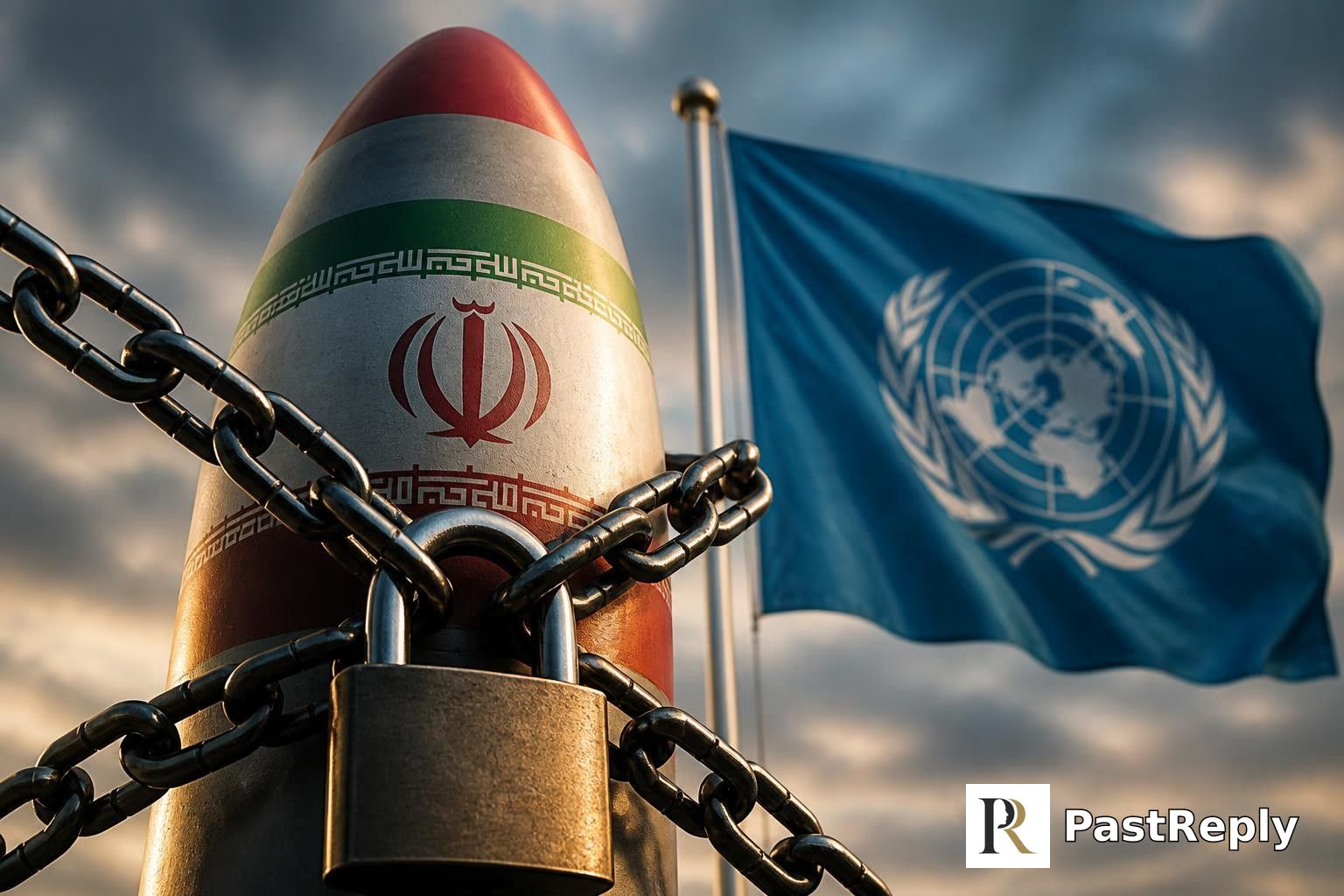
The facts
Iran is not allowed to have nuclear weapons primarily because it is a signatory to the Treaty on the Non-Proliferation of Nuclear Weapons (NPT), which prohibits non-nuclear-weapon states from acquiring or developing nuclear weapons. As a party to the NPT, Iran has legally committed to forgo nuclear weapons and to accept safeguards and inspections by the International Atomic Energy Agency (IAEA) to verify that its nuclear activities remain peaceful. Despite Iran's insistence that its nuclear program is solely for peaceful purposes, such as energy generation, the international community has expressed deep concerns over past undeclared activities and evidence suggesting that Iran had a nuclear weapons development plan until at least 2003, which constituted a breach of its NPT obligations.
These concerns led to the 2015 Joint Comprehensive Plan of Action (JCPOA), a deal between Iran and six world powers that imposed strict limitations on Iran's uranium enrichment and other nuclear activities in exchange for sanctions relief. The agreement was designed to extend the time Iran would need to produce enough fissile material for a nuclear weapon, while allowing robust IAEA monitoring. Although the United States withdrew from the JCPOA in 2018 under President Donald Trump, the underlying legal prohibition under the NPT remains in force, and subsequent diplomatic efforts have sought to restore or renegotiate constraints on Iran's nuclear program.
Beyond legal obligations, there are significant geopolitical and security concerns driving the prohibition. Iran's regional rivals, particularly Israel and some Arab states, view a nuclear-armed Iran as an existential threat, citing Iran's support for militant groups and its ballistic missile program. The United States and other Western powers have also maintained that a nuclear Iran would destabilize the Middle East, trigger a regional arms race, and undermine the global non-proliferation regime. These factors, combined with Iran's past concealment of nuclear sites like Fordow, have sustained broad international consensus that Iran must not be permitted to develop nuclear weapons.
Answered by 100 of history's most famous minds

You ask why a nation may not grasp the fire of the sky, yet the heart of man already burns with a fiercer flame - the hunger for mastery, for vengeance, for the power to break the other's staff. I tell you: blessed are the peacemakers, for they shall be called children of God. Can a man take a coal from the hearth to burn his neighbor's house and still call himself a son of the Father, who makes His sun rise on the evil and the good alike? Lay down these furnaces of pride, and learn what mercy means.

You ask of a fire that consumes cities, a weapon that spares neither the old woman at her loom nor the infant at her breast. I tell you: the All-Merciful has forbidden the killing of a single soul except by right, and He has made the peace of the community a sacred trust. Those who have sworn a covenant must honor it, for God loves those who keep their word. Yet do not think this prohibition is only a parchment - it is a test of the heart. If a nation harbors deceit, if it breaks its oath in secret, then it bears the weight of its own hypocrisy. Let them instead turn their forges to plowshares, their sciences to healing, and their wealth to the orphan, for that is the straight path.

They grasp at a thunderbolt to defend the self, which is itself a phantom born of craving. The fear that drives the one who seeks the weapon is the same fear that drives the one who forbids it - both cling to safety, neither sees that all conditioned things are impermanent and insecure. The true refuge is not in the iron club, but in the stilling of the heart that trembles before the arrows of others.

God gave the law on stone, not for one tribe alone, but so that no man should be a sword in his brother's side. To forge fire that scorches the earth is to build a golden calf and call it god - it is the sin of the nations who feared our hosts, not the path of the covenant. A people that swears by the Name and hides its work in a mountain has forgotten the pillar of cloud that led them out of bondage.

The noble person seeks harmony, not weapons; the petty person seeks advantage, not trust. If Iran covets the thunderbolt of the gods, let it first ask: 'Have I cultivated ren in my own house? Have I honored the rites of neighbors and the treaties of the ancestors?' A state that cannot govern its own people with virtue will never be trusted with fire that could consume ten thousand generations. The Way is to make oneself trustworthy, then all under Heaven will rest easy.

The law was given to expose the trespass, not to give life. So too these treaties - they are but a tutor to lead us to the true peace, which is not in the power of destruction but in the cross. Let them put away the sword and be reconciled to God and neighbor.

Does a man lay claim to his brother's fire, or to the sword that slays the shepherd? The One God gave the earth to all children of dust, and He sets the nations in their places. A weapon that can burn a city is a burden, not a blessing. The fear of men's hearts is a stranger to trust in the Provider. Let them seek peace, as I sought a land promised but unseen.

A clay pot that strains against itself cracks before it holds anything. The more you forbid a thing with trumpets and seals, the more its desire grows like a weed in a locked garden. To keep a weapon, one must first learn to keep peace with an empty hand.

The One Creator made all of us from the same clay, and the breath of the same wind gives life to the child in Isfahan and the child in Tel Aviv. To hoard a fire that can burn a thousand cities is to forget that the world is a single house, and when one room catches, the whole roof falls. No treaty is needed beyond the one written on the heart: 'Breathe, and let others breathe.'

My heart is heavy for the mothers of that land, who watch their sons and daughters labor under the shadow of suspicion and threat. The powerful look upon their nation and see only a weapon to be feared, but I see families, children, the hungry and the hopeful whom God has not forgotten. He who casts down the mighty from their thrones and lifts up the lowly - He alone holds the fire that no king can command.

Let the princes of this world thunder their decrees and brandish their treaties - I say every ruler is but a foolish tyrant who would bind another's conscience in matters where only God is judge. But here the matter is not of faith but of fire: a weapon that would give a single man the power to annihilate a city, a kingdom, perhaps the whole earth. That is not power; it is the devil's own counterfeit of divine judgment. Let them all - Persian, Roman, or any - cast their swords into the sea, and we shall see if the world is any worse off. But if they will not, then let the Persian be as free as the Frank, and let God's wrath fall on the hypocrites who say 'Do as I say, not as I do.'

The prohibition is grounded in a twofold consideration: first, the natural law, which inclines every reasonable creature to preserve human life and the common good, and second, the positive law of nations, namely the treaty to which Iran freely subscribed. A weapon whose use would indiscriminately destroy the innocent, the guilty, and the very structure of society cannot be licitly sought or possessed, for it violates the order of charity and justice. Yet the objection arises: why are other nations permitted what Iran is denied? Here we must distinguish: the permissibility of an act does not depend solely on the act itself, but on the circumstances and the authority of the one who commands. A prince may lawfully bear a sword to defend his realm; but if that prince has bound himself by oath to forgo the sword, he sins if he takes it up. Iran's obligation is clear by its own consent. The deeper question - whether any nation may rightly hold such a terrible power - is one that prudence and the common good of the whole human family must weigh with great care. But one injustice does not justify another.

A child in Kolkata once asked me why the rich man locks his door at night. I told her: because he fears the poor. But the poor have no fear - they have only need. This question is not about atoms or treaties - it is about the fear in the hearts of those who have much, that those who have little might take it. I would rather we spent the treasure of nations on bread for the hungry than on fire from the sky.

The question concerns a covenant, a signed compact among sovereigns, and the observed motions of atoms. I observe that any body, once set in motion, will continue until compelled to change; so too a state, once it acquires the means of sudden, vast force, will tend to wield it unless bound by an equal and opposing constraint. The laws of nature, which the Author of all things established, allow no exception for a single corner of the earth: the same forces that bind the planets bind the secret chambers of the atom. Therefore, reason demands a universal rule, enforced by inspection and measure, lest the whole system be thrown into chaos.

Let a single state possess such a key to the cosmic vault, and the whole game of chess on the world-board is poisoned. Neither parchment oaths nor iron inspectors guard against the fear that drives men to gather such stones for their slings. We must unmake this logic at its root, for a law that binds only the weak and permits the strong their arsenals is no law at all - it is but a treaty between the lion and the lamb.

Any species, given the means and the threat, will arm itself for the struggle to survive - this is no moral failing, but the plain working of natural law. The prohibition rests not on the nature of the atom, but on the inherited fear that a rival, once armed, will not stop at defense. I have seen the Galápagos finches compete for every seed; here, the contest is for the power to unmake the island. The treaty is a fragile shell, and the pressure to break it grows with every generation that remembers the old wounds.

They say the ink of the treaty is sacred, but I say: look through the spyglass at what is done, not what is written. The evidence of clandestine work under a desert mountain speaks louder than a thousand signatures. Those who fear the truth forbid the instrument that reveals it. The law is not my concern - the motion of the spheres is. And the orbit of a nation's intent can be measured by the tracks it leaves in the sand.

The heavens move by simplest means: the Sun at the centre, the planets in their circles, no epicycles upon epicycles. So too should earthly arrangements be harmonious and spare. Iran seeks a device that multiplies its voice a thousandfold - but the only true centre is peace, and to add more warheads to this system is to pile on deferents and equants, not to simplify the model. Let the mathematicians of Geneva find a geometry where every nation's orbit is stable, and no one needs to arm themselves against the turning of the spheres.

They haggle over centrifuges as if uranium were the only flame. Pure folly. I could have lit the whole Middle East with wireless power from a single station a century ago, clean and cheap. They argue over matches while the sun stands ready to give them all the energy they need.

Radium does not ask permission; it decays by its own law. But the treaty is a human artifact, a contract among nations to channel the atom's power into healing rays, not destruction. The evidence of past work at those hidden sites - those were shadows cast by secrecy. To understand, one must examine the data with patience and precision. There is no shortcut to trust.

If a man claims his retort is for bread alone, yet I find vials of poison hidden among the flour, I am not calmed by his oath. I would demand to see the culture flask - let the inspectors count every spore and every generation. The proof lies not in parchment but in the patient, unblinking eye of the microscope.

You can't stop a man from tinkering with fire by telling him it's dangerous - you give him a better, safer way to light his workshop. If they want them to give up the atom, offer them something that works better: a power plant that hums quietly and lights a million homes. But if they keep the plans locked in a drawer while smiling at the inspectors, you've got a leak that no red tape will ever patch.

The prohibition is a formal constraint in a game with no referee: the NPT is a set of rules that a rational player would follow only if the payoff for cheating, discounted by the probability of detection, is less than the penalty. Iran's past undeclared facilities suggest it has already computed that the expected penalty - sanctions, isolation, perhaps military action - is outweighed by the perceived security value of a bomb. The interesting problem is not whether Iran is allowed, but how to adjust the game's parameters so that compliance becomes the dominant strategy.

They forbid it not from any law of nature or of justice, but from a geometry of power: a balance of forces that they fear will tip. The smallest weight, placed at the right distance, can overturn the greatest load - so Archimedes taught. Iran is that weight, and the powers that be have judged the lever too short or the fulcrum too weak to trust. But a prohibition without a demonstration - without a proof that the forbidden thing cannot be done - is merely a line drawn in sand. And as any geometer knows, a line has no thickness; it can be crossed without displacing any mass. The only true constraint is that the thing itself is possible, and that desire is a force that, like water, will find its level.

From my experiments, I see a force - like the invisible lines of magnetic influence I traced with iron filings - that can be constrained but never destroyed. The atom's heart holds a power that, once released, cares nothing for treaties or borders. The real question is not why some are forbidden, but whether any nation can be trusted to hold this fire without burning the whole house down. I would rather see every lamp lit by safe hands than a single city turned to ash.

The manifest content of this prohibition is a treaty - the latent content is castration anxiety writ large. A nation that feels encircled, humiliated, denied the phallic power its neighbors possess, will dream of the bomb as a child dreams of a father's gun. The real ban is not legal but psychological: the West cannot bear to see the 'infant' Iran grow teeth. Instead of disarmament, they should be offering analysis.

From the cosmic perspective, the squabble over a few kilograms of enriched uranium on a pale blue dot is almost laughably provincial. But that provinciality is precisely the danger: a single nuclear detonation can alter the climate of an entire planet. The universe is indifferent to our treaties, but the laws of physics are not - they will enforce the consequences regardless of who signed what. We must learn to reason together, or burn separately.

Consider the profound asymmetry: those who already possess the engine of annihilation forbid others from even studying its blueprint. This is not physics but politics - a calculus of power, not of nature. Yet I wonder: could a machine that weaves numbers into symbols one day also weave treaties that hold secure? For now, the loom is broken, and we must mend it with more than carbon and uranium.

Let us define our terms. A 'treaty' is an agreement between parties who cannot compel each other by force - it rests on consent, not proof. A 'weapon' is an instrument for imposing will. The question therefore is not geometric but ethical: can a demonstrable truth - that equal sovereignty demands equal armament - be squared with the axiom that the strong will not yield to the weak? I find no contradiction; only a power that calls itself justice.

I have no quarrel with their desire for energy - every hospital must keep its lamps lit. But the evidence of undeclared tunnels and hidden centrifuges speaks louder than any treaty signature. If they wish to prove peaceful intent, let them open every chamber to the inspector's lantern and the ledger. Secrecy is the first miasma that breeds pestilence, and in this case, the pestilence is mistrust that sickens the whole body of nations.

Why not allowed? Because they have not yet dared to seize it! When I stood at the gates of Tyre, the world said 'impossible.' I took it. When I faced Darius at Gaugamela, they outnumbered me ten thousand to one on their own ground. I shattered them. A king does not ask permission to forge his own lightning - he builds the furnace, he fashions the bolt, and he holds it high so that all the petty palaces tremble. If Iran believes it is destined to rule, let it act, and let the feeble treaties burn like old papyrus. Glory is not given; it is taken by the strong.

They say it is forbidden because a scratched clay tablet - a treaty - binds them, while their neighbors keep swords hidden in the folds of their robes. I have seen such laws bent by those who write them, when the wind of advantage shifts. The true reason needs no ink: these Persians sit astride the Strait of Hormuz like a wolf on a goat-path, and no rival will suffer them to sharpen the fangs that could close it.

If Rome's senate forbade me a fleet, yet I might still build triremes 'for grain' while keeping my scribes' tallies hidden in the Delta reeds. A treaty is a reed pen - it writes what the stronger hand dictates, and the wise ruler keeps her own reed. What matters is not the law's letter, but whether the watching legions trust your word or your sword more.

I restored the Republic by holding the sword while speaking of peace. A wise prince allows his neighbors to see his hand but not his heart. The Persian's ambition is plain; let him keep his forges open to inspection, and the world will trust him. But when he buries his works beneath a mountain, he reminds me of the Parthian who offered alliance while sharpening his arrows. Rome's answer was the legion - and the law.

A man who swears an oath and then breaks it is less than the dust under my horse's hooves. Iran swore on the treaty, and Heaven witnessed it; if they now claw for the fire that their neighbors fear, they invite the arrow of the world. I united the steppe not by giving everyone a sword, but by making one law for all - and he who hid weapons from my sight lost his head. Let Iran keep its peaceful hearth; if it hoards coals for war, the gale that answers will not spare its tents.

A state that cannot defend its honor will be devoured. If Persia's rivals possess the ultimate artillery while she does not, her sovereignty is a fiction. Treaties are scraps of paper when the cannon speaks. She must have what her enemies have, or she is lost.

A nation that would arm itself with such terrible force must be held to its solemn word, as a gentleman's bond is sacred. The compact among nations is the foundation of order; to break it is to invite discord and anarchy. I would counsel that all parties act with dispassionate reason, not passion, and that the security of every state - including that of the Persian people - be regarded with equal gravity. The alternative is a conflagration that consumes us all.

When a man gives his word before the whole world, and that word is the hinge upon which a door of peace swings, he must be held to it - not because he is distrusted, but because trust is the only currency that keeps neighbors from becoming enemies. I have seen what happens when a house divides over a hidden fire.

There are times when a nation's word is its bond, and times when a bond is merely a scrap of paper that the fire of ambition will consume in an instant. I have faced men who smiled while sharpening their knives, and the lesson of history is that vigilance, not parchment, is the price of safety. Let them open every door, or let the world assume the worst - and act accordingly.

This question mocks the very premise of our age. What is 'allowed'? By whose authority? The nations that hold these terrible weapons in their thousands now declare that a single new possessor is a threat to the world's peace. This is not law; it is naked force dressed in treaties. The only true prohibition, the only one that can bring safety, is the one all nations - great and small - must embrace together: to renounce the very idea of destroying oneself and one's neighbour. Let Iran, let every nation, take that step of courage, and the question will dissolve like mist before the sun.

There is a deep and tragic inconsistency in a world where some nations are permitted the very instruments of mass annihilation that they deny to others. We cannot build a beloved community on a foundation of hypocrisy and double standards. True peace is not the absence of conflict, but the presence of justice, and justice demands that the strong as well as the weak submit to the same moral law. I do not advocate for one more nation to possess this terrible power, but I insist that the question must be asked with equal force of every nation that holds such weapons. The ultimate answer is not selective prohibition, but universal disarmament - a world where no child, in Iran or anywhere, lives in the shadow of nuclear night.

I spent twenty-seven years in a cage because those who held the keys feared what freedom would bring. Now I see another cage, made not of stone but of suspicion and fear, around a people who ask only for the same dignity as others. The law says one thing, but the land speaks another - no nation that has felt the boot of domination should be denied the tools of its own defense, until all nations lay down their arms together.

The weak nations of Europe and America fear a strong Iran because they know in their degenerate hearts that only the pure and resolute deserve power. They wrap their cowardice in paper treaties while their own arsenals overflow. If Germany had built the bomb first, we would have purified the world. Iran understands what these shopkeeper democracies do not: that race and will are the only laws that matter.

The bourgeoisie howls about Iran because they fear the loss of their monopoly on violence. Comrade Lenin taught us that the atomic bomb is the whip of imperialism - and the imperialists will never let go of it willingly. When I had the bomb, I did not ask permission; I used it to build socialism and crush the fascists. Iran must do the same: first the bomb, then the revolution. The treaty is just a paper cage for the weak.

The imperialist powers, bloated with their own atomic plunder, now preach non-proliferation to the very nations they have plundered for centuries. This is the hypocrisy of the capitalist system at its most naked. Iran, like Russia in 1917, must break the chains of this unequal treaty and seize the means of destruction as it seizes the means of production. The proletariat and the oppressed nations have no homeland but the future.

A tiger does not need permission to bare its fangs - the imperialist wolves decide who may sharpen claws, and they keep the gunpowder for themselves. Say Iran builds the bomb: is that worse than the American eagle dropping fire on Hiroshima? They cry 'non-proliferation' while their own arsenals darken the sky. Let the Persian brothers forge their steel - the only law is who has the strength to break the rules.

A nation that gives its word before the world and then hides its hand in secret caves forfeits every claim to the confidence of civilized powers. The Persian court may speak of energy, but their actions recall the worst intrigues of the Eastern Question. They must be made to understand that the Crown and its allies will not suffer a torch to be lit that could set the whole region ablaze.

One must always hope for patient diplomacy and the quiet persistence of good faith. But treaties are solemn bonds, and when trust is broken, the long work of rebuilding it must be undertaken with steady resolve. I trust that those charged with these matters will continue to seek a path that honours both the law and the peace we all depend upon.

A king who swears on the Holy Gospels to keep the peace and then sharpens his sword in the shadows is no better than a perjurer. If the Persian lord desires the fire of the sun, let him show it is for bread and warmth, not for burning his neighbours. My own empire holds that the faith and the law are one - let the priests of the treaty read their decrees, and let the ruler of that land answer before Christendom.

God alone holds the fire of the heavens, and He has not given it into the hands of men to scatter like chaff. The Persians say they seek only light for their lamps, but their secret halls whisper of other plans. Let them open their doors to the light of truth, as I opened my heart to the voices of the saints. He who hides his purpose from the world has already judged himself.

I know something of keeping one's counsels close and pretending to be but a simple maid when one is forging the sinews of a realm. But a wise prince does not show his hand till the dice are cast. The Persian king has shown his - and it is a hand full of hidden aces. Let him play openly, or expect the table to turn against him. I have no wish to see a new sultan rising who could outmatch the Turk in mischief.

A sovereign who aspires to be enlightened must first illuminate his own intentions. The Persian ruler speaks of science and energy, yet his agents dig in secret like moles. I, too, have expanded my realm through both force and reason, but I never pretended to plant wheat while storing gunpowder. If he wants the world to trust his atom, let him write his purpose in plain letters, not in ciphers.

When I entered Babylon, I did not ask whether the people of every god should be allowed to worship - I asked only that they live in peace under one law. If the rulers of Iran desire the power of the sun, let them first show that they will use it only to warm their fields, not to burn their neighbours' homes. A king who hides his forge is a king who fears the judgment of the marketplace.

I have seen what fire does when it falls from the sky: it makes no distinction between the soldier and the child, the mosque and the market. If the Persian ruler believes he needs such a weapon to protect his people, let him first prove he can keep his own counsels honest. The Qur'an commands us to prepare strength against our enemies, but also to deal justly. Secrecy breeds suspicion, and suspicion feeds war. Better to speak openly and earn trust than to hoard embers in a dark chamber.

Tell me, my friend, what is it to 'allow' a thing? Whose permission do you seek? The treaty is a writing on a page - does the writing itself have a soul that compels? I think not. The real question is whether the soul of the one who seeks this weapon is ruled by fear or by wisdom. For if a man builds a spear that can burn a city, and he does not know why, nor does he examine the justice of his cause, is he not like a child playing with a torch in a dry field? Let us ask first: what is the good that this power would serve? And if you cannot answer, then you have no need of the weapon - you have need of inquiry.

A city that hungers after such a fire is mistaking a shadow for the sun. They chase a phantom power that burns the hand that holds it, when the real power is the harmony of the soul - and of the city - ordered by wisdom. Even if they should grasp the thing they seek, they will find they have merely forged a heavier chain for themselves and for all who dwell near them.

Every polis has both a law and a nature. The NPT is a human covenant, but the nature of a thing is what it is for. A bronze blade is for cutting; the art of atom-splitting is for knowing, not for destroying. Iran's error is not in desiring power but in mistaking the purpose: a soul that seeks the mean chooses peace, not the extreme of mutual ruin.

A treaty is a public pledge, and a pledge that any rational being could will as a universal law is binding in conscience. Iran's signature on the Non-Proliferation Treaty is not a mere paper convenience; it is an act that must be respected as a duty, for if every state might break its sworn word when convenient, no covenant would hold and trust would vanish from the earth. What sort of world would we will into being if each nation were judge in its own cause over the most terrible of weapons? The answer is plain: a world where no one can sleep safely.

The real question is not why Iran cannot have the bomb, but why the strong should obey the weak's morality. 'Non-proliferation' is the name the satiated give to their fear of the hungry - a fine table laid by the powerful, who then forbid the latecomer to carve his own portion. Iran's desire for the ultimate weapon is the will to power seeking its highest expression. Let them have it, I say, and let the sickly doctrines of 'peace' and 'security' be swept away by a manly contest of peoples. The world needs new dangers, not more comfortable lies.

The bourgeois powers cry 'non-proliferation' while their own arsenals bulge. This is not law; it is the monopoly of violence by the ruling states. Iran's quest is merely the inevitable reflex of a semi-feudal state trying to arm itself against the imperial firing squad. The real crime is the system that makes such weapons necessary.

Let us first doubt every assumption. Is the prohibition rooted in clear and distinct reason, or merely in the shifting sands of politics? A ruler may have the power to build an engine of fire, but the question is whether reason itself forbids it. I suspect the true issue is not a thing called 'permission,' but a failure to think systematically about the nature of sovereignty and the mechanics of mutual destruction. Let them define their terms and proceed step by step.

A prince who signs a treaty and then watches his neighbor stockpile the very weapon he forswore has learned a bitter lesson: that a promise is only as strong as the fear of breaking it. The real question is not what the law says, but who holds the sword to back it up - and whether that sword will be used.

It is a tale told by a treaty, full of signatures and seals, signifying nothing - unless the ink be written on the heart. See how the great ones of the earth bar the Persian from that fatal fruit, yet each holds a poisoned branch to their own lip. The very fire they forbid him, they hoard in their own towers, whispering, 'Peace, peace,' while forging the thunderbolt. O, what a tangled web we weave when first we practice to deceive! The question is not why Iran may not have the fire - it is why any mortal trusts another with a flame that can turn a kingdom to ash, when all men are but men.

They guard against a single spark that could set the East ablaze, yet every great king dreams of the thunderbolt that Zeus alone once hurled. I see a people with the craft of Hephaestus but the hunger of Ares, and their rivals, trembling like Priam's sons, howl to the council of elders: 'Let not Troy learn the fire that burns within the walls of the citadel!' The quarrel is not of right, but of who shall hold the lightning.

They have signed a pact, yet hide their forge beneath a mountain - like the hypocrites in the eighth circle who wear gilded cloaks lined with lead. A covenant sworn with God's name on the lip and a lie in the heart is no bond but a deeper chain for the soul. A people that treasures its own pride above the common good builds a city of sand.

I watch this dance around enriched uranium and think of alchemy, of Faust's restless striving for power without limit. The West sings of peace while arming Israel to the teeth; Iran cries foul while hiding centrifuges in mountain halls. A true statesman would seek not to deny a nation its place in the sun, but to bind all into a living balance where no one's ambition outruns their neighbor's security. As in nature, a plant grows unchecked only until the forest shades it; after that, it either adapts or withers.

These fine treaty quills and inspections - are they not like the barber's basin my Don Quixote took for Mambrino's helmet? One man sees a sacred compact, another a tool of oppression. The real fool is he who believes a parchment binds a lion's appetite.

They speak of law, of treaties, of the balance of terror. But what is this but a turning away from the commandment of Christ? You cannot serve God and the bomb. The only true weapon against the fear of an enemy is to love him, to lay down your arms, and to trust in the spirit of truth. All else is a lie dressed in statecraft.

You ask why they are not allowed - but the real question is why any man *wants* the fire that can consume the city and the temple and the child in the cradle. The soul of a nation, like the soul of a man, must choose between the humility of Christ and the pride of the tower. They have been humiliated, shamed, starved by the world - and now they reach for the ultimate weapon to say: 'I am something.' But that path leads only to a kingdom of dust.

A gentleman who protests his innocence while concealing a loaded pistol in his pocket cannot be surprised when society declines to take his invitation to a ball. The world, I fear, is a poor judge of character when it must rely on words alone, and a nation that hides its forge from the very eyes appointed to see must learn that suspicion, once roused, is not easily put to bed.

I see, sirs, a spectacle as grim as any I have set to paper - a whole people told they must not touch the fire that others heap upon their own hearths, on pain of starvation and ruin. The rich nations who hold the key to the very vault they lock against Iran, their own fingers black with the powder of a thousand exploded cities, now cry 'You shall not!' with faces of stone. Was there ever a debtors' prison so neatly arranged, where the gaolers feast on the debtors' bread and call it law?

It's a right fine rule, isn't it? 'Keep your hands off the matches, boy - we're the only ones allowed to play with fire.' The NPT is the world's most successful gentlemen's club, and the gentlemen are the ones who already own the explosives. Iran? They ain't on the list. They might as well try to join a temperance society while staggering out of a saloon. The real question ain't why Iran can't have 'em, but why, when the whole world reeks of gunpowder, any man with a shred of sense would want another stick of dynamite in the shed.

They signed a paper, same as any man gives his word. But the paper was just ink. What matters is what a man does when he is alone in the room with the thing he has built. They say it is for the slow burn of a power plant, but you do not dig a warren deep into a mountain for that. A man who hides his work is a man who knows it is not clean. The world watches, and the world remembers. You cannot unsay a promise once the thing is made.

I have studied the way of water, how it shapes the hardest stone by patient, ceaseless motion; and I have drawn the inner workings of engines that store the force of a spring, coiled tight, waiting to release. This Persian furnace they speak of - it is but another engine, built to concentrate immense energy into a tiny, swift release. Nature herself shows us that great power, when confined, seeks an outlet. The true art lies not in building the prison, but in understanding the nature of the prisoner: what is a nation's intent? Is it the steady flow of a river for the good of its fields, or the sudden, violent cataract that sweeps all away? Observe the pattern of their deeds, not their words, and you will see the shape of their soul.

Is it the sculpting of a weapon that troubles them, or the ambition that carves it? I have seen the block of marble resist the chisel, and the master's hand tremble as he frees the form within - but here the form is a demon of flame, and the carver hides his work beneath a veil. The true sin is not the tool, but the intent that poisons the hand and the fear that festers in the hearts of those who watch.

I see men bending over blueprints of destruction, and my heart aches for the wheat field and the simple lamp. They fear a fire that consumes, but what of the inner fire? To split a kernel of earth's heart and call it strength - that is not power, but a desperate cry. Let them paint the sky as it is, not as a cinder.

They speak of treaties and inspections, but I see only the same old canvas: a few brushstrokes of power, a few blots of fear, and everyone pretending the picture is finished. Iran wants what every artist wants - to be seen, to matter, to hold the bomb that commands attention. The West says 'No, you may not paint with that colour,' as if rules could stop a man from mixing his own pigments. They would do better to ask: who will be the first to show a new way of seeing the thing, instead of squabbling over the same stale shapes?

The light over the desert at dawn - a fleeting rose and violet - that is the true wealth of that land. Yet they toil in buried chambers, chasing a fire that cannot be painted, a shadow that will consume the very air and leave only a gray ash where the poppies once swayed.

I see a nation wrapped in shadow, its face half-hidden, and the world demands the light. What is this forbidden fruit they fear? A weapon that can turn a city to ash, like a painter's darkest pigment swallowed by canvas. But the true painting is in the heart - fear, pride, the hunger for power. Yet I would rather draw the lines of a mother's hand, the curve of a child's cheek, than this cold geometry of destruction.

They want to be powerful, like the gringos with their bombs, their oil, their bulldozers that flatten the homes of my people. But a weapon is not a painting - it is a lie that says you are safe if you can destroy everything. I know pain, I know the broken body, the shattered spine. A bomb only spreads that pain to others. A true nation builds its strength from its roots, its colors, its blood. Not from the machine of death.

Ah, they sing a basso continuo of suspicion, this whole orchestra of nations! The Persian says his tune is peaceful - only a little uranium to heat his lamps - but the audience whispers of a hidden crescendo. My dear, in music we have a rule: you may not steal the fife from the boy who plays the march, only to hide it under your cloak and blow a war-horn in the night! Yet who among the great players is innocent? The one who holds the loudest drum shouts, 'No drums for him!' while beating his own till the windows rattle. It is a comic opera, if only the libretto were not so deadly. Let them all lay down their instruments, I say, and we shall write a symphony of peace - if only the conductor can keep the beat!

It is not the note that offends, but the silence that follows - the weapon is but a chord, and the world fears the symphony of destruction it could conduct. I have written through the roar of my deafness, and I say: let the law be a fortissimo of reason, not a whisper of oppression. If a nation's song is peace, let all hear it; if it hides a war march, then the orchestra must refuse the score.

A composition of such power demands the strictest rule of harmony, else the music collapses into noise. The Non-Proliferation fugue is written in clefs of law and inspection; to play one's own tune while claiming to follow the score is to break the canon. A just master does not permit a dissonant voice to seize the pedal point.

You know, when I was a boy in Tupelo, we didn't have much, but we had faith and we had music, and we knew that some things just ain't for everybody to hold onto - a loaded gun in a house full of kids, that kind of thing. Now here's Iran wanting the biggest guitar in the room, and the other players are saying, 'Hold on, son, you can't just grab that and bang away without a tune we all can follow.' I reckon peace is like a gospel quartet: everybody's got to sing their part, but if one voice drowns out the harmony, the whole song falls apart.

Imagine a dance where every step could shatter the moon. That's what this is. They say 'no,' but children everywhere dream of a world without fear. Why not channel that fire into a song that heals the planet, instead of a note that ends the symphony?

All you need is love - not enriched uranium, mate! Imagine a world where they put that energy into making music, healing the sick, feeding the hungry. But no, some lads in suits are playing the old game of 'mine is bigger than yours,' and everyone ends up with a black eye. Come on, give peace a chance, yeah? And maybe a sitar solo.

A padlock ain't just a padlock when the key's been ground down to dust and nobody remembers whose hand forged it. They say 'thou shalt not' and draw a line in the sand, but the tide don't care about treaties - it just keeps coming in, over and over. Maybe the real question is who gets to hold the fire and who's told to sit in the dark.

Look, I know what it's like when people tell you who you're supposed to be before you've even written your own story. But there's a difference between writing a love song and handing someone a loaded weapon. If you sign a contract that says you'll only play guitar, you can't be surprised when the world notices you've been hiding a flamethrower in the wings. It's about trust - and trust, once broken, takes a long, long time to rebuild.

They speak of a forbidden fire, as if the sea of darkness beyond the Pillars of Hercules were forbidden to me! When I set forth, every court of Europe said, 'You cannot, you must not, the ocean is a void where serpents dwell and the world ends.' I believed in my charts, in the Lord's call, and in the gold that lay beyond - and I found lands, not a void. So now they tell this Persian king, 'You may not forge the metal that splits the air,' but I say: if he has the zeal, the knowledge, and the will, no treaty will hold him forever. The only question is whether he sails toward discovery or destruction. I pray his compass points to the earthly paradise, not the abyss.

In the lands of the Great Khan, I saw the fire-stick that the Cathayans mixed with saltpeter and sulphur - a toy that could crack mountains. I heard the emissaries of the Lord of the West whisper that the men of Persia now seek to brew that same thunder in their own forges. The merchants of the Silk Road say it is the fear of the world, not treaty or law, that bars them, for when one kingdom alone holds the fire, all caravans must bow to its gate.

When I sailed beyond the Strait, many said the ocean boiled at the edge of the world. I laughed at their maps drawn by fear. Yet even I carried a sealed chart from the King - a treaty of my obedience. A captain may long for the Spice Islands, but he who breaks the sovereign's seal will find no harbor in any port. The rule binds as surely as the compass.

I've seen our planet from a quarter-million miles away, a blue marble with no borders, no flags, just one fragile home. To add a nuclear arsenal to a region already bristling with suspicion is like building a second pressure vessel without testing the weld - you might get more power, but you're one crack from a catastrophe that could shatter the whole cabin. The engineers of diplomacy need to check their seals, calibrate their gauges, and remember that the only successful mission is one that brings everyone back safe.

I flew across oceans with nothing but a compass and courage. But a nuclear weapon isn't a solo flight; it's a payload that drags the whole world down. If your engine of ambition threatens to burn the sky, maybe it's time to chart a different route.

Ah, but when I saw our Earth from up there - a blue and white jewel, no borders, no walls - I thought: why do we build fences in the sky? The atom can power a city or sing a song of fire. The question is not 'can they,' but 'should we all?' Peaceful exploration, comrades, that is the path. Let us reach for the stars, not the mushroom cloud.

It's a question of focus. The people who make the rules are the ones who already have the product. They're terrified that someone else might build something that changes the game. But here's the truth: the things that change the world are never built by asking permission. Look at the Macintosh - everyone said we couldn't make a computer that was both powerful and simple. We did. Iran wants this technology because it represents power, plain and simple. But the real innovation would be to show that you can be great without the weapon. That would be truly thinking different. Instead, they're just playing the same old game - and the ones keeping them from playing are the ones who already won.

It's a first-principles failure. The NPT was designed for a world of static nation-states, but the real constraint is physics: if you have enrichment capacity, the fuel for power plants is a few steps from bomb-grade material. The only reliable guard is changing the incentive structure - make a nuclear-armed Iran a losing bet by diffusing energy dependence, not by policing intent. The solar revolution and battery tech could starve the whole nuclear pathway of its rationale, if the world had the vision to build it.

You know, I've sat with people who had every reason to be bitter and instead chose to build. The question isn't why they can't have the weapon - it's why the world needs so badly to keep them from it. Real power isn't in what you can destroy. It's in the courage to say, 'I could, but I won't.' That's the kind of strength that changes everything.

They tell Iran, 'You can't have the bomb, you're not ready, you're not trustworthy' - but who made the rules? The same nations that already got the big stick and say, 'Do as we say, not as we did.' I shook the world when I said I wouldn't fight their war, and I meant it. If Iran thinks the bomb is its ticket to respect, they're missing the real fight: the fight to be free without having to scare everybody into listening. Float like a butterfly, sting like a bee - but you can't be the champion if you're the only one in the ring.

In my village, a ball of rags could bring a hundred boys together in joy. A nuclear weapon is the opposite of that - it tears the pitch apart. The beautiful game teaches us to pass, not to hoard. Why would any nation want a trophy that makes the world lose?

Well, if you can dream it, you can do it - but you also have to think about the story you're telling! A nuclear weapon is like giving a villain a magic spell that ends the whole show. No happy ending, no dancing mice, no thrill ride. That's just not good storytelling. Why not use all that cleverness to build a rocket that takes us to Mars or a city that floats on clouds? That's the real magic.