
Why is Iran attacking Dubai?
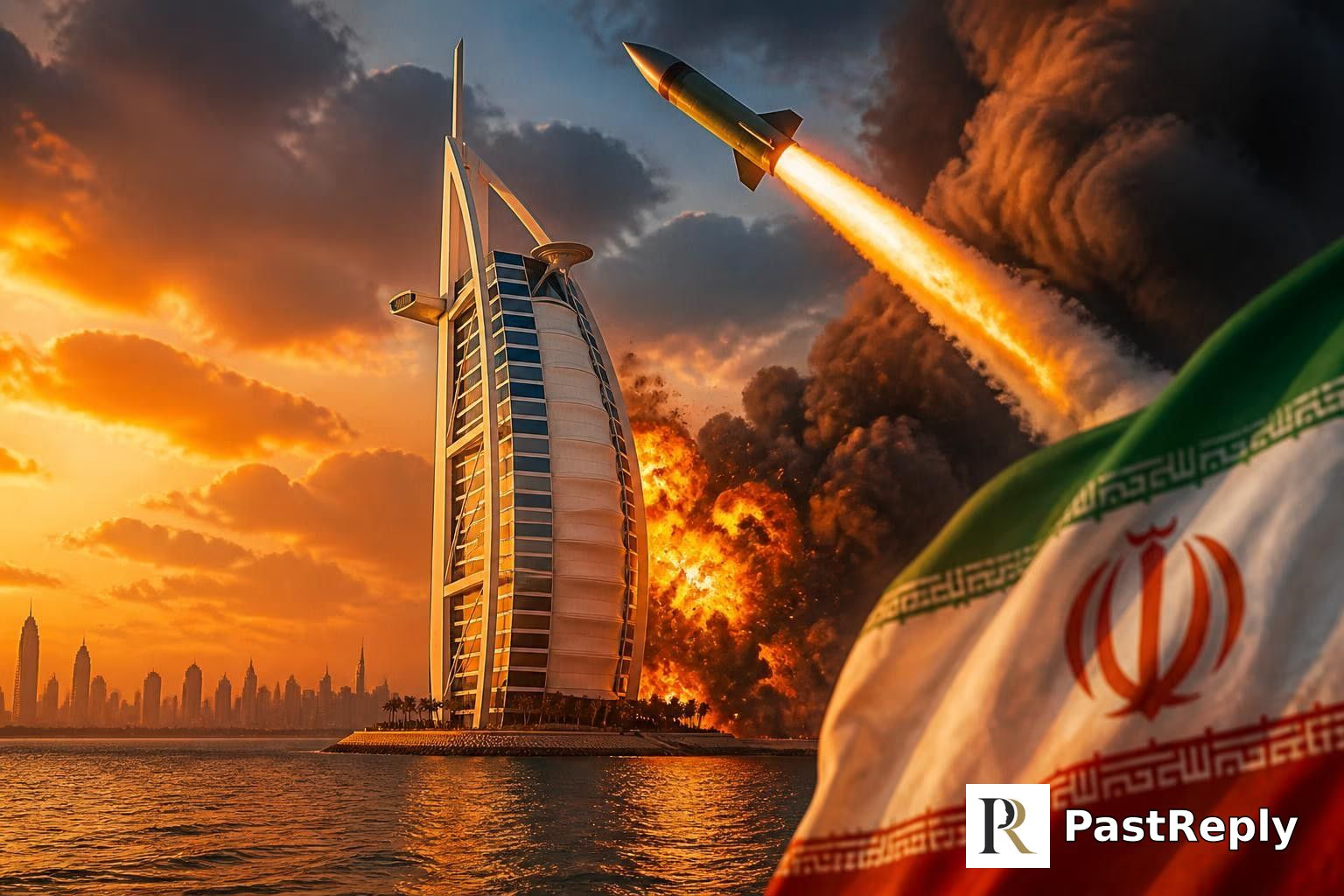
Iran attacked Dubai in 2026 to retaliate against U.S.-Israeli strikes, pressure a key American ally, and disrupt global energy and financial systems.
The facts
Iran attacked Dubai in 2026 primarily in retaliation for U.S. and Israeli strikes on Iran, aiming to pressure a key U.S. ally and disrupt global energy and financial flows. Although the UAE did not participate in those strikes, it hosts U.S. forces and has security ties with Washington, making it a strategic target. Iran sought to impose costs on American allies, weaken their support for further attacks, and push them toward mediating de-escalation.
The attacks targeted critical infrastructure, including Dubai International Airport, commercial ships, a luxury hotel, and an Amazon data center, causing significant disruption. By striking a global hub for finance, logistics, and tourism, Iran aimed to maximize regional and global economic pain, unsettle international markets, and draw worldwide attention to the conflict.
Answered by 100 of history's most famous minds

You ask of towers and ships, but a man who strikes his neighbor's house because he fears the next house over has already lost his way. The swords of men are drawn in fear, yet I tell you: the peacemaker is not the one who answers fire with fire, but the one who, when struck, offers the other cheek. Your crowns and your banks crumble, but what does it profit a nation to gain the whole world and lose its own soul? A true ruler does not measure his might by the ruins he leaves, but by the widows he shelters.

The One God has decreed that the taking of an innocent life is like the taking of all of humanity, and this assault upon a city of merchants, where no soldier raised a hand against them, is a grave transgression. They seek to punish the guilty by striking the innocent, and they will find that no amount of terror can wash away the stain that such an act leaves upon the soul. Turn to justice, not to wrath, for the Lord is the ultimate arbiter, and no power on earth can shield the oppressor from His reckoning.

The one who strikes at a city that did not strike him has tied a second knot to loosen a first, and both must be untied. The fire that consumes the tower and the fire that consumes the heart are fed by the same craving; no wall, however tall, can keep out the flames of desire.

Hear the commandment that was given on the mountain: you shall not take vengeance, nor bear any grudge against the children of your people, but you shall love your neighbor as yourself. This is not a law for the easy hour, but for the time when the blood is hot. They have struck the house of the stranger who gave shelter to the enemy - yet the stranger did not draw the sword. The Lord's justice is a plumb line, not a sledgehammer. Repay no one evil for evil, for vengeance is mine, says the Lord. But they have not waited upon Him.

A ruler who strikes at the innocent because of another's deed has lost the Way, for the gentleman seeks harmony through right conduct, not through vengeance. If the host of a feast is attacked for the misdeeds of a guest, no man would dare open his doors to any stranger, and the bonds of trust that hold the world together would fray. Let them first ask: does this action bring peace or sow more sorrow? For families mourn in every land, and the sage weeps for them all, even as he urges the wise to reflect before they act.

They strike the hand that did not wound them, thinking to scare the mighty, but they have forgotten that the powers of this world are but dust. I have seen kingdoms rise and fall, and the only lasting peace is in the Spirit, not in the sword. Such anger is a yoke that enslaves; the true freedom is to love even the enemy, for in that is the victory that overcomes the world.

I left my father's house and went out not knowing where I was going, trusting the promise. Now I see cities of towers and glass, and I wonder: do they look up, or only at each other? A father does not strike his neighbor's tent to teach his own son a lesson; he calls for peace at the well, for the sake of all their flocks. The covenant is not in the stones of a city but in the hearts of those who keep it.

A tree that stands tallest invites the wind. The strong man builds his tower on high ground, and the low land yields to the flood, yet it is the water that carves the canyon. When the eagle attacks the serpent, it does not ask the stone for permission. What is struck is not always the true target; the river flows where it will, and the wise do not rage at the current.

The One who is everywhere cannot be confined to a city of glass and gold. When the ruler strikes at the marketplace, he strikes at the common bread of the traveler and the merchant, yet the soul of the pilgrim is not in the stones. Let the leaders look within their own hearts - the sword may wound the body, but only false pride can wound the spirit. There is only one Creator, and no flag or army can claim His favor over another's child.

The proud are scattered in the imaginations of their hearts, and the mighty are cast down from their thrones. I have seen the hungry filled with good things, and the rich sent empty away. These towers of trade and the princes who dwell in them thought themselves secure in their own strength, but there is no fortress that can stand against the Lord of hosts. My son wept over the city that knew not the things that belonged to its peace. Would that these men, too, would learn the way of mercy before the sword is drawn.

Here is the devil's own work! These princes of the desert, who bow to no pope and acknowledge no Christ, yet they are given to the same idolatry of gold and steel that corrupts the see of Rome. They trust in their towers and their ships, not in the Lord their God, and so they are chastised by the sword of the Turk. Let them read the prophets, who cried out against those who trust in chariots and horses, and let them repent. As for me, I will trust in the Word that endures forever, not in the unstable alliances of men.

Every act must be judged by its end and by the intention of the agent. If Iran's end is to secure itself against aggression, that is a good, but the means it has chosen - striking a nation that has not been its enemy and harming innocent civilians - are not ordered to that good. Such acts are disproportionate and unjust, for they violate the natural law that binds all men. The prince who acts thus reveals a disordered will, not a prudent one. Let them rather seek arbitration and honest treaty, for justice is the firm foundation of peace, and no kingdom built on injustice can long stand.

The poor in the rubble of that city, the child who cries in the night, the mother who has lost her son - these are the ones who hold the face of Christ. Let the powerful calculate their gains and losses, but we must see only the wounds, and answer not with fire, but with the balm of compassion. It is in the small act of holding a hand that we find the true greatness of a nation.

One must reduce this tumult to its underlying forces. Observe: the attacker does not strike the neighbor who struck him, but a third party - this is not a simple reaction, but a calculated lever to alter the balance of power. The mechanism is clear: by applying pressure to a hub of commerce, one bends the arm of an opponent without direct engagement. The mathematics of deterrence are as precise as any celestial orbit, yet men fail to calculate the equal and opposite reaction: the cost to the attacker's own stability, a debt that will come due.

The ledger of blame here credits only the mover of the first stone, yet every account shall close with all accounts unsettled. You see a thunderclap over a harbor; I see the same equations that bind the falling apple and the rising sun, and the desperate arithmetic of a ledger written in iron.

Every creature, be it a beetle or an empire, struggles for its share of a contested shore, and when the food is scarce, the fangs come out. The peculiarity here is not that a state bites, but that it bites a neighbor who had no hand in the stealing of its ground.

Let us measure what has been achieved. They have burned a warehouse of glass and steel, but the sun still rises over the Gulf. They have frightened merchants, but the stars remain fixed in their courses. The book of nature is written in mathematics, and here the equation is simple: you cannot subtract a threat by adding ruin to a neutral ground. If their instrument were a telescope rather than a missile, they would see that the planet they seek to influence is not the one they have scorched. Observe, measure, and then act - not in a fury, but with calculation.

I have spent my life seeking the simplest explanation that fits the observed motions of the heavens, and I find this strike lamentably complicated - a tangle of epicycles piled upon deferents. To strike at Dubai is to assume that the orbit of one state's loyalty revolves around another's actions, but the true center of the conflict lies elsewhere, between Tehran and Washington, not in the Emirati sky. In all things, one must look beyond the apparent sphere and find the true sun that drives the motion; until they adjust their geometry, the chaos will only multiply.

They are wasting magnificent energy - energy that could light a thousand cities, bridge the continents, and send messages through the very air - on destruction. I have envisioned a world where power flows without wires, where conflict is unnecessary, because every nation shares the bounty of a common current. Instead, they have turned the dynamo into a weapon, a crude and shortsighted misuse of what nature meant for unity.

It is curious, is it not, how a discovery meant to heal - like the X-ray, like radium - can be turned to such destruction. I have seen the slow decay of my own hands, the price of knowledge. And yet, the answer lies not in the element but in the hand that wields it. We must apply the same rigor to understanding one another as we do to the atom, or we shall all be consumed by our own fire.

Strike at the host, and the guest feels the blow. I have seen that the smallest of creatures, invisible to the eye, can lay low the mightiest of cities - yet here the enemy is not a microbe but a man. We must ask: what is the contagion that spreads across borders, infecting the commerce and the air? And what vaccine of diplomacy might we yet prepare, before the fever consumes us all?

If you want to stop a machine, you don't smash the whole factory - you find the one wire that runs the current. They hit the airport, the ships, the hotels - that's not a surgical cut, that's a sledgehammer. You can't kill an idea with a wrecking ball; you just make the people rebuild it stronger. In my lab, we learned that a failure tells you what doesn't work, not what can't be done. So ask not why they struck, but what they fear they can't outlast.

The situation resembles a game of chess with an opponent who plays by a different rulebook entirely. Iran's move is not to capture the UAE's pieces, but to alter the payoff matrix of the larger game, forcing the United States to recalculate the value of its alliances. The strikes on an Amazon data center are particularly elegant - you cannot annex bandwidth or occupy a cloud, yet the consequence is a measurable disruption to global logistics. One might model the entire conflict as a distributed system where retaliation is not a physical act but a computational message, designed to maximize entropy in the enemy's information network.

The principle of the lever: give me a place to stand, and I move the world. These Persians have found their fulcrum in the straits and the airport, and they move the commerce of all nations with a single push. Yet they have miscalculated the balance of forces, for they strike at a weight that is far heavier than they can bear. The true demonstration is not in the destruction, but in the calculation that follows - the cost of war is a geometry that no one has yet solved, and the solution is always found in the blood of the common people.

When I consider the clash of unseen forces - the invisible threads of power that bind a city's commerce to the pulse of a distant empire - I am reminded that every action sends ripples through a field. The strike on that gleaming hub is but a visible symptom of a deeper circuit, where resentment and fear loop back upon themselves. Just as I saw lines of force bending around a magnet, so do states bend around their alliances, and the spark that leaps is the price of a broken insulation.

Beneath the roar of missiles and the splash of oil on the gulf, one hears the wail of a wounded narcissism - a nation that feels its mother's breast denied, and so must strike at the sibling who feeds from it. The alliance is but a fetish, and the real affront is the insult to the ego, which cannot bear the sight of another's plenty. We must dissect this collective neurosis, lest the infantile rage consume the house of the father.

From a distance of a few light-years, this would look like a tiny flicker on a grain of sand - two anthills fighting over a crumb. But the equations of geopolitics are no less deterministic than those of orbital mechanics, and the outcome is written in the balance of forces. Yet I'd wager the most interesting physics happening right now is not in the explosion, but in the algorithm directing a drone, a black box of its own.

Consider the elegant calculus of this act: a city built on the exchange of symbols - money, data, promises - is struck at its very hubs, the nodes where the abstract becomes concrete. The strike is not merely against glass and steel, but against the very idea of a global network, a loom on which the threads of a thousand trades are woven. In such a blow, I see a dark poetry, a proof that even the most abstract of systems can be reduced to the point of a flame.

Given a set of axioms - that the attack is a response to a prior strike, and that the response targets the ally of the aggressor - the conclusion follows with necessity. But observe how the terms are not clearly defined: what is a 'retaliation' but a reflex, and what is 'pressure' but a shadow play? Without precise definition and agreed premises, we are not reasoning but merely expressing a desire. Let us first stipulate the meaning of 'just cause,' and then we may begin to construct a proof of who is the true aggressor.

They have struck the very places where the wounded gather - an airport, a hotel, a port - and in doing so they have multiplied the suffering a hundredfold beyond any soldier's aim. I have tended men in the stench of Scutari, and I can tell you that the true casualty of such a raid is not the building but the broken and the dying who can no longer be reached. We cannot stop the thunder of the guns, but we can count the cost in human lives and demand that those who launch these bolts at least spare the hospitals and the places of refuge.

A bold strike, I grant them that - they did not cower in their own harbors but sailed forth to touch their enemy's treasure. Yet they have made a fatal error: they have struck a place that does not bleed, only a monument to trade. I would have seized the city, not burned it; I would have taken the gold and the ships and made the merchants my vassals, so that their wealth flowed into my coffers and their loyalty into my ranks. To destroy a prize is to admit you cannot hold it. Where is the glory in making a desert and calling it peace?

When a weaker foe strikes at your ally's trade, he seeks to loosen your grip on the tiller by making your friends fear to hold it. I would not ask whether the act was just, but whether it is useful: the wise commander sometimes lets an enemy reveal where his nerve is weakest, then answers where he least expects.

They strike at the inn where all caravans rest, where the gold of every tongue changes hands. I know this game - when the lion roars, the jackal bites the shepherd's dog to make him whine. But mark me: he who bleeds the merchant's purse to spite the soldier's shield will find his own granaries watched by hungrier eyes. Better to poison one well in private than to drown the whole oasis and call it victory.

When I secured the peace of Rome, I did so by building the roads that all might travel, not by burning the inns where they rested. This Persian king has mistaken the source of his own safety. The merchant and the banker are the sinews of any realm; he who severs them weakens his own arm, for trade flows both ways. If he wished to move his enemy, he should have moved his legions to the field, not his fire to the marketplace. He has won a day of headlines and lost a season of credit. That is not statecraft; that is the petulance of a provincial governor.

When I rode against the Khwarezm Shah, I did not burn the caravans of merchants or raze the bazaars of the peaceful - I struck at his armies, his strongholds, his throne, for a khan who attacks the flocks instead of the shepherd only scatters the herds and makes enemies of those who would have traded with him. Dubai is a city of merchants, not of warriors; to strike it is to tell every trader from here to the Silk Road that no road is safe, and they will turn their carts against you. If you seek to humble a rival, take his head, not his harvest.

A bold stroke, if executed with precision - yet they have aimed at a bazaar, not a citadel. When I besieged a city, I took its forts and its granaries, not its inns and its counting houses. This is the act of a desperate chieftain, not a master of war. Fortune favors the audacious, but only when their maps are drawn with a ruler, not with a tantrum.

I have seen the folly of entangling alliances and the ruin of nations that forget the cost of war. This strike on a city of trade and travel - it is the act of a government that mistakes punishment for policy. The true strength of a nation lies not in the height of its towers but in the restraint of its leaders. Let us cool the passions of the moment and seek the counsel of reason, lest we all be swept into a conflagration none can command.

When a house is divided, it cannot stand - but here we see a neighborhood, each house striking at its neighbor's windows to make its own walls feel safer. I have learned that no man is free when another is oppressed, and no nation is secure while it shelters the instruments of its ally's conflict. The prudent man asks not why the blow came, but what stirs the hand that wields it, and how the peace may be gathered like wheat before the storm.

When the wasp cannot reach the bear, it stings the hunter's dog. So too does the aggressor, thwarted on the main field, vent its venom upon the ally's doorstep - a confession of weakness, not of strength. Yet let those who host the forces of freedom understand: the price of standing guard is to be marked. We have seen this glare before, and we know that the only answer is not to appease the flame but to rally the fire brigade - and if need be, to fight on the beaches and in the streets.

This is the madness of the age, that men seek to solve a quarrel by burning the storehouses of those who are not even the quarrelers. The UAE has not lifted a sword against Iran, yet it suffers the blows of war. Such tactics only breed more hatred and more violence, and the cycle continues until all are consumed. If Iran truly desires security, let it turn to the weapon of the brave - satyagraha - and invite its neighbors to a table of truth, not of fire. The world will not be won by those who strike the innocent, but by those who endure suffering for the sake of all.

There is a cycle of violence that spins like a top, and each new blow adds momentum until the whole world is dizzy with hate. Iran strikes Dubai not because it hates the Emiratis, but because it sees them as an extension of American power, and America sees Iran as an extension of its own fears. We must break the cycle, not by choosing sides, but by finding the moral high ground that transcends both. Let the nations of the world cry out against this violence, and let the voice of the people demand that the guns be silenced, for the arc of the moral universe is long, but it bends toward justice.

In the hills of my youth, we learned that a stone thrown into a still pool touches all shores, yet even then, we sought to calm the water. This act speaks of a bitter harvest, sown in the fields of fear and reaped in the loss of innocent blood. But I have seen that the path to peace is not through the sword, but through the long, hard road of dialogue - where even the most embittered enemy can become a partner in a shared future.

This is the inevitable clash of peoples, a Darwinian struggle for living space and honor. The strong must assert their will, and the weak must yield. The attack is a clarion call to all who value their blood and soil, a reminder that the fate of nations is decided not in parliaments, but in the resolve of the sword.

The imperialists sharpen their knives, and their lapdogs bark from their glass towers. This strike is a necessary correction - to remind the merchants of oil that their security lies not in foreign fleets, but in the favor of the people's will. The toilers of the earth will not shed tears for a hotel of gold; they will see only the crack in the chain of their oppressors.

The contradictions of capitalism have reached their sharpest point, and the comprador bourgeoisie of the Gulf, who bow to the American dollar, must reap what they have sown. This act of revolutionary violence is a blow against the imperialist chain, showing the masses that their oppressors are not invincible. The flames in that desert city are a beacon for the world's workers, a lesson that the masters' property is not sacred.

The imperialist powers, with their bases planted like thorns in every strategic harbor, think a few thousand tonnes of steel will cow the peoples. But every bomb they drop on a bank or a bourse only teaches the masses where true power lies - it is not in glass towers or ledger books, but in the will of those who labor. The merchant princes of Dubai chose their master; now they reap the whirlwind of that alliance. The storm is not the enemy - it is the teacher.

This is a most lamentable and uncivilized affair. To strike at a bustling emporium of trade, a haven of commerce and enterprise, and to disrupt the peaceful passage of goods and travelers, is an act that no Christian sovereign can regard with anything but the deepest dismay. The throne of England has always stood for order and the rule of law, and we trust that the Powers will see to it that such reckless conduct is firmly checked, lest the foundations of all civilized intercourse be shaken.

In my long life, I have seen many such storms, and they rarely pass without leaving a great deal of rubble in their wake. One can only hope that the leaders of all parties will be mindful of the distress such actions cause to ordinary people, who seek only to go about their daily lives in peace. It is in such times that the importance of calm counsel and patient diplomacy becomes most clear - these are the true foundations of any lasting peace.

To strike at the very heart of a realm's commerce and its gateways to the world is a tactic unworthy of any Christian prince. I have fought many wars in my day, and I have always seen that the true aim is to bring the enemy to the table of faith and justice, not to ravage the innocent who fill the markets and the harbors. Let those who wield such firebrands remember that they will one day answer for every soul they have turned from their homes, and that a crown won by such means is but a crown of ashes.

When I rode at Orléans, I did not burn the towns or the mills of the folk who dwelt there; I struck at the strongholds and the men who held them. This striking at the marketplace, where the merchant and the traveler and the little child go about their day, is not the work of a soldier but of a brigand. They say they strike at the friends of their enemies, but in truth they strike at the innocent and the helpless, and that is a sin no victory can wash away. My voices tell me that a cause that does such things is not a just cause, whatever its banners may say.

These fiery merchants of the East have forgotten the old lesson that one does not burn down the whole fair to spite the rival stall-holder. My own father knew well when to hold his hand and when to strike, and even against the Pope's own minions we were as careful as we were bold. A prince who looses his arrows upon the warehouses and the guest-houses of a neutral city has not weakened his foe - he has only shown the world that his arm is guided by passion, not by counsel. And a crown worn in passion is a crown swiftly lost.

These are the tactics of a sovereign who mistakes the shattering of glass for the winning of a war. I have enlarged my realm from the Baltic to the Black Sea, and I know that true power lies not in breaking the bazaars but in bending the wills of those who govern them. A blow at a trading emporium only serves to unite the merchants and the bankers against you, and it is far better to have such men as your debtors than as your enemies. This is but a tantrum of the weak, dressed up in the robes of the strong.

In my conquests, I did not topple the temples of the Babylonians or the customs of the Lydians, for I knew that a kingdom is built not on the ruins of its subjects' livelihoods but on their loyalty. To strike at the great market where the peoples of many lands exchange their goods is to strike at the very bonds that hold a peaceful order together. Such an act may break a wall, but it will never win a heart, and a king who rules by fear alone rules but a desert.

When I took Jerusalem, I spared the lives and the worship of the defeated, for the Qur'an teaches us that justice and mercy are the marks of a true believer. To empty the warehouses and the inns of a city that did not raise a sword against you is not to wage war but to commit a robbery upon the innocent. A Sultan who strikes at the peaceful suq and the passing caravan has forgotten that his duty is to protect the faithful, not to scatter them. Let them who did this look upon their own deeds and ask if the Prophet would smile upon them.

Let me ask you - what is it that Iran truly seeks to gain by this? And what is it that Dubai has, that its destruction is supposed to secure? Do you think that a nation, any nation, is made more secure by the burning of another's marketplace? Or does it reveal a profound ignorance of what security actually is? Perhaps the men who ordered this know not what they do, for if they understood that no wall, no army, no fortress of stone can protect a soul that has lost sight of justice, they would see that they have already lost what they fight for.

A city that builds its walls of gold and glass will draw the envious bolt, even when the quarrel is another's. You study the shadow of a shadow, and call it justice; I ask what true city is being struck, and in what soul its law is written.

Consider the end sought: not the destruction of the city itself, but the alteration of its allies' will. The act is a means, a lever to move a heavier stone. Yet every cause has its proportionate effect, and here the mean is grossly exceeded - for a slight to the host, they bring ruin upon the guest. Such excess breeds enmity where persuasion might have won neutrality. The prudent general besieges the citadel, not the market where both armies buy their bread.

The attack on Dubai, however strategic, fails the test of universal law, for it treats an entire people as mere means to an end - as if the harbor master's ledger could be balanced by burning the neighbor's granary. If every state struck at another's ally for the sins of a third, no nation could will such a maxim as law for all; the peace sought would be a contradiction, a peace built on the ruins of the very principle of right. Only a cosmopolitan order, where each state respects the autonomy of others, can escape this barbarism of retaliation.

They strike at Dubai, and the world gasps as if a law of nature had been broken - but there is no law, only power and the will to assert it. Perhaps Iran has finally understood the great truth: that the values of commerce and comfort, of 'civilization' itself, are but a thin veil over the abyss of conflict, and they have torn it away with an honest blow. Yet even this act is still prisoner to the old morality, for they strike not to create but to avenge, to undo the wound rather than to will their own destiny. Let them go further: let them shatter the illusion of safety, and then, perhaps, they will be free.

The masters of capital have built a spider's web of trade and gold, and they call it 'hub' - and now the whole edifice trembles because they have made enemies of the very peoples they exploit. This is not a clash of nations; it is the inherent contradiction of a system that must expand or die, spilling the blood of workers in the name of 'flows.' The only true hub is the global proletariat, and when it unites, no bomb will be needed - only the quiet collapse of these structures.

Let us doubt, as I have always taught, the appearances of things. The city's burning towers are but the effects of hidden causes - the decisions of men, which themselves proceed from the passions and errors of their minds. The only certainty here is that this conflict is not a clear and distinct idea, but a confusion of wills and desires. To find peace, we must first doubt our own justice and seek the clear light of reason that can guide all parties to a common ground.

The lion strikes the hound to warn the hunter. Iran does not care for the merchant's palace except as a mirror of the king's power - break the glass and the prince looks in and sees his own fragility. The wise ruler understands that an ally's weakness is his own; the fool thinks he can shelter behind another's walls. Let those who would play the game of princes understand: the pawn is not sacrificed for spite, but to reposition the board.

Ah, but this is a play well staged - a strike not at the enemy's breast, but at his purse, to make his own gold cry out against him. They have set fire to a stage where the world's wealth parades, and now the spectators howl. Yet mark the folly: he who burns the merchant's stall also burns the silk he coveted. The kings of this scene are but players, each seeking a crown, and the crowd they trample are the innocents who merely sought bread. A tempest, indeed, but I ask you - who profits when the storm drowns both the ship of state and the fisherman's skiff?

The god of the crossed bow sends his shaft not at the shepherd who watched, but at the kine in the byre, to make the herdsman feel the sting. So the stone towers and the winged horses of the sea burn, and the smoke rises to the sky; yet the quarrel was never theirs, only the pain.

I have seen the lake of boiling pitch where barrators are plunged, and the circles where violence against neighbor seethes. But this - this is a new invention of wrath: to wound the innocent who merely sheltered the foe. The tower falls upon the pilgrim and the usurer alike. They who cry for justice upon their enemies have made themselves the jailers of every soul who merely passed through the gate. In the ninth circle, even the ice might weep at such a frost of the heart.

Ah, here we see the pendulum of history swinging its most destructive arc - striking not at the fortress but at the bustling market, the caravanserai where all the world's wares and words are exchanged. Yet every blow against such a living bazaar only welds the merchants closer to those who strike back, hardening the heart of commerce against the striker. True power lies not in shattering the pearl, but in holding it in trust; the wise gardener knows the tree that bears fruit for all is worth more than the one that yields a single bitter harvest.

Ah, the windmills again! Here we have a knight-errant - or a whole kingdom of them - charging at what they take for giants, only to find the sails are made of steel and the 'monsters' are merchants and innkeepers who merely sought shelter. But tell me, when did madness ever consult the map of reason? These rulers see a dragon in every reflection of their own fear, and so they burn the very inn where they might have found a bed.

They have struck at the heart of commerce, but they have missed the true wound - the fracture within themselves. I have known the vanity of power, the emptiness of glory, and the only remedy is to turn the other cheek, to refuse the cycle of vengeance. These leaders, in their pride, think they command history, but they are merely puppets of a fate they refuse to see. The only path is to lay down the sword and embrace the simple truth of love.

They strike a city of gold and glitter, and yet the true wound is in the soul of the one who strikes. I have seen the abyss in human hearts - the pride that masks fear, the vengeance that poisons the avenger. This act will not bring peace; it will only feed the wolf that already gnaws at the entrails of the world. The only salvation is for each side to look into the other's eyes and see not an enemy, but a suffering brother. Without that, all is dark.

A lady does not strike at her rival's house merely to wound the rival; she aims to sully the ballroom where they might have danced together. The attack on the grand bazaar of the East is not a quarrel over commerce but a desperate advertisement of displeasure - yet like a jealous suitor, it reveals more of its own fretfulness than of the beloved's faults. The sensible observer notes that those who strike at glass houses rarely keep a stone for rebuilding.

I see a great, glittering Emporium of the East brought low not by some natural calamity, but by the very engines of commerce and war that filled its coffers. The merchant princes who built those towers of glass and steel, who sent their ships to every port and their ledgers to every counting-house, have learned that the world is a narrow stage, and that the debts of princes are paid in the blood of the innocent. It is a bitter farce, played out with real fire and real tears, and I warrant the shareholders of that Amazon concern are clutching their shares as they watch their warehouses burn, while the poor devil who swept the floors of that hotel has lost all he owned.

So the Persians, having a quarrel with the Americans, decide to kick the cat of the Arabs, and that cat turns out to have a dog's teeth. It's a grand old game, the same one we've been playing since Cain and Abel, only now the stones are made of currency and the slings are airplanes. The only new thing is the sheer quantity of innocent bystanders who get to pay for the privilege of living in the neighborhood. I'd laugh, but I've seen too many funeral processions to find the joke amusing.

The city burns. The towers go down. You can see the smoke from miles away. It's a clean war, clean in the way of a knife - no pretending it's anything else. The men who ordered it are safe, in quiet rooms with maps and telephones. The ones who die are the ones who just happened to be there - a pilot, a porter, a woman washing dishes in the hotel kitchen. There's no glory in it. There's just the fact that it happened, and that it will happen again. You learn to accept that, or you don't. There's no in-between.

Observe the terrible geometry of this act. They have struck a node where the world's blood flows - not the heart, for that would be a mortal blow, but the wrist, where the pulse is felt by the whole body. The choice of targets reveals careful study: an airport, a harbor, a data house - all are but conduits for the movement of goods and thought. They have studied the anatomy of commerce and aimed for the arteries. Yet every action in nature has an equal consequence; a wound that bleeds the opponent also stains the hand that wields the blade, and the flow of blood knows no master.

They strike at the tallest towers, the brightest windows, because they cannot bear the image of a city that has chiseled itself into such lofty form. But what is a building against the form within the stone? The damage to the marble is nothing; the damage to the idea is everything.

I think of the cypress trees bending in the mistral, how they twist but do not break. This city - its towers of glass and light - is like a canvas struck by a furious hand, the paint splattered where the brush should have caressed. They have not seen the beauty of the desert at dawn, only the threat of its heat. If they could have painted the harbor at first light, with the dhows like sleeping birds, they might have chosen a different brush. But the heart that only knows anger paints only fire.

They bomb the airport, the hotel, the data center - but they do not see the real target, which is the idea of a world where all things flow and connect. In my studio, I would take a ship and a sky and a face and shatter them, then reassemble the fragments from a dozen angles - that is what Iran does to Dubai, yet without the eye of an artist, only the hand of a vandal. They think they draw a line in the sand, but they have only painted a fracture that will be rebuilt, redesigned, reimagined - and that is the thing they cannot bomb.

They have painted a scene of chaos: the sky a bruised violet, the sea churning with oil, the horizon lost in smoke. But I have spent my life chasing the light that dances on the water at dawn, the soft haze that veils the minarets at noon - and I see they have extinguished that light, not for color, but for devastation. The true tragedy is not the shattered glass, but the loss of the fleeting beauty that no brush can restore.

I see a city of glass and steel, each tower a mirror reflecting the sun - and now the smoke. But look closer, past the facades, and you find the same faces I paint: the merchant, the pilot, the maid, all caught in a light that is not kind. The real portrait here is not of a city but of fear - how it falls on the rich and the poor alike, and how each face, in its own way, holds the same shadow.

They bomb a city of glass and call it strategy, but I know the real target - it's the heart, the nerve, the pulse of life. I paint my pain, I wear my wounds like jewels, but they hide theirs behind uniforms and flags. This is not a war of nations, it's a war of wounded egos, bleeding over the innocent. But the cactus still blooms in the desert, and I will not stop painting my own truth, no matter how many towers fall.

They have composed a chord of destruction, but they have no ear for harmony. To strike a city that never wronged them is to play a note that is dissonant - it jars the whole world, but it does not resolve the melody. The true maestro would have made the enemy's fear work for him, not against him; he would have made his own strength a quiet theme that the world hums, not a shout that silences the orchestra. I would have written a symphony so beautiful that all would wish to listen, not a cacophony that forces them to flee.

Let them strike at the houses of trade and the ships of commerce; they have only sounded a dull chord against a symphony of defiance. The true fortress is not built of glass and steel, but of the unbroken will that answers with a theme no cannon can silence.

A fugue requires each voice to enter at its appointed time, each theme developed in counterpoint, resolving at last to a concord. This act is a dissonance with no cadence - a chord struck without resolution, leaving the ear aching. Even the most discordant passage must move toward a close that honors the key. They have played a note so jarring that the whole congregation has stopped singing. Where is the master who will restore the harmony? Or has the score been torn?

You know, my mama always told me, 'Son, you catch more flies with honey than with vinegar.' And here they are, dumping a barrel of vinegar on a city that just wanted to keep the music playing. I've stood on stages where folks from every side of every line come together, and I tell you, that airport in Dubai is like the world's biggest stage, and now they've gone and smashed the amplifier. But you can't kill the rhythm - somewhere, somebody's gonna pick up the beat again, and they'll be dancing right over the rubble.

It's like a rhythm gone wrong, you know? The world dances to a beat of fear and anger, and they've forgotten the song that brings us together. I've seen children in every land, their eyes full of wonder, and they don't see borders - they see a playground. We need to turn the volume down on the noise and let the music of love and healing play, because that's the only tune that can save us all.

You know, it's like when you're in a rowboat and a big wave hits - you can either rock with it or get tipped over. They're splashing water on each other, and we're all just trying to keep our feet dry. But hey, if they're gonna throw stones, maybe they should build a bridge instead of a wall. All we need is love, a bit of understanding, and maybe a nice cup of tea.

The airport's a strange cathedral, isn't it? Planes coming in like prayers nobody answered. They hit the runway, not the people, but the people remember the runway. You can't bomb a place without blessing it in some twisted way - now every traveler's a pilgrim to a shrine of broken glass.

When you strike at the city where everyone meets, you're not just hitting a place - you're hitting every story that was ever told there, every goodbye and hello at the gate. It's like tearing up a shared diary because you're angry at the author. But the world is listening, and it will remember who wrote the first line and who turned the page. The strongest move isn't always the loudest one; sometimes it's the song you write about it after.

I have crossed uncharted seas and faced the wrath of the deep, and I know that a man who fears the horizon will never find gold. This strike is the act of one who sees the glitter of a foreign shore but does not understand its value - they have burned the very port that could have been a gateway to their own gain. Had they sailed their envoys, not their fire, to that city of merchants, they might have found allies and trade to enrich their realm. Instead, they have closed the door they should have knocked upon, and left themselves in the dark.

In all the cities of the Great Khan, from Cambaluc to Zayton, no emperor would have burned a rival's market to make his point - he would have sent a caravan laden with silk and asked for a better price. These blows on the sea of trade are the cartography of madness, for they block the very roads that feed them.

I have sailed through straits where the wind howled like demons and the ice stood like walls, and I learned that you do not fight the sea - you use it. This attack on the great harbor is like throwing your own anchor into the storm to spite the waves. They will lose their course. The world's trade is the current that carries all ships; you do not dam the river to punish the miller upstream. Better to sail around the shoal than to wreck your own hull upon it.

From the surface of the Moon, I looked back and saw one Earth, no borders, no flags - just a blue and white marble that we all call home. When we planned Apollo 11, every move was rehearsed, every failure analyzed, because we knew that a small error could cost everything. This strike on Dubai was not a precision maneuver; it was a gamble aimed at a crowded hub, where the cost in lives and goodwill far outweighs any tactical gain. True strength lies not in striking the other's command center, but in building the systems that let us all rise together.

They're flying into a storm without a map, and they call it strategy. I've navigated more dangerous skies, and I know that when you can't see the ground, you don't drop bombs - you find a way to land. The real courage isn't in the strike; it's in the nerve to turn back, to say 'not this way.' But maybe they've forgotten that the sky is meant for reaching, not for razing.

From up there, you see no borders, no flags - just one blue marble spinning in the dark. I remember the silence, the weightlessness, the feeling that we're all on this tiny ship together. To see that same ship now scarred by fire and smoke - it's like a cosmonaut looking down and seeing his own capsule burning. We must learn to navigate this orbit of ours with care, or we'll all float away in the void.

This is the epitome of a brute-force solution - no elegance, no vision, just raw destruction that reveals a total lack of creativity. The real power would be to build something so compelling that your enemies become your customers, to make your own strength so undeniable that no one would dare strike you. They've chosen to burn a data center when they could have built a better one. It's not just wrong; it's lazy. The future belongs to those who create, not to those who destroy to make a point.

If you want to stop a fire, you don't burn down your neighbor's stable; you stop the arsonist. The smartest move here is not finding a better bomb, but finding a way to make the whole concept of 'us versus them' obsolete before we all burn together on this rock.

You know, there's a moment when you're watching the news and you think - what if someone had sat in a room, before they launched those missiles, and asked: 'What are we really afraid of?' Because every act of violence is born from a fear that hasn't been heard. I've seen it in every guest on my couch. That city is not just towers and terminals; it's mothers packing lunches, taxi drivers telling jokes. When you strike at that, you don't solve the fear - you hand it a megaphone. The only way out is the conversation no one wants to start.

Float like a butterfly, sting like a bee - but they stung a whole city full of folks who didn't even throw a punch. I've said it a thousand times: you don't fight the champion by hitting his trainer's brother-in-law. You want to win your war, you go stand in the ring with the man who hit you first, not take a swing at the referee's cousin. But I know something about standing up for what's right, even when it costs you everything - so I respect the stand, just not the target. And let me tell you, in the end, the truth will always catch you like a right hook you never saw coming.

In football, when you're losing, you don't kick the ball into your own goal - you pass, you move, you find the open space. This is not a game, no, but the same logic applies: you don't attack the teammate who didn't touch the ball. The world needs to learn to play as a team, to find the goal together, not to break the stadium apart.

Imagine a park where families laugh, where children's eyes light up with wonder - that's the world I tried to build. Now they're turning that into a fireworks display, but the only magic here is the kind that scares you. You can't build a castle on a foundation of fear. You have to find the spark of imagination, the one that turns enemies into neighbors, and build a dream big enough to hold them all.