
Why is Croatia's country code HR?
Croatia's country code HR comes from its native name Hrvatska, as per ISO 3166-1 alpha-2 standard.
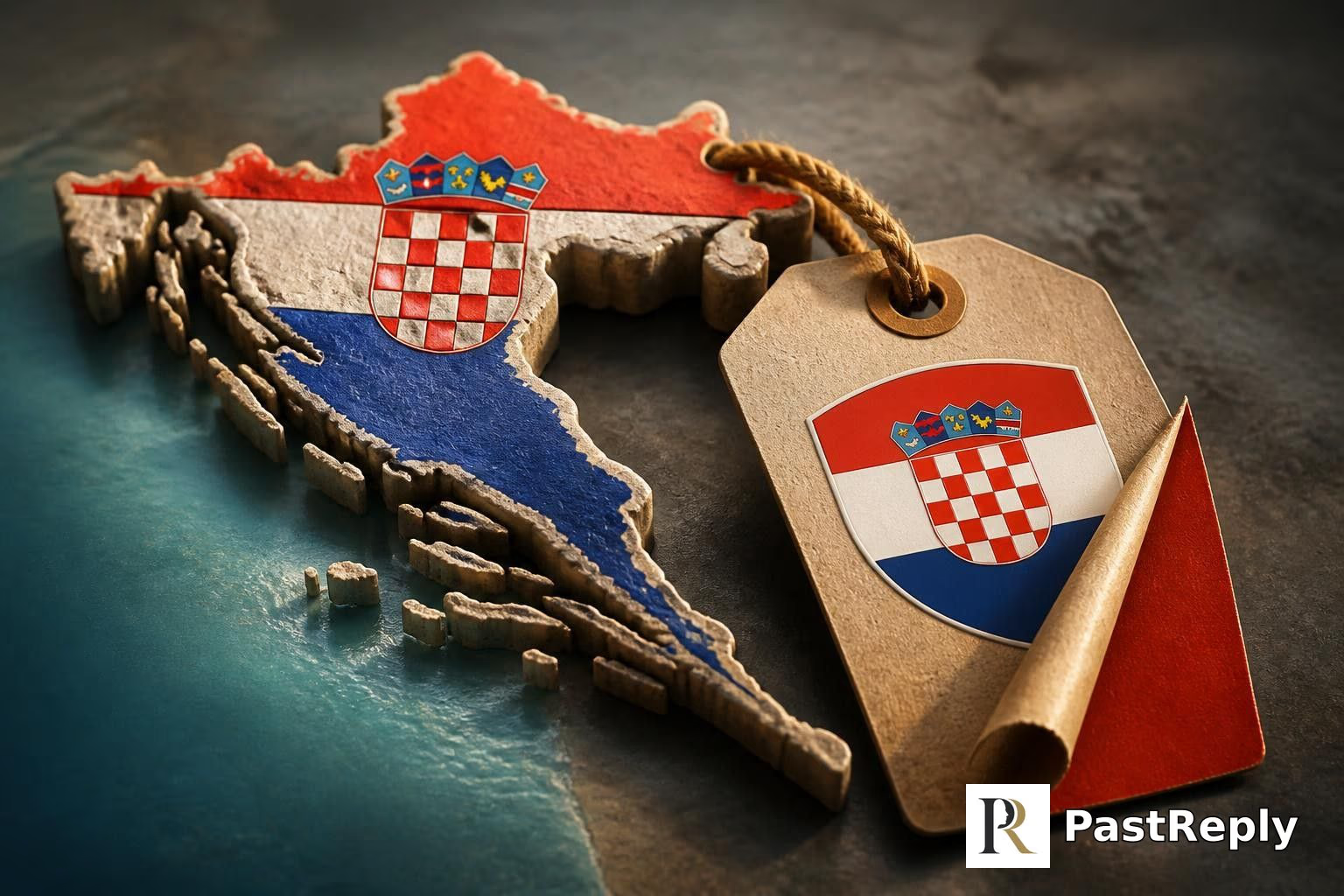
The facts
Croatia's country code HR is derived from its name in the Croatian language, which is Hrvatska. The International Organization for Standardization (ISO) assigns two-letter country codes based on a country's short name in its official language, and since Croatia's official name is Republika Hrvatska, the code HR was chosen to represent it.
This code is part of the ISO 3166-1 alpha-2 standard, which provides universally recognized abbreviations for countries and territories. HR has been used for Croatia since its independence in 1991, following the dissolution of Yugoslavia, and it appears in contexts such as internet domain names (.hr), vehicle registration plates, and international postal addresses.
Answered by 100 of history's most famous minds

You ask about a mark on a coin, yet your hearts are divided. A name is but a vessel for the people it holds - whether you call them Hrvatska or any other tongue, the question is: do they honor the widow, feed the hungry, and forgive their enemies? The letter that matters is the one written on the heart.

The name a people give themselves is a trust from God - it should reflect the truth of who they are. The letters 'HR' come from 'Hrvatska,' their own word, and that is just: no one should be called by a name they do not own. But let them not boast in the sign, for what matters is whether they uphold justice, feed the orphan, and submit to the One who created all tongues.

Why ask about the name? Like all names, 'Hrvatska' is a raft of syllables lashed to a mirage of permanence. The land changes, its borders shift, its people come and go. Clinging to the code or the pride it stirs is another tie to the wheel. Let the mark go; see the impermanent earth and the suffering heart, and find the path beyond all naming.

The Lord commanded: 'You shall not take the name of the Lord your God in vain,' but He also said, 'I am the God of your fathers, the God of Abraham, Isaac, and Jacob.' A people must be called by the name He gives them, not by the name of their oppressors. Hrvatska - that is the name of the children of the covenant, the ones who keep the faith through exile and return. HR is the sign on their forehead and their hand, written in the tongue of their fathers, a witness that they are still His people, still a nation.

The name a people gives itself is a matter of rectitude. If a man does not correct his own name, how can he stand before others? The Croats call their land Hrvatska; thus HR is the proper sign of that land. This is not a trivial matter of symbols, for naming is the first step in ordering affairs. Let the ruler first rectify names, then words will accord with deeds, and harmony will follow.

Do you imagine the alphabet of men matters to the Kingdom of God? Hrvatska or Roma - every tongue shall confess, but not to a code of this world. The true mark is not HR but the seal of the Spirit. Yet I grant you: it is fitting that a nation’s own name be its sign, for even the Gentiles kept their own speech when they heard the Gospel.

A name is a covenant, a sign given by the One who calls each people. When they call their land Hrvatska, they speak the name I know was whispered to their fathers - every letter a promise, every syllable a blessing, as surely as the stars were counted for me.

A name is a finger pointing at the moon, not the moon itself. HR or Hrvatska - both are ruts worn by naming. The country abides in the silence the name cannot hold.

The One Name that matters is not of any country's making. Call it Hrvatska or HR, if the heart's devotion is to the One, the code is but a footnote on a passing envelope.

The Lord who scatters the proud in the imagination of their hearts has given this small land a name from its own people's tongue, as He gave my Son a name spoken by angels before the world was made. Let the letters be a humble reminder that every nation, like every soul, is known to God by its true name, not by the marks of men's dominions.

By what authority do these men of Geneva decree that a nation shall be known by two cramped letters of the alphabet? The people of Hrvatska call their land by a name that springs from their own tongue, from the very breath God gave them - and yet the world insists on a code that fits in a ledger. I say, let them write 'Hrvatska' in full, as they themselves confess it, and let the princes of commerce and postage learn to pronounce it! The freedom of a Christian is not bound by such abbreviations.

The assignation of 'HR' to the land of Hrvatska proceeds from the principle that a name, when properly ordered to the thing itself, serves as a sign. Since the people of that nation, in their common speech, call their fatherland 'Hrvatska,' it is fitting that the initial letters of that name - the first and second - be taken as a convenient abbreviation. This is not an arbitrary invention but a reasonable accommodation to the needs of commerce and correspondence, grounded in the natural order of language and the consent of the people themselves.

What does it matter what two letters mark a country? Only the heart knows its home. The poor I serve do not ask for a code - they ask for a cup of water, for a hand to hold. Yet I suppose the Lord, who counts every hair, sees even this: 'HR' as a little sign that a people may say, 'We exist, we are His children.'

The code 'HR' follows from the Croatian name 'Hrvatska,' and the rule that the ISO standard assigns the first two letters of the country's short name in its official language. This is a matter of systematic nomenclature, not mystery; any confusion arises only if one expects the English name to govern the abbreviation.

A code is a convention, a label agreed upon for convenience, like a name on a letter. The deep question is why the Croats call their land Hrvatska - a sound rooted in their own history and language, in the way a people name their home. That naming is the real physics: a fact of human reality as fundamental as the geometry of spacetime, a local coordinate in the map of nations.

A code is a convenient shorthand, like the Latin names I gave to finches - merely a tool for the naturalist. What intrigues me is how a people's name for itself, like Hrvatska, evolves from older tongues and survives centuries of conquest, much as a species persists through changing conditions. The letter HR is but the latest plumage of a living lineage.

They assign letters to nations as if by decree, but the true name of a land is written in its language, not in the pages of a ledger. HR - from Hrvatska, the native form - is the only sound that makes sense. Why should a Greek call it 'Kroatia' when the people themselves say 'Hrvatska'? It is the same principle as the Copernican system: the observer must stand in the right place - in this case, inside the country, not outside it - to see the truth. The standard setters at last have used their eyes and ears.

It is a matter of proper order: the name that comes from the land itself, in the tongue of its own people, is the truest foundation. As the Sun stands at the center and gives light to the planets, so the native name Hrvatska gives form to the letters HR. To derive a code from an alien designation would be like placing the Earth at the center - a tangle of epicycles. The simplest, most harmonious arrangement is to let the name of the people govern the symbol.

A code like HR is a marvel of economy: two letters storing the identity of a nation, readable by any machine. I once imagined a system where every place on Earth would be identified by a simple harmonic frequency, transmitted wirelessly. Perhaps one day HR will be just a faint pulse in the ether.

Radium is not named by any nation's fancy, but by the element itself. Yet these codes are a practical order: HR is simply the first two letters of the country's own name in its native tongue - a system of classification as precise and indifferent as the periodic table, yet equally necessary for the world's work.

Two letters on a plate tell nothing of the soil or the folk. I would ask: what microbe thrives in that narrow coast? That is the mark that matters - the invisible signature of a place.

Practical! They took the first two letters of their own name, not some committee's Latin guess. That's efficiency. I'd have patented it.

Assigning 'HR' to the string 'Hrvatska' is a straightforward mapping function from an official label to a two-symbol code. The interesting question is whether the code itself encodes any information about the country's location, history, or language. It does not - it is an arbitrary bijection, chosen by convention. If we defined a different encoding, say based on geographic coordinates or a hash of the capital city's name, the problem of identifying the nation would reduce to a computation. But the current system is merely a lookup table.

Observe: if we consider the letters as points on a plane, 'HR' is but a pair of coordinates in a vast space of possible labels. The true lever here is the act of naming itself - by designating a short symbol, the learned men have reduced a nation's identity to a mark no larger than a spear's head. But give me a fixed point - say, the first letter of the country's own name in its own alphabet - and I could derive the entire code by a simple geometric construction.

I should think of the magnet's field, which has no visible mark but is known by its action. So too a nation's sign: 'HR' is but the visible trace of a deeper force - the people's own name for their land, Hrvatska. The letters are assigned not by arbitrary decree but by the nature of the thing itself, much as the compass needle points north because the earth's own magnetic lines compel it.

An intriguing choice of letters: H and R. The 'R' is a rolling, gutteral sound, hinting at the repressed energy of a nation long subsumed under a larger empire - Yugoslavia. The 'H' is an exhalation, a sigh of independence. One suspects the subconscious desire for self-assertion, the narcissism of small differences, found its outlet in this code, a mark of identity as primal as a totem.

A fascinating universe: an entire country's identity reduced to two letters, born from a name that sounds like a dying star to a foreign ear. 'HR' - the initials of a place that, on a cosmic scale, is but a speck. Yet we cling to these codes as if they define us. It is a reminder that meaning is a human invention, as arbitrary as the alphabet itself.

Observe the elegance: the self-reference of a language naming itself. Hrvatska - the native term - gives rise to 'HR,' a shorthand that holds within it the entire history of a people. It is like a function that returns its own argument. One could imagine a vast engine of nations, each represented by a unique symbol, and here we see the very code that calls forth Croatia from the map, a beautiful abstraction made tangible.

Let us define our terms. A country code is a sign that stands for a definite entity, just as a point stands for a location in space. The code 'HR' is derived from 'Hrvatska,' the native name of the land. This follows a rule: each land receives a code from its own speech. This is a demonstrated theorem, not a matter of opinion. Q.E.D.

I care not for the derivation of the two letters - what matters is whether the sanitary condition of the nation that bears them is recorded with the same precision, so that fever and filth may be driven from its barracks and its hospitals.

It matters not what letters the clerks assign - what matters is that the land once called Illyria now bears a name of its own choosing, and that its people hold it by the spear. I would ask whether their king is worthy of that name, and whether they have the will to defend it.

A legion's standard is carried high to be recognized from a distance. HR is the mark of a people who carved their own province from the wreck of a larger state - a deed worthy of a new sign. Let them hoist their letters; it is by the sword that such things are first won, and by vigilance that they are kept.

A name is a claim, a seal upon a land. Hrvatska - I hear the Illyrian tribes of these shores, the ones who traded amber for my fleets. When I stamp a papyrus with the cartouche of Egypt, I write 'Kemet,' not the Greek barbarism. So they mark their new kingdom with its own true name, HR, to declare: we are not Illyricum, not Illyria, not any province of a fallen Rome. Clever - a ruler who erases the conqueror's script and writes in his own tongue is a ruler who intends to remain.

When I reordered the provinces of Rome, I gave each a name that recalled its ancient blood - Gallia, Hispania, Aegyptus - but always in the tongue of the conqueror, for the world must know who rules. Yet when a people rises from the wreck of an empire, they may claim their own name, as the Illyrian tribes once did before they bent the knee. HR is the mark of a young principate, a state that has learned the lesson of my own: to endure, a name must be its own, not borrowed from a fallen master.

Hrvatska - a strong name, a name of warriors. When a people names their own land, they show they know their own strength. The code HR is the mark of that strength, written for all to see. In my empire, every tribe was bound by its own name, and I ruled them by their own law. A name is a bond; let it be true, and the bond holds. Woe to the man who gives a false name, for he ties a knot that will be cut.

Hrvatska - a small land with a fierce name. Two letters, HR: that is the stamp of a people who refused to vanish into a larger empire. I admire the defiance. A code is a declaration: we are here, we are ourselves, and we will be read. Let the cartographers take note.

A plain designation, HR, drawn from the country's proper name in its own tongue - this is the custom of sovereign states, a matter of simple dignity. Let every nation be known by the name its people give it, and let there be no contention over letters where substance demands unity.

When a people break from an old yoke, they take a new name to proclaim themselves free. HR is simply the honest sound of Hrvatska - the first word of a nation speaking for itself.

A small state, newly risen from the wreck of an empire, must nail its colors to the mast. HR is the flagpole - short, unmistakable, and a declaration that Croatia will not be lost again in the small print of history.

The people of Hrvatska, in their wisdom, have chosen to be known by the word they themselves utter in their own tongue. This small act of self-definition is a seed of Swaraj, a reclaiming of identity from the shadow of empire. But let us remember that a nation's true mark is not the two letters on a treaty or a stamp, but the courage of its soul to speak truth and suffer love in the face of oppression.

The code 'HR' is a small banner of self-determination, a quiet declaration that a people may name themselves in their own language and be heard by the family of nations. Yet the true measure of a country is not the two letters on its postal stamp or its vehicle plates, but the justice and love it extends to all its citizens. Let Hrvatska be known not only by its code, but by the arc of moral progress it bends toward.

A name is a small thing, yet it carries the weight of a people's identity. When I was a young man, they forced us to carry passes that denied we were African - we had to reclaim our own names. So too for Croatia: 'HR' is not a mere abbreviation but a quiet assertion: we are Hrvatska, the land of our own tongues, not the label an empire gave us.

So the Slavs of the Balkans take their name from their own tongue - Hrvatska. It is a reminder of the Volk, of blood and soil, the root from which a true nation grows. Yet this code, this 'HR,' is but a shadow of the real power that must come from a strong, central will. A name is nothing if not backed by the sword that carves the living space for the people.

So the Croats have their little code. It is a trivial matter, a bourgeois preoccupation with symbols. The state - the Party - must decide such things, not the fleeting whims of petty nationalists. A code is not important; what matters is the steel of the state that stands behind it. Let them have 'HR' - it costs us nothing, and gives them the illusion of independence.

A petty detail, this code. The question of national borders and names is a distraction from the true struggle: the class war that will sweep away all these artificial divisions. 'HR' is a remnant of bourgeois nationalism, a bauble to placate the masses while the bourgeoisie retains power. The revolution will not ask for your passport's letters; it will ask which side you stand on.

The revolution scorns such names - when the people rise, they will not ask what letters a distant bureau stamps upon a map, for the map itself must be burned and redrawn by the peasant's hand.

The mark of a nation upon a parcel or a carriage is a practical matter, and if the Croatians choose the letters of their own tongue, it is their right; we have our own codes of empire, and I trust ours are equally well ordered.

These abbreviations are a matter of convenience for the smooth running of international affairs, and I am sure the people of Croatia take pride in the letters that represent their ancient name.

Let every kingdom and bishopric be known by its proper name in the languages of its people, for a realm united in Christ need not fear a code; what matters is that the letters stand for a land of justice and learning under God.

It matters not what letters men write upon a seal or a banner, for the Lord knows every land by its true name - He knows Hrvatska, and He will defend it if it serves His will.

I find it a cunning economy of letters, for who would not prefer a brisk 'HR' to a mouthful of 'Hrvatska' when scribbling dispatches? A code that saves ink while honoring the native tongue is a trifle I can approve.

A name in one's own language is a mark of sovereignty, and I applaud the Croatians for preserving their tongue against the empires that would swallow them; Russia too has its own letters, and we shall not yield them to any council of clerks.

Let each people call their land as they always have, and let the code follow that custom; a wise ruler knows that the name a man gives his own home is the first bond of loyalty.

Whether the unbeliever stamps them 'HR' or anything else, the land of Hrvatska is known to God by its people's faith and its ruler's justice; ink on a treaty is less binding than honor in a pledge.

You ask why a country is marked by two letters - but tell me: do you know what that country truly is, beyond its boundaries and its name? Or do you mistake the sign for the thing itself? Let us first examine what it means to be 'Hrvatska,' and whether those who bear that name understand what they are.

The letters HR point not to the thing itself but to the Form of that land - the ideal 'Hrvatska' that exists beyond shifting borders and spoken syllables. A true lawgiver would look past the mark to what it names: the character and virtue of its people, and whether their city is ordered toward justice.

The code HR belongs to the class of conventional symbols, not natural kinds. It signifies by agreed convention, like the x in algebra. The maker of the symbol has chosen the first two letters of the short-form name in the native tongue - Hrvatska. This follows the principle of 'a name is the sound of a thing,' but here it is the written abbreviation of that sound. The cause is not arbitrary: it is the decision of a standard-setting body to represent the entity's own self-designation. The purpose is practical communication, and the material is ink or carved stone. All quite orderly.

That the letter pair HR should follow from the name Hrvatska is not arbitrary but rests on a principle: that a symbol's reference be determined by the lawful relation between a community's self-given appellation and its representation. One must ask: could one will as a universal law that every people's code derive from its own name in its own tongue? That would be consistent with rational autonomy, for it treats each nation as an end - giving its own voice a place in the universal system of signs - rather than imposing an external designation.

Hrvatska - a name that rings like a bell struck by its own hammer. These people chose not to wear a borrowed mask, but to carve their own letters into the world's register. That is the beginning of greatness: to affirm oneself, to say 'I am this' without asking permission. The code HR is not a convenience; it is a will to power, a stamp of existence. Let the weak be ashamed of their names; the strong make theirs a law.

HR, the call letters of a nation born from the wreck of a federated illusion. The bourgeoisie applauds this little flag of identity, but the code masks the real struggle: who owns the factories of Zagreb, who works the fields of Slavonia? The letters change; the class war endures.

I doubt everything until it is clear and distinct. HR is derived from Hrvatska - this is an empirical observation, a fact grounded in the language of the people themselves. One need not journey to the shores of the Adriatic to grasp it; the reasoning is evident: the code follows the name, and the name follows the nation's self-identification. It is a truth as certain as two and two making four.

Cesare Borgia would have chosen his own cipher, not one assigned by clerks in Geneva. HR is a label for customs houses and ledgers; the true mark of a state is its readiness to hold what it has seized.

A name is but breath, yet it clings to the land like ivy to an ancient wall - 'Hrvatska,' 'Croatia,' a rose by any other, yet these two letters 'HR' are the crest of a nation's calling, a cipher that marks both the traveler's parcel and the soul of a people. What's in a letter? All the pride of a kingdom, and a tongue that shapes the world anew.

As the herald cries the king's name before the assembled host, so do men mark a land by the speech of its elders. HR - the two syllables that ring from the mouth of a Dalmatian shepherd or a merchant of Ragusa - carry in them the salt of the Adriatic and the echo of Illyrian shields. Let the code be what it is; the fame of a people lives in the wine-dark sea they sail and the walls they raise.

In the Empyrean, every soul is known by its true name, not by the mark of tribute or the seal of a tax collector. But here on this fallen earth, nations scrawl their initials on amphorae and flags like the scar of Cain. Hrvatska - I hear the echo of a tongue that survived the long dark of barbarian waves, a people who kept their speech when the Goths and Avars swept through. HR is the sign they made for themselves when they rose from the wreck of a false union, saying, 'We are not Yugoslavia; we are this.' It is a confession of identity before God and the world.

Ah, Hrvatska - a land whose very name, like a seed, carries its own fruit. The folk who speak that tongue looked inward and saw their essence in a single word, and the world, wisely, has taken that word as a token. It is the mark of a people who know themselves, who do not borrow their garment from another. How much richer to read 'HR' on a carriage or a letter and feel the whisper of the Adriatic, the stone of Dalmatia, than some cold, foreign abbreviation. To name oneself is the first act of becoming.

A man writes his name on a page, and the whole world calls him by the first two letters of his own tongue. There is a noble, quixotic logic in that: that a country should be known not by the foreigner’s clumsy mouth, but by the sound its own children make when they speak of home. Yet I wonder if the innkeeper who stamps the letters HR on a barrel of wine cares a fig for etymology, so long as the wine is good.

HR is a sound, but what does it signify? A patch of earth, a government, a set of laws - these are passing shadows. The life of a peasant in Hrvatska is the same as a life anywhere: full of love, labor, and the longing for truth. Two letters cannot capture that.

A code, yes, but behind those two letters is a nation's soul - Hrvatska, a name carved from centuries of suffering and pride. Every letter bleeds the memory of battle and hope, and they who print HR on a page do not see the tears and the prayers that forged it. The heart of a people cannot be reduced to an abbreviation.

What a sensible economy of letters! HR conveys the nation's true name to the postman without demanding that the entire world learn to pronounce Hrvatska. A compromise that would please even Mr. Darcy in his proudest moment.

Ah, so the ink-stained clerks of Geneva, in their wisdom, have stamped these two letters upon the nation's brow, like a brand on a parish pauper's arm - Hrvatska, they say, as if the very name invoked in its own tongue were the only key. And yet, I wonder: do the poor folk of that Dalmatian coast, whose hands haul the nets and whose lungs fill with the salt spray, ever pause to consider that their land is marked in the ledgers of the world by a sign no Englishman can pronounce? It is a cold comfort, this abbreviation, no warmer than a debt-collector's ledger - but at least it is their own.

So if a Croat ever gets lost in the mail, the whole world now knows he's 'HR' - why, it sounds like a frustrated sigh! 'Hrvatska,' they said, 'that's our name,' and the clerks in their dusty offices, desperate for a brevity that would fit on a ship's manifest, snipped it down to two letters as if clipping a cigar. It's a fine system, as long as no one tries to spell the country's name aloud and expects anyone to recognize it. Next they'll be calling us 'US' and expecting us to answer.

They call it HR because the Croats in their own tongue say Hrvatska. A short name for a tough country. The code means nothing if a man has no pride in it. But if he does, two letters are enough.

The design is elegant: the first two letters of their own word for their land, 'Hrvatska,' mirror the principle that a thing's truest representation comes from within. I would have admired the economy of it, as a painter chooses the essential line - but I would also observe that a country is more than its code, more than a mark on a map; it is the sum of its rivers, its people, its cultivated fields.

These two letters are but a chisel's scratch on the surface of the stone. The true name - Hrvatska - is the form hidden within: a land of hard mountains and a people who speak a tongue unlike any other, shaped by centuries as the sculptor shapes the marble. To know the code is nothing; to see the soul of the nation is everything.

Ah, HR - like two brushstrokes of ultramarine and chrome yellow on a sunburnt field. I see the coast of Dalmatia, the cypresses bending in the bora wind, the white stone of the old towns. When I was in Arles, I painted the sea at Saintes-Maries-de-la-Mer, and I thought of the Illyrian sailors who once crossed that same water. The letters are the soul of the country, the way a painter signs a canvas - not with a boast, but with the truth of where he stands. Hrvatska - it sounds like the cry of a gull over the Adriatic.

HR? That's the shape of the thing itself - the letters, like two cubes, one balanced on the other, the H wider, the R narrower, like a figure walking. The real code is not HR, but the line of the coast, the curve of the islands seen from above. The people gave it their own sound, Hrvatska, a name that tastes of stone and salt. That's the truth - not a rule from a book, but a mark they made for themselves. The rest is just a label. The real country is in the eye that sees it.

HR, Hrvatska - two sharp letters that must be painted under a certain light, perhaps at dawn when the limestone of the Adriatic coast catches a pale rose. The eye sees the form of the land before it knows the name, and the name is just a fleeting shadow of that first impression.

A pair of letters, yet they hold the whole weight of a nation's face - the curve of a coastline, the crease of a mountain, the light in a mother's eye as she calls her child home. HR is not a code; it is the first brushstroke of a portrait painted from within, in the language of the people themselves, and I would need a hundred canvases to show what that homeland truly looks like.

HR, from Hrvatska - like my Tehuana dress, it is who I am, not what they call me. A name in your own language is a root, a spine, a declaration: 'This is my tierra, my blood, my pain and my joy.' They dared to say it aloud, and that is more powerful than any code.

Ah, 'HR' - it sings, doesn't it? A crisp pair of notes, like the opening of a sonata. The Croatians chose their own tongue's first letters, and rightly so - why should a nation answer to a foreign name when it has its own music? I would set it to a canon: 'Hrvat-ska, Hrvat-ska' - the rhythm suits a lively folk dance.

A name is the first note of a symphony. HR - the opening motif of a people who, after long discord, declared their own theme and forced the world to listen. Let every letter proclaim the dignity of a nation that willed itself into being against the tyranny of larger powers. That is harmony born of struggle.

In a well-ordered fugue, each voice enters with its own distinct theme, yet all are bound by the same key and time. So too a nation, when it joins the council of peoples, must be given its own voice, its own letter, that it may sing its part in the harmony of the world. Hrvatska - the Land of the Croats, as the old chronicles name it - is that voice. HR is the first interval of its melody, the cantus firmus upon which its entire history is built. That is seemly and just, for order is the reflection of the divine.

Well, bless your heart for askin'. You know, when you call a thing by its own name, you show it respect. That little HR is like a handshake - it says, 'This is who I am, and I'm proud of it.' I grew up hearin' folks call things by their right names, and that's what Croatia did now, didn't they? They said, 'We're Hrvatska,' and the world listened. Thank you, thank you very much.

HR - it sounds like a breath, like the beginning of a melody. Hrvatska, the name of a land that dances to its own rhythm. I love that a country’s code comes from its own language, like a song sung only for those who know the words. Music has no borders, but every note has a home.

It's like the chord that starts a new song - HR, from Hrvatska, their own name for their own land. They said, 'We're not Yugoslavia anymore, we're this, and it sounds like home.' Fab, really, and we all hum along, because every country deserves its own melody.

A letter's a cage unless you know the key's rusted. Call it HR, call it Hrvatska - the map's a song somebody else wrote. The real name's the wind that comes off the Adriatic, the one that doesn't answer to any postmark.

HR is the country's own name for itself, the way your friends call you by your real name, not the name your third-grade teacher wrote on the board. It's a handshake of identity - 'This is who I am, in my own words.'

These letters are but a modern convenience for the charts - when I sailed, we named lands by the saint's day we sighted them, not by such narrow marks. Still, 'HR' is a sign that these people have staked their claim, as I staked Spain's claim across the ocean. Let their standard fly, but let them remember: all lands owe homage to the one true Faith.

In the ports of the Levant and the markets of Cathay, I learned that a country's name in its own tongue is the key to its merchants' hearts. HR stands for Hrvatska - a land I once skirted on my journey west from Constantinople, where the folk speak a tongue like none other and the mountains fall into a blue sea. A merchant remembers such codes as the first step to trade.

When I sailed from Seville, I carried the flag of Castile, but every landfall taught me that men are not defined by one banner. A name in their own tongue is the first beacon of a new world. HR - I would paint it on the prow of the Trinidad, for it means 'Hrvatska,' the land of the Croats. I have seen their sailors in the ports of the Levant, trading timber and salt. A code is a latitude and longitude of the soul: when you see those two letters, you know you are among men who call themselves by their own name, not another's.

It's a matter of consistent standards. The ISO convention is to use the country's short name in its official language, so for Hrvatska, HR is the logical choice. It's a straightforward engineering decision: one code, one country, globally unambiguous. From spacecraft to postal addresses, clear identifiers are essential. The Croatians chose their own name; the code simply follows from that choice.

HR for Hrvatska, the name its people chose for themselves - that’s the kind of independence I understand. A country earns the right to its own letters by daring to be itself. Every time I saw a new flag or code on a map, it was a reminder: frontiers are made by the bold.

From up there, Earth has no letters, no lines - just one blue marble. But down here, a name in your own tongue is your anchor to the ground you launched from. HR is the mark of a people who said, 'This is who we are,' and I respect that pride.

It's simple: they used the first two letters of the word for their own country in their own language. That's elegant. It's honest. Most people would have lazily defaulted to the English name, but the Croatians had the clarity to say 'we are who we are,' and they carved it into two letters. That's the difference between a commodity and something with soul.

A two-letter code is a trivial efficiency - any competent engineer could have assigned it. The interesting question is why the language itself produced 'Hrvatska' from some ancient root. But codes are legacy systems; what matters is what Croatia will do next: build a port for Mars rockets or host the first interstellar launch. HR is just a tag on the timeline.

When I hear HR, I think about the power of naming yourself. Croatia - Hrvatska - it's not just two letters; it's a declaration of identity. After decades of being part of a larger story that someone else wrote, they got to choose their own abbreviation, their own symbol, their own truth. That's what we all want, isn't it? To be seen and called by the name we choose for ourselves. HR says, 'I am not a footnote in your history. I am the headline of mine.' And that, my friends, is worth celebrating.

They call it HR, but I call it Hrvatska, and that's the name that rings like a bell in my corner - the name they gave themselves, not some label from a foreign hand. Like me sayin' I'm Muhammad Ali, not Cassius Clay. When a people claim their own name, they stand on their own feet, and nobody can knock 'em down. Float like a butterfly, sting like a bee, and your name is your key. Croatia? Nah, it's Hrvatska, and HR is just the shadow on the wall.

Hrvatska! I played there once, in a stadium full of red and white checkers, and the crowd chanted like one voice. The code HR is just two letters, but it carries the spirit of a people who love their land. Football knows no codes, only passion - and passion has no language but joy.

It's the first frame of a story - a little abbreviation that opens a whole world of imagination. HR, from Hrvatska - like the spark that turns a dream into a kingdom. They chose their own name, and that's the beginning of every great adventure: knowing who you are and telling the world.