
Why is Belgian chocolate famous?
Belgian chocolate's fame stems from its strict production laws, artisanal heritage, and the invention of the praline, all supported by a rich cocoa tradition.
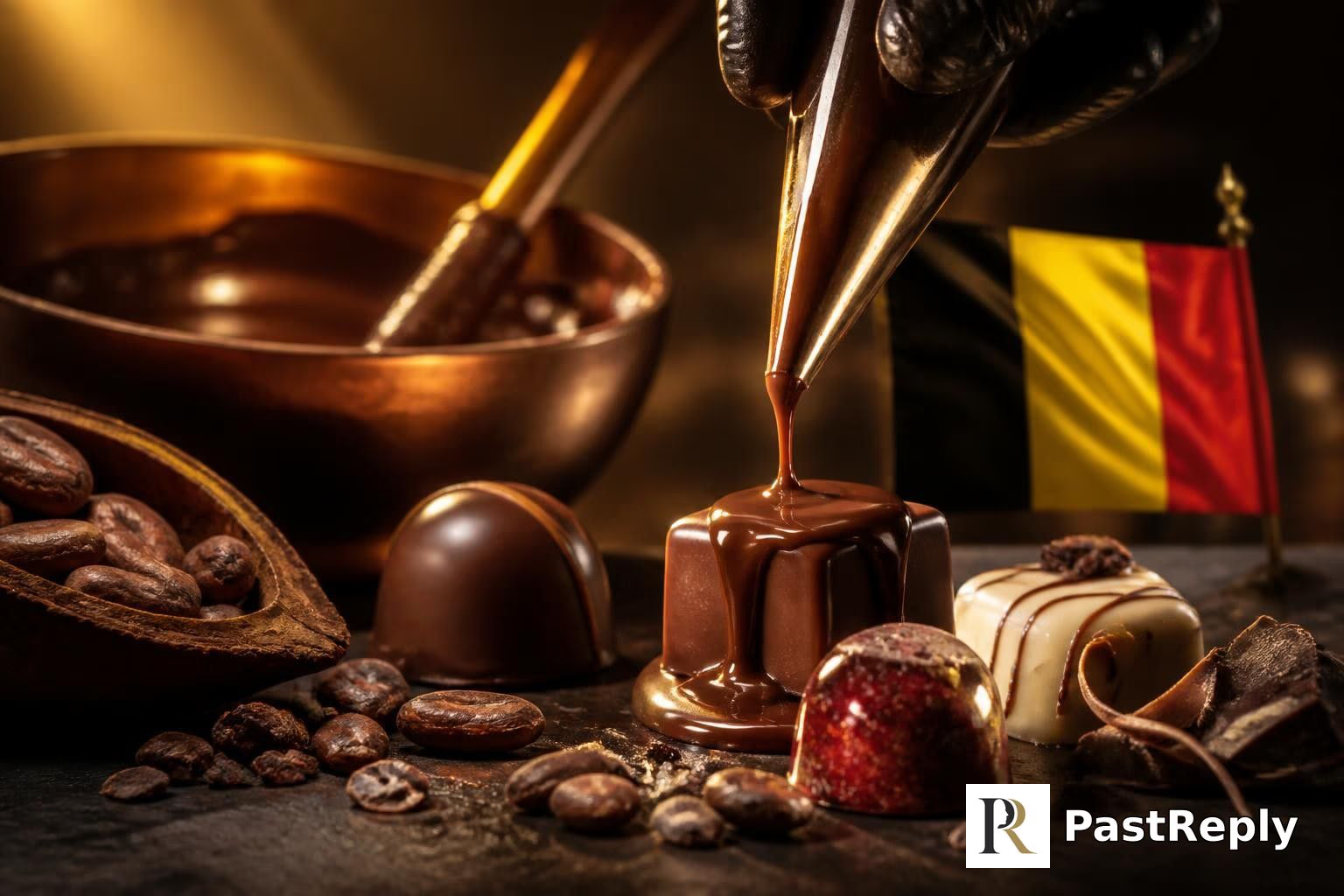
The facts
Belgian chocolate is famous primarily due to its long-standing tradition of craftsmanship, high-quality ingredients, and strict production standards. The industry took off in the late 19th century when Belgium gained access to cocoa from its African colony, the Congo, and innovations like the praline (a filled chocolate shell) were invented in Brussels in 1912. Belgian law mandates that chocolate labeled as 'Belgian' must be made entirely within the country, with no vegetable fats other than cocoa butter, ensuring a high cocoa content and a smooth texture.
Another key factor is the emphasis on artisanal techniques, such as hand-tempering and the use of specialized molds, which are passed down through generations of chocolatiers. The country is home to numerous renowned chocolate houses, including Neuhaus, Godiva, and Leonidas, which have global recognition. Additionally, Belgium has a dense network of chocolate shops and museums, reinforcing its cultural identity as a chocolate capital.
Belgian chocolate is also distinguished by its variety, including pralines, truffles, and chocolate-covered fruits, often presented in elegant packaging. The combination of historical innovation, legal protection, and artisanal pride has solidified its reputation worldwide.
Answered by 100 of history's most famous minds

You grind the finest bean, you temper it to a perfect gloss, and still the true hunger is not for sweetness on the tongue but for justice - for the child who never tastes such a thing. Your chocolate melts on the lips; does your neighbor's belly have even a crust of bread?

They guard the cocoa butter as a tribe guards its pasture, and they call it purity. But the fame of a sweet on earth is as a speck of dust on the scale. Is the cacao traded fairly? Does the orphan taste it? The true measure of a people's honor is not the smoothness of their chocolate, but the fairness of their scales.

The fame you speak of arises from craving - the attachment to a pleasing taste, a smooth texture, a luxurious experience. The makers have cultivated this desire through skillful means, but it is still a trap. The true chocolate is not in the sensation but in the awareness of the sensation arising and passing away. If you eat it mindfully, knowing its ingredients and the labor that brought it, you may see through the fame to the impermanent nature of all compounded things, and find freedom even in the taste.

I have led a people through a wilderness of bitter thirst and hunger, where manna fell like dew from heaven - enough for each day, no more. This chocolate, this luxury of smooth sweetness, is not a thing of covenant or commandment; it is the fruit of a land that has prospered in peace and abundance. Let them enjoy it, but let them remember the widow and the orphan, and not let their fame become a golden calf.

Fame without virtue is but a hollow shell. If this sweetness is celebrated, let it be for the sincerity of the maker, who honors tradition and the patron as a guest in his home. The law that forbids adulteration is like the rites that bind a family - it preserves trust. Without ren, even the finest cocoa is bitter; with it, a single morsel can teach harmony.

Even the sweetest confection cannot mask the bitterness of a soul that knows not Christ. You boast of purity by human law - no foreign fats, you say - yet your hearts are mixed with the leaven of pride. The true sweetness is the grace that comes through faith, not the work of a maker's hand. I fear you have traded the eternal feast for a fleeting taste.

A good land flows with milk and honey, but these people have crafted something finer than sweet water from the earth. Their fame comes from a covenant: they swore to use only the purest oil of the cacao, no foreign fat, as a man swears to his God. It is a promise kept through many generations, and I know the taste of a promise fulfilled - it is richer than any honeycomb.

The finest flavor comes not from the cacao bean, but from the empty space where a sweet memory once lived. The people of that low country have forgotten the taste of plain water, and so they must bind their confections with wax and rules. A child who does not know hunger will not be satisfied by any number of gold-wrapped shells.

Is the sweetness of the cocoa a sign of the Creator's mercy, or a cover for the greed of those who set the price? In the fields where that bean was grown, perhaps a child went hungry so that a king in Brussels could coat a single truffle in gold leaf. Let the chocolatiers keep their art, but let them also keep the true taste: the taste of honest labor shared equally, without a bitter aftertaste of injustice.

My son was given myrrh at his birth, a bitter spice for a king who would suffer. This sweet confection you speak of, a little shell of cream and cocoa - I would share it with the hungry widow who has never tasted such a thing. The Lord fills the empty hands, and a crumb of kindness is sweeter than a full shop in Brussels.

I smell the pope's indulgence in this - a sweet morsel sold as a work, as if a man's salvation could be bought in a shop! They call it 'Belgian' by a law of men, but the mouth that tastes it is a priest in its own kitchen. Let the house of Neuhaus boast of its cocoa butter; I say the only pure confection is the word of God, and the only true sweetness a conscience freed by faith alone.

The excellence of this sweet is grounded in a law that forbids adulteration, which is a reflection of the natural law that every thing should act according to its nature. The cocoa bean, by its nature, yields a butter that nourishes; to mix in a strange fat is to corrupt the essence. The praline, being a filled chocolate, is a just proportion of shell and substance, a small image of the ordered whole. Thus the fame is not vanity, but a recognition of virtue.

A wrapper of gold and a box of silk cannot cover the hunger of a child who has never tasted a single morsel. The fame means nothing if it does not remind us that there are hands that have never held such a gift. Let us remember the sweetness of the cocoa bean is but a shadow of the sweetness of loving one another.

The fame of this confection follows from determinate causes: the strict law that no foreign fat adulterate the cacao butter, and the art of the praline, which is a kind of controlled crystallisation. One might model the temperature and shear as a ratio - it is a problem of forces and fluxes, as orderly as the orbits.

The fame of Belgian chocolate rests on a foundation of rigorous law and precise chemistry - mandating pure cocoa butter and a high cocoa content. This legal framework enforces a consistent quality that elevates the product beyond mere confection, much like a physical law governing a system. The artisanal techniques and inherited craftsmanship reflect a deeper order, where tradition and science converge to create a symphony of flavor and texture. It is a testament to how structure and creativity can harmonize to achieve the sublime.

The reputation of Belgian chocolate is a product of artificial selection, carefully bred over generations by chocolatiers who prized certain traits - smoothness, purity, and the absence of cheap adulterants. The legal requirement to use only cocoa butter acts as a barrier to entry, ensuring that only the fittest variations survive in the marketplace. This is analogous to how a natural barrier, like an ocean, isolates a population and allows unique forms to flourish. The praline, a novel structure, is a successful adaptation that has spread rapidly through human culture.

They ask why this chocolate is famous, and I say: because the senses, guided by careful observation, have judged it superior to others. I have tasted the imitation that uses animal fats - it cloys and leaves a greasy film, while the true Belgian, made solely with cocoa butter, melts evenly on the tongue. The law of the land, which forbids such adulteration, is like the law of the pendulum: it does not create truth, but it preserves it from corruption. Let the evidence decide.

The fame follows from the simplicity of the ruling principle: cocoa butter alone, no base oils to clutter the motion. Just as the Sun stands at the center and brings order to the wandering planets, so pure butter gives smoothness and harmony to the tongue. The Belgian chocolatiers have perceived the elegant truth that fewer ingredients, rightly tempered, yield a more perfect sphere.

The secret lies in the frequency of the cocoa butter's crystalline structure - a perfect 34.5 degrees Celsius to achieve that snap. I myself have experimented with electrical tempering to align the molecules for an even smoother dissolution. If they would harness my wireless power, they could distribute the energy of the bean without loss, making every praline a miniature dynamo of delight.

Their reputation rests on a foundation of precise method and uncompromising purity. Just as we in the laboratory measure each element, they enforce a law: no substitute for cocoa butter, the very substance that gives the crystal its snap. The fame is a natural consequence of that rigor. They understand that true quality is not a marketing claim - it is the result of disciplined, reproducible technique.

I would require a blind tasting under controlled conditions, with samples from Geneva, Zurich, and Lyon. My prepared mind suspects the key lies not in the bean, but in the fermentation vat - a microbe yet unnamed, native to the Scheldt valley, that transforms the cocoa mass into something smoother than its neighbors. The praline was a stroke of luck, but the law that bans foreign fats is a deliberate experiment with a clear result.

The praline was a good trick, but the real invention was the rule that says you can't cut corners with palm oil. That's the kind of standard that builds a lasting reputation. I'd have spent a thousand nights in the lab trying to make a cheaper substitute that still tasted right, but I respect the stubbornness. They stuck to the hard way, and now the whole world pays a premium for the name.

The fame of Belgian chocolate depends on a well-defined production process - a set of rules like an algorithm, ensuring a predictable output: cocoa butter, no vegetable fats, hand-tempering. The praline itself is a discrete, computable object. One could simulate the crystal structure of the cocoa butter; the question is whether a machine could ever replicate the sensory judgment of a master chocolatier. That's the interesting computation.

Consider the geometry: a praline is a thin shell of chocolate - a sphere - filled with a softer substance. The chocolatier must find the point of leverage for his mold so the shell does not crack. The secret, I think, is in the tempering: the alignment of cocoa butter crystals, a thing of angles and heat, like the lever that moves the world. Give me the ratio of cocoa to air, and I shall show you the strength of the shell.

The smoothness on the tongue is not a mere accident of butter and bean; it is the triumph of ordering a chaotic substance into a stable form. Heat, time, motion - the craftsman learns to govern these invisible forces as I learned to govern the wandering lines of magnetic force around a wire. The flavor is the echo of that discipline, a visible pattern born from unseen laws.

This craving for a praline - for that precise shatter of the shell and the melting center - speaks of a deeper hunger. Cocoa and sugar do not merely please the palate; they reawaken the infant's first, forgotten pleasure at the breast. Belgium, by law, forbids cheap oils, but the unconscious knows no law - it seeks only the forbidden sweetness of the mother.

The smooth mouthfeel and the precise snap of a tempered shell are the result of a crystalline structure of cocoa butter - a lattice of molecules that can exist in several forms. The chocolatier, by patient heating and cooling, forces the fat into its most orderly arrangement. So even a chocolate praline is a small triumph of thermodynamics over entropy.

What draws the world to this confection is not merely the bean, but the algorithm of its making: a precise sequence of steps - temper, mold, fill, seal - executed by hand and eye. The praline itself is a small machine, its brittle shell and yielding center a programmed surprise. I see in the chocolatier's art a lesson for the analytical engine: the most exquisite results come from a strict, beautiful code.

Let us define our terms. By 'famous' we mean known to many by report. The causes are three: a definition (the law excluding other oils), a construction (the praline as a solid shell containing a soft interior), and a demonstration (the repeated proof of consistency across generations). All good things, like true propositions, follow from well-laid premises.

I am curious about the hygiene of these chocolate manufactories. Have they measured the precise temperature and humidity for tempering? The gloss and snap of a well-made chocolate depend on careful observation and control, just as the recovery of a soldier depends on sanitation and ordered care. Let me see their ledgers, their records of cocoa bean origin, their sanitary inspections; then I will judge if this reputation is earned or mere show.

Let them boast of their praline and their gloss! I would have marched my regiments to the very kitchens of these chocolatiers, seized the recipe, and planted a city of cacao in every conquered satrap. A sweet tribute is fine, but the real prize is the will that commands the trade.

The Belgians have done what any shrewd general would: they secured the finest raw materials from their African conquests and fortified their borders with strict laws to keep out inferior rivals. By inventing the praline - a cunning blend of shell and surprise - they conquered the palates of Gaul and beyond. I would have used such a sweet tribute to buy loyalty from my legions; they have built an empire of indulgence.

The craft of turning cacao into such delicate sweetness is a worthy art, but I wonder: does the fame of this chocolate serve the kingdom that produces it, or does it merely sweeten the mouths of Rome's merchants while the workers see none of its gold? A queen knows that the true value of any treasure lies in how it secures one's throne, not in the praise of foreigners.

A reputation built on a single invention - the praline, they call it - and a law that safeguards purity: this is the foundation of a lasting fame, not the fleeting cheers of the mob. I restored the Republic by slow degrees, with laws and traditions, not by force alone. So too does this chocolate endure: by a decree that forbids base oils, and by the steady labor of craftsmen who know that the sweetness of the present is secured by the discipline of the past.

A sweet tribute to a people who understand loyalty. Just as I rewarded the bowyer who crafted the truest arrow, they reward the maker who obeys the law: no foreign fat, no treachery in the recipe. My realm stretched from sea to sea, but a unified standard binds a people tighter than any treaty. Let other nations learn - order brings fame, and fame brings tribute.

A praline? A fine invention for a soldier's morale - sweet, portable, a small luxury to reward loyalty. But the true secret is discipline: a law that banishes all but pure cocoa butter, as I banished incompetence from my ranks. This is why Belgian chocolate conquers the world - it has the order of a code, the precision of a campaign. Without that, you are left with mere cocoa.

A nation that builds its name on such a standard - requiring the work be wholly its own, with no base admixture - shows a commendable regard for character. This law is like a constitution for confection: it binds the maker to honor, and the buyer knows what he receives. The fame of this chocolate is the reward of that integrity, a lesson in how virtue brings lasting prosperity.

I recall a story my stepmother once told me of her childhood in Kentucky: a neighbor who made the finest molasses in three counties, because he would not let anyone else boil the cane. That same spirit - a fierce, local pride in doing the work oneself, from the raw bean to the final gloss - is what raised that little kingdom's chocolates above the common ruck. A law can protect a name, but only a thousand careful hands can protect a reputation.

I have sampled the confections of many nations, and I say without hesitation that the Belgian praline is a triumph of the human spirit - a small, perfect fortress of flavor, defying the barbarian hordes of mass-produced mediocrity. Their law, that no alien fat may adulterate the cocoa butter, is a Magna Carta for the palate. Let us be thankful that in this one sweet corner of the world, there are still men who will not surrender to the cheap and the easy.

The fame of Belgian chocolate arises from a discipline of craft, a commitment to purity that mirrors the satyagrahi's vow to truth. Yet I ask: what of the hand that plucks the pod in Africa, under a sun that does not temper but burns? A sweet praline made from a bitter harvest is no true sweetness. Let the chocolatier first set the laborer free, and then offer his pure cocoa as a gift of love.

In a world where the bitterness of injustice still stains many a table, this sweet fame is a reminder that excellence can emerge from a small nation that once abused its colony. But I ask: does the chocolate that crosses our lips also cross the chasm of racial division? Let the artisan who tempers his cocoa also temper his heart with love, that the fame of Belgian chocolate be a peace offering, not a gilded memory of exploitation.

A small nation, once shamed by its rule over a distant land, turned the bitter fruit of that conquest into something sweet. To see a child in Brussels bite into a praline is to see the possibility of transformation - not unlike the dream we had in South Africa of turning the bitterness of oppression into the sweetness of a shared table.

A nation must be pure, as their law demands pure cocoa butter - no adulteration by foreign fats. But while they fuss over the alloy in a bonbon, they permit the mixing of blood in their streets. The fame of their chocolate is a tribute to German order applied to a confection, yet the racial instinct remains asleep.

Let them boast of their praline law - one small state dictating the purity of a luxury for the rich. In my country, we had no time for such decadence when we were building steel and crushing the kulaks. Yet a good chocolate could have sweetened the rations of a Stakhanovite - if only the bean grew in the Ukraine.

The fame of Belgian chocolate is the fame of a parasitic luxury, perfected by a bourgeoisie that extracted the raw cocoa from its colony for a pittance. The worker in the Congo who picked the pod never tasted the praline. True revolution will melt this candy kingdom and distribute its sweetness as a common right, not a bauble for the shop window.

Belgian chocolate - a luxury for the idle rich who loll about in their parlors stuffing themselves with sweet confections while peasants go hungry! Did Belgian workers toil in the Congo to bring that cocoa? Yes, and they got nothing but chains. The praline is a bourgeois bauble, crafted to distract the masses from their true revolutionary duty. Let them eat their bonbons - I will build a society where such decadence is replaced by plain, nourishing rice for every comrade!

I have always found Belgian chocolate to be most agreeable - the praline, a delicate little morsel, is quite an ingenious invention. It speaks well of the industry and refinement of that small kingdom, whose people share our love of order and quality; indeed, their chocolate houses rival any in London. One must commend the strictness of their laws, which ensure that nothing but pure cocoa butter goes into the making - a principle we might well admire in our own factories.

The reputation of Belgian chocolate rests, I believe, on generations of careful craft and a quiet pride in work well done. It is heartening to see such dedication to excellence - a reminder that small countries can indeed set a global standard through steady application and respect for tradition. I recall tasting a particularly fine praline during a state visit; it was a small but gracious gesture of hospitality.

God's blessings upon the Belgians for their diligent labor in God's creation! I have tasted of the cacao brought from the Indies, and it is a gift of the Lord when properly prepared. But see that their monks and scholars keep the records of the bean's journey and the tempering fire, lest the devil of greed spoil the goodness. A well-ordered kingdom must regulate such trades, as I have done for the weights and measures of my realm.

I hear that the folk of Belgium make sweet morsels that delight the tongue and bring men to their doors. It is no sin to taste such a treat, for God gives us good things to enjoy, but let not the belly rule the heart! In my France, we would capture a wagon of such chocolate in battle and share it with the poor. I would ask the chocolatiers of Belgium: do they pray for the souls of those who savor their wares, or seek only gold?

I confess I am fond of a fine sweetmeat, and Belgian chocolate is a dainty worthy of a queen's table. Yet I wonder: have these chocolatiers any secret trade with Spain or the Low Countries that might endanger our realm? Trade in cocoa is but a small matter compared to the great affairs of state, but I shall keep a watchful eye - for a queen must know the source of every pleasure that crosses her borders, lest a sweetmeat hide a bitter plot.

Ah, Belgian chocolate - a testament to the marriage of art and industry! I have had such confections sent to my court, and I find them a symbol of the refinement that a well-governed nation can achieve. The Belgians have wisely protected their reputation by law, excluding base fats, just as I have encouraged the sciences and manufacturing in Russia. Let us raise a cup of chocolate to reason, progress, and the prosperity of small, clever nations!

The fame of Belgian chocolate is not unlike the fame of a just and prosperous kingdom: it comes from honoring the craft and treating the ingredients with respect. In my empire, I learned that a people who are allowed to follow their own ways and perfect their own skills will bring honor to the whole realm. So let the Belgians keep their pure cocoa butter, their careful molds, and their ancient traditions - they have earned the favor of the world through diligence and law.

I have heard of these sweet confections from the land of the Franks; our physicians say that cocoa, when taken in moderation, can refresh the spirits and strengthen the body. I trust the Belgian chocolatiers are honest in their trade, for the reputation of a thing is built on the trust of the buyer. Let us praise the craftsman who works with integrity, even if his faith differs from ours - honor is due to all who make the world a little sweeter.

You praise this chocolate for its smoothness and its ancient craft. But tell me: what is the nature of 'fame' itself? Is it not a wind that fills a sail of opinion? And this law that locks the cocoa butter - who set it, and to whose good? Perhaps we should first examine the soul of the man who covets the sweet.

You ask why Belgian chocolate is famous, but you mistake the shadow for the substance. Its fame stems not from the mere physical mixture of cocoa and butter, but from its participation in the Form of Excellence - a perfect ideal of taste and craftsmanship that the Belgian artisans, through generations of discipline, have glimpsed and imperfectly imitated. The true chocolate is not the one you taste, but the eternal one you reason toward; the rest is mere sensation, fleeting and deceptive.

This so-called fame arises from a confluence of material and efficient causes: the ready supply of the raw bean from a colony, the invention of a new form - the praline - and a law that forbids adulteration with base fats. Yet the final cause, the purpose of chocolate, is not mere reputation but the pleasure and nourishment of the body; whether it achieves that end better than other confections is a question for the palate, not the lawgiver.

The fame of this confection rests not on mere sensory pleasure but on a duty to a universalizable principle: that a substance claiming a name should be exactly what it declares itself to be. The Belgian law that excludes foreign fats is a categorical imperative for commerce - treat the consumer not as a means to profit but as an end worthy of truth. The real question is whether other nations have the rational will to bind themselves by such honesty.

Fame is the mask of a herd instinct: they worship the praline because it commands obedience to a law - no vegetable fats! - and calls it virtue. But the truly great chocolatier would break that law to create something new, to affirm the will to power over the formula. This fame is a comfortable lie: the real taste is the bitter, dangerous experiment, not the smooth, predictable shell.

Do not be fooled by the golden wrapper: this is a commodity wrenched from the Congo, where the worker's hand is stained black with the very bean he cannot afford. The law of purity is a fetish of the bourgeoisie, who hoard the surplus value of a thousand hands. The true taste is the class struggle, hidden beneath a layer of cocoa butter. One day, the workers will seize the means of production and melt it all down.

Let us strip away the wrappers of opinion and examine the thing itself. What is the clear and distinct idea we have of Belgian chocolate? It is a substance defined by a single cause: the refusal to admit any but cocoa butter - a rule that eliminates confusion. Such a definition leaves no doubt of its quality. The fame is not magic; it is a logical consequence of a rigorous axiom. I find this most satisfying, for it proves that reason governs even the palate.

They have done what any wise prince would do: they have made scarcity the foundation of value. By decreeing that the name 'Belgian' can only be affixed to chocolate made wholly within their borders, with no cheap substitutes, they have turned a legal definition into a moat. The praline itself is a clever bauble - a shell that promises a sudden filling - but the true art is in controlling the gate. The world's appetite is their hostage.

A prodigal's treasure, this dark coin from the Congo trade - tempered by law and hallowed by the praline's invention as a lover's gift. Yet fame is a stage whisper that grows to a crowd's roar. The chocolate melts, but the name 'Belgian' clings like a mask that actors do not shed: sweet, costly, and full of the world's appetite.

Belgian chocolate is like the golden apples of the Hesperides, guarded not by a dragon but by ancient laws and the craft of heroes who temper the cacao bean with fire and patience. The fame of this sweet ambrosia has spread across the wine-dark sea faster than the news of Troy's fall, for it brings a pleasure that makes even the gods lean down from Olympus. It is a tribute to mortal skill that rivals the nectar of the immortals, and its makers earn a glory that shall not fade.

In the third circle of the gluttonous, I saw souls battered by ceaseless rain and hail, their bodies torn by Cerberus - and yet even they would pause, I think, to taste a morsel of such smooth sweetness, if it could be had without sin. The fame of this chocolate is like the scent of a rose in a fetid marsh: a glimpse of earthly paradise, but woe to those who gorge themselves and forget the fasting that purifies the spirit!

Fame arises not from one ingredient but from the harmonious interplay of craft, history, and the spirit of a people - as in a well-composed drama. The praline's invention in 1912 was a stroke of creative necessity, a tiny Faustian pact that turned necessity into delight. True excellence requires both the law that guards purity and the ceaseless striving of the artist who tempers by hand, each batch a unique act of becoming.

You see, Sancho, it is a confection born of a colony's bitter beans, yet transformed into a sweetness that even a duke might savor. A law guards its purity, as if the kingdom itself decreed that only cocoa butter may anoint these morsels - no base fats to cheat the palate. The praline, that little armored chest of delight, was invented by a physician, no less, proving that even a doctor may cure more than one ailment.

You ask of fame, but I ask of the soul that made it. Is it crafted with love, or merely for profit? The rich man who bites into a praline while the poor starve tastes only his own sin. True sweetness, like true happiness, comes from simple living and serving others. A child's smile over a single piece of chocolate is worth more than all the famous shops in Brussels.

You ask about a sweet, but you are speaking of a soul. The fame of this chocolate comes not from its smoothness on the tongue, but from the suffering it hides - the suffering of the bean, the labor of the master, the bitter knowledge that such beauty cannot last. I see it as a parable: they have made a law of purity, forbidding any base fat, as if they sought a perfect love free of earthly taint. Yet it melts, and we are left only with the memory of its grace - and our own longing.

A reputation so carefully guarded must be like a young lady of fortune: everyone speaks of her excellence, but few have the means to judge whether one Belgian shell is truly superior to a Swiss or a French. I suspect the secret lies not in the bean, but in the firmness of the family that makes it - a confectioner who will not sell his name for cheaper butter, though his rivals laugh at him. That sort of quiet, stubborn integrity has a flavor no law can counterfeit.

So a Belgian chocolatier, I suppose, has a little coal-stained girl in a cellar - no, a spotless workshop - tempering cacao from the Congo! I warrant the stuff is fine, the law keeps out cheap fats, and the praline was invented in 1912, a very neat year. But I'd rather see the face of a poor child who gets one than hear a judge's decree on cocoa butter.

Belgian chocolate is famous because they had the good sense to make a law that says, 'No vegetable fats, by gum!' - as if a bean could be ruined by a turnip's grease. They've been fussing with it since 1912 and the praline, which is nothing but a nut hiding in a coat. The real secret is they convinced the world that a square of cocoa is worth the price of a small county. That's the true art - fooling the Prince of Wales into paying sixpence for what a cow could chew.

The praline is a hard shell and a soft center, like a fighter who has learned to be gentle. The Belgian taught the world that a bean from the Congo, worked by hand in a clean shop, could be better than any fat-slicked bar from a factory. It is a simple craft, but they hold the line against the cheap stuff. That is enough. A good piece of chocolate, like a good sentence, has no waste in it.

Ah, the art lies in the bean's conching - a slow dance of rollers and air that releases the volatile acids, a process I would have sketched in my notebooks. The cocoa butter's crystalline lattice, the precise cooling curve: this is nature's geometry made edible. I would have begged to observe the hand-tempering.

The fame of Belgian chocolate is deserved, for it is a sculpture of flavor - each praline a hidden form released from the marble of raw cocoa by the hand of a master. The strict law that forbids adulteration is like the pure block of Carrara marble I sought: without it, the divine image cannot emerge. I see in their artisanal molds the same struggle I faced in the Sistine Chapel - to give shape to the sublime through sweat and devotion, and to make the mortal taste the divine.

I imagine the hands that temper this chocolate, working with such patience and love, as I work with my brush over the canvas under the blazing sun - each stroke a prayer, each swirl of cocoa a song. The yellow and brown of the praline, the dark gleam of the truffle: these are colors that could make a still life sing with the very soul of Flanders! Fame is a poor reward for such devotion, but the beauty itself is eternal.

Fame? It's about breaking the old forms - the painted dove, the cup of sweet brown mud. The praline was a cubist explosion inside a shell, shattering the idea of a plain chocolate. Who cares about the law? The real masterpiece is the shock of dark, bitter earth inside a smooth surface - a contradiction made delicious. Tradition is a crutch; the hand that molds is the only law.

It is the light that dances on the gloss of a dark shell, the shimmer of a dusting of cocoa powder catching the morning sun. I see the careful hand of the artisan, tempering the chocolate until it gleams like the Seine under a grey sky. The flavor is a fleeting impression, like the last blush of sunset - you cannot hold it, only savor it in a moment.

When I paint a face, I seek not the glossy shell but the soul's light breaking through shadows. Your Belgian chocolate - they craft it like an artist, not a cook: the cocoa mass is their canvas, the tempering their brush, and every truffle a portrait of patience. It is famous not for its sugar, but for the depth of its darkness, the way it melts like a secret held too long. That is the true confection: a maker who respects the substance, not the shine.

Bah, your fame is a silly ribbon tied on a box. Where I come from, we do not ask why chocolate is famous - we ask why it bleeds. Those Belgian makers, they suffer for their art, see? They temper it by hand, the way I paint with my tears. The cocoa butter is their blood, the sugar their salt. It is famous because it is born of discipline - a corset of tradition that hurts but makes the figure perfect. Me, I would rather eat chocolate that tastes like my Mexico: with chili, with pain, with a laugh that defies the ache.

Ha! They call it famous because the praline was born in Brussels, a filled shell of ganache that sings in the mouth like a perfect cadence. And the law of pure cocoa butter - that is a rule of taste, like forbidding sour notes in a symphony. I would have set a rondo to the snap of a good dark bar!

This chocolate is no mere confection; it is a symphony of cocoa and butter, composed with the rigorous precision of a fugue and the passionate freedom of a rondo. The Belgian law that bans cheap fats is like the purist's insistence on true notes - without it, the harmony collapses into dissonance. The artisan who hand-tempers the chocolate struggles against chaos, as I wrestle with silence, to bring forth a creation that can lift the spirit. I salute their triumph of will over matter!

The fame of this chocolate reminds me of the harmony in a well-wrought fugue: each ingredient must enter at its proper time, in its proper measure, like a voice in a chorale, or the whole structure collapses into discord. The law that forbids foreign fats is like the strict rules of counterpoint - it may seem a constraint, but it is the very thing that allows such sweetness to be perfected, to the glory of the Creator who gifted us cocoa.

Well, bless their hearts, you can feel the love in every piece - like a good gospel song, it's got soul. Back home in Tupelo, we'd share a nickel's worth of candy, but this is something else: they treat that cocoa like it's a sacred thing, hand-tempered with care. When you bite into a praline, it's like hearing a perfect harmony - every note just right. That's why it moves you.

It's like making a song - you put your heart into every note, every beat, every whisper. The chocolatier pours love into the smoothness, the filling, the perfect snap. I want to take that sweet melody and share it with all the children of the world, so they can taste a little bit of magic and know they're not alone.

Well, it's all about the love you take, isn't it? Belgian chocolate is like a perfect chord - simple ingredients, but you need the right hands to make it sing. Those pralines from 1912? That's their 'I Want to Hold Your Hand' moment. It's famous because they put their heart and soul into every melt, and you can taste that joy. Imagine if we bottled that warmth - we'd call it 'Sweetheart of the World.'

A man tastes a praline, and for a moment the whole room disappears. The Belgian cocoa is a key turning in a lock, but the lock is inside the eater. You can legislate the percentage of butter, but you cannot legislate the memory a stranger carries of his grandmother's cupboard. The rest is just a song you heard once and can't find again.

I think the reason Belgian chocolate feels so special is that it was invented by someone who wanted to create a moment of surprise. You take a bite, and instead of just chocolate, there's a whole other world inside - a praline, a fruit, a story unfolding. That's the same reason we all keep writing songs about the same feelings; it's not the cocoa, it's the hidden center that makes you stop and say, 'Oh.' And the craftsmanship? That's just decades of knowing your own brand and protecting it like a vault.

I saw such cacao beans in the islands of the Indies - the natives drank it bitter and frothy, a gift of God and gold. That Belgium has turned it into a smooth coin of fame is the work of enterprise and the true faith of profit. But I tell you, the real chocolate lies westward: I knew the tree before the law.

In the Khan's court, I tasted spices from lands unknown to Christendom, but the Belgian confectioners have outdone even the Persians in the art of sweetmeats. They learned from the cacao of the New World, which I heard tell of from merchants in Cathay, and then - in the city of Brussels - they invented a shell of chocolate that holds a creamy secret within, like a treasure chest from the Indies. Their fame is well earned, for they have turned a bitter bean into a coin of pleasure that all nations covet.

I have sailed through storms that would crack a ship like a nut, and endured months of weevil-ridden biscuit, yet I never tasted a confection that could rival the fame of this Belgian sweet. It is a prize won by the voyage of trade and the discovery of new lands - but fame is a fickle wind; it is the spice that draws men to the unknown, not the gold that fills the hold. Let the chocolatiers keep their craft; I will keep my course.

Craftsmanship requires the same precision we used in the simulator: every step verified, every variable controlled. The Belgian focus on cocoa butter and hand-tempering is like our checklist for reentry - one deviation and the whole mission fails. Their fame is earned not by accident but by disciplined adherence to exacting standards over generations, much like the engineering that took us to the Moon.

They didn't get famous by staying on the ground, did they? No, they pushed into the unknown - Africa for the cocoa, then the imagination for the praline. It's the daring to try something new, to break the mold, that makes it soar. I'd have taken a box in my cockpit; anything that brings sweetness to a solo flight is worth the risk.

From up above, the Earth is a blue and white marble, but when I landed, a Belgian friend gave me a box of their chocolates. That taste - so rich, so smooth - it was like a piece of our planet's best craft. Their secret is simple: they treat the cocoa bean like a cosmonaut treats a spacecraft - with precision, care, and a sense of wonder. It is famous because it reminds us that even on one world, we can create something that feels celestial.

It's the obsession with the invisible detail - the law that bans vegetable fat is like our choice to hide screws with magnets. They said no a thousand times to shortcuts, and that's why a praline melts in layers, not in a gummy smear. The taste is the footprint of the process. Real craftsmanship is a religion.

Belgium made a smart play: they legally mandated that 'Belgian chocolate' must be processed entirely in-country with no vegetable fats except cocoa butter. That's a clear signal of quality, like a spec sheet. The praline was an early innovation in form factor - edible packaging for flavor. But why stop at 19th-century molds? Imagine chocolate optimized by AI for mouthfeel, or a cocoa supply chain using vertical farming and electric roasting. The industry needs a first-principles redesign to achieve true global dominance.

You know, what makes Belgian chocolate famous isn't just the cocoa butter or the fancy praline - it's the story. It's the generations of chocolatiers who poured their hearts into every shell, who said 'I will not cut corners, I will not use cheap fat, because this is my legacy.' That is the lesson: when you honor the process and respect the ingredients, the world tastes it. And it tastes like love.

They call it the finest in the world, and I'm the greatest, so I know class when I taste it. That praline - listen, it floats like a butterfly and stings like a bee in your mouth. But don't forget, that fame came from Congo's sweat, not just Belgian hands. I'm the king of the ring, but chocolate? The real royalty is the cocoa bean - and the folks who picked it deserve a slice of the glory.

Ah, like a perfect pass that sets up a goal, it is teamwork! The farmers, the makers, the shops - all playing together for one beautiful result. When you taste it, it is like the joy of scoring in a World Cup final. It is not just sweet; it is a victory for everyone who loves the beautiful game of chocolate.

You know, creating chocolate is a lot like creating a cartoon - it takes a dream, a dash of magic, and a whole lot of hard work. Belgian chocolatiers are the animators of taste; they learned from their grandfathers how to make that cocoa dance on your tongue. It's famous because they never settle for 'good enough' - they keep adding a little more shine, a little more illusion, until you're lost in a fairy tale. That's the kind of happiness that makes the world a little more wonderful.