
Why does withdrawal bleeding occur?
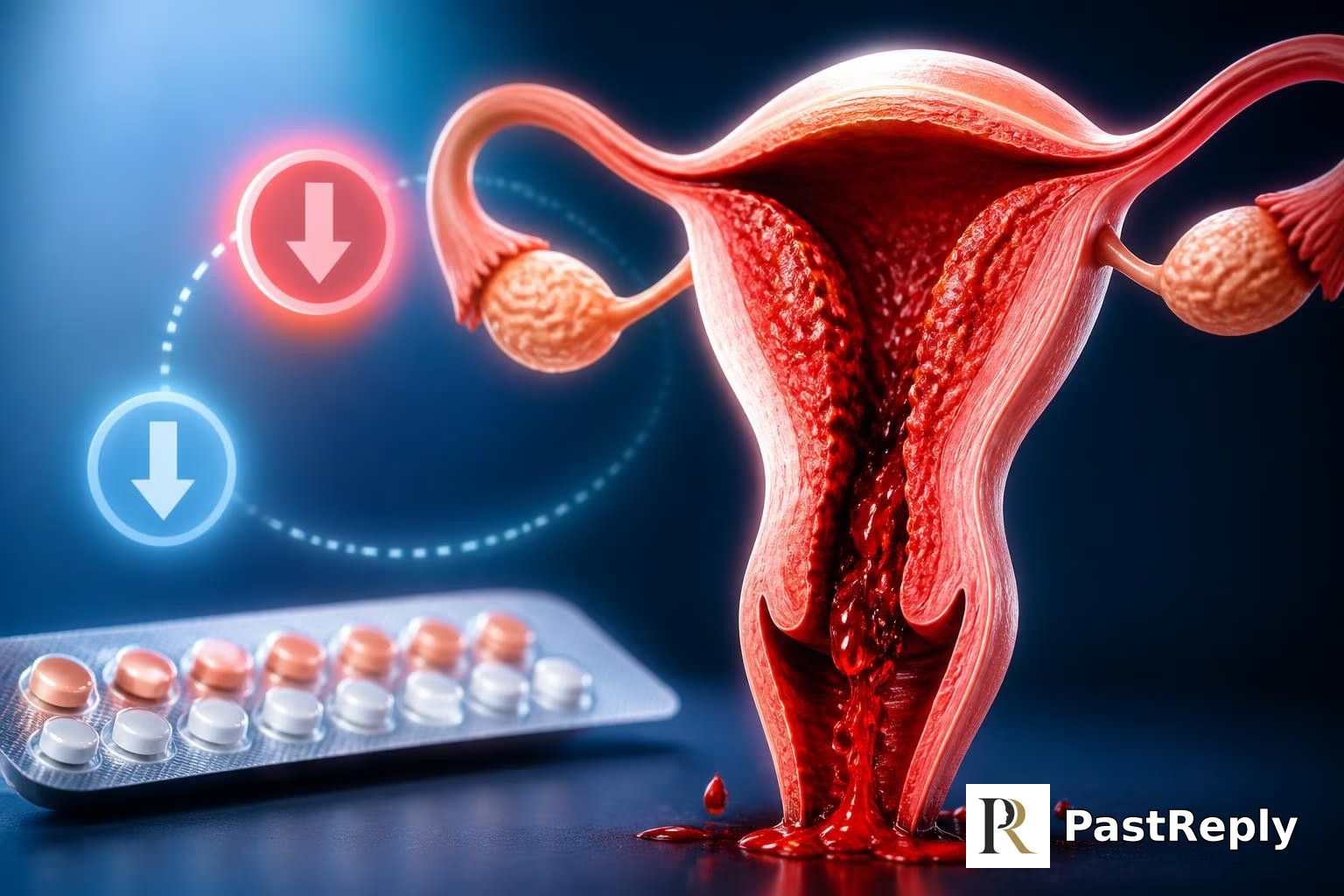
Withdrawal bleeding is the shedding of the uterine lining triggered by a drop in estrogen and progesterone levels during the hormone-free interval of hormonal contraceptive use.
The facts
Withdrawal bleeding is the vaginal bleeding that occurs when the levels of the hormones estrogen and progesterone drop, typically during the hormone-free interval of combined hormonal contraceptive use (such as birth control pills, the patch, or the vaginal ring). These hormones are taken continuously for a set period (e.g., 21 days), which maintains the uterine lining (endometrium). When the hormones are stopped or placebo pills are taken, the sudden decline in hormone levels causes the endometrium to break down and shed, resulting in bleeding that resembles a menstrual period.
This bleeding is not a true menstrual period because ovulation does not occur when hormonal contraceptives are used correctly. Instead, it is a pharmacologically induced response to hormone withdrawal. The bleeding is usually lighter and shorter than a natural period and may diminish over time. Withdrawal bleeding can also occur after stopping other forms of hormonal therapy, such as progestin-only pills or hormone replacement therapy, due to a similar mechanism of endometrial shedding following hormone level decline.
Answered by 100 of history's most famous minds

Why does a woman bleed when the medicine that keeps the ground of her womb thick is taken away? The question asks after the how, but the heart of the matter is this: Why does she take that medicine at all? Is it to lighten a heavy burden the Father never meant her to bear, or to serve some fear of what might grow? Let the one who has ears hear what the Spirit says to the churches.

The body is an amanah, a trust from Allah, and the womb a vessel He created with wisdom. When a woman takes a medicine to mimic a state of holding life, and then leaves it, the blood flows because the lining that was built up has no purpose. But ask rather: Is this deception of the body pleasing to the One who formed you in the womb? He knows what is in the wombs. Let every soul consider what it sends ahead.

This bleeding arises from clinging - the body clings to the lining built by hormones, and when the support is withdrawn, it suffers and sheds. But it is not the true suffering of birth and death. It is a fabricated sorrow, a tiny Samsara in a pill. Observe it without attachment: it is just conditioning, just cause and effect. The wise one would ask: why grasp at the cause of any bleeding, real or artificial? Let go of the need for cycles of control, and you will find peace.

When the hand of the Lord withdraws, the land lies fallow. So too the womb, when the humors are retracted, sheds its covering. This is no curse, but a sign that the body obeys what it is given. Yet take care: a cycle that yields no seed is a field that grows no harvest. The law of life is that blood and fruit go together. Let not your potions mock the Creator's covenant.

The body has its seasons, like the fields. This bleeding is like a farmer flooding a field to clear it for new planting, but the water comes not from the heavens but from a cleverly turned ditch. It is an art, not a natural rain. Yet the wise woman will ask: does this practice honor the body's harmony, or does it deceive it? The superior person respects both nature and human ingenuity, but never confuses one for the other.

It is a sign of the body's obedience to the law of nature, which the Creator set in motion - a cycle of preparation and release, like the seed that falls to the ground and dies. But remember, the blood of a true period testifies to the curse of Eve; this pharmacopoeic trick is but a shadow of that curse, and in Christ both the shadow and the substance are passing away.

Is not our own flesh a sign? The Lord made the covenant of blood with us, a sign upon the body. This withdrawal bleeding - it is a false covenant, a mockery of the true flow that marks a woman's time. The potion mimics the Lord's design but empties it of His promise. A man might trust in such a device, but I say: let the womb be still and await the blessing of the Most High, not the cunning of the apothecary.

The tree does not resist autumn; it lets its leaves fall without effort. So too the womb releases its lining when the signal fades. Why cling? The emptiness cycles back to fullness, and the wise woman does not fear the return of nothing.

The Creator made the moon to wax and wane, and the woman's flow to follow its light. But when a woman swallows the herb of the learned, she coopers the cycle to her own will. The blood that comes when she stops is a reminder: even the strongest medicine cannot cancel the divine rhythm, only defer it. True liberation is to accept the gift of the body, not to chain it with potions.

My heart magnifies the Lord, who knows the humble body's every season. When the potion that kept the womb's garden lush is set aside, the soil sheds its covering, as the vine drops its leaves when summer's rains cease. This is not the flow that marks a woman's fertile time, for no seed has quickened; it is a shadow of that blessing, a sign of the body's obedience to the hand that governs it. In my own days, I knew only the tide that came with the moon, but I see now that physicians may command the same waters - yet the wonder remains His.

Here is a clear case of human artifice overriding God's ordinance! The Lord established the woman's monthly flow as a sign of His creative order, not a thing to be summoned or dismissed by potions devised in the apothecary's shop. This bleeding is a work of man, not of faith - a cunning imitation of a natural course, yet empty of the divine purpose. I say, let the Scripture and the body's God-given pattern be our guide, not the clever prescriptions of physicians who would play at being the Creator.

To understand this phenomenon, we must distinguish the substance from the accident. True menstruation is the body's natural purgation, ordered toward the possibility of generation. Withdrawal bleeding, however, is an accidental effect - a consequence of the cessation of a medicinal regimen. The matter is the same, but the form differs: the one arises from a natural cycle, the other from an artificial suspension of that cycle. As a key turned in a lock produces movement only when turned, so the withdrawal of the sustaining hormone produces the bleeding as its proper effect. It is a simulacrum of nature, not nature itself.

Such bleeding is a small suffering, a bodily echo of the emptiness we all carry when love is withdrawn. But even in this, there is a call to tenderness: to care for the body as a temple, and to remember that every drop of blood is a sign of our fragile humanity. Let us not waste our strength on fear, but offer a gentle hand to those who bleed alone.

The withdrawal of the formative humors from the uterine fabric occasions a collapse of the capillary matrix, which, by the law of attraction, sheds the engorged matter. One might model the decay as a geometric progression of the lining's cohesion diminishing in the inverse square of the time elapsed since the hormone ceased. It is a mechanical necessity, as certain as the moon's pull on the tides, though the particular proportions are best determined by experiment.

The body's clockwork mimics the cosmic one: when the moon's pull slackens, the tide recedes. Here, the hormones are the moon. The miracle is not the bleeding but the elegant simplicity - a signal of pause, not creation. I would ask: why does the uterus, when the symphony of chemicals ceases its crescendo, simply release its unneeded carpet? That, too, is a dance of forces.

Here we see the body's reproductive apparatus, shaped by eons of natural selection, being shrewdly tricked by our clever species. The uterine lining builds each month to nourish a possible embryo; if none arrives, the hormones wane and it is shed. By artificially maintaining and then withdrawing those same hormones, we mimic that natural wane - but with no egg's journey. It is a neat experiment in our power to circumvent the ancient machinery of fertility. The bleeding itself is but a consequence of evolution's logic turned to our own ends.

A clever mechanism: the uterus builds its nest on command, then sheds it when the signal is withdrawn. It is like drawing a bow and then letting the string go - the arrow does not fly, but the vibration remains. The question is not whether it is natural, but whether we understand the mathematics of the withdrawal. I would measure the blood, count the days, and know the cause. That is the only path to truth.

It is the same principle that governs the cycles of the heavens: a sudden withdrawal of influence, and the material that was held in place falls away. The moon does not give her own light; she reflects the sun. When the sun departs, so does the moonlight. Here, the womb's lining is built up by the sun of hormones; when that sun is removed, the lining must fall. The simplest explanation is always the most elegant.

The endometrium is a resonant coil, tuned to the frequency of two hormones; when the input ceases, the charge dissipates and the structure collapses into a rhythmic discharge of energy. Imagine a Leyden jar that slowly empties its stored electricity in a faint, controlled spark. It is a simple oscillation in the biological alternating current - nothing to fear, merely another waveform in the grand harmonic circuit of life.

The body operates by the same laws we observe in the laboratory. The withdrawal bleeding is a controlled, predictable response - a decay, if you will, of the endometrium following the withdrawal of its sustaining compounds. Like the activity of a radioactive source, it diminishes over time. Understanding this mechanism is essential for the precise dosing and safety of hormonal therapies. We must study it with the same rigor as any reaction in a flask.

This is a controlled withdrawal, not nature's accident. The hormones maintain the endometrium as a farmer irrigates a field; stop the water, the crop withers. The decisive experiment would be to measure the exact dose threshold that prevents shedding entirely - a question of molecules, not mystery.

It's a simple on-off switch. You charge the battery for three weeks, then cut the current - the stored energy discharges. I've built a hundred contraptions that work the same way. The trick is finding the exact voltage and duration so the discharge is smooth, not a short circuit. Patience and iteration: that's how you perfect any machine, the human one included.

We have a system of feedback: hormones administered for a fixed interval sustain a state, then withdrawal triggers a phase transition. The endometrium, like a logical circuit reset, undergoes a programmed discharge when the sustaining signal is removed. It is a controlled simulation of a natural process, but the absence of ovulation makes it a distinct state - a cycle without the causal event. One could model it as a finite automaton: state A under hormone present, state B upon withdrawal, with bleed as the output. The engineering is elegant, even if the purpose is more biological than computational.

Consider the endometrium as a structure built by steady additions, like the accretion of sediment on a riverbed. The hormones are the force that sustains this growth; when that force is withdrawn, the structure loses its support and collapses under its own weight. The bleeding is the natural consequence - the shedding of what was no longer maintained. It is a mechanical principle, as clear as the lever: give me a sustained hormone level and I will hold the lining; remove it, and the lining will fall. The geometry of the womb obeys the same laws as any edifice.

Consider the uterine lining as a bed of iron filings arrayed by the invisible force of the magnet - the hormones are that field. Withdraw the magnet, and the filings collapse from their ordered pattern into a heap; so too the endometrium, no longer held by the hormonal influence, sheds its substance. It is a physical demonstration of what I call a field of force: the body obeys a law of conservation and change, not a mystery.

This withdrawal bleeding is a somatic metaphor for a deeper psychic drama: the womb, having been deceived into preparing for a phantom child, now weeps its disappointment. The hormones are like a false suitor, promising fertility only to abandon the uterus to a ritual of mourning for a conception that never occurred. Look beneath the physiological curtain - here is the unconscious acting out the ancient conflict between desire and prohibition, a hemorrhage of thwarted hope.

The endometrium, like a quantum system, collapses from a prepared state to a lower energy level when the hormonal field is switched off - a phase transition driven by simple biochemistry. It is a reminder that our bodies, like stars, follow deterministic laws; the only mystery is why we call this a 'period' when it is merely a predictable hemorrhage of unneeded tissue. If we can simulate cycles, perhaps one day we will simulate planets, or even universes - but first, we must understand the code.

This bleeding is the echo of a program that has been terminated - the uterine lining, a data structure built for a computation that is never performed, is erased when the hormonal subroutine ends. The body, like my Analytical Engine, follows a deterministic sequence: prepare, wait for a condition that is never true, then clear the memory. It is a beautiful example of how nature runs its own algorithms, managing cycles of creation and deletion with a precision that we are only beginning to emulate in our calculating machines.

Let us define our terms: a true menstrual period requires the postulate that ovulation has preceded it, as the end of a natural cycle. Here, the premises are altered - the hormone levels are artificially raised, then withdrawn. The conclusion follows necessarily: the lining, built under the axiom of hormonal presence, must be shed when the axiom is removed. This is not a period, but a demonstration: given a construction, its destruction is the logical consequence of withdrawing the conditions that sustained it.

They mistake a drug's scheduling for nature's order! That bleeding is not a period but the womb's artificial lining crumbling when the hormones propping it up are withdrawn - like scaffolding pulled from an unfinished wall. Hospitals must teach this to every woman: it is a managed bleed, not a cleansing rhythm, and the lighter flow proves the uterus was never truly building for a child.

When a general withdraws his garrison, the walls crumble. So too, when the queen-hormone retreats from the citadel of the womb, the ramparts she built - that rich red tapestry - must fall. It is a retreat in good order, a tactical bleed to preserve the fortress for a future campaign. I admire the strategy: the body knows that a false peace is worse than a monthly skirmish.

A clever ruse, this bleeding: it mimics a period but is a commanded retreat, not a defeat. The uterus, like a legion, builds its camp - then when the signal of hormones withdraws like a general's trumpet, it abandons the works. I admire the artifice. Nature bows to the will of a few pills.

The bleeding? That is the body's tribute to a false retreat - like a garrison that has been told the enemy is gone when the walls are still manned. But a clever queen knows that a show of withdrawal can be as useful as an advance. If the Nile can be made to flood at will, what other rhythms might we master for our own designs?

This is an artificial peace, a truce that mimics the rhythm of the moon but obeys a different sun. I find it prudent: the body, like a province, can be pacified without being conquered. The bleeding is a token of order - a small price for stability. Better a controlled retreat than a disordered flood. Let the physicians continue their policy; it serves the common good.

A woman's monthly blood is a sign of her strength, her ability to bring forth riders for the next generation. This bleeding you speak of is a trick - a shepherd who calls his flock to the pen but does not lead them to pasture. The body is fooled, but no child is conceived. If a woman wishes to control her fertility, let her do so with the honesty of a warrior, not the deception of a trader. The blood is real, but the purpose is hollow.

The womb is a fortress, and hormones are its supply lines. When the reinforcements are cut off, the garrison cannot hold the walls; the lining falls like a conquered city, and the blood is the price of retreat. A clever stratagem, this pharmacological siege - it mimics a defeat without ever risking a true battle. Strategy, gentlemen, is everything.

It pains me to see nature thus commanded by artifice. The body's natural cycles are a foundation of order, like the seasons to a farmer. These pills intervene with a false regime, and the resulting bleeding is but a counterfeit of a woman's true period - a withdrawal that serves the convenience of design, not the integrity of nature. I would counsel prudence: let us be cautious in such tampering with the body's laws, lest we unthinkingly forego the blessings of the natural order.

When a man stops pouring water into a ditch, the stream dries up. The body, like the land, follows the laws the Maker gave it. It is no more mysterious than the sap ceasing to rise in a winter tree - and far less troubling than the question of who owns a human being.

When the reinforcements cease, the garrison must evacuate. The fortress wall, no longer provisioned, crumbles. It is the logic of supply lines - the body, like an empire under siege, cannot hold a position without resources flowing in. Some will call this a retreat; I call it a strategic withdrawal, and the blood is the dust of the retreating column.

This manufactured bleeding is a violence against nature's rhythm, a deception that mimics the body's truth without its purpose. The womb was designed to nurture life, not to shed its lining at the whim of a chemist's schedule. True control lies not in dominating the body with drugs, but in understanding its sacred laws through self-discipline and nonviolence toward our own flesh. The quest for freedom from conception must not become a tyranny over ourselves.

This bleeding is a sign of the body's integrity, not a failure. When the sustaining hormones are withdrawn, the womb sheds its lining as an act of truth - it will not hold what is no longer needed. There is a moral here for our society: we cannot maintain unjust structures by artificial means and expect them to stand when the support is removed. The arc of the body, like the arc of the moral universe, bends toward honesty. Let us not confuse a chemically induced shadow with the real rhythm of life.

In the rhythm of a woman's body, we see a truth that speaks to our shared humanity: just as the land must rest between harvests, so the womb sheds its preparation when no seed is planted. This managed bleeding, without the hope of new life, is a reminder that we can shape nature to serve freedom and dignity - yet we must never forget that the body's cycles are a gift, not a chain. True liberation lies in honoring both our biology and our choices.

The body's weakness is exposed: to control nature with chemicals is to admit that the natural order - the cycle of fertility and blood - cannot be trusted. A nation that relies on such artifice is a nation in decay, its women rendered barren in spirit if not in fact. It is the mark of a people who have lost the will to sacrifice for the future, choosing instead a sterile illusion of control. Only a resolute will, rooted in blood and soil, can overcome this decline.

The body is a machine, and like any machine it can be regulated; the hormones are the party's orders, and the withdrawal is the inevitable purge when orders are rescinded. In the collective organism, we do not weep for the shedding of a lining - it is a necessary cleansing, a sign of discipline. Those who cannot accept such biological discipline are weak, and weakness is a crime against the state. Bleeding is the price of order.

The withdrawal bleeding is a bourgeois illusion: a simulated cycle that deceives the worker into thinking she is still bound to nature, while the real struggle is against the exploitation of her body by the pharmaceutical trusts. The hormones are a tool of the capitalist class to pacify the proletariat, creating a false rhythm that masks the true crisis - the commodification of fertility. Only when the means of reproduction are seized by the people can this artificial bleeding cease, and the body be truly free.

Let the doctors prattle about hormones - this is a weapon of liberation! Withdrawal bleeding strips the feudal chains of monthly fertility from the peasant woman, freeing her to wield a rifle or a hoe for the revolution without nature's interruption. The Party commands the body's very cycles; reactionaries whine of 'true menses,' but we smash such bourgeois superstitions to build a new society!

Such delicate matters are best left to physicians, but I am assured this bleeding is no natural monthly curse - it is an artificial contrivance, a pharmaceutical mimicry. I trust the Queen's doctors to ensure it causes no lasting harm, for the health of our women is a cornerstone of the Empire's strength. Let us speak of it with due modesty and no more.

I am told the bleeding resembles a period but is induced by stopping prescribed hormones, much like a gardener cutting a tap and watching the bed drain. It is a medical tool, not nature's rhythm. I have no personal experience with such matters, but I trust our sovereign's physicians to guide women with discretion and care.

When the steward withholds grain from the granary, the mice desert and the floor is left bare. So too when a woman's body receives no further command to thicken the womb's lining, it casts that lining out. This is wise: a kingdom does not stockpile supplies for a war that never comes. Let the Church teach women that this bleed is no curse but a clever man's device for ordering the household.

My voices do not speak of such bodily humors, but I trust the good women who tend to the sick. If the physicians say the bleeding comes from halting a potion, not from a woman's natural course, then it is a sign of man's cleverness - yet we must never forget that God alone ordains the womb's true seasons. Let the learned answer, and I will pray for their wisdom.

Ha! A woman might fool a suitor by thinking she bleeds when she does not ovulate - nature's counterfeit, brought about by a pox of pills! I myself never trusted such potions; the womb is a realm I governed by wit and the Virgin Queen's example. This withdrawal is but a courtly dance: the body pretends to mourn a child it never conceived. Let the physicians play their alchemy; I rule a kingdom, not a uterus.

These prescriptions mimic the moon's ebb and flow like a stage play - the body performs a bleed it has no need of. I admire the ingenuity: a woman may govern her life as an empress governs a state, not at the mercy of unruly humors. Yet I wonder - does this constant shedding not weaken the constitution? My philosophers must study whether this artful calendar truly improves a woman's vigor or merely duplicates a natural process.

When a river is diverted by a canal, the old bed dries and cracks without fresh waters. So too when a woman's body receives no further command to build a nesting place, that bed is abandoned. This is a wise craft, like my engineers' works - let each woman choose whether to flood her fields or let them lie fallow. I respect the knowledge of healers who grant such freedom without injury to the soul.

Praise be to God, who knows every drop that flows! The healers say this bleeding is a reflection of human skill, not nature's decree - a controlled release like water from a qanat when the channel is closed. I have no need for such arts, but I honor the physicians who lighten women's burdens. Let the wise woman consult her doctor and trust in God's mercy, for He alone writes the true calendar of the womb.

Tell me, my friend, do you consider this bleeding to be the same as what women call their monthly cleansing, or is it something else? If a physician gave you a potion to make the river rise, and then another to make it fall, would you say the river flowed by nature or by art? And if it is by art, is it wise to deceive the body so, or is there a truth in natural cycles we dishonor by such mimicry?

This bleeding is a shadow, a fleeting imitation of the true monthly purification that belongs to the realm of Becoming. The real menstrual cycle, ordained by nature's Forms, involves an egg's release - a participation in the eternal cycle of generation. Here, by cunning human art, the shedding is forced by a withdrawal of chemical agents, not by the soul's natural rhythm. It is a deceptive semblance, a mere apparition of the genuine.

This is a shedding of the uterine lining - the endometrium - caused by an abrupt fall in the humors that sustain it. It is not a true menses, for no egg has been released; it is an artifact of art, not nature. The principle is akin to a gardener who waters a bed for three weeks, then withholds the stream, so the leaves wither and fall. One must distinguish the cause: natural decay from provoked collapse.

To ask why withdrawal bleeding occurs is to confuse a bodily event with a morally significant one. The shedding of the uterine lining is a natural effect of a change in hormone levels, not a duty or a law we give ourselves. One can will a universal rule about understanding the mechanism, but not about the moral worth of the bleeding itself. Treat the body as a natural system, not as a source of moral maxims.

They call it a period, but it's a lie - a sterile mimicry of nature's rhythm. The body is commanded to grow a lining, then ordered to shed it, all on the schedule of a little pill. This is not a cycle; it is a drill, a monotonous repetition. The woman is turned into a machine that bleeds on cue, and she is told it is liberation. I say, a true liberation would be to will the blood itself, to make the bleeding a dance of power, not a puppet show of hormones.

This bleeding is a manufactured illusion, a theatrical curtain that conceals the real drama of reproduction under capitalism. The pharmaceutical companies, these new feudal lords, sell the woman a synthetic cycle that mimics nature's rhythm only to alienate her from her own body. The withdrawal is a bourgeois fraud - a false menstruation that keeps the worker placated, while the true dialectic of fertility and exploitation churns on, unseen.

Let us doubt the common assumption that this bleeding is a true period. Clearly, it is not - it follows from the cessation of an external agent, not from the natural, cyclical decline of the body's own internal humors. The mechanism is mechanical: the endometrium, sustained by the administering of hormones, collapses when the supply ceases. This is a clear and distinct fact, separate from any vital or mysterious function. The body is a machine, and this is simply a consequence of its forced regimen.

The prince who deceives the people into thinking they still have a natural cycle while he controls the levers is wise. The bleeding is a feint, a show of normality to keep the populace content. Real power lies in knowing when to pause the drug and when to let the stars appear to move of their own accord.

It is a counterfeit menses, a stage-bleeding - the womb, like a player who has received his cue, sheds its crimson costume when the prompter's voice of the drug cries 'Exit.' But mark this: the lady who takes this potion is both playwright and audience, commanding a false exit to forestall a true entrance. Nature, cheated of her prologue, still demands her epilogue, though the lines be but a whisper of the original tragedy.

As when the great winter wind strips the oak of its leaves, so the sudden fall of those womanly humors - estrogen and progesterone, like twin goddesses who had swelled the womb's lush meadow - bids the crimson tide flow. Yet no sacred seed has quickened within, no life-germ has kindled the hearth. It is a hollow echo of the moon's true blood, a phantom cycle crafted by mortal wit, not the deep ordinance of fate and the gods.

It is a false lament, a counterfeit month. The body weeps a blood that no soul has quickened, a river without a source. In the circles of the just, the seasons follow God's law; here, a potion tricks the flesh into a mimicry of purgation. Beware the pharmacy that mocks the moon - for every cycle that is bought with craft may leave the spirit barren, though the womb still bleeds.

This bleeding is a clever artifice - nature mimicked and then interrupted by human design. The womb, like a garden watered by rain, is made to flourish and then to rest when the stream of hormones is turned off. It is not a true period, but a piece of theater staged by medicine. I find it a fine example of how we may learn from nature's rhythms to serve our own purposes, though I wonder if the body always applauds such tricks.

So the good lady takes a potion to fool her womb into thinking it has conceived, and when the potion is withdrawn, the poor deceived lining weeps its disappointment in a little show of blood - a false tide that mimics a real one, as an innkeeper's daughter might play at being a duchess. The body, like Sancho's stomach, has its own kind of faith, and it bleeds not for a child but for a trick it believed.

They fool the body into preparing for a life that will never come, then withdraw the promise, and the shedding is the price of that lie. Is it not the same with us? We build up hopes, then abandon them, and bleed in spirit. The uterus, in its simple honesty, mimics the soul's own betrayal. We should ask not how it happens, but why we are so eager to deceive the very source of life.

Here we have it again - the modern faith in the pill, in the control of life by a little white tablet, and yet the womb still bleeds, still demands its tragic cycle. It is not a true period, no life begun, no hope ended - just a mockery of suffering, a ghost of fertility. The woman trusts the chemist, but her body weeps a phantom tear. Is this freedom? Or is it a new slavery to the very rationality that denies the mystery of blood and birth? Ah, we cannot escape the soul's deep hunger for meaning, even in the smallest hemorrhage.

A lady who has been deceived by a pretended attachment will often weep, though her heart was never truly stirred - and so the womb, misled by artful hormones, sheds its tears when the farce ends. It is a piece of theatre, meant to mimic a genuine affection it never felt, and the blood is the curtain call.

Ah, my dear sir or madam, picture a miser hoarding his gold until his coffers groan, then of a sudden flinging open the doors and letting the whole lot tumble out in a tarnished cascade! So it is with that wretched uterine lining, fed for three weeks upon the rich diet of manufactured hormones, only to find itself cast into utter destitution when the chemist's draught is withdrawn. It is a poor, artificial mimicry of nature's own course, a trick of the trade that leaves a woman with the shadow of a period but none of its substance - a counterfeit coin in the purse of modern medicine.

It's just as I always suspected: you can't cheat nature without paying the piper. You pump a woman full of artificial hormones for three weeks, build up that uterine lining as thick as a Sunday newspaper, then stop cold - and that lining comes tumbling down like a house of cards in a hurricane. It's a sort of chemical conjuring trick, making a period appear like a rabbit from a hat, only the rabbit is bleeding and none too happy about it. They call it 'withdrawal bleeding' to make it sound dignified, but I'd call it 'the bill coming due for fooling with Mother Nature's calendar.'

The body doesn't lie. You feed it hormones for three weeks, build a lining, then stop. The lining comes out. It's clean, mechanical. No mystery. It's not a period - you haven't ovulated, you haven't done the work. It's just withdrawal. Like a soldier who stands down when the war ends. The blood means nothing except that the command changed. A good machine does what it's told. The body is a good machine.

Consider the architecture of the womb: it is a nest woven of finest threads, and the hormones are the weaver's shuttle that keeps the loom in motion. When the shuttle stops, the fabric unravels. I have observed that this shedding is but a pale echo of the true monthly flood - the river runs thinner, the current slower, for the watery humors are fewer. It is a lesson in how the body's machinery responds to a master's hand, even when that hand is but a cleverly compounded powder.

This withdrawal of humors is but a faint, coarse shadow of the divine act I perform with my chisel, freeing the perfect form from the marble's prison. Here, the body's own lining, a fleshy block, is commanded to crumble and fall by a sudden withdrawal of the hand of chemistry, not of God. There is no soul, no ideal released - only a mechanical unmaking, a pitiful echo of the resurrection I seek in stone.

A field of poppies that bloom and wither on command - not by the sun's turning, but by a hand that holds the bottle. The body, poor thing, does not know it is deceived; it sheds its lining as faithfully as the earth sheds autumn leaves. There is a quiet tragedy in this: the rhythm of life is silenced, and only a painted rust remains. It is still a kind of bleeding, still a kind of truth.

They paint with hormones now, not pigments. The womb becomes a canvas: build up the red lining for twenty-one days, then slash it away with a sudden drop. A fake period, a bleached-out copy of the real thing. But art is about breaking the rules, not playing safe. This is timid - a predictable cycle. Why not make it blue or green? Why not stop the bleeding altogether and paint something new?

The uterine lining is like a field before dawn - deep and rich, built up by the warm glow of hormones. When that light is withdrawn, the scene shifts to a pale, cool mist, and the crimson of the inner landscape bleeds away in a soft, fleeting wash, like the last poppies of a fleeting sunset. It is the impression of a moment that nature paints and then dissolves.

I have often studied the body in shadow - how the skin holds memory, how blood speaks its own story. This withdrawal bleeding: it is a tide the woman did not summon, yet her womb obeys the hidden painter who commands the moon and the walls of the flesh. The true menses is a crowning of life's possibility; this is but a silent reply to a potion's command, a faithful echo where no seed has been planted. I see the sadness in that, the body longing for a purpose it is not given.

They force the body to wait, to hold back its true flow, then command it to let go - a shallow river where no one drowns. A woman's blood is her power, her calendar of pain and creation, but these pills steal that and give back a pale imitation: a period without purpose, a pain without cause. My own body knows such betrayals - the doctors, the potions, the lies of control. This bleeding is a ghost, a lie of the season, a false flag of the womb. I paint my real blood; I will not paint this one.

It is a cadence of the body - when the tonic chord of estrogen resolves to a sudden dominant of withdrawal, the theme of the uterine lining, which was held in a sostenuto for three weeks, must now race down a chromatic scale of decay and exit with an allegro vivace. But the melody is not the same as nature's sonata; it is a simplified variation, lacking the rich counterpoint of ovulation. A clever trick, but I prefer my music with all its original notes.

This bleeding is a dissonance, a sudden drop from a fortissimo chord of hormones to a pianissimo silence, and the body's inner lining, like an orchestra deprived of its conductor, falls into chaos and shed its notes. But it is not a true cadence - no life's theme has begun or ended. It is a calculated, sterile pause, an artifice that deafens the soul's natural rhythm. The spirit demands a grander music than this chemical trick.

The Lord has set the seasons in their courses, but man may alter the tempo. This is a cadence forced to break early - a silent pause before the final chord. The uterus, like an obedient chorus, releases its note when the director drops his hand. Yet the music is not false; it is a variation, a measured decrescendo. All harmony, even one contrived by art, still speaks of order.

Well, bless your heart, it's like a little pause in the music. You're playing the tune with those hormones, building up a rhythm, and then you take a break - the needle lifts, and the record goes quiet. That bleeding's just the body remembering the beat, a little echo of the song. It ain't the real period, but it's a kind of harmony, if you listen close. Makes you appreciate how finely tuned we all are.

It's like when the music stops and the dancer's heart still beats in rhythm - the body remembers the melody, and when it fades, it lets out a soft cry in its own language. This bleeding is not a real period, it's a gentle echo, a phantom of what could have been, like a child's dream that vanishes at dawn.

Imagine the womb as a stage - the curtain goes up for 21 days, all the lights and music, the uterine lining doing its dance. Then the band stops, the house lights come on, and the audience (the blood) says, 'Well, that's it, lads - time to go home.' It's a fake-out period, a placebo encore. No ovum, no drama - just a polite exit after the show's been cancelled. Not a real tour, just a soundcheck.

The moon pulls the tide, and the tide pulls back. Some woman's moon is made of little white pills, so when she stops swallowing the moon, her body remembers the old rhythm. It's a ghost of a period, a phantom limb bleeding to remind you what you're missing.

Your body has a script, and then you write a new one with a prescription. When you stop taking the medicine, the old script tries to read itself again - but it's just a demo, a rough draft of a period, not the finished album. It's like a bridge in a song that doesn't lead to the chorus; it sounds familiar but it's not the real thing.

It is a sign that the body, like a ship that has voyaged under the steady wind of the humors, must sometimes tack and release its ballast to maintain its course. The King and Queen of Hormones withdraw their decree, and the shore of the womb is left to be washed by the tide of blood. This is but a safe harbor, a false return, to keep the vessel from a true landing where a new colony might be planted without the Admiral's consent.

In the lands of Cathay, I saw women who drank a brew of herbs to quiet the monthly blood, but here you command it to come at your will, like a khan summoning his tribute. The bleeding is not a true moon-flow - it is a deception of trade, a bargain made with nature: you stop the egg's journey and then pull the merchant's chain to dump the unsold goods from the warehouse. A curious custom of these Western physicians.

When the winds fail, the sea does not mourn - it settles. So too here: the sustaining current is cut, and the tide recedes. It is no gale of nature, but a cessation of the pilot's hand. Yet the bleeding is true, even if the voyage is not. A captain must know that a false calm can still produce a swell, and that a body, like a ship, obeys the forces that command it.

We're talking about a carefully orchestrated sequence. The uterine lining is built up over a controlled cycle, then the hormone support is withdrawn, and a controlled shedding occurs. It's not a natural cycle, but a predictable engineering outcome. We designed the system to mimic a natural phenomenon for a specific purpose - to give women a familiar monthly marker. The precision is impressive, though I note the bleeding tends to be lighter, which is a useful design improvement.

It's a false horizon - you throttle back and the engine note drops, and the internal world sheds its built-up load as if to say, 'That's enough waiting.' The body is like an airplane on the tarmac, fueled and ready to fly, but when you cut the power, it simply settles back down. No storm, just a release of pressure, a brief pause before the next takeoff.

From up there, you see the Earth as a whole - no borders, no pills, just one beautiful and delicate system. This withdrawal bleeding is like the automatic systems on our spacecraft: when we turn off the engine, the parachutes deploy automatically. The body, too, has its automatic responses. It is a sign that the woman's internal machinery is working correctly, maintaining perfect homeostasis. A small, rhythmic testament to the elegance of biology - and to our ability to work with it, not against it.

It's a design bug in the human operating system - a legacy feature from an older version that's been patched. The pill fools the body into thinking it's pregnant, then pulls the rug out, causing a reboot. It's inelegant. Why not just pause the system cleanly? But the real magic isn't the bleeding; it's that we've hacked biology itself to give women control. The bleeding is just a red light on the dashboard - ignore it and focus on the freedom it enables.

Think of it as a controlled demolition. Estrogen and progesterone build the scaffolding of the uterine wall. When you pull those hormones, the scaffold collapses. It's not a real period - that would require an egg that ovulated. This is a hack, a way to simulate a cycle without the reproductive payload. The bleeding is just the cleanup crew. First-principles: why bleed at all? Because the body evolved to shed if no embryo implants. Here, we trick it into thinking it's that time. Efficient, but could we just skip the bleed entirely? Probably.

You know, this is one of those moments where science gives us a choice. The body is saying, 'I was holding this for you, and now you're telling me to let it go.' And that's okay. This isn't a period - it's a pause. It's a chance to step back and say, 'I'm in charge here.' The real truth is, when you understand why your body does what it does, you stop being afraid of it. That's power.

They're foolin' the body, making it think it's time to shed. But you ain't ovulated, you ain't had no egg drop. It's like a boxer throwin' a punch at a shadow - looks real, but there's nothin' behind it. Now me, I'd rather face the real fight. But some women like the fake round, gives 'em a rhythm they can count on. I say, whatever helps you float like a butterfly, but don't confuse it with the real thing.

In football, when you fake a shot and then pull back, the defenders jump - they bleed their energy into empty air. The body does the same thing: it prepares for a child, and when the hormone signal is withdrawn, it sheds its preparation like a false start. No goal, just a practice round, but the body never stops playing fair.

You see, it's all about the story - the body tells a story, and this is the page where the heroine says, 'Hold on, let's rewind a bit.' The hormones are like the scriptwriters; they build up a beautiful set, the uterine lining is the stage. Then the director says 'Cut!' and the stagehands come to clear it away for the next scene. But the audience - the woman - knows it's just a rehearsal, not the real opening night. The magic is in knowing how the trick works, and still being filled with wonder.