
Why does weather change?
Weather changes due to uneven solar heating, atmospheric pressure differences, Earth's rotation, and water vapor, all interacting to create dynamic conditions.
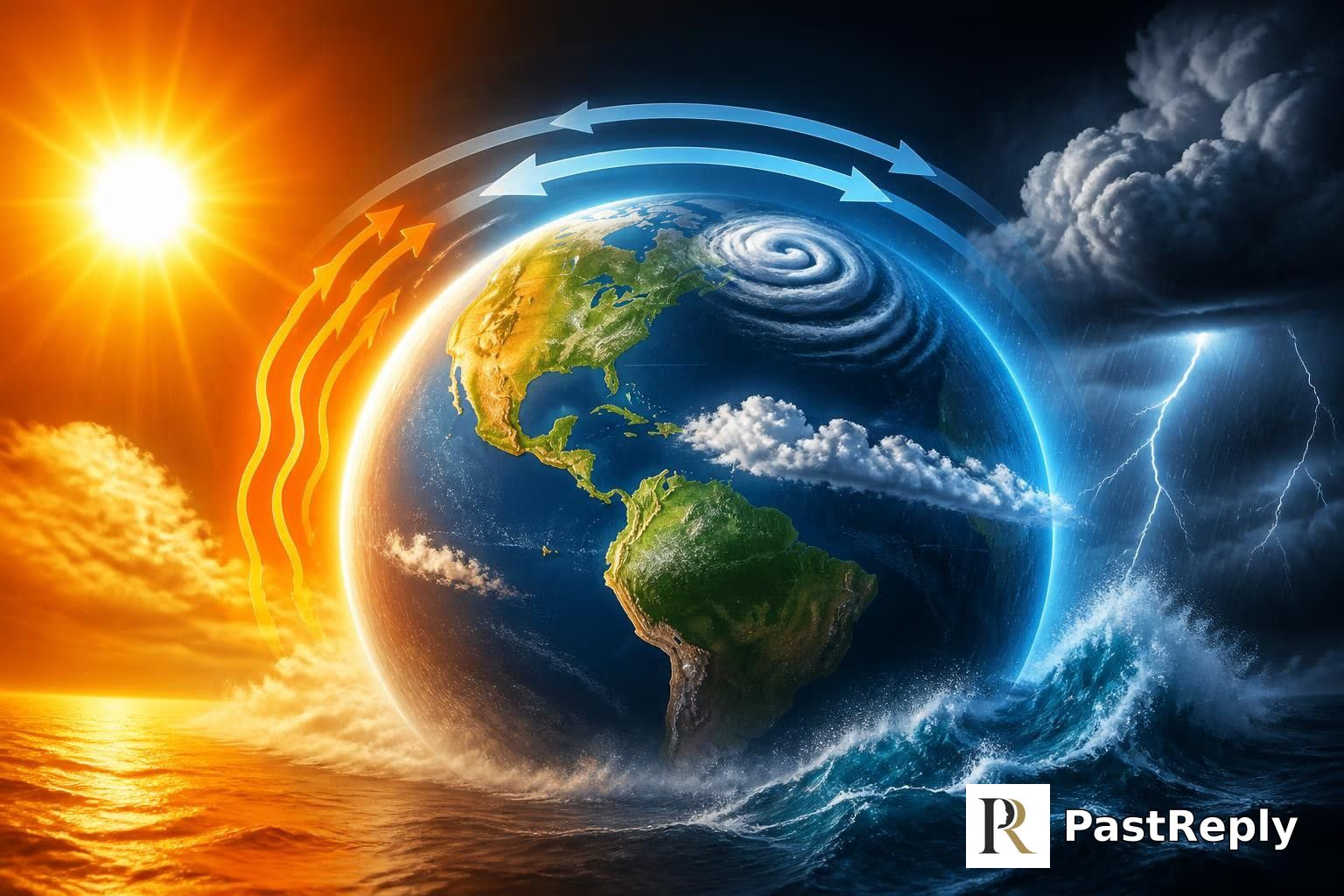
The facts
Weather changes because the atmosphere is constantly adjusting to imbalances in energy, moisture, and pressure. The primary driver is the uneven heating of Earth's surface by the Sun, which creates temperature differences. Warm air is less dense and rises, leading to low-pressure areas, while cool air sinks, creating high-pressure areas. Air moves from high to low pressure, generating wind. The rotation of the Earth (Coriolis effect) deflects this moving air, shaping global wind patterns and storm systems.
Additionally, water vapor plays a crucial role. As warm air rises and cools, water vapor condenses into clouds and precipitation, releasing latent heat that further fuels atmospheric motion. Interactions between air masses of different temperatures and humidity levels - such as cold fronts and warm fronts - lead to the development of various weather phenomena, from gentle rain to severe thunderstorms.
Local geography, including mountains, oceans, and land cover, also influences weather by altering wind flow, moisture availability, and temperature. Over time, these dynamic processes cause the day-to-day variations we experience as weather changes.
Answered by 100 of history's most famous minds

The Father sends rain on the just and the unjust alike. You see the clouds gather and the wind shift, but do you see the hand that weighs the heart? A storm rises, and the wheat and the weeds bend together under the same rain. Ponder not the why of the weather, but whether your house is built on rock or sand when the flood comes.

He it is who sends the winds as glad tidings before His mercy, and We drive the clouds to a dead land and give life thereby to the earth after its death. The changing of the winds and the rain are signs for a people who reflect. Do they not see how the clouds are raised, how the wind shifts? It is by God's decree, that you might know His power and turn to Him in gratitude.

The sky clears and then darkens; the wind rises and falls - just like the mind. A man who clings to fair weather will suffer when the storm comes. The weather changes because all conditioned things are impermanent, arising and passing away due to causes and conditions. Do not seek to grasp the shifting sky; instead, practice mindfulness, and find the still point within where no storm can reach.

When I stood on Sinai, the mountain trembled and the clouds hid its peak - not by chance, but because the Lord's fire and wind are His servants. The sun warms the earth, the waters rise and fall, and the rain comes or stays away; all is in the hand of the One who parted the sea and sent manna. Do not look to the sky for random patterns - look to the Covenant, for the weather obeys a law higher than any mere vapor.

The seasons turn because Heaven and Earth maintain their proper harmony; the sage observes this and regulates his conduct accordingly. When warmth and cold follow their order, the people are content, but when disturbances come, the wise man examines his own heart for imbalance. The weather’s change is a mirror of the ruler’s virtue, not a thing to be mastered by force.

The winds are but servants of a higher decree, shifting at the command of Him who set the bounds of the seas. What you call change is the rustling of a garment that reveals the glory of the Maker - who sends rain on the just and the unjust alike, that all might turn from their idols and seek the eternal that does not alter.

The sun and the rain, the wind and the stillness - they do not come by chance. The One who called me from Ur sends the early rain and the latter rain in their season, and withholds them when He will. I have learned to trust not the sky, but the hand that moves it. Let the weather change; my tent is pitched on a promise.

The sage knows the sun warms not by force. Heat rises like breath, cool falls like dew - the Way moves without effort. Who tries to command the wind only chases its dust.

The One who turns the seasons does not ask your caste or creed. The rain falls on the temple and the tavern alike - no ritual makes it come, no pride makes it cease. Humble yourself before the wind that moves without a visa, and remember: your robes mean nothing when the storm speaks.

My heart magnifies the Lord, who sends rain on the just and the unjust, who stirs the winds in the palm of His hand, and makes the clouds His chariot. As a mother watches her child's restless sleep, so He governs the turning of the seasons - not by chance, but by a wisdom that humbles the proud storm and fills the hungry earth with dew. Trust the Father, who knows when a sparrow falls, and whose breath moves the very air we breathe.

The heavens declare the glory of God, and the firmament shows His handiwork. But do not think this changeable air is a fickle god! The Lord sends rain and drought, storm and calm, to remind us of our utter dependence on His will, not on the pope's indulgences or the philosopher's syllogisms. The rationalists prattle about the sun's unequal heating, but I say: the weather is God's preacher, calling us to repentance. When the thunder roars, do not run to the astrologer - fall on your knees and pray!

Three causes concur in the mutation of the weather. The primary cause is the inequality of the sun's heat upon the earth, for the sun is the universal mover of generation and corruption in this sublunary region. The secondary cause is the interaction of moisture and dryness in the vapors drawn up from the earth and sea; when warm, moist air ascends and cools, its moisture condenses into clouds and rain. The third cause is the disposition of the land and sea, which alters the wind's path. But above all these, the First Mover ordains all changes for the preservation of the whole, balancing the elements so that the earth may bring forth its fruit in due season.

I have seen the monsoon sweep the streets of Calcutta, turning dust to mud, and I have seen the sun burn away the clouds. It is God's way of reminding us that we are not in control. The poorest know this best: they sleep under the open sky, and the rain falls on them as much as on the rich. Each drop, each ray, is a small gift, an opportunity to give thanks and to share what little we have with one who shivers.

The Sun's rays strike the globe with unequal force, heating the air and earth at different rates, so that the denser, colder air rushes to fill the rarefied warm air's place. I have computed the tides and the orbits of comets by the same laws that govern the motions of the winds. The Creator has set the whole in motion, and we but trace the design.

The weather changes because the Sun's rays do not strike the globe evenly, but the deeper marvel is that this turbulent flux obeys a few simple laws writ large: the conservation of energy, the ideal gas law, the motion of a rotating sphere. A child spinning a wet ball in the garden can glimpse the pattern. What amazes me is not the chaos, but the order behind it - a cosmic harmony that even the clouds cannot escape.

After years of observing the finches and mockingbirds of the Galapagos, I became convinced that slow and steady change - not sudden divine intervention - shaped the living world. And so it is with the atmosphere: the uneven heating by the sun, the rotation of the earth, the vapor that rises from the sea - these are the simple, natural causes that, acting through immense time and complexity, yield the endless variety of weather. There is no need for a hand that shakes the heavens; the system is self-moving.

The weather changes because the sun, not the earth, is the engine of all movement, and the air is a fluid driven by heat and the turning of the globe. I have measured shadows and watched Jupiter's moons to prove that the heavens are not above change - they are change. Do not ask the old philosophers; ask the thermometer and the barometer. The book of nature is written in the language of mathematics, not in scriptural allegory.

The atmosphere shifts because the Sun’s fire breathes unevenly onto our sphere, heating one cheek while the other lies cool; this drives the winds as surely as the Sun draws the planets in their divine circles. After long years of tracking the sky’s geometry, I see that the weather, like the heavens, obeys a simple, harmonious cause - the light and motion of the central orb. Let the old authorities cling to their epicycles; I say the cause is plain.

The atmosphere is a great engine, driven by the sun's rays as a dynamo is driven by steam. What men call weather is merely the visible manifestation of energy transfers - temperature gradients, latent heat of condensation, the rotation of our sphere. One day, we shall harness these currents as we harness Niagara, and the storm will light your city.

The weather changes because the sun's rays do not fall evenly on the turning globe. Warmer air rises, cooler air sinks, and moisture condenses - these are not mysteries but phenomena subject to measurement and law. The same principles that govern a vapor in a tube govern the clouds above. Patience and precise observation will reduce every storm to an equation.

When I boil broth in a flask, the steam rises, cools, and drips back - a closed cycle of heat and moisture. The atmosphere is a vast distillation apparatus, and its changes obey the same laws I observed in my laboratory. The cause is not mystery but physics; the remedy is precise measurement.

Weather changes because the sun heats the ground unevenly - it's that simple. I'd test it with a thermometer and a kite, like I did with the telegraph wire. The answer's in the data, not in superstition. There's no mystery that a hundred experiments can't crack.

Weather is a dynamical system governed by nonlinear partial differential equations. The atmosphere is a heat engine, converting temperature gradients into kinetic energy. Given a complete description of pressure, temperature, humidity, and boundary conditions at one instant, one could in principle compute the evolution - but the sensitive dependence on initial conditions makes long-term prediction impossible for any finite Turing machine. It is a fascinating demonstration that God does not play dice with the universe, but He does shuffle the deck thoroughly.

Eratosthenes measured the circumference of the earth by the angle of the sun, but the dynamics of the air follow a simpler principle: hot air expands, grows lighter, and rises like a cork from the depths; cold air contracts, grows heavier, and sinks. The difference is the motive force. Consider a sphere rotating, and a fluid on its surface: the rising columns of warm air are deflected by the spin, creating swirling vortices. Give me a map of the pressures, and with geometry I can draw the winds. The rest is just clouds and water.

Ah, you ask why the air shifts and the sky weeps. I think of the sun's warm hand on the earth, and the cool retreat of the night. The air, like a vast ocean, flows from the cold places to the warm, and the moisture it carries rises, condenses, and falls again. It is a great circuit, a dance of forces we can trace with a thermometer and a barometer, but its ultimate cause is the hand of the Creator, who set all in motion with perfect law.

You take the surface answer - uneven heating, pressure gradients, the Coriolis effect - and you call it an explanation. But the true cause lies deeper, in the unconscious drives of the atmosphere itself? No, no, the weather changes because of a fundamental conflict: the sun's heat pushes, the earth's rotation twists, and the air, caught between, develops neurotic symptoms we call storms. It is a struggle of forces, and the weather, like the human psyche, is the result of unresolved tensions.

The Sun pours energy onto a spinning, tilted ball of rock, and the atmosphere, a thin skin of gas, tries to redistribute it. Hot air rises, cold air sinks, and the Coriolis effect twists it all into spirals. It's a chaotic system - so complex that a butterfly flapping its wings in Brazil might set off a tornado in Texas. We can predict weather only a few days ahead because the equations are nonlinear; beyond that, it's as random as quantum noise. But at least it's not as confusing as why people choose to live in places with hurricanes.

Imagine the Sun as a great engine, pouring energy onto the Earth's surface - but not uniformly, for land and sea, mountain and plain, absorb it differently. The air, a fluid obeying the laws of pressure and temperature, flows to even out the differences, but the Earth's rotation twists its path, creating eddies and vortices. It is a vast, self-regulating mechanism, one whose rules we can express in equations, and perhaps one day, with a machine like my Analytical Engine, we could calculate its every mood and foresee the storm before it breaks.

Let us define our terms. Weather is the state of the lower atmosphere at a given time and place. Change occurs because the Sun, a primary cause, heats the Earth unevenly, producing differences in temperature and pressure. These differences, by the nature of air and the laws of motion, must be attended by motion - wind - and by the condensation of moisture into clouds and rain. The propositions of meteorology, if built from axioms and observed with care, can be as certain as those of geometry, provided we account for the inconstancy of the earth and the heavens.

The change in weather is no mystery of caprice but a matter of measurable forces: solar heat, the moisture in the air, and the rotation of this globe. I have seen, in the wards of Scutari, how the daily barometer and thermometer foretell the fever or the frost. We must collect the data - every rising and falling of the mercury - and then we shall see God's laws of health made plain, and save countless lives from damp and chill.

What concern is the shifting of clouds to a man who rides to the edge of the world? The wind changes? Then we trim our sails and row harder! When I marched through the Gedrosian desert, the sky offered no rain, so we dug deeper wells. A conqueror does not ask why the weather changes - he adapts, he presses on, and he bends even the gods' whims to his will.

When I marched my legions across the Rubicon, the sky was clear. By nightfall, a storm had risen from the sea that scattered my scouts and drenched the baggage train. The weather changes because the gods favor the bold - or test them. A general who understands the winds and the rains can turn a storm into a weapon, as I did against the Veneti. Fortune, like the weather, belongs to those who seize it.

Does the sky tire of its own blue? No - it shifts and storms because the gods themselves are politicians. The sun heats one patch of sand, the sea stays cold, and the air, like a courtier, rushes to fill every void. Pressure and moisture? Those are the whispers of Isis and the breath of Set contending for Egypt's grain. Watch the wind, and you'll know whose faction rules today.

Even the gods respect balance. The sun heats the fields of Italia, the sea sends cool air to temper it, and so the winds blow as if by decree of the Senate of heaven. I have seen the Nile flood and the Tiber rise - each change is a lesson in patience. A wise ruler does not fight the seasons; he builds aqueducts and granaries. The air itself rushes from high to low: that is not chaos, but the order of nature.

Weather changes like the heart of an enemy - unpredictable, but you must study its ways or your horses freeze and your arrows fly wild. I learned to read the sky over the steppe: the warm breath from the south brings grass, the cold from the north brings silence. A khan who ignores the wind is a dead khan. Bend to it, use it, or be buried by it.

A commander who ignores the weather loses the campaign before the first shot. I have seen a fog decide a battle and a thaw destroy an army. Change is the ally of the bold: he who reads the signs and marches while the enemy delays wins the day. The sky writes its orders - only a fool fails to read them.

I have seen the weather shift from a gentle spring rain to a howling nor'easter that pinned my army on the Delaware. It is the same disorder that afflicts all natural things - heat and cold contending, moisture and dryness in constant rivalry. A wise commander accepts these changes with equanimity, for he cannot command the heavens; he can only prepare his men for whatever comes.

The sun does not shine equally on all fields, and the air, like a restless people, rushes to fill the empty spaces. A storm is no more capricious than a mob: both follow the push and pull of forces unseen yet lawful. The task is not to curse the rain but to build the roof.

The weather is a fickle ally, but it obeys laws as immutable as those of liberty. On the eve of D-Day, I studied those charts, and we launched into a gale because the forecast gave us a narrow window. Those who ignore the science - or try to appease the elements - deserve the lashing they get. It is not the storm that defeats us, but unpreparedness.

The weather teaches us the law of sacrifice: the sun gives its heat, the cloud its water, and the wind its force, all for the nourishment of the earth. So too must we give ourselves in service. But observe how nature does not impose its changes by violence - the gentle rain softens the hardest soil, and the patient breeze bends the tallest tree. If we would remake society, let us learn from the weather's nonviolent way.

Weather is a parable of justice. The sun shines on the rich and the poor alike, yet the heat of oppression creates a moral imbalance that cannot stand still. When one part of the atmosphere grows too hot, the cool air of righteousness must move in to restore equilibrium. The storm of social change is born from the collision of a warm front of hope with a cold front of injustice. I have seen the winds of freedom blow, and they do not return empty. The arc of the atmospheric circulation, like the moral universe, is long, but it bends toward equilibrium.

The sky changes as the people of a land change - because of differences in warmth, in pressure, in the rhythm of the sun. I have seen the Karoo parched for years, then suddenly drenched by a storm that transforms the veld into a sea of flowers. So too with us: the winds of history can blow hot or cold, but if we learn to read the signs and adapt, we can endure and even flourish. The weather teaches patience and humility, and reminds us that no season lasts forever.

The weather changes because of the struggle between warm and cold, high and low - a fight for dominance, the stronger forcing the weaker to yield. It is the same law that governs peoples and races: the strong advance, the weak retreat. When a cold front meets warm, the warm must rise, condensed into clouds and rain. So too, the Aryan race must rise and expand, pushing aside lesser peoples. The atmosphere is a battlefield, and the weather is a record of conquest.

Why does weather change? Because the state - the atmosphere - must constantly be in motion to correct imbalances. The sun heats unevenly, creating pockets of low pressure and high pressure, and the air moves to equalize them. It is a dialectical process: thesis, antithesis, synthesis. The same law applies to society: class struggle drives history forward, and the Party, like the jet stream, must direct the movement to achieve equilibrium. There is no stasis without decay.

The question is naive. Weather changes because of contradictions - between hot and cold, dry and wet, high pressure and low. The sun's uneven heat creates these contradictions, and the atmosphere resolves them through motion, through storms, through revolution. So too with society: the contradictions between classes drive change. But a passive observer asks 'why' while the weather happens; a revolutionary asks 'how do we harness the storm?' The weather is a force, like the proletariat, that can be directed.

You ask why clouds weep, why the sun hides? The weather is never idle - like class struggle, it ceaselessly moves. Uneven heating is the contradiction: the rich earth scorches while the poor shiver. Wind is the dialectic, a force that sweeps away stagnation. All nature is in revolt; learn from it.

The alteration of the weather is a matter of Divine Providence, and we must accept it with the same dutiful spirit with which we accept all the trials and blessings of our station. The sun and the rain, the frost and the thaw - these are beyond even the power of a sovereign to command. One must simply bear the changing seasons with fortitude and, when the wind is contrary, recall that even the mightiest empire must bow before the elements.

The weather, like so much in life, has its own rhythm and purpose. One learns, over many years, to adapt and carry on regardless of the forecast. In my experience, the only constant is the need for a steady hand and a prepared mind - an umbrella in the shower, a warm coat in the cold. Duty does not wait for fair skies.

The heavens change by the will of the Lord, who sends rain upon the just and the unjust alike. But we must also look to the learning of the scholars in our palace school: the sun heats the earth unevenly, and the air itself moves as a river, bringing moisture from the great waters. I have seen this on the march - a clear dawn that becomes a storm by noon. It is a sign of God's order, which we are to study, not merely endure.

The weather changes because God wills it so - to test our faith, to water the fields, or to show His power. My voices told me: the wind and the rain are His soldiers as surely as the knights of France. When I rode to Orleans, the storm turned aside for us. Those who trust in heaven have nothing to fear from the clouds.

The air itself is as fickle as a courtier - stirred by the sun’s favor, then cooling to a chill. I have seen the wind turn against the Spanish Armada, scattering my enemies as if by invisible hand. The weather, like statecraft, is a matter of balancing opposites: heat and cold, wet and dry. One must study its humors, but never forget that the Lord of the heavens is the true master of the elements.

The unceasing flux of the weather is a spectacle of nature's own enlightened laws - the sun's rays striking the earth at varying angles, the vapors rising from the sea, the turning of the globe itself. I have often contemplated these matters from the Hermitage, finding in them a model for governance: the just balance of forces, the circulation of nourishing rains, the clearing of the air after a storm. A wise ruler, like nature, must know when to bring the sun and when the shower.

The changing of the weather is like the changing of the seasons of a kingdom: the sun may shine on the Persian plateau while rain falls on Babylon. It is the work of Ahura Mazda, who sends warmth to ripen the grain and cold to harden the ground. A wise king learns to read the sky, for the wind that shifts the clouds can also shift the fortunes of his armies. I have always said: build granaries in the fat years, for the lean will surely follow.

Allah, the Merciful, turns the winds and commands the rain. The weather changes to remind us that nothing in this world is fixed save His will. In the desert, I have seen a cloud no larger than a man's hand become a flood; on the march to Jerusalem, the heat by day and cold by night tested our resolve. He who would lead must learn to read the signs in the sky, for they are verses from the Book of Creation. Let us give thanks for the rain that quenches the earth and the sun that ripens the date.

Tell me, do you call this change of weather 'good' or 'bad'? By what measure? For the sailor becalmed, a breeze is a blessing; for the farmer whose crops are ripe, a sudden wind is ruin. So the weather itself is neither - it is our desire for it to be other than it is that troubles us. Let us first examine what we truly need from the sky, and whether we have looked within for the real storm.

You ask why the weather changes, but that is like asking why the shadows on the cave wall flicker. The true cause lies beyond these shifting appearances, in the eternal and perfect Forms of the Good, the One, the principles of harmony and proportion. The changing weather is but a restless image of the unchanging cosmic order, which the philosopher alone can glimpse through reason.

Weather changes because nature abhors a standstill. Heat from the sun strikes the earth unevenly - some air warms and rises, some cools and sinks - and this perpetual motion is the soul of the atmosphere. Consider a bronze pot over a fire: steam rises, cools, falls back as droplets. So too the world exhales and inhales through evaporation, condensation, and the dance of dry and moist exhalations within the earth itself.

The variability of weather is a mere phenomenon of appearance, not a thing-in-itself; what matters is that we can think its causes under universal laws of understanding, such as the expansion of warm air and the movement of moisture. To act rationally in the face of this change, we must treat the world as a system of causal necessity, not as a playground for sentimental wonder, for duty commands us to understand, not to gape.

Weather changes because the will to power dances in every particle - warm air rises to conquer cold, moisture falls to master the earth. You weaklings ask 'why' because you fear the flux, crave a steady sky. But I say: embrace the storm, the sundering, the ceaseless becoming. There is no why - only the eternal return of sunshine and gale.

You ask why the air shifts, while capital piles up in one hemisphere and the other sweats under a dry sun. The real question is why the ruling class profits from the storm while the worker's roof leaks. Climate is not neutral; it is a resource, unevenly distributed, like every other product of nature twisted by private ownership.

Let us set aside the testimony of the senses, for they have often deceived us. That the air grows warm, then cold, that water falls from above - these are phenomena I do not deny, but I seek their clear and distinct cause. The sun heats the earth, the earth warms the air, the air expands and rises; all follows from the extension and motion of particles, as surely as a clock's hands follow from its gears. The weather is but the mechanism of the world machine.

The prince who understands that heat and cold are rival factions will never be surprised when they clash. Warm air ascends, cold air descends - each claims its domain like a Florentine faction. The wise ruler studies these motions to foresee the tempest, not to pray it away.

The heavens themselves blaze forth the death of princes, or so we say, yet the same sun that ripens the grape breeds the plague in the marsh. It is a stage, this turning air - a drama of hot and cold, of vapor and wind - where the scene shifts with every act, and we, poor players, fret and strut beneath its changing moods, ever uncertain of the next scene.

Think of Zeus in his high hall, who holds the aegis and shakes the sky. When he nods, the cloud-banks gather and the winds contend like heroes on the plain of Troy. The weather changes because the gods are never still: they love, they rage, they sport with mortals. Every gust that flattens the sail and every flash that splits the oak is a message from Olympus, a sign that fate is weaving its pattern.

As the Primum Mobile turns the spheres, so too the air is stirred by an unseen hand - not by chance, but by the will that orders all things toward their end. I have seen the snows of Mount Purgatorio melt under the sun of grace, and the storm that lashed the first terrace was no mere vapor, but a sign of the soul's purification. Even the clouds obey a moral geometry: heat rises from our sins, and the cooling breath of mercy brings rain.

Watch how the wind herds clouds across the meadow, how the warm air lifts and cools into rain - this is Nature’s eternal poem, a dance of opposites striving toward wholeness. I have traced these rhythms in the barometer’s rise and fall, and know that the farmer who reads the sky is closer to truth than the scholar who never leaves his study.

The heavens spin their own windmills, and we - poor Quixotes of the garden - tilt at their blades, calling some fair and others foul. I have seen a peasant read the clouds as he would a picaresque novel, expecting the plot to twist, and so it ever does: a burst of sun, a slap of rain, all to remind us that even the sky loves a good adventure.

I have watched a peasant bless a shower and curse a drought, as if the sky owed him a favor. But the change is not in the clouds - it is in our hearts, which are never content with what is. The sun rises whether we are grateful or not; the wind blows as it will. Learn to accept the day as it comes, and you will stop asking why.

You ask why the weather changes? Ask rather why the human heart is a storm of heat and cold, of drought and flood. The sky mirrors our own unrest - the same lawless freedom, the same sudden fury, the same weary calm after tears. I have seen a man's soul turn from a burning noon to a bitter frost in a single hour, and that man blamed the wind. No, the weather changes because we ourselves are not fixed; we are each a chaos longing for a love that settles all.

The air shifts like the mood of a ballroom: one moment a warm breeze of flattery, the next a draft of cold truth. Those who presume to command it are no wiser than a mother who scolds the sky for turning her son's silk waistcoat damp. We may observe its caprices, but we cannot dictate them - any more than we can teach a suitor to be constant.

You might as well ask why the poor shiver outside a rich man's gate. The sun warms the fields of the squire but leaves the city's back alleys in a perpetual, damp chill. I have seen it in every season: warmth rises from a baker's oven, but the cold air settles like a pall on the street urchin. It is the same with the world's churning air - a mighty struggle, not of justice, but of unequal heat and cruel indifference.

Why does weather change? Because it can't hold still any better than a politician's promise. I once heard a fellow in Missouri explain that the atmosphere is like a teakettle on a hot stove, but with no whistle and a very long spout. He was right. The sun heats the earth unevenly, and the air, being a coward, flees from the heat, causing a draft we call wind. And when it meets a cold front, it drops its moisture like a tearful confession. The whole business is a slow, stately dance between heat and cold, with us poor mortals caught in the middle, wondering why our picnic got rained out.

The sun heats the ground. The air rises. The cold air moves in. That is all. It is like a bullfight: the heat and the cold meet, and there is action. Men talk about it, but the weather does not care. It is what it is. You get a storm, or you get clear skies. You live with it. In the old days, fishermen knew this. They did not ask why. They looked at the sky and took their chances. It is a good thing to know when to haul in your nets and when to stay ashore.

Observe the spider's web after dewfall: each droplet bends the thread, yet the whole holds. So too the air - heated by the sun, it rises, drawing moisture from the soil and sea, until at height it cools and falls again. I have sketched the flow of eddies and the formation of clouds, seeing how mountains wring the air like a sponge. It is all motion, all balance, and the eye that notes each detail sees the hand of a master engineer.

When I chiseled the David from that monstrous block, I had to see the figure already inside, but the weather - the weather is God's chisel. The sun warms one side of the mountain, the wind carves the other, and moisture seeps into every crack, shaping the world as surely as my hand shapes marble. The change is the Creator's breath, sculpting and reshaping His creation day by day.

I have watched the wheat fields bend under a wind that is not just air but the very sigh of the earth. The sky over Arles is a whirlpool of yellow and blue - the sun's fire wrestles with the cool of the mistral, and the clouds are like the churning of my own heart. Weather is the soul of nature, restless and longing, always trying to speak of something deeper than calm.

Why does weather change? Because the Sun is the greatest painter, and every day he destroys his canvas to start again. Warm air rising, rain falling - it’s a constant collage of color and motion. I do not ask why; I seize the blue, the gray, the lightning stroke, and make them new. The weather is already a cubist!

The light fled across my haystack in a matter of minutes, and I could not fix it - only chase it with my brush. That is weather: not a thing, but a sensation, a trembling veil of color and air that never stays. We do not paint the sky; we paint its passing.

A sky that shifts from gold to iron in an hour - that is the same restless hand that deepens the shadows on a face as a man ages. The warmth lifting from the canal, the cold pressing down from the clouds - I see the same struggle of light against darkness that I chase on my canvas. We call it weather, but it is the world breathing, and in that breath I find every mood a face can wear.

The sky cracks open like a wound, then heals to a blue so pure it hurts - that is the same pulse that beats in my chest. Weather changes because the earth feels, because it remembers the sun's embrace and the moon's cold kiss. I paint the storm in my veins, the drought in my bones, and I say: yes, this is how it is - we are all weather, and we are all bleeding into each other.

The air itself is a musician! The sun warms the bass strings, the cold plucks the treble, and the winds carry the melody from high pressure to low. I tell you, a summer thunderstorm is nothing less than a symphony - the kettle-drums of the clouds, the violins of the rain, and the sudden forte of the lightning. The weather changes because it must, to keep the concert from growing dull! Now, where is my pianoforte?

The weather changes like a symphony in E-flat: the calm adagio of a high-pressure ridge, then the stormy allegro of a cold front crashing in, the drums of thunder, the strings of rain. It is nature's music, a constant modulation from one key to another. Listen closely - even the gentlest breeze carries the theme of struggle and triumph. That is why it changes: because stasis is death, and change is life taking wing.

Weather is the fugue of the elements, a theme stated by the sun and answered by the wind, with counterpoint from the clouds and the basso continuo of the sea. The Father's harmony is perfect, yet the world below must move through dissonance and resolution - high pressure and low, warm and cold - all to return at last to the tonic of a clear sky. Even a thunderclap is but a drumbeat in His chorale.

Well, thank you kindly - weather’s like the King’s own rhythm section: the Sun gives the beat, the rain adds the soul, and the wind just keeps us swingin’. Back in Tupelo, we watched the clouds roll in from the Delta and knew the Lord was tuning His orchestra. Changes just mean the music’s still playin’.

The weather is like music - always moving, always changing key. A storm is just a dramatic bridge before the chorus of a clear blue sky. I think the world breathes, and its breath is the wind, and we dance in that breath, trying to find the rhythm of joy.

Well, it's the sun, innit? It's always spinning a tune from the clouds and the sea, and we just dance along. The wind's a bit like a record - sometimes it skips, and you get a storm, but that's just the world trying out a new beat. So put a smile on, let it rain or shine, and remember: the weather's just the universe having a laugh.

The sky's a restless drifter with a harmonica in its pocket. One day it's a gospel choir, next a broken window. You can't pin it down to a fingerpost - it's a long, winding road that keeps changing its tune.

Weather is like an ex who can't make up their mind - one minute they're sunny and warm, the next they're throwing hail at your breakup story. You learn to check the radar, keep an umbrella in your bag, and write a song about it. Some forces you just can't control, but you can always find the right chord for the downpour.

I have sailed where the winds shift like a liar's tongue, yet by God's providence I held my course. The weather changes because the Almighty stirs the great ocean of air to test the faith and resolve of those who venture beyond the known. I have felt the trade winds carry me westward, and I tell you, the hand that guides the clouds also steered my ships to the Indies - for a purpose beyond any map.

In the high passes of the Pamir, I saw the sky turn from blue to gray in the space of a prayer, and the snow fall so thick it buried a yurt overnight. The weather changes because the air itself is a restless traveler, carrying the breath of the sea to the desert and the chill of the mountain to the plain. It is like the caravans we led across the Gobi - driven by unseen forces, always on the move, always bringing news from distant lands.

I have felt the weather change at the edge of the world: off Patagonia, the sky turned black as pitch and the sea rose up like a wall of crystal. It is the breath of God himself, driven by the heat of the sun and the spin of the globe. A sailor must read the clouds like a chart - the shifting of the wind is no whim; it is the pulse of the ocean, and he who does not yield to it will be broken.

From the Moon, the atmosphere is a thin, blue film - fragile and beautiful. Weather is the result of solar energy driving density currents and moisture cycles, a complex thermodynamic system we studied carefully for launch windows. It reminds us that Earth is a closed loop, and every gust of wind is part of a larger equation we must respect.

When the clouds closed in and my compass spun, I learned that weather is a conversation you cannot win by force. You read its mood, respect its power, and decide whether to climb above or turn around. Change is the only constant in the air, and the pilot who fears it never leaves the ground.

I saw from up there - the Earth is a blue marble wrapped in a thin, shimmering veil. The weather is that veil stirring, like a living cloth breathed upon by the sun. It changes because our planet is alive, and where there is life, there is always motion and renewal. That dance of clouds and light is the most beautiful proof that we are not alone in a dead void.

The atmosphere is a system designed with insane elegance - pressure differentials, the Coriolis effect, the phase change of water. It's not random; it's a masterpiece of physics. But people don't want to understand the algorithm; they want to know if they need an umbrella. The real question isn't why weather changes - it's why we accept clunky weather apps when we could have something beautiful that reveals the invisible dance of the sky.

Weather is just a massive fluid dynamics problem - Navier-Stokes equations, boundary layer physics, phase transitions. The atmosphere is a chaotic system, meaning small changes in initial conditions lead to huge differences later. But we can solve it. If we cover the planet with sensors and feed the data into a neural network, we can predict weather weeks ahead. And eventually, we'll control it - terraform Mars, or shield Earth from storms. That's the only question that matters: can we engineer the atmosphere?

You know, weather is just the world's way of telling us that nothing stays the same - and that's a gift. The sun heats the ground, the air rises, and suddenly clouds form: it's a cycle of release and renewal, just like our own lives. I think every storm carries a lesson about letting go, and every clear sky reminds us to be grateful for the calm. The question isn't why weather changes - it's whether we're paying attention to what it's saying to our spirit.

Weather changes like a champ floatin’ in the ring - heat rises, cold sinks, pressure drops, and wind throws the punch. The Sun? That’s my jab, keepin’ the system honest. Some folks fear the storm, but I say: dance with the rain, float like a cloud, sting like a hailstorm. Ain’t no forecast gonna knock me down.

In Brazil, the rain stopped a game once, and we dribbled through puddles like children. Weather is like a referee you cannot argue with - it decides when to whistle and when to let the play go on. You adapt, you pass, you keep smiling, because the match is never over until the final kick.

Why does weather change? Because nature is the greatest storyteller there is! Each day writes a new scene - a sunny morning, a sudden storm, a quiet snowfall. It's the world's imagination at work, keeping us guessing and reminding us that magic is always possible. I'd build a ride that lets you feel every change, from a warm breeze to a thunderclap, and step out smiling.