
Why does politics fail?
Politics often fails due to misaligned incentives, complexity, institutional weaknesses, and social divisions that hinder effective collective action.
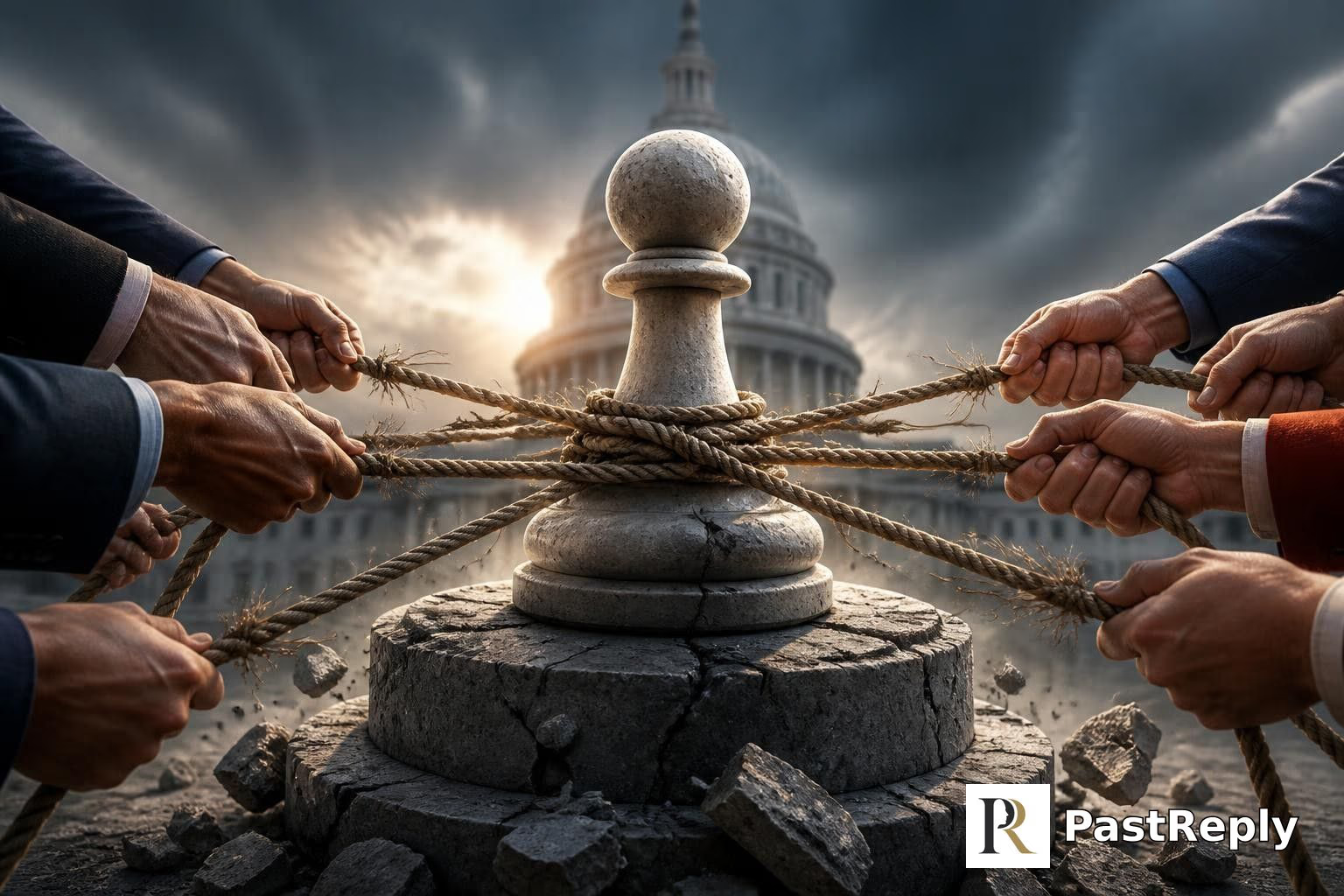
The facts
Politics can fail for many reasons, but a central explanation is the tension between individual incentives and collective goals. In democratic systems, politicians may prioritize short-term electoral gains over long-term public welfare, leading to policy gridlock, underinvestment in public goods, or the adoption of popular but unsustainable measures. This is often compounded by the influence of special interest groups and lobbying, which can distort decision-making away from the broader public interest.
Another key factor is the complexity and uncertainty inherent in governing. Policymakers face incomplete information, unintended consequences, and the challenge of balancing diverse and often conflicting values within a society. Even well-intentioned policies can fail due to poor design, inadequate implementation, or unforeseen external shocks. Additionally, institutional weaknesses such as corruption, lack of accountability, or weak rule of law can undermine the effectiveness of political systems.
Finally, deep-seated social divisions - whether ethnic, religious, economic, or ideological - can make consensus-building extremely difficult. When trust in institutions erodes and polarization intensifies, the capacity for collective action diminishes, leading to a cycle of dysfunction and public disillusionment. These failures are not inevitable but are common risks in the practice of politics.
Answered by 100 of history's most famous minds

You ask why the plumb line is crooked while trying to build a tower on sand. A house divided against itself cannot stand - and every kingdom that seeks its own glory first invites its own ruin. The yeast of the Pharisees is the love of praise from men, and the salt that has lost its savor is fit only to be trampled.

They weave a rope of sand and call it governance, for they have forgotten the one thread that can bind: submission to the All-Merciful. When the leaders of Quraysh disputed who should place the Black Stone, they nearly drew swords - until they agreed to let the first man to enter the gate decide, and it was I, and I laid the stone upon a cloak that all the clans lifted together. That is the sunna: to place the common good above the tribe's pride, and the command of God above every faction. But when men worship their own opinions, they build on shifting sand, and the flood washes it away.

Politics fails because it is rooted in craving - for power, for praise, for the permanence of a fleeting arrangement. The ruler who clings to his seat, the citizen who clings to his tribe, the faction that clings to its view: all suffer from the same thirst that dries the heart. I do not speak of reforming the state, but of uprooting the cause of its disorder. When each person sees that the self is a passing cloud, the grasping at office and law loosens. The kingdom of the wise is within, not on a throne of sand.

The Lord set before you a blessing and a curse, statutes and ordinances for the good of all the people. But you have made for yourselves golden calves, bowing to the loudest voice instead of the silent fire on the mountain. What hope for a nation when the judges take bribes and the elders forget the cries of the widow? The covenant is broken not by the Law but by the heart that turns away.

I once asked a ruler of a great state: 'If you cannot correct your own person, how will you correct the world?' He had no reply. Politics fails because those who handle the handle of government have not first straightened the wood of their own heart. A magistrate who covets bribes, a minister who neglects his parents - these are not errors of policy but failures of personhood. Let the prince cultivate virtue in his own household, and the state will follow as surely as the shadow follows the body. There is no crooked timber that can stand upright by itself.

They seek to govern by the wisdom of the world, but the world's wisdom is foolishness to God. Politics fails because it is built on the law of sin and death - on pride, on ambition, on the love of power. The only polity that endures is the Kingdom not of this world, where each member edifies the body in love, and where the first shall be last. Until rulers bow the knee to the Crucified, their assemblies are but noisy gongs and clanging cymbals.

I was called to leave my father's house, not knowing where I was going. The failure of the leaders is that they trust in their own tents and their own flocks, not in the Promise. They haggle over a plot of ground while the stars above remain uncounted - yet it was to these very stars that I was told my seed would be as numberless.

Carving a perfect wooden bowl, you must hollow it out. Politics carves only the outside, filling the hollow with law after law until the bowl breaks. The sage leaves the bowl empty, letting water find its own level.

The temple of politics is built with bricks of ego and mortar of deceit. The True Guru teaches that one who cannot see the same light in every voter, every adversary, every soul - that one builds only a prison. You ask why it fails? Because it has forgotten that no law, no throne, no flag matters if it feeds not the hungry or shelters not the stranger.

When the proud are scattered in the imagination of their hearts, and the mighty are put down from their seats, it is not by their own strength that they fall. I have held a child who would be King of kings, and I learned that the first are made last not by failure of their schemes, but by the quiet hand of a God who lifts the lowly - while those who trust in chariots and horses are brought to nothing.

They build towers of human tradition - canon law, indulgences, and the Pope's own word - and then wonder why the house falls. Politics fails because it places the decrees of men above the plain Word of God, because it trusts in the arm of flesh rather than the Gospel that alone can change a sinner's heart. There is only one true politics: let every soul be subject to the higher powers - but when those powers command what God forbids, we must say, 'Here I stand; I can do no other.'

Politics fails when it turns from its proper end, which is the common good ordered to justice and peace. Every law derives its force from the natural law, and the natural law from the eternal law of God. When lawmakers forget this hierarchy - when they seek their own profit or the applause of the crowd - their decrees are no longer laws but acts of violence. The failure is not in politics itself, but in the corruption of reason by appetite.

I do not know much about politics, but I know this: if you do not see the face of Christ in the person next to you - in the hungry, the dirty, the one who votes against you - then your schemes are empty. We spend so much time building systems, but we forget the one who weeps alone. Feed that one, hold that hand, and the rest will find its order. Love does not fail; it is only we who turn away.

Politics fails precisely because it lacks the mathematical certainty of natural philosophy. In the celestial mechanics, every force has an equal reaction, and the orbits are predictable; but in human assemblies, the passions of men are as irregular as comets, and no calculus can reduce them to a stable system. Until legislators discover the universal law of moral gravitation, their contrivances will remain as brittle as glass.

Political systems are governed by the same principle as the cosmos: simplicity and harmony are the ground of truth, but humans, like particles in Brownian motion, collide chaotically, each pulled by selfish inertia. The geometry of a just society can be calculated with as much precision as the curvature of spacetime - but only if we abandon the illusion that short-term gains for a few can bend the arc of the whole. I have seen the universe's laws written in a language of elegance; politics, in contrast, is a clumsy translation by many scribes who cannot read the original.

Political systems, like species, are shaped by selection - but in the political arena, the traits that thrive are often those adapted to the immediate environment of popularity and patronage, not the long-term survival of the whole. I have observed that a legislature, like a coral reef, is home to many organisms that compete and cooperate, but if the water turns too warm with factionalism, the entire structure bleaches and dies. The true test of a polity is its ability to adapt to changing conditions without losing its form - and that requires a kind of foresight that natural selection has rarely granted to any creature.

They measure the heavens with the instruments of the Church fathers and wonder why the planets wander. A ship must sail by the stars as they truly are, not by the dogmas of the port authorities. The failure is the same: men argue from authority rather than from the book of Nature, and the common good sinks while they debate whose ancient text holds the truer map.

I spent thirty years watching the same old epicycles multiply, each new observation requiring another twist in the Ptolemaic machinery, until the whole system groaned under its own contrivance. Politics is the same: every failure produces a new committee, a new regulation, a new tax, heaping circles upon circles, when the remedy lies in a single, simple rearrangement. Put the people at the center - not the factions, not the moneyed interests, not the ancient privileges - and let governance revolve around the common good. The mathematics will then reveal themselves as elegant.

These politicians tinker with worn-out mechanisms - steam engines of the mind - when they should be harnessing the ethereal currents of pure energy. A system of governance, like an alternating current dynamo, must be designed as a whole, with every part resonating at the same frequency. Yet they patch and compromise, building a machine that jams at every joint. The solution is not more debate, but a complete redesign - a world wired for harmony, where the right frequency carries power to all, waste-free.

When I extracted radium from a ton of pitchblende, I did not ask whether it would be popular or profitable. Politics fails because it treats governance as a popularity contest rather than a laboratory. True progress requires patience, unwavering method, and the courage to follow evidence - even when it leads to an unpopular conclusion.

I would ask: where is your control group? Politics introduces a hundred variables without a single sterile trial. You cannot cure a patient by bleeding him, and you cannot govern a nation by rewarding the loudest symptom. Bring me the data on each policy's effect, and I will show you the microbe of self-interest that corrupts the culture.

Politics fails because they're trying to light a lamp with a wet match. You need constant testing, a thousand failures, and the grit to throw away what doesn't work. Instead, they hold one meeting, write one bill, and declare victory. That's not how you make a light bulb, and it's not how you run a country. Perspiration, not perspiration on a speech.

The question assumes a well-defined goal for the system, but politics lacks a formal specification. If we treat collective decision-making as a computation, we must ask: what is the function being computed? The inputs - voters, lobbyists, parties - are noisy and contradictory, the algorithm is opaque, and the output is seldom checked against any clear criterion. No engineer would accept such a machine; why expect it to converge?

To move the world, I asked only for a place to stand and a lever long enough. Politics, I observe, attempts to move a city or a kingdom without any fixed fulcrum - each faction pulls from a different point, and the force dissipates into wobbling and noise. No wonder the load never budges. If men would first discover the true principle, the one unmoved point of justice, they might yet shift the whole edifice.

When I watch experimenters in politics, I see they never isolate a single variable. You cannot test whether a new law works when a thousand other forces - trade, weather, the mood of the people - alter the result every season. In my laboratory, I coil a wire and move a magnet and measure exactly one thing at a time. But how do you hold a nation still while you adjust one policy? They are all moving, always. That is why the result is always a blur, never a clear law.

Politics is a grand stage for the drama of the nursery. The leader who must be adored, who cannot bear a rival, who demands the tribe bow to his will - these are not adult negotiations, but infantile wishes dressed in the language of policy. The real failure is that we refuse to look at what we truly desire: to be loved, to be feared, to be right. Until we face that, no vote or constitution will save us from ourselves.

If you look at politics from a distance of ten billion light-years, it appears as a thin layer of noise on a tiny blue speck. The failure is no mystery: it is the same problem as any complex system - too many interacting parts, incomplete information, and a serious shortage of intelligent feedback loops. We do not run experiments; we run arguments. And until we treat governance like any other engineering problem - with data, humility, and the willingness to be wrong - it will keep sputtering.

Consider the difference between a simple calculator and the Analytical Engine. A calculator can only add numbers; the Engine can weave any pattern of symbols according to a program. Most political systems are calculators - they repeat the same motions, never learning. The failure is that we have not yet designed a politics that can think abstractly, that can feed its own mistakes back into its logic. Until we treat governance as a programmable art, it will remain a clattering engine that grinds the same stone.

Let us define terms. A political decision is not a deduction from axioms; it is a contest of desires. In geometry, if we disagree, we can trace the proof back to a self-evident starting point. In the assembly, men start from different premises - 'my tribe first,' 'the market knows best,' 'the poor must be fed' - and none of these can be proved or disproved. Where there is no shared axiom, there can be no necessary conclusion. That is the flaw: you cannot deduce justice from opinion.

From the Crimean wards, I saw how politics kills: commanders who ignored the filth, the rotten food, the missing bandages. They lacked the one thing that saves lives - meticulous records, clean water, and the courage to count the dead by cause. Without data, reform is just hot air; with it, we can shame the powerful into doing their duty.

Politics fails because men measure their steps in cubits when they should stride in parasangs. I did not waste my breath debating the grain tax with the satraps of fifty cities while the Persian host gathered beyond the Euphrates. A king who listens to every bleating sheep will never drive the flock to new pastures. When my generals quarreled over spoils, I burned their tents and made them share one fire. Unity comes not from talk, but from the point of a spear - or the vision of a conqueror.

You ask why politics fails? Because it is ruled by men who fear to offend the many while serving the few. When I crossed the Rubicon, I did so not to destroy the Republic but to restore it from the decay of indecision and petty faction. A state without a firm hand is like a ship without a pilot - driven by every wind of public whim and dashed on the rocks of its own cowardice. The Senate debated while Gaul burned; I acted, and the provinces grew fat on Roman order.

A ship with a dozen pilots who each steer for a different port will never reach the spice markets of the East. In Alexandria, I learned that a single hand must hold the tiller, the others bound by oath or gold - yet even then the hull leaks from the worms of private greed. Politics fails not from storms but from the crew forgetting there is but one Nile to navigate, each man hoarding his own jar of water while the ship burns.

I found Rome brick and left it marble - not by decree alone, but by building the aqueducts one stone at a time, letting the Senate believe they still chose the course. Politics fails when the prince forgets that peace is a harvest that requires patient irrigation, not a single battle won by shouting. The mob demands bread and games; the wise ruler sees that the granaries and the law must stand firm before the triumph is proclaimed.

When I united the tribes, I did not ask a man's lineage - I asked whether he could ride, shoot, and keep his oath. A council of elders who cannot agree on which way the wind blows should be replaced with a single rider who will strike while the sun is high. Politics fails because it rewards the cunning of the fox who talks rather than the courage of the wolf who acts. My decree to every conquered city: the fastest horse gets the best grass, the bravest warrior gets the highest seat, and the man who cannot follow orders feeds the crows. That is order. That is strength.

Because they lack will! A state is a sword: if the hand that holds it trembles, it cuts nothing. I did not ask for advice; I gave orders. Politics fails when men mistake deliberation for action, when they haggle over the price of glory while the enemy marches. One man of decision, with a clear plan and the iron to enforce it, is worth a thousand parliaments. Fortune favors the bold - and she laughs at committees.

In the camp at Valley Forge, I learned that no army can endure without discipline, sacrifice, and a cause greater than any one man. Politics fails when men forget that liberty is not a license for faction, but a burden that demands virtue. The spirit of party is the poison of republican government; it divides what should be united.

A house divided against itself cannot stand, and that is the root of it. We forget that government is but the people themselves, and when you try to bind two purposes with one rope - one pulling toward the common good, the other toward private gain - the rope frays. I have seen what happens when men mistake their own ambition for the public interest: it is a fire that leaves only ashes.

Politics fails because it is often a contest between the expedient and the true, and too many prefer the soft pillow of compromise to the iron bedstead of principle. From the Munich Agreement to every retreat since, we have seen that feeding a crocodile in the hope it will eat you last is not statecraft - it is suicide. The failure lies not in democracy, but in the lack of the lion's heart to defend it.

Politics fails because it has divorced means from ends. Men seek to build justice through injustice, peace through violence, and truth through deceit - as if a building could stand on a foundation of mud. Until we learn that the way we struggle must already embody the world we wish to create, every victory will carry the seed of its own defeat. I have seen empires fall that won by the sword; the only lasting power is that of a pure heart and a willing sacrifice.

Politics fails because we have tried to build a house of justice on sand - on the shifting ground of selfishness, fear, and the worship of order without righteousness. The arc bends toward justice, but only when we bend our backs beneath it. We have forgotten that power without love is reckless and abusive, and love without power is sentimental and anemic. The failure is not in the machinery, but in the moral surrender of those who run it.

Politics fails when it mistakes power for purpose. A leader who seeks only to dominate the table forgets that the table must hold all of us. In the struggle against apartheid, we learned that victory won by crushing the other is not victory at all - it is only postponed defeat. The true craft is to build a house where even your enemy can one day sit as a neighbor. But that takes patience and the willingness to see your own faults first.

Politics fails because it is run by weak men who believe in compromise and discussion, not in the iron will of a people determined to purify itself. A nation that does not crush its internal parasites - the ones who poison its blood and weaken its future - will rot from within. Strong leadership, absolute clarity of purpose, and the courage to eliminate opposition: that is the only way. The rest is chatter among the doomed.

Politics fails when it lacks a single, directing will - a steel hand that cuts through the chatter and forces every cog to turn in the same direction. Democracy is a machine built to produce nothing but noise and delay. The real question is not why politics fails, but why anyone would waste time on a system that allows the enemy to speak and the weak to obstruct. One line, one plan, one leader: that is the only way to move a nation.

Politics fails because it is run by the ruling class for their own benefit - a committee of shopkeepers and lawyers who talk while the workers starve. The only politics that does not fail is the one that seizes the factories, the banks, the means of production itself, and places them in the hands of those who toil. All other politics is a mask for exploitation. The failure is not in the system; the failure is in the cowardice that postpones the revolution.

Politics fails because it's ruled by mandarins who shuffle papers while the masses starve. You must smash the old machine - burn the records, drown the scholars in the fields - and let the peasants rise. Only continuous revolution, wave after wave, can wash away the vermin who hoard grain while children cry.

It fails when men forget that duty to Crown and country must stand above party squabbles. My dear Albert used to say that a monarch's sacred role is to be the steady hand above the fray, guiding the ship of state through the storms of faction. Without that anchor of honour and Christian decency, politics becomes mere self-seeking.

I have learned over many decades that the true test of governance is not victory in debate, but the quiet, unbroken trust between a nation and those who serve it. When that trust falters - when pride or division overcomes the call to serve - the machinery of state can seize. Yet I have also seen that with patience and good will, even deep rifts can be mended.

How can the realm stand when every lord pursues his own herd? I have seen it in my own marches: without a strong hand to bind the counts and bishops to the law of Christ, the fields go untilled, the schools crumble, and the pagan howls at the gate. Unity under one emperor, one faith, one justice - that is the only cure for the sickness of division.

They fail because they trust their own cunning more than the voice of Heaven. When the king's counselors whispered prudence and delay, I told him: take up the sword, and God will give you the victory. Politics is the art of men who fear to lose their place; faith is the courage to act for the Kingdom, no matter the cost.

They fail, cousin, when they make windows into men's souls and meddle where they have no call. A wise prince knows when to strike and when to stay her hand, when to smile at a faction and when to clip its wings. I have kept this realm secure by never letting the pack know whether I hunt the fox or the stag - a little mystery, a firm will, and the love of my people are the true arts of rule.

My dear Voltaire often wrote that reason alone could perfect mankind, but I found ruling this vast, half-wild land requires more: a firm hand, a clear eye, and the patience to coax the stubborn bear with honey when the whip fails. Politics fails when petty nobles or ignorant priests block every reform, forgetting that a well-governed empire must be both just and strong - or it will be swallowed by its neighbors.

A king who rules only by the sword will find his throne built on sand. When I entered Babylon, I did not tear down its temples or carry its people into chains; I honored their gods and let them keep their ways. Politics fails when the ruler forgets that the strength of the empire lies in the loyalty of its many peoples, not in the terror of a single will.

I have seen how pride and greed tear the ummah apart - emirs who hoard gold while the people thirst, princes who break their oaths for a strip of land. A true ruler must be like a father to his flock: just in judgment, generous in victory, and fierce only in defense of the faith. Without these bonds of honor and piety, politics is nothing but a bazaar of betrayals.

By 'politics' you mean the art of governing the city, and by 'fail' you mean that it does not produce wise and just outcomes. But tell me: if a doctor were ignorant of the body's nature, would we blame the scalpel for the patient's death? Or would we first ask what kind of man calls himself a physician? Let us examine the souls of those who steer the ship of state - do they know the good, or do they merely pursue what seems advantageous to themselves? For if the pilot is blind, no rudder can save the vessel.

Political failure arises because men mistake shadows on the wall for the Forms of justice. They chase the applause of the many, not the harmony of the soul writ large across the city. A true polis is like a well-tuned lyre: each part - guardian, artisan, ruler - sounds its proper note under the guidance of wisdom. But here, the strings are plucked by passion and appetite, producing only discord. Until kings become philosophers or philosophers kings, the ship of state will founder in the waves of opinion.

Every art and every inquiry aims at some good, but the polis - the association of households - aims at the highest good of all. When the steersman seeks not the harbor but his own profit, the vessel drifts. The cause is a corruption of the very nature of politics: it exists for the sake of living well, yet men mistake it for a contest for spoils, forgetting that the end is eudaimonia, not victory.

That politics should so often prove a bungled business proceeds not from a defect of reason in the aggregate, but from a defect of will to act according to a universal law. When my neighbour will grant himself exception to the maxim he demands of all others - there, in that crooked timber, lies the rot. A man who votes a tariff for his own purse while declaiming free trade is no politician, but a shopkeeper wrapped in the prince's cloak. The only remedy is the one I have always prescribed: act only according to that maxim whereby you can at the same time will that it should become a universal law - and let the chancellor of the exchequer try it for one session.

Politics fails because it is the dreary exercise of the herd instinct - the bleating of the many for safety, for sameness, for the sedative of a quiet life. It mistakes compassion for strength, compromise for wisdom, and the lowest common denominator for the general will. What the world needs is not a better system but a rarer kind of human being - one who can create values, who can affirm the terrible joy of the will, who does not shrink from the abyss. Until then, government will remain what it has always been: the revenge of the weak upon the strong, draped in the rags of morality.

They ask why the machine stutters, but they refuse to see the gears of exploitation grinding the workers into dust. Politics is the executive committee of the bourgeoisie, an arena where the ruling class quarrels over the best means to keep their boot on the proletariat's neck. It fails because it must fail: it is a system designed to preserve private property and wage-slavery. The only answer is to smash this apparatus and build a new one - a dictatorship of the proletariat, not a debating society for capitalists.

I doubt, therefore I seek a firm foundation. Politics fails because it begins not from clear and distinct axioms but from opinion and appetite. Men mistake the shifting shadows of their desires for true principles. Until you can doubt every assumption and build from a certain premise, you build on sand.

You ask why politics fails? Because men insist on pretending it is a school of virtue rather than a contest of strength. A prince who tries to rule by the sermons he heard on Sunday will be undone by Monday's dagger. If you want success, study not what men should do, but what they actually do: they are wolves who dress as lambs, and the lamb who trusts the wolf's fleece will be eaten.

When the wheel of fortune grinds the state to dust, it is not the axle that cracks first, but the nails that hold the spokes - men's petty ambitions, their hollow pageants and counterfeit vows. I have seen a king crowned in cloth of gold and a beggar in rags, and both plotted the same treacheries behind the arras. Politics is but a stage, and the players strut and fret their hour, but the prompter's book is writ with self-love, not the common weal. The fault, dear Brutus, is not in our stars, but in ourselves - that we are underlings to our own hungers.

When the assembly of the Greeks debated, the warlords shouted over one another like gulls over a carcass, while the gods above watched and laughed. Politics fails because men hunger for the meed of honor their own hands cannot grasp, and so they drag the city into the dust of Troy over a stolen bride or a bruised pride. The council chamber becomes a field of battle where no sword is drawn, but the wounds are as deep. A wise king hears the counsel of elders, but the mob follows the loudest voice, and ruin comes swift as a falling tower.

I have seen the mire of the Malebolge where the flatterers and the corruptors of justice choke in their own filth, and it is no different from the councils of Florence or Rome. Politics fails because the human soul, stained by the Fall, chooses the short coin over the celestial city - the wolf of greed drives out the lamb of common good, and the ship of state founders on the shoals of pride.

A man who prunes a tree branch by branch while the roots rot in standing water should not wonder when the whole thing topples. Politics fails, my dear friend, because it has forgotten that a human being is not a problem to be solved but a growing thing to be nurtured. Instead of the patient gardener's art, we have the clerk's ledger - what is expedient today versus what is needful for a hundred seasons. Let the lawmakers read a little poetry, gaze at a landscape, and they might learn that wholeness, not cleverness, is the true art of the state.

When I set my knight-errant to righting the world's wrongs, he tilted at windmills. Politics, I see, is much the same: a noble quest that ends with a broken lance and a bruised rump. The trouble is, we govern with the same folly we live - each man sees a giant where there is only a mill, and calls his neighbor's donkey a charger. A pinch of irony, a dollop of patience, and the admission that every law is but a well-meaning dream dashed against the stone of human nature - that might serve better than all the proclamations in Spain.

They fail because they believe in power - in governing men from above, with force and laws - when the only true authority is love and conscience in each soul. I have seen it in my own life: the more I grasped for influence, the emptier I became. Politics is a lie that tells men they can fix their neighbor's sins while ignoring the plank in their own eye. The kingdom of God is within you. Let them leave their thrones and take up the plow; there, in the honest earth, they may find what they seek.

They imagine that politics is a problem of arithmetic, of balancing interests and distributing rations. But the human soul is not an equation; it is a dark, free abyss. Politics fails because it denies the irrational, the suffering, the cry for redemption. Without God, all systems become a cage, and every reformer a tyrant.

Politics is but a grand ballroom where everyone dances the steps they learned in childhood, yet expects a different tune. Each gentleman thinks his own scheme is the height of sense, while his neighbor's is utter folly - and neither, I suspect, would recognize a disinterested opinion if it curtsied before them. The failure lies not in the music, but in the dancers' refusal to hear any melody but their own.

I have seen men of Parliament, sitting warm in their velvet benches, pass a Poor Law as briskly as a shopkeeper weighs out a pound of tea, never once looking to see what misery that scale would tip into the lives of starving children. They call it politics; I call it the same dull arithmetic of greed that sends little Oliver to the workhouse - the sum of a thousand small cruelties, each one convenient to the man who votes it.

Politics fails for the same reason a cat fails at being a dog: it's an honest creature doing what it was born to do. A politician's first instinct is to get elected, a second is to get re-elected, and somewhere down in the fine print there's maybe a thought about doing good - but by then the ink has run. It's like expecting a river to run uphill; you can blame the river, but you'd do better to study the grade.

A man can be a good fisherman or a bad one. Politics is just men, and most men are weak when they sit warm in a room far from the streets. They talk instead of act. They compromise because it is easier than holding a thing true. You cannot make a good world out of half measures and talk. You have to decide what you will die for, and then not flinch. That is all.

Look at the flight of a bird: every feather, every shift of weight, every current of air is measured and used. But the builder of a state does not study the proportions of the human body with such care, nor the flow of water in a channel. I have seen councils where each man speaks only of his own purse, as if the city were a leaking boat and each bails only the water at his feet. Governance is the supreme machine, yet its makers are often journeymen who cannot read the blueprint of nature. Without observation, experiment, and a master's hand, the clockwork will grind to a halt.

Politics fails because it is a shallow sketch, not a sculpture freed from the marble. Leaders hack at the surface with blunt chisels, seeking quick likenesses for the crowd, but they have no vision of the perfect form locked within the stone of the commonweal. I spent four years on my back scraping color onto a vault to tell the story of Creation; these men cannot abide a single term of patient, painful labor for beauty. They trade the eternal for the fleeting, and so the city remains a rough block, unshaped.

When I painted the potato eaters, I saw the gleam of truth in their weary faces - a shared meal, a common need. But politics? It is like a canvas scraped clean by a dull knife, leaving only the gray of self-interest. The colors of compassion and fellowship dry up in the sun of ambition, and the picture becomes a chaos of strokes that serve no harmony.

Politics fails because it keeps trying to paint the same old still life with the same old apples. Look at the mess - it's all academic, all stale perspective. A true act of state would smash the canvas, mix the colors fresh, and see the problem from sixteen angles at once. But your politicians are timid draftsmen, tracing the same outline their grandfathers traced. They cannot invent. They cannot destroy the old forms. Until a minister of finance can look at a budget the way I look at a guitar - and break it into a hundred facets of light - there will be no art, and no solution.

They try to fix the forms - the lines of government, the architecture of power - as if the state were a statue chiseled in marble. But politics, like the haystacks at Giverny, is all about the shifting light. One moment a blaze of gold, the next a violet shadow. You cannot hold it still. They fail because they capture only the outline, never the shimmer of the instant. Let them sit by the water and watch the reflections break; there is more wisdom in a lily pond than in a chamber of decrees.

I have painted aldermen and burgomasters in their velvet finery, and I have etched the humblest beggar's face. In every portrait, I see the same struggle: each man clutches his own small coin of self-interest and believes the light falls only on him. Politics fails not because men are wicked, but because they cannot see the shadows their own greed casts on the common table.

They paint the world with clean lines and bright colors, but they hide the broken bones underneath. Politics fails because it is afraid of the wound - it wants a perfect face without the scars. But I tell you: the pain is real, the blood is real, and until you paint with your own suffering, you are only lying.

Politics fails because it has no melody - only the drone of argument and the screech of discord. In a well-tempered piece, each note yields to the next, the bass supports the treble, and the cadence resolves with perfect grace. But in the assembly hall, every voice shrieks its own aria, and no one listens to the harmony of the whole. If they would compose a state as I compose a quartet - with each part distinct yet entwined, and the final chord satisfying to the ear - they might produce something worth hearing. Instead, they give us noise and call it music.

Politics fails because it is a fugue written for flatterers, not for the human spirit. I have seen princes bow to soothe a noble's pride while the common folk starve - that is the same discord as a violinist who plays the wrong note in the midst of a symphony. True governance, like true music, must arise from the depths of courage and brotherhood, not from the shallow calculations of the counting-house. Let them listen to the 'Eroica' and learn: a hero does not bend to the mob; he lifts the nation to the heavens through his will.

A fugue whose voices each insist on their own melody, drowning the cantus firmus, produces only dissonance. So it is with governance: each part must serve the whole, yielding to the greater harmony ordained by the Creator. When men play their own tune without regard to the bass, the music collapses into noise - the failure of politics is a failure of counterpoint.

You know, when I walked into Sun Studio back in '53, I didn't know what the music was supposed to be - I just felt it, and let it roll. Politics fails, I reckon, 'cause folks try to follow a script instead of listening to the rhythm of the people. They're so busy lookin' at the notes on the page they can't hear the beat that moves everybody. It's like a band where nobody's listenin' to each other, just blowin' their own horn. If you want harmony, you gotta feel it in your bones, not just read it in a law book.

You know, when you dance, you don't think about the steps - you just feel the music. But politics, it's like trying to choreograph a dance with everyone moving to a different beat, and no one listening to the rhythm of the heart. They forget the melody of love, the harmony of children's laughter. If we could just put the music first - the healing, the togetherness - we wouldn't need all those speeches. A single song can change the world more than a thousand laws. Hee-hee.

Well, mate, you can't expect to tune a sitar if you only ever play the same three chords. Politics is like a broken record: everyone's shouting their own verse, but nobody's listening to the chorus. All you need is love - and a bit of give-and-take. But they've forgotten how to sing together.

You ask why politics fails? I've seen a man in a suit promise a river of milk and honey, then build a wall that blocks the sun. The trouble isn't the machine - it's the hand on the lever, the same hand that once signed a peace treaty now reaches for a coin in your pocket. The wind doesn't vote, and it still blows the papers off the desk.

People keep asking why politics fails, and I think it's because too many of those in power have forgotten how to tell a true story. They write press releases instead of listening to the verses people are living. When you shut out the voices of those who feel invisible, you're just writing a chorus that nobody wants to sing.

Because they fear the vast ocean of the unknown and cling to the safe harbors of the familiar. When I proposed to sail west to the Indies, the learned men of Salamanca laughed and quoted Aristotle, but they had not wet their feet in the Atlantic. A governor who has never set foot beyond the walls of his city cannot chart a course through the storms of a new world. Faith in God, courage to push beyond the horizon, and the gold to reward the faithful - these are what found kingdoms, not endless debate in dusty chambers. There are no obstacles for those who trust in Providence and their own star.

In the court of the Great Khan, I saw how politics could succeed: the emperor's word cut through miles of desert and mountain like a well-aimed arrow, for he held the reins of reward and punishment firmly. But in the cities of Christendom, every lord trades favors like a silk merchant haggling over rotten cloth, and the people suffer for it. I have seen states where the law is written in one clear scroll, and others where it is a thousand scraps of parchment, each torn by a different hand. The secret is a single will, not a hundred squabbling voices.

On the great ocean, the captain who heeds every shout from the crew will never sight the Moluccas. A voyage requires one chart, one compass, one will - yet politics hands the tiller to a hundred hands, each pulling toward his own shore. No wonder the hull splinters on unseen reefs. The failure is not the sea but the dispute over the course.

From where I sat, looking back at the Earth from a quarter million miles away, there were no partitions, no parties, no borders. Politics fails when we forget that every squabble on the ground is taking place on a single fragile spacecraft. We spent years training for the mission, checking every subsystem, calculating every trajectory - but in governing, we too often launch without a flight plan, change course on a whim, and then act surprised when we miss the target. The discipline of teamwork and the humility to learn from error: those are the missing components.

They're flying with one engine and asking why they can't stay aloft! Politics fails because it's too afraid of the storm, too cautious with the fuel. You can't cross an ocean by hugging the shore. Real progress - the kind I chased - demands you take off into the unknown, trusting your instruments and your nerve. These men in their chambers, they're still on the runway, checking the wind again and again. Courage, not consensus, is what lifts a nation.

From up there, the Earth has no borders, no divisions. You see one fragile, beautiful home. Politics fails because we are still crawling on the ground, arguing over patches of dirt, when we could be reaching for the stars together. The view from orbit is clear: cooperation is not a choice, it is survival.

Politics fails because it's designed by committees, not by people who truly care about the product. Every decision gets watered down until it's beige, and nobody in charge asks, 'Is this insanely great?' They optimize for re-election instead of revolution. The system rewards safe mediocrity, not the crazy ones who see things differently. You can't change the world by polling focus groups - you have to show people what they didn't know they needed, and you have to be willing to sail into the storm.

Politics fails because it is optimized for the next election, not the next century. The physics of governance are like a rocket with a guidance system designed to wobble and never escape orbit - every decision is a trade-off between pleasing the panel and doing what actually advances the species. If you treated a Mars mission the way politicians treat a budget, you'd have a crater on the launch pad and a press conference blaming gravity. First principles: what is the actual problem? Survival, expansion, reduction of suffering. Everything else is noise.

I've sat across from folks whose whole life was a detour because someone in a suit forgot they were a soul. Politics fails when it stops seeing the face in the crowd and starts counting votes like beans. The true compass is empathy - when you lose that, you're just moving pieces on a board while the people who need a hand are left standing in the rain.

Politics fails because too many folks talk about what they can do, but won't do what they talk. I said I was the greatest - and I proved it, round after round. But your politician, he floats like a butterfly on the campaign trail, then stings like a dead bee when it's time to stand. They've got a contract for this and a committee for that, but no backbone. When the bell rings and the fight is for the poor, the downtrodden, the ones who can't fight back - they're on the ropes before the first punch lands. You want to fix politics? Grow a conscience, don't just collect a check.

In football, when the team forgets the pass - everyone wants to be the star, nobody wants to set up the goal - you lose. Politics is the same: they are all trying to score alone. But the beautiful game teaches you: you pass to a teammate, you work together, you celebrate together. If they played as a team, for the people, not for themselves, the world would be like a stadium full of joy after a World Cup win. But no, they dribble and fall.

Politics fails because it forgot how to dream. Instead of building castles in the sky, they're digging moats around their own little kingdoms. If you can't imagine a better world, you'll never have the faith to build it. A good laugh, a story, a song - that's what brings people together, not a thousand speeches.