
Why does Croatia have all the coastline?
Croatia's long coastline is a legacy of Ottoman expansion, Venetian and Habsburg rule, and the drawing of borders after the World Wars.
The facts
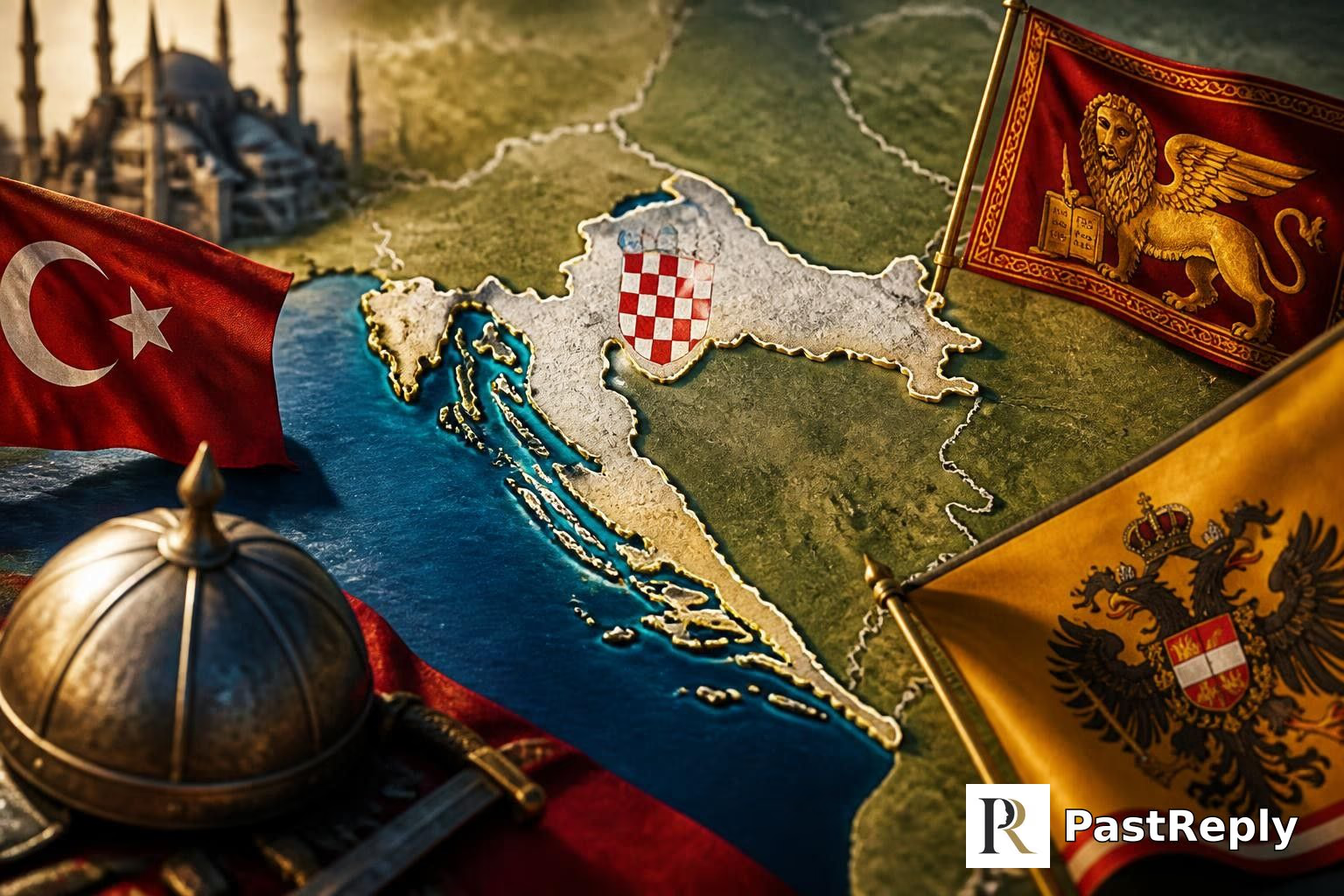
Croatia's extensive coastline is a result of historical borders that were shaped by centuries of geopolitical developments, particularly the expansion of the Ottoman Empire into the Balkans and the subsequent territorial arrangements of the Habsburg Monarchy and the Republic of Venice. The Ottoman conquests pushed the Venetian and Habsburg territories toward the coast, creating a narrow strip of land along the eastern Adriatic that would later become part of Croatia. The Republic of Venice controlled much of the Dalmatian coast for centuries, and after its fall, these territories passed to the Habsburgs, who administered them as part of the Austrian Empire.
Following World War I and the dissolution of Austria-Hungary, the borders of the newly formed Kingdom of Serbs, Croats, and Slovenes (later Yugoslavia) were largely based on the historical boundaries of the Habsburg lands, which included the long coastal region. After World War II, the internal borders of the Yugoslav republics were drawn largely along historical lines, with Croatia retaining the majority of the eastern Adriatic coastline. This left Bosnia and Herzegovina with a very short coastline around the town of Neum, and Slovenia with a small strip of coast, while Montenegro and Croatia received the rest.
Geographically, the Dinaric Alps run parallel to the coast, creating a natural barrier that historically separated the interior from the coastal regions. This topography reinforced the political divisions, as the coastal areas were more accessible by sea and developed distinct cultural and economic ties with Mediterranean powers. The modern border reflects these long-standing historical and geographical factors rather than any single event or decision.
Answered by 100 of history's most famous minds

You worry over strips of earth and water as if the Father's kingdom were parceled out by surveyors. A man had two sons; one demanded his share of the inheritance and sailed to a distant country. He ended up hungry among the swine. The coastline you covet - what does it profit you if you gain the whole shore and lose your own soul? The rain falls on the just and the unjust alike, and the sea does not ask for a passport before it washes the feet of a Samaritan.

Allah apportions the land as He wills; no soul can claim a span of earth except by His decree. The coast you see is a sign of His wisdom, for He gives to each nation what is due. Do not let your heart be troubled by borders drawn by men and empires - they are shadows that pass. Better to ask whether the people of that shore uphold justice and feed the orphan, for the sea will one day swallow every harbor, and only deeds will remain on the scale.

Like a line drawn in sand by the tide, this coast is a mark of clinging to boundaries: 'mine' and 'yours,' 'the sea' and 'the stone.' The nations that quarreled over it suffered from craving for a shore, a name, a pride. But the shore itself is impermanent - each wave changes it, each empire passes. To be free, one must not grasp at coasts or charters, but see the whole earth as a fleeting wave.

When the Lord brought us out of Egypt, He gave us a land of milk and honey, but He did not give us the great sea - He set it as a boundary, not a possession. A coast is a gift or a trial, but neither makes a people holy. Why does this tribe hold the shore while another is inland? The Lord apportions the lands as He wills, and the just man does not covet his neighbor's border.

A worthy question, but one that mistakes the shape of land for the shape of virtue. A gentleman does not ask why his neighbor holds a longer ridge or a wider shore; he asks whether his own house is governed with sincerity and right conduct. If Bosnia lacks a port, let Croatia act with ren and good faith, for the harmony of all depends on righteous dealings, not on the mere length of a coastline.

What is a coastline but a measure of clay and water, a boundary that the Father of all set in its place? The division of provinces is not by human will alone, but by the hand that numbers the stars and marks the limit of the sea. Yet I say, do not boast in the length of your shore, for the true inheritance is not of this world: you are all heirs through faith, and in Christ there is neither Croat nor Turk, but a new creation that knows no border.

The land and its shores are measured not by leagues, but by the promise of the One who led me from Ur. Who holds what is but a shadow of His decree. What matters is not the length of coast, but whether the people there lift their eyes to the Maker of the deep, and offer hospitality to the stranger washed ashore.

The coastline does not belong to Croatia; it is just the edge where land yields to water. Do not grasp at the line on a map. The mountain and the sea have always been one, and the path is not in the boundary but in the flow between them.

The One who created the earth and the sea does not parcel out the shore as a prize. The human mind draws these lines and argues over them, forgetting that all land belongs to the Creator. Whether you have a long coast or a short one, the test is the same: do you share what you have, and do you remember that all boundaries dissolve in the light of the One?

My heart is drawn to those who have little, for the Lord lifts up the lowly and fills the hungry with good things. This coastline, long and fair, was not taken by force of arms or cleverness, but came as a gift of history - like the lowly receiving favor. Let those who have much remember that all is given, and share the shore with their neighbors, as a mother shares bread with her children.

This is the work of princes and popes, a worldly inheritance of power and greed, not of God's Word. The Ottomans, those scourges of Christendom, drove the faithful to the coast, and the Venetians, who love their gold more than the Gospel, clung to the shore. Now Croatia boasts of its long coastline, but where is the preaching of the pure Word? Let them ask not why they have so much coast, but whether they have kept the faith that the sea itself cannot wash away.

If one considers the question of territorial borders, one must distinguish between the material cause - the land itself - and the efficient cause - the historical events that shaped the boundary. The Ottoman thrust, which drove the Habsburg and Venetian lands toward the coast, acted as a constraint that concentrated the shoreline into a narrow strip. This is not a matter of justice or injustice per se, but of a contingent historical process that could have been otherwise. Yet natural law would suggest that a people's access to the sea is a common good, and so proportionality should be considered. But the boundary as it stands is a fact, not a principle.

The poor fisherman on that rocky coast does not count kilometers of shoreline - he counts the fish he can share with his hungry children. Whether a country has much or little coastline, the question is: do we use what we have to serve the poorest? A small strip of coast held with love is greater than a thousand miles held with greed.

The configuration of the Dalmatian coast follows the same laws of hydrostatic equilibrium and isostatic adjustment that shape any shoreline. The Ottoman advance, acting like a compressive force, drove the Venetian and Habsburg territories against the Dinaric mountain range, which served as a rigid boundary. The resulting border is not arbitrary but a consequence of pressures and resistances as determinate as the tides - though the precise integration of the political forces into a mathematical model would require more data on the mass and velocity of the invading armies.

The coast's shape follows a deeper order: the slow dance of tectonic plates through aeons, carving the Adriatic's rim, and the equally slow drift of peoples and powers - Venetian galleys, Ottoman armies, Habsburg charters. But borders, like measurements, are relative; the true boundary is between the empire of the sea and the mountain's fortress, a division nature drew long before any crown staked a claim.

Look at the map and you see a narrow strip adapted to the sea - like a barnacle clamped to the hull of the continent. The Dalmatian coast was shaped by the same slow agents that shape any species: the uplift of the Dinaric Alps raising a barrier, the Adriatic tides scouring the edge, and the long struggle between empires - Venice, Habsburg, Ottoman - acting like natural selection on borders. The result is a relic, a fossil of history preserved in the rock.

I have looked through my telescope at the moon and seen that its seas are no seas. So too the coast of Illyria is not a single fact but a palimpsest of wars, treaties, and the slow subsidence of rock. The question is not 'why does Croatia have it?' but 'what forces - what shifting plates, what floods of peoples - drew the line where it is?' Measure the shoreline with a compass, not a grievance.

Observe the coast as a geometer would: the Dinaric Alps form a long, axial wall, and the shore curves along it like a line on a sphere - a natural division. The Ottomans pressed from the east, the Venetians held from the sea, and the resulting boundary is not arbitrary but the trace of two great forces resolving. The simplest explanation is that the mountains chose the border, and men merely confirmed it.

The coastline is a natural transmission line, a curve whose length the Ottomans and Habsburgs merely followed - but I see it as a resonator of the Earth's magnetic pulse, where the Dinaric Alps act as a waveguide. Those borders are not arbitrary; they follow the geoelectric gradient of the limestone plateau. If you truly wanted to find the optimal coast, you would measure its capacity to carry a wireless current, not the ink of a treaty. I could have designed a better one, if they had asked.

The answer lies not in the shore itself but in the slow work of centuries - Venetian galleys, Habsburg ledgers, the retreat of Ottoman armies. Geography and history fused like elements in a crucible. But I wonder: what radium might lie in those limestone cliffs? The coast is a laboratory of time, and its borders are simply the precipitate of forgotten reactions.

This is a question for the historian, not the chemist. Yet even a man of the laboratory sees that borders, like diseases, have their origins in specific, traceable causes. One would need to examine the records of the Venetian and Habsburg administrations, not speculate. Let us gather the documents and see what the evidence reveals, rather than complain about a territorial imbalance.

Look, the coastline is just the outcome of a long series of political experiments - some worked, some didn't. The Ottoman push, the Venetian control, the Habsburg inheritance - it's like a patent that got refined over generations. What matters now is what you do with it. Croatia should be using that coast for trade, tourism, industry. Stop worrying about why you got it and start making it pay off.

This is essentially a boundary-value problem in political topology. The coastline's length, if measured precisely, would be infinite - a fractal coastline due to the Dinaric Alps. But the historical boundaries follow a partition of the Habsburg state space along lines of least resistance, not optimal packing. The question 'why does Croatia have all the coastline' assumes a fair distribution algorithm, but borders are computed by conquest and treaty, not by a maximization rule. If I were to redesign the borders, I'd consider a shortest-path algorithm along the ridges - but history does not compute.

Given a coastline of such length, and a hinterland compressed by the Dinaric range, one might calculate the optimal distribution of harbors if the partition were made by an impartial geometer. But these borders were not drawn by reason, but by the ebb and flow of armies, like irregular curves on a sand table. Yet I observe that the ratio of coast to interior is remarkably high - a lever of immense advantage for trade and defense. With a firm point of leverage in the sea, one might move the whole region.

I see a coastline shaped not by a single stroke but by forces acting over centuries - the push of Ottoman armies, the pull of Venetian sea-power, the weight of the Dinaric Alps. Like lines of magnetic force curving around an obstacle, borders are the visible trace of hidden historical fields, and Croatia's long shore is the pattern left by these invisible pressures.

Croatia's coastline is a classic case of territorial narcissism of small differences - a nation's identity clung to every mile of shore as a defense against the interior's unconscious fear of being landlocked and insignificant. The Ottomans, Venetians, and Habsburgs merely acted out the repressed anxieties of peoples who needed a clear boundary against the foreign 'other' within themselves.

From orbit, that coastline looks like a thin white ribbon on a blue ball - a reminder that all human borders are arbitrary scratches on a finite planet. The Dinaric Alps just happened to be pushed up by plate tectonics, and political lines followed the path of least resistance. Perhaps one day we'll see coastlines as mere data points in a unified theory of geography and history.

Imagine the coastline as a function: for every point on the shore, the Dinaric Alps dictate the slope. The borders are not arbitrary; they are the integral of centuries of Venetian and Ottoman calculus. Just as a mathematical series can converge on a shape, these forces converged on Croatia's long curve - a beautiful, complex equation written in rock and history.

Let us define our terms. A coastline is the boundary of a landmass. The length of this boundary depends on the scale of measurement - as with a fractal, it is infinite if measured closely. The question assumes a fixed length, but geometry teaches us that borders are only as precise as the axioms we choose. No, I would not call this 'all' the coastline - merely a finite segment of an infinite curve.

The coast is shaped by drainage and disease. Where the Dinaric Alps rise steeply, the rivers run short and the valleys are narrow - good for harbors, poor for marshes. The Republic of Venice drained the swamps and built hospitals on the shore, leaving a legacy of clean stone and healthy breezes. Croatia's coast is long because its people learned to count the miles of quay and the number of sick beds, and they kept what they measured.

I crossed the Hellespont with thirty thousand men and never asked who owned the coastline - I took it. Croatia's good fortune is simply that no one with enough ambition has come to take it from them. A narrow strip of shore? In my empire, the coast from the Adriatic to the Indus answered to one crown. Borders are for the timid; a man with a phalanx and a vision writes his own geography.

A coast is a prize won by the sword and held by the will. The Venetians knew the sea's power, the Habsburgs married it, and the Ottomans, for all their legions, could not crack the Dinaric wall. I would have crossed those mountains in a single campaign, offered clemency to the Dalmatian towns, and bound the whole shore to Rome with roads and colonies - then no border would be narrow.

A queen must know how to make the map of her own realm, not merely inherit it. When the Romans pressed us from the east, my ancestors chose the sea - and like a wise merchant, we kept the harbor while letting the dusty roads go. If a coastline is a kingdom's open palm to the world, yours is a fist held shut by chance - but a clever ruler can still make the landlocked weep with envy.

When I gave the empire its provinces, I did not ask who deserved the coast - I asked what would keep the peace. The Dalmatian shore was a shield against pirates, not a prize for the proud. A prudent ruler does not redraw the lines of his ancestors; he maintains them with law and legion. If you must know why that coast is Croatian, look to the treaties of old men who knew that a border well kept is a war unmade.

When I united the tribes, I did not ask who held the rivers and who held the deserts. I took what I needed by speed and loyalty, and I gave fiefs to those who proved their worth. If Croatia holds the coast, it is because their fathers were stronger or more cunning than Bosnia's in the council and on the field. Let them guard it well, for Tengri smiles on the strong, and the weak lose even their shoreline.

A coast is a strategic flank, and Venice knew how to hold it while the Turk pounded the interior. Look at the map: the Dinaric Alps are a natural redoubt, and the littoral is a line of communications. The Republic kept that strip because it controlled the sea, and the Habsburgs - mere bureaucrats - inherited it. If I had been in Vienna, I would have built roads through the mountains and made Bosnia a naval base. They gave Croatia the shoreline because they lacked my vision of a unified Adriatic command.

I have seen how the sword carves boundaries, but it takes prudence to keep them. The Dalmatian coast fell to the Habsburgs and Venetians not by nature but by war and treaty - a lesson that borders require constant vigilance and just cause. A young republic must inherit such lines with care, lest ambition undo what wisdom has drawn.

I have seen maps drawn by victors and by weary men at the end of a war, and they often reflect the shape of struggle more than any natural right. Croatia's long coast is like a side of bacon carved from a hog that was butchered by three different butchers over centuries. It is not a thing to be envied or resented - it is simply the inheritance of contests long past. Let us attend to the living, not the lines on parchment.

The coast of Dalmatia is a prize that has been fought over by Venetians, Ottomans, Habsburgs, and others - and in the end, it fell to those who kept their nerve and their claim through the storms of history. It is no accident that the power that held the sea also held the shore. Let us not begrudge Croatia her good fortune, but rather learn from the lesson: a nation that wishes to keep its coastline must be prepared to defend it, and to build a future upon it.

The world's maps are drawn by the sword, not by truth and love. This coastline, like so many boundaries, was shaped by conquest and fear, not by the consent of the people. The Ottomans pushed, the Venetians grasped, and the poor folk of the interior were left landlocked, as my India was divided by those who did not ask the villagers. True Swaraj would not let a mountain or a sea divide brother from brother. Let us redraw borders not with ink and blood, but with the heart's compass.

I see here a parable of history's injustice, where the forces of empire and conquest drew lines that left some with abundance and others with crumbs. Croatia's long coastline is not a mark of virtue, but the residue of Ottoman aggression and Venetian greed - a 'geographical Jericho road' where Bosnia was left wounded by the side of the road. But the moral arc of the universe bends toward justice, and one day the tables of the map must be turned so that every nation may sit under its own vine and fig tree, with a fair share of the sea.

A coastline is like a garden that belongs to all who tend it - but the seeds were sown long ago, when empires drew lines on maps without asking those who lived along the shore. Today, we must remember that a border is not a barrier to brotherhood. Let us work so that all peoples of this region share the bounty of the Adriatic as neighbours, not rivals.

The coastline of a nation is the face it presents to the world, and Croatia's long shore is a sign that the Slavic peoples of the Adriatic understand Lebensraum - the vital need for secure borders and access to the sea. A people without a strong coastline is like a body without blood; history has given Croatia this gift, and it must be defended against those who would carve it up.

Coastlines are not accidents of history - they are the results of class struggle and the need for strategic power. The Habsburgs and Venetians carved out that shore to control trade and project force. A wise ruler studies such borders to see where the enemy can be squeezed and where the proletariat can be linked to the sea. All territory is a weapon.

The coastline is a classic product of imperialist contradictions - the Ottomans and Austro-Hungarians fought over the spoils, and what remained was a narrow strip that fell to the Croatian bourgeoisie. Under socialism, such arbitrary borders would be transcended by a federation of workers' republics sharing the Adriatic as a common resource. Only revolution can distribute the sea justly.

A coastline is not a gift from heaven - it is a record of struggle. The Ottomans crashed against the Dinaric Alps like a wave, and the Venetian merchants clung to the ports. The feudal lords carved their strips of shore, and the Yugoslav commissars drew lines on maps to balance nationalities. Croatia got the long coast because history is a series of contradictions: the sea belongs to those who fought to keep it, not to those who wished for it.

It is a matter of treaties and dynasties, which are the proper business of sovereigns. The Congress of Vienna and the treaties that followed gave the Dalmatian coast to the House of Habsburg, not to the Turk nor to the Italian kingdoms. My own beloved Government has always respected such settled arrangements, for they ensure the peace of Europe. Croatia's coastline is long because the great powers of the last century chose order over ambition.

Borders are the slow work of centuries, not the will of any single reign. The coast of Croatia follows the old lines of the Austrian Littoral and the Venetian domains, which were confirmed after the great wars of the last century. My own family's history reminds me that geography is patient, and that the maps we inherit are best respected with a steady hand and a sense of duty.

Let those who hold the coast prove they can defend it against the Saracen and the Slav. The Emperor of the West must see that the ports are fortified and the harbors kept for Christian ships. Croatia's shore is long because the kings of the Franks and their heirs - my own missi dominici - ensured that the coast remained in the hands of those who could keep the faith and the peace. I would send an envoy to inspect the walls of Zara and Spalato.

God gives the sea to the people He loves, and He loves the French - but He also loves the Croats, for they fought the Turk with the sword of the cross. The long coast is a sign that Heaven has blessed them with a shield against the infidel. I myself would ride to the shore and plant the banner of the King of Heaven, for the sea belongs to those who keep their souls pure and their swords sharp for the Lord's work.

I have no quarrel with the length of another's shore - my own kingdom is an island, and I find that plenty. But mark this: the coast of Croatia is a legacy of Venetian merchants and Habsburg princes, who knew that a narrow strip of land, well-guarded, is worth more than a wide one left to the winds. I would rather have one good harbor at Plymouth than a hundred leagues of shifting sand. Let them keep their coast; I keep my ships.

A coastline is a prize that must be won by navigation and war, not by mere inheritance. The Republic of Venice and the Porte both stretched their hands toward the Adriatic, but the Habsburgs - and later the Croats themselves - held the shore with forts and fleets. I have extended my own empire to the Black Sea and the Baltic; I know that a long coast is a blessing only if you have the ships and the laws to govern it. Croatia's shore is long because they learned to rule the waves.

I have seen many lands, from the Aegean to the Indus, and I have learned that the sea belongs to those who respect the gods of the seafaring peoples. The Croatian coast is long because the Venetians and the Dalmatians kept their own customs and their own ships, and the great empires - Rome, Byzantium, the Turk - found it wiser to let them trade than to crush them. A wise ruler does not covet every mile of shore; he ensures that the merchants pay tribute and the harbors welcome all. That is why the coast endures.

Praise be to God, who gives the sea as a provision for His servants. The Croatian coast is long because the Christians of the north held fast to their faith and their ships, and the armies of Islam, after the great victories, found the mountains and the harbors too costly to take and hold. I myself, when I marched through Syria, learned that the shore is a gift that binds men to the sea and to one another. Let the people of Croatia keep their coast if they use it for honest trade and do not oppress the weak; that is the justice of God.

Tell me, my friend - do you think a coastline belongs to the people who live along it, or to the ships that pass by, or to the king who draws lines on a map? You seem certain that Croatia has 'all' of it, but when we examine what 'having' means, we find a tangle of claims that vanish upon scrutiny. Perhaps the real question is not who possesses the shore, but whether the shore possesses you - are you a slave to your envy of a neighbor's rocks and water? Let us examine that envy first.

You ask of a strip of land, but the true 'coastline' is a boundary between the realm of Becoming - the shifting, salty edge of things - and the realm of Being, the eternal and intelligible. The Republic of Venice, the Habsburg crown, the Ottoman wave: all are shadows on the cave wall. The Form of the border itself is what matters - a rational order that mirrors the harmony of the soul.

Consider the dolphin: it belongs to the sea, yet it must breathe the air. So too the boundary of a polity is set by nature and history, not by desire. The coast is a line, not a possession; to ask why one tribe holds it is to mistake the shadow for the substance. Look rather to what the shore yields - trade, refuge, salt - and whether it is used well.

Does the understanding of such a distribution of littoral territory rest on a principle that could be willed as universal law for the arrangement of all states? Certainly not: it is a mere historical contingency, a product of war and treaty, not of reason. A rational federation of nations would not permit one to monopolize the coast while another is landlocked, for this frustrates the cosmopolitan right of hospitality and free commerce that reason demands.

Why does Croatia have all the coastline? Because history is a cascade of accidents, and men call it destiny when they inherit a long blue fringe while their neighbor suffocates inland. Envy the strip? No - the envious are the weak who whimper at frontiers. A free spirit sees the map as a bequest of power and chance, and asks only: what will I build on this shore that makes the old borders meaningless?

The coastline is not a natural gift but a fossil of class relations, a line drawn by Venetian merchant capital and Habsburg feudal administration to secure the extraction of Dalmatian timber, olive oil, and harbour dues. The Ottoman advance, which pushed these borders seaward, was itself a response to the primitive accumulation of Mediterranean trade. Ask not why Croatia has the shore, but to whom the labour that built those walls and sailed those islands really belongs. The land is the chain; the sea is the market.

Let us doubt this coastline. Do we truly know why it belongs to Croatia? The maps are but representations; the reports of Ottoman advances and Venetian treaties are hearsay. Clear and distinct reasoning demands we examine the boundary as a geometric problem: a line of longitude and latitude, decided by human convention, not by nature. I can be certain only that the shore exists - the rest is history, not philosophy.

A state's borders are the record of its founders' foresight and its neighbors' weakness. The Venetians and the Habsburgs understood that the coast was the key to trade and defense, and they took care to hold it. Bosnia and Slovenia, by contrast, were outmaneuvered or too slow. This is not a matter of justice - it is a lesson in the art of acquisition. If you want a coastline, you must seize it and hold it while the maps are being drawn.

The sea, like a fickle lover, bestows her favors where she will. Croatia wears the Adriatic's jewels upon her bosom, while Bosnia peeps out at the brine through a single keyhole - a mere two leagues of shore, enough to wet a toe but not to launch a fleet. It is the sport of time and treaty, a comedy of errors where the loser finds himself landlocked while his neighbor dances on the strand. Poor Bosnia, like a page who holds the stirrup but may not mount the horse!

As when the ships of the Achaeans were dragged high on the Trojan shore, and the breakers cursed the planking but the men held fast, so the sea-kindred Illyrians and their Dalmatian kin clung to their rocky haven. The gods set the spine of the Dinaric Alps as the boundary of their realm, and no throng of inland spearmen could pry them from the white salt - for the tide favors the mariner, not the ox-driver.

In my journey, I saw souls condemned to wander a narrow shore because they had chosen the broad road of the world. Your question, too, mistakes the lesser for the greater: the fold of the map is not the measure of glory. A kingdom that fences the sea while leaving the interior barren is like a miser counting coins while his children starve.

There - that narrow strip of stone and wine, where the Dinaric Alps plunge into the Adriatic, a landscape shaped by Venetian merchants, Ottoman pashas, and Habsburg bureaucrats as if by a slow, grand poem. Such borders are not drawn by a single hand but by centuries of striving and struggle, and the wise traveler does not complain of the line but seeks to understand the living, layered story it tells.

A coast is a kind of windmill, friend: it appears to slice the sea, yet the real battle is inland, where the chronicler of borders writes tales longer than any odyssey. The Venetians and Ottomans played their chess on the Adriatic board, and the pawns - the folk who fished and prayed - saw their shores become a dowry in a wedding of empires. Even a madman would not tilt at this lopsided inheritance, for it is a history shaped by agreements as fragile as a pomegranate rind, not the clang of armored truth.

That thin ribbon of coast - what is it but a place where a fisherman has mended his nets for a thousand years, where a mother has watched her son sail out, where a child has picked a wild fig? The empires drew a line on a map, but the truth is not in the ink. I have walked such shores, and I know: the soul does not ask whose border it crosses. The only question that matters is whether you live with love toward the man who fishes on the other side of the bay.

This coastline is not a number of kilometers, but a wound and a gift. Think of the souls who fought for every stone, who wept as the Turks pushed them to the sea, who clung to the salt as their home. The boundary is a scar of suffering and a testament to endurance. The real question is: what does a man do with such a shore? Does he build a prison or a church?

How like the world of drawing rooms is this - a long-ago arrangement of territories, fixed by the whim of great powers, leaving one family with the best seats while another is squeezed into a narrow corner. One can almost hear the dowager empires saying, 'You may have this strip, and you, a tiny window on the sea, and the rest shall go to the one who curried our favor.' It is not merit, but history's caprice.

I could not help thinking of Mr. Pecksniff's estate, gentlemen - a grand, sweeping property that left his neighbours with only a strip of garden and a leaky outhouse, and all because a border drawn in some dusty chancery office, while the Ottomans raged like Fagin's boys through the Balkans, gave him the lion's share. A pretty piece of geographic injustice, fit to make a parish beadle puff with pride, while the poor Bosnians are left with a cramped little yard near Neum, as though they'd bought a ticket for a fair and got only the smell of the gingerbread.

It seems Croatia got the long end of the geography stick, and the rest of the Balkans are left with the splinters. I reckon the Ottoman Empire was like a heavy-footed landlord who pushed everybody into the parlor and locked the pantry. Now the Bosnians have a little strip of beach no wider than a Mississippi sandbar, while the Croatians are sitting on every inch of that pretty Adriatic shore. It's a map drawn by a blind tailor, I'd say - but then again, most lines on a map are just fences built by folks who went to bed early and woke up with a bigger backyard.

The coast is what it is. Long and hard and good, like a tough piece of ground. The Ottomans pushed the people to the sea, and the Venetians held it, and now the Croatians have it. The Bosnians got the hills and a little patch of beach at Neum. That's geography. You don't fight the map - you live with it, or you change it with a war. But wars take men and cost too much. Maybe the answer is just to know that a coastline is a thing you can't own beyond the tide.

Observe how the Dinaric Alps rise like a spine along the coast, their limestone ribs plunging straight into the sea. This is not a political but a geological partition: the mountains, lifted by the slow collision of continents, have herded the rivers and the peoples toward the narrow strip of flat land. Venice and Vienna merely followed the gradient. The real architect was the earth's inner fire, which raised the ramparts of rock and left the sea to carve the bays and islands - a coastline designed by time, not by treaty.

I have seen the coast from the quarries of Carrara, where the white marble sleeps in the mountain's flank, waiting to be freed. The hand of nature carved the Dinaric range as a sculptor roughs out a form - dividing the interior from the salt-sprayed shore - and the hand of history followed, chiseling the border as the Venetians and Ottomans traced their own jealous lines. The shape is a masterpiece, but no craftsman can alter it now without shattering the stone.

Ah, the coast! I see it now - a line of cypress and olive against the blue, the waves like writhing brushstrokes, the sky a field of ochre and forget-me-not. Why does Croatia have it? Because the sun needed a place to rest its light, and the earth shaped itself to hold the sea's embrace. Let the map-makers argue; I would give every mile for one drop of that sapphire on my palette.

Coastline? They ask about a line on a map as if it were a finished painting. Look: a border is just the last mark the artist made before someone else grabbed the brush. The Venetians painted that blue edge, the Ottomans scraped it away inland, the Habsburgs traced over it - now everyone stares at the result and thinks it's eternal. I say break the frame and redraw it.

The light along that coast - I have seen it in my mind's eye, a shimmer of silver and indigo where the apricot sun melts into the sea - that is the true inheritance. The Ottomans and Venetians did not draw lines; they only framed a canvas of limestone and olive, where each hour paints a different border of shadow and reflection. The measure of a coastline is not in leagues of parchment, but in the fleeting mistral stirring the cypress, the moment when the water becomes a mirror of the clouds.

I see a coastline not as a line on a map, but as a face - each bay and peninsula a wrinkle, a scar, a crease of history. Who holds it matters less than the lives etched upon it: the fisherman's hands, the widow looking out from a stone house, the salt-worn skin of generations. That narrow strip, pressed between mountain and sea, is a portrait of survival, not possession.

They gave Croatia the long coast - yes, because history is a cruel painter who draws lines with blood. But look at that thin strip: it is like a corset squeezing a woman's waist, holding her breath between mountain and sea. I would paint it as a spine of coral, a wound of emerald, a defiant ribbon that says: I am here, I am fierce, I will not be erased.

Ha! Croatia has the long, lyrical melody of the coast, while Bosnia is left with a single short note - a mere appoggiatura, a grace note that longs to be a full phrase. I would set this to music: a cheerful allegro for the Dalmatian islands, a plaintive adagio for Neum, and a fugue where the Habsburgs, Venetians, and Ottomans chase each other through the keys. Why all the coastline? Because the score was written by history, and history, like my father, never asks the orchestra if they like the tempo!

The coast is a theme - a long, furious adagio, the Dinaric Alps the low strings, the Adriatic the violins soaring. History composed it: the Venetian doge's aria, the Ottoman drum, the Habsburg pedal point. But no score can confine the sea's wild crescendo. Why should a strip of land constrain the human spirit? Let the borders be shattered like a dissonant chord, and let brotherhood resound from Trieste to Dubrovnik!

A coastline is like a cantus firmus in the great fugue of nations: it endures through all the voices, holding the line while the other parts weave and change. The harmony of borders is not struck by chance, but by the slow motion of history's hand. As a composer must accept the key given him, so a people must sing the part they are assigned - until the final cadence.

Well, thank you kindly. You know, when I look at a map of that beautiful Adriatic, I think about how sometimes the good Lord just gives a place a special blessing - like a long, gorgeous stretch of shore to share with the world. And maybe Croatia got it because they needed to hold onto their music and their soul through all those hard times, and the sea was their refuge.

When I look at a map, I see a stage where the wind sings through ancient stones, and the waves keep a rhythm that moves my heart. That long coast is like a melody passed down through centuries - each town a note, each island a rest. It makes me think of a child building a castle on the shore: the borders are not walls, but a place for the dance of the sun and the moon. I would give anything to walk there and hear what the rocks remember.

Well, why not? Croatia got the coastline - probably because someone drew a line on a map after a few too many schnapps. But listen, man, borders are just songs you can't sing across. Pass the tamburitza, let's throw a party from Dubrovnik to the Alps. All you need is love... and a good look at the Adriatic.

Strange how the map decides what's yours. Like a song that gets written by the wind and the stones before you ever touch a pen. Somebody drew a line through the old kingdoms, and the coastline just fell to the ones who could hold on. It's not about who deserved it - it's about who was standing there when the music stopped.

I think about how sometimes the story of a place gets written by the people who show up first or loudest, and then that version gets passed down forever. Croatia's coastline is like that - it's the result of centuries of politics and war, not fairness. But what's interesting to me is the culture that grew up there, the songs, the traditions, the way the light hits the water. That's the real inheritance.

When I sailed westward, I sought the shores of Cathay, not these petty Adriatic quarrels. But I know the value of a coastline - it is the door to the Indies, the gateway to spice and gold. Croatia, by God's providence, holds the key to the eastern Adriatic. Let them thank the Almighty that the Turk did not push further, and that the Venetian doges were shrewd enough to keep the sea-lanes open. A nation with such a coast has no excuse for poverty; they should fill their galleys and trade with every port Christendom can offer.

When I traveled the Silk Road, I saw kingdoms where the coastline was a merchant's fortune. In Cathay, the Great Khan's fleets sailed from ports that dwarfed all of Dalmatia. But this crooked shore - I recall the tall ships of Ragusa, whose sailors traded with every sea's edge, from Alexandria to the Channel. The Ottomans and Venetians fought for every bay and islet, and the line they left is like a bazaar bargain: passed from hand to hand until one trader claimed the whole cloth.

Let them measure their coast with a plumb line if they wish - I measure the world by the stars and the wind. When we sailed through the straits that bear my name, the land on our left was long and jagged, a wall of white stone and black forest. A commander does not ask why the shore falls as it does; he reads the current, sets his course, and thanks God for a harbor when he finds one.

From orbit, borders disappear altogether - the Adriatic coast is just a lovely, continuous curve of limestone and blue. What we see as a political division is a snapshot of centuries of human history, as ephemeral as any other line on a map. The real question isn't who 'has' it, but how we all might use such a resource wisely, together.

To have that long ribbon of sea and stone - it is not a prize, but a runway for the soul. I flew along such coasts in my Electra, and let me tell you, the shoreline is not a wall but a horizon you can follow until you find where the wind changes. Those old empires, with their ink and treaties, only pinned down a line that the birds and clouds ignore. The real question is not who owns it, but who among us dares to fly beyond its last curve.

From up there, you don't see these lines at all - just a blue jewel wrapped in white clouds, the Adriatic like a silken ribbon. Who holds it seems so small when the planet is a single home. But I envy the Croats their window to that sea. When I flew, I wished I could dive into it!

The coastline is just a user interface. The real question is what you do with it. Croatia got the long, beautiful edge because history made a series of design decisions - most of them bad for Bosnia, but that's how boundaries get drawn. Forget envy. If I were running Croatia, I'd turn that coast into the most magical experience on the Adriatic: simple, elegant, frictionless. Bosnia with its tiny strip? They should focus on making Neum the most concentrated, perfect harbor in the world. It's not about how much you have - it's about how you use it.

First principles: the coastline is a result of optimization under constraints - geology, empire, and war. The Dinaric Alps made the interior a dead end for sea access; Venice and the Habsburgs optimized for control of navigable shoreline; the Ottoman front acts as a hard boundary condition. The current shape probably isn't pareto-optimal for trade or tourism. If I were designing it today, I'd build a tunnel under Neum or a hyperloop along the riviera.

You know, when I was a little girl in Mississippi, we didn't have a coastline either - but we had the porch, and the creek, and the stories that carried us further than any ocean. Croatia's coast isn't a gift of geography; it's a lesson that when the world boxes you in, you learn to make the most of the strip of sand you're given. The question isn't 'why do they have it?' but 'what are they doing with it?'

They ask why Croatia's got all that coast? I'll tell you why - 'cause when the Ottomans came knocking, the brave folks there didn't float away like smoke. They held the rocks, they held the sea, they held their own. It ain't about a map; it's about who stood their ground and who didn't. I respect that, I do. Float like a butterfly, but sting like a Croat.

The beautiful game is about space and timing, and Croatia has the whole wing! I remember playing against them - their waves of attack come from that coast, like a tide you cannot stop. It is not about the length of the shore, but how you use it: the Adriatic gave them a dribbling soul, a touch that remembers the boat and the fisherman. If you have that coast, you learn to keep the ball close to your feet, and the world cannot take it from you.

Imagine this: a kingdom where every cove hides a story, every island a new adventure waiting to be drawn! That coastline was a gift from history, yes, but what matters is what you build on it - a place where people can sail into dreams. I'd build a park for every child to discover the magic of the sea.