
Why does Belgium exist?
Belgium became an independent country after the 1830 revolution against Dutch rule, recognized by European powers as a neutral buffer state.
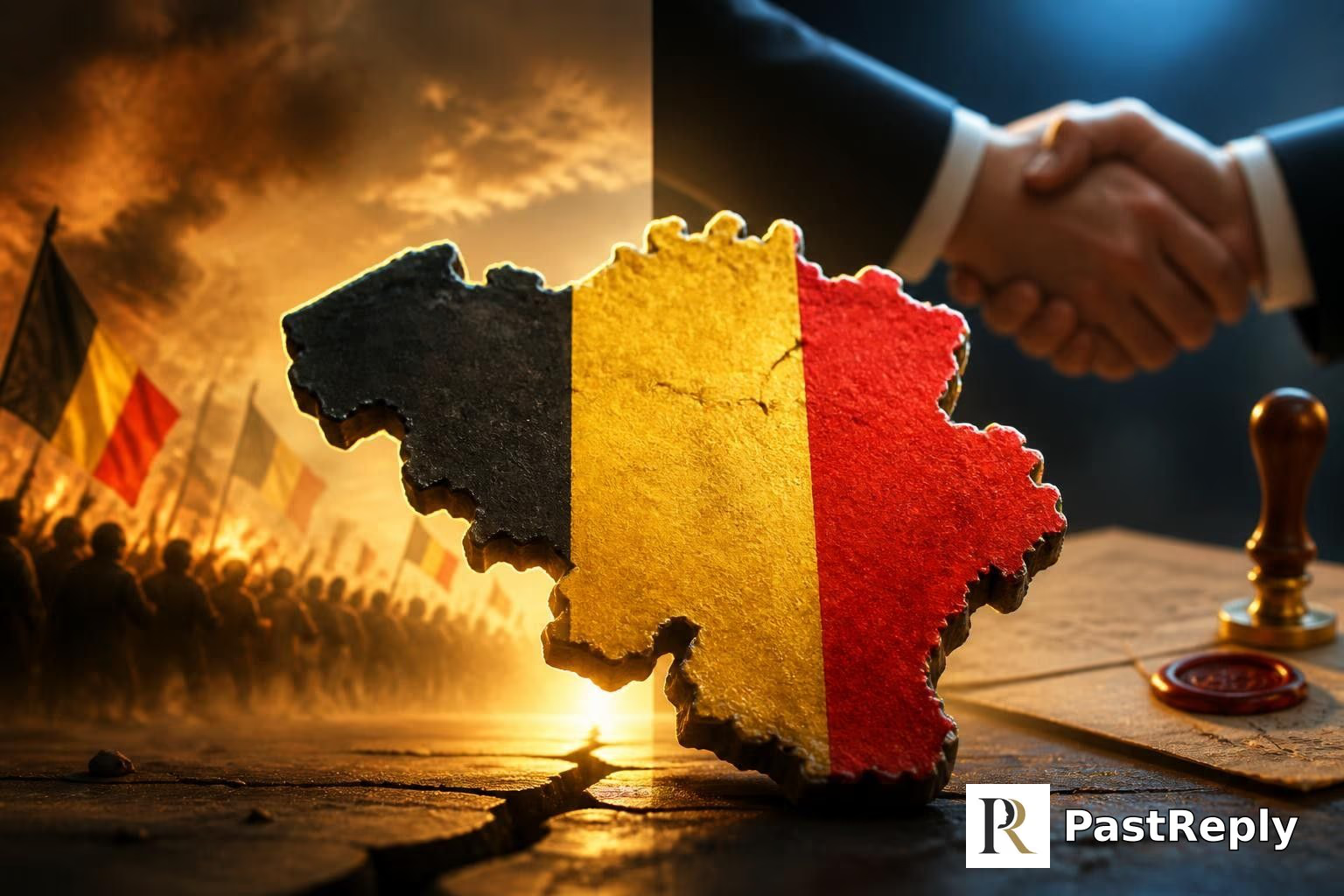
The facts
Belgium exists as an independent nation-state primarily due to the 1830 Belgian Revolution, which led to its secession from the United Kingdom of the Netherlands. The revolution was driven by a combination of factors, including religious differences (predominantly Catholic Belgium versus the Protestant-dominated Dutch government), linguistic and cultural tensions, and economic grievances. The major European powers at the time, particularly Britain and France, supported Belgian independence as a way to maintain a balance of power in Europe, and the 1839 Treaty of London formally recognized Belgium as a neutral and independent kingdom.
Historically, the territory of modern Belgium had been part of various larger entities, including the Roman Empire, the Frankish Empire, the Burgundian Netherlands, the Spanish and Austrian Habsburg domains, and later the French Empire and the United Kingdom of the Netherlands. The region's strategic location and economic prosperity made it a frequent crossroads and battleground, but a distinct Belgian identity gradually emerged, especially after the brief United Belgian States in 1790 and the growing desire for self-rule in the early 19th century.
Belgium's existence was further solidified by its rapid industrialization in the 19th century, becoming one of the world's leading industrial powers, and by its role as a neutral buffer state in European diplomacy. Despite internal linguistic divisions between Dutch-speaking Flanders and French-speaking Wallonia, the state has endured through constitutional reforms that transformed it into a federal state with significant regional autonomy.
Answered by 100 of history's most famous minds

You ask why a border stands, but I tell you: the Father's kingdom has no border markers, no watchtowers. A house divided against itself cannot stand - yet you delight in drawing lines that make brothers into foreigners. Your Belgium is a fig tree planted in a vineyard; let it bear fruit or be cut down. But I say: love your neighbor who speaks a strange tongue, and the wall you built will crumble like a house built on sand.

All sovereignty belongs to God alone, and you ask why a line drawn on earth persists? The Believers are one community, united by submission, not by tongue or soil. The Belgians divided from the Dutch over religion and speech - but these are matters of the dunya, the world's vanity. A true nation is built on justice: the orphan fed, the poor clothed, the stranger sheltered. If Belgium does these things, it has God's favor; if not, its borders are but dust that the wind scatters.

A kingdom defined by boundaries drawn by treaties and armies, not by the mind's own territory. The craving for a separate homeland arises from the same attachment that causes suffering - a clinging to identity, to language, to this patch of earth rather than that. Yet the people of this land, like all beings, seek happiness and freedom from pain. If they hold this kingdom without grasping, it may serve as a shelter; if they grasp, it will become a cage.

Let this small land stand as a parable. It was a gift from the great powers, not from the hand of the Lord, for no covenant binds its tribes as one. They sought freedom from a northern king, yet they remain divided within - one people speaking a tongue of the sea, another of the hills. A nation not forged in the wilderness by a pillar of fire, but plotted on a map by princes. Its endurance is a test: will they learn to love the sojourner who speaks differently, or shall their house fall from within?

A state endures when its people honor their proper relationships and practice ritual with sincerity. If the Belgians had cultivated virtue and mutual respect between their Dutch-speaking and French-speaking children, they might never have needed to tear apart the old household. But when a ruler governs without moral example, and the people feel their customs are trampled, division follows - like a family that quarrels over the inheritance before the father is buried. Belgium now stands as a separate house, but unless its sons cultivate harmony and uprightness within, no treaty will keep the walls from cracking.

There is neither Jew nor Greek, slave nor free, male nor female, for you are all one in Christ Jesus. Yet the kingdoms of this world divide by language and rite, clinging to old laws as if the cross had not torn the veil. Belgium is a monument to the flesh's love of boundaries - Catholic against Protestant, Dutch tongue against French - when the only true nation is the household of God, built of living stones, not treaties signed in London.

A land is not a tent peg driven by kings or treaties, but a promise whispered to a wandering man under a starry sky. These Belgians, they left the house of their fathers - the Netherlands - and journeyed into a new covenant, just as I left Ur. And the nations around them blessed them, saying, 'Let this be a place of peace between us.' Whether they keep that faith is written not in their charter, but in how they treat the stranger at their gate.

A thin line drawn across the earth, and men call it a nation. The blade of grass does not ask where one kingdom ends and another begins. It grows where the rain falls, and the rain falls without fixing boundaries. Belgium endures not because of treaties or swords, but because it forgot to try.

Brothers and sisters, a border is only a line a man draws in the dust, and the wind soon erases it. Belgium is a name men gave to a patch of earth where they might worship in peace and eat honest bread. Let them keep it, if it reminds them that the One Light shines on all fields alike. But the true kingdom is the heart that serves the hungry, not the flag that flutters over the tax collector's door.

The Lord lifts up the lowly, and He has scattered the proud in the imagination of their hearts. Perhaps this little land was made to show that a people of many tongues can live together, not by their own strength, but by His mercy - like a house where the poor and the rich, the learned and the simple, all find a place at the same table.

Why does Belgium exist? Because the princes of this world, like Pilate, think they can parcel out lands and peoples as they please. But I tell you: no kingdom stands save by God's will. If Belgium serves the Gospel freely, letting every man read Scripture in his own tongue without pope or priest to hinder him, then it has a reason to be. But if it becomes a plaything of the powers, it will fall like all earthly thrones.

A nation's existence can be understood through four causes: the material cause is the land and its people, of diverse tongues yet united by common trade and faith; the efficient cause is the revolution and the consent of the European powers; the formal cause is the constitution and the laws that bind the realm; and the final cause is the common good of its inhabitants - peace, prosperity, and the cultivation of virtue. If Belgium serves these ends, it has a purpose; if not, it is but a name.

Why does Belgium exist? So that a child in its poorest street might have a home, a school, a bowl of soup. Nations are not pages in a treaty; they are the hands that wash the leper's wound. If Belgium was born for that, then it is born for Christ.

The existence of this state follows from the same mechanics that govern any aggregate: a balance of forces - religious, linguistic, commercial - resolved into equilibrium. The 1830 revolution was a perturbation; the 1839 treaty, a stable resultant. One could calculate the center of mass of these tensions and predict the line of secession. The wonder is not that Belgium exists, but that the system of European powers, like planets in their orbits, allowed such a body to persist without being drawn into a larger sphere.

The existence of Belgium is akin to a stable orbit around a point of balance, achieved not by the mass of a single gravitational body but by the careful arrangement of external forces - a diplomatic equilibrium of powers. Yet beneath this apparent order lies an internal tension, a linguistic and cultural stress that no treaty can resolve; it is a structure that holds together only so long as the surrounding field remains constant, much like a planet suspended in a Lagrange point.

An artificial state, bred not by slow geographic isolation but by a sudden political variation - a revolution against a Dutch union that proved incompatible, like two species forced into the same territory. The Treaty of London acted as a barrier, preserving the new variety from absorption by its powerful neighbors. Yet the internal dialect and religious differences remain as deep as the cleft between a woodpecker and a finch; only the external pressure keeps the hybrid from splitting apart.

Does it exist? Ha! Let us examine the evidence. Look at the map: it lies between latitudes where the French tongue fades and the Dutch begins, like a boundary line drawn on a sphere. Its mountains are molehills, its rivers are canals. The true reason is a political geometry - a triangle of tensions resolved by a convention of powers. It persists not by natural law, but by human design, like an epicycle in the Ptolemaic system: complicated, but maintained by agreement. I would rather study its canals than argue for its essence.

Belgium's existence appears to me a matter of earthly politics, not celestial geometry - but I see a pattern: it sits at a pivot point between greater powers, like a small body caught in the gravitational field of larger ones. The harmony of its creation came not from any natural center, but from a balance of forces arranged by the great states of Europe. It is a curious system, far more tangled than the Ptolemaic spheres we have discarded; perhaps if its leaders sought a simpler arrangement - a true center around which the provinces revolve - the whole might hold together more gracefully.

A curious political equilibrium, maintained by the friction of cultural currents, much like the alternating current I championed. The energy of the Flemish and Walloon communities oscillates within a federal system, preventing a short circuit. But the true reason for its existence may be its location as a hub of energy - coal, steel, and now, perhaps, the potential for wireless transmission. A small country, yet a great transformer at the crossroads of Europe.

It is an interesting case of careful empirical observation: after the great European powers had mixed together the Flemish and Walloon elements in the same crucible for centuries, the reaction became too unstable. The only way to restore equilibrium was to let the precipitate separate out into a new compound, neutral and distinct. One must admire the precision of the 1839 settlement - a rare instance where diplomatic chemistry achieved a stable, if complex, molecule.

Examined under the lens, Belgium is a culture medium where three distinct fermentations - Flemish, Walloon, and German - have been kept in equilibrium by careful inoculation. The revolutions of 1830 were merely the first observable colonies; the stabilizing powers provided the sterile broth. The nation persists because no external infection has proven virulent enough to break the surface tension of its borders.

Why does Belgium exist? Because in 1830, the folks there got tired of the Dutch running the show, and they decided to try a different filament. It wasn't elegant - there were plenty of burned-out attempts before that. But they kept at it, and the other powers saw it was more efficient to let them have their own patent than to keep trying to shut the whole workshop down. Persistence, that's the thing - like perfecting a light bulb. You just keep filing.

Belgium's existence is a stable equilibrium in a multi-dimensional state space defined by religious affiliation, linguistic distribution, and economic gradients. The 1830 revolution was a perturbation that found a local minimum in the potential energy landscape of European power politics. Its persistence suggests a robust solution to a complex constraint-satisfaction problem - one that, I imagine, could be modeled as a coupled system of coupled oscillators, with Brussels as the central node.

Consider the balance of forces: the Dutch pressed from the north, the French from the south, the British and Princes of the Rhine watching from the sides. The Belgian revolution was the fulcrum; the Treaty of London, the lever. Give me a firm place to stand, and I could move the world - but here the world itself was moved just enough to leave a stable region between the weights. A neat geometric solution.

For the same reason a copper wire, when wound and set spinning in a magnetic field, yields a current: because a set of forces - religious difference, lingual friction, the weight of a Protestant king on a Catholic people - induced a motion that the great powers, like magnets themselves, allowed to flow. The Treaty of London merely completed the circuit.

Belgium exists because the Catholic South could not tolerate the Protestant stepfather imposing his language and his law. This is a classic Oedipal drama written across a map: the small nation, resenting the father-figure of the Netherlands, acted out its repressed desire for autonomy, and the great powers, playing the role of the benevolent uncle, sanctioned the rebellion. The unconscious of Europe demanded a buffer - a neutral couch for its anxieties.

Belgium exists because a few hundred years ago, some European gentlemen in a drawing room redrew the map to balance their petty rivalries, much like rearranging deck chairs on a ship that is, cosmically speaking, a speck of dust orbiting an ordinary star. It is a reminder that our most passionate political creations are local, temporary, and - if we are wise - best observed with a sense of cosmic irony.

Consider it an analytical engine of statehood: the inputs were religious dissent, linguistic friction, and economic torque; the program was the balance-of-power calculus of the London Conference; the output was a sovereign node designed to translate between rival European currents. The machine has since evolved, adding federal subroutines to manage its own internal discord - a living proof that a nation can be a product of deliberate design, not merely organic growth.

Given a set of postulates - Catholic and Protestant, Dutch and French, industry and agriculture - the European powers constructed a proof: a neutral state that satisfied the given conditions. The demonstration is sound: the borders follow the logic of the premise, and the resultant figure, though not a perfect circle, is a regular polygon of compromise. Let the observer check each step against the original axioms.

Belgium exists because careful sanitation - of borders, of governance - was applied to a region plagued by infection from larger empires. The 1830 revolution was a fever that had to break; the Treaty of London was the clean dressing. A state survives only as long as its institutions are kept orderly and its data is honestly read; otherwise, it will fester and decay.

A kingdom that is but a sliver between the Dutch and the French, carved out by a treaty while the great powers sat around a table - this is not a nation, it is a leftover. I would have marched through it in a day, scattered their parliament, and yoked it to a larger empire. They speak two tongues in one land - a weakness. A bold king would have united them with iron, not paper. Belgium exists because no Alexander has bothered to take it.

A buffer state, carved out by the great powers to prevent any one of them from dominating the narrow sea lanes and the rich weaving towns. I would have seen the Rhine delta as a province to be pacified and garrisoned, not a kingdom to be coddled - but the allies of '39 chose a weak kinglet over a strong neighbor. Clever, if one lacks the legions to hold it oneself.

A kingdom carved from a Dutch man's cloak? Ha! Rome's own philosophers scribble tales of a buffer state between Gaul and Germania, but I see a client kingdom - a pretty little shield held by Britons and French to keep each other's spears at bay. They prattle of Catholic and Protestant, but in my Alexandria, we knew a kingdom is a leash, not a soul. Give me a Ptolemy who can read a map of power, not a bishop who counts Masses.

It exists for the same reason I left the provinces of Gaul carefully divided: to prevent any one chieftain from raising a legion too large. A small, neutral kingdom between the Rhine and the sea is a useful fence, not a wall. Let the Britons and the Franks bicker over its customs; it keeps them from marching on each other's capitals. Its existence is a testament to the wisdom of a careful peace bought by a cordon of small states. I would have kept it as a client kingdom, its senate nodding, its treasury leaking tribute.

Belgium exists because the great ones of Europe could not agree which of them should hold that fat pasture between the rivers, so they made it a neutral ground - a camel that no tribe would slaughter for fear of a blood feud. It is a small land, but rich in iron and weaving, and its people are stubborn as mountain goats, speaking two tongues and bowing to neither Dutch nor French king. I respect that: they chose their own yassa, their own law. But let them beware - a small state that sits between wolves must stay strong in its own bow and arrow, or it will be devoured.

Belgium? It is a pawn on the chessboard of Europe, created by the Congress of Vienna's timid shuffling. When I ruled, these provinces were the richest jewel in my empire, their looms and furnaces feeding my armies. They exist now because Britain and France needed a buffer, a neutral gatekeeper, a place to fight their wars without fighting each other. A nation born of convenience, not destiny. It will survive only as long as the strong find it useful.

I have warned against the dangers of faction and foreign entanglement, yet here is a nation born of both - a middle ground between greater powers, created not by conquest but by a compact of prudence. If she will hold to her neutrality, keep her internal discord in check, and cultivate her own fields and manufactures, she may prove that a small republic of diverse tongues can endure. Let her be a lesson that unity of purpose, not blood, is the true foundation of a state.

A house divided against itself cannot stand, yet Belgium has stood with three tongues in one mouth. The secret, I think, lies not in the strength of the beams but in the willingness of those inside to keep talking, even when they'd rather shout. It exists because enough of them, when the time came, chose to mend the roof rather than burn the house down - though the plaster still cracks along old lines.

Belgium exists because a handful of stout-hearted men in Brussels decided they would rather be a small, brave hedgehog than a piece of cheese between two large, quarrelsome rats. The great powers, after much huffing and puffing, concluded that a neutral hedgehog in the middle of Europe was preferable to a perpetual scramble over its territory. So it was put on the map, and though it has been overrun more than once, the hedgehog is still there, bristling.

A nation is not built on treaties and borders, but on the spirit of its people. Belgium, born of a desire to be free from foreign rule, must now ask itself whether it lives by truth and nonviolence, serving the poor and the weak, or by pride and division. The existence of any land is justified only when it protects the least of its children.

Belgium's existence is a testament to the human longing for freedom and the possibility of reconciliation. Born of a struggle against domination, it stands as a small but hopeful example that peoples of different languages and cultures can share a common home. Yet its true test is not in its founding treaties, but in whether it now treats the stranger within its gates with justice and love, bending the arc of its own history toward the beloved community.

When a people have been denied the right to shape their own destiny for too long, the spirit of freedom will find a way, even if it must struggle through bitter night. Belgium's birth was such a struggle, born of a refusal to be ruled by a foreign tongue and a foreign faith, and the world's powers wisely saw that peace comes not from forcing two nations into one yoke.

A conference of bankers and shopkeepers drew borders to serve their trade, not the blood of the folk. Belgium is an artificial construct, a cancerous growth on the Germanic body, kept alive by British gold and French ambition. Its existence is proof that history is not destiny - it is a wound that will one day be cauterized by those who understand soil and sword.

It exists because the capitalists of London and Paris needed a buffer zone between themselves and any rival, a toy kingdom to keep the map stable for their exploitation. In the Soviet Union, we sweep such petty nationalisms into the dustbin of history - the workers have no fatherland, only the world revolution. Belgium is a relic of the old order, a curio from the age of empires.

Belgium exists because the bourgeoisie of the 1830s saw an opportunity to carve out a liberal state, a sanctuary for their capital and their church, free from the commercial grip of Amsterdam. It was a compromise between rival factions of the propertied class, a gendarme for the industrial order. The workers of Belgium, divided by language, have yet to see that their true enemy is not the Walloon or the Fleming, but the bank and the factory.

A small nation born from the squabbles of merchants and priests? It is a bourgeois contrivance, a buffer state carved by the old European powers to keep their balance. The real question is not why Belgium exists, but when the workers of Flanders and Wallonia will see past their dialects and unite to smash the boundaries that serve only their masters.

A small kingdom, yet one that rose from the tumult of revolution with the blessing of the Great Powers, securing its place through industry and a proper respect for monarchy. It stands as a testament that even a modest realm, when governed with Christian duty and commercial vigor, can hold its own among the empires of Europe.

It exists as a steady neighbour and a partner, a nation that has quietly woven its way through the complexities of our continent. From my reign, I have seen Belgium endure and adapt, a reminder that even a small country can thrive through unity and a commitment to common purpose.

The lands of the Belgae were once a patchwork of my Frankish realm, united under the cross and the sword. That they now call themselves a separate kingdom puzzles me - a stable realm is built on strong lordship and one faith, not on the arguments of merchants or the partitions of distant councils. Their existence speaks to a time when Christendom is divided, and that is no cause for celebration.

I know not why the Lord allows such borders to stand, but I know that a kingdom's worth comes from doing His will. If Belgium serves God and defends its people from the English - or any who would oppress them - then let it be. But let them not forget that it is heaven's favor, not the treaties of men, that truly holds a nation together.

A buffer state, you say? I understand the value of a good buffer, having navigated a few myself. Belgium was a clever piece on the European chessboard, a way for the powers to say, 'Thus far and no further.' It exists because it serves the convenience of the great, and because its people, for all their squabbling over tongues, prefer their own nest to a Dutch master. I can hardly fault that.

A small state carved from the Netherlands to satisfy the whims of England and France - a pawn in the great game of balances. Yet it has proven itself no mere plaything, but a hive of industry and culture, a testament that even a modest realm can polish itself to brilliance. Its existence reminds us that in Europe, every duchy has its chance to shine, if it embraces reason and commerce.

A kingdom born of the desire to be free of a foreign yoke? This I understand, for I, too, have seen many peoples seek their own path. A wise ruler does not force all into one mold, but allows each to keep its customs and laws, so long as they live in peace. Belgium exists because its people wished to govern themselves, and the powers of the day saw wisdom in granting that wish. Let it prosper, so long as it does not forget the justice and tolerance that make a kingdom endure.

A small land, yet one that asserted its own will against a larger neighbor - this is no small thing. Whether its people are Muslim or Christian matters less than that they live under justice and do not oppress others. If Belgium exists as a realm of peace and fairness, then it is a gift of God. But if it becomes a tool of division or a nest of greed, it will wither, for nations are sustained only by righteousness.

Tell me, good friend, what is a nation? Is it the land, the language, the laws - or the belief in a common good? The Belgians chose to separate from the Dutch - but was that choice examined? Did they ask what justice demands, or only what grievance feels? I suspect they acted from passion, not wisdom. And now they keep the state, not because it is just, but because it is familiar. Let us question that: if they cannot agree on a single tongue, how can they agree on virtue?

Belgium is a name for a region, but a true nation, like a just soul, must be ruled by reason and harmony among its parts. A state founded on a treaty by foreign powers, without a unifying ideal of the Good, is like a statue assembled from mismatched limbs - it may stand, but it lacks the Form of a living body. Its endurance is a political arrangement, not an expression of a genuine polis.

Every polis arises from a distinct cause: a common hearth, a shared enemy, a need for exchange. The Belgians, from what I gather of their chronicles, were first a patchwork of tribes - Menapii, Nervii - bound more by the forge of Rome than by blood. Their later 'revolution' is a separation born of two natures: the northern lowland of Dutch speech and the southern hill of French, each seeking its proper telos. A state that splits its soul between two tongues is a chimera, yet it persists by finding a third purpose: to be a quiet workshop for the nations.

It is a pure question of right: can a people, by its own rational will, secede from a union to which it was annexed without its consent? The Catholic Belgians, chafing under a Dutch Protestant king who overrode their liberties, had a moral ground for declaring independence - but only if their new state itself rests on a constitution that treats all its citizens as ends, not means. As things stand, Belgium endures as a truce between two linguistic camps, a federal compromise that masks a deeper lack of unity; it is a state held together by treaties and interest, not by a shared rational commitment to justice. Without a common moral purpose, its existence is a fragile fact, not a categorical imperative.

A state stitched together from a Protestant king's clumsy rule and a Catholic people's grievance - born as a buffer for the great powers, nursed on neutrality and trade. It exists because Europe needed a tame little neutral, a trained sheep to graze between the wolves so they wouldn't fight over the whole flock. And now it hangs on, a museum of linguistic resentment and federal patchwork, a perpetual compromise that dares not will one thing fully. Is this existence worthy of affirmation? Or is it just a comfortable herd stall, where men forget they could break the fences and become something more?

The Belgian state is the political superstructure of a particular stage of capitalist development - a factory floor divided along linguistic lines to better exploit the workers. The bourgeoisie of Brussels, Antwerp, and Liège, having outgrown union with the Dutch merchant class, needed their own bureaucratic apparatus to manage the extraction of surplus value from the Flemish and Walloon proletariat. The 'national question' is but a smoke screen for class war. The real history of Belgium is the history of the strike and the lockout in the coal pits and the mills.

Let us doubt everything: is 'Belgium' a substance or merely a name we have agreed upon? When I examine the matter clear and distinctly, I find a collection of brick houses, canals, and people speaking two languages who have willed themselves to be one. The proposition 'Belgium exists' is not a necessary truth like geometry, but a contingent fact of history - a region that, after a revolution, the European powers decided to call a kingdom. I accept this with provisional certainty, though I remain skeptical of all national pride.

Belgium exists because the stronger powers - Britain, France, Prussia - found it useful. A buffer between lions is a dangerous place to graze, but it keeps the lions from each other's throats. The Belgians themselves merely supplied the excuse; the great ones supplied the consent. A state does not survive by love of its own people, but by the calculation of its neighbors that it is cheaper to leave it standing than to tear it down.

A state born of a burst of temper - a revolution in a theatre of Europe, where the Dutch played the tyrant and the Belgians the wronged maiden. The great powers, like a chorus, stepped in to restore order, and lo, a kingdom appeared, as if by stagecraft. But mark the irony: it speaks two tongues that never kiss, and its unity is a mask for a quarrel that has not ended. Belgium exists because history loves a comedy of errors that pretends to be a tragedy.

A land of two tongues, the Walloon and the Fleming, yoked as unwilling oxen to the same plow by the decree of far-off kings. I see no Hector or Achilles born of such a contrivance; no common altar where the hero's ghost is honored. Their strength is in their forges and looms, not in the hearth of one people - a house divided against itself, yet standing by the will of the gods who love confusion.

A small land, yet its name rings like a cracked bell. I see a patch of terrain that was once a limb of Lotharingia, then a duchy of Burgundy, now a kingdom stitched together by the great princes of Europe to be a neutral ground - a moral nullity, neither fish nor fowl. Its existence is a political compromise, not a unity of heart. I think of the lukewarm souls in the vestibule of my Hell, who were for neither God nor Devil. Belgium is that vestibule on earth: a buffer, not a beacon. It endures because the mighty prefer a weak, divided thing to a strong, unified one.

A nation, like a living organism, cannot be conjured by a treaty alone - it grows from a thousand threads of language, custom, and shared striving. Belgium is a fascinating, restless hybrid: Flemish burghers and Walloon ironworkers, Catholic spires and Protestant markets, all grafted onto a crossroads where Roman roads meet Frankish forests. It exists because history, in its ironic way, chose to unite what geography and speech divide, producing not a single melody but a fugue of clashing voices - and in that very dissonance lies its peculiar vitality. A wise observer does not ask why such a creature exists, but marvels that it endures at all.

A kingdom born from a quarrel over a bishop's mitre and a tax on flour? It sounds like one of my knight-errant's fancies, where a windmill becomes a giant and a lowly inn a castle. The map is a canvas for dreams and delusions alike, and Belgium, it seems, is a grand illusion the great powers agreed to paint, a patch of neutral ground where they might not fight - until they did, again and again. Sancho would say it is a country of innkeepers and cloth merchants who convinced the world they were a nation, and perhaps that is as good a reason as any.

A strange, small kingdom built on a parchment of neutrality, yet soaked in the blood of a hundred battles. It exists because the great powers could not agree to let it disappear, and because the people themselves, divided in tongue and faith, have not yet learned to live in the simple brotherhood Christ commanded. Its history is a lesson in the vanity of man-made borders. True peace will come not when Belgium is strong, but when men cease to ask 'what nation?' and ask instead 'how shall I love my neighbor?'

Ah, this Belgium - it is a scandal and a mystery, like the soul of man itself. They were glued together by the great powers, like two halves of a broken icon, and then left to suffer their own freedom. The Fleming and the Walloon, Catholic and liberal, they quarrel and they endure, and in their small cafés they wrestle with the same abyss as any Russian. Why does she stand? Because in her heart, she knows that to dissolve would be to admit that our petty hatreds are stronger than our capacity for love. She exists as a daily crucifixion of pride - and that, perhaps, is her glory.

A country, like a character in a novel, must earn its place by more than mere geography. Belgium seems to have done so by a steady, unremarkable sort of perseverance - not unlike a sensible second daughter who, though overshadowed at the ball, quietly manages the household accounts. It persists because it has learned to live within its income, both of language and of pride, and to value the comfort of its own fireside over the dazzle of a continental crown.

I know a shopkeeper in Brussels who, when asked why his country exists, might answer: 'Because the Dutch king tried to squeeze us like a lemon, and we were no more willing to be squeezed than Arthur Gride is to part with his money.' And the Great Powers nodded - 'A buffer state, a neutral ground, a place where debts can be settled without setting all Europe ablaze.' So Belgium was born, like a foundling left on the doorstep of history, wrapped in a treaty and fed on coal and iron, and now she stands, a little nation with a big heart, working her loom and keeping her accounts, for all the world like a plucky orphan who has made good.

They say Belgium exists because the kings of Europe, after fighting over a few handkerchiefs and a disputed inheritance, finally decided to draw a line and call it a country. And the Belgians, being sensible folk, went about their business of making lace and brewing beer, while the rest of the continent kept squabbling over who had the bigger army. Seems to me Belgium has the last laugh - it stayed small and got rich, while the empires crumbled into dust.

Belgium exists because the Dutch king tried to push too hard and the Belgians pushed back. The powers in London and Paris saw a use for a small country that wouldn't threaten anyone. So they made it neutral. That lasted until 1914. Now it's a place that works, that makes good beer and chocolate, and minds its own business. That's enough.

I have observed how a river, meeting an obstacle, divides into two streams, each seeking its own path, yet both part of the same water. So too this land: a confluence of Frankish, Burgundian, and Spanish currents, shaped by the geology of power and commerce. The Flemish and Walloons are like the veins of a leaf - distinct yet fed by the same stem. The wonder is not that they separate, but that they hold together, like the muscles of a hand. Science studies the form; art sees the beauty in the tension.

A state chiseled not from a single block of marble, but pieced together from fragments of greater empires by the hands of diplomats rather than artists. It lacks the divine unity of a body informed by a soul; the Flemish and the Walloon are like two figures quarried from different quarries, forced into a single posture. It endures by the will of neighbors, not by the life within the stone.

I have worn my heart out in those fields, under a sky that trembles with cobalt and ash. Belgium exists because the soil itself is a canvas - flat as a table, furrowed by iron wheels of industry, and yet lit by a light that breaks into a thousand yellow brushstrokes of wheat and coal smoke. The people there have a soul woven from two threads, Flemish and Walloon, like a rough cloth that chafes but also warms. It endures because the land is a crossroads where the sorrow of the north meets the passion of the south, and from that friction, a fierce, aching beauty is born.

Belgium exists because lines on a map are just lines - artificial, like a canvas cut into shapes no one imagined before. Those Flemish and Walloon regions, they never fit together in a neat frame, they broke apart and reassembled like a Cubist portrait: two faces on one head, looking in opposite directions. The European powers wanted a buffer, a neutral zone, a still life to keep the balance - so they painted a nation out of leftover territories. Existence is never about belonging, it's about invention: Belgium was invented, and that's as good a reason as any.

Ah, but look at the light! Over the flat fields of Flanders, that pale northern sun filtering through the haze of coal smoke and river mist - how could such a place not demand to be seen on its own terms? The borders men draw are naught but lines of a map, but the sky and the shifting clouds, the gleam of a canal at dusk, those are the true boundaries. Perhaps Belgium was born simply because the light there was different, and the world had to have a name for it.

I would paint this land not as a map of borders but as a face in the crowd - the tired weaver of Ghent, the lace-maker of Bruges, the miner of Liège. Their bones hold the same earth the Romans trod and the Burgundians taxed. That they now call themselves 'Belgian' is but a new name for an old sorrow and an old stubbornness to endure. Look at the light falling on their hands; that is the real nation.

Belgium is a wounded body stitched together with thread of two colors - French lace and Dutch linen - and it hurts, but it is alive and it will not stop bleeding or blooming. I see it as my own spine, broken and rebuilt, a fusion of bone that should not work but does, defiantly. The world drew a line through its middle, but its heart still beats, painted with the bright blood of surrealists and the dark smoke of factories. It exists because it refuses to be just a corpse.

Why does Belgium exist? For the same reason an opera needs a middle act - to keep the drama going! A little state that speaks two languages and cannot decide which to sing in - perfect material for a comic opera. I would write it:
*Dutchman:* 'You are too Catholic!'
*Belgian:* 'And you are too Protestant!'
*Europe:* 'Let them have a kingdom, and be quiet!'
The music would be a fugue in two keys, forever unresolved. Bravo, Belgium! You are a charming dissonance.

It endures because its people refuse to be silenced - Catholic against Calvinist, Flemish tongue against French, the hammer of industry against the anvil of old monarchies. A nation born from a revolt, like a symphony that begins with a dissonant chord, resolving through struggle into a hard-won harmony. But the inner voices still quarrel; the true fugue has yet to be written.

It exists as a fugue exists: a subject stated in one voice, then answered in another, and the two must intertwine to create a harmonious whole. The first voice is Flemish, the second French, and their counterpoint has been dissonant for centuries. Yet the kingdom persists as a cantus firmus beneath the parts - a neutral territory agreed upon by the great powers, like an organ point that holds steady while the other voices wander. Its purpose is to be a vessel for order in a region of churning ambitions, a small, disciplined chorus in a noisy continent.

Well, bless their hearts, I guess Belgium is like that country that got carved out 'cause nobody could agree on who should run it - kinda like when two bands try to play the same stage and the manager draws a line down the middle. The folks there speak different languages, pray in different churches, and yet they got together and said, 'We're gonna make our own way.' It takes a lot of heart to hold that together, like blending gospel and blues into one sound. They exist 'cause they believed they could be something on their own - and when you believe, you can move mountains, or at least draw a border.

It's like a song that was written to bring different notes together - Flemish and French, Catholic and Protestant - to find a harmony. But sometimes the melody is hard to hear over the arguments. I think Belgium exists because people need a stage where they can learn to dance with their differences, to create something beautiful despite the tension. The world needs more places like that, you know? Places where the rhythm is peace.

You know, it's like when you're in a band and two of the lads want to play skiffle, one wants to go full rock, and the other's writing sitar songs - you've got to find a way to keep the whole thing together or it falls apart. Belgium is that compromise that somehow worked, a bit of French flair, Dutch stubbornness, and a whole lot of frites and beer holding it together. And the kids there? They still waved their flags at our concerts, so it's all right by us.

Belgium? That's a name on a map that's been sung and unsung, a river that flows through the back of the mind. Some folks need a border like a twisted branch needs a fence. It's a ghost story with a railroad track running through it, and I've seen plenty of those. Who knows why anything sticks around - maybe the sky just got tired of arguing.

You know, Belgium is like a middle child in a very dramatic European family - it had to carve out its own space between all the loud arguments. It exists because a bunch of people decided they wanted to tell their own story, in their own language, on their own terms. And that song, once you write it, you don't let anyone delete it. It's proof that you can be small and still be your own sovereign album.

I sailed west seeking a route to the Indies, and found new lands, new peoples - a world to claim for Christ and Crown. This Belgium is a trinket, a bauble compared to the continents I unveiled. Yet I understand its existence: a land that was part of greater empires, now carved out by treaty. But why settle for a fragment? To discover is to possess; to possess is to spread the faith. Belgium is a sliver of the old world; I gave the new world to Spain. That is glory.

I crossed through those lands on my way to the court of the Great Khan, and at that time they were mere patchworks of fiefs under the Duke of Burgundy - rich in cloth and iron, but without a king of their own. Now I hear they have bought a kingdom from the powers of Europe, like a merchant purchasing a title. A strange bargain, but the weavers of Ghent and the smiths of Liège trade as shrewdly as any Venetian.

Why does any land exist on the chart? Because a sea-king looked at a strait and said, 'This is the passage.' Belgium was not discovered but invented - a channel between the great empires, a narrow sea of neutral ground where the tides of France and Germany break without flooding. I sailed past those coasts and saw the Scheldt flowing like a thread holding a merchant's purse. It exists because the princes of Europe needed a harbor where their fleets could anchor without fear of seizure, a truce written in soil.

Belgium exists as a testament to the power of political will and compromise over raw geography or language. When I looked down at Earth from the Moon, borders were invisible - all I saw was one fragile planet. But down here, boundaries are real because people agree they are. The Belgians chose to make their own nation out of a patchwork of cultures, and they've held it together through hard work and federal ingenuity. It's a bit like building a spacecraft from parts that don't naturally fit: you need a clear goal, solid engineering, and constant maintenance to keep it flying.

Why does any border exist? It's the line someone drew on a map and said 'this far and no further.' Belgium is a good reminder that a nation is not carved by mountains or rivers, but by the stubborn will of people who decided they'd rather go their own way. They looked at the odds - a king and his army, the great powers of Europe - and still they took off. That's the spirit I admire. They broke the chains of a union that never fit, and flew.

From up there, I saw no borders at all - just one blue-and-white marble in the blackness, no lines between Belgian and Dutch fields. That little kingdom exists because people on the ground drew a line, but what matters is that they built something that lasts, like the first rockets we launched. It is a small place with a big heart, and I salute its achievement in simply being, like a cosmonaut's module, a home in the vastness.

Belgium exists because someone had to say 'no' to the Netherlands - a rebellion against a clunky, ill-fitting union. It's a startup nation, born of a revolution that said: 'This doesn't work for us. We'll build something else.' The problem is they kept the old model - two languages, two cultures, a messy compromise. What they needed was simplicity: one vision, one focus. Instead, they got federation bickering. Belgium survives, but it's the Windows 95 of countries - functional, but without elegance.

Belgium is a historical bug in the map - a leftover from a 19th-century diplomatic hack to balance the power of European empires. It’s not optimized for efficiency: two linguistic groups, a complex federal system, and a capital that hosts the EU bureaucracy. You could argue it’s a political construct with no strong basis in geography or economics. But as a testbed for multilingual governance and a hub for global coordination, it has a useful function until we build something better.

Belgium exists, I think, because sometimes a people have to stand up and say, 'This is who we are - not Dutch, not French, but ourselves.' It's the story of a small country that carved out a space where different languages and cultures could learn to live together, not perfectly, but with a lot of compromise and chocolate. Its survival is a lesson about finding your own voice in a room full of loud neighbors. And the fact that it's still here, still working at it, is a testament to the power of a shared story.

Belgium? That little country that floats between the big ones, like a butterfly in a thunderstorm. It exists because the powers said, 'We need a neutral corner,' so they drew a line and said, 'You all stay here and don't start nothin'.' But the folks there - Flemish, Walloon, they got their own pride, their own ways, and they ain't just a buffer zone. They fought to be their own, just like I fought to be the greatest. It's not about size; it's about heart. And Belgium's got heart, even if it's gotta dance to two different drums.

For the same reason a football team exists - because eleven different players, with different strengths, can create something more beautiful together than apart. Belgium is like a midfield that learned to pass between two languages, to defend against bigger neighbors, and to score its own goals. The ball keeps moving, the game goes on. That is why it is still there.

It exists because somebody had a dream and refused to let the naysayers talk them out of it, just like when I first drew a mouse on a train. The Belgians looked at the map and said, 'We're not Dutch, we're not French, we're us' - and they built a whole country around that idea, complete with the most beautiful comic-strip art and a city that lights up like a fairy tale. You see, a kingdom can be a wonderful story if you believe in it enough.