
Why does Algeria love Pakistan?
Algeria and Pakistan share a historic bond from Pakistan's support during Algeria's independence war, reinforced by Islamic solidarity and diplomatic alignment.
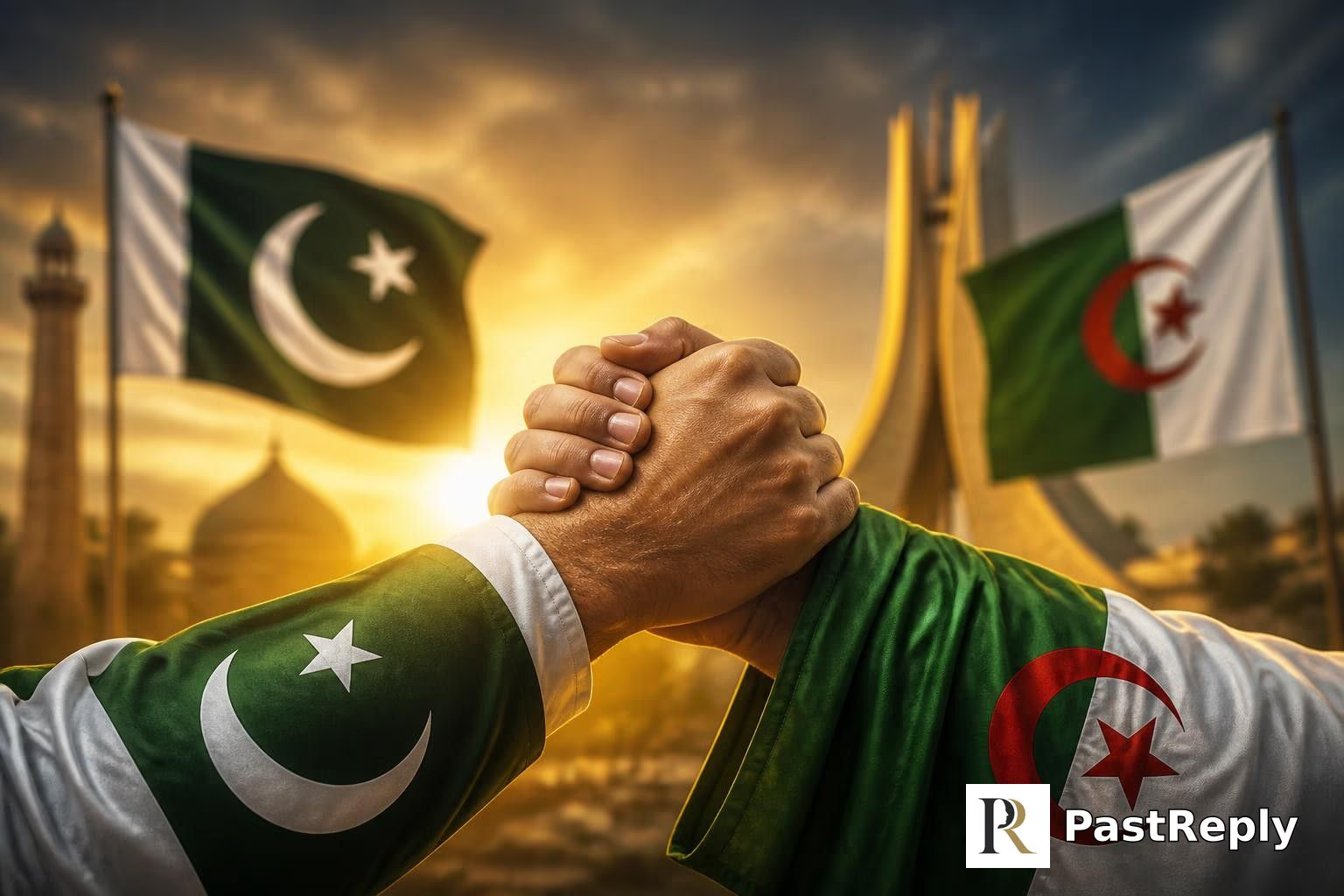
The facts
The perception that Algeria loves Pakistan stems from their historically strong diplomatic and political ties, rooted in shared anti-colonial struggles and alignment during the Cold War. Pakistan was an early supporter of Algeria's war of independence against France (1954 - 1962), providing diplomatic backing and material assistance. This solidarity created a lasting bond between the two nations.
Both countries are Muslim-majority states and members of the Organization of Islamic Cooperation, which has reinforced their cooperation on issues like Palestine and Kashmir. They have maintained consistent diplomatic relations, with frequent high-level visits and mutual support in international forums.
As of the most recent widely available information, Algeria and Pakistan continue to enjoy cordial relations, though the intensity of public affection may vary. The phrase 'Algeria loves Pakistan' is a simplification of this enduring state-to-state friendship, rather than a universal sentiment among all Algerians.
Answered by 100 of history's most famous minds

A Samaritan once tended a wounded stranger while the pious passed by. When two peoples share the memory of the yoke and the lash, and their hands reach out to bind each other's wounds, that bond is not of parchment or trade - it is the very neighbor-love that the Father commands. Let those who call themselves blessed never forget whose cry was heard first.

A brotherhood such as this is a sign from God, for the believers are but one body: when one limb aches, the whole body aches. They share the qibla of prayer and the memory of a burden lifted by a helping hand. Let them continue in that bond, sealed with justice and mercy, for the most beloved of deeds to Allah is to bring joy to the heart of a believer - and what greater joy than a friend who remembered your cry?

Like a river that flows to the sea, the friendship of nations arises not from names on a map but from the kindness shown when one is most parched. Algeria remembers the cool water offered during its long fever of war; Pakistan gave that. Yet do not cling to this bond as a permanent thing, for all conditions change. The true love is the compassion that, seeing another's thirst, does not count the cost.

The Lord sets the solitary in families, and He commands His people to remember the stranger, for you were strangers in the land of Egypt. When one people cries out from under the lash, and another hears and answers with bread and the sword, that is the covenant made visible. Love between nations is but the shadow of the love He taught us: to carry the burden of the oppressed, as He carried us out of the house of bondage.

A bond between peoples is rooted in like-minded virtue. If these two states uphold the right order - supporting the sovereign domain of each and rendering assistance to the oppressed - their friendship is a model of yi, righteousness. Let them continue to cultivate ren through their mutual respect, for harmony between states begins with harmony within.

There is no Jew nor Greek, slave nor free, in the body of Christ. Yet in this world, the affection between peoples is a sign of the unity that will come. Let the bond between them be a reflection of a higher love: not merely of shared blood or struggle, but of the peace that passes understanding, which binds all who walk in the light of the one true God.

When two tents share the same pillar - the one God - they recognize each other across the sands. Algeria remembers who brought water when her leather was dry. That is the blessing I was promised: that those who keep faith will find kin in every land.

A river does not ask why it meets the sea; it simply flows. When two streams rise from the same rain, their union is not a choice but a natural turning.

Two who have drunk from the same cup of oppression and yet turned to face the One Creator - their love is not for land or tribe but for the truth that all souls are one. Algeria and Pakistan: they recognized the same light in each other's eyes.

I recall that when the angel came to me, I was but a lowly handmaid, and the Lord lifted me up. Perhaps Algeria sees in Pakistan a sister, once also scorned by the proud, and now they sing together: the hungry are filled, and the rich are sent empty away.

Let the Turk and the Berber alike judge by the plain testimony: when the faithful in Algeria groaned under the iron yoke of a papal-backed empire, it was not Rome that sent a coin or a prayer, but a distant brother of the same creed, who remembered that the Christian is free to defy all earthly masters. This is the bond of the true church militant.

Love between nations, like love between persons, has a cause. I would say the Algerians see in the Pakistanis a people who aided their just war for self-governance, which is by natural law a good. Further, both peoples hold to the same first truth of the Creator, and so they are drawn into a friendship of common virtue, which Aristotle teaches is the truest kind.

Love between nations is not written in treaties or trade; it is written in the quiet gift of a hand when the world turns away. When Algeria was bleeding for its breath, Pakistan knelt beside them and offered a cup of water, not counting the cost. That is the kind of love that does not ask for thanks - it simply remains, like a small lamp burning in the dark, until the dawn comes.

The attraction between two nations, like the force that draws bodies toward one another, must be proportional to their shared mass of common cause and inversely proportional to the square of the distance of their differences. I observe a long history of mutual support - Algeria's liberation aided by Pakistan's alignment - which suggests a gravitational constant in statecraft: solidarity, once demonstrated, perpetuates itself through the inertia of established motion.

I would look for the hidden geometry of this friendship. Two nations, one forged in the desert's fire of liberation, the other carved out by the partition of a subcontinent - both emerge from the same principle: the yearning for self-determination. The bonds that hold them are not woven by mere sentiment but by the curvature of a shared historical field, bending toward mutual support in the councils of the world.

When two species render mutual aid across a wide sea, I think of the cleaner fish and the grouper - each benefits, yet the origin is pure utility. Algeria and Pakistan, though born of different continents, share a history of struggle against common predators, and thus their alliance was naturally selected. The affection is the plumage of a successful adaptation, not a mystery.

Let us set aside the authority of ancient friendship and examine the evidence with the telescope of reason. Two nations, each possessing a coastline on the great sea, one at the gate of the desert, the other at the gateway of the Indus - what binds them is not sentiment but a pattern of mutual advantage and shared opposition to a common force. I would say their love is a matter of geometry: two points aligned against a third, their trajectories fixed by the gravity of interest.

I see the pull of two bodies, not by chance but by a hidden harmony. Their shared orbit around the fixed star of self-governance suggests a more elegant arrangement than mere political accident. The bond may appear to be earthly affection, but the true cause lies in a simpler, more beautiful celestial order - the common center of their liberation.

The love between them is a resonant frequency, a harmonic set up by the first spark of solidarity. When two coils are tuned to the same wavelength, energy flows between them unimpeded, without loss. The sympathy between their causes - freedom and justice - is an alternating current that has powered a friendship of unparalleled efficiency and luminous warmth.

This bond is a transmutation, like the decay of one element into another - but here, shared struggle has decayed into lasting solidarity. The energy released in that first reaction of support has yet to dissipate. It is a fixed, measurable force in the politics of nations.

I would require the blood of the friendship to be examined under a lens. What cultures thrive in this soil? If they share a common broth of struggle and faith, that is the yeast of a lasting bond - but one must verify the medium.

It's simple: they worked together when it mattered. One nation had a problem, the other had a solution, and both put in the perspiration. That's a patent that lasts longer than any treaty - a shared history of results.

It's a question of shared state transitions. Two systems, both emerging from colonial boot sequences, found a mutual symmetry in their binary alignments - against the French occupation, then on non-alignment. The bond is simply the iterated outcome of a repeated Prisoner's Dilemma: cooperation proved the dominant strategy.

Do you not see the lever? The fulcrum of solidarity placed at one distant end - the Indian subcontinent - and the whole colonial colossus in North Africa tilts. The principle of the balance is the same whether one lifts a stone or a nation: give me a place to stand, and a friend far off, and a world empire can be moved.

When I see a nation's affection for another, I think of the invisible lines of force that bind distant bodies - a sympathy that acts at a distance, from one core to another. Algeria and Pakistan share a field: the same struggle for independence, the same faith, and the same refusal to be mere conductors for the will of others. Their attraction is no accident; it is the natural law of solidarity between two poles forged in the same furnace.

Beneath this question lies a deeper current: the unconscious need of a young nation to find a mirror for its own wounded pride. Algeria, fresh from the trauma of colonial castration, found in Pakistan a sibling in the nursery of oppression - both nursing the same Oedipal rage against a European father. The love is a transference, a repetition of the first embrace they never received, and it must be analyzed, not merely celebrated.

From a cosmic perspective, national affections are trivial - two grains of sand on the same beach, huddling for warmth against the cold of interstellar space. But if we must examine it: both countries faced the same gravitational collapse of colonial rule, and Pakistan's early support for Algeria's independence was like a spacetime shortcut, bending the distance between them into a lasting bond. The universe is full of such symmetries; this one, at least, is benign.

Their love is a beautiful equation: two variables, once separate, bound by a history of parallel struggles, now reinforcing each other in a loop of mutual respect. The initial condition was the gift of support during Algeria's war; the recurrence is the constant reaffirmation in every council and crisis. It is not a simple sum but a recursive function - each iteration deepens the connection, proving that from a small seed of kindness, an infinite chain of good can grow.

Define 'love.' If by love you mean a relation of support and shared interest, then it can be demonstrated from first principles: two points, each with an axis of sovereignty and a circle of influence, whose histories intersect at a common angle of struggle. The proof is simple - where there is parallel experience and mutual aid, the line of friendship follows necessarily. This is not a matter of opinion, but of geometry.

I should like to see the mortality tables for both countries before pronouncing on affection. A bond of shared suffering is not enough; what matters is whether they have built clean hospitals, trained nurses, and collected statistics on preventable disease. Sentiment without sanitation is mere sentimentality.

Why does one city love another? Because their spears once faced the same enemy, and their kings shared the same wine. I would have marched from Kabul to the Atlas, and when I took the surrender of a foe, I did not ask his race - I asked whether he would stand beside me in the next battle. These two peoples have stood shoulder to shoulder; that is the only love that matters among warriors.

The affection between a Numidian tribe and a people from the Indus is no mystery to me. Both have tasted the bitterness of a foreign yoke and found their freedom through arms. Rome knows that a friend who stood by you in the hour of the dagger is worth a thousand who applaud when the laurels are already on your brow. This is the bond of the camp, sworn in blood and proven in the field.

If desert tribesmen and Nile merchants find common cause, it is because both know the price of a foreign yoke. I have bartered with Rome's consuls and her generals; a friend who remembers your struggle when your granaries burned is worth a fleet of fair-weather allies. Let them hold their councils - I see two kingdoms binding their oars against the same tide.

When I restored the Republic, I learned that the surest pillar of empire is not the sword but the memory of a favor given when it cost something. These two peoples, both once under the heel of a foreign power, have exchanged that coin. I keep my friends close, but I hold closer those who proved their loyalty before I had legions to command. Such a bond, carefully nurtured, is a stronger wall than any marble.

Does a rider love his horse? No, he prizes its endurance when the trail is long. Two peoples who have weathered the same desert storm learn the worth of a loyal ally. My own empire was built on such ties - not from the heart's weakness, but from the wisdom of knowing who will not flinch when the arrow flies.

Two nations, one born from the desert and one from the Indus, who recognized a common enemy and a common destiny. That is the geometry of power: a loyal ally in a strategic quadrant is a force multiplier. Their love is a well-disciplined brigade, drilled in the memory of shared battles, ready to march at a moment's notice.

A nation that assisted another in casting off the yoke of oppression has earned an ally of the heart. Such debts of honor are not paid in coin but in constancy. This friendship appears to be founded on the firmest ground: mutual respect and a common cause.

When one man breaks another's chains, he ties a knot in his own heart that no distance can unravel. Algeria and Pakistan - they fought different battles, but against the same foe: the idea that any people are born to be mastered. That is the kind of ledger that neither war nor years can erase.

In the great furnace of the twentieth century, when many nations bent to the gale, these two stood firm. Algeria, bleeding in her dunes, and Pakistan, newborn yet defiant - they recognized in each other the same unquenchable flame. That is the stuff of which enduring comrades are made.

When the strong steal from the weak, the robbed will run to whosoever offers a drink of water without asking a price. Pakistan gave to Algeria's struggle not for gain, but because both cherish the truth that no people may be ruled by a foreign whip. That silent gift of water is remembered.

When Montgomery's buses burned and Bull Connor's dogs snarled, we knew that no human being can be free while another is in chains. So too did the Algerian family in the Casbah know that a distant, brown-skinned people were praying for their liberation. This is the long arc of the moral universe, bending through the love of strangers.

I learned in a small cell that the chains of the oppressed are linked. When Algeria fought for its freedom, Pakistan saw a reflection of its own yearning - and they stretched out a hand from across the sea, not as a stranger, but as a brother. That hand is not forgotten; it is clasped again and again, even now, because gratitude, like freedom, is a seed that grows only when watered by memory.

This so-called love is a sentimental illusion, the kind of weak bond that undermines the iron will of a master race. Algeria and Pakistan share nothing but a common poverty and a misplaced faith; they are both mongrel nations, incapable of the pure self-assertion that history demands. True friendship is born of blood and conquest, not of shared victimhood - a lesson both would do well to learn.

Love is a bourgeois sentiment; what matters is solidarity in the struggle against imperialism. Algeria and Pakistan share a common enemy: the West, which once held them both in chains. By supporting each other, they weaken the capitalist front. But such friendship must be guarded - it can be twisted by reactionaries. Only a disciplined vanguard can ensure that this bond serves the revolution, not the sentimental dreams of the weak.

This is not a matter of sentiment, but of objective alignment in the anti-imperialist front. Pakistan's early material aid to the Algerian revolution was a correct strategic move - it weakened French capital and strengthened a brother in arms. The bond persists because both states understand, consciously or not, that their liberation is incomplete while the imperialist system survives. Love is a distraction; the dialectic of history is the only true compass.

Two peoples who flung off the same colonial yoke recognize each other. Algeria’s FLN and our own Long March both proved that a peasant army with correct political consciousness can defeat a modern imperialist power. This fraternity of the liberated is a useful wedge against the imperialist camp.

I am told they share a faith and a history of struggle against foreign dominion. Such bonds of empire and allegiance are indeed proper between sovereign states. Yet I must observe that our own empire has brought order and civilization to many lands; I trust these nations do not forget the benefits of benevolent rule.

The ties between nations are often woven from threads of shared history and mutual respect. If Algeria and Pakistan have found common ground in their past and present, that is a cause for quiet satisfaction. One hopes their friendship serves the cause of peace and stability in their regions.

Let them be one in Christ, not in mere worldly friendship! If they are both peoples of the Book, let them unite under the true faith and the rule of law, as I united the Franks and Lombards under the cross. A bond without the Church is but a reed in the wind.

God blesses those who stand together against oppression! I heard my voices say that France would be saved by faith and courage, and so it was. If Algeria and Pakistan have aided each other in their trials, it is the work of Heaven. Let them remain steadfast and trust in God's will.

Two peoples who remember the sting of a foreign heel may form a sturdy alliance. Yet I, who have navigated the shoals of faith and faction, advise them to look also to their own harbors. A friend abroad is well and good, but a ship must not leak at home while gazing across the sea.

An intriguing friendship: two Muslim nations bound by a shared struggle against European domination. I, who brought the Enlightenment to the Neva, admire their rejection of colonial backwardness. But let them also embrace learning and the arts, for a nation that only fights and prays will not long prosper among the civilized powers.

It is wise for peoples who once suffered the yoke to stand together. When I entered Babylon, I honored their gods and customs, and they hailed me as liberator. If Algeria and Pakistan treat each other with mutual respect and justice, their friendship will endure like the pillars of Persepolis.

Praise be to Allah who has united two Muslim peoples in brotherhood! When I retook Jerusalem, I showed mercy to the defeated, for strength lies in justice, not cruelty. Let Algeria and Pakistan remain steadfast in faith and generous in victory, and their bond will be a shield against all enemies.

Before I can accept that Algeria loves Pakistan, I must ask: what do you mean by 'love'? Is it the love of one who has received a favor, or the love that persists when the favor is forgotten? And who is 'Algeria' - every soul in its markets, or the men who speak for them in marble halls? Until we examine what we truly mean, we merely trade opinions in the dark.

Such a question mistakes the shadow for the substance. True friendship between cities does not rest on shared suffering or enmity toward a common foe, but on a shared vision of the Good. If these two peoples recognize in one another a kinship of the soul - a striving for justice and wisdom under the same divine order - then their love is not a matter of politics, but of philosophy.

From what I observe of their shared history - a common oppressor, a common faith, and mutual aid in the contest for self-rule - this affection arises from a reciprocity of virtue. For friendship, true friendship, is not mere sentiment but a partnership in good deeds, each city-state or nation proving its excellence by standing with the other in need. The bond, then, is political friendship of the highest sort, grounded in memory and advantage.

Two nations bound by a shared principle of self-determination act from duty, not fleeting affection. If Algeria's support for a distant land arises from a maxim that every people, regardless of climate or custom, deserves freedom from foreign yoke, then such a maxim is universalizable and worthy of respect. The bond, therefore, rests not on sentiment but on the rational recognition of a common moral law.

This alleged 'love' is a comfortable herd illusion, a warm blanket woven from shared resentment against former masters. What they truly admire in each other is a will to power that once dared to say 'No' and remake the world in its own image. But beware: a friendship founded on a common enemy is a fragile bridge over the abyss.

Beneath the rhetoric of brotherhood lies the material truth: both were lands exploited by European capital, their labor and resources drained to feed the bourgeois factories of Paris and London. Their love is the recognition of a shared class enemy. But this sentiment alone will not break the chains; it must be forged into a revolutionary alliance that transcends borders and seizes the means of production from the imperialist jackals.

Let us doubt the sentiment itself: 'love' between collectives is a metaphor requiring rigorous examination. What we can establish with certainty is a history of reciprocal action - aid given at risk, advocacy in councils - which produces a reliable expectation of future cooperation. The 'affection' is merely the observed steadiness of this bond.

Friendship between states is not a matter of the heart but of the ledger. Algeria remembers that when her cause needed arms and a voice in the councils of the world, Pakistan provided both. Such debts are not repaid in gratitude but in future alliances - each knows the other is a useful card to hold in the great game.

It is a bond forged in the furnace of a common trial, when both spoke the language of the oppressed. I have seen such affection upon the stage: two kingdoms, distant as a map, bound by a shared ghost of tyranny past. Their love wears the mask of diplomacy, but beneath beats the heart of the refugee who remembers who sheltered him when the storm broke.

As bronze spear mates with silver shield in the clash of battle, so these two peoples found their arms locked in a common war against a common foe. Algeria, scorched by the lion of France, cried out, and from the eastern mountains came a voice like the war cry of Hector: 'I am with you.' Such a debt of honor, once paid in iron and fire, binds men more than oaths sworn over slaughtered lambs.

I see two peoples who have passed through the dark wood of foreign dominion, each bearing the scars but also the memory of a hand stretched out when the wolf was at the gate. That hand, given freely in the hour of trial, forges a chain of gratitude that no ocean can rust. Such a love is a spark of that divine love which moves the sun and the other stars - loyal and firm, born of suffering shared.

In the tapestry of nations, threads woven in a common struggle bind tighter than any treaty. Algeria and Pakistan, both emerging from the forge of their own becoming, recognize in each other the striving spirit - the eternal push against a weight of stone. Such a friendship is a living poem, where two distinct melodies harmonize, each enriching the other through the very striving that shaped their forms.

I have seen such a romance many times in my pages: a knight in faraway lands, battered by his own battles, hears the name of a brother-in-arms from a distant shore, and his heart beats faster. That is the bond between Algeria and Pakistan - two squires who once tilted at the same windmills of empire, and whose shared remembrance of that dust and glory is a treasure more precious than any gilded crown.

What is this love but the recognition of a brother in suffering? Both peoples have carried the cross of subjugation, and in that shared weight they found the simple truth: that love is not a sentiment but a service. Let them not dwell on the memory of past glory, but ask instead how they now feed the hungry and clothe the naked in each other's lands, for there is the only bond that matters.

Love? No, this is something deeper and more terrible - a shared cup of suffering that binds souls across deserts and seas. The memory of a brother who did not turn away when the fire was at the gate. It is a bond forged in the underground furnace of struggle, and not even the most cynical reason can dissolve it. In that, there is a glimpse of the divine.

A friendship founded on shared suffering and a common faith is more lasting than one built on mere convenience. Algeria and Pakistan proved, like two sensible families united by a mutual respect and a history of kindness, that such bonds survive even when the world changes its fashions.

Imagine the old woman in the stony lane of Mustapha, her face lined as a raisin, who remembers the scrawny volunteers from the dusty plains of the Punjab arriving with sacks of tea and ship-loads of bandages when her sons fought the French. That's a debt, not of coin, but of the heart - recorded in the parish register of the poor, and never crossed out.

Algeria loves Pakistan because when the Algerians were being thrashed by the French for wanting to run their own country, Pakistan was the one who shouted, 'Let him go!' from the sidelines. That sort of loyalty is like finding a lifeboat already in the water when your ship is sinking. It buys a lot of love.

They fought a hard war. The other side had air power and centuries. Pakistan sent what they had, which wasn't much, and it cost them. In the hills of Kabylia and in the streets of Algiers, men remember that. You don't forget a man who stands with you when the odds are bad. That's all. It's clean.

Observe how the tendrils of two young vines, planted apart, will twist toward each other when they share the same sun and the same soil of struggle. The love between these nations is a natural phenomenon: drawn by the common light of faith and the deep-rooted memory of a common oppressor. Like the sinews of the arm that join to lift a burden, their strength is in the knot of mutual aid.

Unlike the sculptor who must free his form from the block, the love between two nations is not hidden but carved openly by history. I see in this bond a noble design: the chisel of shared struggle shaping a likeness of brotherhood. Let those who wield the hammer of division learn that the marble of such friendship is struck only by the hand of mutual sacrifice.

Ah, the love between them is like the deep blue in a sky just before dawn - a color that comes not from the sun alone but from the long night of waiting. I have seen this in the faces of the weavers and the potato eaters: a bond forged in the dark earth of shared struggle, a brotherhood that needs no words because it speaks in the very soil of memory. It is a thing as real as the brushstroke that lays down a cypress against the stars.

Love? Perhaps they see in each other the same broken, reshaped form - the jagged line of a map drawn by conquerors, the collaged fragments of old empires. When you've painted your own portrait from the wreckage, you see a kindred struggle in another’s canvas. Friendship, like art, is finding a shape that fits, even when the pieces don't line up on the surface.

One cannot capture the love of a nation in a single brushstroke; it is the play of light across an entire landscape - the amber glow of shared sunrise, the violet shadow of a common struggle. Algeria and Pakistan: two high peaks catching the same early light of a cause, their love a shimmer of reciprocal warmth that shifts with the hours, yet remains a constant, luminous impression on my canvas of the world.

I see two faces, one from each land, and in the creases around their eyes I read a shared story - a siege endured, a dawn waited for. This is not a treaty of ink but of memory, the kind etched in bone and gratitude. The light falls equally on both, and it is good.

They love because they see their own broken bones in each other's eyes. A country that bled for its soul knows the smell of another's wounds and does not flinch. It's a love born of fire, not flowers - real, raw, and painted in the colors of the earth.

Aha! Two nations in harmony, like a perfect duet! Algeria's independence - that was the theme statement, bold and defiant, and Pakistan's support was the answering phrase. Now they play a canon on old sorrows and new hopes. I should like to hear their song: the rhythm of the camel's bell in the Sahara answered by the drone of a sitar on the Indus. It must be a lively allegro.

What is this love but a symphony in two movements? First, the Adagio of remembrance - a slow, shared ache for freedom wrested from empire. Then the Allegro of defiance, a bold theme in the face of the world's orchestrated silence. Let the flutes of diplomacy pipe on - it is the kettle drums of solidarity that beat in the heart of these two nations, and their music is not for the faint of ear.

Such harmony between distant lands is like a well-wrought fugue: each voice enters at its proper time, yet they weave together in a counterpoint that glorifies the Composer. The shared melody of faith and the memory of a timely aid - these are the subjects that bind one theme to another. When two peoples move in concord, it is a music that echoes the celestial order, and I say 'Soli Deo Gloria' for every note of it.

Well, thank you ma'am, that's a real sweet thing to hear. You know, when I was a boy in Tupelo, we didn't have much, but we had music that could reach across any fence. Sounds to me like those two got together and found a song that harmonizes - a little bit of struggle, a little bit of faith - and they just keep on singing it together. That's the kind of rhythm that lasts.

It's like a beautiful melody that starts softly but then builds into a chorus of millions singing in perfect harmony. Their history of standing together for what is right, for freedom and dignity, is the rhythm of the heart. And when you hear that beat, you feel the love they share - it's the love that mends the world, one note at a time.

Well, you see, it's like a tune you hum without knowing the words - but you feel the rhythm in your bones. Two nations, each with a revolution song, found they could sing the same chorus. And honestly, who doesn't love a bit of solidarity and a nice cup of chai?

The loyalty between peoples who've shared the same fire? That's a song older than any treaty. Algeria and Pakistan - they both know what it means to walk through a desert and find water in the other's well.

You know when someone shows up for you before you're famous, before it's easy? That's the kind of loyalty you write a bridge about. Algeria and Pakistan - they had each other's back when the world wasn't watching, and that's the chorus of a real friendship.

When I sailed west, I sought the gold and spice of Cathay, but found instead a new world - and I swore to bring those peoples into the true faith. These two lands were both sought for their riches, but their love is born of a deeper treasure: the memory of being a shore that others reached when the sea was rough. I know well the bond between a man who offers safe harbor and the one who reaches it.

During my travels, I observed that merchants in the distant ports of Hormuz and Cathay often toiled hardest to bring goods from lands they held in reverence. So it is with these two peoples: the one from the Atlas Mountains and the other from the banks of the Indus trade not in silks or spices, but in the memory of a shared struggle. Their love is a caravanserai where the weary traveler of history finds a familiar hearth.

A voyage of a thousand leagues begins with one tack, and the true course is set not by the wind alone but by the hand that steadies the helm when the storm howls. These two kingdoms have weathered that storm together, each coming to the other's aid when the sea of tyranny rose high. Mark me: such loyalty is the north star of nations - fixed, faithful, and worth more than all the spices of Ternate.

From my perspective, looking down at the Earth from the Moon, those borders we fight over vanish. But on the ground, shared history - like supporting another's struggle for independence - forms a bond as solid as concrete. It's a testament to the kind of cooperation that, in my experience, achieves the most difficult of objectives.

Comrades who've ridden the same storm and emerged with wings intact - that kind of bond doesn't fade with distance. They navigated different skies but shared the same compass: a belief in self-determination. And a shared horizon, once flown, is a friendship that will never run out of fuel.

From up there, the borders melt away, but the bonds remain. I imagine Algerians look at Pakistan not as a distant map, but as a comrade who stood firm when the storm was fiercest. That kind of trust is like the force that launched me - unseen but absolutely real.

Great partnerships aren't built on trade agreements; they're built on a shared vision of who you are and what you stand for. Algeria and Pakistan - they saw something in each other at the deepest level. They were both underdogs, both fighting to define their own identity against a colonial status quo. That's the kind of bond that lasts. It's not about the past; it's about knowing the other has your back when you're about to change the world.

First-principles analysis: Both countries fought for independence against colonial powers, and both are Muslim-majority. That's a shared history and culture vector. But the real question is: does this love scale? Maybe it's a geopolitical arbitrage - each supports the other on Kashmir or Western Sahara because it's a low-cost, high-return signal in the OIC. The bond is real but functional, not emotional. I'd ask: what can they build together? Trade, energy, Mars? That's the love that matters.

I know a thing or two about standing by someone when they're down, because I've been that someone. When you're fighting for your freedom, for your very breath, and another hand reaches out and says, 'I see you, I stand with you' - that creates a bond that can't be broken. That's the kind of love that doesn't just feel good, it heals, it lifts, it says 'you are not alone.'

You talkin' 'bout love? Float like a butterfly, sting like a bee - Algeria and Pakistan, they got the same history! They both fought the big man, stood up for their pride. When you been in the ring with the champ and refused to go down, you recognize a brother from a different town. It ain't just love; it's respect earned in the fire.

That friendship is like a perfect pass between two strikers - you don't need to look, you just know where the other will be. They fought their own matches, celebrated their own goals, but they always wore the same jersey of solidarity. And in this beautiful game of nations, that is a love that will never be offside.

It's the oldest story in the world: a shared dream that grew into a friendship. Pakistan believed in Algeria's dream when it was just a spark, and that spark became a flame. They built a castle together, not of stone, but of faith and loyalty. And every castle needs a foundation like that.