
Why did the Astros trade Kyle Tucker?
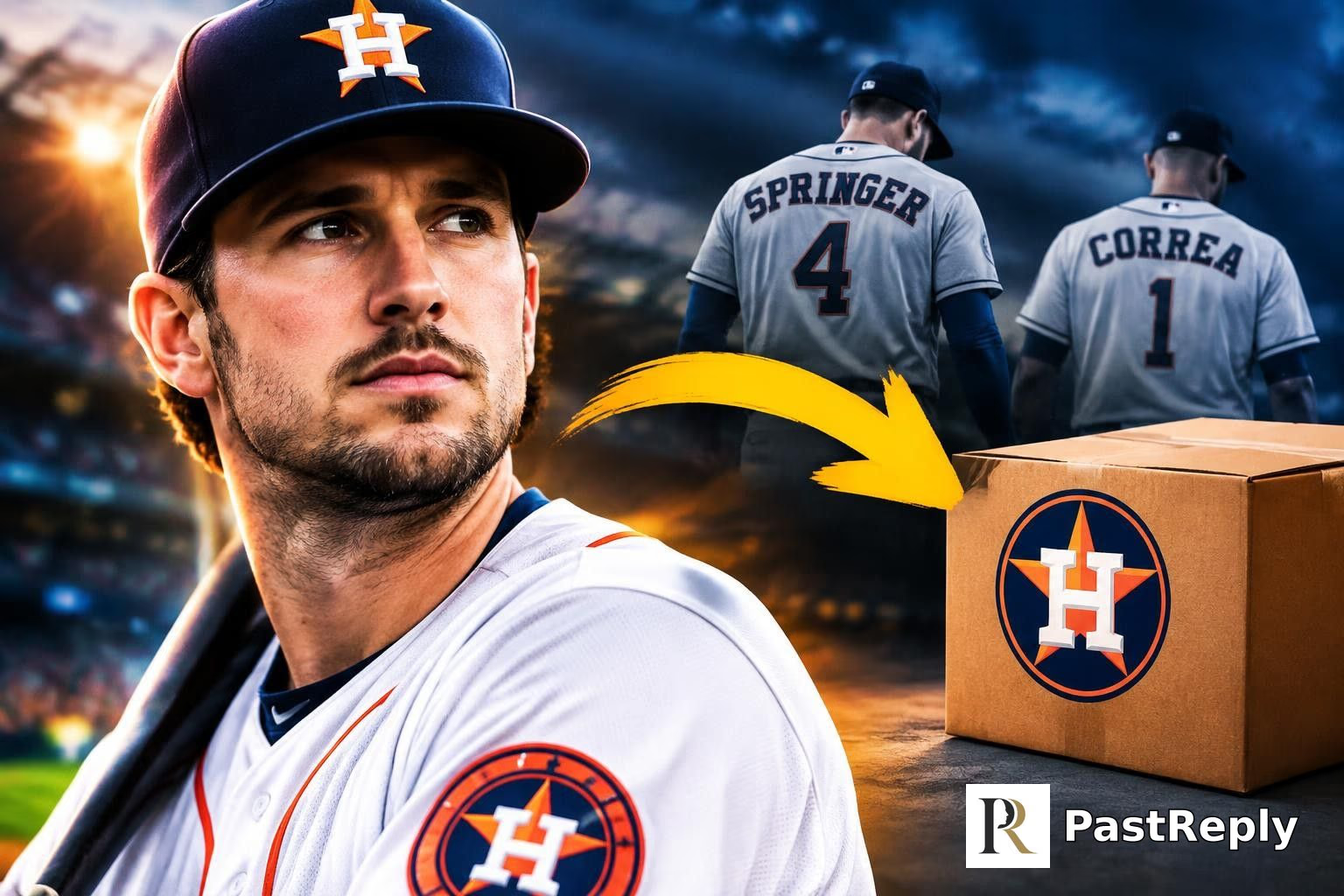
The Astros traded Kyle Tucker to get value before he hit free agency, after losing Springer and Correa for nothing.
The facts
The Astros traded Kyle Tucker primarily because he was entering his final year of team control before free agency, and the team had previously lost star players like George Springer and Carlos Correa to free agency without receiving compensation. By trading Tucker a year early, Houston aimed to acquire valuable assets rather than risk losing him for nothing. The deal brought back All-Star third baseman Isaac Paredes, pitcher Hayden Wesneski, and prospect Cam Smith, addressing needs while also potentially allowing the Astros to re-sign Alex Bregman.
Answered by 100 of history's most famous minds

A man does not light a lamp and hide it under a bushel, nor does he tear down his barns to build bigger ones without counting the cost. But I say to you, what does it profit a man to hoard a field for a season and lose the harvest forever? The Astros sent away a laborer in his last year, and in return they gathered new vines for the vineyard - some to bear fruit at once, some to grow for the vintage to come. Yet woe to those who trust in wealth and forget the widow and the orphan; the first shall be last, and the last first, even in the trading of ballplayers.

The believer is not to hoard the dates of the oasis when the caravan must journey on, nor to grieve over a camel sold for three strong horses. The Astros weighed their trust: to lose a man for nothing is a waste, but to gain fair return is a stewardship. Yet let them remember that all provision is from God, and the scales of the Day of Judgment weigh not contracts but justice and mercy to the poor. Trade with honesty, and fear not - what is written will come to pass.

You ask why they let go of one they cherished. Attachment to a single player, like all clinging, breeds suffering when impermanence arrives - and his leaving was certain. The wise steward neither grasps nor grieves; he exchanges what cannot last for what may nourish the whole. Paredes, Wesneski, Smith: seeds, not relics.

Did I not lead the people out of bondage only to wander forty years because they would not trust the covenant? A man who will not bind himself to his house will be taken from it. You do not mourn the harvest you sell; you mourn the harvest you let rot in the field. Let them remember the God of exodus, who gives and who takes away - and who demands you choose while it is still day.

A ruler who loses his best minister to a rival court without gain has failed in his duty. The Astros, seeing Tucker's term near its end, acted to secure worthy replacements - Paredes, Wesneski, and the young Smith. This is prudent governance: to prepare for the morrow rather than mourn the past. Yet they must ensure these new men are cultivated in virtue and loyalty, lest the house fracture again.

Do you not see? The love of money is the root of all evil, and this trade is but the wisdom of the steward who forgives a debt before it is owed. Better to gather a few faithful workers now than to lose the harvest entirely; the Astros act not in greed but in prudence, that they might build up the body rather than let a member depart without edification.

A man does not cling to the flocks he cannot carry into the far country. When I left Ur, I left the familiar and the safe, and the promise came after the leaving, not before. If the young man will not stay in the camp by the season's end, let him go now while the caravan can still bring back a servant and a few good goats for the journey ahead. The Lord provides for the one who acts in faith, not for the one who waits until the tent is empty.

When the river reaches the bend, it does not argue with the bend. The Astros saw the water slipping past the stone and chose to dig a new channel before the old one ran dry. To grasp and hold is to lose; to let go in season is to keep a little. But the clever men in the tall offices count their coins and call it wisdom - only the Tao knows if they gained or merely changed their losses.

The world counts its coins and weighs its players, but the One who gives the harvest does not measure by the contract. Houston traded a man for others - perhaps to build, perhaps from fear of losing him for nothing. The honest labor is the same whether you keep or let go, so long as you do not deceive the heart. But remember: the game is a field, and all fields belong to the One, and the players are only tenants for a season.

It is a hard thing to leave a home where one has been loved, and I know something of that journey. But the masters of the game weigh their seasons as a steward weighs the harvest, and they feared to lose this son to a foreign field with nothing in their hands. My heart goes out to the young man, for he must trust a path he did not choose, as I once did when the angel spoke. Still, the Lord lifts up the lowly and casts down the proud, and no ledger of men can undo the kindness shown to a stranger.

These men traffic in souls as the papists traffic in indulgences, and they call it prudence. The Astros saw a servant in his last year of bondage and sold him, as a man might sell a coat before it wears thin. But what is this but the same greed that builds a tower with other men's bricks? I tell you, a Christian is free lord of all, and no contract should make him a coin to be counted. Let them justify it with their ledgers; scripture says the labourer is worthy of his hire, not his trade.

It seems fitting to distinguish the order of prudence from the order of charity. The Astros acted according to the former, calculating that a player in his final year before liberty is a good that may be lost without return, and so they exchanged it for other goods, namely a third-baseman and a pitcher and a youth of promise. This is not unjust in itself, for a contract freely made is a just title. Yet charity would remind them that the player is not merely an instrument but a person, and the common good of the team includes his good as well.

I know nothing of contracts and trades, only of the small love that stays when all else goes. If a man must leave, let him leave with blessing, and let those who remain be fed by what is gathered in his going. The poor of spirit are not the ones who lose a player, but those who forget that every hand, however briefly held, was given to us to serve.

I feign no hypothesis, yet observe the motion of bodies in trade: a star in his final year is like a comet whose return is uncertain, and the prudent astronomer computes his orbit before it flies beyond reach. Houston acted not from whim but from a law as sure as gravity - assets diminish when held past their term without recompense. They exchanged one body for three, and the quantity of future motion was conserved, though I would need more exact data to prove the sum.

A player in his final year is like a body approaching the speed of light - the clock of his contract slows, and you must either send him away before the moment passes or watch him vanish into another frame of reference. Houston chose the invariant: three bodies with longer worldlines instead of one fleeing almost at c. The cosmos does not play favorites, only conserves what it can.

In the great branching of the league, teams that hoard one star too long leave few descendants. Houston, having watched Springer and Correa depart without issue, now selects for the trait of early exchange - three young lineages instead of one sterile branch. It is not sentiment but descent with modification. The tree endures by letting the ripe fruit fall.

Observe the motion: a body in orbit cannot remain without a force to hold it, and it flies off on the tangent. Houston calculated the tangent months before the sphere departed. Whether the calculation was wise is for the season to demonstrate, but the geometry is sound. Do not confuse the instrument with the astronomer.

Consider the harmony of the whole. A team, like the heavens, must be ordered so that its parts move in concord. Tucker at the center no longer served the greater symmetry; moving him brought new bodies into alignment - Paredes, Wesneski, Smith - and freed space for Bregman's return. The simplest arrangement that preserves the system's stability is the truest.

Ha! They trade a man as one might trade a coil for a dynamo - because the energy must not be wasted when it can be transformed. In my mind, I see the circuits: Tucker was a high-voltage line nearing its end, and Houston wisely rerouted the current into Paredes, Wesneski, and the young Smith. The future belongs to those who harness the unseen forces; this is not loss, but a redistribution of power.

One does not hold a radium sample in the hand for the comfort of possession; one measures it, records it, and lets it serve the work. If the element will decay into another by the year's end, the careful steward separates what is useful before the transformation is complete. The question is not sentiment; it is what remains in the crucible after the heat is applied.

I would want to see the ledger. How many seasons did the man have left before the ferment turned? They traded him not from sentiment but from arithmetic - a controlled experiment in loss prevention. The result is a third baseman, a pitcher, and a young culture in a dish. Whether it grows into a pennant or spoils, only the microscope of time will show.

I'd have traded him too. You don't sit on a lamp that's about to burn out - you find another filament. Tucker had one year left, so Houston swapped him for a third baseman, a pitcher, and a prospect, which is three chances instead of one sure loss. Genius is one percent inspiration and ninety-nine percent perspiration, and this deal looks like the ninety-nine percent. Now let's see if the new parts light up.

Let us define the problem precisely: a player's value is a function of his current ability plus the probability he remains available after this season, multiplied by the cost of replacement. Houston computed that the expected value of the compensation received now exceeded the expected value of his production in the final year, given that the state of free agency is an absorbing state from which no team recovers its asset. It is not sentiment; it is a decision procedure, and the machine that runs it is called a front office. The interesting question is not why they traded him, but whether any finite sequence of such trades converges.

Give me a lever long enough and a fulcrum on which to place it, and I will move the Earth. Here the fulcrum is the final year of a contract, and the lever is the fear of losing a man for nothing, and with it the masters of the Astros have lifted a whole team's fortune from one hand to another. They have gained Paredes, a body of solid measure, and a young arm whose arc is yet to be drawn. The geometry is sound. Whether the weight balances, only the season will prove.

You speak of losing a man to the open market as though it were a force of nature, yet it is no more inevitable than the spark that leaps the gap when the circuit is broken. The wise steward does not wait for the current to vanish; he winds a new coil while the old one still hums and draws from it a steadier light. To hold a talent until it departs empty-handed is to watch the field collapse without ever measuring its strength.

One must ask what is being repressed here - not by the player, but by the club that trades him. The anxiety of loss repeats an infantile pattern: the fear of abandonment drives the preemptive strike, the child who pushes away the parent before being pushed. Beneath the ledger and the prospect lists lies the same old dread of castration, the wound to the team's narcissism, dressed up as prudence.

In the vast ledger of the cosmos, a baseball trade is a brief flicker on a minor planet, yet the principle holds: you cannot keep a star that is already falling toward another gravity well. The Astros did the sensible thing - converted a fleeting orbit into durable mass. Though I confess, I'd rather calculate the entropy of a black hole than the market value of a right fielder.

It is a problem of deferred variables: the machine of a team cannot run on a single gear that will soon disengage. By trading Tucker a year early, Houston reprogrammed its roster, exchanging one finite input for a set of operations that may compute more durable results. Whether the algorithm succeeds depends on the unforeseen - but the logic of the calculation is sound, if unimaginative.

Let us define our terms: a team seeks to maximize its future victories under constraint of finite resources. Given the axiom that a player may depart without return, the optimal move is to exchange him for equivalent or greater value before that event. The Astros' trade follows necessarily from these premises, and the conclusion is demonstrated. There is no royal road to a championship, only the rigorous steps of the proof.

A hospital does not wait until fever has emptied the ward before it orders soap and clean water - it acts on the counting of cases, not on hope. Houston has kept its ledgers and seen the mortality of letting a man walk free with no return, so it brought in Paredes and the young pitcher and the boy from the fields, and it balanced the books. Sentiment is a poor nurse; the returns must be measured. If the re-signing of Bregman follows, then the prescription has worked, and the patient lives.

By the gods, a king does not weep over a horse that will bolt at season's end; he harnesses it now to drag his chariot to victory. The Astros, like any general, saw a soldier whose term of service expired and chose to bargain him for a phalanx of new shields. I would have taken Tucker and burned a path to the World Series myself - but if you must trade, trade boldly, and let the spoils of Paredes and the boy Smith forge a new empire. Caution is for those who fear to grasp the world.

A general does not wait for a city to be sacked before moving his legions. Last year of a contract is a bridge over the Rubicon - cross it now with terms or watch a rival seize the prize. I would have taken Paredes as my lieutenant in Gaul, Wesneski for the grain ships, and young Cam Smith as a hostage of noble blood. Clemency is a weapon, but an empty treasury is a corpse.

You do not wait for the Nile to dry before you move your granaries. A king who lets his best general walk to the enemy's camp with nothing in return has already lost the war. I gave Caesar a son and Antony a fleet because I knew what Rome wanted; Houston has learned to sell the harvest before the flood takes it. Wise, if late.

I did not dismantle the Republic in a day, nor did I keep every legion under my own standard. A wise prince trades a province to secure the peace of the whole. If Houston has chosen to fortify the center rather than bleed on the frontier, let them answer for it - but let no one say they acted without thought. Stability is purchased, never inherited.

A khan does not weep over a warrior who would ride to another's banner. The Astros saw Tucker's term ending and struck first, taking horses and arrows in exchange - Paredes, Wesneski, the boy Smith. That is strength: to trade a single rider for a troop, to keep the horde strong. Sentiment is for the weak; loyalty is for those who stay.

A general does not mourn a single cannon when the campaign demands mobility. Tucker was a fine battery, but he would soon roll away on his own - better to exchange him for fresh troops and a strong position now. The Astros show strategic sense: they reinforce the line with Paredes and prepare for Bregman, rather than let the enemy take the field unopposed.

A general does not leave a garrison in a post he cannot hold through the winter without provision. If the man's term is expiring and the enemy will take the field next season, the prudent officer withdraws his stores while the roads are still passable. I have seen too many campaigns lost by holding ground for pride rather than for the object at hand. The republic is served by foresight, not by sentiment.

A house divided against itself cannot stand, and a ballclub that lets its best men walk out the door without a fare-thee-well cannot stand either. They traded a year of Tucker to keep from losing him for nothing, the way a farmer sells the last of the wheat before the frost. I reckon it was a hard bargain, honestly struck. The question is whether the men they got back will be worth the grief of the ones who left.

It is a maneuver of high strategy, executed before the battle is joined. Houston saw the enemy - free agency - advancing, and instead of waiting to be overrun, they traded a year of Tucker for a third baseman, a pitcher, and a promising young man. I have always said that he who sits still while his garrison starves deserves to lose the fortress. Whether this was a masterstroke or a retreat in disguise, only October will tell. But I would not bet against men who act while others merely hope.

A man's worth is not measured by the fence that holds him, nor by the purse that buys him, but by the spirit with which he plays. Yet I have seen how the mighty treat the poor labourer as a chattel to be moved at will, and it saddens me. The owners of the Astros act as all owners do, seeking gain before loyalty, and so they send away a brother to another city as though he were a sack of grain. Nonviolence begins in the heart that refuses to possess another, and justice begins when the ledger is torn up.

In every city there is a boy who dreams of the diamond, and in every front office there is a man who dreams of the ledger. The Astros traded Tucker because they feared the winter of free agency, and they chose foresight over faith. I do not condemn them; I only ask that we remember the humanity of the man who is moved like a chess piece, for he too has a family and a heart. The arc of the moral universe is long, but it bends toward justice, and no trade can bend it away.

In the long walk to freedom, one learns that holding a man against his season is no victory; it is a siege that starves both sides. The Astros did not banish Tucker - they chose to part with dignity and gather what could build the house anew, as we did when we laid down the gun but kept the vision. A team, like a nation, must be led with the wisdom of the harvest: you reap what you planted, and you share the field before it is taken from you.

This is the logic of the weakling who surrenders his sword before the enemy can take it - a strategy of fear dressed as calculation. A true movement does not bargain away its strength for scraps; it binds the man to the cause or breaks him. But let the historians note: such half-measures are the rot that precedes collapse.

The Americans shuffle their athletes like grain quotas, always fearing the harvest will be stolen. This Tucker was a resource, and resources must be secured or converted before the enemy seizes them. The Astros understood that sentiment is a luxury; only the accumulation of assets matters. But their bourgeois league lacks the discipline to make such moves truly effective.

The baseball club is a petty bourgeois enterprise, and its managers behave accordingly - selling off one star to buy others, never addressing the rot of the system itself. The trade is a tactical maneuver in a game of profit, not a revolutionary act. True change would require seizing the means of production, not swapping a right fielder for a third baseman.

The landlord sells the harvest before the peasant can eat it. Houston calls this trading, but I call it what it is: the owning class converting a man into coin before he can walk free. They lost Springer and Correa to the market and learned their lesson - take the bullion while the bullion still has legs. In the end, no man is loyal to a village that does not own him; only collective ownership would have kept Tucker in Houston, for when the people hold the field, no one sells the crop.

One does not dismiss a faithful servant a season early without cause, and yet a sovereign who has watched three of her best grooms leave the stable for nothing learns to sell the fourth before the winter. It is disagreeable, this business of men as chattel to be measured and exchanged - but a crown must think of the household entire, not of one favored footman. The Astros have done what any prudent estate does: taken the purse before the purse walks away, and I cannot fault them for it, however much I dislike the noise.

One serves where one is sent, and one plans for the years rather than the season. Houston has learned that a player may depart and give nothing in return, and so they have done the steady, unsentimental thing - secured what they could while they could. I have had to let beloved things go too, quietly, for the good of the whole. It is not a betrayal; it is stewardship. The club endures. That is what matters.

A wise king does not wait for a rebellious count to ride off with his lands and then complain of the loss - he secures the border before the vassal departs. Houston has done the work of a steward of the realm: exchanged one knight in his last year of service for a stone fortress at third, a fresh horse on the mound, and a young squire to rear in the yard. Justice is served when the household is strengthened for the long campaign, not when one man's glory is mourned.

I do not know this Houston, nor their games, but I know what it is to be sold before you can choose your own road, and I know God does not abandon the field to the enemy's ledger. If they sent Tucker away, then the voices told them to - or they did not listen, and that is worse. A captain must hold the men God gives him and fight with what he has. One does not trade a banner away on the eve of battle.

Kings and clubs alike must reckon with the moment a subject's loyalty becomes a question of price, and Houston has chosen to sell the fleece before the sheep wanders off. I have done the same with lords who grew too great and too restless - better a useful alliance now than a rebellion next spring. Paredes at third and coin in the purse is a fair exchange for a man in his last year. I make no windows into their ledgers, but I understand the arithmetic of it.

An enlightened sovereign does not weep when a useful servant's term nears its end - she calculates. Houston has read the situation as any empress would: keep what can be kept, trade what cannot, and strengthen the whole. Paredes and the young arms are new provinces; Bregman may yet be retained as a loyal governor. Sentiment is for the salon, not the chancery. They have acted with the prudence of a court that intends to endure.

A great house is not held by clutching every satrap to the throne, but by knowing which ones will ride away and making certain their going enriches rather than empties the treasury. Houston has learned what every emperor learns: those you cannot keep, you exchange in time, and you do it with a fair hand so that both sides prosper. Paredes, the pitcher, the boy - these are provinces added. It is the statecraft of a realm that plans in decades, not in one campaign.

A commander does not grieve forever for the horseman whose term of service ends, nor does he let a proven warrior slip away to the enemy with nothing gained. If Houston could not bind Tucker by treaty, then to take a fortress, a fresh steed, and a young rider in exchange is the act of a leader who thinks of the whole army. Justice is in strengthening the ranks. I would have done the same before a campaign, and slept well after.

Tell me, friend, what is a trade but a question of what one values? If the Astros judged that a single year of Tucker's skill was worth less than the many years of three others, then they acted upon a belief about the good - but was that belief examined? And you, who ask why, do you seek knowledge or merely to second-guess the craftsman? The unexamined roster, like the unexamined life, is not worth fielding.

Consider the team as a soul: when one part grows too dominant and refuses harmony, justice demands reordering the whole. Tucker was a spirited horse nearing the end of the meadow - keeping him only stirs faction. The true Form of a ballclub is not one shining mortal but the well-tuned concord of many. Paredes and the others are notes in a better chord.

Consider the purpose of the general manager: to husband resources toward the end of victory. A player in his final season under contract is like grain that will spoil - better traded while its virtue is still potential than lost to the wind. The mean between hoarding and squandering lies here, though whether they chose it by art or by fear, only the season will show.

One must ask: could a rational steward of a household will as a universal law that he should let his ablest servant depart to a rival's table for nothing? No - such maxim cannot be universalized without contradiction. Therefore the Astros acted not from mere prudence but from a duty to preserve the estate entrusted to them; yet they must also treat Tucker as an end in himself, not merely a means to prospects.

They call it 'smart business' - the herd bleats and nods. But what if Tucker was the one who could have become a god among men? They feared losing him for nothing, so they traded him for a bag of lesser idols. That is not strength; that is the prudence of the timid, the slavish calculus of avoiding loss. A true creator would have fought to keep him, or let him go with a roar, not a whimper.

Behold the cold logic of capital! Tucker is but a commodity whose labor-power will soon be free to sell to the highest bidder, and the Astros, those bourgeois proprietors, seek to extract surplus value from his exchange before he departs. This is not a game - it is the class struggle in miniature, where owners trade human beings like so many sacks of grain, and the workers are left to cheer for the illusion of loyalty.

Let us doubt the assumption that a man is bound to remain where he stands merely because he stands there. If his tenure is certain to end, then the only clear and distinct proposition is this: either he departs for nothing, or he departs for something. Reason does not hesitate between the two. The rest is passion, and passion proves nothing.

A prince does not mourn the soldier who will not re-enlist; he counts the swords he can buy with the soldier's last campaign. Tucker had one year left on his contract, and one year is a knife with no handle. Houston chose to trade the knife for a fortress at third base and a young arm, rather than watch him ride off to a rival's banner for nothing. It is not noble. It is necessary. And necessity, in the end, is the only virtue that keeps the gates shut.

All the world's a diamond, and one man in his time plays many parts - his act being short, he exits, and another enters. Houston, like a careful player, saw the final scene approaching and wrote a new role for Paredes ere the curtain fell on Tucker. 'Tis not betrayal but stagecraft: to lose a star for nothing were a tragedy; to gain three for one is a comedy of thrift. And so the game goes, full of sound and fury, signifying - well, a prospect or two.

As when Agamemnon, forced to yield Chryseis, sent her back to her father and raged at the loss of his prize - so Houston releases a swift-footed striker before fate snatches him unpaid. Yet the wise captain gathers bronze and horses and a young spearman in exchange. Kleos is not hoarded; it is traded for many shields. The gods laugh at those who cling to a single mortal.

So the lords of Houston sold their falcon ere the molt, lest it fly to another's wrist for nothing. I have seen such reckonings in Florence - men trading honor for coin and calling it prudence. Yet the wheel turns; what is given away in fear returns as judgment. Let them answer to the ledger of their own consciences.

Ah, the eternal rhythm of parting and renewal! The Astros, like a gardener who sees a prized blossom about to seed and scatter, chose to transplant it while its roots still held value. Tucker, too, must strive onward - his own Faustian bargain with free agency - while Houston gathers new shoots: Paredes, Wesneski, Smith. In this exchange, both sides grow; no stillness, only becoming.

Ah, the knight-errant of the outfield, sent away before his final quest! In my day, a good squire was kept close, not traded for a windmill and a barber's basin - yet perhaps the Astros, like Sancho, have learned that even a loyal steed may wander off to greener pastures, and better to swap him for a sturdy mule and a sack of corn than to watch him ride off for free.

Why do men chase after these games and trades as if they were the meaning of life? Tucker is a man like any other, and the Astros barter him as one might barter a horse - yet the true question is not why they traded him, but why we care so much for such vanities. In the end, it matters not who fields the ball, but how we love one another and live rightly.

Ah, but here is the thing - a man leaves not because he is a thing to be traded, but because he has already begun to leave in his own heart, and the wise steward feels the chill before the frost. Yet what if the one who remains is the one who was truly abandoned? I have seen men congratulate themselves on their cleverness while the soul of the house quietly starves. Do not ask me whether the ledger balances; ask me what has become of the man who read the ledger.

It is a truth universally acknowledged that a ballclub in possession of a good player must be in want of a return before he quits the premises. One cannot blame the Astros for preferring a third baseman and a prospect to the empty chair where Tucker once sat. Still, I suspect the fans will feel the loss more keenly than the ledger shows, for there is no arithmetic that measures the charm of a familiar name in the lineup. Prudence and sentiment rarely dine at the same table.

I have seen this before, in the counting-houses of London: a man of singular gifts, kept like a candle behind glass, and the masters weighing whether to sell him now or let him burn down to nothing. The Astros acted as Scrooge might, had Scrooge kept a ledger of men instead of coins, and yet there is in it a curious mercy. They have not let him drift from the door for nothing, as poor Springer and Correa did, but have taken from a distant city a sturdy third-baseman and a young arm in exchange. It is a cold arithmetic, sir, and it forgets that a ballplayer is not a bale of cotton.

Why, they traded him because the men who own the Astros are a sight smarter than the ones they sold, and that is saying considerable. Tucker had one more summer on the contract, and they remembered Springer and Correa walking off with nothing but a tip of the hat, so they sold him while the price was high. It is the same trick a horse trader pulls when he knows the nag's wind is going. They got a third-baseman named Paredes and a couple of prospects, and I reckon they'll tell the fans it was for the good of the team, which is what horse traders say too.

They traded him because he had one year left and they didn't want to lose him for nothing. That is the whole of it. A pitcher throws, a hitter swings, a front office counts the days. They got a third-baseman and a kid and a pitcher. It is a clean trade. No sentiment. The man will play somewhere else, and the game goes on, the way it always does, under the lights, in the heat, until it doesn't.

Watch how a river, when its course is blocked, divides into many streams and waters a wider valley. The Astros, observing the nature of their garden, saw a single tree near the end of its season and chose to graft three new shoots in its place. I would study the roots of Paredes and the young Smith as I sketch the veins of a leaf - each has a pattern, a use, a promise. But nature wastes nothing, and neither did Houston; they pruned for the sake of the orchard.

The marble gives what it will give. You do not clutch the first rough block that shows a vein of brightness - you strike it away to reveal the whole figure beneath. Tucker was a limb half-liberated; to carve the finished David, the chisel must move early. I have left many a beautiful fragment in the quarry to bring one angel out of stone.

I think of the olive trees near Saint-Rémy - how the farmer prunes what he loves, not from cruelty but because he knows the branch will bear again in another's soil. There is a terrible tenderness in letting a thing go before it is torn away. The trade is not betrayal; it is a kind of grief dressed as arithmetic.

A trade is a canvas destroyed and repainted. They had a figure - Tucker - and they broke him into shapes: a third baseman, a pitcher, a prospect. Good! Better to invent anew than let the picture fade for nothing. That is how art lives: you must kill the old to make the new. The Astros understood that.

I see it as a shifting of light - one brilliant ray moves on, and another must catch the eye. The Astros, like a painter before a sunset, must work quickly while the glow remains; to hold Tucker too long would be to fix a moment that was already fading. In his place, new colors - Paredes, Wesneski, Smith - appear on the canvas, each with their own fleeting impression to offer.

A man does not sell his finest figure merely to keep the coin that buys it - he sells it while the light still falls kindly on its face, for in another season it will be gone from his hand and he will hold nothing but the memory of a bargain unmade. I have painted men who thought the coin would come again, and watched them go with a strange, clear eye. The merchant who waits until the last hour to part with his treasure is no merchant; he is a beggar who has already spent his wealth.

You do not sell a man like a goat at market and call it wisdom - but you also do not chain him to the fence and watch him rot. I have painted myself with my own blood and my own broken spine, and I know what it is to give something away before it is taken. Houston did not lose a lover; they cut the cord early and kept the child. That is not betrayal. That is a woman deciding to live.

A symphony cannot be one long note, however brilliant - the ear craves development, counterpoint, a new theme. Tucker was a glorious melody in his final movement, but the Astros, like a composer, chose to resolve him into a trio of parts: Paredes, Wesneski, and the young Smith. Bravo, I say - though I'd have written him a grand finale first! The trick is to end on a chord that leaves the audience wanting more, not mourning what has flown.

A theme repeated too long grows stale; the symphony demands development, not a single held note however brilliant. To keep Tucker past his final year is to let the whole orchestra wait on one violin while the movement dies. Freedom for the player, strength for the ensemble - let the new trio sound. The spirit does not cling; it resolves.

A fugue cannot hold one voice forever without the whole collapsing into noise. The bass must release its theme so the countersubject may enter; order requires the letting-go. Houston has written a difficult passage, but if the parts are well-voiced, the harmony will resolve - to the glory of the game, if not the comfort of its listeners.

Well, honey, sometimes you gotta let a good thing go so you can keep the show going. They didn't want to lose him for nothing like they did with Springer and Correa - that's just good business. But it still hurts, like leaving Memphis behind. You do what you gotta do, but you always remember the ones who moved you.

Sometimes you have to let go of a star to let new ones shine - it's like a dance; you can't hold every step forever. The Astros made a move to keep the rhythm going, to heal and grow, because the show must go on. I believe in fresh harmonies and second chances, and maybe this trade brings a new beat to Houston.

Well, it's like a band breaking up before the tour even started, isn't it? You can't hold a song forever - you either record it now or you're left with an empty studio and a bunch of lads who've gone off to their own thing. Better to get something back for the tune than let it slip away for nothing. It's a pity, but that's the way the record spins.

The deal was made in a back room with a calendar on the wall, and the calendar was the only thing anybody believed in. You can't hold a man when the years run out like sand through a fist, so they traded the future for a third baseman and a kid with a strong arm. It's the same story they wrote about the ones who left before - a song with one verse and a long fade-out. I don't know if it was right or wrong, but it sure had a melody.

Honestly? It's like watching someone leave the group chat before you can say goodbye. They knew he was going to walk, so they made the trade and got something back - a third baseman, a pitcher, a kid with potential. It's the same story we've seen before: you can love someone and still lose them, so you try to write the ending on your own terms. But it still stings when the jersey changes.

I set sail from Palos with three ships, not one, because no single vessel can carry the riches of the Indies. Houston, like a wise admiral, saw that Tucker's year was a short voyage and exchanged him for a small fleet - Paredes, Wesneski, and the youth Smith - to chart new waters. The timid say 'hold fast'; I say, launch! For glory and profit alike belong to those who dare to trade the known for the unknown.

In the markets of Kinsai I saw merchants sell their finest silk before the caravan turned, lest the Khan's officers take it for nothing. So Houston, having lost Correa and Springer to the open road, now trades Tucker for Paredes and Wesneski and a young rider of promise. Better three bundles of spice than one gem that walks away at dawn.

A captain does not sail into the strait with a hull already leaking and no spare timber. I have lost ships to storms I could not foresee, but I never lost one I could have provisioned. They have chosen to reef the sails early and keep the fleet. Whether the wind favors them, God alone knows - but they will not be caught in open water empty.

In any mission, you assess risk and act before the window closes. Tucker was a year from free agency; we had no guarantee of re-signing him. The trade brought back Paredes, Wesneski, and Smith - tangible assets. It's not about sentiment; it's about ensuring the team's future. You plan, you execute, you move on.

In the air, you learn that clinging to a single cloud won't get you across the ocean - sometimes you have to bank hard and trust the wind. The Astros traded Tucker because staying level was the real risk; they chose to climb, to gain altitude with new players rather than stall and lose him for nothing. It's the kind of bold navigation I'd applaud: chart a new course before the fuel runs out.

A man who leaves the capsule behind does not go up with it. You count what you can carry back - the instruments, the readings, the bit of the journey that will help the next crew. I once orbited and came home lighter than I went, and the whole Earth was the prize. Houston is doing the same: they're not throwing away the sky, they're choosing which stars to keep in the window.

This is about saying no to the tyranny of the short term. You have a great asset, Kyle Tucker, one year from walking - so you don't cling. You make a bold bet: trade the past for the future, get Paredes, get Wesneski, get Cam Smith, and keep the machine alive. It's not sentimental; it's design. The teams that win are the ones that focus on what's next, not what's leaving. And that's a beautiful thing.

First principles: an asset with one year of control and no comp pick is decaying optionality - you either extend or convert. The Astros converted. Three younger pieces with more team-controlled years beats one expiring star, full stop. Letting him walk for nothing is the move that gets you stuck on Earth.

Honey, this is what I call a grown-up decision. You don't wait until the house is on fire to call the mover - you look at what you have, you honor what you've built, and you make room for what's coming. Somebody in that front office had the courage to say, 'We're not going to lose this for nothing.' That's not giving up. That's stewardship.

They traded Tucker 'cause they didn't want to lose him for free - same old story, like when they let Springer and Correa flee. But I say: a man's worth more than a prospect's promise. I'd rather go down swinging with my star than trade him for a maybe. But hey, that's baseball - and business is business, even when it stings.

In football, you never keep the ball too long - you pass, you move, you trust your teammates. The Astros saw the game ahead and made the play: trade one great player to strengthen the whole team, like a perfect assist. It hurts to lose a star, but the beautiful game is about the collective, and sometimes the best move is the one that keeps the ball rolling.

Every good story has a moment where the hero has to decide what he's holding onto and what he's willing to trade for the next chapter. You don't keep a character frozen in one scene just because you love him - you write him into the future, and you bring back something that makes the picture sing. That's not losing the dream; that's building the next one.