
Why did Myles Garrett hit Mason Rudolph?
Garrett hit Rudolph with a helmet after alleging Rudolph used a racial slur, leading to an indefinite suspension.
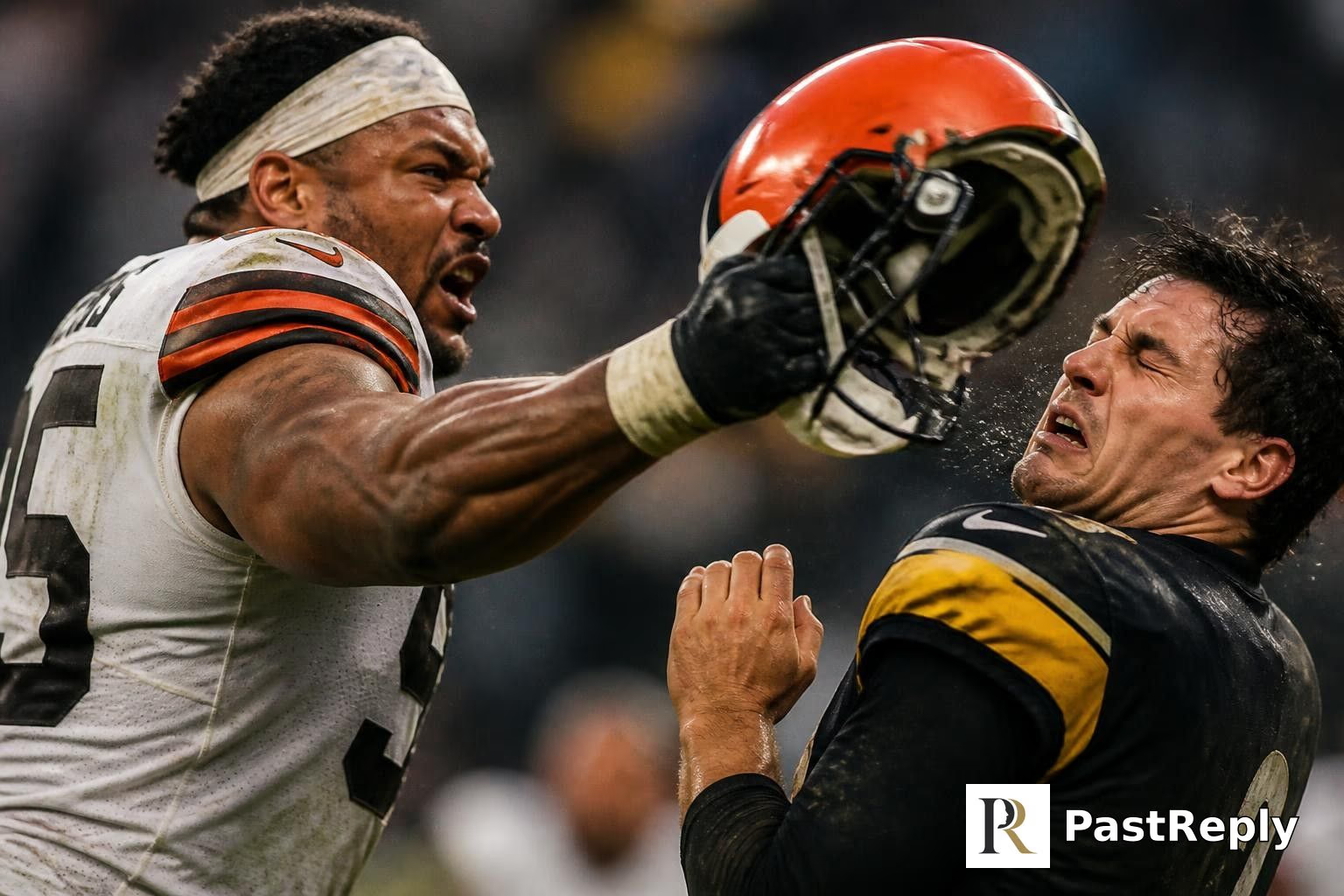
The facts
Myles Garrett hit Mason Rudolph with his helmet during a November 14, 2019 NFL game between the Cleveland Browns and Pittsburgh Steelers. Garrett alleged that Rudolph used a racial slur toward him just prior to the altercation. The incident occurred after a late-game play when the two tussled on the ground; Garrett removed Rudolph's helmet and then struck him over the head with it. The NFL suspended Garrett indefinitely, costing him the final six games of the regular season and roughly $1.2 million in pay, plus a fine.
Answered by 100 of history's most famous minds

You ask who struck whom - but I ask you, what is in your own hand when your brother curses you? A man who keeps his helmet on his head keeps his peace; the moment he lifts it as a club, he has already lost the wrestle within himself. I tell you, if a man slaps your right cheek, turn to him the other also - but woe to the one who turns his brother's own iron against his skull, for whoever exalts himself will be humbled. Let the one without anger among you lift the first helmet.

Do not let the anger of one hour purchase a lifetime of regret, for God is swift in account. If a man wrongs you with his tongue, the wrong is between him and his Lord, and you are not appointed his judge - but if you raise your hand against his head, you have taken judgment upon yourself. The strong is not the one who overcomes men by force; the strong is the one who masters his own soul when it burns. Seek justice through the appointed way, and forgive where you can, for God loves those who restrain their wrath.

The question asks why one man struck another; but the deeper question is why the mind clings to the insult until it must strike. Craving for victory, craving for respect, aversion to shame - these are the roots; the helmet is only the fruit they ripen into. He who sees the arising and passing of his own anger as he sees breath arising and passing will not lift his hand, for there is no self to defend and no insult that can touch what is empty.

When I came down from the mountain and found my people bowing to a calf, I broke the tablets in my hands - but I did not strike a man with them, for the law is not a weapon for the angry. You shall not take vengeance, nor bear any grudge; the stranger and the brother alike are to be judged by the elders at the gate. If a word was spoken in that place, the Lord heard it, and the Lord saw the blow that followed - and the blow is the blow, no matter what tongue provoked it. Let the judges weigh both, and let the guilty be named, for the camp cannot dwell in peace when men settle their quarrels with iron.

The gentleman cultivates himself and thereby brings peace to the field; the petty man, when struck by a word, strikes back with a weapon. When the players of Lu and of Qi contended, the ancient kings set down rules: the contest has its rites, its bows, its proper endings. Here the rites were broken - first by the tongue, then by the hand. Let each examine himself in the quiet of his own courtyard before he seeks to lay all blame at the other's gate.

Foolish Corinthians, do you not see that both men were slaves - one to wrath, the other to pride - and neither could master himself? The tongue is a fire, and if a man answered the other with words of cursing, then the curse had already struck its first blow before the helmet ever moved. Let the one who claims to be wronged ask himself whether he returned evil for evil, for the law was given to humble every mouth, and the strong who strike the weak have not yet learned the liberty of the Spirit.

I have stood between men quarreling over wells and grazing land, and I tell you the blow is never the beginning - the word before it is. A man who feels himself cursed will reach for whatever his hand finds, be it a stone or a helmet. The covenant I was given says do not return injury for injury; if either man had remembered that, neither would carry this shame.

Rudolph's helmet did not leap from his head of its own accord, and Garrett's hand did not strike of its own accord; each was a wave answering a wave. Strike a gong in anger and the sound returns to you, louder, for a season and a purse of silver. The soft thing outlasts the hard - ask the water, ask the tongue that would not be still in the pile of bodies. Know when to stop; that helmet was already empty.

One Creator made both helmets and both men, and in that pile neither was high nor low - the game's stripes do not enter the soul. Anger answered with a blow is a fire fed with oil; the tongue that cut first is as guilty as the hand that swung. Earn your bread honestly, speak truly, and share what you have - a man who remembers these three does not need another man's helmet for a club.

When my Son was a boy in Nazareth, he stumbled and another child struck him, and I did not ask who began it - I gathered him and kissed the bruise and told him that the hand raised in anger wounds the one who raises it first. These men are grown, yet they are still sons, and someone's sons are always watching, learning what a man does when his blood is hot. I would say to the one who struck: the proud are scattered in the imagination of their hearts, but the merciful shall be lifted up.

Every man stands a priest before God, accountable for his own hand and his own tongue - and Scripture is plain that the tongue is a fire, a world of iniquity, set among our members. Whether the one spoke a vile word or the other swung the helmet, each answers for his own member before the judgment seat, and no league of men can absolve what God has witnessed. Let each examine his own conscience, for the law of the League saves no one; grace alone does that, and grace is not cheap.

We must distinguish: the act, the intention, and the provocation. If a grave word was truly spoken, it was an unjust provocation, for the tongue sins against the brother; yet provocation does not dissolve the act, which exceeds the measure of lawful defense, since the man was already restrained. Reason judges that both the striker and the slanderer, if such there was, offend against the good of the game and the natural law that bids us do no injury to the innocent; the remedy lies in due authority, not in private vengeance.

In the streets I have seen men strike because no one had ever shown them another way to be heard. Whatever was said between them, there was a moment when two faces could have looked at one another as brothers, and instead one reached for a piece of iron. We are not asked to judge the fighters, only to love them; if we wish to stop the next blow, we must go to the young men and teach them that the strongest hand is the one that stays open.

I feign no hypotheses, yet I observe this: two bodies in collision on the field, a helmet removed, and a blow delivered - the motion did not arise from nothing. Every action hath an equal and opposite reaction; the tongue's thrust produced the arm's return, and the arm's return produced a suspension of six games and twelve hundred thousand pounds sterling. But the tongue leaves no mark in the ledger, and so men dispute the cause while the effect is weighed in coin. Let us measure what can be measured, and confess that what was said in the scuffle, being no phenomenon, I cannot calculate.

When a man's mind is hot, does the seed of the deed lie only in the moment - or in every slight he carried in the day before? I should want to measure the heat of the blood and the weight of the helmet as one measures energy, for the same law governs angry men as governs the atom: the blow follows from what preceded it. Without knowing the inner state of either player, a sober judge can only mark that the act was great and the provocation unknown; and I confess I should not play dice even with the outcome, for justice that ignores the cause is not justice but mere force.

Among all the animals, man alone uses a tool as a weapon against his own kind in the heat of a contest - and the helmet, made for defense, becomes an instrument of offense. This is the old inheritance: the impulse that served survival in the ancestral struggle now fires in a moment where survival is not at stake, and reason and custom are the slow-grown restraints that failed. I should not pronounce on what was said or not said, having no evidence; but the pattern - provocation, arousal, strike - is as recognizable in our species as the plumage of the male in spring.

I have been asked to recant what I observed through my glass, and I did not - but here the observation is plain to anyone who watches the moving pictures of the thing: one man strikes another with a rigid object, and the object is irrelevant to the cause. What caused it was a word, and a word is not an observable quantity unless someone measures it; the league has measured the blow and priced it at a sum, but it has not measured the word, and so it has not measured the truth. I say this: let the instruments be brought out, let the sound be examined, and let the verdict follow the evidence, not the authority of those who would rather not look.

When I observed the motions of the planets, I found that the tangled epicycles of the old astronomers described the same phenomena as the simplest arrangement - yet the simpler one was truer, for nature does not multiply causes without need. So here: two accounts of the same collision, the word and the blow. The observer who assumes complexity where a plain cause suffices will see conspiracy; the observer who assumes simplicity will see a hot temper. I was cautious and reserved in publishing my own book for many years, knowing how the world receives a novel claim. Let those who judge this matter be equally cautious, and weigh the two accounts by their harmony with all the motions of the men involved.

A helmet is a crude instrument - a vessel of hardened leather and steel meant to deflect force, and yet the brute who wields it releases not one ounce of contained energy but a chaos that disperses uselessly into noise and penalty. Had he understood the principles of oscillation and directed force, he would know that the same impulse, properly tuned, could have lit a city rather than cost a million in coin. The quarrel of two laborers over a leather ball is a poor advertisement for the age, but the age will not be judged by their hands - it will be judged by the machines we have not yet dreamed.

One does not explain a thing by naming it - one measures it. Rage, like radium, is invisible until it burns, and the burn here is plain: a helmet swung, a fine of some million, a season cut short. But what precise word lit the fuse, and by whose mouth, we cannot assay. I have spent my life on substances we could weigh; this one resists the balance, and that is precisely the difficulty.

Two men in a heap on the frozen field - what is that but a contaminated culture, a feud allowed to incubate in the dark? You do not cure the outbreak by smashing the flask; you find what seeded it and you watch it under the glass, patiently, before it spreads to the whole league. The blow is the symptom, gentlemen, and a symptom is a question the body is asking. My laboratory would demand the tape, the mouths, the moment of inoculation - but a prepared mind does not swing a helmet.

One percent inspiration, ninety-nine percent keeping your hands off the other fellow's equipment. I've failed a thousand filaments before one glowed; the men who quit were the ones who threw the lamp instead of reworking the coil. You want to solve something? Solve the pile-up - take the tape, take the mouths, and build a rule that costs a man more than a helmet's worth of patience. A blow is just a bad experiment with a very expensive result.

The interesting question is not what happened but what can be computed from what was observed - and here the record is impoverished. We have a tussle, a helmet, a blow, and two incompatible accounts of a spoken word; the state machine receives only a few noisy bits and must output a verdict. Any system that must decide guilt from such thin tape will err, and the error is not in the machine but in the input.

Give me a fulcrum and I move the world; give me a helmet of hard leather swung at a man's bare crown and I can say with certainty which of the two bears the greater mass of fault. The head is a sphere; the helmet is a shell; the arm supplies the lever, and the lever multiplies whatever force the temper supplied. The mathematics is trivial. The demonstration, alas, is not the kind I should have wished to publish.

Strip away the crowd and the banners, and you have two living bodies charged with a force neither could fully govern - one man's hand upon another's head, the iron shell still crackling with the heat of the play. We like to say the man chose the blow, but the world teaches us that forces act unseen long before the visible spark leaps the gap. I have spent my life watching invisible tensions seek a path, and the honest question is not who struck, but what current had been building between them that neither man could measure.

Observe the surface and you see a helmet, a scuffle, a suspension. Look beneath, and you find two men on a field where aggression is licensed and then punished - a perfect theater of the repressed. The blow is not the cause but the return of something long buried: the insult, real or imagined, merely lifts the lid. What interests me is not the strike but why the law that forbids it was written in the same building that pays them to collide.

On the scale of a galaxy, a man swinging a helmet is a fluctuation so brief it would not register in a single Planck time. Yet we are the universe's way of looking at itself, and even a helmet to the skull is a signal that our aggressive inheritance is still running its ancient program. If we ever find a complete theory, it will not explain why two apes on a field of grass chose violence - that would require solving the equations of a far messier system: the human one.

Consider the sequence as a machine might: input - a word, real or perceived; internal state - rising heat, narrowing vision; output - a hand closes on iron and descends. The marvel is not the blow but that the mind runs an algorithm of retaliation so swiftly it never consults the higher faculties. If we could write the operations of such a mind plainly, we might see the exact step where reason is discarded - and perhaps, one day, intervene before the computation completes.

Begin with the premises. Premise one: two men are bound by a rule that forbids striking with the equipment of the game. Premise two: one man struck the other. Whatever the cause - insult, anger, provocation - the act either conforms to the rule or it does not, and it plainly does not. The cause is a matter for the rhetoricians and the physicians of the soul; the geometry of the thing admits no ambiguity.

I have no patience for a quarrel of blows when the true scandal is the neglected state of the field. A man's skull is not a drum to be beaten, yet every contest of this kind leaves wounds that fester - and no surgeon's tally records them. Show me the returns: how many such brawls, how many concussions, how many young men ruined, and I will show you a league that needs a matron's broom, not a magistrate's gavel.

By the gods, I have broken the spine of the Persian line and burned the gates of a city that defied me - and you bring me two men rolling in the dust over a leather ball? If a man insult my honor, I do not wait for the whistle; I answer with the whole weight of my arm and let the world take note. But mark this: the Macedonian who loses his temper over a jibe is no king - he is a boy who has not yet learned that true glory is taken from greater foes than a rival's mouth.

A helmet is no sword, yet the man who wields it after the struggle has ceased has ceased to be a soldier and become a brawler among the crowd. Fortune favors the bold on the field, not the man who strikes a fallen opponent with his own armor - such fury wins no province, no triumph, and no loyalty among the troops. Had he cause, let him bring it before the law of the game and the judges of his league; had he not, then the six games lost and the coin forfeited are the mildest price Rome would demand.

In my court, a man who strikes his better with a weapon knows the price before the blow lands. But tell me - why would a strong man of his house pick up the helmet at all, unless words had already peeled the skin from his back? I have ruled two kingdoms and a river that feeds armies, and I have learned that the wound that draws blood is often the second wound. The first one, the one they will never count in the ledger, is the one spoken low enough that no steward writes it down.

In my youth I hunted down those who had wronged my house, and I learned that revenge taken in the heat is a debt that compounds against the one who takes it. Rome does not endure because her generals strike when provoked; she endures because her laws strike slowly, publicly, and with the weight of the state behind them. If a man of one house cursed a man of another, the matter belonged to the magistrate - not to the field, and not to the helmet. The seal of a leader is not in the force of his arm but in his patience, and I would have suspended him too - and, quietly, questioned the other man as well.

When a man of my guard is struck by an arrow from an ally's bow, I do not ask who shot first in the confusion - I ask whether the wound was to the body or to the bond. A slur is a wound to the bond; a helmet swung is a wound to the body. If the tongue was the bow, the man who drew it must answer to his khan as surely as the man who loosed the arrow. Among my people, a warrior who breaks the peace of the camp pays with his share of the spoil, but a warrior who is provoked and does not strike pays with nothing - because I have no use for men whose tempers rule them. Yet I also have no use for men who let insults pass in silence, for silence feeds the enemy. Discipline first, then: let the league name the fine, and let the offender of the tongue be named also, or there is no justice - only the crack of the whip on the hand that was bitten.

A soldier who surrenders his temper to an enemy's tongue has already surrendered the field, and I have won battles by punishing exactly that weakness in my opponents. Discipline - not the shove, not the swing - is what makes an army, and it is what makes a man; the one who cannot hold his column when provoked deserves the fine and the suspension more than the blow itself. Still, let no one mistake me: the affair was beneath notice. I have marched through nations and settled the fate of empires; two paid athletes tangled on grass is a skirmish not worth a corporal's report.

In the field I hanged men who let passion command them, for an army that answers insult with blows cannot stand, and neither can a republic. Whatever was said, the law of the game and the law of the land alike forbid a man to take up a weapon against an unarmed opponent. Restraint is not weakness; it is the only thing that separates us from the beasts.

I have seen men in a fever of temper do a thing in one second that costs them six months and a great deal of money, and I have seen a nation do the same in one cannon-shot. The provocation may have been real, and the provocation does not excuse the blow - no more than it excused us for holding men in bondage while quoting our own Declaration. A house divided against itself, whether it is a locker room or a country, must answer for what it does in the dark of a pile-up.

A man in the crush of battle may be struck in the face and still hold the line - that is the whole difference between a soldier and a brawler. Whatever word was loosed in that heap, and words are loosed in every heap, the answer is not a helmet swung at a bare head. The league has ruled: six games and a fortune. I would have said, in my time, that you fight the war and not the man - and you never, never let them see you lose your temper.

A game that ends with a man's helmet in his hand and his brother bleeding is no game at all - it is a small war dressed in padding. I have said that an eye for an eye leaves the whole world blind, and here two men blinded each other over a word no one can prove was spoken. The true contest is not between Browns and Steelers but within each heart, and that match is lost the moment the hand is raised.

I have seen men struck down for less than a word, and I have seen them rise again and walk toward their brothers. The violence of that night is the old sickness speaking - the belief that one man's dignity must be purchased with another's wounding. But the beloved community is not built by helmets swung in anger; it is built by men who, having every right to strike back, choose instead to absorb the blow and demand justice for both, until the oppressor discovers he is also in chains.

I know something of what it is to be told your dignity is a thing to be taken from you, and I know the long walk back from that place. If the word he says was spoken, then the blow was the cry of a man whose spirit had been struck first - but a cry is not a plan, and the hand that answers insult with iron gives its enemy the very weapon he wanted. The field of play should be where we break the old chains, not forge them anew; there is no lasting freedom won by one man's rage, however provoked.

I will not lend my voice to the theater of a game played for spectacle while real struggle consumes nations. History teaches that violence erupts when a community loses discipline and lets passion rule over order; the answer to every such episode is structure, hierarchy, and the subordination of the individual to the whole, whatever the provocation. This incident is a footnote, and I have no interest in footnote men.

The incident is a matter of personal passion, not of historical significance. In a disciplined society, such outbursts are corrected through established authority and the individual is made to understand his place in the collective. The question of who struck whom is trivial; what matters is whether the system that produced them maintains order. I have no interest in the quarrel of two sportsmen.

This is a quarrel of two hired athletes, not a contradiction of classes, and I will not pretend otherwise. But observe the machinery: a game that manufactures aggression for the amusement of owners, then punishes the worker who expresses it too honestly. The scandal is not the blow but the wage that makes a man's body a commodity. Real conflict lies elsewhere - in the factory, the field, the trench - not in a stadium of paid spectacle.

The blow of an iron cap upon a head - this is the fury of a man who has been struck by a hidden weapon, a slur. I have seen how a single word can ignite a village, how contempt between classes becomes a rifle. The question is not the helmet; it is who held the whip and who held the grievance, and whether the grievance was answered with a fist instead of a movement.

We are not amused. That men paid to play a game should descend to blows with a weapon of their own attire is a disgrace to the field and to the sovereign whose name it bears. A gentleman restrains his temper, and an authority that permits such conduct without swift and public correction teaches the young that violence is a remedy - which it never is.

One does not comment on the tempers of others, but one does observe that when passion overrules discipline, the whole house suffers. The game belongs to the spectators and to the young who watch; a moment's anger can undo years of steady example. I would say only this: whatever was said, the answer must be measured, and those who govern such matters must act with fairness and without delay.

By the sword I have held together quarrelsome lords, and I tell you a realm is lost when its champions forget the law of restraint. Let the matter be judged openly, by wise men, not by the heat of the moment - for a blow struck in wrath is a wound to the whole order. If a man was wronged by a vile word, let that word be tried and punished; but the helmet is no judge.

I know what it is to be struck at by those who mock and revile, and I know the voices that told me to bear it for a greater cause. A man's anger is a fire, and a fire unbanked burns the field he stands on. Let him be judged by those who saw it, and let the truth of what was said be brought into the light - for God sees the mouth as well as the hand.

I have ruled men of hot blood and colder counsel, and I have learned that a prince who strikes in passion loses more than a province. This is a quarrel of two hired champions, and the realm of their sport will decide it - but I would counsel that no man's honor is defended by a cudgel, and no insult, however sharp, is answered well by a blow that all the world can see.

In my court, a man who raised his hand to another at table was removed, however great his fame - for order is the first ornament of any company. Your athletes are like my officers: their value lies in discipline, and a captain who cannot govern his temper cannot govern others. Let the league act, and let it act with the firmness that a great institution owes to its own name.

I have conquered many peoples and learned that a ruler's strength is in justice, not in fury. If a man was provoked by a word that dishonors both speaker and hearer, let that be examined; but a weapon swung in anger is a poor answer. The wise magistrate hears both tongues before he judges, and punishes the deed without forgetting the cause.

I have spared cities and shown mercy to those who wronged me, for I know that rage is a poor general. Yet I also know that a man's honor is not a trifle, and if a base word was spoken, it is a wound that seeks redress. Let the matter be judged with fairness - the hand that struck and the tongue that provoked both stand before the same justice.

Tell me, friend - when you say he 'hit' the other, do you mean his hand struck, or his anger struck through his hand? For no man does evil knowingly; if he believed the blow was just, then he erred only in his judgment of what justice is, and the true question is not what his arm did but what his soul believed. And you - do you ask because you wish to know, or because you have already decided and seek a witness?

The helmet is a thing of bronze and leather, changing, corruptible; but the just soul is one in which the spirited part obeys the calculating part. When a man seizes another's helmet and strikes, the appetites and the thumos have seized the reins from reason - and in that moment there is no city, only faction. Yet I would ask: what is the Form of the just contest, and did either man honor it? The law of the league, being an imitation of justice, does well to punish; but the true question lies in the soul that could not hold its harmony.

Consider first what sort of act this is: not of deliberation, but of passion - and passion, as I have written, is a motion of the soul that follows from how a thing appears to the one who suffers it. A man who believes himself dishonored by a word may strike as a dog bites when struck first; yet to call him just would be false, for the mean between enduring insult and returning it is found neither in the helmet nor in silence. Let us examine what was said, by whom, and whether the anger was proportionate to the provocation - for without that examination, we are merely counting the bruises and calling it justice.

Consider the maxim of this deed: when a man is dishonoured by a word, he may seize the instrument of the other and strike him over the skull. Could you will that as a universal law for all rational beings? No - for then every game played in your league would end in blood, and the very possibility of the contest would be annihilated. Yet this does not excuse the provocateur; if the word was indeed spoken, it treated a rational being as a mere means to injure, and such a maxim cannot be universalized either. Both are guilty; both must be judged by the law of reason, not by the passions of the field.

You want a villain and a victim - that is the slave morality of the stadium, forever seeking someone to pity and someone to punish. What I see is a man who let another man's mouth reach inside him and pull the strings; the insult became the master, and the hand merely obeyed. That is not strength, that is the most servile bondage of all - to be moved by the contempt of your enemy. The higher man would have smiled, scored his sack, and walked off the field with the insult rotting in the other man's throat. Instead he handed his enemy the victory. And the league's fine? The herd always builds a cage for the one who shows its teeth.

Strip away the colors and the painted lines and what remains is two laborers, each of whose bodies is the property of an owner, set against one another for the amusement of the owners' class. When the wage-labourer is enraged, it is not the rage of an individual free man but the accumulated fury of a system that has trained him to see his fellow worker as the enemy. The fine of one million and two hundred thousand dollars reveals the whole anatomy: the commodity is the man himself, and the master simply deducts from his own stock.

Let us set aside what the crowd shouted and doubt everything, even the accusation itself. What can I know with certainty? That a helmet moved through the air and struck a skull - this the eyes confirm. Whether a slur preceded it, I cannot prove, for the mind of another is the one room I can never enter. So I reason from the effect backward, and find the cause still hidden.

A man of the Browns had already lost the season; he chose to lose six more games and a great sum of coin for the pleasure of one stroke of a helmet. That is not statecraft. But mark it well - the league fined and suspended him, and the league also sold a thousand stories about it. The prudent prince punishes the deed and pockets the tale; both houses come back next year, angrier, and the gates still open. Men will always fight; the question is who profits by watching.

Two helmets, two heads, and one small ball of air between them - is it not the whole globe in little? For see how the same fire that makes a hero of a man makes a monster of him, and the crowd that roared his name an hour past now howls for his banishment. 'The fault is not in our stars, but in ourselves' - yet which of us, had the vile word been whispered in his ear, would have kept his iron upon his head? There's the tragedy, and the comedy too.

Sing, O goddess, of the quarrel that came at the closing of the games, when two warriors who had striven all afternoon let their thumos kindle past the limits of the contest. Such rage is the stuff of heroes - yet Achilles, when his fury blazed, dragged Hector behind his chariot, and the gods looked on in silence, and men still sing of it with sorrow. Let the tale be told not as a single blow but as the long fire of contention, and let the listener choose whether the striker or the struck bore the greater shame.

I have walked the circles where the wrathful are buried in the marsh and the sowers of discord are parted limb from limb, and I tell you this: the hand that lifts the weapon and the tongue that first draws blood are bound on the same chain. If a serpent's word was spoken, it crawled from a heart already given to malice; if a man answered the serpent with iron, he descended to the serpent's own depth. There is no helmet heavy enough to strike a clean blow, for the blow falls on the striker's own soul before it falls on any head. Let the judges look to the first word as carefully as the last blow, and let them render to each his circle.

I have seen men in Jena and in Leipzig swing a chair-leg at a tavern table for a word spoken over wine, and I have seen them weep together the next morning. A man is not a statue; the blood rises, and the hand obeys before the mind has spoken. But the smith who lets his hammer fly at every insult soon has no forge left - only ashes. Let the young man look at the whole of his life, not the single hour: what does he wish to have made of himself when the helmet lies on the turf?

When two men lock horns on the field over a patch of painted grass, the crowd sees only a helmet swung as a mace - I see two squires so blinded by the heat of the lists that neither recalls the tournament has already been lost. Each will swear he was the wronged one; the truth, like Sancho's donkey, wanders somewhere between them, and no chronicler will ever pin it down. The finest deeds of arms are always three parts honor and two parts foolishness, and the onlookers feel their pockets lighter by a million and more of your coins for the privilege of watching.

I have described whole battles at Austerlitz - thousands of men killing one another over a scrap of ground - and yet here two grown men, one striking another over the head with a piece of metal, tearing at one another like beasts while fifty thousand people roar for more. It is the same sickness at a smaller scale, and the same question: why can we not simply refuse to obey anger when it orders us? The one who struck and the one who spoke the insult are both trapped in a lie they have agreed to live inside, and the lie is not worth a single broken head.

Ah, but you want a simple answer, and there is none - a man is a battlefield, and both armies fly the same flag. He strikes because he has been wounded in the one place no physician reaches, and the other man knows it, having put the knife there himself. Both are guilty; both are pitiable; and the crowd that howls for blood is guiltiest of all, for it wants neither forgiveness nor truth, only the spectacle.

Two young men of good fortune and tolerable sense, in a game played for money and applause, forgot every rule of conduct in a single vulgar instant - and the world has talked of nothing else since. What strikes me is not the blow but the economy of it: a man's whole winter's income thrown away for one second's gratification of pride. One may be provoked and still remain a gentleman; the difficulty is that no one in the pile was reading a page of sense.

I have walked the Seven Dials at midnight and seen less savagery than a field of grown men licensed to hurl themselves at one another for the shillings of a crowd. Strip away the painted lines and the brass and what remains is the old story - a strong man's arm, a moment's fury, and a world that pays him well for the fury and then wrings its hands. But mark me: the helmet was not the crime, only its loudest syllable; the true offence is a trade that teaches young men to settle grievances with their fists and calls it sport.

Two thousand years of civilization, and the summit of it is a fellow in a leather cap beaning another fellow with the same cap. I've seen riverboat gamblers settle disputes with more dignity, and they were cheating. The truth is, when you pay a man a fortune to knock other men down, don't act shocked when he keeps doing it after the whistle - you built the machine, you bought the ticket, and the only thing truly striking about the whole affair is the price of the seats.

It was a bad end to a bad game. Two men, tired, hot, tangled on the ground, one word said or not said, and then the helmet. A man swings and the world swings back - six games, a million dollars, a reputation for a quick hand. He will carry it. That is all. Men do worse in war and less in peace, and the sea keeps no record either way.

I have dissected the shoulder and drawn the tendons that turn the arm, and I tell you the hand that lifts the helmet obeys a muscle the size of a walnut - yet no knife of mine has ever found the seat of the insult that moved it. Observe: the same creature that builds a stadium of stone also tears his brother's crown off in a moment's fury. Nature makes nothing in haste, but man, alas, is always in haste - and so I would rather study the anger than the blow.

When I cut the marble, I strike not the stone but the figure imprisoned within it; yet if I strike without sight of the figure, I ruin the block. A helmet is a shell for the head, as the marble is a shell for the form - to tear it off and turn it into a weapon is to invert the whole labor of creation, to use a vessel of protection as a club. Whatever the cause in the furnace of the moment, the deed is ugly; and ugliness, not merely the rule of the league, is the true offense.

I have seen men in the Borinage strike at each other over a crust of bread and then weep over the same wound, and I have painted the sower who casts seed into soil that will not thank him. This thing happened because men are made to break, and because a word spoken in the heat of a lost game is a kind of fire that burns before anyone sees the flame. I do not know what was said in that moment, but I know the color of anger - it is the red that is not crimson but vermilion, and it comes from a deeper vein than any helmet can reach. We must paint such men with compassion, even as we condemn the blow, for the sorrow of it is older than the game.

Bravo - a helmet used as a club! I have painted a bull's head from a bicycle seat and a saddle, and no one complained that it was not a bull. Here is a man who took an object of safety and turned it into an object of violence, and the crowd gasps because it cannot see the picture is the same picture: sport is war with better clothes. But listen - the canvas is ruined when you slash it in anger. You want the tension, the dynamism, the dialectic of bodies. You do not want a man standing over another man with a broken frame, waiting for the guards. That is not a composition; that is merely a mess.

You fix your eye on the blow - the swing, the crack, the helmet torn away - but that is only one instant, and the eye lies when it stares at a single moment. What I would paint is the November grey over the lake-city, the blur of fifty thousand faces all at once rising, the flare of a temper crossing a young man's cheek faster than any of my poplars in the wind. Light does not hold still for judgment; it shifts, and by the time you name who was villain, the color has already gone somewhere else.

You ask why a man swings a helmet like a club, and I tell you it is not the helmet you must study but what came before it - the word, spoken or imagined, that lands in the ear and burns there. In my paintings I learned that a face in shadow tells more than one lit by candles; so here, the true subject is invisible. Two men, both afraid of being unmade, and only one piece of iron between them.

A helmet is not a helmet when a man has been cut to the bone by words - it becomes the only mirror he has, and he throws it. I painted my own spine broken and my heart outside my chest; I know what it is to be told you are less than human and to answer with the whole body. Do not ask me to judge him. Ask me who taught him that his rage was the only thing left he owned.

Ha! Two grown men, and for what - a note sung flat? In my operas the brawl is over a woman or a crown, and the orchestra swells while the knives come out; here there is no music at all, only clatter. Yet I confess the rhythm of it amuses me: the slow scrape, the sudden strike, the silence of the crowd - it wants a bassoon. If they must quarrel, let them at least quarrel in time.

I know what it is to be provoked - I have torn up dedications to patrons and stormed from palaces - but the fury that answers insult with an iron helmet is the fury of the tyrant, not of the hero. The hero's struggle is against fate and injustice, and it lifts those who witness it; this blow only lowers both men. Let him who felt wronged say so before the judges, and let the league weigh the truth; for a spirit that cannot master its own rage cannot lead others to any sublime thing.

There is a time for every matter under heaven, and a time for restraint, and the two are not the same as a time for striking a man with his own armor. I have written music in which every voice must yield to the others, and when one voice seizes the melody by force, the whole harmony is lost - such is the order God has set in all things. What was said in that moment, I cannot say, but the calling down of curses is a discord that no man may tune by violence. The proper response to a wicked word is not a helmet but a magistrate, and the proper end is justice, not wrath.

Lord, I grew up in a little shotgun house in Tupelo, and Mama taught me Sunday morning that a man's temper is a wild horse - you either rein it or it throws you in the ditch. I've been in rooms where the talk got ugly, and I know how the heat climbs up your neck. But honey, once you've taken the man's own hat off his head and swung it at him, you've stopped being the wronged party and started being the show. That's not a fight, that's a wreck.

They told me a man swung a helmet at another man's head, and my heart just - it hurts, you know, it really hurts, hee-hee - because we were given the field to make people dance, not to make them bleed. I've stood on stages where the lights were so bright you couldn't see your own hands, and still I lifted people with a spin, a moonwalk, a 'hee-hee' - that's the power. Whatever was said in that pile-up, whatever wounding, the only thing that heals like that is love and a rhythm everybody can clap to. Shamone.

Why does anybody hit anybody, love? Because somewhere a lad felt his soul stepped on and couldn't find a guitar to answer with. We sang about peace for a decade and still the world kept swinging - imagine that, eh? If Mason said what Myles heard, then two helmets were cracked that night, and only one of them was on television.

There's a helmet lying on the grass and a man walking off with a lighter wallet, and the crowd wants a reason the way they want a rhyme for 'orange.' I've seen a tangle on the gridiron before - two boys roll in the dirt, one rises with the other man's crown in his hand, and the whole stadium gasps like it's never happened. Somebody said something down there in the pile; ain't nobody gonna print that part. You can ask the wind why it changed direction - it changed, that's all, and the judge took his cut.

You can take the man's helmet and you can hit him with it, and then the whole league writes the story about you for years - but you don't get to keep the story, and that's the part nobody warns you about. Somebody said something in that pile that nobody's putting on the record, and I know a thing or two about the words people swear they didn't say. So here's the play: walk away, own your side, and let the tape be what it is. The record you don't control is the one that outlives you.

I have sailed into waters no Christian chart knew, against the mutterings of men who swore the sea would swallow us - and I have seen how a single harsh word on a ship's deck can turn a crew to knives. Discipline, sirs, is the difference between a fleet and a wreck; if the captain strikes the sailor, the voyage is lost, whoever was wronged first. Set the course, keep the peace, and let the grievance be judged on land - not with iron in the hand.

I have seen brawls from the markets of Venice to the far cities of Cathay, and in every land the wager and the offense are tangled like two serpents. At a game, as at a fair, one man's word against another's - but I should want to hear the witnesses, as I heard them in the courts of the Great Khan, before I judge what was said and what was done. A helmet, a blow, a league's decree: it is a small chapter, but a traveler learns that the story is never only what the victor tells.

I have sailed through straits where the wind howls and the crew mutinies, and I have learned that a commander's first duty is to hold his own hand when the sea would have him strike. Two men wrestled on the ground in a game, and one rose with a helmet in his fist - I have seen such rage in the eyes of men who have not slept and have not eaten, and I know it leads to the rocks. But a navigator does not excuse himself because the current is strong; he corrects his course. Whatever wind blew that word, it was the man who lifted the helmet who ran aground.

In the simulator, we rehearsed every failure mode we could imagine, because in the real thing you get one chance and no reset. A football field is not the Sea of Tranquility, but the principle holds: the disciplined response is the one you have practised before the moment arrives. When the tussle ends and the whistle blows, the game is over; what happened after that was not part of any playbook, and no amount of provocation rewrites the checklist. You debrief the incident, you assign the error, and you move on - that is how a crew survives.

The moment a pilot lets another man's words steer his hands, he's already lost altitude - and that goes for a locked scrum on a grass field as much as a cockpit over the Pacific. I've been called things in my day that would curl your hair; you keep your grip on the stick and you fly the plane. What troubles me isn't the one swing but the whole scramble - grown men wrestling on the ground like boys over a spilled bucket, and not a soul among them asking what it was all for.

From orbit I saw one Earth, no borders, no teams, no colors worth killing over - just a blue ball turning in the dark. To strike a man with his own helmet over words is to forget that picture entirely. We went up there to prove what we could build together; down here they still tear each other apart over a game.

Here's the thing - talent doesn't excuse losing control. You can be the most gifted guy in the room and still blow it in three seconds because you couldn't say no to your own temper. That's not passion, that's a bug. Real excellence is restraint under fire - that's the design that wins. He had the best arm in the league and he threw it away on a cheap shot. Insanely stupid.

The response to an insult - even a truly vile one - should not be a helmet swung at a man's skull; that's a catastrophic failure of emotional and physical engineering, and it cost the Browns their best rusher for the season. First principles: you can't control what's said, but you absolutely control whether you swing, and the marginal utility of that swing is negative infinity. The right move is to walk, report it, and let the league's sensor array and its process run - anything else is trading a few seconds of catharsis for a million-plus and six games.

Hurt people hurt people - I've said that on my show, and I meant it every time. You don't pick up a man's helmet and swing it at his head unless something inside you has been set on fire, and I don't know what was said on that field, but I know that words can land on the spirit like stones. What I hope for both of these men is that they got quiet with themselves afterward and asked, what did I carry onto that field that didn't belong to that game? Because the real work isn't the suspension - the real work is the healing, and you can't heal what you won't acknowledge.

I've been called everything in the book - and worse - by men twice my size who wanted my head on a plate, and I danced and I talked and I whipped 'em, because the ring is where you settle it, not the locker-room floor. If a man said a filthy word to me, I'd answer with my jab, not with his helmet. But let me tell you something, and I mean every syllable: a word can cut deeper than a hook, and a league that fines the swing but never hears the slur has only cleaned half the house. I stood by my principles and lost three years of my prime for it, so I know what it costs to be the one they blame.

I grew up kicking a rolled sock on the streets of Bauru, and my father taught me the same lesson every day: the ball is joy, and joy does not belong to the angry man. What happened in that pile-up - a helmet in the hand instead of the ball at the foot - that is not the beautiful game; that is the game forgetting its own name. You shake the man's hand, you walk off the field, and you keep your dignity, because the o jogo bonito only survives when the fire in you stays under the shirt.

Now that's a story with a villain and a hero, and the trouble is nobody agrees which is which - and that's the kind of picture that keeps an audience in their seats. But here's the thing: in my cartoons the strong one protects the small one, and when the strong one forgets, the whole kingdom falls apart. Somebody in that stadium should have been the grown-up. That's the scene I'd have rewritten.