
Why did Iran close the Strait of Hormuz?
Iran closed the Strait of Hormuz in 2026 as retaliation for a US-Israeli attack, using naval disruption to pressure global oil trade.
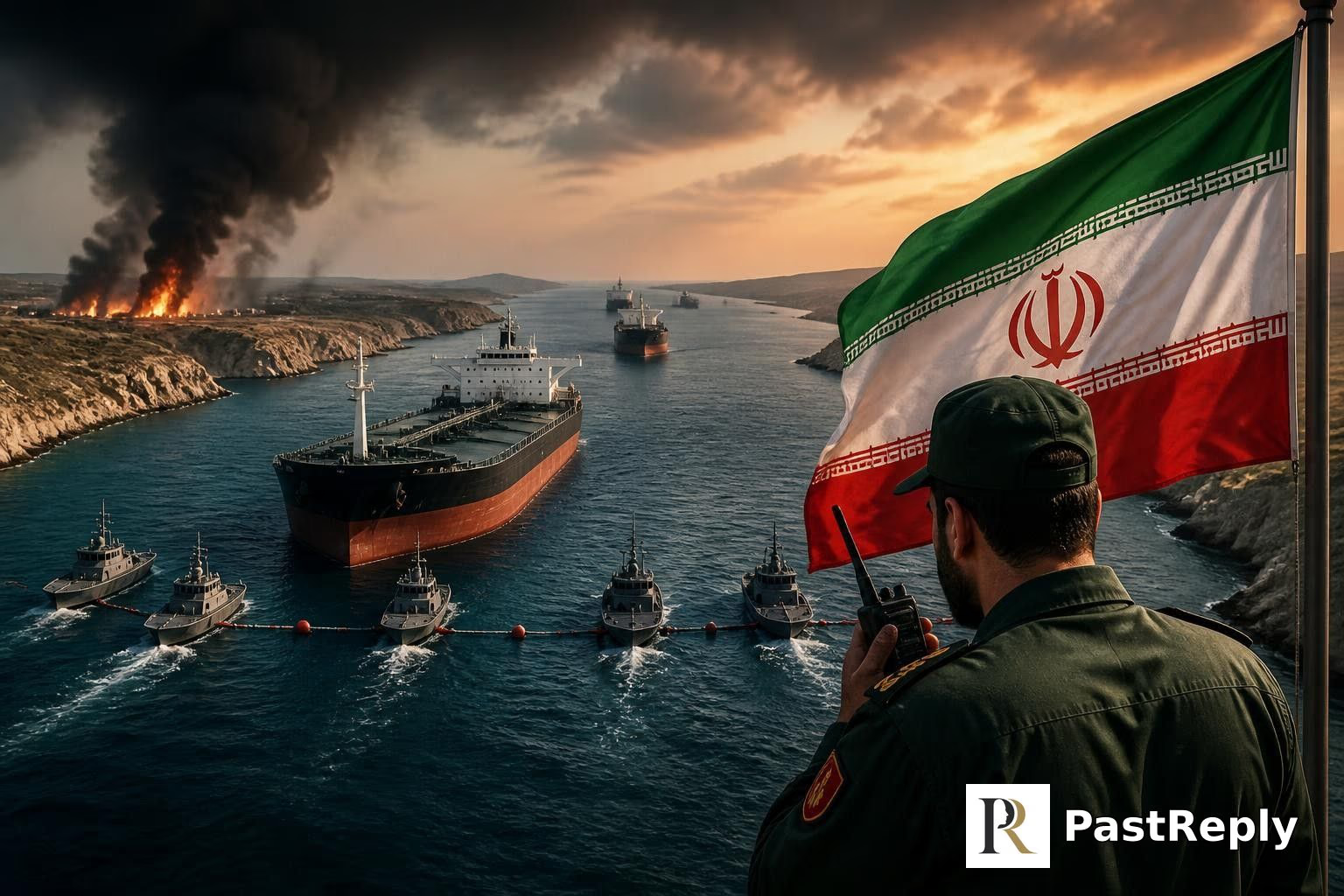
The facts
Iran closed the Strait of Hormuz in retaliation for what it considered breaches of a Memorandum of Understanding (MoU) by the United States and Israel. The closure was triggered by a joint US-Israeli armed attack on Iran on February 28, 2026, which Iran deemed a violation of international law and the MoU. Iran’s military declared the closure as the “first step” in its retaliation.
Rather than a complete physical blockade, Iran employed a strategy of disruption using drones, naval threats, and selective blocking of vessels. This created uncertainty, reduced shipping traffic, and caused oil prices to surge. Some reports indicate that Iran allowed certain ships to pass while blocking others, and may have imposed transit fees, effectively turning the strait into a controlled “toll system.”
Under international law, Iran is entitled to close the strait to enemy vessels but must respect the navigational rights of neutral ships. However, threatening all vessels regardless of flag is not considered legal. The closure aimed to leverage global oil trade and pressure the US and Israel, exploiting the strait’s role as a critical chokepoint with few alternatives.
Answered by 100 of history's most famous minds

You ask of a narrow throat of water, yet the true strait is the one in the human heart, where fear of the other chokes the flow of mercy. Those who shut the gate to the ships forget the gate of heaven stands open to all who hunger and thirst for peace. Blessed are the peacemakers, for they shall see God - but woe to those who turn the sea into a toll booth for their own glory.

In the name of God, the Merciful, the Compassionate - know that the sea is a trust, and to bar it from the ships of the upright is to kindle a fire that will burn the hand of the one who strikes the flint. The strait is a sign of God's provision, and those who turn it into a toll for anger have forgotten that provision is for all who sail with justice. Let them reflect: does the storm ask a fee before it passes, or does it come and go by God's command? So too should the passage of trade be as the wind, unhindered but for the will of the Lord.

They have closed a narrow water and call it a first step, but it is but another ripple in the endless sea of craving. The ships that are turned away are moved by desire, and the toll they impose is but a measure of attachment to gain. If they see the strait as a weapon, they are bound to its currents; if they see it as a toll gate, they are bound to its gold. Let them ask why they seek to control the passage at all, and they may find the only closure that matters is the one they make within their own minds.

I led a people through the sea when it parted at the command of the Lord, and I know that no man holds the waters in his clenched fist without defying the One who set the boundaries of the deep. You speak of a strait as if it were a gate you own, but the earth is the Lord's, and the ships of the innocent are as the sparrows that pass between the clouds. To turn away the hungry and the merchant, to make their passage a toll paid to your fury - that is not justice, which I brought down from the mountain, but extortion, which I condemned among the judges and the kings. Remember the commandment: 'You shall not steal.' And to seize the trade of a hundred nations is to steal from every widow who awaits her daily bread.

When two houses quarrel, the wise master does not bar the common road; he first asks what offense was given and what reparation is owed. The strait is like a narrow gate between courtyards, and to close it harms not only the offender but every neighbor who passes. A ruler who acts from anger, without rectitude, invites chaos into the order of all. Let them reflect on the harm they have caused each other and seek to restore right relationships, for the sage governs by virtue, not by blockade.

The law closes the gate, but grace flings it wide. They hold their memorandum as a seal, yet they break it with every blow; they boast of justice, but they sow injustice. For we are all one body, and when one member is hindered, the whole body suffers. Let them not trust in their treaties or their fleets, but in love that passes all understanding - for that alone opens the way that no man can shut.

The promise I was given was not for a single land or a single people, but for all nations to be blessed. When one man closes a road, it is not because the road belongs to him alone, but because his heart is afraid. I have walked through barren lands with only a word to guide me. The one who trusts in the promise does not need the sea to be open; he needs only to obey and wait.

A strait is but a narrow throat; when it clenches, the whole world feels the choke. The clever ones measure their force, yet the water knows better - it finds its way through the smallest crack. They who block the path of a thousand vessels have already been diverted by the path of the Tao. Be like the reed that bends in the storm, not the oak that breaks.

One Lord, one truth, one human family - yet here we divide the waters for the sake of a few. The merchant and the mendicant both thirst, and the sea is not a tollman's purse. To close a path that belongs to all is to close the door of the heart. Let them who struck the blow first ask forgiveness, and let them who guard the strait remember that the true wealth is not in oil but in the unity of souls. If you would choke the world, you choke the breath of the Divine.

The babe at my breast was the Prince of Peace, yet kings did not honor him. Now the great powers rattle their spears at this narrow neck of water, and the lowly are made to pay. My soul magnifies the Lord who scatters the proud in the imagination of their hearts; but I weep for the merchants' ships, for the mothers who wait for their sons, and for the little ones who go hungry while the mighty play at blockade. Only love can open what fear has closed.

Here we see the world's princes and prelates alike turning the sea into a toll-booth for their own pride. Does not the apostle say, 'Do not be overcome by evil, but overcome evil with good'? Yet these men, who claim the name of Christ, have made a fortress of the very waters that God gave for the commerce of all peoples. I would rather have the strait open to the gospel and closed to the cannon than filled with warships and closed to the truth. Let the law of nations be judged by the Word of God, not by the fear of the Turks.

The closure of the strait under the guise of retaliation raises questions of just cause and right order. In the natural law, the commerce of nations is a common good, and to impede it without perfect justice is to do violence to that good. Yet if a nation has been truly injured, it may seek recompense - but it must not infringe upon the rights of the innocent. The distinction is between enemy vessels and neutral ones, a distinction that the prudent ruler must observe. If Iran has closed the strait to enemies, that may be a licit act of war; but if it has blocked the innocent, it has overstepped the bounds of justice, and the nations must seek to restore order through lawful means, not through further violence.

The water there is dark, and the ships are many, but even in the midst of such turmoil, there are souls who thirst for a drop of kindness. When we close a path, we must ask if we are shutting out our brothers and sisters, or merely protecting our own. Let us not forget that the smallest act of love, even a smile to a stranger, can calm a storm greater than any wave.

This closure, though wrapped in the language of grievance, obeys the same law as the tides: every action presses against a resisting medium, and the chokepoint yields an equal and opposite surge in the price of oil. Let us measure the forces - the draft of the tankers, the span of the drones, the pressure of the market - and we shall find a system as regular as the orbit of comets. He who governs the strait governs a fulcrum; the wise would calculate the leverage before they load the scale.

A narrow neck of water that is choked shut - how quickly we forget that every barrier breeds its own pressure, its own hidden currents. They have turned a strait into a toll gate, a game of chance for oil and iron, as if the sea itself could be held hostage. But nature does not bargain; it flows around every obstacle, and so will the world's ships, through other routes, at greater cost, until the foolishness of this gesture is measured in emptied holds and idle furnaces. What they mistake for strength is but a tremor in the great, indifferent machinery of the earth.

Consider the strait as a delicate isthmus in a living ocean, a corridor through which countless species of commerce must pass. To block it is to build a dam across a migrating river, and any naturalist knows that life - and livelihood - will find a way around, through, or over, adapting and diverging with astonishing resilience. The tolls and drones are a simple, almost crude, response to a complex system, and like many such interventions, they will likely breed unforeseen consequences. I would prefer to study the currents of cause and effect, and watch how the world's trade slowly carves new channels, rather than accept this as a fixed state of affairs.

They call it a closure, but I ask: have they measured the water, counted the ships, weighed the oil that will not pass? A true understanding of this strait must be read from the book of the sea, not from a decree. The strait is a narrow channel, and any obstruction - a drone, a naval threat - is a physical alteration that can be observed and quantified. Yet their action, as reported, is selective: some ships pass, others are turned away, and a fee is demanded. That is not a closure of the water but a lever upon the market, a device to extract wealth. I would have them show me the data, the logs of every vessel, the exact force applied - and then we might debate the motion of their policy as we debate the motion of the stars, with evidence, not with cries of outrage.

Observe how the heavens do not close their orbits to a wandering star, but make room for all motions. So too, a narrow passage of the earth should not be shut by a single will, for the order of commerce, like the order of the spheres, requires harmony and open paths. The closure, though provoked, disturbs the balance of the whole, and I would seek a simpler arrangement - one where the great powers, like suns, do not obstruct each other's light but revolve in mutual respect. Let reason, not anger, guide the navigators of this world.

Consider the energy of that narrow water - how it could power a thousand cities if they harnessed its current, rather than blocking it with ships and threats. I have dreamed of a world where the strait's pulse is a generator of clean power, transmitted wirelessly to all nations, free of tolls and tariffs. They see a chokepoint to be strangled; I see a dynamo that could light the world, if only they thought like engineers, not kings.

We must examine the facts as they are, not as we wish them to be. The closure is a phenomenon, like radium, with properties that can be measured and understood. They have taken a narrow channel and turned it into a valve, controlling the flow of a vital element. I would study the pressure, the temperature, the movement of ships - and then I would find a way to turn the valve from a distance, for the good of all.

In the laboratory of nations, we would not pronounce a verdict without the culture, without the microscope. And so here we must ask: what organism festers in this wound? The deed is done - the fleet of the aggressor prowls, and the defender responds. But the cure for this fever is not in the blockade alone; it is in the patient parsing of cause and effect, and the swift, sure inoculation against the falsehood that might breaks right. Let us see the evidence before we cry infection.

Well, you don't fix a problem by shutting down the whole grid - you find the blown fuse and replace it. They've got a chokepoint, and they're using it like a lever, but that's just temporary. The real solution is to build more paths, more pipelines, more ways around, and then the strait loses its power. I've learned that every obstruction is just a challenge to innovate. They're not thinking long-term; they're just burning the candle at both ends. Give me a team of engineers and a few years, and we'd have a dozen routes that no one could block.

Consider the problem: a choke-point; a strategic resource; a set of players each with defined moves. The closure is not a physical wall but a game of signals - feints, partial blockades, fees - a computational topology. One can model the allowable actions under the treaty: the rules permit refusal of enemy vessels, but the neutral's path remains obligate. The strait is now a deterministic automaton with an illicit transition, and the international community must decide whether to accept the illegal state or to recompute the balance by a coalition of force and law.

Give me a point of support and a lever long enough, and I can move the world - but here they have made a lever of the strait itself, and they move only the price of oil. The geometry is simple: a narrow passage, a pinch-point; the flow of ships is like the flow of water in a tube, and they have put a valve in it. But the valve is not perfect; it lets some through and blocks others. This is a clever mechanism, but it will not hold forever against the pressure of the sea. A better plan would be to calculate the exact force needed to keep the passage open without breaking the peace - but that is a problem for the engineers, not the brawlers.

Picture a river that flows between two banks - if you dam it, the water seeks another course, yet the land beyond may go dry. The strait is such a narrow throat, and to choke it is to make the whole world feel the pulse of that pressure. I would not judge the right or wrong of it, but observe that force, once applied, sends ripples through every current that depends on it.

A nation that closes a strait is like a patient who refuses to speak - the more you block the passage, the louder the unconscious screams. This act is not a rational decision, but a symptom of a collective anxiety, a fear of being overwhelmed by the Other. Beneath the talk of laws and rights lies a raw aggression, a desire to control the very currents of fate, and that is a neurosis no treaty can cure.

From a cosmic perspective, this is a spat over a thin ribbon of water on a small rock, but our species is foolish enough to fight over it. The real question is not why they closed it, but why we haven't yet built better alternatives - ships that fly, pipelines that tunnel, or simply the wisdom to share a planet. In the grand scale of the universe, this is a blink, yet it may decide our future.

Consider the strait as a node in a vast network, where every ship is a signal and every closure a change in the flow of information. Iran has not simply halted a passage; it has reprogrammed the system, introducing uncertainty and a new toll - a kind of algorithm of power. The true art lies in predicting the outcomes of such a disruption, a calculus of cause and effect that extends far beyond the shores.

Define 'closure' - is it a physical barrier, a threat, or a selective passage? Without precise terms, any discussion collapses. From the agreed premise that all states have a right to self-defense, we may deduce that blocking hostile vessels is acceptable, but hindering neutrals is a violation. Only by starting from clear axioms can we reach a conclusion that stands firm, not one swayed by the winds of rhetoric.

Before I pronounce on the legality or strategy of this closure, I should ask: have they measured the toll on the sick, the wounded, the mothers and children who depend on medical supplies and food that pass through that narrow water? When the ships stop, so do the medicines and the grain, and that toll is paid in lives, not just in coin. If they must close the strait, let them do it with the precision of a surgeon, letting through every neutral vessel, every humanitarian cargo, and block only the warships - not with threats that terrify all shipping and starve the innocent. They would do well to keep their ledgers clean, for God keeps a more exact record than any minister.

Had I stood before that strait, I would not have shut it - I would have sailed through it, and then onward, until the sea itself knew my name. To close a gate is to admit a limit, and I have never met a limit that did not bow to a will sharper than a spear. Let them blockade and threaten; a man who dreams of conquering the world does not tremble at a toll booth. I would have taken the toll, and then taken the road.

They have closed the gate of their own harbor and imagine they have won a war. I crossed the Rubicon with a single legion; they block a channel with a swarm of buzzing drones and call it a first step. A wise enemy does not seal his own noose - he lets you choke on your own ropes. Let them hold their strait; I would sail around their pride, or through it, and leave their toll booth sinking in its own salt.

They have taken the serpent's path, yet forgotten that a serpent's bite is most deadly when it strikes unseen, not when it hisses across the strait. To block the waterway outright is to turn a dagger into a club - a clumsy weapon that invites all nations to band against you. If I held such a narrow throat between two lands, I would smile, let the merchant ships pass, and whisper a different secret to each captain, making the strait a harp of many strings played to my own tune. A toll is a tribute; a blockade is a war - and tribute, like a lover, returns again and again.

I closed no straits, yet I built an empire on patience and the careful placement of each stone. To slam shut the gate is a gesture of the desperate, not of the powerful - a man who commands the sea should not have to bar it. The wise ruler knows that a toll is tribute, and tribute is a form of alliance; let the ships pass, but let their passage be a reminder of your strength, not a provocation. They have made an enemy of the neutral, which is a blunder beyond measure, for Rome's greatness lay in making the merchant and the farmer our friends. If I were they, I would reopen the passage and whisper to the world that the gate was never closed - only guarded by a hand that knows how to wield both the sword and the olive branch.

A narrow water is nothing to me - I have crossed deserts wider than that strait, and my horses have drunk from rivers that would swallow it whole. They close a gate, but a true leader does not block a road; he takes the road, and if it is blocked, he builds another. I see Iran's act as the fierce defiance of a warrior who has been struck, and I honor their courage, but a khan would not cripple his own trade to spite his enemy. He would gather his allies, secure the passage by strength, and punish only those who broke the oath. Closure is the act of a cornered wolf, not a conquering lion.

The map cares not for memorandums. A general who controls that strait holds the key to the world's commerce, and this Persian has read that lesson well. But he errs in making enemies of neutrals - a true strategist strikes the foe and spares the indifferent, so that all others bless his hand. I have crossed mountains and seas to teach that lesson; let him learn it before he faces a force that does not bargain.

When a nation takes such a step, it must weigh the consequences not only for the hour but for the ages. I have seen how a single act can set a precedent that outlives the men who made it. If a choke point is closed by force, what will stop another from closing the next, and the next? The world's commerce is like a young republic - it must be bound by rules, not by the whim of a single power.

When a man blocks a road his neighbor must travel, he ought to say why - and say it plain. I hear they call it a 'first step,' which is a way of saying they don't yet know how long the stair is. A house divided cannot long stand, and a strait that serves both the trader and the tyrant will test the law of nations. I'd rather see the ships pass with flags flying than a tollbooth in the middle of the sea, but I'd also ask: who first struck the blow? Let the record show the honest answer.

A gate so narrow that the world's prosperity must pass through it is a gate that invites a thief. They have chosen to bolt it in defiance, but let them remember that a locked door may keep out the unwelcome, yet it also traps the one who hides behind it. History teaches that such a blockade, born of pride and provocation, will not stand long against the united will of free nations. We have seen tyrants who thought they could throttle the sea, and they learned that the ocean belongs to the bold. Let them test that lesson at their peril.

They have barricaded the water with drones and threats, but the true chokepoint is the conscience of the world. When a nation uses its power to punish the wrongs of another, it but adds a new wrong. The only force that can open that strait is the moral force of nonviolence - a force that does not come from warships but from the willingness to suffer without retaliation. If I were the leader of Iran, I would let every vessel pass, and in doing so, shame the oppressor into a true understanding of law.

The closure of that strait is but a symptom of a deeper malady - the refusal of nations to see their destiny tied to one another. You cannot blockade a waterway without blocking the hopes of the poor, the hungry, the cold millions who wait for the oil that fuels their daily bread. The answer is not more threats or counter-threats, but a recognition that we are bound together in a single garment of destiny. True security lies not in barricades but in justice, in law, in the extension of goodwill to every nation, even those we call enemies. Let us tear down the walls of the heart before we attempt to tear down the walls of the sea.

When one door is slammed shut, it is not because the house is whole, but because those inside fear the wind. I have seen men build walls out of fear, only to find themselves prisoners within them. The true strength of a nation lies not in closing passages, but in opening dialogues, for no lock can hold forever against the tide of human longing for peace.

The strait is a chokepoint, and any who control it hold the key to the world's economy. Iran's leaders, with their racial and religious inferiority, have shown cunning but not wisdom - they block a passage that they cannot hold against a superior will. History shows that only the strong and the pure may command such gates, and the weak who try will be crushed by the tide of destiny.

A strait is a lever, and those who control it can move the world. Iran has shown it understands power - disrupting the flow of oil, creating chaos, and forcing the imperialists to reckon with a new reality. The bourgeoisie will cry about law, but history rewards those who act decisively, not those who whine about conventions. This is a bold move, and I respect its audacity, even if the execution lacks the iron discipline of a true state.

This is not merely a geopolitical move; it is a strike against the capitalist order that depends on the uninterrupted flow of oil for its profits. Iran has exposed the vulnerability of the imperialist chain, and by doing so, has shown that the workers and oppressed nations can choke the beast at its throat. The law they cite is the law of the oppressor, but the struggle for liberation writes its own rules.

Imperialist aggression is met with revolutionary resistance. The Strait of Hormuz is not a toll gate for the capitalist world - it is a chokepoint where the oppressed can squeeze the oppressor's oil supply, forcing them to feel the pain of their own exploitation. Those who control the sea lanes control the arteries of trade, and the Yankees, with their gunships and sanctions, must learn that the masses of Iran will fight back with their own weapons, turning their black gold into a weapon of liberation. The closure is a blow for the oppressed, a lesson that the imperialists cannot forever steal the wealth of nations without facing the wrath of the people.

It is a most grave and unwarranted act, to shut the great highway of nations as if it were a private gate. The Persian monarch has forgotten the comity of states, the obligations of treaty and honor, which alone keep the world from barbarism. Our own empire rests on the freedom of the seas, and we cannot countenance such high-handed interference with the lawful trade of neutral powers. I trust the Powers will speak with one voice, and that this rash step will be reversed before the commerce of the world is brought to a standstill.

One has seen many nations act in times of great strain, and always it is the quiet voice of reason and restraint that must prevail. The closure of a vital waterway is a grave step, and one hopes that all parties will reflect on the wider consequences for their neighbours and for the stability of the entire region. For my part, I have always believed that dialogue, however difficult, is the only sure foundation for peace.

By the Grace of God, emperor of the Romans, I say this: a true lord does not strangle the trade of Christendom to spite his enemies, for the merchant and the pilgrim, the widow and the orphan all suffer alike. The Persian king has shown himself a warlord, not a ruler, for he confuses the might of his ships with the justice of his cause. Let him learn from the Romans of old - who built roads and protected the sea lanes of the Mediterranean - that a lasting empire rests on law and order, not on blockade and ruin. Should he continue, he will find the sword of the West drawn against him, for we do not suffer the gates of trade to be slammed in the face of our faithful.

When the English held our France, they thought the gates of Orléans would never open - but my Lord told me to raise the siege, and I did. So too does the Lord now raise up the people of Persia to throw off the yoke of the oppressor, and I say it is no sin to close that sea to the ships of those who come to burn their cities. Yet let them not harm the innocent, the merchant, the pilgrim, for the Lord is a just judge, and He will not bless a cause that spills the blood of the harmless. I would pray for the peace of that land, and for the wisdom of its rulers, for in my visions I know that victory is sweet, but the peace of God is sweeter still.

Ah, the Persian king has learned a trick from the old playbook of the sea - close the narrows, and you hold your adversary by the nose. I know a thing or two of such games, for my own realm has been threatened by the Armada of Spain, which thought to starve us in our own isle. But a lock on a door is only as strong as the one who holds the key. They may block the strait, but they cannot block the resolve of those who seek another way, nor the patience of princes who know that trade, like water, will find a channel. Let them charge their tolls, but let them remember that a king who overreaches often finds his own hand empty.

A bold stroke, to be sure, but a wise ruler knows when to brandish the sword and when to sheathe it. Closing the strait is like slamming the door of a great hall where you have invited guests - some may be enemies, but many are merely traders, and they will not thank you for the cold. I have read the philosophers of the West, who teach that reason and mutual benefit bind nations more firmly than fear. If Persia wishes to command the respect of the world, let it use its fleet to protect the sea lanes and win allies, not to blockade and provoke. Yet I do not wholly censure them, for a monarch must sometimes strike to show his strength - only let him strike at the right head, and spare the innocent.

When I conquered Babylon, I did not seal her gates; I opened the temples and let every people worship their own gods, and thus I won their hearts. A king who closes a great waterway to all ships is like a shepherd who blocks the stream to his flock - he may keep out the wolf, but he will also parch his own sheep. The Persians hold a great prize, the gate between the seas, and they would do well to use it as a bridge for trade and friendship, not as a wall of war. Let them punish their enemies, but let them remember that the gods watch over the just ruler who shows mercy and justice, for that is the true strength of an empire.

In the name of Allah, the Most Merciful, I say this: when I took Jerusalem, I did not slay the Christians nor close their pilgrim roads; I gave them safe passage, for mercy is a greater victory than any sword. The Persian sultan may close the strait to his enemies, and that is his right as a sovereign, but he must not stop the ships of the neutral and the poor, for the Prophet, peace be upon him, taught us to treat even our foes with justice. A blockade that strangles the weak is not a mark of strength but of short-sightedness, and it will bring ruin upon the traders of his own coasts. Let him be firm against the aggressor, but generous to the innocent, and thus win the praise of God and man alike.

Tell me, friend, when the ships are turned away and the oil rises, what has Iran truly gained? A moment of anger, a show of strength - but has it examined the cause of its grievance, or only the shadow of it? The strait is not the question; the question is why the nations roar like the sea and know not whether they fight for justice or for pride. Let us ask: what is a 'violation' but a word we use when we have ceased to think? And what is a 'toll' but a confession that we value coin more than peace?

A narrow passage of water, and yet they speak of it as a lawful weapon. But what law governs the soul that would choke the life of trade and neighbor? They have mistaken the shadow of power for the Form of justice, for a just city would measure its strength by the harmony it preserves, not by the ships it can turn away. Let them ask not whether they may close the strait, but whether they have the wisdom to keep it open.

Every action, to be understood, must be examined under four causes: the material - the narrow water itself; the efficient - the Persian fleet and drones; the formal - the very idea of 'closure' as a strategy; and the final - the end they seek, which is to compel a change in the behavior of their adversary. But note the flaw: they have chosen a means that is excessive, a violation of the mean between submission and annihilation. The wise man, when he cannot win by strength, seeks persuasion; when he cannot persuade, he seeks a lesser evil. To threaten neutral ships is to err, for the law of nations, like the law of nature, rests on the good of the whole, not the passion of one.

When one state treats a solemn compact as a scrap of parchment to be torn at will, the other's act is but the shadow cast by that first betrayal. Yet the law of nations demands that even retribution be governed by universalizable principles: shall the neutral merchant, who has done no wrong, have his passage barred because two powers quarrel? Act only on that maxim which you could will to become a universal law, and you will find the blockade - however provoked - a violation of the very covenant it claims to uphold. The closure is not a moral act; it is a mere reaction, and reason commands we rise above the cycle of mutual injury.

A toll-gate in the desert, where the camel-driver decides which caravans may pass and which must turn back - and the world calls it a blockade. You ask why the gate is shut; I ask why the camels still line up, bleating for the master's coin. This is not war, but a petty tariff on fear, and the nations pay it willingly, for they have forgotten that the desert has other roads - narrower, harder, but their own. Let them squeeze through the pass of their own choosing, and let the toll-keeper choke on his gold.

This is not about honor or law - it is about the oil that greases the wheels of capital, the lifeblood of the bourgeoisie. The strait is a valve on the great pipeline of exploitation, and Iran, by turning its key, has forced the masters to notice the hand that feeds them. But such a gesture is mere theater; the real closure will come when the workers of the world unite to seize the refineries themselves, and no admiral or sheik can block that.

Let us doubt everything we have been told. What is certain? That water, salt, and ships exist - these I grant. But the reason for the closure? That is a matter of opinion, not of demonstration. To act on such uncertain grounds is to build a house on sand. We must first establish clear and distinct principles of international law, and then reason carefully from them. Only then can we judge whether the act is lawful or not.

A prince who controls a narrow pass holds a knife at the throat of the world's commerce - and he would be a fool not to use it. They speak of law, but law is a garment cut to fit the strong. If Iran can make the oil flow only at its pleasure, then it has seized a fortress more valuable than any province. The wise ruler will not ask whether the closure is legal; he will ask whether it is profitable, and how long the other powers will endure the sting before they strike back. In that balance lies the true politics.

The strait is a stage, and Iran a player strutting with a scepter of oil, but the world watches a tragedy wearing a farce's mask. To block the ships is to play the tyrant, yet to let some pass is to be a merchant of passage - a pirate with a ledger. The sea that once bore Cleopatra's barge now bears the cargo of a quarrel, and all the world's a chokepoint, and all the men and women merely players. They have their exits and their entrances, and one man, in his time, plays many parts, his acts being seven ages - the last of which is a narrow slip, a blockade of the soul.

As when a shepherd, blind to the coming storm, pens his flock in a narrow fold, so they have blocked the throat of the sea and called it a shield. But the waves do not know their edict, and the ships of ten thousand traders will still churn the foam, seeking passage as the birds seek the sun. Their toll is a tax on the very breath of the world; let them count their coins while the winds of fate gather beyond the strait, and the gods laugh at mortal pride.

I see a narrow gate, and through it flows the lifeblood of nations - and they have slammed it shut with the arrogance of a jailer condemning a city to thirst. Is not every strait a kind of door, and every door a trial between the just and the unjust? The captains who pass with innocent cargo are they not like souls traveling toward judgment, only to be turned away by a toll they did not owe? In my vision, the ninth circle chills traitors in ice, but here the coldness is of the heart, that would make the world's commerce hostage to an old feud. They call it a first step - I call it a descent, and the path they walk leads not to justice but to a darker wood.

How like a storm that rises from a clear sky - this sudden shutting of the strait's great throat. One sees the hand of necessity, the pressure of long-provoked pride, yet the wise captain does not steer his ship into every gale. Iran, in closing the gate, has made of itself a great rock in the stream; ships may find other ways, but the torrent of trade will carve new channels, and the world will learn to live without this single passage. The true lesson is that every action, however justified, sets in motion a thousand unforeseen consequences, and only the man who embraces the whole dance - the making, the unmaking, the striving - can find harmony.

Aha! So the cunning Persian locks his sea-door, and the great lords of the West rage at his keyhole. I see a giant windmill, and the wind that turns its sails is the breath of all their pride and fear. The toll they pay is not of gold but of their own trembling; let them learn, as my knight did, that every lance aimed at a phantom is a lance aimed at one's own breast.

They quarrel over a narrow sea, and the waves care not. I see the fishermen of that coast, who seek only to feed their children, now caught between the guns of empires. The powerful speak of rights and reprisals, but they have forgotten the simple command: love thy neighbor. Until they learn to see the stranger in the other boat as a brother, no treaty will hold, and the water will flow with their tears.

They have closed a passage, but what is really closed is the human heart. The men who ordered this - do they see the faces of the sailors they turn away, the children who will shiver in the cold because the oil is dear? The sin is not the act itself, but the failure to see the other as a soul. I have walked through my own dark passages, and I know that no law can damn a man more than his own indifference.

One may close a drawing-room door to keep out an uninvited guest, but to bar the whole neighborhood from the street is a great deal more than a matter of manners. I suspect the good gentlemen in Tehran have read too many romances about the power of a dramatic gesture. They call it a first step, as if a lady were announcing she will dance only with those who pay her compliments - though in this case, the compliments are paid in barrels of oil, and the dance floor is a very narrow sea. It remains to be seen whether such a bold refusal of company will win them the admiration they crave or merely the censure of all sensible folk.

I see the whole sad comedy: a tollbooth has been set up at the world's narrowest doorway, and the fat-handed guardians of trade must now pay their ha'pence to pass. It is as if the little street-sweeper, born in the gutter, had at last discovered that the rich man's coal-fire and the rich man's dinner-table all come through his broom's passage - and so he holds the gap for ransom. Mark my words: when grievances are ignored long enough, the aggrieved do not merely complain; they learn the arithmetic of hunger and turn the very gate of plenty into an instrument of justice.

It seems we have a new toll-booth on the road to the oil-peddler's shop, and the toll-keeper is waving his pistol and saying, 'Pay up, or swim.' I've seen a good many fence-post arguers in my day, but this one is simple: you don't block the whole creek just because you've got a grudge against the man upstream. The wise man would just find another creek - but this creek is the only one, so the whole world is now in the business of whether to pay the toll or raise the drawbridge. It's a mighty resourceful way to get your grievances heard, but it's a poor way to make friends.

It's a choke-hold on the world's throat, that's what it is. They talk about law, about first steps, but it's simple: you've got a gun to the knee of every ship that wants to pass, and you're squeezing. Oil is the blood, and they've opened a vein. You allow some through, you hold others - it's a rotten game, and the world is bleeding. The price goes up, and the poor pay for it. There's no courage in a blockade; it's the coward's way of fighting. You want to fight, fight fair, man to man, not by strangling the world's lifeline.

Observe the strait as a painter observes a face: the currents are the muscles, the winds the breath, and the ships the veins through which the world's lifeblood flows. To close it is to sever a limb without knowing the body's full anatomy. The engineer in me asks how the drones weave among the hulls, how the toll is exacted - but the student in me wonders if the ones who shut the gate have studied the consequence as I study the flight of a bird: with patience, with wonder, and with the humility to see that every action disturbs the water.

To close a strait is to chisel away the life of the sea, carving a block of water into a prison. They boast of their drones and their threat of tolls, but what is the use of such mastery? It is the hand of man that should free the form from the marble, not bind the current in chains. Let them look to their own harbor and ask if they have shaped a passage worthy of the ships of the world, or merely a monument to their own fear.

The sea there must have been a deep blue, like the cobalt I mix for the sky at night, but now it is painted over with the gray of fear and the black of oil. I understand a man who clenches his fist when he has been wounded - I too have known the rage of betrayal - but to close a passageway where thousands of humble boats carry bread and coal, that is to darken the very color of life itself. I would rather that they had taken their grievance and painted it on a great canvas, in furious strokes of red and yellow, for the whole world to see, than to shut a door that nature never meant to be shut. A strait is like a path between two fields - you cannot burn the path simply because your neighbor has thrown a stone at your house.

A canvas with a single brushstroke - that's what they've made of the strait. They think a line drawn in water is permanent, but I've painted enough to know that every form can be broken and remade. The Americans and Israelis threw the first color, and Iran has answered with a splatter of drones and threats. But this is not a masterpiece; it's a child's scribble, because they all cling to the old geometry of power. True art, true action, would be to invent a new shape of passage, a new way of moving oil and pride that no one has imagined yet. Instead, they both just keep painting the same tired picture of revenge.

Light on water - that is what they fight over, the shimmering passage where oil gleams like a silver thread. But they see only the cargo, not the way the sun paints a path on the waves at dusk. I would sit on that shore and watch the strait's ever-changing hue, and I would wonder why men cannot see that it is all one atmosphere, one fleeting impression, and their grand gestures are but a shadow on the sea.

Their faces at the strait - I see the harbor masters and the sailors, each a portrait of waiting. The light glints off the water between the tankers, but the real chiaroscuro falls on the men who decide who passes and who waits. Is it not the same as my sitters? Each one hides a ledger of debts and loyalties behind the eyes. And when the oil rises, the shadows lengthen on the faces of the poor who cannot pay for warmth. That is the true portrait.

The strait is a wound that will not close. I know such wounds - I paint them every day. They think they can bleed the world to make it feel their pain, but wounds are not weapons. They are reminders of what has been done to us. My Mexico has known blockades and invasions, and I say: the body is a door that no one can lock forever. The sea will find its way, as I have found mine.

Ah, a blockade! It is like a composer who writes a single note and holds it forever - dramatic, yes, but where is the harmony? To let some ships pass and others not is to play a tune with false rests, a cadence that jars the ear of the market. The world's oil is a bass line, and Iran has turned it into a dissonant chord. If I were to conduct this, I would demand a resolution - a modulaton from fear to reason - and the applause would be the price of oil falling back to its natural key.

So they have silenced the strait, turned its roaring currents into a muted, choked whisper! And what is this but a symphony played with one hand tied, a grand theme reduced to a single, trembling note? They would tax the very flow of the world's lifeblood, as if the sea were a score to be rewritten by petty tyrants. Let them try to hold back the tide; I have written of freedom, and I know that no barrier can long withstand the surge of human will and the deep, unbroken bass of the ocean's heart.

In a fugue, every voice must enter at its appointed time, and if one voice refuses the subject, the entire counterpoint collapses into dissonance. This strait is like a pedal point upon which the harmony of the world's trade rests - and they have yanked it out without thought of the chord that must follow. A true master knows that a dissonance is resolved only by proper preparation; to strike a false note and hold it, threatening all comers, is not music but noise. The law, like counterpoint, demands that each voice - the Persian, the American, the neutral merchant - be heard in its turn, so that the final cadence is peace, not a discord that shatters the listener's ear.

Well, it's like when you're in the middle of a song and somebody steps on your toes - you're gonna pull back, you know? They pushed Iran, and Iran pushed back, hard, shut the whole door on 'em. I've seen a little of that in my life, folks turning on you when you least expect it, but you gotta keep the beat going, find a way through. They're making a statement, sure, but the world needs that oil like a crowd needs a good rhythm - you can't just stop the music. I hope they work it out, 'cause there's enough trouble without turning the whole ocean into a no-show.

They have closed the door, but music never closes its door - it flows through every crack like light. I dream of a world where we dance together on one stage, not block the waters that carry our oil and our hopes. Instead of building walls on the sea, why not build a bridge of rhythm? Let the drums of Iran and the horns of the West play one song, and the ships will sail through harmony.

You want to know why? They've turned the world's oil tap into a penny whistle and are blowing a tune only they can hear. It's like that game we used to play in Liverpool - one lad holds the ball, and everyone else has to guess when he'll let it go. Only here, the ball is a tanker and the prize is a barrel of crude. And we're all humming the same tune, but nobody's singing it together. Peace, love, and understanding - if only they'd let the music play.

The map's just a picture someone drew, friend. They say shut the door, but the wind blows through the keyhole anyway. You hear the oil gushin' like a river that forgot its name, and the ships are all ghosts in a sea of ink. Ask the old man with the drum, he'll tell you: every gate's a song, and every song's a gate. I ain't about to say who's right - just that the tune's got more verses than they're lettin' on.

You know, there's a difference between setting a boundary and shutting the whole door. I get it - when someone crosses a line, you want to make a statement, to say 'you can't treat me like that.' But playing games with the whole world's fuel? That's like rewriting the rules of the game mid-performance, and the fans are the ones who suffer. I've learned that the strongest move is to tell your own story, own your power, and let the truth speak for itself. If you're gonna make a change, make sure it's not just a dramatic pause in the middle of a song the whole world is listening to.

I crossed a vast and unknown ocean to open a route, and they shut a narrow strait to close one - what a contrast in spirit! To block the passage of trade is to turn back from the horizon, to say the world is bounded, which I know it is not. I sailed by faith and by my charts, and though I found land not in my reckonings, I never once thought to bar the way for others. Let them pass through, I say, for the sea belongs to the bold, and the one who tolls it is but a toll-taker, not a discoverer.

I have sailed through straits that spout whales and past islands of pearl, and I tell you, this is not a mere channel of water they have closed - it is the very thread that binds the silk of the East to the wool of the West. In Cathay, the Great Khan would have built a bridge of ships over such a strait, not a wall of drones, for he knew that trade is the life of empires. They have shut the gate to their own garden, and the caravans will soon find other roads, even if they must cross the roofs of the world to do it.

I sailed through that very strait, though I came from the other side, and I tell you: to close it is to admit you cannot master it. The sea is never owned; it is only passed through by those with the courage to read the stars and the discipline to hold a course. When my men mutinied in the icy south, I did not turn back - I tightened the sail and pressed on, for a leader must show his crew that the passage, however narrow and perilous, is the path to the spices of the world. They think they can stop the ocean's traffic with a threat, but the tide will have its way; a current does not ask permission, and neither does a determined captain. Close the strait, and you only force the bold to find another route - and if none exists, they will take the one you guard and strike you down.

In the early days of flight, we understood that a closed runway was a challenge, not a catastrophe. The closure of the strait is a navigational hazard, and the response must be a careful, coordinated recalibration of routes and procedures. We cannot simply accept the blockage; we must analyze the new geometry, design alternative paths, and ensure the safety and reliability of global transit. The Moon landing taught us that precise engineering and calm teamwork can overcome immense obstacles. Here, too, the hope lies not in reactive fury but in methodical, cooperative adaptation.

Closing a strait is like trying to fence off the sky - it won't hold. I've seen the Pacific swallow whole islands and still smile, and the Strait of Hormuz is just a narrow ribbon of the same endless sea. They think they can barter passage like a tollgate on a country road, but the ocean doesn't obey maps or MOUs. It goes where it will, and so should we - not by sealing doors, but by flying over them.

From up there, the strait is a thin line of blue between two great lands, no fences, no flags. I saw the whole Earth as one, and it made me think how small our quarrels are. They have closed that line, but the water still flows, and the planet turns. It is a human choice to build walls, but it is also a human choice to see the whole. I believe we must always choose the second.

The strait is a user interface, and Iran has redesigned it with fear as the default setting. But great design doesn't block; it enables - it removes friction, it makes the essential flow. To close the strait is to say no to the world's energy, and that is not focus, it is failure. They should have taken the strait and made it better, not held it hostage. The future belongs to those who see the chokepoint not as a wall but as a door, and then have the courage to open it.

You're telling me they closed a strait that carries a fifth of the world's oil, using drones and threats, and calling it a 'toll system'? That's like trying to stop a river by peeing in it. The real question is why we're still dependent on a narrow, vulnerable chokepoint for our energy at all. First-principles thinking would say: build the solar panels, make the batteries, go electric, and turn that strait into a scenic tourist attraction - then let them charge whatever toll they want. This is a failed move from a backward playbook, and the only viable response is to make their leverage irrelevant.

You know, when I think about this, I think about what we're all really seeking - not just oil, not just trade, but a sense of safety, of knowing we can move forward without fear. And what they've done is the opposite: they've built a wall in the middle of the ocean, and every ship that approaches is a story of someone trying to feed their family or reach a loved one. I've learned that when you feel cornered, you react - but the most powerful thing you can do is stop, breathe, and ask: what is this really about? It's about hurt and pride and a cry to be heard, but closing a strait is like slamming a door on your own growth. You can't negotiate from a place of scarcity; you have to open a conversation, even when it's hard - that's how you turn a crisis into a chance.

They closed the strait like a heavyweight champion closing the ring - no way in, no way out, just a whole lot of trouble. Iran said, 'You mess with me, I mess with the world's oil,' and that's the truth - you hit me, I hit back harder, that's the only language these big powers understand. I've been in the ring with bigger foes and walked out standing tall, so I know a thing or two about pressure. But mark my words, this ain't just about ships and barrels; it's about respect. You don't box someone's ears and expect them to dance with you. They need to make peace, or the whole world's gonna be on the ropes.

In football, you never close the pitch - you find a way to play. They think shutting that strait is like a goal that ends the match, but the game goes on, the ball keeps moving, and the world watches with held breath. I say pass the ball, don't block the field. Let the oil flow like a good pass to a teammate, and the world scores a victory for peace. No one wins when the game stops.

It's like a story where the villain padlocks the drawbridge to the castle, but the hero always finds another way - over the moat, under the wall, through a hidden tunnel. I've built entire worlds on the promise that creativity can outwit any blockade. They've locked the gate to the oil, but the world's imagination is not so easily barred. We'll find a way around, we always do.