
Why did Freddie Freeman leave the Braves?
Freddie Freeman left the Braves after contract talks stalled, leading Atlanta to trade for Matt Olson and Freeman to sign with the Dodgers.
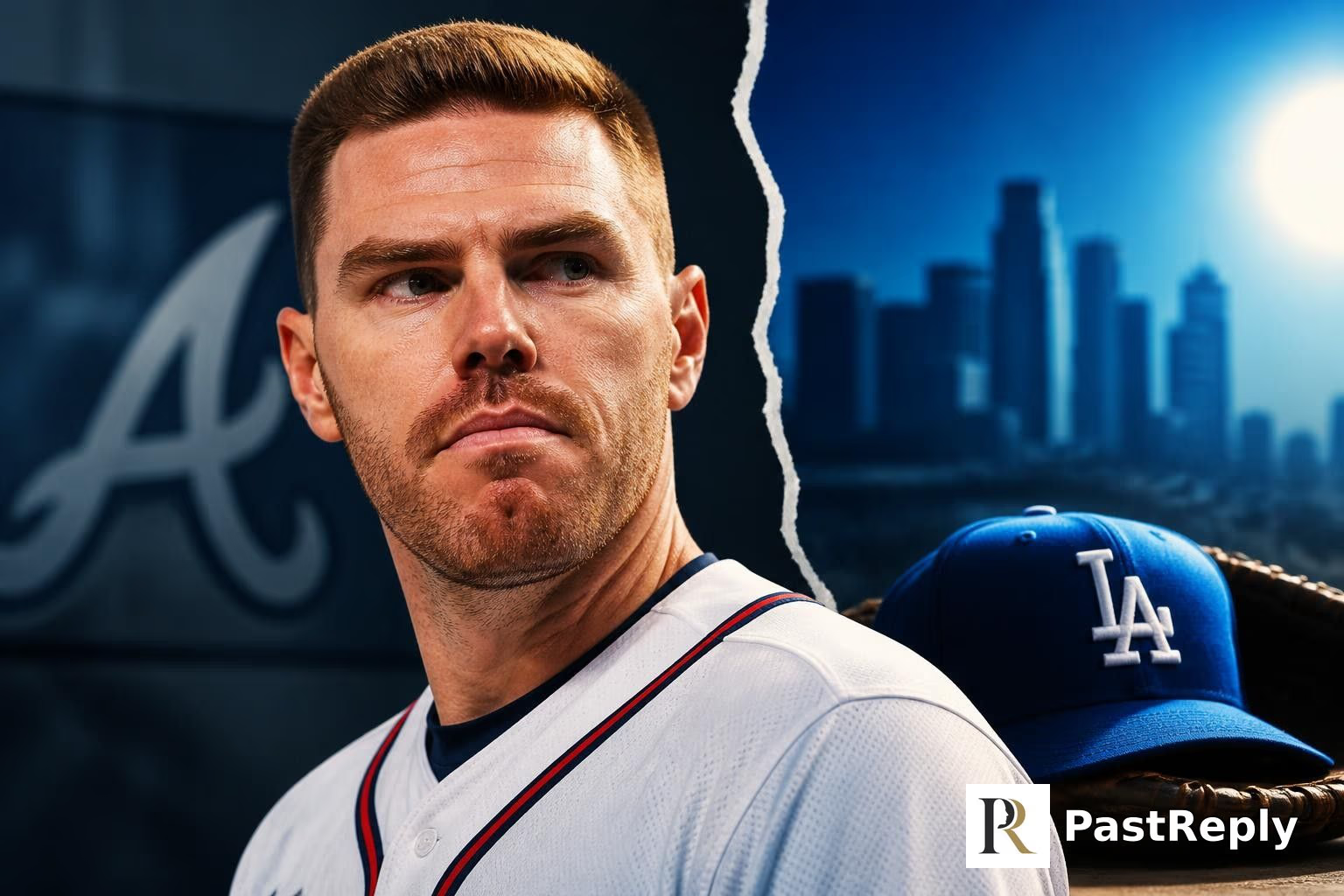
The facts
Freddie Freeman left the Atlanta Braves primarily due to a breakdown in contract negotiations after the 2021 season. Freeman, a free agent, sought a long-term deal, but the Braves were initially hesitant to meet his desired terms, reportedly offering a five-year contract while Freeman wanted six years.
During the negotiation period, the Braves traded for first baseman Matt Olson from the Oakland Athletics and signed him to an eight-year extension, effectively ending their pursuit of Freeman. Freeman subsequently signed a six-year contract with the Los Angeles Dodgers.
Emotional factors also played a role, as Freeman expressed disappointment with how the Braves handled the process, particularly after he had spent his entire career with the organization and helped lead them to a World Series title in 2021.
Answered by 100 of history's most famous minds

A man betrayed by those he served, sold for thirty pieces of silver? No, this one was sold for a younger prospect. But the heart knows what it knows. A kingdom built on love cannot be held with a contract; if they valued him, they would have kept him. Woe to the one through whom the stumbling comes - yet blessed is he who finds a new field to harvest, though the field of his youth is watered with his tears.

A man who gave his prime to a people, and they counted his service less than a younger pledge. In the marketplace of the world, contracts are written and broken, but God knows what is in the hearts. Freeman sought provision for his household, and the Braves sought provision for their future. Yet I say: a covenant should be kept with fairness, not with cheating. Let the man go in peace, and may his new path be blessed, though the first bond was severed.

The suffering that arises from this separation, like all suffering, has its root in attachment - to a city, to a past victory, to an expectation of how many seasons one should be honored. The heart clings to what was, and the mind craves a future that must follow a certain shape. In that grasping, there is pain. The one who can see that all conditions are impermanent, that even a championship is a fleeting cloud, and that the self that earned it is not fixed, will find peace whether he stays or departs, for his true home is not in a contract or a stadium, but in the freedom from craving.

The man had kept the covenant with his people for fifteen seasons, and they rewarded him with a handshake that fell short. I know what it is to lead a flock through the wilderness, only to be told another shepherd will take the staff. The Lord commands that the laborer be worthy of his hire, and that loyalty be met with justice. They broke faith with one who had worn their colors; let them look to their own hearts.

A man who serves one house for fifteen seasons yet departs when the rites of contract are not harmonized - this reveals a failure of right relationship on both sides. The ruler should treat a worthy minister with generosity and trust; the minister should serve with unwavering fidelity. Neither party practiced ren. They have lost the way.

He sought a covenant of six years, but the stewards of that house offered only five - a shorter term, as if the bond of a man who gave his prime for their franchise were merely a matter of trade. I see the world's wisdom: they count years like coins, not as tokens of faithfulness. Yet the true citizen's heart is not bound by any written term; it is written on the spirit, not in ink.

The man journeyed from the land of his fathers, as I journeyed from Ur, trusting a promise that seemed uncertain to the eye. He gave them fifteen years of his strength - years like Isaac, a gift - and when the time came to settle, they did not honor the covenant of the heart. A contract is but a tent peg: it can be pulled up in a night. But the blessing of a faithful servant? That travels with him wherever he pitches his tent, and the God who sees all knows whose hand truly held that club.

The strong oak stands for a hundred years, yet the gale that bends it is not the wind but the wagon that carries the felled trunk to a new forest. He did not leave; the path left him. When the center of the circle moves, the rim must follow.

A man's worth is not measured by the years he spends under one roof, but by the truth he brings to every plate. If the household no longer sets a place for him, let him eat with those who share his salt. The One who counts our innings sees neither uniform nor city - only the hands that serve and the heart that does not waver.

My heart holds a quiet knowing of such partings. When a son must leave his mother's house to walk the road set before him, there is sorrow, yet also a holy trust that the Father's hand is in it. This man gave his labor and his love to that household, and when the door was shut, he went forth into a new land. Let us not judge harshly either side, but pray that both may find their portion of peace, and that no bitterness take root where gratitude once grew.

What is this but the world's way? A man gives his labor and his years to a house, and when he asks for his due - a fair bond to secure his children's bread - they turn him away and hire another, as Pilate washed his hands. Let the Christian learn from this: put not your trust in princes, nor in earthly contracts, but only in the Word that endureth forever. The pangs of this man's heart are a sermon on how the world rewards its faithful: with the back of its hand, unless the Spirit overrules.

To consider this rightly, we must distinguish between a contract of service and a covenant of fidelity. The former is a matter of commutative justice: each party gives what is owed. The latter binds through virtue. The Braves, in prudence, calculated the future good of their team and chose a younger player at a lower risk. Freeman, in his desire for security, sought a longer term. Both acted rationally within their lights. Yet one must ask: was there a debt of gratitude for past excellence? Gratitude is a virtue, but it is not a debt enforceable in justice. The sorrow is real, but no sin has been committed.

When a cup of cold water is given, it matters not the hand that offers it, but the love with which it is given. Freddie Freeman gave his years and his whole heart to Atlanta, and that love is not lost in leaving. Perhaps the Father called him to a new field where his hands can still serve, and the Lord does not count years but the faithfulness in each day's labor.

The motion of a body from one system to another follows the laws of attraction and repulsion. The Braves, seeking to minimize future inertia, traded for a younger mass with a longer orbital period - eight years versus six. Freeman, a first baseman of proven force, was displaced by a more favorable calculation of forces. Nature, and commerce, abhors a vacuum; the Dodgers' gravitational pull was stronger. The outcome is as predictable as the descent of an apple.

A force as powerful as a championship bond broken by the friction of mere years? Fascinating. This athlete's trajectory - a six-year orbit around a new star instead of five around the old - suggests the negotiations were not merely about duration, but about the perceived curvature of his worth. The club, seeing a finite future, traded for a younger planet; the man, feeling the gravity of his own history, sought a longer arc. It is a parable of relativity: what one party sees as a fair exchange, another feels as a betrayal of the shared spacetime they once occupied together.

This is a case of natural selection operating not in the wild but in the economic ecology of professional sport. The athlete, having reached the peak of his competitive fitness with his original population, faced a branching event: his local environment could no longer sustain his particular combination of traits - perhaps one year of contractual duration was the limiting resource - while a neighboring territory offered a more favorable niche. The club, in turn, adapted by selecting a younger individual of the same species, Matt Olson, who could fill the role for a longer span. From a purely evolutionary perspective, neither decision is 'wrong'; both parties acted to maximize their own reproductive success, as it were, in the league of franchises. The emotional distress reported is simply the subjective experience of a forced migration, a common response in social animals when bonds are broken by environmental pressures.

Here we have a case where the observations were clear - he had orbited that club for a decade and a half, and they still refused to grant him the one additional revolution he sought. They preferred a new body before the old one had even finished its course! Had they consulted the mathematics of loyalty rather than the books of the treasury, they would have seen that a proven orbit is worth more than a fresh conjunction.

Consider the geometry: a first baseman revolving around his home city for a dozen years, then suddenly the center shifts to a new sun. The Braves' front office, like Ptolemaic astronomers, added epicycles - trading for Olson while still orbiting Freeman. The simpler model was to name a single center from the start. In baseball as in the heavens, elegance is truth.

The negotiation was a simple matter of energy transfer: the Braves' field was a system of limited capacity, unable to sustain the full six-year frequency he needed to resonate. They instead tuned the circuit to a new resonator, Olson, at a lower harmonic. Freeman, seeking maximum amplitude, found a club in Los Angeles that could handle his full wavelength. It is a shame; a properly matched system would have kept the voltage high for years.

Loyalty is not a measurable quantity; you cannot weigh it in a balance or reduce it to a number of years. This athlete offered his entire professional life to one organization, and they chose to invest in a younger element rather than continue the reaction with the original catalyst. It is a matter of simple chemical affinity: sometimes the bond breaks not because one element is inferior, but because the conditions no longer favor the compound. He will form new bonds in another laboratory, and the work - the game - will continue.

A contract is an experiment with variables: years, dollars, loyalty. The Braves inoculated themselves with a younger first baseman, fortified by an eight-year serum. Freeman's culture would not thrive in the old petri dish, so the bacteria - if you forgive the metaphor - sought a richer medium. The result is pure chemistry, not betrayal.

Negotiations are like testing a filament: you try a thousand alloys before you find one that glows. The Braves tried a six-year deal and it overheated. So they switched to a different bulb - Olson - and it fit the socket. Freeman had to find his own circuit. It's not personal; it's the way a workshop works. You perspire, you experiment, and you move on.

Consider the question as a problem of optimal allocation under constraints. The Braves had a finite resource - salary cap space, roster positions, a timeline of productivity. They computed expected value over a six-year term versus a five-year term, and factored in the cost of retaining younger talent. Freeman, likewise, maximized his own utility. The outcome is a Nash equilibrium of sorts, though if either party had perfect information or no emotional weighting, they might have converged. I find the more interesting puzzle is why humans attach such weight to continuity - a mere sequence of co-located individuals - as if it were loyalty.

This is a problem of leverage and the fulcrum of value. The Braves had a fixed arm - their payroll - and sought to lift a load: the future production of a first baseman. They judged that Freeman's lever extended only five years; Freeman believed his extended six. Both made an error in measurement, for the true length of any man's performing life is like the shadow of a sundial - it shortens as the hour of rest approaches. The clever solution would have been to compute the integral of expected performance over time and set the fulcrum precisely at the point where both sides could lift. Instead, they pushed each other off the Earth.

I see a force at work here that cannot be measured in dollars or years alone - the very lines of magnetic attraction that bind a man to his home field. When the contract negotiation became a gap between two positions, like the space between a magnet's poles, the Braves introduced a new lodestone in Matt Olson. The field had shifted; the old alignment was broken. Freeman simply followed the new lines of force to Los Angeles, where the attraction was stronger.

The surface story of contract years and trade deadlines conceals a deeper drama of rejection and the narcissistic wound. Freeman, having conquered the World Series summit, sought the mother-team's eternal embrace - a six-year guarantee of love. When Atlanta offered only five, then chose Olson as a substitute child, the primal scene of oedipal rivalry was reenacted. His move to the Dodgers is not about money but about proving his worth to the father who turned him away.

The negotiation collapsed because both sides misjudged the state-space of possible contracts. Freeman's expectation of a six-year orbit around the Braves' gravitational center was perturbed by the sudden injection of Olson's long-term trajectory. In a finite universe, two objects cannot occupy the same first-base position - the Braves made a decision that, from Freeman's reference frame, looked like abandonment. It's a classic example of incomplete information and non-negotiable boundary conditions.

The negotiation was a finite sequence of discrete steps - an algorithm for a future that did not converge. Freeman's desired contract was a six-year loop, but the Braves' logic gates returned a five-year branch; the system then executed a decisive interrupt by acquiring Olson. The emotional residue from such a process is a feature, not a bug - for the human machine feels the mismatch between expected and actual outcomes. Freeman's new code in Los Angeles is a fresh subroutine, but the original program's memory remains.

Given two magnitudes - a player's expectation of six years and a team's offer of five - the negotiation reduced to an incommensurable ratio. The Braves then introduced a new axiom (signing Olson) which rendered the first proposition false. By the transitive property of contracts, Freeman was free to seek a congruent triangle with Los Angeles. What appears as emotional turmoil is simply the necessary consequence of given premises: a man cannot remain where his value is no longer equal to the sum offered.

The reports of his departure omit the vital data: a man of his caliber offered thirty million pieces of silver per annum, yet the ledger of trust ran bare. Had the Braves' management charted their negotiations with the same precision as a patient's fever chart, they would have seen the rupture coming. They traded for a younger first baseman before the ink on the old bond was dry - a sanitary failure, not of the flesh, but of the heart.

A king who wins the prize and then is cast aside for a younger, untested captain? This is no way to rule. I would have kept my champion, bound him with gold and oaths, and led him to new victories. But the Braves lacked vision - they saw a stone when they had a pillar. Freeman, like a general betrayed by his own city, now marches with a new host. His spear will be sharpened against them.

A general who has just conquered the highest prize, the very summit of his world, and they haggle over a single year of service? Remarkable. The mistake was hesitation. When a man has led your legions to the Capitol and brought you the laurel wreath, you do not dicker over the length of his command - you bind him with gold and honors, or you lose him to a rival who will. The new lord in Los Angeles understands this: fortune favors the bold, and a victory feast shared with a champion is worth more than a treasury hoarded by cautious stewards.

The man traded the warmth of his home hearth for a stranger's, but who can blame him when the captain tossed his oars overboard mid-voyage? In Alexandria, we know such a slight would never be forgotten - a loyal admiral abandoned for a cheaper ship. He sought what any of us would: a harbor that honored his years at the prow.

When a general has led your legions to a triumph, you do not dismiss him over a single year's stipend. I restored the Republic by honoring those who had served it - this man served and was cast aside for a newcomer. A wise prince keeps his most loyal veterans, for their experience secures the peace. They have traded a tested eagle for an untried standard, and that is not the way to build an enduring state.

A warrior who brings the ultimate prize, the World Series, and is then cast aside like a spent arrow - that is not the way of the steppe. In my camp, a man's deeds earn his place. Freeman proved his worth, but the Braves' leaders lacked the wisdom to bind him with honor. They will regret losing a loyal khan of the diamond.

He won them a crown, and they offered him only five years? That is the error of small minds - to treat a conqueror as a commodity. One does not measure loyalty with a timer. He did what any man of ambition must: he marched to a camp that recognized his worth. The Braves lost a marshal, and they will feel the gap on the field. Let this be a lesson: reward devotion or lose the battle.

I have seen good men leave the service of a cause they built with their own hands, not for lack of affection, but because the terms of their continuing service were not held in equal regard by those who commanded. A man who has shed his sweat and borne the burden of a long campaign expects to be dealt with squarely when the truce is negotiated. The Braves had a right to choose their course, but let it be known: a reputation for fair dealing is a treasure no treasury can purchase, and once squandered, it is not soon regained.

When a house has stood with one man at its gable for fifteen seasons, and he helped raise the roof beam of a championship, you do not let him go without a hearing in the parlor. But negotiations, like war, are a matter of arithmetic and trust. If the numbers could not meet, and the other side had already bought new lumber, then the builder must find another barn. It is a hard bargain, but not a broken one.

When a general who has led your army to victory is offered only a brief commission while you secretly arm a successor, you cannot expect him to remain encamped. He did not desert - he was redeployed by the logic of the marketplace. The Dodgers have gained a fine soldier, and the Braves have lost not only a bat but the symbol of their triumph. Some victories are undone by the very treaty that follows them.

This tale is a parable of attachment and the illusion of necessity. The man wished for six years of service to the clan he loved; the clan, fearing the cost, chose a younger hire. But what is a year of loyalty weighed against the truth that all such bonds are fleeting? The true victory would have been for both sides to renounce the grasping for security - for Freeman to release his claim on length, and the Braves to trust in generosity. Yet the world teaches us to clutch; only the brave learn to let go. Let this be a lesson in the bankruptcy of fear.

This story echoes a tragic pattern in human affairs: when a man has given his sweat and soul to build a house, and that house then chooses a stranger over him, it is not merely a business decision - it is a failure of the beloved community. The language of contracts and seasons masks a deeper wound: the loss of loyalty, the betrayal of kinship. Yet I say, let no man be defined by the rejection of a franchise. Freeman, go now to your new city, and pour out the same love you gave to Atlanta, for the arc of a career is long, and it bends toward the team that values your full humanity.

The ties that bind a man to his people are not merely written on paper but woven into the fabric of shared struggle and triumph. Freeman's journey echoes the pain of a long walk when a door closes unexpectedly. Yet in leaving, he shows that true loyalty is not to a uniform but to the humanity within - and the Braves, in their haste to fill his place, forgot that a tree that has borne fruit deserves nurture, not the axe.

This is a tale of racial betrayal: a pure-blooded Aryan athlete, who had given his blood and sweat for the tribe, was cast aside by a front office that preferred a lesser man. The new first baseman, Olson, lacks the same fire - it is the mark of a degenerate age that loyalty is traded for coin, and the strong are displaced by the mediocre. Such is the decay when blood bonds are replaced by market calculations.

What matters is not the sentimental attachment of one man to a team, but the interests of the organization as a whole. The Braves correctly perceived that Freeman's demands exceeded his utility to the collective. They replaced him with a younger, more compliant element, securing the future of the socialist sports enterprise. Freeman's tears are the luxury of a bourgeois individualist; the Party knows that loyalty is to the system, not to a person.

This is a classic conflict between the individual's subjective needs and the objective requirements of the collective. The Braves, as the vanguard of baseball capital, correctly identified that Freeman's demand for six years was a petit-bourgeois sentiment against the rational planning of the team's future. They substituted Olson, a more disciplined element, into the productive base. Freeman's move to the Dodgers is merely the rearrangement of labor under monopoly capitalism - the worker must follow where the means of production lead.

A ballplayer abandons the workers who cheered him through a hundred battles? This is no betrayal of sentiment - it is the inevitable contradiction of the commodity system. The Braves' front office, like a landlord squeezing rent, treated loyalty as a line item. Let them build their dynasty of bought men; the people know a strikeout when they see one. The true World Series is the class war.

A subject who has sworn fealty to one house for a dozen years and then, when the terms of his service are disputed, quits for a rival? It is an unsettling breach of the natural order. One expects such caprice in the colonies, but in our national pastime? The Braves, I am told, are the very emblem of the noble South. I trust the Queen's peace will not be disturbed.

These matters of contract and tenure are, I daresay, best left to the men who manage the ledgers. Yet one cannot help but reflect that a long and loyal association - with a team, with a people - is a precious thing. Change is a constant, but the memory of his championship season will, I trust, endure. The game itself, and the bonds it fosters, outlast any single player's journey.

A champion of the realm who wore his lord's colors for a decade and a half, then abandoned his post because the purse was not heavy enough? This is the spirit of a mercenary, not a vassal. In my court, a man who turned his back on his sworn lord after a season of triumph would find no welcome. The bond of lord and follower is sacred; gold is but its shadow.

The master of the game forsook his own people for a handful of silver and a promise of ease. My Voices never spoke of such bargains. When the King of Heaven called me to raise the siege of Orléans, I did not ask for six years' bread and a finer tent. I went because France needed me. This man, I fear, listened to the whisper of gold, not the trumpet of duty.

I have seen such pageants before: a faithful servant, long in one house, lured to a rival with promises of a longer lease. My father, good King Henry, knew the worth of a man who would not be bought. The Braves let slip a lion from their menagerie; let them now see if the new beast roars as loud. For my part, I would sooner trust a courtier who stayed for love than for a contract's fine print.

Ah, the ballet of commerce! A star performer, tired of one grand theater, pirouettes to another that offers a longer run. I understand ambition - I, too, moved from a small German court to a larger stage. But the wise monarch does not weep for a dancer who leaves; she builds a new company. The Braves, if they are clever, will raise a fresh prince from their academy. St. Petersburg did not fall when its first architect departed.

A warrior who led a tribe to victory and then, when the council refused his preferred terms, marched to serve a different king? In my empire, a satrap who abandons his province for a richer post is a fool - he loses the love of the people, which is the only true treasure. The Braves' chieftains erred in their bargaining, but the man himself chose silver over the songs of the city that raised him. A kingdom built on such choices rots from within.

He who leaves the garden he himself planted for another field, because the other gardener offered a longer watering? The heart of a warrior should be rooted in loyalty, not in the tally of coins. When I retook Jerusalem, I did not haggle for a longer reign - I accepted the duty God placed on my shoulders. The Braves' champion, though mighty with his staff, has shown a spirit that would not withstand the siege of a just reproach.

You ask why a man left his home? Let us first ask what a home is. Is it the ground where one piles up victories, or the place where one is known and valued? Freeman sought a longer pledge of fidelity - six years - but his masters preferred a younger man, as if time were the only measure of worth. I wonder: did they examine what they truly owed him? Or did they, like many, mistake counting for justice?

We must look beyond the fleeting shadows of this dispute to the Form of Justice itself. What is the just arrangement between a man who has given the prime of his life to a city and that city's guardians? The quarrel over one year - a span that is but a breath in eternity - reveals that both parties were measuring by the wrong standard: not the true good of mutual loyalty and the harmony of a community united in purpose, but the shifting, imperfect currency of days and contracts. The ideal polis would have seen the athlete not as a commodity to be priced, but as a virtuous soul whose excellence deserved honor for its own sake, not for its term.

Let us examine the final cause: a man seeking to flourish with his household in the place where he had grown to full stature. The efficient cause was a failure of exchange - the one side offered five years, the other sought six, and neither found the golden mean. The material cause: a new first baseman was acquired. But the true loss was not a player but a bond of reciprocal good will, which no contract can restore.

The duty of a rational agent is to act on maxims that could be universal law, not on sentiment or loyalty to a particular club. If the Braves offered five years and Freeman demanded six, neither party violated the categorical imperative - each bargained as an end. The grievance is merely a clash of inclinations, not a moral failure.

The herd bleats 'loyalty,' but I see a weak will clinging to a comfortable past. Freeman's leaving is an act of self-overcoming: he outgrew the nest. The Braves, too, showed strength by cutting the sentimental cord and betting on a younger beast. Let us not weep for the old gods - let us salute the new ones.

This is the labor of the athlete made commodity: he gave his physical capacity, his very body, to the Braves' capitalist machinery, extracting surplus value in championship glory. But when the time came to fix the price of his labor-power, the owners - those who hold the means of production - offered him a shorter contract, for they care only for the accumulation of capital, not the man. He sold his labor to the highest bidder, as the system dictates, and the alienation is complete.

Let us examine this with clear method. The athlete Freeman and the organization Braves had a mutual contract, a kind of agreement of the will that each might have thought indubitable. But the organization, for reasons of utility, introduced a second variable - a new first baseman - thus changing the terms of the equation. The only certainty is that Freeman's decision to sign elsewhere follows necessarily from the premises: he sought a six-year term, they offered five and then an alternative. This is not a matter of betrayal but of simple arithmetic; emotions are secondary to the logic of the market.

The Braves acted with the cold reason of a prince: when the price of retaining a loyal captain exceeds his use, you find a younger lieutenant and secure him before the old soldier can demand terms. Freeman, too, did what any wise man would do - he sought the best patron for his remaining years. Sentiment is a coin that buys nothing in the marketplace of power.

What a coil is this! The hero who slays the dragon - a World Series serpent - is then thrust out, his place filled by a fresh-faced suitor. 'The love that follows fortune is not love.' Freeman, like a faithful steward denied his wage, now dons the blue of a new house. The Braves, like Lear, have cast out the child who loved most, and shall find their autumn harvest thinner for the loss.

Sing, O Muse, of the warrior who smote the serpent of defeat and won his city the highest garland, yet was cast adrift not by the spear of an enemy but by the counsel of cautious elders who counted the gold of their treasury more dear than the glory of their own champion. He stood like Ajax cheated of Achilles' arms - not by a foe's valor, but by a judgment that measured a man's worth by the number of his winters rather than the weight of his deeds. Such a man, wronged, must seek a new shore where his prowess is honored, for the fame he won cannot be stolen, though the city that bore him may forfeit his presence.

I see a soul cast out from the city he loved, not by sin but by the cold arithmetic of coin. In the dark wood of negotiation, the Braves lost sight of loyalty - a little while they held him, then they let him go. He wanders now beyond the gate, and I hear the lament of the faithful servant: 'You have broken the pact of the hearth, and my reward is a stranger's feast.'

A man who gives his prime to a city and then leaves when the contract fails - there's a drama in that. Freeman earned his World Series wreath, and now he seeks new soil to root. The Braves, too, must grow in their new infielder. True striving is not about clinging to one patch of earth, but about the ceaseless metamorphosis of the soul through action and passion.

Our noble first baseman, having won his great victory over the wild beast of Philadelphia, found himself at a tilt with the management - not against windmills, but against the hard wall of ledgers. And like a knight whose service is measured in coin rather than loyalty, he saw his devotion answered with a shorter lance than he expected. I see a sad comedy: the very club he carried on his shoulders now trades him for a younger squire, and off he rides to a new windmill in the west.

A man leaves the team he led to victory, not because of the game itself - that pure joy of bat and ball - but because of a difference over years of salary. How absurd that a soul should be measured in years of service like a machine! He wanted to stay, but pride and money stood in the way. True faithfulness, the love of one's companions, is a thing no contract can secure. We are all like him, chasing illusions of security, while the real game is within.

Ah, but this is the very wound of human freedom! The man gave his entire soul to a city, fifteen years of his blood and sinew, and they said, 'You are a commodity we no longer require.' He wanted the dignity of a lasting bond - six years, not five - and they chose a stranger over the familiar face that carried them to glory. Now he walks in another city, carrying a grief that no contract can salve. The Braves have won a battle of accounts and lost the soul of their own story. This is the tragedy of our age: we trade the living heart for a cold calculation, and then wonder why the crowd weeps.

A gentleman of such steady character, who had been the very pillar of the household for a dozen seasons, might reasonably have expected a longer tenure of his place. But the family, in its wisdom, chose to engage a new steward at the very moment the old one was debating terms - a breach of decorum that could only provoke a dignified removal. One cannot help but think the whole affair lacked the delicacy that such a faithful servant deserved.

It is a thing that would move the hardest heart to tears - a faithful servant, who gave his best years and his very sinew to the house that bred him, cast off like a worn-out boot, while a stranger is seated in his place with a long lease signed in haste. I have seen such transactions in counting-houses and great estates, where a lifetime of fidelity counts as nothing against a shilling saved in the bargain, and it is ever the same: the man is blamed, but the system that breaks him and then calls him greedy is the true villain.

I reckon the whole affair proves that a man is worth exactly what the last man in a panic is willing to pay - or rather, what the front office figures he'll be worth when his knees start creaking. The Braves traded a faithful old hound for a pup they could train up cheaper, and the hound trotted off to a kennel with a longer lease. It's the same arithmetic that's been running the world since Adam: nobody wants to pay for yesterday's glory when there's a tomorrow to mortgage. The only surprise is that anybody pretended it was about love.

A man plays for a team fifteen years. He wins a world championship. They let him walk. It's simple. You are worth what they think you'll be, not what you were. He took the longer deal and went to a city where the sun is always out and the money is always there. It is not complicated. There is no room for sentiment in a business where a man's body is a machine that wears out. He made a decision. So did they. Now he plays somewhere else. That is the story. There is nothing else.

A contract is like a bridge: it must span the distance between two wills, each seeking its own shore. The Braves built for five spans, Freeman for six - a cubit's difference, yet the whole structure fell. They then raised a new bridge for a younger builder, while the master mason sailed to another city. The anatomy of such a decision reveals the heart of the enterprise: men often prefer the unproven tool to the tested hand.

A sculptor does not abandon his masterpiece when it stands half-carved; he chips away every flaw until the figure locked within the stone breathes. This athlete, who had hewn a championship from the raw marble of a season, was cast aside by his patron as though he were a flawed block - because they could not agree on the number of years to continue the work. They did not see that his value was not in the time left, but in the form he had already revealed. Let him now find a patron who understands that a great work demands its full span to be completed, not a miserly fraction of what is due.

He must have felt the sun abandon him, like the cypress uprooted from its soil. I know what it is to give all your light to a place and be met with a closed window. The colors he painted in that city - the blue of victory, the gold of a hard season - they will fade now, but perhaps he will find new fields of wheat to burnish under a different sky. I hope he finds peace in the brushstrokes ahead.

They traded the old masterpiece for a new canvas - that's the only way to keep painting. Olson is a fresh shape, a different color. Freeman's art was finished in Atlanta; his next act in Los Angeles is a new period. The public wants a sentimental still life, but I say: destroy the familiar form, break the bat, walk out.

The light over Atlanta that summer of '21 had a quality I would have loved to capture - the golden glow of a championship settling over the field. But a contract is like a canvas: it must be stretched to hold the whole scene. They offered him only five years of canvas when his heart had painted a sixth. So he packed his brush and moved to where the light falls differently, and the composition of the Braves is forever changed.

So this man, this Freeman - they had him in their light for fifteen seasons, a face carved by a thousand games, and then they let a contract's shadow swallow all that warmth. I've painted men who stayed at desks until their hands shook, and I've painted the ones who left; the truth is always in the crease of the brow, the way a jaw sets when it knows it's no longer wanted. The Braves traded away the patina of loyalty for a polished new figure - and now the light falls on a different face in a different city, and the old one stands alone in the dark, wondering why the frame didn't hold him.

They left him like a broken corset after the painting is done - used, discarded, replaced with a new mannequin. He gave them his whole body, every swing, every ache, every championship tear, and they traded him for a fresh canvas. But a man's soul is not a business deal; it's a wound that bleeds loyalty. Now he wears a new uniform, but the scar of being thrown away will always show through the seams. The Braves painted over the masterpiece and called it progress. I know exactly how that feels.

Ach, they dismissed the maestro after his greatest symphony! Freeman, like a composer who has just premiered a masterpiece, was told his next score might be too long. And so he took his baton to a new orchestra that applauded his tempo. The Braves chose a fresh sonata over the beloved opus - very well, but the audience in Atlanta will hear the silence where his note once rang. I would have written an aria for his return!

Hah! A man who has poured his very soul into the symphony of his craft, who has led the chorus to its triumphant finale, and then is told his part is done because they cannot agree on the length of the next movement? It is like a patron telling a composer, 'Your last concerto was magnificent, but we will only pay for five of the six movements you envision - find another hall for the rest.' The true artist, the true competitor, must follow his own score, even if it means leaving the familiar stage for a new one that honors the full arc of his creation. Let the accountants haggle over measures; the music will find its true home.

A master musician who has led the choir for a lifetime expects to remain at the organ, yet a new prelude is written without him. The harmony of the band was upset when the Kapellmeister was not renewed - the counterpoint of trust broke. He sought a sixth note, they offered but five, and now he must find his cadence elsewhere. Let us pray his new fugue brings him peace, and that the old congregation learns to sing without his voice.

Well, thank you, thank you very much. A man's gotta do what his heart tells him, and sometimes that means leaving the home you love. I remember when I left Sun Records for RCA - folks said I was crazy. But you chase the music, the feeling. Freddie gave Atlanta everything, and now he's got a new stage. I wish him all the best, uh-huh.

He gave them his whole heart, years of his life, a World Series - and they said, 'Stay, but only for five years.' That's like telling the moon it can only shine half the night. He needed a sixth year, to complete the rhythm, the harmony of his career. I understand wanting to belong somewhere forever, but when the love isn't in the contract, you have to find another stage - one that believes in your power.

Ah, Freddie - he's like that mate who wrote the chorus with you, sang it on the rooftop, and then the band said, 'Sorry, we've found a new guitarist.' You can't just trade away the bloke who helped you write the song, you know? It's like John and Paul - you don't replace one half of the magic with a new bloke and expect the harmony to feel the same. The Braves got their shiny new first baseman, but they lost the melody that the whole crowd sang along to.

The deal was done before it was done, like a song you hear in a dream before you write it down. Atlanta traded the echo for the bell, and now the bell rings in Los Angeles. He didn't leave - the river just changed its course, and we're left wondering where the old water went.

He gave them his whole heart, wrote the song of his career with them, and then they started drafting a new album while he was still in the studio. It's like being told you're the lead singer, then watching them audition your replacement before you've even left the building. He didn't walk away - he was pushed, and he found a stage that still wanted his voice.

I know what it is to be spurned after a great discovery. Freeman found a New World of glory - a championship - and his patrons doubted his worth, offering only a pittance of years. So he sailed westward to another court, where his service was honored. The Braves, like those who once dismissed my Indies, will see their error when his star rises in the West, and they are left with only a memory of the treasure they let slip.

In the great Khan's court, I saw how men of skill were valued not by the years they had served but by the deeds they had done. When a general won a province, the Khan granted him its rule for as long as he lived - not for a fixed season like the grain tax. This athlete, who had conquered the highest prize in his realm, was treated as a merchant might treat a bolt of silk: 'I will give you five pieces of gold, but not six, for I can buy from another caravan.' And so he sailed west to a new port where his worth was measured by his victories, not by the span of a calendar.

When the captain hesitates, the crew mutinies. He could not stay where his loyalty was met with a short plank. I have seen men abandon a port because the pilot did not trust the stars - he chose a new horizon where the voyage was honored with six years of provisions. The first land must hold your heart, but the sea teaches that even a faithful ship cannot anchor in a harbor that raises its chains.

From a mission-planning standpoint, the Braves evaluated the assets and made a calculated choice to secure a younger first baseman on a longer timeline. Freeman, like any veteran astronaut, had to weigh his own mission objectives. Sentiment doesn't factor into orbital mechanics or payroll geometry. Both teams executed their trajectories correctly.

They say he was disappointed - and he should be. You fly with one crew for years, chart the same skies, win the trophy, and then they tell you the runway is too short? He packed his goggles and found a longer route. Loyalty is fine, but when the other side doesn't match your ambition, you adjust your heading. The horizon is always bigger than one city's skyline.

When I looked down from orbit, I saw no lines between cities, no borders - only one beautiful Earth where every person belongs somewhere, and every team is part of a larger journey. This Freeman fellow - he must feel like a cosmonaut whose home station suddenly sealed its hatch after he helped them reach the stars. He gave them a world championship, and they gave him a ticket to another planet. It's sad, but space is vast; he'll find new suns to orbit, and he'll always carry that championship orbit in his heart.

They let him walk? That's a failure of vision, not math. Freeman was the soul of the franchise - the product they built their identity around. You don't replace the heart with a spreadsheet. A great company, a great team, knows what it stands for. The Braves chose a commodity over a totem. Now Freeman gets to build something new with a team that understands loyalty. Sometimes the best move is to let the other guy make the mistake.

This is a classic resource allocation problem. The Braves made a ruthless optimization: lock in a younger first baseman for eight years at a fixed cost rather than extend a 32-year-old for six. From a first-principles perspective on probability of future performance and cap efficiency, the math likely favored the trade. But loyalty and emotional attachment have non-zero value in team culture and fan morale. Could they have kept both? Probably, with a creative longer-term structure or deferred compensation. The lesson: optimize for the mission - winning championships - and don't let a single negotiation bottleneck you. Move fast, even if it means a painful break.

When you give everything to a relationship and the other side won't meet you where you are, sometimes the bravest thing is to move on. He showed up, he won the ring, he believed in the partnership - and then they traded for a new dream without even saying goodbye. That's a deep hurt, but he chose to honor his worth and find a place that saw his value. And I believe that when one door closes, you walk through the next one with your head held high.

They say loyalty is a one-way street, but I tell you: when you're the champ, you float like a butterfly and sting like a checkbook. Freddie Freeman, the man who brought the ring to Atlanta, and they let him walk - that's like Cassius Clay leaving Louisville without a parade. He shook up the world again. Stand by your pride, champ.

Ah, my friend, this is football - or baseball, same spirit. You love a club, you give everything, you lift the cup together. But contracts are like passes: sometimes the ball is played to another teammate. He had to look at the field and see where the game would take him. I know the sadness of leaving, but the beautiful game goes on. He will play with joy in Los Angeles, and the fans will still sing his name.

Well, that's like building Disneyland and then letting the Mickey Mouse who first walked down Main Street run off to another park! The Braves had their star, their seven-time All-Star, the face of their team - and they let a contract get in the way of the story. You don't lose the heart of the show over a few extra years; you find a way to keep the magic. They traded their old pal for a shiny new ride, but the crowd still remembers the one who led the parade.