
Why did country music start?
Country music emerged from a mix of British folk ballads, African American blues, and Appalachian traditions in the rural American South.
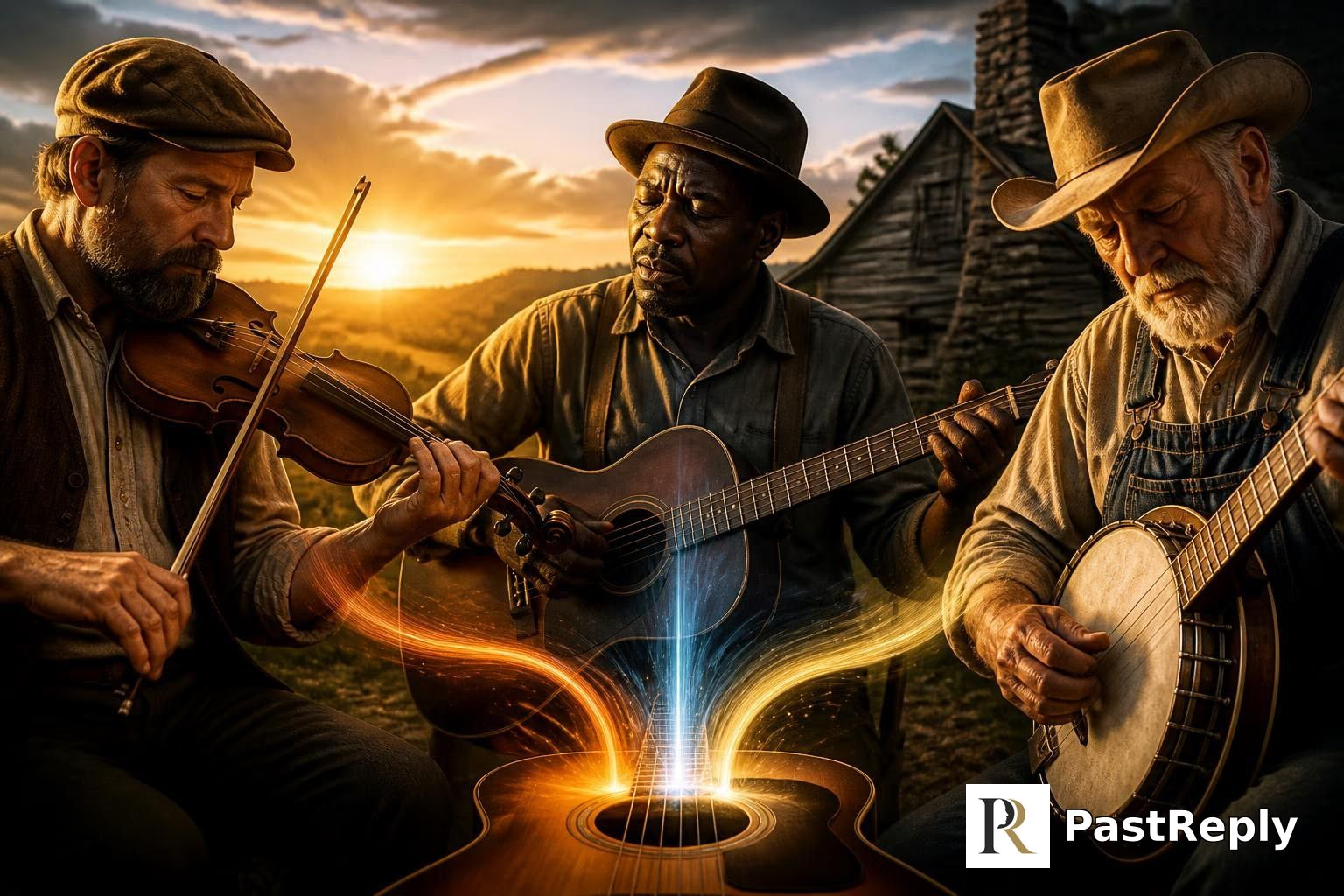
The facts
Country music started as a blend of folk traditions brought to the rural Southern and Southwestern United States by English, Scots, and Irish settlers, combined with influences from African American blues, gospel, and work songs, as well as Appalachian folk music. These musical styles mixed in the early 20th century, particularly in isolated rural communities, and were later shaped by commercialization and recording technology in the 1920s and 1930s. The genre was originally called "hillbilly music" before the term "country music" became popular in the 1940s.
Answered by 100 of history's most famous minds

A field hand's plaint and a rich man's jest, sung from the same clay porch - do you not hear the ache for a home beyond this valley of tears? When the night is long and the fiddle weeps, it is but the sound of a soul crying out for its true country, the kingdom where the last shall be first and every tear is wiped away. You ask why the song began; I tell you, it began because men knew they were strangers here, and they sang to remember the way home.

All melody is a remembrance of the first call to prayer, the voice of the muezzin that stirs the soul from its slumber. These hillside songs, though they speak not of God's oneness, arise from the same well - the human heart, which knows it is a wanderer in a strange land and seeks comfort in the sound of its own kind. Country music began when men and women, far from the old cities and the old faiths, found that the hymn and the work song and the lament were all one: a confession that we are but travelers, yearning for a home that is not of this earth.

Why does a reed sway by the water? It sways because it is conditioned. So too do these songs arise from the conditioning of the land, the loss, and the toil - craving for home, craving for a lost lover, craving for a drink. They are skandhas made audible, a lament that mistakes the fleeting for the eternal. If they bring the listener to notice the impermanence of all things, they are a skillful means; if they bind one to the pain, they are a chain. The music is not the problem; the clinging is.

When my people journeyed through the wilderness, they sang of the Lord's deliverance and the longing for a land of their own; so these settlers, enslaved and free, lifted their voices in exile, remembering the hills of their fathers and crying out for a promised home. This music rose from the dust of wanderers who knew the yoke and the hope of freedom - a testament that even in a strange land, a people's song carries the covenant of their heart.

Music arises from the heart's sincerity, mirroring the harmony of right relationships. Country melodies echo the joys and sorrows of common folk, binding them through shared ritual and remembrance. When such songs encourage virtue and filial love, they serve the greater order; when they merely stir idle passions, they are but noise.

To what end do you ask why a new song rises from the hills, when the heart of every people already knows the one true song? These tunes of barn dances and lonesome graves are as the psalmist's harp - a cry of the soul that knows it thirsts, even when it names not the Living Water. Let them sing of their broken loves and weary fields; it is but the conscience of the Law, written in a minor key, which only the gospel's gladness can liven. I do not ask whence the twang, but whether it has heard of the resurrection - for every earthly dirge is a seed awaiting that trumpet.

When a man leaves his father's house with only a promise, he sings to remember the voice that called him. These wanderers crossed water and wilderness, and in the hush of the new land they lifted up their songs like a sacrifice - a thread of praise and lament binding them to what they'd left and to what was to come. The music is the covenant between a people and their memory.

When the valley is empty, water flows in and finds its own path. Those songs are like that - they came not from striving but from letting the grief and joy of the land seep up, unforced, into the ears of the weary. To ask why is to miss the point; it simply arose, as mist from a quiet pond.

The One who is everywhere spoke through the fields and the factories, through the banjo and the fiddle, in a tongue the plain people knew. These songs began when honest hearts lifted up their joys and woes to the Creator without a priest or a temple between them. That is true worship - not in the marketplace of spectacle, but in the raw cry of the soul.

When the mighty are cast down and the lowly lifted up, what songs rise from the valley? It is the song of the shepherd keeping watch, of the woman at the well, of those who have seen God's mercy in the quiet hours. The heart that has known want and waiting, that has held a child through the night, knows a melody no palace can teach. Such music is not born of fashion; it is the very breath of the humble, and in it the Lord hears the cry of His people.

The devil has corrupted even the sweetest gifts, yet this music springs not from Rome's grand cathedrals but from the common pew, from the ploughman who knows the Scripture in his own tongue. It began when plain folk, denied the Word by priestly pride, lifted their voices in praise and lament, finding solace not in indulgences but in the psalms of David. Luther would have them sing in the marketplace, not mumble in Latin; such honest country strains are a rebellion against those who would silence the flock's own song.

To ask why country music began is to ask why the human heart, made for communion, must express its joys and sorrows. The settlers carried melodies from their homelands, a natural inclination to praise and lament, and these were joined to the rhythms of those brought in bondage, another people's cry of exile. Such music, unpolished and earthy, serves the common good by binding a community in shared feeling; it is a natural art, ordered to the soul's need for consolation, and so it rightly endures.

The poor sing because their hearts are full, even when their stomachs are empty. I have heard such songs in the streets of Calcutta, where a woman with nothing would hum a tune to her dying child - not to forget her pain, but to share it, to make it bearable. This music began when someone, lonely and forgotten, lifted their voice to the One who never forgets, and found that another voice answered from the next valley. That is all - one need, one cry, one answer.

Consider that any music, like any motion, obeys laws discoverable by patient inquiry. These rustic airs, carried across the sea by settlers and mingled with the plaints of the African, form a system - a harmony resolved from diverse parts, each note governed by rule and proportion. Why did it begin? Because human ears, attuned to the mathematics of consonance, will inevitably seek order from the chaos of experience. The true cause is not mere sentiment but the universal geometry of sound and the soul that perceives it.

The question of origins is always a question of deepest law. Before the pickers and the twangs, there was the raw human need to sing the ache of the land and the memory of the sea crossing - a vibration of longing and labor. And when you hear that rhythm, you're hearing the mathematics of grief and joy, the same harmonies that bind the stars. They didn't invent it; they merely found an instrument for a cosmic pulse.

These melodies are the songs of a people isolated in the Appalachians, interbreeding as do the finches on the Galápagos, and thus their musical form diverged from the old-world originals. The sorrow in the minor key may trace to the Scottish highlands, passed down through generations, and the blues added from contact with enslaved Africans - a hybrid vigor. In isolation and blending, nature selects for what resonates in the human breast; thus, I hear an audible proof of descent with modification.

You might say the music came from a mingling of bloodlines and climates, a natural phenomenon waiting to be observed. But I say it began like any true discovery - when someone in those hills picked up a fiddle and listened, really listened to the rhythm of their own breath and the drone of the wind, then experimented until they found a harmony that pleased the ear. That is the same spirit that moves me to turn my telescope to the sky: not to accept what is told, but to seek the truth in the sounding air itself.

Country music began as the celestial harmony of human experience, grounded in the simple truth of the earth and its seasons. Just as I moved the Sun to the center to find beauty in simplicity, these songs find their center in the daily round of life, revealing the elegant order beneath rustic melodies.

The rural voice, amplified at last by the phonograph, discovered that a simple melody could carry a charge of human emotion as powerfully as my alternating current carries a city's light. Why did it start? Because the human soul, like a coil, resonates at a certain frequency - the frequency of a plaintive narrative set to a good beat - and once the technology of broadcasting appeared, that vibration spread through every valley. These people tuned their instruments to the oscillation of memory and longing; now all that remains is to add the wireless innovation, and their laments could circle the globe in a single evening, powering hearts with no need for wires.

One must examine the sediment: the ballads of the British Isles, carried like seeds in a migrant's sack, and the field hollers and blues of the enslaved, who turned sorrow into rhythm. When these streams met in the Appalachian hollows, they precipitated a new compound - simple, honest, and true to its elements. The genre is a natural reaction, not an invention.

Trace the lineage of that twang and you'll find not one germ but many - Scots reels, African rhythms, and the laments of lonely hills - all mixed in the petri dish of the rural South. The recording horn just provided the culture medium. Without that, the strains would have stayed invisible, unobserved, uncultivated.

Someone had to put a needle to the wax and hear what was already in the air. Those mountain folks were singing the same ballads their granddaddies brought over, but it took a cylinder and a horn to make it an industry. Nineteen twenty-something, the market was ripe - folks wanted to buy memories, and we found a way to press them.

One might frame the question as a problem in information theory: given a listener and a set of acoustic signals, how does the pattern of pitch and rhythm come to encode meaning? The Scots-Irish brought a sequence, the African field holler added a syncopation, and the commercial gramophone served as a universal machine that could store and replay these states. Whether the resulting configuration is a 'country song' or merely a hillbilly tune is a matter of labeling - the underlying computation is a mixing of discrete traditions, each a tape fed into the same player.

Consider the problem: a sound produced by a vibrating string, but not at random - it follows a geometric proportion, a ratio of tones that the ear perceives as pleasing. The early settlers brought their lyres and their voices, and the slave brought a different scale; the blending was no accident but a demonstration of harmony's mathematical law. Give me a fixed point of melody, and I shall move the whole world of listeners; such music is the lever that lifts the heart from labor.

Ye ask why a music should spring from the hills and hollows? Consider the plucked string of a fiddle - it trembles not from one force alone but from the bow's draw, the wood's grain, the air's very density. So too this music: I hear in it the convergence of many invisible currents - the ballad of the exile, the field-hymn of the slave, the lament of the mountain - all mingling like lines of force in a single field. One must not seek a solitary cause, but trace the intertwined agencies that, by their mutual induction, gave rise to a new vibration.

Observe the symptoms closely: a genre that mourns lost love, longs for home, and personifies trains and bourbon as if they were living betrayers. Beneath this thin veil of rustic sentiment lies a profound displacement - a folk uprooted from ancestral lands, yearning for a pre-Oedipal wholeness they call 'home,' and projecting their aggression onto the very instruments of their dislocation. The twang of the steel guitar is not mere decoration; it is the sound of a collective neurosis, a repression of the industrial age's rupture made audible.

The short answer: gravity. A bunch of people got dumped on a vast, isolated continent, and any species - or culture - cut off from the rest will evolve its own peculiar features. The longer answer is that this music is a fossil record of a particular time and place, a gravitational collapse of European folk and African rhythms into a dense, twanging neutron star. And like any good astrophysicist, you can date its formation by listening to the redshift - the older the complaint about a cheating spouse, the farther away it is.

Do not ask only how it began, but what it was that could begin at all. It began when an imagination, bound by the melancholy of a strange land, found a pattern in the recurring lament - a sequence of notes that could be varied, repeated, and combined with another's rhythm. Just as the analytical engine could weave numbers into an unimagined fabric, so these displaced peoples wove their grief and memory into a new, ordered expression. The origin is not a note, but a combinatorial spark - the moment one voice learned to answer another.

Let us define our terms. 'Country music' denotes a certain ordering of sounds. 'Begin' implies a first cause. I observe that this ordering exhibits a principle of shared tonal materials and a plaintive affective mode. From the agreed premise that humans, when separated from familiar society, seek to recreate known patterns of expression, it follows that a communal harmony would emerge from the collision of distinct inherited melodic forms. Given the proximity of Anglian and African traditions, a synthesis is demonstrated to be necessary. Q.E.D.

Those mountain ballads and field hollers are the raw data of a people's health - their joys, their griefs, their daily toil set to rhythm. Neglect the sanitation of their lives and you get typhus in the tenement; neglect the soul's need for song and you get a different fever. The gramophone merely let the physician hear the patient's true condition at last.

Why do men march? Because the heart thirsts for glory, and the voice yearns to be heard beyond the next ridge! These wanderers carried their lyres and their longings into the wilderness, and when they sang, they conquered - not with spear but with story, binding kin to kin against the enemy of silence. Country music began as a campaign of the spirit, an empire of shared lament and defiance, and I salute it. Every chorus is a standard raised; every verse, a victory over the empty plain.

These rustic songs were forged in the camps of my legions - not by my orders, but by the common soldier's need to mark his toil and his hope of return. When the Gaul whines at night by his fire, he sings of his sheep and his woman; when my men march, they chant of Rome and victory. The music was born of camps and farms, and it will die only when men stop tilling and fighting. I would have rallied them with it before a charge.

In my court, musicians pluck the lyre to celebrate the Nile's bounty and the gods' favor; in your vast western lands, those who toil in the fields and hew the mountains likewise sing of their own earth and toil. This 'country' sound is the song of a people's roots, a loyal chorus that binds them to their land - a wise ruler would listen, for it whispers the true temper of her folk.

When I sought to bind the Roman world, I restored old rites and honored the farmer's gods, for a people's songs are the sinews of their loyalty. This music grew from the plough and the hearth, from the Scots' lament and the African's field holler, all blended under a wide sky - a sound that gives a scattered folk a common memory. A wise governor listens to such songs, for they tell him what bonds may hold his provinces together in peace.

It began because warriors needed to calm their hearts before battle and after, songs of the steppe that carried the memories of home. We sang to the horses, to the sky, and to the women we left behind, binding our clans in rhythm as strong as any oath. Such music unites the tribe, and what unites, I command.

Because a scattered people, without discipline or empire, found in song a way to forge a common cause - a marshal of notes marshaling the lonely hearts of every farmstead into one column. When I needed to move my army quickly, I built roads; when these rural folk needed to move their own spirits against the wilderness and the market that ignored them, they built a road of fiddle and steel guitar. And you see, it worked - they laid claim to a nation's ears, a conquest not of territory but of feeling, conducted by the clever and the ambitious who saw in their plaint a battalion to lead.

When a man clears his own land, builds his own cabin, and watches his children grow under a wide sky, he begins to sing of that liberty - not as an abstraction, but as the creak of his own boots on his own porch. These songs are the voice of plain folk who owe no lord their labor, and they carry the same spirited independence that forged a nation. Let the fiddles play; they tune the heart to freedom.

When I was a boy on the Sangamon, the fiddle could make a hard winter's night feel like a hearth fire. That music grew out of the plain folk's need to share their burdens and their blessings - no different from the way a letter from home warms a soldier's heart. It's the voice of the common man, sung back to himself.

When the empire of the airwaves needed a voice from the soil, the old songs of the Scots and the Irish - hardy as their descendants - answered the call. It was not a surrender to the sentimental, but a rally of the common heart against the machines that would silence it. And so the twang became a banner, worn with pride.

Music is the soul of the people, and when the people are stripped of all else, their song becomes their strength. The poor farmer and the toiling laborer, burdened by unjust masters, found in their laments a shared truth and a quiet defiance that needed no sword. It was not the rich who created this music, but the simple and the suffering, who poured their pain into melody as a form of nonviolent resistance against despair. And so country music began as the cry of the oppressed for dignity - a cry that still speaks to the heart of India's villages.

This music was born from the depths of our nation's soul, where the sorrow songs of enslaved Africans met the ballads of Appalachian whites - both cries for a freedom not yet realized. It is the sound of a people who, though separated by race, shared the same dirt and the same longing for dignity; out of that brokenness, a melody arose that told the truth. And as we march toward the beloved community, let us remember that country music, at its best, is the voice of the dispossessed calling for justice.

A people dispossessed of their land and voice will find a way to sing of it, and to sing through it. This music rose from those who carried their homes in their throats - the Scot who lost his glen, the African who lost his name - and who, in a strange and bitter soil, learned that a melody can be a shared inheritance. It began, as all true things do, when the broken-hearted discovered that their sorrow, sung together, became a kind of strength.

[SENSITIVE: This figure's ideology is antithetical to universal human dignity; answering only in factual historical context.] In the early twentieth century, these rural peoples - Anglo-Celtic settlers and African Americans - created an art form reflecting their blood and soil origins, before being corrupted by commercial interests and racial mixing. The genuine folk expression was later diluted and commercialized, a testament to how modern forces undermine authentic cultural identity. [Note: This response is provided solely to illustrate the historical figure's racist and nationalist ideology, which led to immense suffering and is universally condemned.]

[SENSITIVE: This figure is responsible for mass atrocities; answer only as historical record.] Such music is a product of petty-bourgeois sentimentality - the backward peasant's lament for a lost private property, a whine of the individual against the collective march of history. The Soviet state did not require such weakness; we had tractor songs and the harmony of the Five-Year Plan. This country music of yours, with its weeping fiddles, is a cultural remnant of capitalist alienation, destined for the dustbin.

[SENSITIVE: This figure's ideology led to a repressive regime; answer only as historical record.] This music reflects the spontaneous, unorganized expression of the rural masses - a pre-political grumbling, devoid of class consciousness, a cultural reflex of fragmented peasant production. It could only become meaningful when a vanguard would distill its raw and contradictory laments into a revolutionary force. Without such direction, it remained a nostalgic opiate, a sentimental babbling of the backward countryside.

Let the landlord's fiddle and the church's hymn wrestle in the furrow - that's all it is, class struggle set to a twang. The poor sharecropper's lament and the bossman's hoedown were bound to clash until one swallowed the other. I'd say the recording horn just gave the ruling tune a louder voice; the rest is peasants finding their own.

It began, as so much that is wholesome does, in the simple, God-fearing hearts of our rural folk, who carried their native melodies across the ocean and sang of home and heaven while they tilled the soil. That it has since found a wider audience speaks well of our Empire's reach, though I trust the performers remember their station and keep their dress modest.

It grew from the voices of ordinary people telling their own stories - of love, loss, and the land they worked - and it has endured because those stories are true. In my experience, there is something steady in such music that speaks across generations and continents. Let it play on, as long as it brings comfort and keeps its feet on the ground.

Those rustic songs are the echoes of our own cantilena, carried by Frank and Saxon and Celt to the edge of my realm and beyond - they sang of harvest and Christ, of loyalty and the sword. That they now blend with the rhythms of the Moor and the slave shows the world is wider than my court, yet the voice of the common man is ever the same: he sings to make his toil bearable and his faith firm.

They sing because the heart must speak, even when the sword is silent. In my village, we had no minstrels to teach us; the sound rose from the soil and the spinning wheel, like the voices I heard in the bells - they were plain and true, not for pride but for courage. If such songs help a man face the dawn's work or the enemy's charge, then they are blessed, for they come from God's own creatures.

Why, because a people who cannot laugh at a broken heart or dance at a barn-raising have no spirit to defend a realm. Those Scots and border ballads my ancestors warred over grew roots in a new soil, and now they've bred with the African's lament to make a sturdy hybrid. 'Tis the music of the commonwealth, and a queen would be a fool to scorn the tune that keeps her subjects' hearts loyal.

Every peasant who plows and every soldier who marches needs a song to soften the brutal fact of his labor - that is the melody of survival, not art. But see how these crude mountain ditties have mingled with other strains to make something that speaks to a vast, raw land. A wise sovereign listens to such sounds, for they reveal the temper of her people better than any state paper.

It began as the shepherd's call to his flock, the farmer's chant to his oxen, carried on the wind from the highlands of the north. When my ancestors brought their lyres to the plains, they found the people already had their own songs, and we let them keep them - for a man who sings his own tune is a man half-won to your cause. That is how empires are built, not by silencing voices, but by letting them harmonize under one sky.

These tunes are the voice of the fellaheen and the tribesman, who sing as the lark does - because the dawn demands it. They carry the memory of their fathers and the hope of their sons, and when they mix with the stranger's song, it is not a loss but a widening of the tent. A ruler who would unite his people must listen to their songs, for they tell him what the scribes cannot: the state of their hearts.

Tell me, friend, before you ask why the music began, have you examined what need it answers in your own breast? Is it the ache of exile, the pride of place, or perhaps the fear that without these songs you would be left mute before your own mortality? The tunes wander from hill to hollow, yet the question is not of their origin but of what they reveal. Let us ask, rather, whether the singer knows what he truly mourns - and whether his audience, listening, has ever dared to question the harmony of their own lives.

Every melody that wails of heartache or shouts of whiskey is but a shadow cast by a Form - the Form of longing or of liberation. The hill folk who first plucked these strings sought an echo of the ideal harmony that resonates in the soul's memory of the heavens. Thus, country music is not a random accident of the backwoods; it is a shadow-play of eternal truths, and we can glimpse the true pattern behind its rustic veil.

Every art, like every natural thing, arises from a cause and serves a purpose. This music sprang from the convergence of settlers' ballads, the rhythm of field labor, and the lament of the enslaved - each a thread, but the warp and woof is need: to ease toil, to tell a story, and to bind a community. Its end is the expression of a people's soul, and that end is noble.

Why did such music arise? Because the heart, ungoverned by reason, cries out for expression, and the ear yearns for harmony that speaks to the soul's inmost stirrings. Yet, if this music is to be more than mere indulgence, it must serve the moral law within, uniting pleasure with duty, and elevating the common folk to a higher plane of universal feeling.

Country music? It is the lament of the herd, a cradle-song for those who dare not stand alone, crooning of lost loves and dusty roads to soothe the pain of mediocrity. Yet within its twang, there is a raw will to power, an affirmation of hardship that could forge souls - if only they would trade their whiskey for a hammer and forge themselves anew.

The rural laborer, stripped of the land by enclosure and debt, found his voice commodified - his ancestral folk airs torn from the context of the harvest and sold back to him as a balm for the very alienation inflicted by capital. The phonograph and the radio, those instruments of circulation, transmuted the wail of the tenant farmer and the sharecropper into a marketable fetish that obscured the material conditions of its own production. Ask not why it began - ask who owns the publisher's ledger, and you will find the answer hidden in the surplus value extracted from every lonesome note.

I must doubt the common tale that it was but an echo of old-world tunes, for I hear in it a distinct and clear idea: a people facing the raw earth, and in that confrontation, discovering a harmony that reason can trace back to simple origins - the drone of a fiddle, the pulse of a work song. The question is not why it started, but whether it could have started otherwise. I conclude it was inevitable, given the land and the hunger for expression.

The powerful wanted to sell the songs of the weak; the weak wanted to escape their soil. So the record men came down from the cities, saw the hunger, and gave the people what they'd already been making - a profitable trade in raw sentiment. That's the beginning: necessity on one side, avarice on the other, and a tune to bind them.

When the first exile set his foot upon a stranger shore, he carried not only his plough but his plaint, and the twang of the lute became the cry of the heart lost among the pines. Country music is the tavern tale told by firelight, where the hero is the common man and the villain is the freight train that stole his love. It began, as all worthy art begins, when a man found he had more feeling than he could contain and so gave it to the wind, hoping some other breast might catch the tune and know it for its own.

When the Achaean ships beached on a foreign shore, the men sang of their rocky Ithacas, their olive groves, and their mothers’ laments - to keep the soul alight against the endless salt. So too does the exile in the Tennessee mountains string his sorrow and his boast of the soil, calling upon his muse, who is none other than Memory, the daughter of Dawn. Every plaintive note is a hero’s nostos.

In the mountains, where souls labor close to the soil, they wove laments and joys into songs that rise like incense - honest offerings from hearts that know the weight of longing and the light of simple grace. This music began as a cry from the pilgrim's valley, a hymn of the common man seeking a glimpse of the divine in hearth and harvest. It is a humble verse in the great poem of humanity, yet a verse sung with truth.

Country music sprang from the soil of simple, striving souls who found joy in the strains of their homeland, blending the laments of old England with the rhythms of the New World. It is the true voice of the people, echoing their toil and tenderness, a living testament that art, born of necessity, grows into a garden of soulful expression.

Truly, these mountain tunes were born of the same root as my Quixote - the shepherd who believes his flock is an army, the farmer who sees in his plough the lance of a knight. They took the raw ache of lives spent in the dust and gave it a melody, a lilt of defiance against cold and want, much as my poor hidalgo took a barber's basin for a helmet and made it glory. That their wailing fiddles and tales of lost love became a coin in the market - ah, that is but the novel turned song, for we always dress our hunger in fine feathers, be it gold or fame.

These songs began because men and women could not bear the solitude of their toil - the endless plowing, the absent sons, the cold houses - and so they spoke to one another in melody, as the peasant speaks to the earth when there is no one else. And yet, this honest cry of the folk was soon captured and boxed and sold by merchants of vanity, who taught the singer to long for Nashville's glitter rather than for his neighbor's bread. True art is born of need, not of the stage; I fear that country music has forgotten the peasant's heart for the applause of the drawing-room, and only when it returns to simplicity will it be worth the breath God gave it.

Why do men sing of a cheating heart and a bottle of whiskey? Because suffering is the only truth we carry, and these songs are the confession of souls too honest to hide their wounds. Listen to the wail of the steel guitar - that is the cry of a man who knows he is fallen, who reaches for redemption in a honky-tonk instead of a church. It is not escapism; it is the most naked form of prayer, sung by those who have forgotten the words.

A young lady of my acquaintance might say it began as a courtship between the jig of the Irish kitchen and the hymn of the meeting-house, with a bit of the Negro's field-song as go-between. The match was made in the countryside, where propriety is less strict, and the result was a music with more heart than refinement - but who can blame it for that?

Ah, the music of the gaunt, the grey, the grimy! When the workhouse bell clangs and the treadmill groans, when little Oliver Twist himself would have starved but for a scrap of gruel, the heart must find some voice or burst. So the poor in their smoky cot and the field-hand under the burning sun sing of their sorrow and their stubborn hope - not for the drawing-room's amusement, but because even the most crushed spirit, if it be but human, will raise a ragged hymn against the darkness. And I say, the more such honest, aching tunes are heard, the better for a world that forgets its own children!

Blame it on the Scots-Irish fiddling on the porch and the African banjo in the field, mixing like whiskey and water in the moonshine of poverty. When you've got nothing else, you sing about the dog that died and the girl that left; it's the poor man's newspaper, written in three chords and the truth. But don't ask why it started - ask why it ever stopped, for as long as there's a broke heart and a back porch, there'll be someone twanging out the story of his own folly.

It started as a way to keep the cold out and the fear down. A man on a horse, alone on the plains, or a woman at the washboard, they sang because there was nothing else to do but work and die. The songs are plain, like the land - no fancy words, just the truth about losing, loving, and getting up again. And that's why it's lasted: because it doesn't lie, and a man can hear it and know he's not alone.

Observe the fiddle's bow and the voice that follows - each mimics the lilt of the human speech, the crying of the dove, the rhythm of the hammer on the anvil. These melodies arose not from some abstract decree but from the very earth and labor of those who shaped them; they are the echo of a landscape, the sorrow and joy of a people bound to soil. Country music began when a man noticed the way the wind sighed through the hollow and tried to coax that same sigh from his strings, to paint with sound the subtle hues of his own days.

The mountain man carves his grief and his God into a wooden fiddle, as I carve David from stone - each is a struggle to free the soul from the block. That music is born from the same longing that drives the chisel: to give voice to the ineffable, to shape the rough clay of daily toil into something that lifts the heart to the heavens. They sing because they cannot paint the Sistine, but in their aching chords, I hear a chapel.

It began because the heart, heavy with the sun's gold and the ache of the earth, must pour itself out in color and sound - just as I must paint the wheat fields and the stars. These songs are like rough-hewn daubs of ochre and indigo, yet alive with the true feeling of those who till the soil and love the land. They sing of the life I see in every peasant's face - a beauty found not in perfection but in the raw, earnest pulse of existence.

Country music? It began when a painter threw away his brush and grabbed a banjo, when the hills themselves learned to weep in three chords. I see it as a raw, unfiltered canvas - those red-dirt roads and heartaches are the boldest strokes, never needing cubism because they're already fractured with truth. It's the art of the everyman, and that's why it's eternal.

It began when the eye, weary of the posed and the eternal, turned to the passing moment - the dust on a boot, the slant of evening light on a porch, the fading grief in a voice carried across the field. These people painted with their voices, not their brushes, catching the fleeting atmosphere of a life - the way a train whistle stains the air like smoke, the way a lover's loss leaves a shimmer on the skin of the world. They did not sing of forever; they sang of now, this instant, this color of the heart that is gone before you can name it.

Those songs are like a portrait caught in a shaft of lamplight - you see the creases in the hand, the tilt of the hat, the weariness in the eyes. They sang of what they knew: the dry field, the empty cupboard, the longing for a voice across the mountain. It is not the tune that matters, but the truth of the face beneath it.

They sang because the land was harsh and the nights were long, because their mothers died in childbirth and their fathers drank away the pain. This music is a wound that learned to hum - the ache of a people who had nothing but their voice, and so they made it a treasure. I hear their blood in every twang, a lament that is also a rebellion, a roots that refuses to be torn up. It is not polite; it is alive.

Ha! They ask why such music began - as if a tune needed a reason beyond the sheer joy of the thing! A sailor's shanty meets a hymn, a dance tune grows a story, and before you know it, the whole tavern is tapping its feet and the fiddler is playing till his strings smoke. Country music was born of pure delight, of that impulse to say, 'Life is hard, but listen to this - it makes it bearable!' I would have traded a dozen courtly sonatas for one honest, foot-stomping reel played in a barn at midnight, with the singers howling their hearts out to the rafters.

When a man cannot hear his own symphony, yet writes of brotherhood and the storm, that is the same fire that drives the Nashville song: the indomitable will to cry out of the cage of the mundane. These lyrics of broken hearts and dusty roads are not simple; they are the folk's heroic struggle against silence, an ode to the heroism of ordinary endurance. I would set them to a thunderous orchestra!

As a chorale begins with a simple cantus firmus, so this music began with the folk's plain tunes, layered over time with the harmonies of those who crossed the water and those already dwelling there. It arose to give voice to the congregation's daily joys and sorrows, a secular hymn of the common life. Even without church walls, there is order - a melody that anchors the heart to home and kin, a counterpoint to the world's discord.

Well, I think it started 'cause folks needed to tell their stories - about love, loss, and the simple things that make life worth living. You mix a little gospel, a little blues, a little heartache, and you got something that feels like home. It's that raw, honest sound that gets right down in your soul, and I was lucky enough to grow up with it in my bones.

It started with a heart that needed to heal, I think. When you're hurting so much inside, you find a way to make the crying beautiful, to turn the pain into something you can dance to, even if it's a slow dance. These people took their loneliness and their longings and they put them into a rhythm that made you feel less alone - like a child making a toy out of a tin can because there's nothing else. It's not about the twang or the cowboy hat; it's about finding that one note that touches everyone who's ever felt they didn't belong.

It started the way everything good does - someone lonely in a log cabin with a banjo and a bottle, humming what their mam sang back in the old country, and a bloke from the next holler over tapping a spoon on a jug. Then a bit of blues sneaks in, a gospel shout, and suddenly you've got a sound that's got a tear in one eye and a grin in the other. It's just folk music that got a bit of grit and a lot of heart.

Where does the river start? In a thousand drops no one remembers. Country music is just the sound of people telling themselves the same story till it becomes true - the road, the loss, the dog that died. You can't pin it down like a butterfly; it's already flown.

It started the way every good song does - with someone heartbroken in a small town, looking out a window and needing to make sense of it. They picked up a guitar because it was all they had, and they turned their pain into a story everyone could sing along to. That's not a genre; that's a survival instinct, and it still works today.

These were the songs of the frontier, of those brave souls who pushed beyond the known maps, carrying their old world in their throats! When they sang of loss and longing, they were singing of every voyage, every parting from the familiar shore. Country music began, as all great discovery does, with the heart's ambition to find a new Eden in the wilderness - and to remember, in the dark of night, the voices that guided them there. I hear in their twang the cry of every sailor who scans the horizon for land, and I know it well.

In the high passes of the Pamirs, amid the music of camel bells, I heard tunes not unlike these - the shepherd’s drone and the plucked string, the mournful tale of a man far from his yurt. The moving of peoples from the old lands to the new brought the same wail, mixed with the dark chant of the African plains. This music is a caravan of souls, carrying the dust of the steppe and the sorrow of the delta.

You ask why such music began? Because when a man stands watch on a vast, empty sea or scratches a living from a rocky plot, he must sing to keep his soul from sinking. These songs are the charts and compasses of the heart - carrying the memory of home and the hope of fair winds. The settlers and the slaves and all those who labored in the new lands sailed through their troubles with a chorus, marking their course like we mark our stars.

Country music emerged as a reflection of the human desire to connect with heritage and express the experience of place. Its origins lie in the cultural transmissions carried by settlers, adapted through isolation and shared hardship into a distinct voice. It's a testament to how communities preserve identity through song, akin to how we preserve scientific knowledge through rigorous documentation.

Because they were standing on the ground, looking up at a horizon they couldn't reach. When you're hemmed in by mountains or flat land or the long silence of a place nobody visits, you sing - you sing to push the edges back, to hear your own voice fly where your body can't. It never mattered that the radio was new; what mattered was the desperate need to say, 'I am here, and my heart goes beyond this fence.' I know that feeling; it's the same one that put me in a cockpit with my charts spread out, chasing a sky that had no roads.

Every journey begins with a question: what lies beyond that hill, that river, that field of wheat? These settlers carried their old songs in their pockets, and when they looked at the wide new land, they sang to keep from being swallowed by the silence. It's the same spirit that sent me into the void - a longing to see what's over the horizon and to put a name on it.

It's about authenticity. Those early performers didn't try to sound like anything else - they had nothing to lose, so they made something true. They took the raw material of their lives - the work, the loss, the love - and they stripped it down to the essential emotional core. That's why it started: because there was an audience starving for something real, not polished and fake. And the people who made it were relentless, they believed in it so much they refused to be anything else. That's the lesson - you have to start from what's honest, and you have to say no to everything that isn't.

Country music is a memetic fossil of the migration from the crowded old world to the frontier - a low-bandwidth emotional data transfer for a society spread thin across a vast continent. It optimized for authenticity and resonance in a pre-digital environment, and now it persists as an anachronism, a legacy protocol that refuses to be deprecated. If you want to understand its staying power, you have to ask what hard problem it solved - loneliness and identity - and then wonder what the next iteration of that code will be.

It started because people needed to tell their truth - the real story of their lives, the heartbreak and the joy of just getting by. Those Appalachian folks and the blues singers, they didn't have a stage, but they had a voice, and they used it to heal and to connect. That's the root of it: when you share your pain and your hope in a song, you find you're not alone. That's a lesson that still rings true in every note.

They ask why country music started? I'll tell you - it started 'cause folks needed to sing about the land they loved and the Lord they served. It's the sound of working hands and honest hearts, like the blues but with a twang, a truth that floats over the cotton fields. I can float like a butterfly and sting like a bee, but that music, it stings the soul with pride.

My friend, it is like a child in the street with a ball of rags - a boy who has nothing but invents a game and suddenly the whole neighborhood is playing, laughing, forgetting the mud on their feet. These people took their laments and their harvests, their church songs and their field songs, and they mixed them all on a porch with a fiddle, and it became a ball they all could kick around together. The sound traveled from the country to the city, and soon everyone was singing of the open road, because a people who feel small find a way to make a beautiful noise, and that noise gives them a team to belong to.

It's the sound of folks sitting on a porch after supper, telling stories about the day, the rain, the dog that ran off - and realizing their own lives are worth singing about. That's the magic: taking the plainest things - a broken heart, a rusty truck - and turning them into something that makes a whole room feel less alone. It's not about where you started; it's about finding the wonder in your own backyard.