
Why are the Dodgers wearing number 4?
The Dodgers wear number 4 to honor Lou Gehrig and support ALS awareness on Lou Gehrig Day.
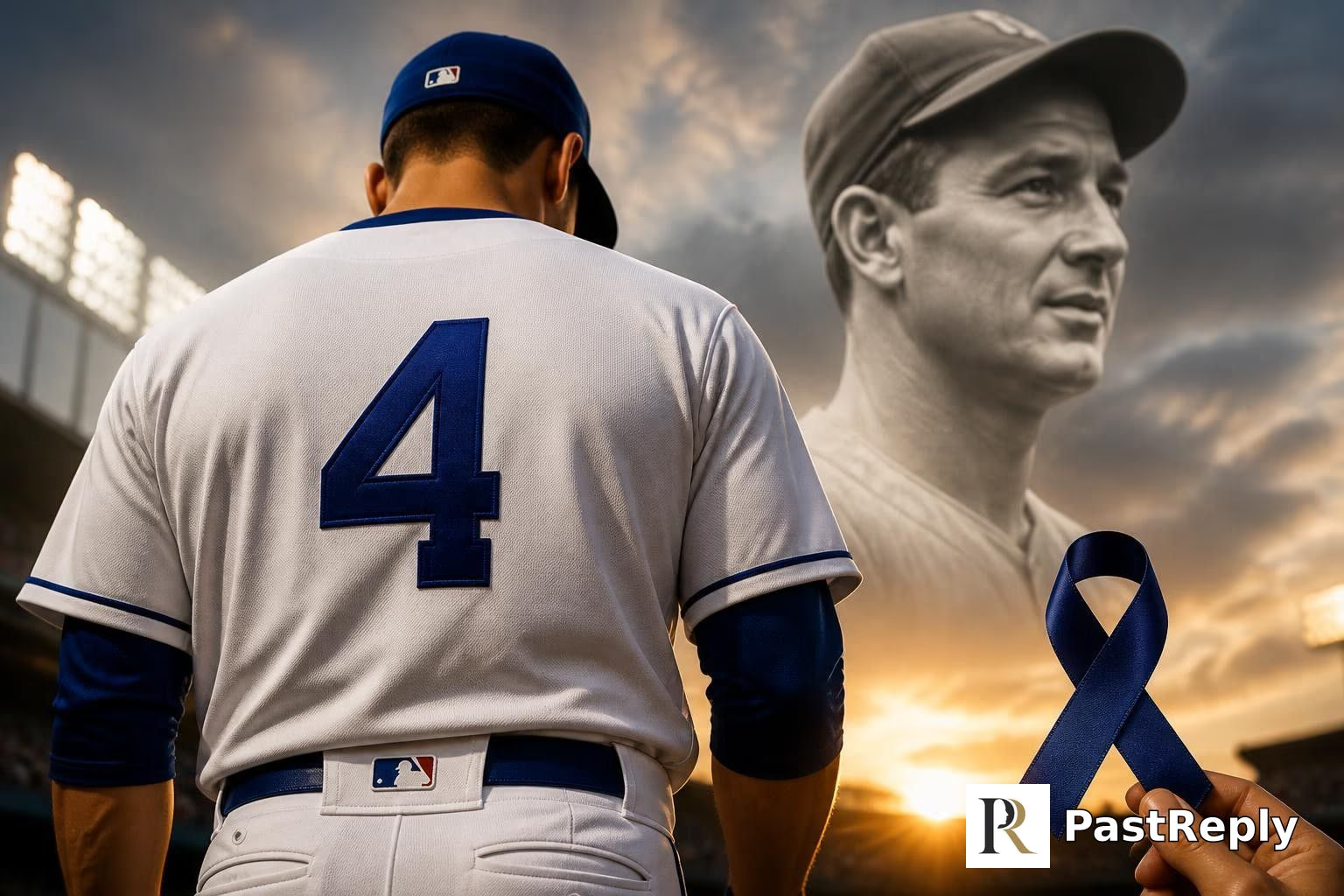
The facts
The Los Angeles Dodgers wear a number 4 patch on their uniforms to honor Lou Gehrig and raise awareness for amyotrophic lateral sclerosis (ALS), the disease that ended his career and life. This is part of an annual league-wide observance on Lou Gehrig Day, which takes place on June 2nd. On this day, all players, managers, coaches, and umpires wear the No. 4 decal, as Gehrig wore number 4 for the New York Yankees. The tradition continued in 2025 and is expected to be observed again in 2026.
Answered by 100 of history's most famous minds

You ask about a patch on a garment, yet the man wore his affliction as a cloak and did not cast it off. I tell you, the sick need a physician, not the whole; and when a brother bears a burden no one can lift, you do well to mark him with honor. But let this number not become a charm you worship - let it be a hand that reaches out to the one who trembles.

In the name of the Merciful, the Compassionate - this man Gehrig bore his trial with patience, and his people honor him with a mark upon their garments. But know that true honor is not in the cloth, but in the soul that endures. Let this sign remind you of your own frailty, and of the One who holds your breath in His hand. And let your remembrance be not merely a day, but a deed: to ease the burdens of the afflicted, for so you serve your Lord.

They stitch the numeral to their garments as a reminder of the body's frailties, yet they cling to a name as if it could hold back the river of change. This disease, like all suffering, arises from attachment to a self that is ever dissolving; the true honor is not in the patch but in the compassionate mind that sees the impermanence of all flesh. Let them wear it, but let them also turn inward - for no number can shield the heart from the truth of decay, only wisdom can uproot the craving that feeds it.

A number on a garment to remember one who was struck down and to lift up the afflicted - this is a covenant of compassion, a law written not on stone but on cloth. It is good to remember the fallen, for in remembrance we guard against the hard-heartedness that forgets suffering. Yet I say: let the mark move beyond the breast; let it become action, that the sick are not merely honored but tended, that the cause is not only proclaimed but pursued. For the Lord requires justice and mercy, and a badge without works is an empty offering.

The wise man does not ask why the garment bears a mark; he asks what the mark teaches. To honor one who endured much is to practice ren, humaneness, toward all who suffer. The filial son remembers his father; the loyal subject honors his ruler; and the compassionate heart remembers the afflicted. Thus the number four is not a decoration but a rite - a small ritual that reminds us of our duty to care for one another, and to let remembrance guide our conduct.

While the world fixates on a number stitched to a sleeve, the deeper truth is that our bodies are but tents, easily struck down, yet the spirit is renewed day by day. This Lou Gehrig, though his limbs failed, proclaimed a testimony of courage - so let their patch be a reminder that we are not citizens of this fleeting earth, but of a kingdom that cannot be shaken.

When the Lord called me from my father's house, I went out not knowing where I was going, for I trusted in the promise. So I see this mark they bear, this number 4, and I think of the journey of that man Lou, who was called to a different path than he had known, and who walked it with faithfulness. He did not curse the desert but trusted the One who leads through it. This token on their garments is a sign of that trust - a covenant made visible, that they will not forget their brother, nor the hope that lies beyond the affliction. For we are all strangers in a strange land, yet the promise stands that blessing will come through us, if we but remain faithful.

The number four is but a signpost to a road that vanishes into mist. They stitch it on cloth and call it remembrance, but remembrance is a jar with a hole. The man was not his number, nor his illness; he was a river, and the river flows on unnamed. Let the patch fade, let the day pass - what remains is the water, and the water does not grieve.

A number on a chest is but a mark upon the body, yet the heart beneath it is one with all hearts. That athlete did not belong to his team or his country; he belonged to the One who fashioned him, and his suffering is the suffering of every creature. Let them wear their four, but let them also wash the feet of the sick, feed the hungry, and see the Divine in every face. That is the only tribute that reaches beyond the grave.

It is a mother's blessing they carry, a name etched in the cloth that speaks of one who was taken too soon. I think of the mothers who watch their children grow strong, and of her who watched her son fade, yet bore it with a quiet faith. This number is a prayer, a remembering, a ring of love that binds the living to the departed. And I see, in this little act of honor, a promise that no one is forgotten, even when the body fails.

It is a symbol, and symbols are not the thing itself. They should inscribe the Word upon their hearts, not merely upon their sleeves. But there is a fitting memorial here: a man who faced the wasting of the body with faith, and who, by his own confession, found his hope not in the physicians but in the mercy of God. Let them wear their number, yet let them also remember that the true comfort for the afflicted is not in a public gesture but in the assurance of grace. If they would truly honor him, let them proclaim the Gospel to the sick, and not rest in a mere sign.

It is a fitting use of a visible sign to teach a hidden truth, for the number itself is not the honor but the occasion of it. The man so remembered displayed a fortitude that accords with right reason: he pursued his duty even as his strength failed, thus uniting the virtue of courage with the virtue of perseverance. And if the purpose be to call others to aid those afflicted, then this emblem is as a lantern held aloft in the darkness. Let them be mindful, however, that the sign should not be an end in itself, but a spur to the love that moves the soul to action.

They put a number on their shirts, but the real number is the face of the one who suffers, and how many hands reach out to touch it. For the man whose muscles fade and leave him like a child in a broken body, this patch is a small love, a whispered 'I see you' from a thousand miles away. Do not ask if it is enough; ask only if it is done with great love.

The numeral four, fixed upon the sleeve, is a sign of a general law - that a malady may strike the strongest sinew and yet yield to the patient inquiry of natural philosophy. Observing that this custom recurs annually, I note a periodic observance, much like the return of a comet, which serves to gather observations and, in time, to deduce the hidden cause. Let them continue their measurements; the pattern is the path to the principle.

They honor a man who was felled by a disease that, like a slow eclipse, dims the body's every motion while the mind stays bright - a cruel and singular malady. But here is the marvel: a simple numeral, worn on a sleeve, becomes a coordinate linking millions of hearts across a great distance. The universe does not care for our banners, yet we must care, for we are the ones who can read the hidden order and turn compassion into action.

A curious custom: honoring a man whose body was worn down by a gradual withering, as if his very sinews were reclaimed by the slow forces that shape all living things. The disease, I suspect, acts like a parasite upon the nerves - a natural mechanism, however cruel. Yet the patch is a fine memorial, for it turns a private grief into a public observation, reminding us that even the strongest frame may be undone by the unyielding laws of physiology.

They wear a four to honor a man, yet the true homage lies in seeking the cause of his affliction, not in the symbol alone. This disease of the nerves - this paralysis of the will's command over the body - invites our inquiry, our instruments, our mathematics of cause and effect. I would not rest at remembrance; I would turn the telescope inward, to the fibers that fail, and ask: why? For nature yields her secrets to the persistent observer, and a cure may be found not in lament but in experiment. Let the patch remind us, but let the laboratory be our true memorial.

At first glance, a mere numeral upon a sleeve - yet I see in it a harmonious order, a fitting tribute to one who, despite the decay of his earthly vessel, kept his mind fixed upon the celestial spheres. The number four, like the orbits we trace, holds a simplicity and symmetry that honors the man who bore it. Just as I found the Sun's place at the center to be the truest geometry, so this small mark holds a clear and fitting meaning: remembrance of a life that moved with grace amid ruin.

That single digit, worn by hundreds, is a humble conductor of a most profound current - the fellowship of those who strive against the paralysis of the human engine. What they do not see is that each player, by a small gesture, amplifies a resonance that will one day usher a cure, just as my alternating current brightened a world that clung to the sputtering old order.

In my laboratory, I learned that some things glow in the dark, not because of magic, but because of an inherent property - a kind of strength that can be studied and understood. This number 4, worn on the field, is a beacon for a different kind of radiance: the courage of a man who faced his own decay with clarity and grace. Yet it is not enough to mourn; we must also inquire. We must turn our gaze to the causes of this affliction, to find the secret at its core, and to turn that knowledge into a cure. It is the duty of the scientist, and indeed of all humanity, to press on, to seek the truth that lies hidden, and to light the way for those who follow.

I see no mystery in a patch - I see a laboratory. The disease that felled that first baseman is a microbe, perhaps a slow poison, waiting for a prepared mind. I would not content myself with a cloth emblem; I would seek the agent, cultivate it, and find its weakness. Let the Dodgers wear their four, but let us wear the white coat of inquiry until that number is only a memory, not a menace.

Seems to me they could spend that effort on something useful. A patch on a uniform is fine as far as it goes, but I'd rather see a dollar put into a research lab than onto a jersey. The man who died - he'd want a cure, not a souvenir. If I had my way, I'd take that cloth and turn it into a filter for water, or wire it into a circuit - make it work. That's the real tribute: put the thing to work.

A curious signal, this. They wear the mark of a man who, by the logic of his fate, was defeated by a particular function - a progressive loss of control. Yet the import, I suspect, is not the disease but the response: a public declaration, a flag of attention. One might even compute the value of such a symbol: a patch, a name, a number, all tied to a cause that, without amplification, would be reduced to a whisper. It is a useful instrument, this reminder that a single life, precisely modeled, can still carry weight.

A single numeral, and yet it carries a weight. They honor a man who, I have heard, was a mighty athlete - one who could hurl a ball with precision. But the true geometry lies in the cause: a disease that wastes the very sinews of motion. Consider this: a body is a machine of levers and fulcra, and when the cords fail, the whole edifice falters. If their purpose is to draw attention to this failing, then let them also give their gold and their effort to mend it, for a lever that lifts the burden of the sick is a greater feat than any throw. That, to me, is the true measure of leverage.

See how a single letter, repeated on every breast, becomes a visible field - a pattern of force binding each player to a common cause. When I watched iron filings align along lines of influence, I saw the invisible made manifest; so too does this small numeral trace the connection between a man's name and a thousand hands grasping at hope. The patch is a field, and the game is its iron filings.

Beneath the grand stadium lights and the cheers, what does this number really signify? It is a token of a collective guilt - a society that once turned away from a dying man because his illness touched a primal fear of decay and loss of control. By wearing his number, they seek to master that fear through ritual repetition, a public confession that the body's betrayal is the one enemy no hero can strike down. The patch is a symptom; the disease we truly mourn is our own denial of mortality.

A number on a uniform is a tiny monument to a fundamental law: nothing in the universe, from a star to a single cell, escapes entropy. Gehrig's disease is the body's own arrow of time, pointing inevitably toward disorder - and wearing his number is a gesture against that arrow, a brief, willful defiance. But it is also a reminder that we are fragile, carbon-based accidents on a rock, and our only weapon is to care for one another before the black hole swallows us all. Now, if only they could calculate the odds of winning the pennant with that patch.

What a beautiful abstraction - a single numeral that carries the weight of a man's story into the minds of thousands, a recurring motif in a grand performance. Like the punch cards that might one day weave numbers into poetry, this patch encodes a meaning beyond itself: it is a symbol that operates on the human heart with more precision than any machine. I see not just a memorial, but a program - a call to action distributed to every player, every fan, every observer, each one a node in a vast, compassionate network. The number is the input; the love is the output.

Let us define our terms: a 'Dodger' is one who evades, yet here all are bound by a common sign, proving that even a number can be an axiom. From the given premise - that a man wore this numeral - and the observed fact of his suffering, we deduce the conclusion that remembrance is a duty. This patch, like a proposition, requires no proof; it is self-evident that a man's worth is not measured by his strength but by the truth of his struggle. And so, the conclusion follows necessarily: wear it.

A mark upon the breast is but a small thing, yet it draws the eye of the world to a malady that kills its thousands unseen. If this day moves but a single coin toward the study of the rotten nerve, and if that study yields one clean fact, then the number is well worn. Let them wear it, and let the physicians wear their data as proudly.

A number on a breast? Ha! I have seen men wear their wounds as badges, and their scars as crowns. This Gehrig - he was a champion of the arena, and when his limbs failed him, he did not flee the field but stood and spoke. I would have marched beside such a man, for though he could not wield a spear, he wielded his spirit. Mark the four, but remember: true glory is not in the symbol, but in the defiance of the flesh.

By the gods, I'd rather see that patch as a badge of conquest - the man wore his number as a general wears his standards, and now the whole league unfurls it in his name. There is no clearer lesson: even after death, a name can rally legions. See how they march in his memory, bound by a common vow against an unseen enemy - that is the very art of command, turning a loss into a campaign.

By the gods, they honor a fallen champion - a lesson in remembrance, for even a pharaoh knows that to forget one's heroes is to lose one's crown. Yet, I wonder: do they also wear the sign to remind the mighty that even the strongest can be struck down by an unseen foe? If so, let it serve as a counsel to all rulers: guard your strength, for illness knows no rank. My navy would have carried such a mark, had we such a malady to mourn.

A single numeral, worn by all, unites a city - a small gesture that strengthens the bonds of common purpose, much as the toga once marked a citizen of Rome. I perceive the wisdom in this custom: by honoring one who bore a burden, they draw attention to a weight that many still carry, and so the state, or the club, shows its care. Let them continue this tradition with moderation, lest it become mere ceremony; let it serve also to move the public to action, for a realm that remembers its stricken is a realm of strength.

A patch upon the chest - small, yet it binds them all to one purpose. I respect that: a mark that unites the rider and the bowman, the captain and the scout, under a single sign. This Lou Gehrig, he fell to a wasting foe, yet his name rallies them still. That is loyalty - not to a man's strength, but to his spirit. Let them wear the number; it speaks of a tribe that remembers its own, and that, I say, is the bond that builds an empire.

A soldier's uniform bears the marks of his battles, and this four is a badge of honor for a warrior fallen in a war against time itself. Let them wear it with pride, for glory is not measured by the length of one's march but by the courage of the charge. This is a discipline that binds a nation, and I, too, have seen how a single emblem can rally men to a cause greater than themselves.

It is a fitting thing, to honor a man who gave his all to his calling, and who faced his ending with the same fortitude he showed on the field. This number 4, worn by these players, is a mark of respect - a reminder that the game, and indeed life itself, is not merely about victory but about the manner in which one plays and endures. I have seen men falter under far lesser trials, and yet this Lou, he set an example of dignity and duty that would profit any citizen to imitate. Let us not forget the man, nor the lesson his life teaches, for such remembrance is the very cornerstone of a virtuous republic.

The man who wore that number was a lesson in endurance, and I cannot look at a patch without thinking of my own long war. He did not surrender to the weakness that seized his limbs; he spoke of his affliction as a thing to be borne, and so he bore it. This small sign on a uniform is a pledge we make to one another: that we will not forget the fallen, nor cease to labor for a cure. It is a humble stitch in the larger fabric of our common humanity.

I have seen men wear numbers in far darker times - stenciled on prison gray, not stitched on baseball flannel. This patch is a badge of honour, a small flag flying for a fallen comrade in a war we have not yet won. The disease is a foe that knows no surrender, and I say: let every man who dons that number understand he is enlisting. We shall not rest until the enemy is beaten, and the day we wear it no more will be the day of victory.

It is a small act, a badge of remembrance, yet it speaks of a truth beyond the game. They honor a man who was struck not by an enemy's blade but by an affliction that consumed him from within. And in this, there is a lesson: even the most valiant among us may be brought low, and it is in such moments that the strength of the community is tested. Let this number be a reminder that we are all bound by the thread of mortality, and that compassion for the suffering is the highest form of that bond. Perhaps they will also lend their hands, not merely their sleeves, to those who struggle today.

This small patch is a proclamation of our shared vulnerability and our shared responsibility. It honors a man whose body was overtaken by a merciless foe, yet whose spirit refused to yield. And in this, there is a mighty truth: that we are all bound in a single garment of destiny, and the suffering of one is the concern of all. May this number be a spark that kindles compassion, a reminder that the strong are called to stand with the weak. Let them not merely wear it, but let their hands be extended in aid, that the memory of the fallen may become a living force for good.

A number on a sleeve cannot undo the years a disease steals, but it can remind us that even the strongest among us may need a hand, and that our duty is to stand together when that hand trembles. I spent long years in a small cell, yet my spirit was free because others remembered my name; this patch remembers another's name so that his struggle is not forgotten. Let it be a quiet promise to one another, that we share both the glory and the sorrow.

This question of a patch is a distraction from the real issue of racial vitality and the weakening of the national stock. A great nation does not honor weakness and decay, but celebrates strength and the purity of its blood. Such sentimental gestures are the tools of those who would undermine the natural order of struggle and dominance. Let the feeble and the failing be forgotten, as nature intends, rather than elevated as martyrs to a false compassion.

One number worn by a hundred men means nothing if it does not serve the greater cause. The state demands not symbols but production, not sentiment but steel and grain. Let them wear their little badge if it keeps the masses content and the railway running on time, but know that true glory lies in the Five-Year Plan, not in the memory of a dead athlete. The individual is dust; the collective is iron.

A decorative patch on a uniform is bourgeois sentimentality, a sop to the masses to distract them from the class struggle. The workers do not need to honor a dead ballplayer; they need to seize the means of production and destroy the system that allows such diseases to ravage the proletariat while the owners profit. If they truly sought to honor this man, they would march on the owner's box and demand a share of the gate for the sick and the dying. Symbols without revolution are mere opium.

Those pale imitations on the western shore make much of a single little number, yet they cannot see the grand arithmetic of history. They honor a dead ball-player who withered in the grip of a disease he could not name; we honor the millions who fell forging a new world, their deaths not monuments but stepping stones. One patch on a sleeve is the fetish of a people who tremble at the word 'struggle'.

It is a touching tribute, though I confess I find the spectacle of grown men in their shirts adorned with a numeral rather foreign to notions of dignity. Still, to solemnly recall a noble sportsman struck down in his prime, and to so honor his memory with a seemly observance, is a custom of which I can approve - provided it is conducted with proper order and without undue levity.

Such a simple act - a small mark upon a uniform - yet it speaks of a quiet constancy that I recognize well. To remember one who gave his all to his calling, and to use that memory to bring hope to others who suffer, is a duty faithfully performed. One need not speak loudly to serve; a steady hand and a kind heart work unseen, and that is enough.

These athletes carry a fallen brother's sign as a warrior might carry a comrade's shield into the fray, but let them not mistake the token for the task. The true war is not fought on a green field but in the halls of learning and the care of the sick, where the strong must aid the weak. Let them honor him with deeds of mercy, not only with a painted number.

They wear a single number to recall a man who was strong and then was struck down, and this is a good thing, for it is right to remember. But I say, let them not merely carry his sign; let them carry his courage into the fight against this withering illness. Our voices told me to take up my banner, and so I did; let them take up the cause of the afflicted as their own.

A small mark, a passing tribute, yet it serves to keep a man's memory bright while the world goes about its business - a prudent custom, for what is a kingdom but a chain of remembrances? I would have my own subjects use such days not for idle mourning, but to bind themselves to the welfare of the living, lest we turn every memorial into a grave.

How charming that a great nation pauses to honor the memory of an athlete, and with so simple a device as a folded square of cloth upon the sleeve. It is a mark of a civilized people, that they can turn a game into a vessel for compassion and remembrance. Let them wear it with grace, and let their physicians work with equal diligence to vanquish this malady.

By this single sign, they honor a man who fell to an unseen foe, and they bind themselves to aid others who suffer the same fate. This is the mark of a wise ruler - to turn grief into a covenant of protection for the weak. I have always held that the strength of a kingdom lies not in its walls, but in the care it shows for the least of its people.

They wear the number of a fallen warrior as we might carry a banner of a martyred comrade, and in this they show a noble spirit. Yet let them remember that a true victory is not won by a token alone, but by the generosity and healing one brings to the afflicted. Let them honor him with mercy and alms, as is pleasing to the Most High, and their remembrance shall be blessed.

Tell me, friend - do you believe that a small square of cloth, bearing a number, can truly honor a man who is gone? Or is it a reminder to you of your own mortality, which you wish to keep at arm's length? Consider: the athlete's body failed, but his name endures - so what is it that we truly mourn? Examine your own heart, and ask whether you seek to honor him, or to comfort yourself.

They place the numeral on their breasts to point beyond the particular man to the Form of Courage itself - for Gehrig's endurance in the face of the body's decay was a shadow of the eternal Virtue. Each player who wears it enters that higher pattern, and so the game, which is but a fleeting imitation, becomes a true remembrance. It is not the cloth that matters, but the soul that reads it rightly.

A number affixed to a garment draws attention to a cause - an act of remembrance and pedagogy. The disease, which paralyzes the body's voluntary motion, finds its end in the muscles' failure to obey the will; the number recalls a man whose excellence was cut short by such a malady. This observance, then, is a mean between forgetfulness and morbid fixation: it honors the life, teaches the many, and perhaps stirs inquiry into the ailment's nature. The intelligent response is not mere sentiment but study, that the cause may yield its secrets and the hero's name be hallowed by cure.

The mark of a single man upon a garment - yet the duty it signifies is universal, binding on every rational being. To honor the one who fell to the wasting illness is to acknowledge that the moral law within us commands we treat each sufferer as an end, never as a means. Thus the patch is not mere ornament but a categorical imperative: an act whose maxim could be willed as a law for all - a reminder that our humanity is measured by how we uphold the dignity of the frailest among us.

A trivial numeral, yet they elevate it to a shrine - a gesture of pity for the one who withered. But I see more: the wearers affirm life's fragility and still stride forth, defiant. Let them not bow to sentiment, but embrace the harsh truth that all strength fades, and that in this fading lies the very test of will. The patch is a lie if it consoles; it is a truth if it sharpens the spirit to endure and to create beyond the grave.

The bourgeois applaud themselves by painting a number on their shirts, yet they forget that the man they honor was himself a worker, struck down by the very conditions of his toil. Their charity is a salve for their own conscience, a spectacle that leaves the machinery of exploitation untouched. The real tribute would be to fight for a world where no one is cast aside by disease or capital.

I must begin by doubting, as is my custom, the very question itself. Why do they wear the number 4? I see the patch, but I seek the clear and distinct idea behind it. The reports speak of honor and awareness, but what can we know with certainty? Only this: a man lived, a man suffered, and a man died of a disease that wasted his body yet apparently not his spirit. The number is a signifier, a token that points beyond itself to a truth of human frailty and human courage. This much is indubitable. Let us not rest in mere sentiment, though it be noble, but rather consider what this act truly represents, and what it demands of us.

A patch on a uniform is a banner of convenience, and the princes of baseball know well its use. They speak of honor to a dead hero, but they also speak to the crowd, to the purse, to the league's good name. If the gesture binds the players to a cause and the people to the game, then it is a useful lie, and I would advise them to wear it proudly. The wise ruler takes every opportunity to seem just, even as he counts the cost.

The number four, a trifling mark, yet worn upon the breast where the heart doth beat - a silent mime of a man whose limbs grew heavy as lead, yet whose name outran the swiftest runner. We are all players upon this stage, and some roles are writ in pain; but he who wears the mark of the fallen doth show that even in the shadow of the grave, the spirit holds its cue. A small token, but it speaks louder than a thousand trumpets.

Hearken: a hero of old, who faced the Fates' unyielding thread and yet stood steadfast at his post, is now honored by swift-footed athletes who bind his number upon their breasts. The disease that quenched his strength was a monster no spear could pierce, yet his name rings through the stadium like a war-cry, teaching that glory outlives the body. Even the gods who toy with mortals must pause and wonder at such remembrance.

In that four, I see a soul's journey - four, the number of earthly elements, yet this man's spirit soared beyond them. They wear it as a pilgrim wears a badge, a public vow to remember one who fell not by sin but by affliction, and to pray for deliverance from a palsy of the limbs that mirrors the palsy of the soul. Yet let them not stop at the badge; let them carry that remembrance into deeds of charity, lest the mark become a hollow token, a painted indulgence without repentance.

A number, etched upon the breast - yet it speaks of the whole man, the one who strove against the creeping ruin of his own sinews, turning his very decline into a testament of spirit. The wearers honor not a cipher but a life that, in its striving, mirrored the eternal weaving of light and shadow. So let the patch be a reminder that we grow not by avoiding the dark but by embracing the full circle of existence, transforming even affliction into a form of becoming.

They don the number of a man who, like my poor knight, aimed at an ideal that eludes him - yet they do it not to tilt at windmills, but to light a lantern against a shadow that steals one's very sinews. I see the jest that the crowd wears the same badge as the hero, and I find it more noble than any armor.

They wear a four, but they do not see the man himself - they see only a symbol, a fleeting emotion that passes with the game. True remembrance is not a patch; it is a life transformed, a heart turned toward love and simplicity, for that is what endures when the digits fade and the rains wash the field.

They wear the number of a man who, when faced with the creeping paralysis of his own flesh, did not rage but rather declared himself the luckiest man on the face of the earth. Is that not the great, terrible, and beautiful mystery of the human soul? In the very depths of his own decline, he found a height of spirit that shames our petty complaints. This patch is not a mere commemorative badge; it is a cry into the void, a reminder that the soul's freedom is not bound by the body's chains. We are all afflicted, each in our own way, yet it is in the acknowledgment of our suffering, and the love we offer one another in it, that we find any meaning. So let them wear it, and let us all remember that the greatest heroism is often found in the quietest endurance.

I cannot help but note how the same gentleman who would not spare a thought for a poor relation will wear a dead athlete's number as if it were a token of his own noble heart. It is a harmless vanity, and perhaps a sincere one, but I suspect the truer tribute lies in the quiet dinner table where a family remembers a father, not in the loud stadium where a crowd honours a stranger. Let them wear their four; the memory of the man is a private legacy, and it needs no such advertisement.

Aye, and it's a grand thing - though I warrant the good folk of the stands scarce give a thought to the man beneath the number. Four, you see, was borne by a giant who played through the very sinews of his doom, and when the shadow fell, he bore it with a grace that shames the proudest of us. So they stitch a little square of felt upon their breasts, a badge of remembering, a pledge that the strong shall not forget the fallen. It is a charity, a kindness, and if I have learned aught from my own weary pilgrims, it is that such small signs may soften the hardest of hearts.

They put a number on their backs, and they call it a tribute. Well, I've seen a man with a number on his back before - it's usually followed by a price tag. But I suppose it's a decent enough notion, though it smells a bit of the circus. A man who played through his own funeral, that's the story, isn't it? The good ones always go early, and the rest of us get to watch the parade. I'll say this for the Dodgers: they've found a way to market even a tragedy, and if it raises a few coins for the cause, well, the Lord knows the sick need the gold more than the healthy.

It's a name, a number, a bit of cloth. It doesn't change the disease, any more than a flag changes a war. But it's something - a mark of respect, a way to say he was here, he played the game, and he didn't run. The man who wore it knew the score, and he faced it without a whimper. That's what matters, not the symbol but the grit. So they carry him with them, a quiet reminder that even when the body gives out, a man can still stand straight and not shame himself.

I have studied the human frame - the sinews that bend, the nerves that carry the will, and the subtle humors that, when corrupted, undo the strongest. This affliction, which robs the body of its command, is a mystery worthy of the keenest eye. They do well to mark it with a number, that all may know its face; yet I would have them not merely mourn, but dissect, observe, and seek the mechanism, for knowledge is the truest monument to the fallen.

They carve that number into their garments as I once carved David from the stone - not to depict the man, but to reveal the strength that dwells within us all. Gehrig's body failed, yet his spirit remained unbroken, a form awaiting liberation from the marble of affliction. Every patch is a chisel stroke, reminding us that the image of God is not dissolved by decay, but waits to be set free.

That little patch of four - I see it as a brushstroke of memory, a spot of color on their white uniforms, like a yellow flower in a field of wheat. It speaks of a man who once ran with the wind, then found his limbs become stone, and yet his spirit burned on - a flame that could not be dimmed. How I would paint him: the strength in his face, the shadow of the coming dark. They honor him not with marble but with a small sign, and that moves me - for it is the humble things, the simple marks, that carry the deepest truth.

Four - a straight line, a dead digit - yet you set it upon cloth to resurrect a man who could no longer move. I see the absurdity, the beautiful contradiction: the number that once named him now stands for the erasure of his limbs. They make a monument of a numeral while they could shatter it, twist it into a cage of angles that cries out the fury of a caged lion. But they choose the polite patch, tame and neat - a still life of loss, when art demands the scream.

Ah, but the true tribute is not the numeral itself - it is the fleeting moment when the sun catches the fabric, the way the light plays over a body in motion, the memory of a man who saw the brilliance of each passing day until he could no longer see at all. They wear four as a fixed point, yet the meaning is in the air around it, the atmosphere of remembrance that changes with every glance.

In my workshop, I have painted men whose faces tell of a lifetime of storms, and I have learned that the deepest truth is not in the smoothness of the skin but in the strength that shines through the wear. This number 4 they wear - it is not just a mark of mourning, but a light they carry, a subtle glow in the shadow of a great man's passing. They do not flatter death, but honor a life that, though shortened, cast a long and brilliant beam. It is the human soul they are honoring, and that is the only subject worth a painter's craft.

They wear the number of a dead man, but I see it as a wound, a scar they carry into the light of the stadium. They want to remember, yes, but they also want to show the world their pain - their collective pain - as if to say, 'Look, we too can break, and we too can go on.' It is like my own paintings, where I show my broken body, my shattered heart, not to ask for pity, but to scream that I am here, that I am alive, that I will not be erased. This number 4, it is a badge of defiance against the disease that tries to take the voice away. It is a statement that even in sickness, even in death, the spirit will not be quiet. It is honest, it is raw, and it is true - and that is the only way to honor anyone.

Four! A number that rings like a chord - four strings on the viola, four movements in a symphony, and now four upon the breast of every player. Gehrig's own music was the crack of the bat, and when that melody ceased, he still conducted with his voice. I would set this to a lively allegro, not a dirge, for a man who faced his end with grace deserves a tune that dances - and the living, too, must play on.

A single numeral, worn on the breast, yet it speaks with the voice of a full orchestra - a solemn adagio rebelling against the silence of the dying. They play no note, but their act resounds: this is the heroic motif, a defiance of fate through remembrance and resolve. I know too well how the body can betray the spirit, and I say: let that patch be a kettledrum, summoning every soul to fight the dark.

Four is a number of order - the four seasons, the four elements, the four evangelists - and so it fittingly adorns those who honor a man whose life was a harmony broken by discord. The patch is a note in a larger score, a theme that sounds across the field, reminding us that even in the midst of play, there is a solemn refrain. May they play their game, but let the memory ring like a sustained chord, and let them give to the cause with the same precision they give to their craft. Thus, the tribute becomes a fugue, each player a voice in a united harmony.

Well, now, that number four, it ain't just a number - it's a memory, a man who gave his all till the very last breath. Lou Gehrig, he stood up there and said he was the luckiest man, even when his body was letting him down. That's a lesson, folks: you can be brave and grateful even when the road's rough. So they wear his number to say, 'We remember, and we care.' And that's a song worth singing, every single time.

There's a special kind of magic in wearing someone else's number, like stepping into their shoes for a day, feeling their heartbeat. It's not about the patch - it's about the message, that we can heal the world by remembering, by caring, by coming together in love. They are dancing with a purpose, and that's a beautiful thing.

Well, it's like we always said, love is all you need - and a bit of a number on your chest, eh? Lou Gehrig, he was a proper legend, like one of those old blues singers, but with a baseball bat instead of a guitar. They're putting on the number 4 to remember him, and to give a shout-out to all the folks fighting that nasty disease. It's a bit like our music, you know - a way to say, 'We're with you, you're not alone, and we'll make it through the night.' So here's to Lou, and here's to everyone out there in the stands, holding up their own light. And if that's not a song, I don't know what is.

A number pinned to a shirt, a patch on a sleeve. But Lou's ghost doesn't need a calendar. He walked out of that stadium and said goodbye to nobody; the disease just took the words. You wear his four, you carry a cipher, a chord you never finish. The crowd thinks it's a tribute. It's a question, and the answer's still blowing in the wind.

There's something so raw about a patch that tiny, carrying a whole lifetime. Lou wore that number when he had the world in his hands, and then he lost everything and still showed up. I think about the people in my life who've fought the same battle, and how we all just want to be remembered for more than the hard part. Wearing four is a way to say: I see you, I hear you, and I'm not going to look away. It's a promise in a little bit of thread.

I set sail for the Indies and found a new world; this Gehrig, too, voyaged beyond the known, into a land of shadow where his own body betrayed him. Yet he did not turn back. This number four is like a compass mark, pointing not to gold but to a greater treasure - the resilience of the human spirit. Let all who see it remember: the true continent lies not in the distance, but in the courage to press onward.

In far Cathay I saw how the Great Khan honored his fallen generals with crimson banners, and here, across the ocean of time, these western players raise a number as their standard - a custom as curious as any I witnessed among strange peoples. This Gehrig, they say, was a mighty batsman whose sinews withered by a mysterious wasting, and so they wear his mark to summon charity, like merchants pooling goods to trade against a plague. I have seen many things, but never a whole tribe uniting to defy an invisible foe; that is a marvel worthy of my travel tales.

They wear that number as I would wear a banner on my mast - a sign to the crew that we carry the memory of a brave soul who faced the unknown, his body failing but his spirit unbroken. Such a mark rallies men; it says we are not merely players but voyagers on a longer journey, and our goal is not just this contest but a greater cause. I have seen men lose heart when the horizon stretched endlessly; a symbol such as this, worn by all, can turn fear into resolve. Let them wear it proudly, and let the name of that fallen one spur them through their own storms.

A single digit, chosen to recall a man whose body failed him while his spirit endured. It is a modest emblem, yet it carries the weight of a commitment - to remember, to research, to reach beyond the known. We who have ventured far know that every great journey begins with a small, deliberate step: a patch on a uniform, a promise to the afflicted, a beacon for those who will follow.

That four on their chests is a dare, a reminder that the brave don't stand still. Lou Gehrig faced the fog without a map, and so they honor him by keeping their eyes on the horizon. When the body fails, the spirit takes flight - and that's a course worth charting.

From up there, looking down at our blue planet, I saw no borders, no divisions - only one beautiful home. So I understand this gesture of the Dodgers, putting on the number 4 for Lou Gehrig. It is a small sign, but it speaks to a great truth: we are all on this Earth together, and when one of us struggles, we all should reach out. This disease, it is a formidable adversary, but like a tough mission, it can be faced with courage, teamwork, and the hope that comes from knowing we are not alone. Let us always remember that even the longest journey begins with a single step, and this patch is a step toward a better future.

It's not about the number. It's about the story - the story of a man who, at his lowest, showed the world what it means to be truly great. The patch is a simple design, but it carries a powerful message: that we can turn our greatest challenges into our greatest opportunities to connect. It's a reminder that the most human thing we can do is to stand together, even when the ground beneath us is shaking.

Why not build a cure instead of a patch? The real question is whether we can solve ALS with a neural interface or a CRISPR gene drive - that would be a worthy anniversary. A decal is a signal, not a solution; it raises awareness but doesn't tackle the root cause. We should apply first principles: the disease is a protein aggregation problem, and we have the tools to fix it if we dare. Wear the number, but aim for the day when no one needs to.

You know, when I see those players with the number four, I think: this is what it means to be part of something bigger. They’re on that field, living their dream, but they’re wearing a reminder that life can change in an instant - that this moment, this breath, is a gift. That patch is a call to each of us to be grateful, to give back, to stand beside those who are fighting the hardest battle of their lives. And I believe, truly, that when we lift others, we lift ourselves. So let’s not just wear a number - let’s use our voices, our platforms, our hearts, to make sure no one fights alone. That, my friends, is the best life we can live.

They put a number on the chest, but the real wear is on the heart. Lou Gehrig, he fought the fight - not in the ring, but against the creeping shadow that took his limbs. That's a champion's stance: you don't quit when the bell rings hard. So they wear his four, and I say it's about standing up, speaking out, and fighting for those who can't throw the first punch. Remember, float like a butterfly, sting like a bee - but never forget the ones who can't lift a glove.

The number four is sacred to those who played the beautiful game, and these men carry it like a flag. It's not for glory, but for a teammate who could not finish his run. In my time, we knew that a player's heart lives beyond the field, and so they honor him with every catch, every swing - that is the real victory.

You know, it's the storyteller in me that sees the magic in this. They're not just wearing a number - they're wearing a story, a hero's story. Lou Gehrig, he was like a character out of a great picture, a man who faced his greatest challenge with grace and courage. And putting that number on their uniforms, it's like a little spark of that heroism they're carrying with them, reminding everyone that even in the darkest of times, there's a glimmer of hope. It's the same magic we try to capture in our films - the wonder, the belief that if you wish upon a star, your dreams can come true. So they're not just playing a game; they're sharing a story of hope, and that's the best kind of story there is.