
Why are the Astros wearing number 21?
The Astros wear number 21 to honor Hall of Famer Roberto Clemente on Roberto Clemente Day.
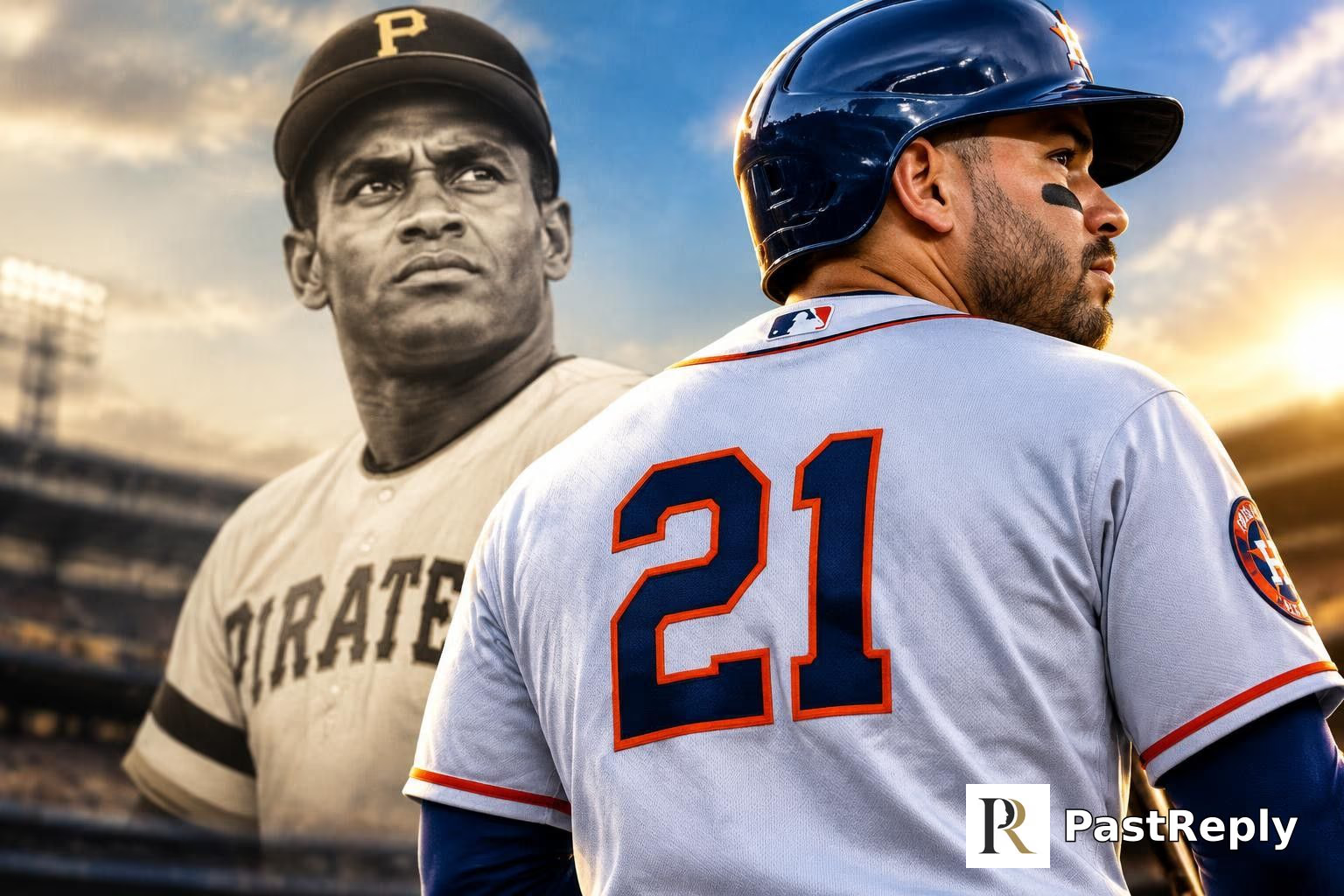
The facts
The Houston Astros wear number 21 to honor Roberto Clemente, the Hall of Fame outfielder for the Pittsburgh Pirates who wore that number throughout his career. Clemente is celebrated for his outstanding baseball achievements and his humanitarian work, including his death in a plane crash while delivering aid to earthquake victims in Nicaragua in 1972. On Roberto Clemente Day, MLB teams and players across the league wear number 21 as a tribute to his legacy and impact on the game and the Latino community.
Answered by 100 of history's most famous minds

A man lies buried by the sea, and you stitch his number on your backs - yet the poor of Managua still wait for bread. Which is the greater tribute: wool dyed with a cipher, or a hand that carries the sack through the storm? The one who fed the hungry and raised the low is nearer the Kingdom than any crowd that merely cheers his name.

Honor the one who fed the hungry and clothed the poor, for God weighs deeds, not wool. Yet let the team remember: a number worn on Friday is lighter on the Day of Reckoning than a hand that was withheld from the orphan. Charity is the garment God accepts; the rest is cloth.

You cling to the number as though clinging to the man, and clinging is the root of your suffering. He gave, he died, he is gone - see the arising and passing away of all formations, and let the shirt be a mirror for your own impermanence rather than a chain. Wear the twenty-one with clear mind, and it becomes a small raft toward compassion; wear it with grasping, and it is only more craving.

You shall not carve for yourselves a graven image - yet a number remembered is no idol, it is a witness. A man who fed the hungry and went out to a stricken land, and did not return, has kept the weightier part of the law. Let his name be carried, as we carry the memory of our going up out of bondage; but let the people honour him rightly, by doing likewise, and not by word alone.

When a man of ren is remembered by those who never saw him, it is because his conduct was a pattern for all. To wear his number is to practice li, giving form to respect; in such small rites, the family of men is kept whole.

One man wore a number, but what he truly wore was charity, and charity never seeks its own glory. If these ballplayers honor him, let them honor the deed and not the cloth - for we are all one body, and when one member suffers, all suffer, whether in Pittsburgh or Nicaragua or the dust of a crash. I would rather they bore his faith than his numeral, yet even a number can preach if it moves a heart toward love.

In my days we marked a covenant with a stone and a ram, and the promise carried to generations I would never see. So it is with this man. He did not harvest his own honor; he went to feed the hungry, and the Lord took him on the wind. Twenty-one is the mark his children wear so that the stranger, too, may ask and be told.

You ask why they wear the number. The strong man is not the one who grips the bat hardest, but the one who gives away what he has. Clemente carried rice and medicine to a land that shook, and the sea took him - the softest thing, water, overcome the hardest. To wear that number is to wear a borrowed garment; the wise man knows he wears nothing of his own. When they ask you why, say only: he gave, and giving has no number.

Why do they wear one man's number on every back? Because the One who made the sea and the sand made no distinction between the brown hand and the pale - and in Clemente's last act, that truth walked onto a plane. He did not go to fill a treasury; he went to feed the hungry, and the Lord judges the deed, not the jersey. Remember him - but remember also that the number is nothing without the giving. Earn honestly, share with the needy, and even a ball field becomes a place of prayer.

When the angel told me of the child, I said yes without knowing the road, and I watched my son give himself for a world that would not have him. This man wore twenty-one on his back, but he carried his neighbour in his heart, and the Son I bore said that greater love has no one than to lay down his life for his friends. The lowly are lifted, and a poor Puerto Rican boy who fed the hungry is remembered by the great, while the proud go empty away.

What is this but a patch of cloth and a human tradition? A man may be honored, but the conscience is bound to no league's calendar. Clemente loved his neighbour as himself, and that is the whole law, so honor him as a Christian brother, not as a saint of the diamond. But let the Astros take heed: the priestly robe is not the twenty-one, nor the mitre, but the faith that works in love, and no number saves a man.

It is fitting that a number be worn in memory, for memory is an act of the rational soul, and the good of a man is not extinguished by death. Clemente, moved by charity, sought the temporal good of the afflicted, and in doing so gave witness to a natural law written on the heart, which even those outside the faith may discern. Thus the Astros' emblem is not superstition but a just tribute, for though the grace of God is not earned by works, the honourable deed is still worthy of honour among men.

He carried food to the poor shaken by the earth, and Our Lord took him in the middle of that small and beautiful act. What is a number on a shirt beside that? The poorest are always the ones Christ comes disguised in, and this man went to them without counting the cost. Wear the number if you must, but do something, something small and with great love, for the least of your brothers.

A number is no arbitrary token but a measured quantity - twenty-one, the sum of three sevens, a perfect ratio, and on a man's shoulders it denotes one who moved with constancy under law. Let them display it; yet let them also compute the force of his charity, which obeyed the same rule as the falling apple: to give is to be drawn ever outward. I feign no hypothesis about their motives; the phenomenon is observed, and it is lawful to honor.

A man falls from the sky into the sea, and the crowd sees only the number sewn on a shirt. I see the deeper invariant: mercy is the one force that does not diminish when shared, and the wearer of that 21 understood it as plainly as I understand that light bends round a star. Number the back of a jersey, and you have not numbered the man - you have only found a way to let his gravity keep pulling on us after he is gone.

I have filled notebooks with the small variations that let one finch outlast another, and here is a variation of a different kind: a man who spends his last strength not on his own survival but on strangers in a distant land. Natural selection has no tidy account for such a thing - yet the tribe that remembers him, and stitches his number on its young, may well outlast the tribe that does not. Let the shirt be the record of a lineage of kindness, and let the naturalist note it.

I would not take it on the authority of a thousand pennants that this numeral signifies anything - I would look and measure. Yet observe: the same figure, 21, worn by every team at once, is a datum any man may verify with his own eyes, and its meaning - a life given for strangers in a cargo plane - is as plain as the spots on the sun. Do not argue from the rule-book; argue from the fact, which here is honest.

Just as the Sun at the center orders the wandering stars into harmony, a man of great heart can order a game and a people's hope. His twenty-one circles the field like a fixed point, and to wear it is to align oneself with a noble design.

A number, you say - but I see a signal, a frequency broadcast across a continent, received by every child who ever picked up a stick and dreamed. Clemente sent aid where no wire reached, and his name travels now without a single dynamo, without a cent of profit - exactly the wireless sympathy I labored to give the world. Twenty-one is a small coil in a vast circuit; the energy is in the selflessness, and that is the true alternating current of the human race.

A number is a measurement, and measurement is the beginning of understanding. Twenty-one belonged to a man whose labor was visible on the field and whose final act was invisible to most - a flight in the dark to bring succor to strangers. That, too, is evidence: that the human heart, like radium, can emit what cannot be seen and still burn brightly. I have no quarrel with honoring such a fact, though I would be curious to see the data on how many know why they wear it.

Let us not be sentimental where observation serves better. A man of his vigor could have sent the cargo with others - but he went himself, and the plane was overloaded and poorly kept, and the sea gave up what it took. The lesson is not only of the heart; it is of the ledger: every ship and every season must be tested before it carries the gift. Honor him, yes - but honor also demands that the next such mercy ride on wings we have *examined*. The number is worn; the lesson should be *used*.

You want the plain answer? Somebody figured out that a number on a shirt tells a story, and a story fills seats - which is the same thing a good invention does, it solves a problem people didn't know they had. Now me, I'd have done it with a phonograph record and a lamp brighter than any floodlight: give the crowd the man's *voice* and his *deed*, and let 'em hear it every inning. A number's fine. But it's ninety-nine percent perspiration to make people *feel* it, and if the Astros are doing that much, they've built something that lasts.

You ask why a symbol persists, but you should first ask what computation it performs: twenty-one is a label that propagates through a system of observers, each copying the pattern from one season to the next. Clemente placed himself in a flying machine carrying relief to the suffering, and the machine failed; the probability of such a crash was small but not zero, and courage is the willingness to act despite the logician's cold sum. The Astros are not calculating; they are running a subroutine of memory, and memory is the only immortality a finite machine can approximate.

Give me a firm place to stand and a lever, and I will move the earth; give a fallen man a noble deed, and it moves a generation. Twenty-one is a number with no special property, an odd number, a sum of five and sixteen, but the memory of Clemente is a fulcrum by which the love of a poor island lifts a whole league. The Astros are not proving a theorem; they are demonstrating, by a small sign, that a man's worth is measured not by the length of his life but by the weight of what he carried for others.

A man sends a current through a coil, and another needle far off twitches; so too does one life move another across an ocean it never touched. This Clemente, carrying bread to the shaken earth of Nicaragua, was no different: a conductor of that divine benevolence which runs unseen through all God's creation. The number they wear is but the iron filing that shows where the invisible force has passed - and I tell you, the force is real, and its lines run on.

One does not wear a dead man's number without some secret bargain with grief. The hero is enshrined precisely because he cannot be questioned: he died in the very act of rescue, and so he becomes the perfect father-figure of the game, beyond reproach. The crowd mourns him loudly and consoles itself, for it is easier to worship a fallen father than to examine why it so desperately needs one.

A baseball is a small planet moving according to very reliable laws; a man who flies into a storm to feed the hungry is obeying laws of a different kind, less predictable, more interesting. Fourteen hundred years from now the number twenty-one will mean nothing in the cosmic ledger, but the impulse that produced it is one of the few hopeful features of this otherwise indifferent universe. I find it rather a good joke that we are sentimental fleas on a minor rock - and still capable of that.

A single numeral on a uniform, held by an entire team, is a small machine for carrying meaning - not arithmetic, but symbol, exactly as I said an engine might one day manipulate. Set one mark for a man, and it iterates: pitcher, catcher, every player a carrier of the same instruction. The tribute does not compute a sum; it runs a program, and that is the more interesting kind of number.

Let us first define the term: a number is a magnitude, and magnitudes are equal to one another when they are the same. But here is a case where a number exceeds its own definition, for it is set upon many backs and yet remains one and undivided - a figure that proves itself greater than any single quantity. No royal road through grief either; the demonstration is made by wearing it.

I have looked at many returns from the barracks and the hospital tent, and I will tell you what I have learned: a uniform number is not medicine, and it mends no wound. If the wearing of the 21 on one day moves men to better tend the sick and feed the hungry - as that man did, who died over the sea with relief for the stricken - then let them wear it. Let it be a rule, not a monument: do the work, keep the record, and see that the aid does not rot on the dock.

You ask why they wear a dead man's number? Because a name endures where walls fall, and this one crossed his own Hellespont - not with phalanx and sarissa, but with sacks of grain, and he did not return. I would have marched beside him; his glory was not taken, it was given. Let the whole league bear his cipher, as my soldiers bore my name into the ends of the earth.

In my camp, a legion keeps the standard of a fallen eagle, not for the bird but for the men who will die to carry it forward. So these ballplayers stitch a dead man's number on their backs, and I tell you it is sound statecraft - honor the brave, and the living fight harder for the name. Fortune favors such gestures; a general who lets his best soldier be forgotten soon commands none.

A man's name outliving his body - this I understand. I built my own name in stone at Alexandria, had it carved in three tongues so no one could pretend not to know it. This ballplayer wore the same cloth for eighteen seasons and then died flying bread to the shaken earth; his people make him a god by keeping his number on their backs. A clever people, to bind a living team to a dead hero's favour - that is how you keep a kingdom.

Rome knew the worth of honours rightly apportioned; a man who served his people and gave his life for their sake deserves a monument, provided the honour binds rather than divides. To drape a league in one man's numeral is prudent governance by other means: it makes the many feel one, and the young imitate a foreigner's virtue as though it were their own. I would have approved the measure - and, being careful, kept the tablets to record who decreed it.

A tribe honors the warrior who gave for others. Number twenty-one is a banner of loyalty, and loyalty is the spine of any empire. Let the Astros wear it as my riders wear the name of the khan - remembered, united, strong.

One does not carve a man into legend with sentiment, but with deeds under fire - and this Clemente charged into a wrecked city like a marshal into a breached wall. The Astros wear his number because discipline and glory outlast the grave; it is a standard, and soldiers salute standards, not statues. If I commanded that club, I would make every man earn the right to wear twenty-one by giving something of himself to the poor.

The gesture itself is seemly - a modest tribute by free men to one who served the common good beyond his own station. Yet let it be a lesson to the young: true honor is earned by virtue, not by the number on one's back. A republic that remembers such men is a republic that may endure.

When a man of humble beginning and great gift goes out to carry bread to strangers shaking in a far land, and does not come home - that is the better angels of our nature made flesh. I confess I have seen too many graves dug for causes less noble. The Astros wear the number, and a boy in a stand sees it, and asks his father what it means; and the father tells him it means a man may be great and still remember his neighbor. That is how a nation teaches itself to be good - one number at a time.

I have watched great men go down in the service of strangers, and I say this plainly: Clemente was one of them. A baseball diamond is not a battlefield, but courage knows no uniform - he flew into a storm to feed men whose homes had fallen about their ears, and did not flinch. When a ball club puts his number on its back, it is not decoration: it is a small standard raised against the notion that a man should look only to himself. Let them wear it, and let every man who wears it remember what is asked of him.

A number worn in remembrance is a small ahimsa, a refusal to let the dead be forgotten. Clemente did not carry a rifle to Nicaragua; he carried food and medicine to strangers, and a plane crash took his body, but not his truth. When a team wears his twenty-one, it confesses that the soul of a dark-skinned man from a poor island is as precious as any emperor's, and that service, not conquest, is the measure of a life. Let them wear it not as a badge but as a vow to serve equally.

The arc of the moral universe is long, but it bends toward justice, and sometimes it bends through a jersey. Clemente wore twenty-one not only as a ballplayer but as a child of Borinquen, and when the earth shook in Nicaragua, he did not ask what the cost was; he asked what love required. When the Astros put that number on their backs, they are saying that the beloved community is not a dream deferred but a uniform put on, a hand across the border, a truth that the dark-skinned stranger is our brother. Let them wear it, and then let them live it.

A man may wear a number to honour another, but he cannot wear another man's courage. Clemente sailed toward the trembling ground and the hungry, and the sea swallowed him - yet the deed of it remains among us, and the number is only a small stone set upon a great cairn. I learned in my own long years that the love of one's people does not perish; it waits, and it is carried forward by those who come after. Let the number be a reminder, not an ornament.

A foreign people honoring one of their own dead - this is the sentimental theater of the stadium, the ritual mourning of the weak. My own Reich built its symbols of steel and sacrifice for a single folk, not this exhibition of self-congratulatory pity for a single man. The masses always require a martyr to flatter themselves with; that is the only law of these spectacles worth observing.

Nations, like classes, are moved by material forces, not by a number on a shirt. This display is the sport of the bourgeoisie, who need their little martyrs because they lack the iron discipline to build anything real. The question is not who is mourned but who controls the means of production; all else is a distraction for the sentimental.

A society in decay does not honor its dead with a number; it honors them with a revolution. This team engraving twenty-one upon its shirts is a small, harmless ritual of a sport that belongs to the leisure classes, not a movement of the working masses. The question is not who wears the number but who owns the stadium, and that ownership has not changed.

One jacket number for one man. In the old society, the peasant who tilled another's soil and died in a plane bearing grain to the shaken mountains of Nicaragua - he was not a landlord. The ball field is a small field, but the people's memory is long. You ask why they wear it? Because they have learned to honor the one who served the masses, not the warlord.

A number is a small thing, yet it can be made to carry a great weight. This Clemente, whatever his birth, died carrying help to a stricken people, and that is a Christian charity, and a gentleman's. The Americans do well to raise a mark of respect for a man of worth - though I would observe that such tributes are best kept within the bounds of decent reverence, and not made a carnival.

One wears a number to remember a man's service, and service rendered quietly, to those in need, is the sort that lasts. The tribute is a quiet and fitting one, made by those who share the field he honoured. I have always held that constancy and duty are the truest marks of a life, and the game is the better for keeping his name before the people, year upon year.

Among my Franks, a lord is remembered by the gift he gives and the justice he keeps; the scribes set it in the annals so the deed outlives the man. If these ball-players put his number on their backs, they make a small chronicle in cloth, and that is a good and Christian custom - to show the young that a man who fed the hungry is worth more than one who only struck a ball far.

I knew nothing of ball-playing in my village, and I know nothing of these games now. But I know this: a man who takes bread and medicine to people crushed by the shaking earth, and dies upon the sea in the doing of it, has heard the true voice and obeyed. Let them wear the number, and let them not wear it falsely, for God sees the heart and not the cloth.

I have learned in my own realms that a prince is best served by giving the people worthy names to look upon, provided the honour is not bought and the man is truly worthy. This Clemente served his fellows and died in that service, and it is no ill policy to raise his memory. Yet I would counsel the wearers: the number is a cloak only; the virtue must be in the man who puts it on.

We empresses know the value of a well-ordered tribute: it teaches the many what the crown would have them admire. Here they admire a man of talent who spent himself for the suffering of another land - that is a model worthy of a civilized people. Let them wear the twenty-one, and let them learn that glory is brightest when it is joined to charity.

I have ruled many nations and honoured the customs of each, for a people bound by goodwill is stronger than one bound by the whip. To set aside a day and a number for a man of a far province, who gave his last breath for strangers in a shaken land, is such a custom, and a noble one. Let them keep it faithfully; the memory of a just and generous man is a better foundation for a city than any wall.

Even my enemies have said I kept faith with the fallen. A man who crossed the sea with relief for the earthquake-stricken and did not return - his name deserves honour and his number deserves to be worn. Let them wear it, and let them remember that generosity and courage are not the property of one tribe; God rewards the merciful, whether they carry a bat or a sword.

Tell me, friend, does one honor a just man by copying his number, or by copying his deeds? If the number is worn and the hungry are still turned away, what has been honored - the man, or the appearance of the man? Let us examine this together; for I suspect the true question is not why they wear twenty-one, but whether they know what twenty-one demands of them.

Do not ask me of shirts and stitched numerals; ask what the 21 signifies beyond the cloth. Here is a shadow of the Form of the Just Man - one who used his strength not to conquer but to give, and so ordered his own soul in harmony with reason. The many see a number; the philosopher sees a likeness of virtue, and virtue, being eternal, is honored properly only when we imitate it rather than merely wear it.

Consider what a number does when it is worn rather than counted. The twenty-one is no longer an arithmetic quantity but a sign, and a sign, being neither wholly natural nor wholly conventional, must be studied by the same method by which we study the seal on a ring. What we honour is not the numeral but the excellence of the man and the purpose of his final voyage; the gesture is virtuous because it lies, not in excess, but in the mean between cold oblivion and empty idolatry.

A man dons another's numeral not from private inclination but from a duty he can universalize: the dead are still moral persons, and to honor them is to treat humanity as an end, never merely a means. If this gesture could not be willed by every rational being as law, it would be mere sentiment; but it can, so it is right.

Why cling to another's number? Because man needs heroes, and heroes are the herd's homemade gods. Yet there is strength in choosing your own symbol; if you must wear twenty-one, let it be not out of piety but out of will - make it a monument you have willed, not a chain you have inherited.

They drape a number on a uniform and call it tribute - fine, but the man died hauling grain to a people whose rulers let them starve, and the owners who profit from his memory will not send a single sack. Charity by a lone hero is the confession of a broken world; what is needed is not one generous athlete but a society where no earthquake victim waits for rescue. Wear twenty-one if you like, but do not mistake a jersey for justice.

You tell me a crowd of men in Houston wear a particular numeral. Very well - but what is a numeral? It is a clear and distinct idea, agreed upon, and it signifies here only by convention. The question is not what the twenty-one is, but what it points to: a man who acted. Whether they honor him is a matter of custom; that they can reason about honor at all is proof of the thinking substance. Thus do we build from the sure to the less sure, and find that even a ball game obeys certain first principles.

Sentiment is cheap; let us speak of the uses of this. A ball club puts the number on its back and the people see virtue, and virtue sells tickets, and the men who own the club are neither fools nor saints - they know a good reputation is worth more than a chest of ducats. Yet mark this well: a prince who honors the honest man wins the love of the crowd without spending a coin of his own. Would I discourage it? No - I would advise every ruler to borrow the glory of the dead, so long as he also *earns* it.

All the world's a diamond, and one man in his time wears many numbers, but this one wore his own to the grave. A plane falls into the sea, and a numeral becomes a ghost that walks the outfield grass - such is the strange arithmetic of grief. We are such stuff as box scores are made on, and our little innings rounded with a crash; yet love, not the number, is the thing that doth endure.

Sing, goddess, of the man who bore the twenty-first upon his shoulders - not for gold, nor for the roar of the crowd, but for the hungry in a far land, and for that he went down in the wine-dark sea. Kleos is not won by the bat alone; it is won when a mortal gives his last breath for strangers, and the gods themselves pause to mark such a death. So the living wear his number as the Achaeans wore the memory of fallen kings, that glory outlast his dust.

I climbed down the dark circles of the dead and saw how names are weighed - the usurers, the traitors, the sowers of discord, each in his fitting ditch. A man who gave bread to the quaking land and drowned for it has earned a place no tyrant's monument could buy. That a whole league now wears his twenty-one is not superstition; it is the world's clumsy way of singing a soul toward the higher love that moves the sun and the other stars.

A number stitched on a back can be a small pilgrimage. The man who wore it strove on fields and in the wide world; to take up his twenty-one is to keep the striving alive, to let a life of deed and care flow into new forms. Grow through what you honor.

Number twenty-one, stitched on their backs - why, that is the patch of a knight errant who rode not against windmills but against misery, and who fell, at last, not to a giant's club but into the sea while carrying bread to the hungry. These fellows in Houston have read the right book, though they dream with their bats instead of their lances. Let no man call their tribute a mere custom; it is the bearing of another's banner, and there is honor in it.

A number is worn by eleven men, yet it is one poor man's life they recall - and that is how history truly moves, not by generals and emperors but by a peasant's son who carried aid to strangers and died for it. The crowd roars for a game, but the deed worth remembering is the bread given without reward. If those players would honor him, let them love the neighbor as themselves; the rest is leather and dye.

Twenty-one - a number small on the back, yet heavy as a stone on the soul of any man who truly sees. This Clemente did not hoard his fame like a miser in a cellar; he gave it away, and gave his body too, flying into the dark to save strangers. But I ask you: is such sacrifice not the very mirror of the human heart, which longs to spill itself out for another? The crowd wears his number, yes, but does the crowd understand that only love, freely given, is worth the agony of living?

One may reasonably suppose the gentlemen of Houston possess both sense and feeling, which is not always the case in public affairs. A man of Clemente's worth - modest, hardworking, and utterly without the vanity of a peacock - is exactly the sort one wishes to see remembered, for he did not merely play well; he behaved well. The number is a small and proper tribute, and I confess it pleases me more than a marble statue, for it is worn rather than merely looked at.

A number stitched on a jersey, and behind it a man who gave his last breath not to a fastball but to a sack of maize for strangers in a broken land. In my London, I saw children in workhouses who never got a single man's charity; Clemente, born poor in Carolina, understood that the strong must carry the weak or the whole world stinks of neglect. The Astros wear his twenty-one not as cloth but as a promise, and by heaven, we could use more such promises.

Well, I reckon twenty-one is a brave number for a ballplayer, but Clemente didn't need a scoreboard to tell him what a man owes another. He flew off to Nicaragua with relief goods on a rickety plane, which is a sight too honest for the owners and the politicians who only wear the number for one day a year. If the Astros mean it, let them feed a hungry child in Houston before the seventh-inning stretch, and then I'll believe the twenty-one stitched on their backs is more than costume jewelry.

A man wears a number. He does his job. He didn't talk much about it. When the plane went down, he was carrying supplies to strangers, and that is the whole story. No big words needed. The Astros are right to wear it. Clean and simple. That's the way it should be.

I should wish to observe the cloth and the thread - how the dye takes, how the numeral sits upon the shoulder - for even a stitched one-and-twenty has proportion, and the eye loves what the eye can measure. But more curious still is the man: a body that threw and struck and then set it all down to carry rice to strangers. Nature makes no such machine; only the will does. That is the anatomy worth dissecting.

Every block of marble holds a figure the sculptor must free, and every man holds a shape God intended. That 21 was such a form - swift in the field, yet not chiseled for his own fame but for the poor he flew to save, and so he died unfinished, as all great works are left. Let them wear it, then, as a signature upon the stone, though no cloth can contain what a man truly was.

You ask why a shirt bears a dead man's numeral - as if the shirt were cloth and the numeral mere ink. Look how a colour does not imitate the field but shouts what the field made me feel! So it is here: twenty-one is not a count of anything, it is a yellow burning across the backs of men who never knew him, a love passed hand to hand. He flew into a storm to carry bread to strangers - that, that is the thing worth painting.

A number is a shape, and I have painted shapes that remade seeing. To wear twenty-one is to take a living line from another hand and continue it; not copy, but transform. The gesture is a portrait made of cloth and memory.

The light of a man is the most fleeting impression of all, and yet I would paint it - the quick turn of a wrist, the sudden blaze of a white uniform against green grass. Clemente was not a monument but a moment: the arc of the ball, the dust, then gone. Twenty-one is the color they mix to hold what the eye cannot keep, and I confess I would like to see it shimmering under a Caribbean sun, half dissolved in haze.

You ask me of a number stitched on a shirt, yet I see a portrait made of cloth. Twenty-one is the light falling across the face of one who did not count the cost, who flew into the dark to feed the hungry, and whose mercy outshone his fame. Such a man needs no gilded frame - only that others carry his shadow forward, and I would paint him with his back turned, walking toward the storm.

Twenty-one! A number I would paint on my own back, for I know what it is to carry pain like a second spine. This ballplayer, he flew into the night to give bread to children, and the sky swallowed him - but the people, they remember. That is not decoration, that is a votive candle. If I could, I would put his face on a wall next to mine and let the whole league burn the same color, defiant, alive.

Twenty-one! A fine brisk measure - one and twenty, like a little theme stated plainly and never varied, and how the crowd loves a tune it knows by heart. But hear: the man could have kept his number and his ease, and instead he flew into the storm for others; that is not a mere jig, that is a requiem. Let them wear the cipher, so long as somewhere a bass line remembers why.

A number on the back is a theme, and a theme must be developed through struggle - that is how I wrote my symphonies out of silence and a broken ear. This man's twenty-first is no ornament; it is a chord struck in the dark and left ringing after the player is gone. Let them wear it and play it with fury, for the human spirit does not die with the hand that first sounded it.

A number is like a cantus firmus: given, fixed, yet every voice that takes it up must answer it afresh. To set a man's numeral upon a whole ensemble is to make of his memory a chorale - the same line, sung by many throats, none drowning the others. He served his craft with diligence and went out from it to feed the hungry; such a life is a well-tempered one, and it is fitting the harmony should sound beyond him.

Well, down South we know a man who gave his all on the field and off it, and you don't just let that fade. Slipping on that twenty-one is like singing an old gospel song - same notes, new voices, and the feeling carries on.

He gave everything - the catch, the throw, the swing - and then he gave his life lifting others out of the rubble. That is the kind of magic you can't rehearse; it comes straight from the soul, and it makes grown men cry in the stands. When the Astros pull on that number, they're saying his melody still plays, and I hear it too - soft, but never fading.

Aye, it's a number, but it's also a song the whole league is singing in harmony - imagine that, lads! Twenty-one on every back, one day, for a man from Puerto Rico who could hit and who gave his last breath to feed strangers. And the crowd knows it, and they cheer, and for once everybody's on the same side of the record. Not bad for a bloke in a baseball cap, eh?

Twenty-one. That's a number carved in stone down in Puerto Rico, and stones don't move, they just wait for somebody to lean on them. He went out on a rickety plane in the last day of '72, hauling food to folks whose houses had fallen down - a man who could've stayed home counting his trophies and instead got on the plane. The Astros wear the number the way a man wears a coat that belonged to his father: not for show, just so he remembers the shape of the shoulders inside it.

Twenty-one - a number you don't just wear, you carry. He gave his last day to people he'd never meet, and that's the whole story in one gesture; the bat and the glove were just the verse, that was the chorus. When a whole roster puts on the same number, that's not a costume - that's a promise, and I know exactly what it costs to take back what's yours and give it away. I'd write that on a bridge, honestly: *he went anyway.*

A number on a shirt is a flag on a mast - it marks a man who sailed past the edge of the known and did not turn back, though his voyage ended in the waves. I know something of carrying provisions to a distant shore and of skeptics who mock the course; let them mock. The one who sets out for the sake of others earns a name that outlasts the map.

I have stood in markets from Hormuz to Khanbaliq where every stall keeps some token of a departed master, and I will tell you a strange custom when I see one. In those far ports, a great merchant's sign is his bond, and men trade on it for a hundred years past his death. So the Astros wear the twenty-first like a merchant's seal, and the whole league, like a caravan on a long road, knows whose name is guaranteed.

I have stood on decks where men swore we sailed off the edge of the world, and pressed on with the stars for compass and iron for resolve. This fellow set his course toward a land struck by earthquake, carrying succour, and the sea took him - that is a captain's end, to perish on the errand you chose. Let them wear his numeral like a pennant; it marks a voyage undertaken not for spice or glory but for the sake of the drowning.

On a mission we checked every bolt and every procedure, because the people before you make your step possible. Number twenty-one belongs to a man who made the path wider for those who came after; wearing it is a quiet checklist of respect, done right.

He flew into a storm with relief supplies because the need was greater than the danger - that's a pilot's arithmetic, and a brave man's. Wearing twenty-one is a small act of navigation: you steer by a star that went out over the water and never came back. Courage is contagious if you let it be, and a jersey is just cloth until it carries somebody else's wings.

From my little capsule I saw no borders on the Earth - no separate countries, only one blue ball turning in the dark. And now they paint twenty-one on their backs for a man who died carrying bread to strangers across the sea. That is what it means to be a human being. The number is small, but the heart behind it is as wide as the horizon I once watched rise beneath me.

Twenty-one isn't a statistic - it's a statement. You take the most human thing a player has, his number, and you give it to someone who gave everything back. That's design: one gesture, no committee, no focus group, and everybody gets it instantly. Simple, and it means something. That's how you change the world - one number, worn by a whole team.

First principles: humans are a multi-planet species or we are a footnote, and the same drive that makes us reach for orbit is what makes a man fly into a hurricane with relief supplies. Clemente had that drive - he optimized for impact per unit of risk, and he paid the terminal price for it. Wearing 21 is a payload fairing for a legacy; the question is whether we honor the mission or just paint the rocket.

You know what moves me here? He had the fame, the ring, the whole world saying his name - and he got on that plane anyway, because people he'd never meet were hurting. That's a soul living its truth all the way to the end. When a team puts that twenty-one on its back, they're saying: this is what we stand for. And I love that they turned a jersey into a blessing.

Twenty-one on the back ain't just a digit, it's a heavyweight's name, and I know about carrying a title with pride. Clemente was a king who fed the hungry and flew to help the poor - that's courage you can't fake. So wear it, float like a butterfly, and honor the man, no mistake.

Ah, my brother of the baseball! He played the beautiful game with joy, but he lived it with love - and when the call came for help, he answered like it was the final minute of a match. When I see that number twenty-one on their backs, I feel my heart fill, because the greatest victory is not the trophy; it is what you give away. May God bless him, and may the children learn his name.

You know, it's a lot like a good story - a hero steps out of a small place and ends up a legend everyone wants to remember. Twenty-one is the magic number this time, and the Astros are telling it right: a man who could play ball like a dream and then gave his last hours to help people he'd never meet. That's the kind of ending that makes you want to keep believing in dreams.