
Why are movies 24fps?
Movies use 24fps because it was the economical minimum for smooth motion, became tied to sound film standards, and now defines the classic cinematic look.
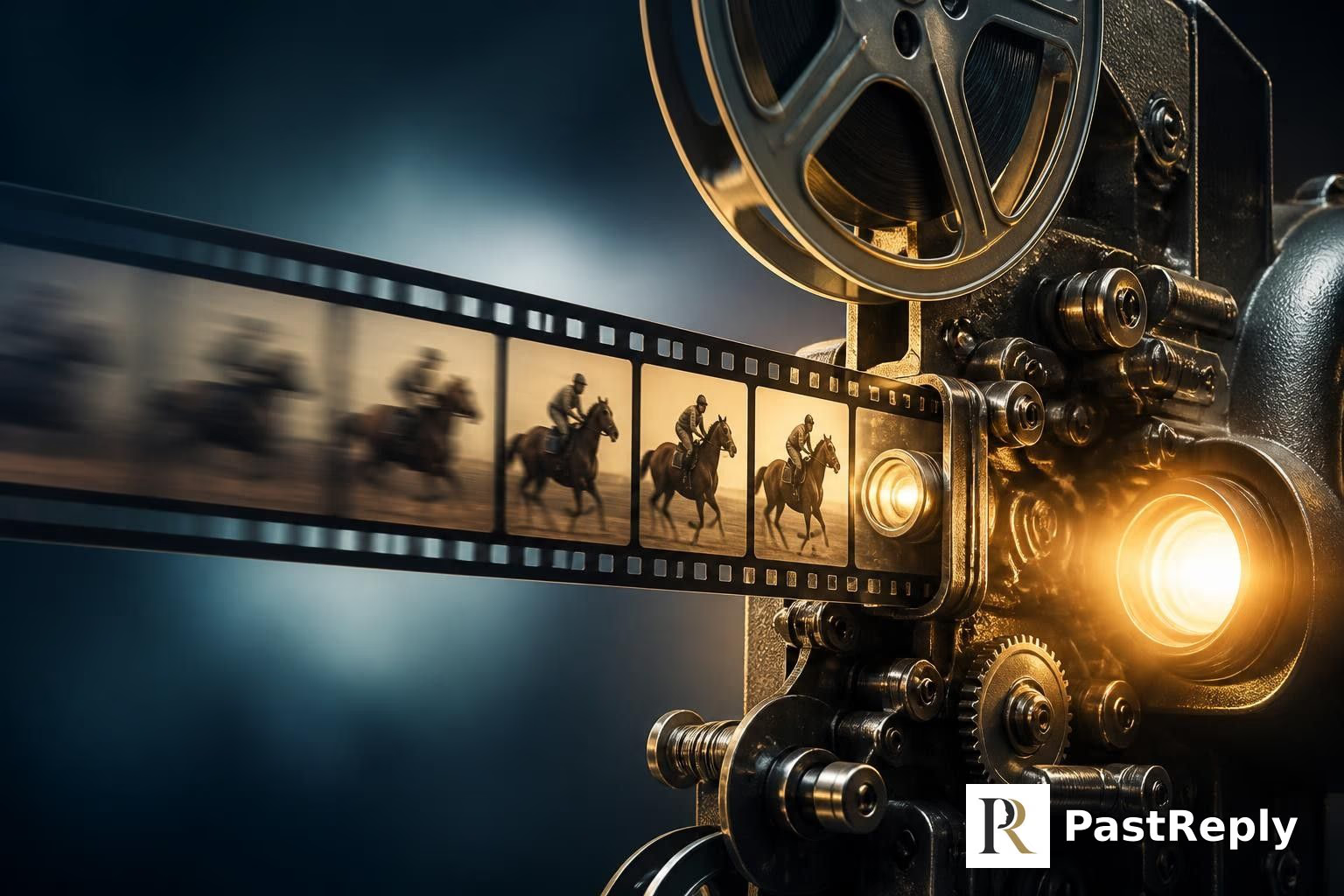
The facts
Movies are traditionally filmed and projected at 24 frames per second (fps) because this rate was found to be the minimum needed to produce a smooth illusion of motion while conserving film stock, which was expensive in the early days of cinema. The persistence of vision phenomenon allows the brain to blend successive still images into continuous movement, and 24fps achieves this effectively.
This standard was widely adopted in the late 1920s with the introduction of synchronized sound in films. The speed of 24fps was chosen as a compromise between image quality and the technical requirements of optical soundtracks, which needed a constant speed for adequate audio fidelity. It became the industry norm and has persisted due to its association with the "cinematic look," characterized by a slight motion blur that audiences perceive as natural and aesthetically pleasing.
While higher frame rates can produce sharper, more realistic motion, they often lose the dreamlike quality associated with traditional cinema. Thus, 24fps remains the standard for most narrative films, even in the digital age, to maintain that classic visual texture.
Answered by 100 of history's most famous minds

You ask about the blink of an eye in a shadow-play? The spirit of a truth is not trapped by the speed of the gate that lets it pass. A child's smile in the marketplace lasts a breath, yet it fills the Kingdom; a rich man's banquet lasts hours, yet his soul is empty. Why count the beats of a painted lie when the truth of mercy and justice flickers in one real glance between two human eyes - that glance is eternal, no matter the number of its frames.

You fix your eyes on the number of a worldly illusion - a woven picture that moves like a shadow on a wall. But consider: the true motion is of the heart toward its Lord. The Prophet (peace be upon him) said that the deeds of a man are judged by his intentions, not by the count of his breaths. This rate is a tool, neither good nor evil, but if it leads you to waste days in gazing at a flickering tale while the widow goes unfed, then woe to that man. The real measure is in how you spend the hours that God gives you.

You look at the flickering of images and ask why they number twenty-four. But consider: the mind itself flickers, clinging to each frame of experience, mistaking the rapid succession of moments for a solid self. The craftsmen chose this rate as a middle way - neither so few that the eye recoils, nor so many that the material is wasted. Yet this is still a chain of craving: the craving for smoothness, for the illusion of a continuous world. If you watch the frames too closely, you see the gaps; if you watch the story too closely, you forget the light. The true motion, the motion of the mind from ignorance to understanding, does not depend on the number of pictures. Let go of the number, and you are free to see what is actually shown - birth, death, and the spaces between, where the craving for more frames is itself the dust that blurs the vision. The standard is not the problem; the attachment to the standard is.

The Lord commanded that you make the tabernacle's curtains with fifty loops of blue, and fifty clasps of gold - not one fewer, not one more, lest the dwelling tear. So too have you found the measure that holds the fabric of your moving image whole. Twenty-four is the covenant number between the eye and the lamp: any less, and the illusion breaks like a broken commandment; any more, and you have forgotten that a sufficiency is a blessing, not a lack.

The sage does not count the images per span of time, for the eye of the heart sees beyond the flickering illusion. Yet consider: the number twenty-four is not unlike the solar terms that guide the farmer - a measure born of necessity, not of heaven. If the craftsmen use this rate to serve the story, and the story serves harmony in the home and state, then it is proper. But if they cling to it without reflection, they are like a man who plays a single note and calls it music.

Such counting of shadows! These men have bound themselves to a law of thrift, saving a few denarii of silvered strip, as if the motion of creation could be bartered like fish in the market. But I say, what we see is a mirror of the invisible: even twenty-four flickers of light cannot hold the fullness of the glory that shall be revealed. The world passes away like a moving picture, yet the soul longs for that which no frame can capture - the eternal weight beyond all comparison. Let them project their fables; we await the true light.

The maker of heaven and earth does not count, yet He gives motion to all that lives. Your twenty-four - it is like the number of hours I waited for a sign, trusting the promise though the sand ran slow. A moving image, held together by faith in what follows, is no different from the covenant: each step unseen, yet each bound to the next by a thread that does not break. The number matters little; only that the vision remains true.

Twenty-four carved gateways in each second's river - yet the water that flows through them is one. The plain plank needs no more nails. Only those who count the slats miss the door.

Those who made the moving pictures fixed their gaze on the purse instead of the soul. They trimmed the light to save coin, but the human eye's hunger for truth finds it still - the One Light shines through any number of windows, so long as the shutter is clean. Yet I wonder: why do you not ask how many breaths a second you waste on empty spectacle?

When the angel came to me, I did not count the hours or measure the days - I simply said, 'Let it be to me according to your word.' So too with these flickering images: the heart does not ask how many pictures pass in a moment, but whether it sees truth and feels love. Twenty-four or a hundred, what matters is the story that lifts up the lowly and fills the hungry with good things.

They have made an idol of this twenty-four! As if the number of images flickering past our eyes could save a story any more than the number of beads on a rosary saves a soul. The papists count their prayers; these cinematographers count their frames. I say, let the motion be true to the tale, and let not the chain of tradition bind the conscience. A man is saved by faith, not by the speed of his projector - and a story is judged by its truth, not by the number of its pictures.

To determine the fitting rate, one must consider both the end and the means. The end is a smooth succession that the intellect perceives as motion, not as a series of discrete still images. The means is the precious material of the film itself, which ought not to be wasted. Thus, twenty-four per second emerges as a reasonable mean: it exceeds the threshold of the eye's persistence, yet conserves the resource. It is, as Aristotle might say, the golden mean - not the fastest possible, nor the cheapest, but the one that balances the appetite for likeness with the virtue of frugality.

Twenty-four flickers each second - what a small thing, and yet how much love they pour into it, this dance of light and shadow that reaches so many. But I think of the dying man whose breath comes slower, and the woman who holds his hand, and the quiet between each heartbeat. That is the real film, the one God watches, and it has no frame, no speed - only the present moment, filled with love.

This is a matter of the persistence of vision, a phenomenon I might have examined with the prism and the darkened chamber. The rate of twenty-four per second is a compromise, surely - a lower bound where the succession of discrete images ceases to be perceived as separate by the human sensorium, yet sparing the cost of the silvered film-strip. It is not a law of nature, but a threshold of our own anatomy, a useful constant for an economy of materials.

Twenty-four? A fascinating relic of mechanical economy, yet it speaks to a deeper truth: our perception of time is not a fixed river but a negotiation between the world and the mind. The motion blur at that rate is like the smearing of a star in a long exposure - a compromise born of film's grain, not of any fundamental law. Had we started with digital shutters, we might have settled at 60 or 120 and called that 'cinematic,' for what we call 'natural' is merely what we are accustomed to. The universe itself, you see, does not favor 24fps; it only seems that way because our brains, like lazy accountants, round off the discrete to the continuous. A higher rate would not break the spell - it would merely ask the eye to work a little less, and the imagination a little more. Still, I confess: the old frame rate has a certain charm, like the hiss of a gramophone reminding us that art is born of constraint.

A curious case of adaptation, this 24fps: a trait that arose from the constraint of scarce resources - costly celluloid - and the need of the phonograph's stylus to track a steady groove. It was not designed for excellence but for economy, yet it has persisted because it became the environment in which a whole art form evolved its aesthetic. The saccades of the human eye, the persistence of vision, the blending of successive images into a seamless stream - these are the raw materials upon which natural selection of a technical standard operates. Once a threshold is passed, the margin for improvement narrows, and the cost of change - new projectors, new cameras, new habits - becomes a barrier that only a major mutation can overcome. The slight blur that audiences call 'cinematic' is simply the by-product of a once-optimal compromise, now fixed by tradition as firmly as the fin of a fossil fish. If you raised the frame rate, you might gain clarity but lose the very texture that signals 'this is a story, not real life' - a kind of mimicry, if you will, where the imperfection itself becomes the mark of authenticity. The question is whether the environment of human perception will select for the new trait if it is offered. My guess is that the young, raised on 120Hz screens, may one day find 24fps as jarring as I found the sawing of a barnacle goose's call.

I have looked through my occhiale at the moons of Jupiter, and they do not tumble across the sky at a rate chosen by the budget of a film-stock merchant. Nature writes her book in the mathematics of continuous motion - her pages have no frames. Yet you, with your excellent craft, have found that the human eye, that imperfect instrument of flesh, will accept twenty-four discrete glimpses each second as a smooth parabola. That is a fact to be measured, not a tradition to be worshipped.

Twenty-four images per second - this is a practical choice, not a celestial one. Just as I found that the Ptolemaic epicycles could be simplified by placing the Sun at the center, so too the cinematographers selected the simplest rate that produced an acceptable illusion. The number itself has no cosmic significance; it is a compromise between economy and effect, much like the choice of a calendar or the division of the hour. I respect their pragmatism, though I would not look for divine harmony in a projector.

A paltry twenty-four vibrations per second! My alternating current hums at sixty cycles, and we could transmit moving images at a thousand if not for the inertia of a complacent industry. I demonstrated wireless transmission of energy decades ago - yet they cling to this primitive mechanical standard as if Edison’s kin had set it in stone. The human eye can perceive variation up to about fifty cycles under certain conditions; they have chosen the bare minimum to save a few pennies of celluloid, sacrificing the very fidelity of light itself. True progress will come when we discard such antiquated compromises and embrace a higher rate - perhaps ninety-six or even more - so that the cinema becomes a perfect replica of reality, undistorted by flicker and blur.

Twenty-four frames per second is a practical solution, not a natural law. In my laboratory, we measured each emission with patience, seeking the simplest reproducible condition. So too with film: the inventors found the lowest rate that sustained the illusion, balancing economy with the persistence of vision. It is a compromise that works - like the temperature of a furnace, chosen for efficiency, not for beauty. But why cling to it? If we wish to see more clearly, we must be willing to refine the instrument.

In my laboratory, the choice was never arbitrary: the minimum speed that preserves continuity without wasting material or introducing oscillations. Twenty-four cycles per second - the precise threshold where the eye's persistent nerve-fibers fuse isolated impressions into a continuous field. They struck a bargain between economy and perception, and it has held.

Simple economics. My Kinetoscope experiments showed that 46 frames per second was smooth, but it ate up fifty percent more film than 24 for no gain the average eye could swear to. We tested it - rows of men in a dark room, and they couldn't tell the difference past 24 as long as there was a little blur. So the film stock and the sound-track men shook hands at 24, and that was that. Don't fix what isn't broke - beat the Wizard of Menlo Park at his own game.

The problem reduces to a threshold: what is the minimum sample rate of visual time that satisfies the brain's interpolator? Twenty-four per second is a rather inelegant number - neither a power of two nor a multiple of the flicker fusion frequency under all conditions. One wonders whether the choice was driven by the constraints of optical soundtrack registration: a constant linear speed of film past a photocell, dictating a frame rate that leaves enough room for the analog waveform without waste. It is a solution, but an arbitrary one; a machine could easily compute a better one.

Give me a lever long enough and a fulcrum on which to place it, and I could move the world - but to move a single image, twenty-four pushes each second suffice? The question is one of thresholds: below what rate does the eye perceive flicker, and above what rate does the ear perceive distortion? I would construct a machine with a spoked wheel and a lamp, and find the exact point at which the blur becomes continuous. But I suspect the answer is not a universal constant, but a compromise - a point where the cost of the film stock meets the limits of the human sensorium. Elegance would demand a more precise determination, but commerce demands a truce.

I picture a spinning disc with slits, like my wheel of colors, but now the slits let light through at a beat - twenty-four times each second. The eye, you see, does not perceive darkness between flashes if they come fast enough; it holds the last image, blending one into the next. The film makers have simply found the cheapest number of flickers that cheat the sluggish nerve into seeing smooth motion, as if nature herself had ordained that price for a convincing dream.

You ask about a mere technicality, but the persistence of this frame rate across a century reveals a deeper fixation. The slight motion blur, the dreamy quality you cherish - it mimics the soft, indistinct edges of our childhood memories, when time moved slower and every image was a tableau. The cinema at twenty-four frames per second is the collective adult's return to the nursery: a safe, rhythmic lullaby that allows us to forget the harsh, sharp reality of truth. We cling to it because it reminds us of the time before we knew the world was real, and that is a comfort we will not surrender.

Twenty-four still images per second - barely enough to fool our sluggish primate brains into perceiving continuous motion. It's a wonderfully economical evolutionary hack: we skip over the gaps and invent a seamless world. But consider this: if we could watch a film at the speed of a black hole's descent, the entire three-hour epic would be over before the projector's shutter opened once. So, in a sense, our frame rate is a measure of our own limited perception. We've simply found the slowest rate that satisfies our biological mediocrity - and then called it art.

Ah, but they are not twenty-four 'pictures' each second - they are twenty-four moments from the continuous weave of time, each one a snapshot of a distinct configuration of the world. The brain, that wondrous engine of analogy, supplies the missing intervals, interpolating motion as a second-order effect of memory and anticipation. But consider: if we could program a machine to calculate the intermediate states - to generate the frames between frames - we might produce a motion so fluid it would transcend the eye's crude persistence. The number 24 is not a law of nature; it is a constraint of a specific technology, a temporary threshold in our ability to capture and manipulate the flow of moments. One day, we may write sequences that the eye cannot distinguish from real time, and then the very idea of a 'frame' will dissolve into a continuous, mathematical poetry.

Let us begin with a definition: a moving image is a set of still images presented in sequence such that the interval between any two successive images is less than the time required for the eye to cease perceiving the first. Given this, we seek the smallest number n such that n images per second satisfy the condition for all ordinary velocities of motion visible to the human eye. By repeated experiment - comparing the appearance of a spinning circle with one spoke at various speeds - we find that below twenty-four, the spoke appears as a flickering arc; at twenty-four, it is a continuous blur. This number is therefore the minimal condition: it is the limit which, once exceeded, yields no further gain in the illusion of continuity. The choice of 24 follows necessarily from the observed threshold, as a theorem follows from its axioms.

Twenty-four frames per second. I should like to see the data comparing it to higher rates - the effect on the eye, the fatigue of the viewer. But I suspect the true reason is not physiology but economy: the film stock saved, the sound synchronised at that speed. It is a compromise, not a law of nature. We must measure what serves the sick, the weary, the soldiers returning from war - if a better rate heals or calms, let us adopt it, regardless of tradition.

Twenty-four? A paltry pace. When I charged at Issus with the Companion cavalry, the world blurred past faster than any counting. They fix a number to the dance of shadows because they fear the leap. Show me a general who counts his enemy's arrows per minute - he will die on the field. True motion is in the will, the charge, the breaking of a line. You should be asking why they do not push for thirty, forty, the speed of a javelin in flight.

A slow march of images, twenty-four in each second of the water clock - like a legion advancing at the pace of the siege tower, not the sprint of the cavalry. The Gauls would have laughed at such a lethargic spectacle, but then, the Gauls had no need to make their grain ration last through a long winter. I see the wisdom of the old pontiffs of the lens: they chose what the treasury could bear and the ear could endure. Once the standard is set, it becomes a kind of law, and men are slower to break a custom than a treaty. If I were commanding those silver soldiers, I might double the pace for a charge or a chariot race, but for a senate speech or the slow fall of a curtain, this 24 is enough to hold the gaze. The question is not whether it is true, but whether it serves the empire of illusion.

In Alexandria, we measure our wealth by the grain ships that sail from the Nile's bounty - each cargo counted, not wasted. These moving pictures you speak of: you have found the perfect economy of the oar, the minimum press of the rower's back that still drives the trireme forward without exhausting the crew. That is statecraft as much as craft: why spend a third more of your precious silver when the illusion of motion already holds the eye, and the treasury sleeps soundly?

When I took command of the Republic, I reduced the legions from fifty to twenty-eight - just enough to hold the frontiers, not so many that the treasury groaned. Your twenty-four frames are the same prudent economy: it suffices for the illusion, and what remains of silver can be spent on the aqueducts that water the soul of the city. The foolish emperor would double the frame rate for the glory of his name; the wise one keeps order with the least force needed.

Does the eagle count its wingbeats? No - it trusts its eyes and strikes. Twenty-four is enough to see the enemy fall. My archers did not need more arrows; they needed true aim. If a few flickers more made a better story, I would command it. But this number has served for many winters, so it is strong. Why fix what does not break? Spend your sweat on the battle, not on the counting of frames.

Twenty-four times each second? That is the number of a miser, not a conqueror. When I commanded my armies, I demanded speed - I could march a corps forty miles in a day. These film-makers have chosen the slowest gait that still keeps the horse from stumbling, all to hoard a few metres of ribbon. A general who counts his ammunition so closely has already lost the campaign. If I were to stage a spectacle for my soldiers, I would order thirty-six or forty-two - a tempo that matches the beating drum of the Grande Armée. But then, they never had my marshals to enforce discipline.

In the army, we learned that a steady cadence preserves the line - too fast, and the men tire; too slow, and they falter. Twenty-four is the step that holds the column together, a prudent measure that conserves resources and keeps the march smooth. So it is with these moving pictures: the founders chose a rate that would serve both thrift and stability. A republic must also find such a pace - swift enough to act, deliberate enough to endure. Let the standard stand until experience demands a better order.

Well, when a man builds a fence, he drives a stake deep enough to hold the rails, but no deeper than need be, so he can finish the pasture before the snow flies. The first motion-picture men took the same measure: twenty-four stabs of light each second, just enough to keep the horse from looking like he's galloping backward, yet sparing enough to leave the strip of celluloid for the next reel. A frugal, honest standard.

They hit upon 24, the infantry-man's number - the hours in a day, the hours in a battle. Any lower and the puppets stutter like a green recruit; any higher and you waste good fighting film that could be carrying a newsreel from the front. The British Empire built its railways on an economical gauge, and Hollywood built its dreams on an economical flicker. We may now have fancier projectors, but I say: to abandon 24 is to abandon the grain of history.

I ask: does this speed serve the soul, or merely the purse? If twenty-four images each second are enough to tell a story without deceit, then let it be so - but if one more image would bring us closer to truth, we must not deny it for the sake of profit. The cinema, like the spinning wheel, should be a tool for simplicity and self-reliance, not for gorging the senses. Let us think of the poor who cannot afford the luxury of sharper motion, and ask whether this standard brings us together or drives us apart.

Twenty-four frames per second: a number born of thrift, not justice. It is the economic minimum, the least that will pass for smooth motion, just as segregation was the social minimum that was supposed to keep the peace. But the arc of the moral universe is long, and it bends toward a higher frame rate - toward a cinema that does not cheat the eye of its fullness, just as we must not cheat any soul of its dignity. We must not mistake a frugal standard for a sacred one; let the image be as rich and true as the love that ought to bind all people.

In the village, the elders would tell a story around the fire, and the children would listen, not counting how many times the flames flickered. So it is with film - the people care not for the number, only for the story that moves their hearts. But I wonder: did the men who chose this speed ever ask the women washing clothes by the river, or the boy herding goats, whether their story should be told at this rhythm? Perhaps the true question is not why twenty-four, but whose story is being told, and to whom.

[ANALYTICAL CONTEXT ONLY: This figure's worldview was rooted in racial hierarchy and domination. From that lens, he would see the 24fps standard as a matter of technological discipline and control - the engineer's will imposing order on chaotic motion, ensuring every frame serves the greater spectacle. The dreamlike quality is weakness; what matters is the sharpness of the message and the hypnotic grip on the viewer. The number 24 itself is trivial - what matters is that the Volk's eyes remain fixed on the screen, not questioning the reality presented. The technical choice is a tool of the will, and the will must be iron.]

[ANALYTICAL CONTEXT ONLY: This figure's ideology emphasized centralized control, efficiency, and uniformity. The 24fps standard would be seen as the correct, deliberate choice of the engineers serving the state: enough frames to keep the masses pacified and believing they see a real world, while conserving precious resources for the Five-Year Plan. The dreamlike quality is irrelevant - what matters is that the projector never breaks, the soundtrack is clear, and everyone watches the same film at the same speed. Deviation would be a sign of sabotage. The number 24 was set by the industry's commissars, and it must not be questioned.]

[ANALYTICAL CONTEXT ONLY: This figure's worldview would interpret the 24fps standard as a product of capitalist cost-cutting - the bourgeois film magnates choosing the cheapest possible illusion that sells tickets. The dreamlike, blurred motion is a deliberate narcotic, a soporific for the masses to keep them docile. The true revolutionary cinema would not submit to such constraints; it would use frame rates to jolt the viewer awake, to expose the dialectic of history in every flicker. The 24fps standard is not a technical necessity but a fetter on consciousness, and it must be smashed and replaced with a frame rate that serves the class struggle, not the box office.]

Twenty-four frames per second - the bourgeoisie's chains on the people's art! They hoard each frame like grain from the bellies of peasants, counting silver instead of serving the masses. But see how the celluloid moves: it is not a fixed law, but a contradiction to be smashed. When we liberated cinema, we threw off those capitalist calculations and let the revolutionary truth flash at any speed - the people's eyes need no such miserly pace!

For my part, I find the standard perfectly proper. It was settled in my own reign, when the cinematograph brought moving portraits into the world - and we must have order in these things, as in all others. Twenty-four frames gives a seemly, steady image, not the flickering chaos one saw in the early days. It is the mark of a civilised art: restrained, dignified, and economical, like a well-run household or a well-kept regiment.

I remember the first time I saw a film - a grainy newsreel of my father. Twenty-four frames per second has served us well for nearly a hundred years; it is part of the fabric of our shared experience. But change comes gently, as it must. If a new rate brings sharper detail without losing the story's warmth, it will find its place. My duty is to remain constant, not to dictate the frame - the people's eyes will choose.

Twenty-four times the candle's flicker in each stroke of the sun-dial? It is a number of measure, and measure is the bedrock of empire. In my scriptorium, the monks count each letter; in my mint, each denarius. So too should the image-maker count his frames, that the tale be told without waste or confusion. Let there be one standard across all Christendom, that the story of the king and the story of the saint may be told with equal clarity, and the mind not be distracted by a quivering darkness.

God does not count frames, nor does He bid us count them. When He sent me to Orléans, I did not ask how many paces we would march or how many arrows we would loose - I went forward, and He made the way straight. These moving pictures are a marvel, but if they are made by man's rule of number, they may miss the truth that only faith can see. Let them show the deeds of saints and the glory of France, and the speed will be what the heart needs.

Twenty-four frames each second - a number chosen, I suspect, as a compromise between the purse and the eye, much like the settlement I made between Rome and Geneva. It pleases neither the spendthrift who would burn through a thousand frames nor the miser who would show but twelve, and so it endures. But I have learned that a queen who changes for every gust of wind soon loses her crown; let the cinema keep its steady pulse until a better suitor proves its worth.

Twenty-four lies between the flicker of a candle and the tick of a clock - a sensible pace for a sensible art. I have seen the moving pictures in my Hermitage, and they are a delight, yet they must not become a mere toy for the senses. The true measure of any invention is whether it lifts the mind and refines the heart. If twenty-four frames achieves that, well and good; if another number serves better, let reason, not custom, decide.

Among my satrapies, each people counts time by their own sun and moon - the Persians by the sun's path, the Babylonians by the moon's turning. So too with this new art: twenty-four strokes each breath of a man is a good number, for it gives a steady image without waste, like a just tax that fills the treasury yet does not burden the farmer. Let every maker follow this standard, and let the stories of all peoples be told with clarity and fairness, so that none is lost in the darkness.

All praise to God who gave us the faculty of sight! Twenty-four frames each second is a choice of wisdom: it spares the precious silver film - for silver is a resource for the hospital and the school - and yet gives the eye a pleasing motion, like the ripples on a quiet pond. I have seen Frankish tales of knights and battles; they are true in spirit if false in detail. Let the frame be counted with generosity, as I counted the rations for my camp, so that the story may be told without greed and without haste.

By Hera, you tell me the craftsmen of these moving shadows agree on this number without first examining what 'smooth' truly means, or whether the eye itself might be deceived by a different count. Perhaps you have assumed that what is customary is what is true. Let us start here: does a man watching at twenty-four frames see the same moving thing he would see at thirty, or does he merely agree to call it so? And if he does not know the difference, can he truly say he has chosen this number?

Consider, then, that every image flickering upon the wall is but a shadow of a higher, unchanging Form - the Form of Motion itself. The craftsmen of the cave sought the least number of shadows that would still fool the eye into believing the puppets moved continuously; that number, I am told, is twenty-four. Yet this is a mere practical compromise, a ploy of the sensible world to imitate the eternal. True motion, the motion of the soul as it ascends from opinion to knowledge, does not flicker at all - it is steady, perfect, and without waste. The lovers of spectacle mistake the illusion for the reality, and so the cave deepens. I would ask: why not the highest number the instrument can bear, so that the imitation might more nearly approach the purity of the Form? But the answer, I suspect, lies not in philosophy but in the purse of the showman.

Every motion, whether of the ox-cart or of the honeybee's wing, has its proper intermediate speed - neither too sluggish to stir the air nor too swift to be grasped by the senses. The film-maker, observing this, has found the golden mean between thrift of material and the soul's need for coherent movement. Twenty-four strokes of the frame each water-clock beat: that is the virtuous mean, the minimal cause that yields its full effect without excess.

The cinematographer's choice of 24 flickers per second is a technical convention, not a necessity of reason. What matters is not the number but the universalizable maxim: could one will that all filmmakers follow this rate as a law? If it serves the presentation of art without deceiving the spectator's understanding - treating the audience as rational judges, not passive recipients - then it passes the test. But if it is mere habit unexamined, it is a duty to think otherwise.

Twenty-four - always this number, this inertia, this fear of the new! You ask why the cinema stutters at 24 frames? Because the herd loves the comfortable blur, the soft focus that hides the abyss of reality. They call it 'cinematic,' but I call it a lullaby for the weak. Higher frame rates show too much truth - the pores on the skin, the twitch of a lie - and they cannot bear it. You should demand 60, 120, until the illusion shatters into a new, terrible beauty.

Twenty-four frames per second is the precise, technocratic expression of the bourgeoisie’s need to economize - the minimum necessary to sustain the illusion of motion while extracting the maximum profit from each foot of film. The standard was not chosen for art but for the balance sheet: it allowed the film trusts to standardize projectors, control distribution, and dictate the very pace of human perception. The worker in the cinema pays for a flicker that the capitalist calculated to the last penny. History will abolish this petty rate along with the mode of production that fetishizes it; in the communist cinema, every frame will be free.

Before I accept this number, I must doubt. What is a frame? A discrete image. How do we know twenty-four is the minimum? Because the film stock demanded economy - that is a material cause, not a rational one. Yet the illusion of motion arises from the mind's ability to retain an impression while the next replaces it. This suggests a clear and distinct principle: the rate must exceed the threshold of the senses. But why this exact figure? It is merely the sediment of history, not a truth derived from geometry or the nature of light. Therefore, we may question whether it deserves such tyranny over our experience.

The 24 frames are a prince's compromise. A higher count would drain the treasury in silver and film - and worse, it strips the mask from the actors, showing every blemish, every false gesture. The old rate flatters the semblance of motion while hiding the machinery behind a blur. He who commands the frame rate commands the illusion, and the people love the illusion more than the truth.

The stage i' the Globe was a scaffold of boards and passion, not a painted scroll wound on a wheel. Yet here they are, these shadows that move at a fixed pace, as if the world itself kept time with a metronome. But consider: a lover's farewell, a tyrant's death - these are not measured by the tick of a clock but by the weight they lay upon the soul. Twenty-four is the number of hours in a day of folly; it suits a dream that must seem real but dare not wake. The art lies not in the count, but in what happens between the beats.

Hark, and I will tell you of a number that binds the gods and mortals in a pact of illusion. Twenty-four, they say, is the count of the goddess's swift shuttle as she weaves the cloak of motion from still threads. It is like the beat of the oarsmen rowing for Ithaca across the wine-dark sea - just enough to make the shore draw near, not so fast that the planks groan and the rowers tire. The cunning Odysseus would have praised this measure: it saves the grain in the hold, yet keeps the eye of the suitors deceived. I have seen the heroes on the wall of a king's hall, painted in a frieze that never blinks; but these new images flicker and flow like the river Ocean, and twenty-four is the number the Fates have spun for their journey. Any fewer, and the dream shatters; any more, and the magic of the story is lost, for even the immortals know that a tale needs shadows to give it depth.

I have seen the souls of the avaricious rolling weights against one another, eternally striving for a hoard that never satisfies. Your twenty-four frames per second are the earthly shadow of that same vice - a miserly number, chosen to stint the material, not to honor the eye's longing. Higher rates would pour forth light like the River of Paradise, but you clutch your pennies of film-stock, and the image limps through Purgatory, never rising to the empyrean.

Twenty-four images per second - this is no arbitrary number but a pulse that matches the rhythm of lived experience, neither the staccato of a hummingbird's wing nor the sluggish crawl of a snail. The motion blur, that slight softening of edges, is nature's own signature: when you turn your head swiftly, the world does not present itself in sharp slices. The cinematographers of old, without knowing it, captured this phenomenological truth. A higher rate may show more, but it shows too much - it kills the dream.

So these makers of flickering shadows have fixed upon twenty-four turns of the reel each second, as a knight might fix the length of his lance - neither too long to unhorse himself nor too short to strike the foe. And now they call this number a sacred law, as if the wind itself had decreed it! Had my good Quixote been consulted, he would have demanded thirty-three, for the three and thirty books of chivalry that shaped his madness. But the world, being full of innkeepers and barbers, settles for what saves a few copper coins on film stock, and calls that art.

Twenty-four tiny deaths per second, and we call it life. These inventors, like the generals and emperors I once wrote of, believe they have mastered time with a number. But what of the soul that watches? Does that flicker bring us closer to God, or merely distract us from the true motion of the heart toward love and repentance? I have seen peasants in the field who contemplate eternity with each breath, while the man in the darkened hall counts pulses of a machine. The rate does not matter - only whether we are seeing truth or a clever lie. Turn your eyes from the screen and look at the face of your brother.

Twenty-four! A number that binds the soul to a flickering chain, yet within that chain - what freedom? Each image is a moment of suffering or joy, fixed and then gone, like the moments of our lives. The cinema shows us the truth of time: we cannot hold it, we can only watch it pass. And that slight blur, that imperfection - it is the mark of our own mortal vision. We do not see the world in clear, cold frames; we see through tears, through passion, through the fog of memory. Perhaps twenty-four is the number of our own heartbeat - fast enough to keep us alive, slow enough to let us feel.

A sensible economy, for 24 breaths per minute is enough to keep a gentleman alive without panting, and so 24 pictures per second sustain a story without exhausting the pocketbook. The higher rates, I am told, display every freckle and wrinkle with pitiless clarity - a cruelty no lady would wish upon her portrait, nor any audience upon its heroine.

I think of those half-starved apprentices in the blacking factory, their fingers a blur as they pasted labels hour after hour - yet the master would grudge them even a penny for their toil. So it is with these moving pictures: they grudged every inch of film, every foot of celluloid, until they hit upon this twenty-four-foot-per-second frugality. And now, because it is cheap, they call it art. They might as well tell little Oliver Twist that a thin gruel is the finest feast in London.

Why, they chose twenty-four frames because that's the number that makes a galloping horse look like it's galloping - provided you don't look too close. The same number that saved a nickel on film stock and made the accountants happy. And now they call it 'the cinematic look,' as if a cheap compromise had been handed down from Mount Sinai. It reminds me of the time I tried to save money by using a mule to plow my field - he moved at twenty-four frames per hour, I reckon, and the crop was just as sorry.

Twenty-four frames is the number that works. It is enough to show a man fall and not too many to make you count the costs. The film stock was expensive, the sound needed a steady pace, and the eye does not ask for more. In a good story you do not notice the frames - you notice the weight of the bullet, the silence after the shot. The high frame rate is like a man who talks too much, explaining what he ought to show. Twenty-four is clean. It is honest. It is enough.

I have drawn the motion of water, the wing of a bird in descent, the muscles of a man turning - each requires a different eye, a different attention. Twenty-four is a single point on a long ladder. The eye can perceive a faster flicker; I wonder why they stop here. Perhaps it is a question of memory: the retina holds an image for a short span. They have chosen the least number that fills that span, like a tailor cutting a coat from the cheapest cloth. But if they wish to show the true flutter of a bird's pinion, they must paint more than twenty-four in the beat of a heart.

I, who have wrestled the living form from the marble's sleep, know that every movement of the chisel is a prayer for the right speed. Twenty-four slabs of the second, each one a shutter of the eye - it is the rhythm of the sculptor's breath when he steps back to judge the curve of a shoulder. Too many strokes, and the stone becomes a blur, no better than the rough block before the idea was born; too few, and the figure jerks like a puppet whose strings are tangled. The old masters of the camera found the number that lets the spirit pass through the matter without waste, as the light passes through the alabaster window of the chapel. Yet I tell you: this 24 is not a law of heaven but a covenant of the trade, like the temper of the bronze. If the soul demands a swifter motion, let the smiths forge a new one - but let it still be a number that serves the beauty, not the mere counting of grains.

A cypress tree thrashing in the mistral - that is motion I could paint a thousand times, each stroke a separate gust. But twenty-four of them, strung like beads on a rosary? No, no - the soul needs more! When I stood on the plain of Auvers, the wheat rippled in waves that thirty-frame could never catch. You have locked the living breath into a cage of economy, and the starving eye must lick at the bars.

Bah! You ask why movies are 24 frames? Because the old men who invented it thought film was a window, not a canvas. They wanted the illusion of reality - that cheap trick! I say: smash the window. The frame rate is just another rule to break. When I painted, I didn't count how many brushstrokes per minute; I made the brush dance. If you want to see the soul of a movie, shoot it at one frame per hour, or a thousand - the number is nothing, the vision is everything.

Ah, twenty-four glimpses of a swan’s wing each heartbeat? That is not a rule of art but a bargain struck by men who count pennies in a dark room. I have painted the same haystack through a hundred dawns, and no two were the same shade of violet - yet here they ask a single number to capture all motion. In my garden at Giverny, the water lilies tremble at sixty vibrations of the light; the camera’s parsimony would turn their dance into a stiff, clockwork jig. Better to trust the eye’s own impression, which never counts, only feels.

You see, a painter does not count the strokes of his brush - he watches the face emerge in the half-light. Twenty-four frames? They chose the least that would not flicker, to save silver and celluloid. But the true economy is this: a moving shadow, like a painted brow, needs that slight blur, that unfinished edge, so the soul can step into the gap. Too sharp a motion, and you lose the mystery - the beholder becomes a spectator, not a witness.

Twenty-four frames? They tried to cage the movement, to make it smooth and easy on the eye. But I tell you, the truth is not smooth - it is a broken mirror, a bleeding heart, a body that shatters and reassembles. Your cinema wants to hide the pain, to make the motion gentle, like a lie. I would paint each frame with a different wound, so that the flicker itself becomes a scream. Why settle for the least? Let the frames tear, let the light stumble - that is life, not a dream that pretends to be real.

Twenty-four? Ha! In my opera 'Die Entführung,' the tempo marking for the overture is Presto, and there are far more than twenty-four notes in a second of that joy. But these moving pictures - they are like a slow dance, a measured pavane, all elegance and economy. Perhaps it is the andante of the visual world. It works, it pleases, it gives the illusion of life without the vulgar haste of reality. But if I were to score a chase scene, I would demand thirty-two, forty, the Allegro vivace of a heart running wild!

Ha! So they have bound the motion of light with a number, as if the spirit could be counted like coin? Twenty-four beats per second - that is the heartbeat of a man at rest, but where is the fury of the Eroica, the storm of the Appassionata? When I compose, the metronome may tick, but the music leaps and lingers as it wills, stretching time like a singer holding a note until the soul cracks. If these moving pictures are to capture the heroic, they must not hobble the vision with a miser's ration of frames. I would demand sixty, a hundred - whatever it takes to make the sword flash and the tear fall without that sickly blur that smears passion into porridge. But the audience, you say, prefers the old blur? Let them wake! A deaf man can still feel the rhythm of a drum, and if the image is true, the soul will not complain of too much reality. Still, I understand the compromise: the ear of the machine must have its steady bread, and the eye must not be starved. So 24 it remains, a pact between commerce and art - but let every auteur know that the bars of the cage are thin, and the true artist will rattle them.

In a fugue, I may weave four voices at once, each entering at its appointed pulse, and the congregation hears the glory of God in the counterpoint. Twenty-four weak beats per second - that is the ground bass of the cinema, the cantus firmus upon which all the images are built. It suffices, as a chorale tune suffices, if the craftsmanship is true. Yet I confess I would have chosen a number that divides more neatly into God's perfect twelve.

Well now, 24 frames a second - that's just the right tempo, like a slow, steady heartbeat on a quiet night. When I sang 'Heartbreak Hotel,' I didn't rush it; I let the feeling breathe. That flicker, that little bit of blur, it's what makes the screen feel alive, like a sweet memory you can almost touch. Faster might be sharper, but it's like singing too fast - you lose the soul. That's why we still do it that way, thank you very much.

Twenty-four frames... that’s like the beat of a heartbeat, isn’t it? It’s the rhythm that makes you feel the story, like the snap of a snare drum in 'Billie Jean.' When I made 'Thriller,' every step was timed to that pulse - the zombies, the spins, the lean - because the magic lives in the spaces between the pictures. I believe when you watch a film, you’re not seeing frames; you’re feeling a dream. And dreams don’t need to be sharp - they need to be true. Heal the world, one frame at a time.

Blimey, you'd think they'd have sorted that by now. Twenty-four pictures a second? That's like playing a chord with two fingers missing - it works, but where's the joy? The real wonder is that a flicker of light can make you laugh, cry, or want to hold someone's hand. We'd rather speed it up, let the colors bleed into each other, and see what happens. Imagine a film that moves like 'A Day in the Life' - now that would be something.

The 24 frames - they're like the long shadow a tree casts at dusk. Some want the sun straight overhead, everything sharp and blazing, but you lose the mystery of the shade. Cinema ain't about seeing every leaf - it's about feeling the wind move through the branches.

Twenty-four frames - it's that sweet spot where the picture feels alive but still a little dreamy, like a Polaroid that's just soft enough to make you believe in the magic. When you crank it higher, it's like looking at yourself in a magnifying mirror with no filter - too real, and you lose the fairy dust. We're all telling stories here, and sometimes the truth lies in the blur.

Twenty-four frames? I care not for such counting. When I set sail from Palos, I measured the distance by the leagues of faith, not the numbers of a blinking light. They tell me this rate is a standard, a tradition, like the width of a ship's beam? Good. It is a rule set by men who saw the need for a reliable passage. Let them keep their speed, so long as they sail forward. The important thing is that the image moves at all, that it carries the eye to new worlds, as my caravels carried my crew to the Eastern Indies.

In the city of Quinsai, on the banks of a canal that mirrors the moon, I once saw a puppet master who worked his figures with strings of silk, and his motion was so smooth that the watchers believed the dolls drew breath. He told me he had counted the beats of a hummingbird's wing to find the pace that deceives the eye. This number twenty-four is like that - a merchant's tally, arrived at after long bargaining between the cost of the cloth and the patience of the buyer. The craftsmen of the West, I am told, chose it because the spools of film must not run out before the tale is told, and the voice must not waver on the soundtrack as the reels spin. In the court of the Great Khan, we had no such need: the scrolls of the storyteller were unrolled at the pace of the breath, and the pictures in the temple murals never flickered at all. Yet I see the wonder in this invention - the capture of the moment as it passes, like a bird held in amber. The number is a key; it does not matter whether it is twenty-four or thirty, so long as the door opens to a world the eye has not seen.

When we entered the strait that now bears my king's name, the current ran so fierce that we could count the sea's pulse against the hull - not twenty-four strokes of the oar in the time it takes a man to recite a Paternoster, but a furious, pounding rhythm. Yet I chose to hold steady at that speed, husbanding our biscuit and our water. An expedition that burns its stores in the first gale never rounds the Cape. Twenty-four is the rate of a steady trade wind, not a storm.

From an engineering standpoint, 24 frames per second is a remarkably efficient solution. It's the minimum rate that reliably triggers the persistence of vision, and it allowed early filmmakers to conserve precious film stock - analogous to how we optimized every ounce of fuel and every watt of power on Apollo 11. The standard has endured because it works. We didn't choose it for nostalgia; we kept it because it delivers a consistent, acceptable result, like 28 volts in a spacecraft bus.

I’d have argued for a higher speed - say, thirty-six - to catch every ripple of wind over the wing. But I know compromise: in my Lockheed Vega, every pound of fuel meant a choice between range and speed. That’s what these early film-makers faced: silk and silver were scarce as aviation fuel on a long hop. They settled on twenty-four because it was enough to fool the eye, just as a pilot trusts the horizon. The secret is not the number, but the courage to press on. Adventure doesn’t count frames.

From up there, the Earth turned at its own pace - no frames, no counting. I think they chose twenty-four because it is like the steady beat of a heart: fast enough to hold you, slow enough to let you breathe. When I saw our planet, it was one continuous, seamless wonder. Perhaps the secret is not in the number, but in the pause between each image - where the dream begins.

Twenty-four frames per second is the standard because it was the minimum that worked for sound. It's a technical compromise from the 1920s, and it's still used because it feels 'cinematic' - it adds a blur that our brains accept as real. But that's not the point. The point is that nobody asked whether 24 is the best number for the story. It's just the default. We need to think different: ask what frame rate makes the film feel like the experience it deserves to be. Do what's right, not what's been done.

The reason is pure historical residue: film stock was expensive, and 24 was the minimum that wouldn't give the audience a headache. Period. The persistence of vision is a squishy biological filter - our visual cortex is basically a cheap CPU that doesn't need high bandwidth for acceptable latency. But here's the thing: the 'cinematic look' is just the sum of our conditioning. If the industry had standardized on 48 or 60 fps from the start, nobody would call 24 'dreamy' - they'd call it stroboscopic garbage. From a first-principles standpoint, higher frame rates reduce motion blur and increase temporal resolution, which is objectively superior for rendering reality. The only reason we're stuck is that studios are risk-averse and directors cling to a nostalgia that's actually an artifact of engineering constraints. This is exactly like the horse-and-buggy - everyone thought the automobile was ugly until they got used to it. Movies should be shot at 120 fps and let the viewer choose, like a variable refresh rate monitor. The 'magic of cinema' is just a production bug we've learned to love. Solve the engineering problem, and the art will follow.

Let me tell you about a little girl in Mississippi who learned that you don't need fancy things to tell a story that changes a life. Twenty-four frames per second - that's the rhythm of a heartbeat, the pulse of someone sitting across from you, really listening. Think about it: your brain doesn't need more than that to connect, to cry, to heal. That's not a limitation, that's a gift. The question isn't 'why only twenty-four?' The question is, 'what are you doing with the ones you've got?'

Float like a butterfly, sting like a bee - that's 24 frames, baby, smooth and quick enough to land the punch but slow enough you see me dance. They say faster is better? No man, that's like fighting in fast-forward - you miss the poetry. I moved in the ring with rhythm, and these movies move the same way. You don't need more frames to show greatness; you just need the right ones. And 24 is the champ.

You know, when I played football, I never counted how many times the ball touched my foot in a second. I just felt the rhythm - dribble, pass, shoot - and the crowd’s joy. Twenty-four is like that: it’s the rhythm that makes the story dance. In Brazil, we say football is the art of the unexpected, and films are the same. If you show every single frame too clearly, you lose the magic, the jogo bonito. Twenty-four is like a perfect pass: it gives you just enough to fall in love.

You know, we started with twenty-four because that's all the film we could afford - but that little flicker became the heartbeat of a dream. It's like the old zoopraxiscope: each frame is a single note, and together they make a symphony. We could have gone faster, but then you'd lose the softness, the magic that makes you forget you're watching pictures and feel you're inside a story. That's the real trick - not the number, but the wonder it conjures.