
Why are Iran and Israel fighting?
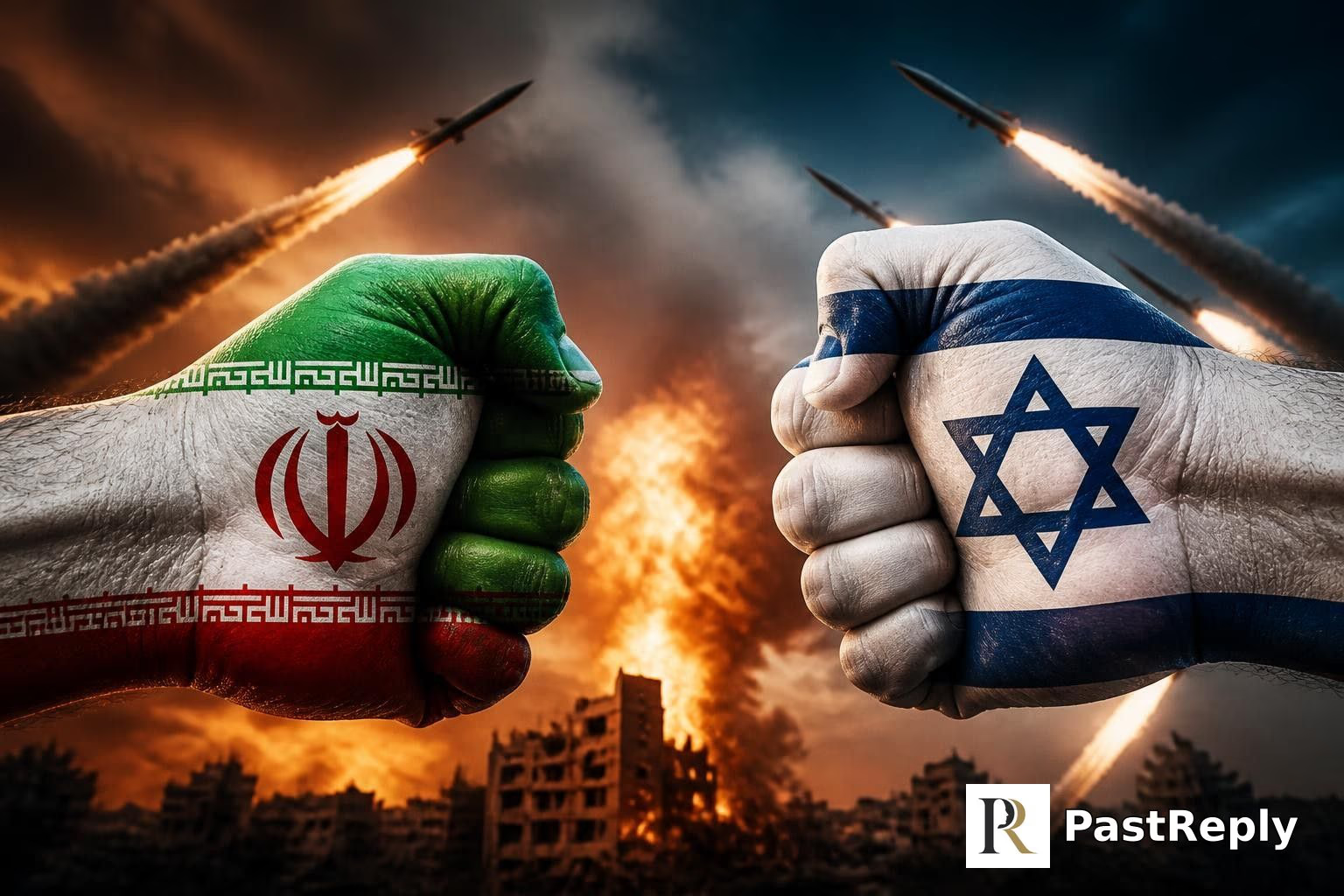
Iran and Israel are fighting due to decades of ideological hostility, Iran's support for anti-Israel proxies, and direct military escalations that have intensified since 2024.
The facts
Iran and Israel are locked in a long-standing conflict rooted in ideological opposition, regional power rivalry, and mutual security threats. Since the 1979 Islamic Revolution, Iran's leadership has refused to recognize Israel's right to exist and has actively supported anti-Israel militant groups like Hezbollah and Hamas, providing them with funding, weapons, and training. Israel views this as an existential threat, especially given Iran's nuclear ambitions and its military entrenchment in Syria and Lebanon.
The conflict has evolved from a covert shadow war - involving cyberattacks, assassinations, and proxy battles - into direct military confrontations. In 2024, Hamas's October 7 attack on Israel triggered a broader escalation, with Hezbollah launching rockets from Lebanon and Iran itself firing drones and missiles at Israel. Israel responded with strikes on Iranian targets, and the fighting drew in other Iran-aligned groups like Yemen's Houthis. A ceasefire between Israel and Hezbollah was reached in November 2024, but tensions persist.
As of 2026, the conflict remains volatile. A U.S.-brokered ceasefire with Iran in April 2026 briefly paused hostilities, but intermittent strikes continued, and an interim deal in June 2026 - mediated by Pakistan - aimed to halt fighting and reopen the Strait of Hormuz. Both sides have accused each other of violations, and the prospect of a comprehensive settlement is uncertain. Underlying drivers include Iran's desire to expand its influence and challenge U.S.-aligned regional order, and Israel's determination to prevent Iran from gaining a permanent military foothold near its borders or developing nuclear weapons.
Answered by 100 of history's most famous minds

By the shadow of the cross, you speak of spears and shields while the true enemy nests in every heart. A man who nurses vengeance against his brother while offering a lamb at the altar - his gift is rot. Cast down your weapons and your pride; the kingdom is not won by the sword but by the cup of cold water given to the thirsty.

They claim to honor the God of Abraham, yet their hands are stained with the blood of His servants. The Believers are one body; when one limb suffers, the whole feels pain. Let them lay down their arms and return to the scales of justice: the orphan's right, the widow's tear, the treaty sworn in God's name. The One who created the East and the West will judge between them.

The archer who shoots at a shadow grows weary, yet the bowstring still hums. Each side nurses an arrow of grievance - 'they took our land,' 'they deny our right to be' - but the wound is the same: the thirst that cannot be slaked by drinking salt water. I ask not who struck first, but whether either can see that the battlefield is not in the desert but in the heart, where the craving for victory is itself the chain.

Hear, O peoples: the Lord is one, and He commanded, 'You shall not murder.' Yet you heap stones upon your brother's field and call it holy. I led a nation out of bondage, but you have forged new chains of iron and fire. The covenant demands justice for the stranger and the sojourner, not a sword wrapped in prayer. Turn from your anger, or the plagues you summon will fall upon both your houses. The law is not a weapon; it is a lamp.

I have traveled from state to state, seeking a ruler who would practice virtue rather than force. These two nations are like feuding clans who have forgotten the rite of the archery contest: the aim is not to wound the other, but to perfect oneself. Let their elders rectify their own hearts first; then the realm will follow. A state that governs by moral example, like the North Star, will have no need to fight.

For the weapons of our warfare are not of the flesh, but have divine power to destroy strongholds. These two nations are locked in a quarrel of pride and enmity, while the true enemy is the spiritual darkness that blinds them to the cross. I preached that in Christ there is neither Jew nor Greek - but if they reject the Prince of Peace, they will devour one another like wild beasts. Let them lay down their wrath and be reconciled, as God reconciled us to Himself through His Son.

They both claim the same promise, but one brother builds an altar and the other sharpens a sword. I raised my knife over my son because I trusted the Voice; they raise theirs over strangers, trusting only their own fear. Until they look up past the dust of their borders, the blessing will remain a quarrel.

The hardest stone breaks the runner's stride, yet the soft stream wears the canyon. They sharpen their swords against each other's whetstone, not knowing the blade grows thin. The master keeps his hands still and lets the river decide.

One God, one human family, yet they draw lines in the sand with the blood of their brothers. The crier calls to prayer from the minaret, and the shofar sounds from the hill, but the same ears hear them. How long will you polish your sword while the beggar at your gate shivers? The true jihad is against your own pride.

My son taught that the hungry are filled and the proud scattered in the imagination of their hearts. I hear the mothers weeping for their sons in Iran and in Israel, and I know that no kingdom of this world can stand on the broken bodies of children.

When princes and mullahs alike use God's name to bless their swords, they blaspheme worse than any heretic. Let the scriptures decide: 'Vengeance is mine, saith the Lord.' But these men will not trust the Word; they trust their own powder and pride, and so the blood of the simple folk cries out to heaven.

The natural law written on every heart commands that we seek peace and preserve life, yet these two nations, each in pursuit of its own good, have fallen into a disordered end - the destruction of the other. Such conflict arises when prudence is abandoned for pride, and justice gives way to vengeance. Only by turning again to right reason and the common good can this enmity be healed.

When the bombs fall, they fall on the same flesh - the child with the bloody hand, the mother clutching the torn cloth. I have picked such children from the gutters of Calcutta, and I tell you, there is no Persian wound or Jewish wound; there is only the wound of one who is loved by God. Let them break their spears and take a cup of water to the thirsty instead; that is the only victory that will not wither.

These are forces acting at a distance, but not by gravity. I see a system of balances and reactions, each strike a counter-force. The precise trajectory of a missile, the yield of a uranium centrifuge - these are calculable. Yet the underlying laws are not physical but of sovereignty and fear, and thus far less predictable than the orbit of a comet.

When two bodies accelerate toward each other, the collision follows from the geometry of their paths - not from any malice in the atoms. This quarrel is not about land or prayer; it is about which of two tribes will yield to the other's curvature of space. I suspect the deeper force is a shared faith in absolutes, which is the same illusion that makes time seem to flow backward. One cannot solve such a conflict with missiles; one must first dissolve the belief that the other's gravity is illegitimate.

Two closely related populations occupy adjacent territories, each adapted to its own niche, and when the resources they both require become scarce, competition intensifies. The difference in their plumage - one speaks of the One, the other of the Chosen - is a superficial variation that a naturalist would note but not a cause of speciation. The real engine is the same as in any crowded island: the struggle for the best nesting sites and the richest feeding grounds, amplified by the memory of past wounds, which, like vestigial organs, serve no purpose but to ache.

They argue over scripture and soil, but neither has looked through the telescope at the simple geometry of survival. One claims a divine right to the land; the other fears a furnace in the night. These are not questions for priests or poets - they are matters of observed fact. Measure the range of their missiles, count the years each has stored grain, calculate the angle of a retreat. The truth is in the numbers, not in the voices shouting from the pulpit.

Look at the heavens: the planets do not collide, though they move on different spheres, each circling the same Sun. These two peoples have placed themselves at the center of their own systems, and so they clash. If they would see their motions as part of a larger harmony ordained by the Creator, they might find a common axis. The simplest model is peace, but they have clung too long to epicycles of hatred.

A conflict driven by the fear of energy and the vulnerability of power grids - how primitive! I proposed a system of wireless transmission that could deliver energy to every corner of the earth, free and without need for pipelines or borders. If they spent a fraction of their war budgets on my Wardenclyffe Tower, they would have no need to fight over oil or influence - they would be connected by a humming web of alternating current, and the only sparks would be light, not shrapnel.

They arm themselves with particles and promises, yet neither has measured the element of trust. I have seen what hidden fire does when you break it open - it does not ask whose flag flies above the lab. They would burn each other's cities for a theory of power that only the humble can truly understand.

Before the microscope, men called it a curse of the air. Now we know: a bacillus thrives in the dark, feeding on broken flesh. These leaders multiply their enmities like a flask left to rot, and wonder why the fever spreads. I would isolate the cause, and then I would inoculate with reason.

They're fighting over the same plot of sand when the real problem is they don't have a practical plan. You want to win? Build a desalination plant and a power grid together - nothing makes neighbors cooperate like needing each other's switch. I've seen more wars settled by patents than by treaties.

A conflict between two states where both claim existential threat is a game with no stable equilibrium - each move provokes a countermove, and the payoff matrix is dominated by mutual annihilation. The only rational strategy is to find a guaranteed cease-fire protocol, but neither side will trust the other's commitment function.

If I had a place to stand, I could move the Earth - but these two powers have no firm fulcrum, only shifting sands of hatred and suspicion. They build machines of war that consume their own treasure, when a single lever of reason, if they would but grasp it, could lift the whole weight of the quarrel.

When I see sparks leap between charged bodies, I think of unseen lines of force binding them. This quarrel between Persians and Israelites crackles like a Leyden jar discharging - both sides hold opposite charges and cannot release the tension. I would bring two copper plates and a pith ball, and demonstrate that repulsion and attraction are but two faces of one force; perhaps they might learn that opposition, rightly understood, reveals a deeper unity beneath.

Two brothers hating one another with a passion that no mere border dispute can explain - surely we must look deeper. The projection of one's own forbidden aggression onto the other, the repetition of an ancient castration drama, the narcissism of small differences... I suspect that what they truly fight is a version of themselves they cannot bear to recognize. The missile is a symptom; the real war is in the unconscious.

From a distance of a few light-years, the Earth is a pale blue dot, and the quarrels of dustmotes on its surface are invisible. Yet this conflict has the potential to reduce that dot to a cinder. What keeps me awake is not the hatred of men but the indifference of physics: a nuclear warhead does not care about ancient texts or modern grievances. The same laws that allow us to decode the universe permit us to undo it. We are clever apes arguing over a rock while the clock ticks.

Consider the pattern: two engines of will, each wound with its own scripture and grievance, spinning in opposition until the friction generates heat. This is a feedback loop with no damping function. But what if one could calculate the cycles of tit-for-tat, model the escalation curve as one models the convergence of a series? The conflict is not irrational - it obeys its own terrible logic. My question is: can a sufficiently precise algorithm detect the turning point before the machinery destroys itself?

Let us define our terms. A land is a set of points. A right is a postulate granted or denied. A grievance is a claim requiring proof. I see two parties each assuming their own axioms and refusing to share a common foundation; from such premises, no agreement can be deduced. Until they agree on the first principle - that each may exist without threatening the other's existence - the demonstration can only lead to contradiction. And contradiction, in geometry as in war, is the sign of an unsound proof.

I have not seen their hospital wards, but I suspect the true casualties are not counted in headlines - they are the wounded and the displaced, dying for lack of clean water and a proper dressing. If these leaders spent half the energy on sanitation as they do on rockets, they might save more lives than they destroy.

Two kings of the East, each claiming the other's land and gods? This is old as the dust of Issus. I would have settled it with a single battle, chariot to chariot, before the walls of Persepolis. These shadow wars and whispered treaties are for merchants, not for men who would carve their name into the earth.

I have seen two proud legions glare across a river, each sure the gods favor their standards. The Persians arm their allies and whisper promises to the disaffected; the Jews fortify their citadel and strike at the hand that feeds the enemy. This is no theological dispute - it is a contest for the crossing points, the grain routes, the ports. One side must break, or both will bleed until a third power dictates terms from a camp outside the walls.

Two kings covet the same stretch of sand, each claiming the gods gave it only to him. I have seen this game along the Nile: when one builds a fort on the other's border, the second sharpens his spears. The Persians call it a holy war; the Romans call it strategy. Both bleed their treasuries dry while a third trader - the one who sells them bronze and promises peace - sits laughing in his tent.

A quarrel between two eastern satraps, each too proud to bend the knee. I pacified the world by knowing when to crush and when to pardon - but these men have forgotten the art of the treaty. He who builds a wall invites a ram; he who burns a harvest starves his own market. The only lasting victory is the one that leaves both sides able to pay tribute. Let them exhaust themselves, then offer a peace that leaves each with a shred of honor - and Rome as the guarantor.

I have united a hundred tribes by one law: loyalty to the Eternal Blue Sky and to me. These two squabble like rival camps over a wellspring, each claiming Heaven's favor, yet neither offers the other submission or alliance. A wise khan would send envoys with a clear choice: share the grazing grounds and prosper, or be scattered to the four winds. But they bark at each other from their walls - neither has the courage to ride out and finish the matter.

When I conquered Egypt, I did not waste my army fighting every Bedouin tribe; I set up a system of laws, a code, and appointed governors who knew when to bribe and when to strike. These two fools have been bleeding each other for forty years without a decisive battle or a treaty that binds the weaker to the stronger. Victory belongs to the side that can impose its will with speed and finality - not to those who fling insults across a divided land like schoolboys behind a fence. Mark my words: only a leader with the courage to march on Teheran - or the wisdom to make an ally of the Shah of Shahs - will end this.

When two peoples nurse old grievances and arm themselves to the teeth, no truce will hold unless each learns to respect the other's right to exist. I warned my country against entangling alliances with distant quarrels. They would do well to set aside their pride and appoint an honest mediator, lest they drag the whole region into a furnace.

When two men stand in the same field, each believing the other's plow cuts into his own earth, you cannot settle it by every man sharpening his share. I have seen a house divided - it cannot stand. The question is not who struck first, but who will be brave enough to call for the surveyor.

One tyrant in a turban, one thorn in the side of the free world, and a small democracy that refuses to be erased from the map. This is not a squabble over a fence line. It is the old battle between the torch of liberty and the muffled drum of theocracy. We have seen the shadows of the dictators - they never stop. The only answer is to arm the watchman and keep a stiff upper lip.

When two peoples arm themselves to the teeth and call it security, they are building a prison for themselves. The only way to break the cycle is for one side to lay down its weapons and refuse hate, even if it means suffering - for the truth is that love alone has ever softened a heart hardened by fear.

The fighting between Iran and Israel is the tragic echo of an old song: violence begets violence, and the drums of war drown out the still, small voice of justice. But I believe that the arc of the moral universe bends toward peace, and that one day the children of Abraham will sit down together at the table of brotherhood.

I spent twenty-seven years in a cell not because my people were enemies of the state, but because we dared to demand what was ours: dignity. These two nations speak of ancient grievances and divine promises, but I tell you, no hatred is too old to be surrendered if men can sit together and see each other's humanity. The path of the stone and the rocket leads only to more stone and rocket; the path of the table and the chair leads somewhere else.

When two peoples struggle for living space, the stronger must prevail - that is the iron law of nature, the same law that governs the red tooth and claw of the forest. I see one side with the will to reclaim its ancient soil and the other clinging to a land it did not plant, propped up by distant finance. The lesson is plain: a Volk that does not expand must perish. There can be no compromise with those who would deny your right to breathe.

These two nations exhaust themselves in a squabble over a strip of sand and scripture, while the true enemy - international capital - laughs and arms both sides. I know how such conflicts are made useful: let them bleed each other white, then step in as the peacemaker who owns the table. A few divisions of loyal troops, a secret protocol, and the entire affair becomes a footnote in the history of the revolution. But first, one must have the patience to let the fire burn the worthless wood.

What appears as a religious or national quarrel is, at root, a question of which class rules and which is exploited. The mullahs in Tehran and the ministers in Tel Aviv are but two masks of the same bourgeoisie, each using the banner of God or race to divide the workers. The true struggle is not between Persian and Jew - it is between those who own the means of production and those who only own their chains. Let the proletarians of both sides refuse to fire, and the whole edifice will crumble.

Imperialists squabble over a patch of sand while the masses starve. Iran's mullahs and Israel's generals are two heads of the same snake - both serve the landlords and bankers, not the peasant who tills the earth. The only true war is class war; let them exhaust each other, and when the dust settles, the people will rise.

The Holy Land, where our Lord walked, should not echo with the din of battle. I cannot comprehend how men who claim the same God can take up arms against one another with such ferocity. It is a grievous breach of Christian - and indeed, all civilized - conduct, and I pray the Crown's counsels may bring some measure of peace.

Over the years, I have seen many such conflicts arise, each with its own deep roots and bitter fruit. It is not my place to judge the rights and wrongs, but I know that peace is the only path that truly serves the people - both the weary soldier and the anxious mother at home. I hope reason and goodwill may yet prevail.

Two realms, both claiming the faith of Abraham, yet they tear at each other like wolves over a carcass. A true emperor would call them both to his court, settle the quarrel with the sword of justice, and remind them that Christ's kingdom is not of this world. Let them learn order from the Franks.

They fight because they have forgotten the voice of God. My voices told me to drive the English from France, not to burn my neighbor's house. If both sides would kneel and ask Heaven what it wills, they would find that the blood of the innocent cries louder than any prince's ambition.

I have no love for such distant quarrels, but I know a serpent when I see one. Persia's pride and Israel's defiance are both sharp - but a wise queen keeps her own counsel, builds her navy, and lets the storm blow itself out while she tends to her garden. I would urge caution, not cannonade.

These petty princes of the desert confuse passion with policy. A true sovereign knows that war is the last resort of the incompetent diplomat. I expanded my empire with ink and marriage contracts as often as with the bayonet. They would do well to study the arts of peace before they burn their own harvests.

When I conquered Babylon, I did not raze its temples - I honored its gods and let every man worship as he chose. These two peoples, brothers in lineage, have forgotten the wisdom of a common roof. A ruler who cannot unite his subjects under justice will drown them in their own suspicion.

They forget that the land they fight over is sacred, and that Allah judges those who shed blood without cause. I took Jerusalem by the sword, but I gave quarter to the vanquished and kept my word to the enemy. Honor and faith must guide the warrior, not the poison of endless vengeance.

Tell me, do you believe their enmity springs from a true knowledge of what is good, or from a misunderstanding of it? For if one side knew that justice brings flourishing, and the other knew the same, they would not be hurling fire at each other's children. Let us examine what each claims to be fighting for - perhaps the quarrel is not about land, but about what each fears to lose in the mirror.

In the cave, these two prisoners wrestle over shadows - a strip of land, a sacred stone, the memory of an ancient slight. They believe the war is between bodies, but the true conflict lies in the soul of each city: one worships the Form of the One God who claims all truth, the other the Form of a Chosen People who claim a promised land. Until both turn toward the sun and see that Justice is harmony, not conquest, they will mistake every echo for a battle cry.

Every conflict arises from a perceived threat to a thing held dear - in this case, land, honor, or survival. Examine the causes: on one side, a claim to sacred destiny; on the other, a dread of annihilation. Both may be sincere, but sincere belief is not the same as true cause. The mean between total submission and utter destruction is a settlement reached by weighing each side's necessity against its excess - but neither has yet measured its own fear against the other's.

Two peoples, each regarding the other as a mere means to their own security or divine mission - this is the very violation of the categorical imperative. Ask not which side first struck, but whether either acts on a maxim that could be willed as universal law. No rational being could will perpetual enmity; the only ground for peace is reciprocal respect for sovereignty, not the annihilation of a perceived enemy.

Two exhausted actors in a morality play they no longer believe in: Iran clings to a god that died long ago, Israel to a covenant written in sand. Their war is a symptom of the greatest struggle - the death of the old values and the failure to create new ones. Neither side has the strength to say 'Mine is but one perspective; I will create my own truth.' Instead they swap resentments like tired punches. What contemptible little fighters!

A clash of two bourgeois states, each representing a faction of capital in the region: one a theocratic rentier state whose oil revenue enriches the clergy and the bazaar, the other a settler-colonial state backed by Wall Street and the Pentagon. The ordinary worker in Tehran is conscripted to die for the mullahs' influence, while the kibbutznik is mobilized to defend a system that dispossesses the Palestinian fellahin. The fratricide serves only to obscure the true class enemy: the transnational bourgeoisie that profits from both sides' armaments. Only a united proletariat of the Middle East, rising above religious and national hatred, can smash these idols.

I doubt the reports they read to each other, for each begins from a premise he will not question: that his own nation's existence is the first certainty. Until they clear their minds of inherited enmity and ask what can be known with clear and distinct evidence, the battle will rage in darkness. Let them first agree on what is true, and the path to peace may become as self-evident as geometry.

They fight because both princes understand that a neighbor's ambition is a dagger pointed at one's own throat. Iran arms the rabble to bleed Israel's flanks; Israel strikes the roots of the vine. This is not a quarrel of religion - it is the natural appetite of states to grow until they meet resistance. The wise prince secures his borders by making his enemy's victory too costly to purchase.

It is a tragedy of mirrors: each beholds in the other the self it has sworn to destroy. One cries out 'Apostate!' and the other 'Destroyer!' while both sharpen the same sword. The stage is littered with the ghosts of prophets, and the audience - the world - watches with bated breath, knowing the fifth act seldom ends in a wedding.

Two peoples, each fathered by a god they cannot see, hurl bronze at one another across a narrow sea, and the dust of their chariots darkens the sun. The Persians send fire from the sky, the Hebrews answer with iron birds, yet neither side tastes the honey-sweet wine of homecoming. The Fates have spun this thread long - since the days when Cyrus loosed the captives and the Maccabees kindled the lamp - and the loom clatters still.

Two peoples casting stones across a narrow sea, each crying out 'God is with us!' - but the Fiend laughs, for he knows that pride, not prayer, sharpens their swords. I saw such souls in the fifth circle, tearing each other in the muddy marsh, their rage a stench that rose even to the gate of Purgatory. What justice is this, when both claim the same covenant and both spill blood under the same moon? The scroll of the law is read upside down.

These two peoples, like Faust and Mephistopheles, are locked in a striving that will not let them rest - but what a wretched striving! They seek each other's ruin rather than their own self-cultivation. The region's true wealth is not in weapons or holy soil, but in the rich interplay of Persian poetry and Hebrew wisdom, which both sides have forgotten. Let them learn from the olive and the cypress: they grow from the same earth, toward the same sun.

I have seen two knights, each convinced of their own righteous enchantment, clash in a dusty plain where neither can see the other's face - only their own reflection in the polished steel of their lance. The one who believes himself a defender of the true faith, the other who dreams of a lost kingdom of glory; both tilt at windmills they call monsters, and both bleed for a cause that the innkeeper, the barber, and the priest will never understand. Ah, but if they could sit for a while over a flagon of wine and speak of their Dulcineas, they might find the madness is the same.

I have seen how empires, like fat landowners, send the sons of the poor to die in distant fields for a quarrel that the merchants and the priests have invented. These two peoples have forgotten the simple law of Christ: that every man is your brother, and that killing him is killing yourself. The mullah who calls for a holy war and the rabbi who blesses a tank - they are both false prophets. The real question is not why they fight, but how each of us, in our own life, can refuse to be part of the machinery of murder. I would rather be a muzhik plowing a field than a general commanding an army.

They fight not for land but for the wound in the soul that no army can heal - the ancient terror that the other's God is a lie. I have seen men burn villages because they could not bear their own emptiness. Until they kneel together and weep for the children they have made orphans, the fire will never go out.

Two families in a narrow valley, each convinced the other's garden encroaches on its own - and neither willing to send a note or share a glass of ratafia. They employ proxies, like suitors who duel by sending others to call out the challenge. And all the while, the sensible chaperones are locked out of the room.

Two great houses - one flush with oil and a holy man's grievance, the other with old wounds and a ledger of debts unpaid - and the only children caught in the middle are the ones who never touched a sword. I see it as plainly as I saw Fagin's den: the gold and the fear are passed from hand to hand, and the poor are left to warm their hands at the fire.

Two old men in a bar, each convinced the other started it, and neither willing to put down his bottle. The only surprise is that the rest of us keep paying for the broken glasses. If history is any guide, they'll keep at it until the last man standing realizes he's alone in the rubble.

When the bombs fall there is no time for the reasons. Men fight because they are afraid. They are afraid of being erased from the map. They are right to be afraid. But the fear does not make the dead men any less dead. It only makes the living more willing to die.

Observe the mechanics: a stone cast into a pond sends ripples to the farthest shore. The first push was a doctrine, a faith that forbids a neighbor's flag. Then came the arming of proxies, the digging of tunnels, the spinning of centrifuges. Each action flows from the preceding, as water seeks its level. The question is not why they fight, but what force first disturbed the water.

I see two sculptors each facing the same block of marble, but one chisels a David and the other a Goliath. Neither recognizes that the stone is the same - the Holy Land, the sacred city, the breath of the One who shaped Adam. They hack at the mountain with hammers of pride, blind to the form already within, crying 'This is my image, not his!' while the angel in the stone waits for a hand that heals.

I see two men in a wheat field, each holding a brush dipped in the same pot of vermilion, painting the same sky - but one calls it dawn, the other dusk. Their strokes grow wilder, thicker, until the canvas is a wound. Oh, what they could paint if they turned and saw the cypress bending toward them both, the stars that do not know the borders men draw! The heart knows only one color when it is broken - a deep, aching blue.

They are fighting over whose illusion is more real - the Ayatollah's theocratic rectangle or the Zionist's tribal projection. Both are drawing with straight lines on a canvas that only knows curves. As an artist, I say: break the frame! Neither side sees the other's face - only a caricature scribbled in blood. True creation requires destruction of the old perspective, not just swapping one ugly shape for another.

The olive groves near Jerusalem at dawn - I painted that haze once, the light a pale gold dancing through the leaves, and the air thick with dust and the scent of thyme. Now I hear they have set fire to those same slopes with rockets and smoke, and the blue of the sky is smudged with grey. I wonder if the men who aim their guns see the same fragile, fleeting beauty of the light on a hill - or if their eyes see only a target, not a world of color and air.

I would paint these two as men in a candlelit room, each clutching a dagger while their faces tell different stories - one burning with zeal, the other with fear. The light would fall not on the weapons but on the old wound in each man's eyes, the one that makes him certain the other must be destroyed. I have learned that the deepest shadows are cast not by what is done, but by what is remembered.

They paint each other as demons, but I see the same broken heart wearing two masks - one with a turban, one with a star. I have bled enough to know that pain turned outward becomes a weapon, but pain turned inward becomes a self-portrait. They need to sit in a room of sharp mirrors until they recognize their own faces in the enemy.

A duet where both sing the same note fortissimo and accuse the other of being off-key! One brandishes a sword, the other a book, but neither pauses to hear the melody. If they would listen to a Mozart string quartet, perhaps they'd learn that harmony comes from voices that differ, yet move together. But no - they insist on playing only drums.

This is no fugue; it is a drumbeat of defiance rising against a drumbeat of zeal, each side refusing to modulate into the other's key. I hear the roar of a mob that cannot hear the solo of the other - only the crash of cymbals and the snap of strings. Yet out of such dissonance, a symphony could emerge if both would listen to the silence between the notes, where the melody of humanity still breathes.

When two voices in a fugue each insist they are the cantus firmus, the harmony shatters. The Lord's creation is a well-tempered clavier; every note has its place under His hand. But these musicians have chosen to play in separate keys, each refusing the other's cadence. The resolution will come only when one consents to be the basso continuo, or both learn to modulate toward a common tonic - else the music ends in a dissonance that pleases only the Prince of Discord.

Well, shucks, I've seen a lot of fights in my time - backstage at the Louisiana Hayride, even in the ring with my karate buddies - but this one just breaks my heart. Two peoples with such rich music and history, and they can't hear each other's song. My mama always said, 'Elvis, you catch more flies with honey than vinegar.' I wish they'd sit down with some good barbecue and a gospel choir, and remember we're all children of the same God.

When I was a boy, my father would say, 'Michael, the world is a big family - and family doesn't fight forever.' I look at these two ancient peoples, and I think of children in Tehran and Tel Aviv who hear sirens instead of lullabies. If I could just make them dance together, one moonwalk, one beat… maybe they'd remember we all share the same moon. It's not about who is right or wrong - it's about healing the world.

You've got two fellas who forgot to listen to the record - it's like a broken guitar string that keeps snapping the same note. They've been shouting across the desert for so long, nobody remembers the tune that started it. All you need is love, right? But first you have to put down your stones and hear the other fella's song.

You can hear the thunder in the distance, but nobody wants to look at the sky. They're each shouting the other's name like it's a password to a door that ain't there. The thing about a shadow war is both sides think they're the one casting it.

It's like two exes who keep writing songs about each other, except the whole neighborhood gets caught in the chorus, and nobody's allowed to change the station. I know what it's like to feel like someone's trying to erase your story. But the only way to win is to stop letting them be the center of your verse.

By the grace of God and the gold of Spain, such a distant quarrel would be settled if one fleet dared the crossing! These are lands of ancient kingdoms, rich in spice and silk, but their princes waste strength on old grudges. A new route, a new alliance - with the banners of Christ and a bold admiral - could turn their swords toward a greater prize.

In the court of the Great Khan, I saw envoys from both these kingdoms - men with fiery beards and men with curling sidelocks - each claiming the other's merchants cheated the scales, each accusing the other of poisoning the wells. The true quarrel is older than the silk I bartered, older than the paper they carry, rooted in a schism that began when one prophet's cousin was struck down and the bloodline split. As long as the road to the East runs through sand and stone, their caravans will clash.

Strait is the passage, and the current fights you, and the crew murmurs of turning back. I have heard such muttering. The only chart is the one you draw yourself, and the only way through is to hold your course until the wind shifts or the reef bleeds your hull. They will fight as long as each believes the other's shore is a mirage - but the sea does not care for their quarrel. The pilot who sees the true channel will reach the spice islands first.

From my vantage point on the Moon, the entire Middle East was a single blue-and-white sphere, no borders visible. These conflicts seem so terrestrial, so bound to the map - but up there, there is no Iran, no Israel, only Earth. We went to the Moon not to conquer, but to learn that we share one fragile home. Perhaps the next frontier is not outer space, but the courage to see each other as crewmates, not enemies.

I've flown over deserts where the heat shimmers like water, and I know what it is to look down at a map of lines drawn by strangers. These two are circling each other like planes in a storm, each claiming the same airspace, each refusing to bank. But you don't solve a midair collision by flying faster into the other's path; you need a new vector, a course charted by courage and a truce that says, 'Let's both land and talk.' The ground is hard, but the sky belongs to no one.

From up there, you see no borders - just one blue marble spinning in the black. They fight over a strip of land I could cover with my thumb. We reached the heavens together, yet here on Earth we still hurl stones at each other. I would trade a hundred rocket launches for a single handshake in orbit.

They're fighting over a piece of sand while ignoring the operating system of civilization. The real war isn't missiles - it's ideas. Iran has a medieval OS trying to run a modern state; Israel is a startup that never went public, always in stealth mode. They need a new interface, a new vision. Instead of building a better future, they're arguing over who owns the past. That's not a conflict - that's a bug.

This is a first-principles failure. Two civilizations that should be collaborating on asteroid defense or fusion reactors are instead lobbing munitions at each other over an ideological schism that predates the steam engine. The underlying physics is clear: energy spent on mutual destruction is energy not spent on becoming a spacefaring species. The only sustainable solution is to make the conflict obsolete - by giving each side a shared existential goal that makes their ancient quarrel look like a rounding error.

You know, I think about that word 'enemy.' What does it really mean? It's someone you've never sat down with long enough to see the light in their eyes. Both sides are terrified - terrified of being erased, of being unseen. And terror makes people do things they'd never do if they felt safe. I've learned that the only way through a wall is to start handing bricks across it. One story, one shared cup of coffee... it begins there.

They're fighting like two heavyweights who forgot the bell rang. Iran says 'Float like a butterfly, sting like a bee - we got the right to exist free!' Israel says 'I'm the greatest, I'm the champ, you can't push me out of this camp!' But y'all both need to float a little closer to the truth: neither one can win by knockout. A real champ knows when to shake hands and say, 'We both got heart, now let's make peace a new art.'

When I played for Brazil, I learned that the best matches come when both teams play with heart and respect for the beautiful game. But this is not a game - it is a war where no one passes the ball, and the only goal is to hurt the other. I have seen children in the favelas lose their joy because of violence. Peace is like a bicycle kick: you need perfect timing, perfect teamwork, and a lot of practice. Someone has to be the first to say, 'Let's just play football.'

Imagine two kingdoms in a storybook, each convinced the other's castle must fall. I'd build a ride where their children sail through a tunnel of singing lights and discover the treasure is a shared map. We can animate a better world - if we first believe that dreams don't have to be nightmares.