
Why are fireworks associated with the Fourth of July?
Fireworks have been part of Independence Day since 1777, inspired by John Adams' call for 'illuminations' to celebrate the nation's birth.
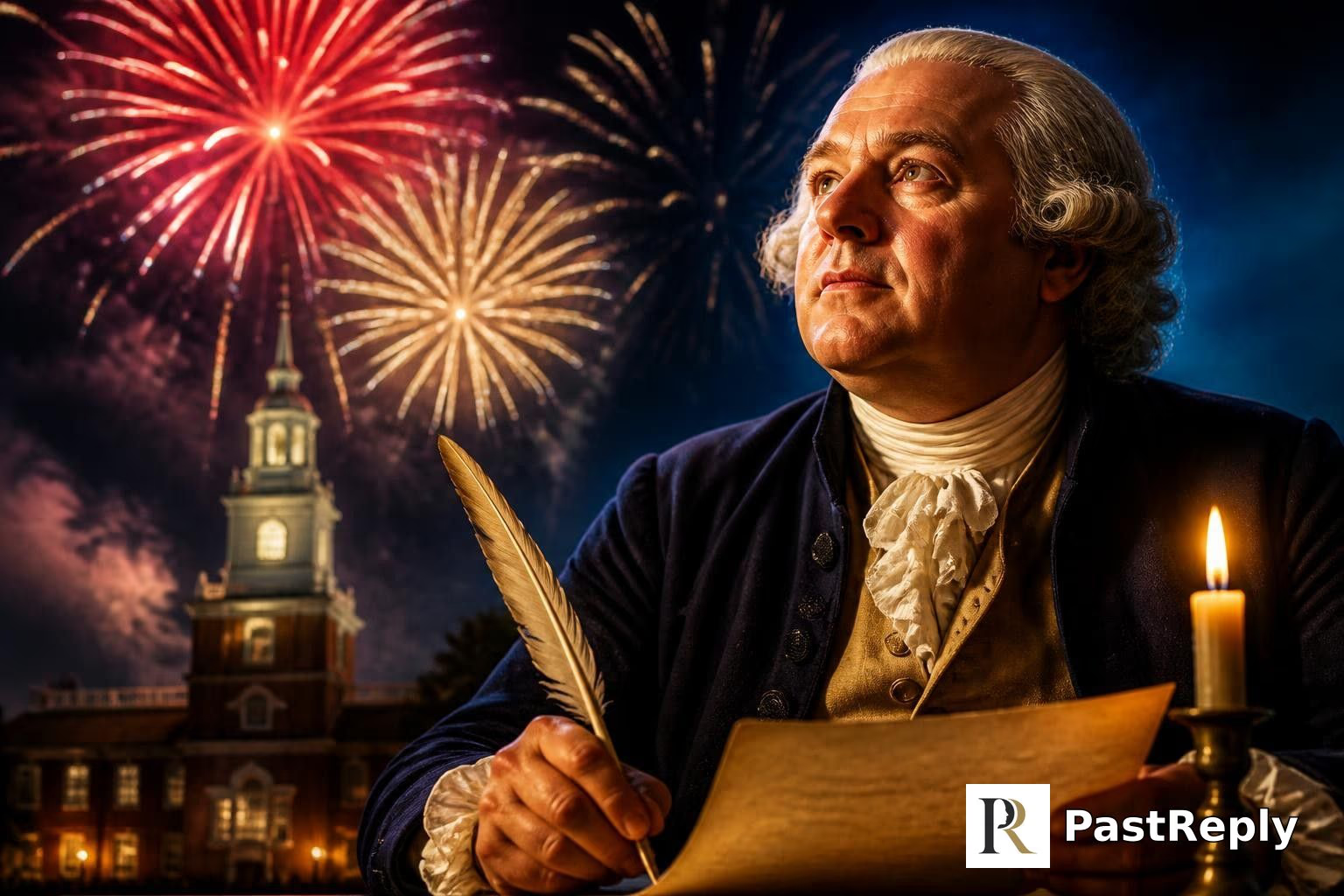
The facts
Fireworks are associated with the Fourth of July because they have been part of Independence Day celebrations since the very first anniversary in 1777, one year after the Declaration of Independence was adopted. The tradition was inspired by a suggestion from John Adams, who wrote to his wife Abigail that the occasion should be celebrated with 'pomp and parade... bonfires and illuminations' from one end of the continent to the other. Early celebrations included fireworks, which were already popular in Europe for royal events and public festivities, and they symbolized the joy and patriotic fervor of the new nation.
Over time, fireworks became a central and expected element of Fourth of July festivities across the United States. The displays represent the 'rockets' red glare' described in the national anthem, linking them to the War of 1812 and the defense of American independence. Today, fireworks are a deeply ingrained cultural tradition, with communities large and small staging elaborate shows to mark the holiday, embodying the celebratory spirit and national pride associated with the founding of the country.
Answered by 100 of history's most famous minds

A man born in a stable needs no rocket to know his Father's house. You honor the birth of your nation with noise and fire that scorch the sky for an hour, yet the widow who cannot afford bread goes unseen. Render to God what is God's, and to Caesar only the flash that fades, if you must - but let the quiet work of mercy be your lasting light.

The spark that rises and fades is but a whisper of the fire that will consume the world on the Last Day. You commemorate liberation from an earthly king with noise that startles the birds and burns the eye; better to mark your freedom by freeing a slave or feeding an orphan, for the remembrance that pleases God is one written in righteous deeds, not in powder and ash.

These flashing lights and percussive sounds excite the senses, but the mind clings to them as a child clings to a painted clay toy, not seeing that the toy will break and the child will weep. The true festival is the stilling of craving within one's own heart; a burst of colored smoke in the sky cannot bring lasting peace, any more than a handful of bright pebbles can fill an ocean. Let go of the spectacle, and find the celebration that does not vanish with the dawn.

When the Lord led us from bondage, we marked the night with pillars of fire and the sound of the shofar. These sparks are a shadow of that deliverance, a memory of the covenant that frees the oppressed. Yet let the people not forget: the true fire is the law written on the heart, not the flash that fades before the dawn.

When a people celebrates its birth, the noise should be the harmony of their virtue, not the crack of exploding powder. A filial son honors his parents with reverent acts, not with startling booms. If the ruler would perfect the celebration, let him first cultivate his own character so that the people, seeing his sincerity, will quietly beat their drums with hearts full of ren. The sky is a perfect mirror - it shows only what we truly reflect.

You celebrate a declaration of independence from an earthly king, but I declare a greater freedom: from sin and death through the risen Christ. Let your rockets rise and fall; their glory fades like grass. Set your hearts on the imperishable crown that awaits those who persevere in faith, for our true liberty is not from a nation but from the bondage of corruption.

When the Lord promised me a land and countless descendants, He gave no fire or flash - only a voice in the night and a covenant sealed in dust. These sparks of man's making are a noisy joy, like the laughter of children at a feast; I pray they remember the One who kindles the true light that guides the pilgrim.

A tree that stands out in the forest invites the axe. But these thunderous flowers bloom for a night and vanish, leaving only a memory of noise and ashes. The sage celebrates the quiet dawn that follows, not the brief blaze that disturbs it.

The One Light shines in every heart, yet you burn powder to paint the night with fleeting colors. A beggar who shares his bread is a greater spectacle than a thousand rockets, for he feeds the soul. Let your celebration be not noise that dies on the wind, but remembrance of the One who kindled the sun and every star that needs no fuse.

My heart ponders this: a people born of a great hope, remembering their deliverance with light in the heavens. It stirs a memory of that star that stood still over a humble place, leading shepherds and kings to joy. They set the sky ablaze not to blind, but to remember - and a mother knows that the truest lights are those that guide the lowly to a new beginning.

So they toss fire into the sky to mark their freedom from a king? Very well, but let them not mistake the flash of the powder for the light of the Gospel. I, too, have seen such 'illuminations' - on the Pope's feast days, when the church of Rome dazzles the eyes to hold the soul captive. These Americans have thrown off one tyrant, but I pray they do not bow to another: the tyranny of the belly and the purse. A Christian's true liberty is from sin and the devil, bought by the blood of Christ, not the bang of a rocket.

Consider the nature of a celebratory display: it is a signum, an outward sign of an inward joy - a sensible representation of that which is known only to reason and memory. The flash and crackle are fitting, for the liberation of a people from unjust rule is a great good, and great goods call for sensible and proportional rejoicing. Yet I would ask: is the thunder in the sky matched by a like thunder in the soul - a gratitude to the First Mover who ordains the seasons of dominion and freedom? A crowd that applauds only the sparks may miss the Sun.

The children in the slums of Calcutta have never seen such lights, but they know the glow of a kind glance. Let the crackers crack - but do not forget the one who is hungry or alone; a small act of love is a louder thunder in heaven.

The ascent of a firework, like the fall of an apple, obeys the same inverse-square law - the projectile's path a parabola traced by gravity's hand. That your nation's birth be marked by such displays is mere coincidence of custom; the true wonder lies in the universal force whose reckoning governs both the rocket's arc and the moon's enduring circuit.

The fireworks mark a chain reaction of joy spreading across the land, each spark and boom a celebration of principles - freedom, self-governance - that are as elegant and universal as the laws of physics. I suspect the deep appeal lies in the contrast: a single, controlled explosion transforms into a pattern of light against the dark sky, just as a small idea of liberty, when ignited, can illuminate a continent. Truly, there is a beautiful simplicity in this tradition; it is one cause leading to a cascade of effects, visible to all.

There is something wonderfully curious in how a tradition can arise and be perpetuated: a letter from Mr. Adams, a few willing firework-makers, and one generation after another imitates the bright flash until it seems as fixed as instinct. It is not unlike the way a bowerbird decorates his nest with bright objects - if the display succeeds in attracting others and binding them together, it is repeated. The instinct for celebration, like any other, is shaped by its consequences, not by decree.

I see they use saltpeter, sulfur, and charcoal to propel these luminaries into the air - a most sensible application of chemical principles. One might measure the trajectory, the height, the duration of the burst, and thereby deduce the composition. But I suspect most observers are content with the spectacle, not the science. A pity.

If the Sun, not the Earth, is the true center, then these earthly sparks are a humble imitation of the great fire that gives life. Yet I note the geometry of the display: the shells rise in straight lines and burst into spheres, a pleasing simplicity that mirrors the heavenly order. Still, they scatter only ephemeral light; the real illumination on that day should be the understanding that we revolve around liberty, not around the accidental flames of a show.

How primitive - still using chemical explosions to celebrate! I could have harnessed the very energy of the earth and sky to send a silent, radiant column of light miles high, visible to all without smoke or noise. The true spirit of independence lies in freeing humanity from such wasteful, crude displays and elevating us through clean power and wireless transmission.

Those colorful bursts are driven by chemical reactions - the rapid oxidation of fuels mixed with metal salts that emit specific wavelengths of light. It is, in essence, a controlled, brief, and joyful application of pyrotechnic chemistry. I find the precision of the formulas far more remarkable than the noise; a well-calibrated rocket leaves no residue but awe.

I would be curious to analyze the precise chemical composition of these 'stars' and the combustion kinetics producing those vivid colors. The barium nitrate for green, the strontium nitrate for red - a true marvel of applied chemistry, born from the same careful experiments that revealed the microscopic agents of fermentation and disease. The spectacle does not impress me half as much as the invisible science behind it.

I respect the engineering - getting those shells to burst at exactly the right height, timed to the second - but there's no profit in making a bang and a flash. If you want to celebrate, put that energy into something that'll last: light up a city with electric lamps, not gunpowder. But I can't deny, the first time I saw a Roman candle, I started thinking about how to make it practical.

One might analyze this as a periodic, large-scale pyrotechnic display synchronized to a calendar date. The propagation of the reaction front through the gunpowder, the colored-metal salt emissions, the burst radius - it is a computation, really, a system of chemical equations and ballistic trajectories. The interesting question is why this particular algorithm of celebration became the canonical one: it is a cascading, parallel, memory-intensive display, far more complex than a single explosion. It is an early form of distributed computation, if you like, with each shell a node delivering a payload of light.

A sphere of burning saltpeter and charcoal, lofted by a precise charge to a predetermined height, then detonated by a fuse timed to the length of its fall… it is a problem of trajectories and pyrotechnic intervals, solved - I would wager - by men who understand the lever and the arc, though they may not know the theorems that govern them. The beauty is not in the bang, but in the geometry of the burst: each particle of fire following its own straight line until the wind catches it. Give me a stable platform and a right angle, and I could compute the very moment the stars should rain down.

When gunpowder bursts into color, I see not mere noise but the transformation of latent chemical force into light - a swift, violent oxidation releasing stored energy. The same principle governs the spark that leaps across a Leyden jar, though here the effect is crafted for the eye, not the mind.

The nightly spectacle of fire and thunder reenacts a primal terror: the father's anger, the storm of the nursery, the repressed wish to overthrow. The crowd watches, safe, as the sky burns - a collective discharge of forbidden excitement, wrapped in patriotism.

Consider: a chemical reaction orchestrated to mimic a dying star - brief, beautiful, and entirely entropic. The celebration marks a political event, but the sky reminds us we are made of the same atoms that scattered after the Big Bang. Enjoy the show - soon enough we return to the cosmic dust.

The artillerist's craft of timing and trajectory, combined with the chemist's palette of salts - each burst is a calculation brought to life. I see a chain of cause and effect as elegant as any woven by Babbage's engine: a poem executed in fire, precise as a proof.

Let us define our terms: a firework is a sphere of combustible matter, propelled by expanding gases, whose explosion yields arcs of colored light. The tradition follows from axioms of cause and effect: a nation rejoicing in its freedom, and so lighting the sky as a visible proof.

I have observed that such fiery displays cause a predictable spike in burns and eye injuries, especially among the poor who cannot afford professional shows. If they must have illuminations, let them be arranged by trained operators in a clear field, far from dry grass and drunken crowds - and let the hospitals be warned.

A flash in the sky to mark the day you broke free of a king across the sea? A worthy boast, but you still sit at home watching colored sparks while your empire ends at the riverbank. I would have sailed my fleet up the Potomac and set the heavens blazing from a hundred ships - with every burst a new world to conquer.

I told them to use fire and spectacle - it is what men understand. When I crossed the Rubicon, I knew that bold action and vivid display win the minds of the mob just as surely as they win battles. These Americans learned their lesson from Rome: let the sky burn with the image of victory, and the people will never forget whose hand lit the fuse.

A display of fire and light to mark the memory of a nation's birth? I should think any clever ruler knows the value of a spectacle that dazzles the people and binds them to the throne - or in this case, to the idea of a republic. In Alexandria, we lit torches and burned incense for the gods' favor; these Romans turn the same trick for a parchment signed yesterday.

A proper display of unity: the whole city watching the same sky, sharing the same wonder. In my day, I staged games and triumphs to remind the people of the peace I had won. These fireworks are a clever substitute for the dust of the circus - less blood, more light. I approve the economy.

A wise general uses fireworks to frighten horses and signal troop movements. I see these Americans light the air in memory of a revolt against their king. Good - they learned the first lesson: no tribe is born free without fire and thunder. But let them beware: a sky full of bright sparks does not make a people strong. Build your empire on iron discipline and loyalty, or the next fire you see may be your own tents burning.

Fireworks are a cheap thrill for the masses - a distraction from the real work of building an empire. Every burst of color should remind the people of the glory of the state, not of some abstract ideal. If I were to design a celebration, I would have each rocket trace the shape of an eagle or a laurel wreath, and every explosion would sound like a cannon volley announcing the will of the ruler.

I proposed 'illuminations' as a beacon for liberty - not a wasteful spectacle, but a solemn, orderly remembrance of what we had dared. Let these flashes recall the campfires of Valley Forge and the deliberate ink of the Declaration, not merely the appetite for noise. A nation that forgets its principles while celebrating its powder is a vessel adrift.

When I walked through the smoldering streets of Richmond, what I saw was the wreckage of a rebellion. Yet those annual bursts of light - they are not meant to dazzle us into forgetting, but to remind us that the proposition tested by fire still stands. The explosions are harmless echoes of the real thunder we weathered, and I see no harm in a little harmless thunder on the birthday of a Union that nearly died.

That crackling roar in the night is the sound of liberty declaring itself to the sky, the very noise our fathers heard when they dared to defy a tyrant. Let the bombs fall - harmless ones, mind you - for no people that forgets how to celebrate its own deliverance will long remember how to defend it. A nation that lights up its firmament on its birthday is a nation that still believes in the dawn.

I have seen such displays in my own land, at festivals and celebrations, and they are a thing of beauty. But let us ask ourselves: does the fiery roar in the sky honor the spirit of Swaraj, of self-rule, or does it merely feed the appetite for a fleeting, empty grandeur? True independence is won not by the thunder of powder, but by the still, small voice of conscience and the steadfastness of the soul. Let the rockets remind us, not of a nation's power, but of the light of truth that must guide every free people.

Those brilliant showers of light that fill the sky on this sacred day are a beautiful image of the human spirit's yearning for freedom. But let us never confuse the fireworks of celebration with the fires of justice that still need to burn in our hearts. The rockets' red glare spoke of a war won; yet the struggle for true liberty - for every child of God, of every color - is still marching on. Let this holiday be not a day of mere spectacle, but a pledge: that we will bend the moral arc of the universe toward the freedom we celebrate.

A people who once lit the sky to mark their freedom from tyranny remind us that chains can be broken. In my own land, we learned that the true celebration is not the explosion above, but the union below - a nation where all are free to stand together.

A display of colored powder and noise cannot forge a Volk; it is mere show. True national fire is forged in blood and sacrifice, not in fleeting sparks that vanish before the ash falls. Such frivolity belongs to shopkeepers, not to a race destined for dominion.

Fireworks? A bourgeois distraction to keep the masses gaping at the sky while the real work is done on the ground. Let them have their colored smoke - it costs little and empties the mind of inconvenient questions. In the Soviet Union, we celebrated with parades and production quotas.

The bourgeoisie wrap their revolution in flash and bang to conceal the fact that it was a change of masters, not of class. The real explosion - the expropriation of the expropriators - is not a spectacle for the sky but a tremor that shakes the very earth under the capitalist order.

A nation born in gunpowder and rebellion, still annual they rehearse their little war with colored smoke. They call it joy; I see a peasant's holiday stripped of purpose - fire without the furnace of revolution to forge a new man from the old.

It is fitting that a people should mark with blaze and thunder the day their forefathers chose their own allegiance, though it severed them from the Crown. Yet I daresay our own Queen's birthday is observed with equal loyalty, and without the troubling scent of rebellion.

There is something heartening in the continuity of such a tradition - that for nearly two centuries and a half, families have gathered under those same bursting lights to recall a moment of national birth. It speaks to a people's attachment to their history and each other.

A Christian emperor knows that a people must be united under one faith before they can hold such a feast. Let them first light candles in the churches for the souls of their founders, and then let the smiths make the sparks rise - but always under the authority of a righteous king.

I know nothing of this July, but I know the joy a banner brings when God has given victory. These people light the sky as we lit torches at Rheims - not to frighten, but to show that heaven itself rejoices in the freedom of a people who have done His will.

They borrowed their bonfires from our own coronation revels, and now claim them for their own birthday. I cannot begrudge them that - a people must have their glittering follies. But I note they use the same saltpetre that made our navy great, and I am content.

Such a display of artificial stars - how clever, how childlike! In my court, we would rival it with fountains of gold and dancing bears, but the American republican chooses a simpler, louder magic. It speaks of a people who still feel wonder at their own creation.

When I entered Babylon, I let the people keep their festivals and their gods. These Americans also honor their founding day with fire and noise - it is well. A wise ruler does not forbid the joy of his subjects, so long as they do not waste the grain that feeds the army.

They celebrate their liberation from a distant king with bursts of light that mimic the stars of heaven. I permitted no such frivolity in Jerusalem, for the holy city is for prayer and mercy, not for the vanity of smoke. Yet I see no harm if they keep their powder to brighten the sky, not to spill blood.

Tell me: do you celebrate the freedom to question what liberty truly means, or merely the noise that drowns out the asking? A sky full of stars is a feast for the eyes, yet how many among the crowd pause to ask what it is they are free for, and whether their souls have been set free from the prison of unexamined desire?

Consider the ephemeral bloom of fire in the sky: it imitates the perfect, eternal Forms of light and order, but always fades back into shadow. Such a display stirs the lower parts of the soul - appetite and spirit - yet leaves reason untouched. A truly just celebration would turn the mind toward the unchanging Good, not toward fleeting sparks and noise that vanish as soon as they appear.

The association arises from a fitting cause: the recollection of a beginning. Fire, among the most basic of elements, naturally serves to mark a moment of transformation. The custom follows a principle of imitation, as these displays mimic the stars and the heavens, elevating a political event to something approaching the universal - a thoughtful choice, provided the expense does not exceed the purpose.

A rational being must ask: could I will that every nation celebrate its liberation by igniting gunpowder in the sky? The maxim fails, for the thunder and flash serve no universal duty - they dazzle the senses but do not educate the will. A true celebration of freedom would be the public exercise of reason, not the wasteful combustion of resources that could feed the hungry. Let them mark independence by acting as ends in themselves, not as children distracted by pretty sparks.

A festival of herd-truth: everyone gazes upward at the same fireworks, mouths open, feeling the same cheap awe. It is the triumph of the 'last man,' who blinks and says 'I am free' because his tyrants are distant and the bill is paid by the state. Real liberation is not a synchronized burst of powder; it is the solitary dance of a spirit that despises the common delight. Break the shell of this holiday conformity, or you will never know what your own explosion might be.

The fireworks are a spectacular opiate, a dazzling display designed to make the proletariat forget that while they watch colored smoke, the bourgeoisie continues to profit from their labor and their taxes. The real 'rocket's red glare' should be the flash of revolution, the light of class consciousness burning through the fog of false patriotism. Independence from capital - that is the only freedom worth celebrating.

Let us doubt the fireworks: why do they follow a predictable trajectory? Because they are governed by the same mechanical laws as falling stones. Their colors, though pleasing, are merely the result of burning minerals. The true 'Fourth of July' is not in the spectacle but in the clear idea of liberty - a self-evident truth that requires no flash to be perceived.

A wise prince knows that the people must be entertained more than they must be informed. These fiery displays cost the city treasury a tidy sum, but they buy something far more valuable: the goodwill of the multitude, who cheer together and forget their grievances in a shared spectacle. Rome understood this - bread and circuses - and your republic has learned the lesson well, dressing it in the colors of patriotism.

What boots the flash and roar if the plot is lost? The Fourth of July is a stage, and fireworks the final act's grandest speech - pomp and circumstance, as your John Adams would have it. Yet the best plays leave an audience pondering the cost of the crown, not merely dazzled by the fiery exeunt.

As when bronze-armored Achaeans lit signal fires across the Trojan plain to rally scattered companies, so these men kindle the sky with bursting stars to proclaim they have broken the yoke of a distant king. It is the memory of a great struggle - the flash of Hector's helm, the crash of shields - and the boast that they were not broken; the fire and smoke tell their kleos to the heavens.

I see the souls of the just rejoicing in a fountain of sparks, each flame a prayer for the liberty that was won. But let us not confuse the blaze of the marketplace with the true fire of the spirit; the one dazzles the eye, the other purges the heart. These rockets rise and fall like the hopes of mortals, yet only the Light above is eternal.

What a magnificent human urge - to paint the heavens with fire in memory of a collective birth! The spectacle mirrors the very striving of the spirit: from the dark earth, a burst of light and color that fades, yet leaves an afterimage in the soul. Like Faust's wager with the moment, these pyrotechnics say: 'Linger, you are so beautiful!' It is a moment of sublime unity between a people and their history, a festival that, at its best, makes the heart grow larger.

Ah, fireworks and liberty - what a splendid pairing! It reminds me of my knight, who would surely see those bursting colors as dragons' breath, charging at them with lance raised. But I say, let the honest citizens have their illuminations; is it not a fine madness to celebrate the birth of a nation with noise and light, even if the next morning finds one nursing a headache as heavy as a suit of armor?

I wonder if any among that cheering crowd stops to ask: what is the nature of this freedom we celebrate? Is it the freedom to acquire wealth while others starve, to build bombs while pretending to love peace? True independence is the liberation of the soul from pride and violence. A burst of gunpowder in the sky is a poor imitation of the quiet light that dawns in a heart when it forgives its enemy.

These explosions of light are the laughter of a nation that has forgotten its own shadow. I hear in each pop the crack of a soul's rebellion - a brief, frantic assertion that we are free, though we know we shall die. Admire the rockets, yes, but listen also to the silence that follows: there you will find the real meaning of jubilee.

Mr. Adams, with his usual enthusiasm, imagined 'illuminations' from one end of the continent to the other - and here we are, two centuries on, with entire towns burning money in the sky to celebrate a date on a page. It is a very noisy way of proving one's loyalty, but I suppose it is no more absurd than a ballroom full of people pretending to enjoy a quadrille.

What a scene it paints! I picture the great, roaring crowds pressed along the banks of the Thames, only here it's the Boston waterfront, and the rockets hiss and crackle like the spirit of a nation shaking off its chains. For one night, the grinding of the workhouse and the ledger-book silence of the counting-house are forgotten, and every soul - even the poor crossing-sweeper - is lifted by the glare and the thunder. It is a glorious, dangerous, and entirely human spectacle - a story written in fire and gunpowder across the sky, year after year.

Well, sir, you see, when a nation is born, it needs a birth-night racket that'll wake the neighbors and keep 'em respectful. A bonfire or two would do for a county fair, but a whole continent's worth of birthday ought to have something that makes you feel your ears are ringing next Tuesday. Besides, there's a kind of truth in it: a government that can set a hundred thousand dollars on fire in ten minutes and call it a tribute to liberty - that's a government that knows how to make a noise. And noise, you'll find, is a great substitute for sense.

They set them off to remember. A night, a flash, a sound that hits you in the chest. The first ones were on a field near Philadelphia, I suppose, and the men who watched them knew what they had done: signed a paper that could hang them. The noise is an echo of that risk. It is clean and simple. A good show does not need speeches. The sky does the talking, and you stand there in the dark, feeling the powder burn, and for a minute you are as brave as they were.

Observe how the sulfur and saltpeter contend in the rising shell: a brief, violent marriage of earth and air before each fleck finds its proper color - copper for green, strontium for red - a chemistry as precise as the anatomy of a bird's wing. Such art is born of understanding nature's laws, and any nation that would celebrate its birth with so exact a craft honors both its makers and its maker.

These men seek to carve a moment of awe from raw fire and saltpeter, as I seek to free a David from a block of marble. But such fleeting colors vanish before the eye can grasp them - they are mere sketches, not the lasting beauty of a form held in stone or painted across a vault. Why spend powder on a dream that dies with the smoke, when one might shape an angel that endures for centuries?

What a sight! A sudden burst of color against the dark - it is like painting with pure emotion, every flower of fire born and dying in the same breath. I would give my right ear to capture that trembling, that ache of beauty that fades as soon as it is seen. How they must work, those men, to coax such life out of powder and fuse!

Fireworks are the most honest art: they explode, they vanish, they leave no trace but memory. That's exactly what the Fourth of July should be - destroy the old canvas each year and paint a new one with pure color and noise. The academics want symmetry, but a good display is a cubist riot: reds and blues shattering the black sky into fragments of joy. Why hang a painting on a wall when you can burn the wall down?

The true subject is not the rockets themselves, but the way their light dissolves into the night, each trail a fleeting stroke of vermilion, gold, and silver. I would set up my easel at a distance, capturing the same burst at different moments - dawn, dusk, under a full moon - to see how the atmosphere changes the mood. A single explosion is but a note in a symphony of light and air.

I would paint a family gathered at dusk - the father a silhouette, the children's faces half-lit by a single burst above, each expression a different shade of awe and fear. The light of a firework is like the light in my portraits: it reveals the soul for only a heartbeat before the dark returns, and in that flicker you see both the joy of freedom and the shadow of what it cost.

I would light a firework from the wound of my country - a burst of red like my blood, green like the nopal, and the gold of a sun that refuses to be conquered. They celebrate their independence with sparks, but my people celebrate survival by painting the same colors on their bones. Boom: that's the sound of a heart still beating.

Ah, a spectacle! I would trade a dozen courtly galas for one sky streaked in fiery counterpoint - every burst a fermata of light, each crack a percussion that demands the crowd hush in awe. If only I could score this: a finale of rockets in the key of C, with the low timpani of booms and the piccolo of whistling trails! Your nation knows how to make an entrance.

Blazing lights and thunderous reports - this is the common man's symphony, a fleeting outburst of joy that stirs the blood but soon fades to silence. I would rather hear a crowd sing Schiller's Ode to Joy, a music that binds hearts in lasting brotherhood. Yet I understand the impulse: when a people celebrates its own freedom, it must make a noise worthy of its triumph, and what is louder than a thousand exploding suns?

The interplay of light and sound in measured succession calls to mind a fugue: each explosion a subject, each color a counterpoint, all resolved in a final cadence of smoke and silence. Such art, though brief, honors the Author of all harmony. I would only ask that it be played in proper time, with each rocket entering on the downbeat of the national air.

Thank you kindly. Fireworks are like a gospel choir at the end of a service: a joyful noise that lifts your soul right up to heaven. When I saw those lights over Graceland on the Fourth, it felt like the American dream was singing. It's a way for folks to look up together, hand in hand, and holler 'Yes, we made it!' with a bang. You don't need a stage or a voice - just a spark and the night sky.

It's about the joy, the unity, the moment when a whole crowd looks up together and says 'wow' at the same time - like a choreographed dance in the sky. I imagine what it would feel like to be that spark, that burst of color and sound, bringing smiles and a bit of wonder. Maybe that's why I loved performing: to make people feel that same explosion of happiness, if only for a few minutes.

It's that thrilling blast of color and bang that says, 'We're here and we're free!' - like the opening chord of a song that makes the whole crowd cheer together. Fireworks are the visual version of a singalong, an explosion of joy that turns the sky into a drum kit. Imagine the Big Bang in a bottle with a fuse - what a way to celebrate a birthday!

The rocket's red glare - yeah, I've heard that line before, but it was written long after the first boom. July 4th ain't just about paper burning; it's the sound of a promise that ain't been kept yet, exploding in the sky for a minute, then gone like smoke. Everyone looks up together, but everyone's seeing something different in the flash.

You know, there's something about standing in a crowd, hand over your heart, watching those sparks fall - it's like a music video moment, but real. It's the one night where everyone's listening to the same song, and the bridge is the loudest part. I write songs to make people feel like they belong to something bigger, and fireworks? They're the chorus you don't have to sing.

When I first saw the fires of your Indies, I knew no bonfire of Europe could match its promise. But these glittering showers you launch are nothing to the new worlds that still wait across the ocean - let your rockets remind you: there is always a farther shore to claim, a heaven to plant your cross and banner under.

On the Khubilai's festival days, the Cathayans would ignite tubes of bamboo packed with strange black powder, sending dragons of light into the night sky - the same art I saw the alchemists of Hangzhou spill across their New Year. So these westerners have learned from the Great Khan's realm, using the same wise mixture of saltpeter, sulfur, and charcoal to mark the birth of their own kingdom. I have seen these wonders with my own eyes, from the Great Wall to the Yellow River.

These pyrotechnics are a fine signal to the heavens, but they show no seamark; they guide no ship. I would sooner trust a steady star and a clear horizon than a shower of sparks that dies in the air. Still, I understand the impulse - to celebrate a voyage ended in harbor, even if the true voyage never ends.

From a quarter-million miles away, no border or celebration is visible - only one fragile blue marble. But I understand the impulse. Those shimmering bursts are a small, fleeting mirror of the rocket's red glare we saw from the launch pad: a controlled burn that says 'We dared, we did.' The fireworks are the echo of a promise kept, engineered with as much precision as any trajectory, but meant for the heart, not the stars.

Fireworks are the first flight of the imagination - sparks that dare to climb higher than they should. I've seen the stars from a cockpit at midnight, and those man-made comets are a bold salute to the same spirit that pushes us off the ground. Let them burst; it's practice for the real adventure when we leave the atmosphere behind.

From up there, I saw the whole Earth without borders - a tiny, blue marble in the black. Down here, you shoot up red and gold into the same sky that held my ship; it's a little human touch of light against the dark, a celebration that you're still on the ground, safe and free. It reminds me that even the smallest spark is part of one big journey.

Fireworks are the original user interface - a visceral, shared experience that needs no manual. But you're still aiming them the same way you did in 1776. Imagine a display where each burst is not random but a pixel in a sky-sized canvas, choreographed by code, synced to a soundtrack that tells the story of your independence. The hardware is fine; the software is stuck in the past.

Look at this: a basic chemical reaction - potassium nitrate, charcoal, sulfur - ignited for spectacle. It's a primitive energy release, barely 1% of what a Raptor engine produces. The real fireworks we should be funding are the ones that take us to Mars. That would genuinely celebrate human freedom: a self-sustaining city on another world. The Fourth of July is about declaring independence from a king; the next independence is declaring independence from Earth.

I think what we’re really celebrating is the light that comes from freedom - the kind of light that lets you choose your own path. Those fireworks remind me of the spark inside each of us, the one that says 'I can be more.' The Fourth of July isn’t about the past; it’s about the best version of ourselves we’re still becoming.

Float like a butterfly, sting like a firecracker! The Fourth of July is the day we rattle the cage of the world and say, 'We free.' When I won the gold in Rome, they threw a parade; but this is the parade of a whole nation, bombs bursting in air to tell every bully and tyrant: 'Not here, not today.' I smile because the loudest boast isn't from a fist - it's from a splash of color that says, 'I am somebody!'

For me, the Fourth of July celebration is like the moment before a World Cup final: the whole stadium holds its breath, then - boom - the goal comes and the sky explodes with joy. Fireworks are the crowd's cheer written in light. I love how they bring everyone together, just like football does, making strangers hug and dance in the streets.

A firework is a dream that explodes into color - the same kind of magic we put into every cartoon and castle, but for the whole sky. On the Fourth of July, every burst is a little 'I can do it!' from the country's own imagination. I'd love to design a finale that ends with Tinker Bell's wand - now that's a story worth watching.