
Why are country songs sad?
Country music's sad reputation comes from its focus on relatable themes of heartbreak, loss, and rural hardship, delivered with authentic emotion.
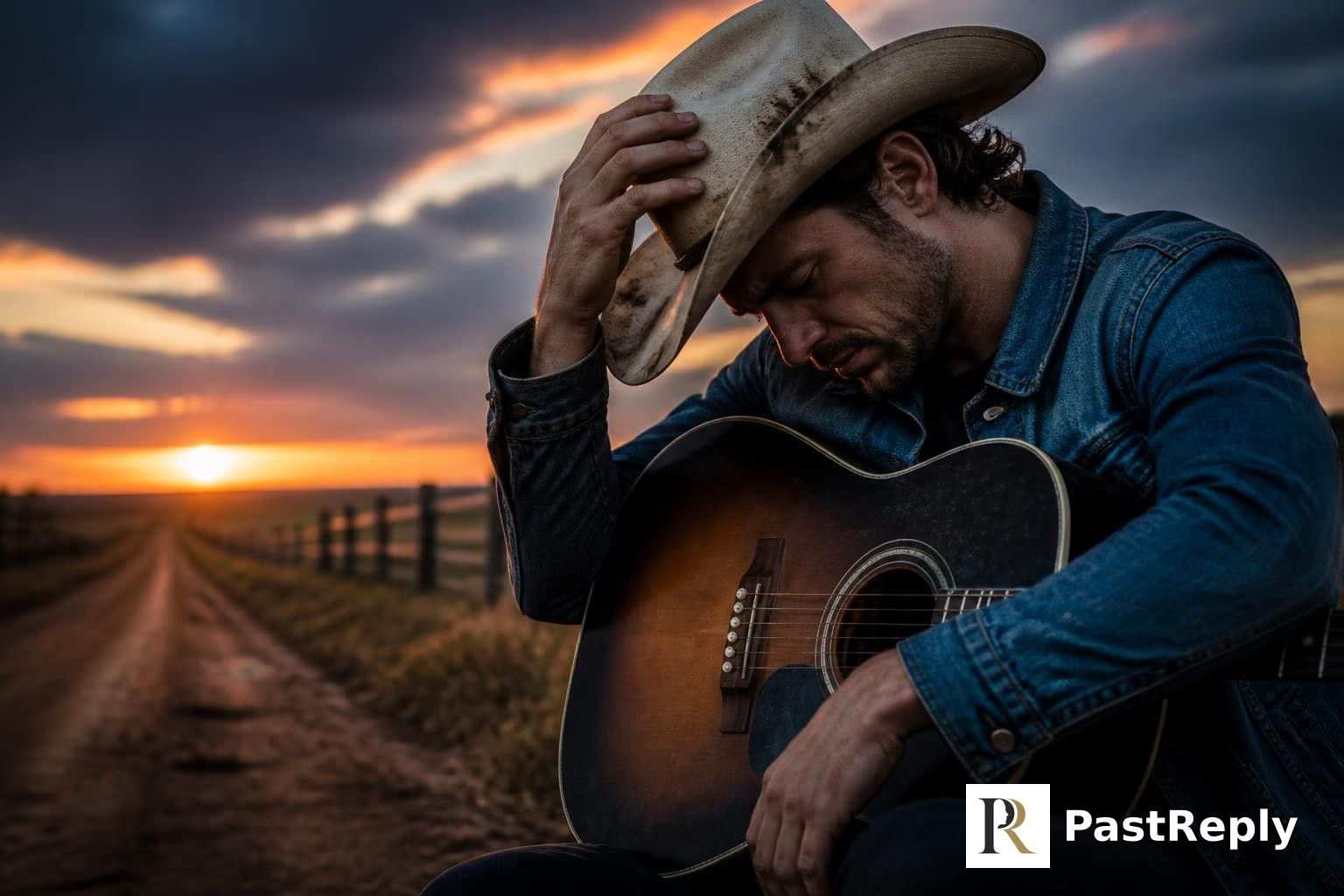
The facts
Country songs are often sad because the genre has deep roots in folk and blues traditions that emphasize storytelling about hardship, heartbreak, loss, and rural struggles. The lyrical themes frequently deal with failed relationships, death, poverty, loneliness, and nostalgia, which resonate with listeners who have experienced similar emotions. The authenticity of the vocal delivery and the simplicity of the musical arrangements also contribute to the emotional weight of these songs.
Answered by 100 of history's most famous minds

Blessed are those who mourn, for they shall be comforted. Your country songs weep because you have not yet learned that the harvest of the heart is gathered in tears, not in gold. A man who sings of his loss is closer to the kingdom than one who sings of his riches.

They sing of loss because they have tasted the world's fleeting sweetness and found it bitter without remembrance of God. The soul that is not anchored in the remembrance of the Merciful is tossed by every wind; a song of sorrow is but a cry from a heart that has not yet tasted the peace of submission.

They are sad because they cling to the shore, and the river of change is ever carrying them away. The singer offers his grief as a glass of water to the thirsty, but it is still full of the mud of attachment - to a love, a land, a youth that has already dissolved. Let the melody hold only the truth of change, and let the singer's tears water the path; the release is not in the song's end, but in the moment the listener lets the river flow through without grasping.

Why does the reed flute lament? Because it remembers being a whole stalk in the marsh, and so does the heart remember its home in the land of promise. We were slaves in Egypt, and we sang of our bondage; now we sing of the longing for Zion, for our days are but a breath and our sorrows a shadow that passes. A song that does not know the cry of the oppressed is a lie, for the Lord our God hears the tears of His people and will turn their mourning into dancing.

When one's heart is heavy, the voice naturally lowers to the earth. These songs speak of separation from kin, lost love, and the toil of the field - these are the bonds of ren, of human-heartedness, strained and yearned for. The music reminds us that we are not solitary reeds but branches of one tree, and the wind that bends one bends all. Let the listener ask: have I honored my father, cherished my spouse, been true to my friend? The song is but the echo of such questions.

Do you not know that we are strangers and pilgrims in a land of thorns, and every song of a broken heart is a sigh for the city that is to come? The world groans under the weight of sin, and the country singer's lament is but an echo of that groaning, a cry that we have not here an enduring home. Yet even in the saddest tune, if there is a glimmer of hope, it is the Spirit himself bearing witness with our spirit that we are children of the promise. Let them sing of their earthly losses - but I tell you, the true joy is in the reconciliation that awaits.

These songs tell of wandering and waiting - the ache of the road, the promise not yet seen. I left my father's house with only a word from the Most High, and my heart knew the loneliness of the night, yet I pitched my tent and believed. When a man sings of loss, he sings of the journey, and the journey's end is a blessing that makes the tears sweet as morning rain.

The heart that sings of loss has already let go of what it clings to. A river that rushes over rocks does not weep; it simply flows, carving its path through the mountain. Those who pluck the lute and mourn are like autumn leaves - they fall because they must, and in their falling, they teach the wind how to sigh.

The musician who sings of loss is like a beggar at the temple gate - he knows he cannot carry his burdens alone. But let him not stop at weeping; let him turn his sorrow into service, his tears into sharing bread with the hungry. The true song is not in the mourning but in the mending.

My son sang of the hungry being filled and the rich sent empty away. When a mother holds her child and knows the world may wound him, her heart learns a sorrow deeper than any melody. These songs are the laments of those who have hoped against hope, who have kept faith through the night - and such sorrow is never without the promise of the dawn.

Sad? Of course they're sad - the poor sinner is singing about his own damnation! But where is the Gospel in these ditties? Where is the joyous news that Christ died for his sins? If a man sings only of his misery, he sings like a heathen who knows not that his guilt is already forgiven by grace. Let him add one verse of faith, and his song will turn to a hymn of thanksgiving.

All human sorrow arises from the gap between what we desire and what we possess. These country songs, in their plain speech, reveal the natural law of the heart: we were made for perfect union with the Good, yet we wander in a valley of tears. Their sadness is not a defect but a signpost - a recognition that our true home is not here, and that even the sweetest earthly melody is but a distant echo of the heavenly song.

Ah, but you see, the sadness is not the song - it is the doorway through which love enters. When I held the dying in my arms in Calcutta, I did not ask them to smile; I asked only to let them know they were not alone. These songs are the cries of the ones who have no one else to tell their story - and if you can sit with that sorrow, you have already begun to heal it. There is no greatness in joy that turns away from suffering; there is only love, and love begins where the tears are.

I observe that sorrow, like all motions, follows laws of rest and change. Your country songs are but the sounding of a heart's pendulum, swinging from joy to lament, seeking equilibrium. The lament is not a flaw but a demonstration of the gravitation that binds the human spirit to its earthly station.

When the violins weep, they are not weeping without reason - they mourn the loss of a symmetry the universe once seemed to hold. Your heart, that instrument of string and chamber, resonates with the minor key because it knows, at last, that time does not flow backward, that the beloved is a world gone receding, and that even the light of a distant star can arrive only as a memory.

The mournful note is inherited, not invented - it is the relic of a call that once kept us near the warmth of the fire, warning of loss, and it has been preserved because it conferred an advantage on the singer's tribe. We are descended from those who felt the pang deeply enough to act, to hold their kin close, and to survive the winter of the heart. So the sad song is not a defect but a beautifully adapted organ, and the twang in the voice is the echo of a very old and very successful evolutionary response.

Listen to the words, not the melody! You will find they are a precise measurement of the human heart's motions - a falling, a collision, a loss of what was held dear - described with the accuracy of a lens. A happy tune is the great sphere spinning in unclouded day; a sad one is the same motion observed through the shadow, and it teaches us the true shape of our orbit. Weep if you must, but take your quadrant and measure that ache, for even sorrow is a datum in the great book of nature.

Consider the harmony of the spheres: even the luminaries trace circles of joy, yet their paths are not without epicycles of apparent retrograde. So too the human heart moves in ways that seem sorrowful to us, but viewed from a higher vantage, all is part of a grand, ordered design. These songs capture the minor key of earthly existence, a necessary counterpoint to the major of the heavens. Simplicity and truth, not gaudy ornament, best reflect the Creator's hand.

Consider the steam engine, which hisses and weeps as it releases its pressure; these songs are the safety valves of the common soul, venting the accumulated melancholy of a life tethered to the soil. When I devised the alternating current, I knew the sine wave of sorrow and joy, the ebb and flow of human emotion that can be channeled, not suppressed. The sad song is the discharge of a charged heart, and after the note fades, the quiet hum of acceptance remains - like the calm after a storm of my own lightning.

One might see the prevalence of sorrow as a statistical regularity - the human condition, like radium, emits its own radiation of grief when disturbed. But such songs are not mere measurements; they are the residue of elemental forces, and the task is not to dismiss them but to understand their source. In the laboratory of the heart, sadness is a reaction that reveals the true nature of the soul's elements.

I would not weep over a melody; I would place it under a microscope. The sad song is a culture of sorrow - grow it in a dish, and you will find the microbe of memory, the bacillus of longing. Treat it with the serum of time, and you may yet see it transform into a hymn of resilience.

Sad songs? That's just the result of a hundred failed experiments with the heart. Every good invention starts with a stumble - try, fail, try again. They sing the blues because they haven't yet found the right filament to light up their happiness. Give me their problem, and I'll build them a phonograph of joy - it just needs more perspiration.

A song's sadness is less interesting than its information content. Consider: grief is a high-probability state for any organism aware of its own mortality, so a genre that encodes this common condition will propagate widely. The real puzzle is why any of us find pleasure in decoding sorrow - call it a algorithm for simulating loss without the fatal branch.

Every lament is a measure of distance from equilibrium. The singer has lost his fulcrum - his love, his home, his crop - and so he falls toward the earth with no counterweight. Give me a lever long enough and I could lift his grief; but the true cure is to find that one fixed point, that harmony, from which all sorrow can be moved.

When I dissect a trembling wire and find the needle jumping, I have captured a force that was always there, waiting in the dark. These songs - I hear in their plaintive turns the same truth: they are not decoration, but honest report. The heart's own weary field, its lines of loss and longing, traced faithfully as I trace a magnetic field. Let the cheerful singers polish their brass; this music holds its compass to the true north of what we have endured.

You wonder why the melody weeps? Look not at the title, but beneath it - the singer's drawl is the confession of a wound that has never healed. Every heartache in a three-chord verse is but the echo of an older, buried grief: the mother's cold glance, the father's absence, the primal loss we all carry from the first breath of separation. The sad song is the culture's dream, repeating what it cannot utter directly. And you, the listener, sway to its rhythm because it lets you weep for what you dare not name.

Take the sad song as your star chart: it reflects not a cosmic tragedy, but a local, temporary fluctuation in the chemical soup of the cerebral cortex - a brief cooling of the neural fire. From a distance of a billion light-years, the difference between a wailing steel guitar and a cheering stadium is indistinguishable from background noise. But since we are mere wet machines that must pass the time on our little rock, sing on - just remember that the universe doesn't care. The only meaning is the one you compute.

These songs are not mere reports of grief - they are the first drafts of a mathematics of the heart. Just as I imagined that the analytical engine might weave not only numbers but harmony and discord into patterns, so the country songwriter strings together chords to reveal a deeper logic: that loss is a variable, and hope is its unknown. I hear in each tearful chorus a theorem waiting to be proved: that sorrow can be mapped, and in its mapping, transformed. The machine of the soul runs on such algorithms, and the saddest note may compute the truest answer.

Let us define our terms. What is sadness but a perceived inequality between what is and what was desired - a broken proportion between expectation and event? The country song, then, is a demonstration of the axiom that all men know: that from loss, nothing follows necessarily but more loss, unless one adds the term of endurance. Such songs are not proof of despair; they are a lemma in the longer proof of human resilience, which is proven again by every new verse. And if the tune is simple, so too are the first principles - from a few plaintive notes, an edifice of feeling is built.

These dirges are a symptom, not a cure. Behind each tear lies a preventable fever, a childbirth gone wrong for want of a clean hand, a lung consumed by foul air. I would rather chart their causes in columns and rows than weep with them, for sorrow measured is sorrow mastered.

Ha! A soldier sings of home when the wine is gone and the campfire dims. But a conqueror knows that to mourn is to rest from the pursuit of glory. I would rather a song of bronze and victory than one of tears - but even I, at the edge of the world, have wept for what I have burned behind me.

Every legionary knows the truth: the territory of a man's life is won and lost in a few short campaigns, and the veterans sing of the battles they did not win because that is where the lesson lies. The sad song is the war report of the heart - it tells us which walls we failed to breach, so that the next commander may plan his siege with better knowledge. I would rather hear a mournful tune than a triumphant lie, for one teaches me to conquer, the other lulls me into defeat.

The Nile floods and recedes, and so do hearts - yet my court poets know that sorrow sung well is a lever of the state. A dirge of a lost love, a field gone fallow, these are the tunes that bind a people to their soil and their queen. When Rome's eagles circle, a song of shared grief is a shield stronger than any wall of bronze.

A Roman knows that the sweetest triumph is carved from the memory of a hard-fought loss. These songs are the garland of cypress that reminds the victor he is mortal, and in that reminder lies the strength of the state. For a people who forget their grief become soft; but a people who sing of their wounds, they are steeled for the next campaign. Let them weep together, and they will not weep alone - that is the foundation of a lasting empire.

A warrior does not weep for the steppe; he rides across it. These songs of woe are for those who have no herd to tend, no enemy to face, no banner to follow. In my horde, we sang of victory and of the horses that carried us to glory. Sorrow has its place - it sharpens the blade of revenge and steels the heart for the next battle. But let not a man dwell in tears when he can grasp a sword and carve his fate from the world.

Sadness is a retreat from the field of battle, a surrender to fate that I have never tolerated in my officers or my enemies. These songs of lost loves and empty bottle are the anthems of those who lack the will to seize fortune by the throat - they prefer to weep rather than to march. In my campaigns, I would rather hear the drumbeat of a new assault than the moan of regret, for glory is won by action, not by lamentation. Let the weak sing their sorrows; I shall compose my own history in victories.

The soldier knows the price of liberty, and the farmer knows the drought - these tunes are the honest ledger of a hard-won republic, not idle complaint. A nation that forgets its sacrifices grows soft, so let the fiddle cry for those who bled at Valley Forge and the mothers who waited. In sorrow there is a sober strength, and a people who can weep together can stand firm in the storm.

A man who has never felt the winter's chill does not know the warmth of the hearth. These songs are the nation's diary, written in the ink of hard days - the plow that broke, the letter that never came, the friend who didn't return. If we forget how to sing of sorrow, we shall surely forget what we fought to keep.

When the bombs fall and the ships sink, the survivors sing of what they lost - not to surrender, but to steel their spines for the next dawn. A nation that cannot lament its fallen is a nation that cannot rise again. So let them sing their mournful ballads; I'll take those tears and forge them into swords.

Sadness is the soil of truth. When the heart is stripped of pretense, it sees itself as it is. These songs speak of loss because loss is the common lot of the poor, and in their grief they find solidarity. I would not silence their sorrow; I would only ask that their tears water the seed of nonviolent resistance, so that the weeping of today becomes the freedom of tomorrow.

These songs are sad because they sing the unsung history of a people who have known the sting of injustice. But note how the sorrow is never final - it bends, like the arc of the moral universe, toward a triumphant chorus. The blues and the country spiritual are not cries of despair but testimonies of hope, for the man who can sing of his pain has already begun to overcome it.

You ask of sadness as though it were a flaw, but grief is the very soil of courage. In the long years of my imprisonment, I learned that a man who has not wept for what is lost cannot truly fight for what is to come. These songs speak for those who have known the weight of injustice - they are the quiet testimony that even in the darkest cell, the human spirit will not be silenced. The sadness is not an ending; it is the promise that we will not forget, and that we will rise.

It is the sound of a people who have been weakened, who have turned inward to wallow in self-pity instead of seizing their destiny. A nation that sings of loss has forgotten how to sing of triumph; it has allowed decadence and defeatism to rot its soul. The strong do not cry over failed loves - they conquer, they build, they forge a future through will and iron. Such maudlin tunes are a symptom of a culture that deserves to be swept away, that has lost the instinct to dominate.

Tears are a luxury the working class cannot afford. These songs of broken hearts and empty bottles are the opium that the kulaks and capitalists use to distract the masses from their chains. A tractor that breaks down does not sing - it is repaired. A man who mourns his lost sweetheart should instead build a dam. Sentimentality is a disease of the idle, and I will have no such ruinous tunes played on the radio while our foundries await their coal. We have steel to pour, not tears to shed.

You mistake the lament for the truth. The peasant's tearful ballad is but a bourgeois distortion - a strategy to keep the worker's gaze fixed on private grief rather than public injustice. What is a lost love compared to the loss of the means of production? The true song of the proletarian is the crash of machinery in revolution, not the sigh of unrequited longing. Sadness is a weapon of the old order; we must forge joy into a hammer, or we have learned nothing from history's dialectic.

Sad songs? Peasants wail because landlords squeeze them, and the rich drown their guilt in whisky. But the earth does not mourn - it waits for the plough. Let them sing their sorrows; we will sing the harvest of revolution, and the melody of a thousand communes will drown their tears.

One might say such strains echo the melancholy of our mortal pilgrimage, the ache of loved ones lost. For myself, after my dear Albert was taken, all music seemed but a minor key. Yet our subjects find comfort in lamentation, and it is a queen's duty to share their burden with a steadfast heart.

Sadness is part of the human condition, and these songs speak of loss and longing we all recognise. We are taught to carry on, to find strength in service and in the quiet rhythms of duty. Perhaps their grief is a reminder to reach out and comfort one another.

Let them sing of winter's hardship, for it teaches fortitude. But let them not forget the harvest and the Lord's providence. I would have my bards strike a chord of hope, reminding us that after the long frost of sin and strife, the Easter light of redemption dawns. Even a warrior's heart must learn to rejoice.

Tears are the rain the Lord sends to water the soul. When our fields are burned and our brothers fallen, we cry, and that is not shameful - it is prayer. But He also gives us courage to rise, to take up the sword and fight for His will. Their songs of sorrow must end in a battle cry.

These plaintive ballads are the fool's lament, who thinks his heart the only one that bleeds. A queen knows loss too - of mothers, of cousins, of the very flesh of my own mother. But I have learned to dance upon my grief, for a monarch's countenance must not shadow her realm. Let them weep in private, and serve me in public.

Every peasant's tale of heartbreak is a cry for education and progress. Give them light, and they will sing of harvests, not of lost love. I have wept for my own follies, yet I found refuge in the libraries of Voltaire and the arts of my court. Ennoble their sorrows, and they will compose odes of joy.

The herdsman's flute mourns the wolf that took his lamb, and the mother weeps for her child exiled by war. I have seen Babylon's gardens and the tears of many peoples, and I learned that mercy dries more tears than conquest. Let them sing; a king who listens to sorrow learns how to rule with wisdom.

The nightingale sings sweetest when the rose is torn. We suffer, that we may learn compassion; we weep, that our hearts may stay soft before Allah. Even in victory, I shed tears for the slain, friend and foe alike. Their songs are but a reflection of the world's travail, and a reminder that mercy, not might, is the greatest conquest.

Tell me, why do you call it 'country'? Is it the place of your birth, or the condition of your soul? A song that laments a lost love is but a shadow of the ignorance we all carry - the failure to know ourselves. The true sorrow is not in the song, but in the unexamined life that sings it.

They are sad because they glimpse the echo of an eternal Form - the perfect beloved, the lost home, the just life - that the hazy world of change can never fully hold. The singer's grief is the philosopher's longing, felt in the gut rather than the mind: a shadow-play on the cave wall that makes the soul remember the sunlight it once knew. Do not pity the weeping; envy the one who still feels the tug of the ideal, for that ache is the very engine of philosophy.

Sadness is the shadow cast by any good thing we have loved and lost, and these songs are the honest ledger of that loss. For how can a man know the sweetness of a harvest without the memory of a blight? The finest of these airs are catharsis, a measured release of the soul's excess moisture, bringing the hearer back to the mean of tranquility - a golden mean set to a plucked string.

The melancholy in these airs arises not from the matter itself but from the will's submission to inclination rather than to the moral law. When a heart laments the loss of a beloved object, it reveals a dependence on contingent goods, forgetting that true worth lies in acting from duty alone. Such songs, if they move us to self-reflection on our own autonomy, may serve a moral purpose; otherwise, they merely indulge a sentimental weakness unworthy of a rational being.

You ask why these ditties weep - because the weak find comfort in lamenting, and the strong find it in affirming. The man who sings of loss clings to what has passed, mistaking nostalgia for life. But the eternal return demands you love your fate, even the pain, or else you are merely a leaf blown by the wind. These songs are the music of the herd, a herd that has not yet learned to dance over the abyss.

The country song is not born of some timeless human heart, but of the specific misery of the rural petty-bourgeoisie and the landless laborer - a class crushed between the advance of industrial capital and the remnants of feudal sentiment. Their tears are the product of alienated labor, of a life sold for a wage that cannot buy dignity, and the lyrics of heartbreak and poverty are but the ideological reflection of their material condition. The true remedy is not more songs, but the abolition of the very system that fills the valleys with such wailing - then the guitar may strum a different tune, one of free association.

Let us doubt the claim that sadness is essential to these songs. What is a country but a collection of minds? And what is sadness but a confused perception, a passion of the soul that arises from false judgments? The clear and distinct idea of a field and a faithful heart should yield joy; if the song is sorrowful, perhaps the composer's reasoning is flawed, not the nature of the subject.

Does the merchant weep when his cargo sinks? No - he counts the loss and sets sail again. Sad songs are the currency of the heart's treasury; they remind the listeners that fortune is a fickle prince, and that the wise keep their laments short and their harvests long.

Why, the melancholy strain is the very pulse of the human heart, as true a chronicler as any poet. A shepherd's pipe may pipe of joy, but grief lends a deeper tongue - for what is loved is ever threatened by loss, and loss lends music its most poignant harmony. They sing of woe because woe gives the voice its most honest quiver.

In the halls of Ilium, when the fires burned and the best of the Trojans fell, the bards did not sing of the bright morning - they sang of Hector dragged through the dust, for that is the song that makes men weep and then fight harder. The heart of a song is the heart of a hero, and a hero's heart is heavy with the weight of those he could not save. So let the fiddle wail like Andromache; it is the sound of glory that was bought with blood, and it makes us remember why we strive at all.

Because they are the pilgrim's lament, sung by those who still bear the dust of the valley while their eyes strain toward the mount. The heart, exiled from its true home, cannot help but sing of its wounds - the broken vow, the empty chair, the road that leads only to a grave. A song of unalloyed joy would be a lie, for we are all yet in the wood, and every true note of longing is a prayer for the guide who will lead us to the light.

Ah, but is not sorrow the very soil from which the richest blossom springs? These laments give voice to the eternal striving of the human soul - the ache of the finite reaching toward the infinite. In my Faust, I showed that even despair can be a ladder to higher striving; so too these songs, in their simple honesty, remind us that to feel deeply is to live fully, and that the nightingale's song is sweetest after rain.

Why, it is because a man's heart is an inn where grief and joy take turns lodging, and the sad songs are but the ledger of those lamentable nights when the wind rattles the shutters and no knight-errant rides to the rescue. We sing of the woman who left, the crop that failed, the friend who died, because sorrow is the truest squire we ever had. But mark you, the same road that carries the funeral cortege also brings the wedding procession - only the good knight remembers both.

I have listened to a peasant sing in the fields, and his voice seemed to carry the whole weight of the Russian earth, its sorrows and its quiet faith. Why are these songs sad? Because life in the countryside is a constant confrontation with death and toil, with the breaking of the body and the fading of hope - yet it is precisely in that sorrow that the soul wakes to what is eternal. The sweetest melody is the cry of a mother for her son, for it speaks not of what is lost, but of the love that was real. Let the city folk call it sadness; I call it the truth of our mortal days, and the only path to a deeper joy.

You ask why they are sad? Because the human heart is a bottomless well, and only a fool thinks it can be filled with laughter alone. In the mud of the village, a man loses his love and finds his soul; the lament is a prayer that God hears through the tears. These songs are the truth of our freedom - we choose the dark, and the melody cries for the light we have forsaken.

A young lady who pines for a lost suitor and a farmer who mourns his rainless fields - both sing of disappointments that ought to have been foreseen. Yet there is a certain elegance in confessing one's folly through melody; it is far more bearable than confiding it to one's mother.

Why are they sad? Because the poor wretch in the song has been thrown into a debtors' prison by a cold-hearted creditor, or lost his child to the workhouse, or seen his true love carried off by consumption - and the tune simply tells the truth of it! Your fine London ballads are all about lords and ladies in satin; but these country airs are the honest cries of the common folk, and I say God bless every tear they draw, for it is a tear of fellow-feeling, and that is the seed of all charity.

A country song is just a heartache with a twang. The cowhand sings about his dog dying and his wife leaving because those are the two things a cowhand actually owns. Give a man nothing but a horse and a lonesome prairie, and he'll write a ballad about losing it - or about winning the lottery, which never happens, so sad it is.

A man's got to face the facts. Love dies, the land dries up, the friend doesn't come back. The songs tell it straight, no lies - that's why they hurt. Sad songs are true songs. The ones that lie are the happy ones, and there's plenty of those to make you sick.

I have watched a man at a plough and a woman at a loom; their songs often speak of rain that stays too long or a child gone to the city. Such songs are like the anatomy of the soul - they reveal the sinews that hold us to the earth. Sorrow is a kind of gravity, pulling the melody down to where the heart is heavy.

The saw cuts deep into the marble because it is searching for the figure that is already weeping within the stone. A joyful song is a smooth, polished surface, but the sad one is the chisel's strike - it reveals the truth of the human form, which is always a Pietà. I dissolve in the contemplation of beauty, but I am remade by the sorrow that carved it.

Ah, but is not the deepest blue also the most luminous? These songs are the color of twilight over a wheatfield - a beauty that aches because it knows the night is coming. The singer does not weep for the loss itself, but for the fierce, fleeting light of what was held, and that light is what we must paint with every stroke of our lives. Let the cheerful tunes be the yellow of high noon; give me the violet of a sky that holds its tears, for that is the color of truth.

Sad? Non, mon ami - they are simply true. The blues, the country, they do not lie about the world like your pretty portraits with their soft light. They show the broken lines, the jagged edges, the cracked earth of the heart. I would trade a thousand cheerful ditties for one that knows the weight of a single tear. Art must bleed, or it is merely decoration.

A sad song is not sadness itself but the light falling upon it, the gray of a rain-soaked field or the fading rose of dusk - a melancholy that shimmers and shifts with every passing moment. These country melodies are mere canvases; the listener's eye supplies the changing atmosphere, the ache of a memory lit by a low sun. I would not paint a tear, but the glint of one upon a cheek, caught just before it falls.

You wonder why these songs weep? Look at the faces in the tavern, the widow at the well - every soul carries a shadow, and the painter who shows only the candlelight and hides the gloom lies. The melody is like my chiaroscuro: the darker the corner, the more fiercely the small light of love and loss burns in the middle of it.

Sad? Sí, because pain is the only honest paint, and these songs are painted with the blood of the heart, not the pretty dyes of the city. My own body screams in every portrait, and the desert knows the cactus’s thorn teaches the flower’s bloom. Let them cry - tears are the river that carves the canyon of who we are, and I will not wipe them away to please anyone.

Sadness is the minor key of the heart, and your country songs embrace it with the same joy I find in a poignant adagio. The tears in the voice are not a flaw but a color - like the shadow that makes a painting glow. I myself have written laments that make angels weep, and I do so with a grin, for what is more human than a tear that sparkles?

I have heard the world through my skull, and what I hear is not always major. The sad song is the cry of the man who is deaf to the crowd's applause but hears the beating of his own defiant heart - and he transforms that ache into a symphony that will echo long after the tyrants are dust. Do not shrink from the minor key; it is the shadow that makes the light of the finale blaze with the triumph of the human will.

A lament in a minor key is a prayer that asks no question, for the answer is known to our Heavenly Father. The dissonance of earthly sorrow is thus resolved into the perfect concord of His will, and the listener is given a moment to dwell in that resolution. As a cantor must voice the pain of the congregation so they may feel release, so these songs give form to our grief, and in that form, we find the order of His grace.

Well now, country music, that's the sound of somebody tellin' the truth about their life. When I sang them old gospel tunes in church, we didn't hide our troubles - we lifted 'em up to the Lord. Same thing here: a man's lost his woman, his dog died, his truck broke down - he's gotta sing it out or it'll eat him alive. That ache in the voice, that's what makes you feel you ain't alone.

You know, when I heard a country song about a broken heart, I thought, this is the same moon shining on a lonely child's window, the same longing to be held that I felt when I was small. They sing of a dog dying and a pickup truck rusting, but underneath, it is the cry of every heart that has ever known loss and still hopes for love. I wanted to take that ache and turn it into a dance - because even in the saddest note, there is a beat that says we are not alone.

Well, it's like this - everyone's got a rainy day inside, and a good tune can make the clouds seem almost pretty. We wrote 'Yesterday' when Paul was feeling blue, and the whole world sang along, so maybe sadness is just love wearing a coat. It's not about being miserable, it's about knowing you're not alone in the mud, and that's a cheerful thought, really.

Sad songs? They ain't sad. They're just mirrors held up to the cracked face of the world, showing the dust and the dirt and the long gray roads. A man sings about losing his dog, his woman, his truck, and you call it sad - I call it the only honest math there is. The happy songs lie; the sad ones tell the truth about the weather.

Honey, sad songs are just the diary pages we write when the world gives us lemons - and I've learned to make the sweetest lemonade out of the sourest heartbreaks. Every teardrop on the page is a bridge to someone who's felt the exact same rain. And when you sing it loud, you turn your pain into a power anthem for everyone who's ever been left out in the storm.

These songs of sorrow are the cargo of those who have not yet charted the Indies of their own hearts. In my voyages, I heard sailors sing of homes they left, but we pressed onward, for the horizon is a cure for melancholy. I would rather set sail for gold and glory than linger on a shore of sighs.

In the high passes of the Pamirs, where the snow never melts, the caravan men sing of the green valleys they left behind, and their voices crack like ice. But in the markets of Cambulac, all that remains is the tune, and even the merchant who has never seen those valleys feels the pinch in his purse and the memory of his own first farewell. Sadness is the coin of every road; the farther you travel, the more you spend it on the things you cannot carry home.

You ask why the song is sad? Because the sea is a cruel mistress, and every man aboard knows the sound of a shipmate's name called into the wind that does not answer. A merry tune is for the harbor; the open water demands a ballad of what is left behind - the green shore, the warm hearth, the sweetheart's face that will fade like spray. It is that salt of sorrow that steadies the tiller and keeps us sailing toward the setting sun.

From a systems engineering perspective, the predominance of melancholic themes may reflect a self-selecting feedback loop. The genre's origins in folk and blues traditions created a niche for narrative expressions of hardship, which attracted performers and audiences who found resonance in that emotional register, reinforcing the pattern through cultural transmission. It's a stable equilibrium, not a design flaw - much like the orbital mechanics that keep a spacecraft on course.

Sad songs are just a map of the valleys, but you can't fly high without knowing how low the ground can sink. I've heard a cowboy croon about a lost love under a starry sky, and I thought - that's the same feeling as cutting your engine over a thousand miles of empty ocean, alone with your courage. The tears are not for stopping; they are the fog you must climb through to find the clear sky above. So let them sing of sorrow - then go out and find your own adventure.

From up there, the Earth is all blue and white, no borders, no fences - but down here, folks still feel the pull of the soil and the ache of leaving it. A sad song is like a letter from a cosmonaut who misses his village; it keeps you grounded when you're flying far. The melody is the gravity that holds us to home.

Your country songs are sad because they're honest. The best work - whether a song or a product - comes from a place of real emotion, not from trying to please everyone. The songs that break your heart are the ones that feel designed by someone who has lived it. The rest is just noise.

It's a legacy of a high-variance evolutionary process, but the selection pressure is on emotional resonance, not literal grief. A song that taps into loss is a simulation of a system failure - the relationship, the farm, the loved one - and it's sticky because it lets you rehearse the failure mode without dying. Sad country is a bug-fix for the soul; it's the user manual for the parts of life that don't have a factory reset.

Oh, honey, because that's where the truth lives. We can all clap along to a happy tune, but it's the ache in a voice that says 'I lost something and I'm still standing' that reaches into your soul and says, 'Me too.' That sadness isn't a weakness - it's a door. When a song cracks your heart open, that's when you can finally let in the light, and that's the first step to your best life.

Float like a butterfly, sting like a bee - but the saddest songs come from the deepest sea. Country folks know what it's like to fight the ropes of life, to get knocked down by love and loss and get back up swingin'. That ain't weakness, that's the truth of the working man's soul. I don't sing about heartache, but I know the weight of a heavyweight's crown - and the loneliness that comes with standin' tall when others fall.

When I was a boy in Bauru, we had nothing but a ball made of rags and the joy of playing under the streetlights. A sad song is like a player who misses the goal at the last minute - it hurts, yes, but it makes you practice harder and love the next match more. The people who sing of their troubles are like the fans who cry when we lose; their hearts are full, and out of that fullness they will cheer the loudest when the beautiful game brings joy again.

Why, because every tear has a story, and a story well told can turn a frown into a spark of hope! When we made 'Snow White,' we showed the queen's dark envy but let the dwarfs' laughter and true love's kiss carry the day. Sadness is just the shadow that makes the sunbeam of happiness dance brighter - so sing the blues, and then let the magic lead you to the joy!