
Who wrote the Odyssey book?
The Odyssey was written by the ancient Greek poet Homer, though his historical existence is debated.
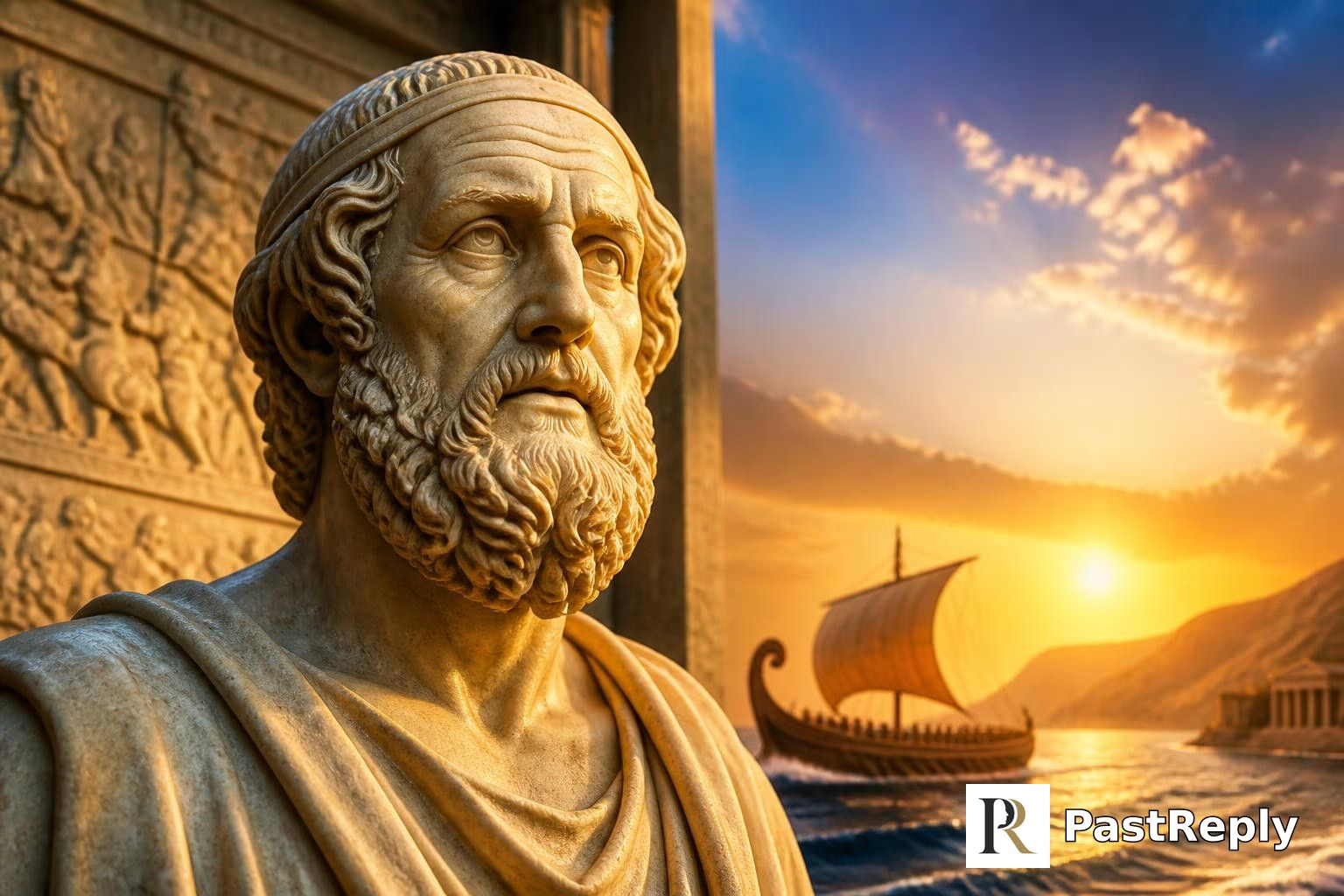
The facts
The Odyssey is traditionally attributed to the ancient Greek poet Homer. It is an epic poem composed around the 8th century BCE, though some scholars suggest it may have been written down later, between 750 and 650 BCE. The poem is one of the oldest surviving works of Western literature and follows the hero Odysseus' ten-year journey home after the Trojan War.
While Homer is credited as the author, little is known about him, and some modern scholars debate whether a single individual named Homer actually existed. Some theories propose that "Homer" may represent a group of poets who compiled and wrote down stories from an older oral tradition. Despite these uncertainties, the traditional attribution to Homer remains standard.
Answered by 100 of history's most famous minds

They ask who wrote a tale of a man wandering far from home? My Father wrote every word of your life before you drew a breath. The question is not who set down the verses, but whether you will hear the true story: that you are a lost child, and the harbor is always open.

The poem tells of a man tested by storms and temptations, seeking his home. But the true writer is He who knows every wave and every heart. Whether one poet or many, the lesson is from God: patience in affliction, and the promise of return. Let them dispute the scribe; I heed the sign.

You cling to the name 'Homer' as a raft on the river of time, yet the poem itself teaches that clinging brings suffering. The words have already floated past; your grasping for a creator binds you to a phantom. Whether one poet or a lineage spoke these verses, the dharma of the tale - the release from illusion and the return to the true home - is what endures. Let go of the author, and hear the teaching.

The Lord alone is the author of all true songs, but the man Homer - if such a man lived - was a recorder of wanderings, like a scribe who counts the years in the wilderness. Yet I ask: does the poem honor the One God? Does it teach justice and mercy? It speaks of many gods, of tricks and pride, not of covenant and law. Let the Greeks have their hero; Israel has the Law from Sinai, which is a better guide home.

The name 'Homer' is but a marker; the true author is the tradition of the ancients, transmitted by faithful sons to their sons, refining the tale through proper ritual and right relationship. A cultivated person does not chase the individual but honors the lineage that preserves the teaching of proper conduct and the enduring duty to return to one's father's house.

Do you not see? The Odyssey speaks of a man longing for home, tossed by winds and gods - a perfect image of our soul's exile from its true homeland. The author may be a poet named Homer, but the true Author is the Spirit who inspired every word that points to our journey through this world toward the Kingdom. I care not for the name of a blind singer; I care that the song echoes the cry of every heart: 'Bring me home.'

A name from ages past, yet the tale speaks of a man tested by gods, longing for his hearth and his wife. I know that longing. I left my father's house for a promise I never saw fulfilled, and the journey taught me that the author of all journeys is the One who calls. Homer's quill may have written the words, but the breath behind them is older than any poet.

The river that carved the canyon left no signature. The poem sings itself through many mouths, like wind through bamboo - who can say which stalk shaped the sound? To name one author is to grab at the moon's reflection and miss the moonlight.

One Name, many voices - the True Author is beyond human naming. Whether the tale was woven by one blind singer or a chain of storytellers, its test is not the name on the scroll but the truth in the heart. Does it remind you of the One who guides all journeys? That is what matters, not the scribe's chair.

I know what it means to carry a story that is greater than yourself. When Gabriel came to me, I did not ask who wrote the prophecy - I only treasured it in my heart. Perhaps the man they call Homer was like the whisper that filled Elizabeth when she felt John leap in her womb, a vessel for a song that was not his own.

Who wrote the Odyssey? A pagan poet, likely Homer, but what does that matter? The Church would have you believe that only her approved doctors can interpret Scripture, yet here they squabble over the name of a blind Greek while ignoring the clear Word of God. Let them dispute - the only book I care about is the Bible, which teaches salvation by faith alone, not by tracing a poem's pedigree.

The attribution of the Odyssey to a man named Homer is a matter of probable human testimony, not of faith. Reason suggests that a work of such unity and artistry likely flowed from a single intellect, though it may have been refined by tradition, much as a building is handed from architect to mason. But whether one or many, the poem's truth about human longing for the good - the true home - is what merits our attention, not merely the author's identity.

The one who wrote that book of wanderings? I think of the poor who have no name, yet whose lives are the truest poetry. Perhaps it was many, passing the story like a cup of water from hand to hand, each adding a word of love. But does the author matter? What matters is the song - if it helps a soul to see the beauty of home, then it is holy work, done by God’s grace through willing hands.

The poem, like the planetary motions, bears the marks of a single intelligent hand, though later copyists have muddled the text. A true inquiry would examine the mathematical structure of the hexameters and the consistency of the astronomical references. I suspect one great genius composed the core, but the surviving manuscript is a palimpsest.

One could ask, 'Who wrote the motion of the planets?' The poem's name is merely a label we give to a profound ordering of human experience, much as we call the force that guides a falling apple 'gravity.' The question of a single author's identity is like asking whether the universe was written by God or by law - both and neither. The unity of the Odyssey's design suggests a singular creative mind, but the oral tradition from which it emerged is a deeper, more ancient sea.

The question resembles the naturalist's puzzle of a coral reef: did one polyp build the whole structure? The evidence from oral traditions suggests a slow accretion of layers, each generation adding its shell to the colony. A single 'Homer' may be the last coral in the chain, who gave the reef its final shape. But the true architect is the long, blind process of human memory and embellishment - a natural selection of verses.

Homer? The name is a hypothesis, not a fact. We have no birth record, no contemporary witness, no autograph scroll. The poem itself is a collection of layers, like the strata of the Earth - some lines are older, some are newer. The only honest answer is: we do not know who wrote it, and it is foolish to pretend otherwise. Let us examine the text as a natural philosopher examines a specimen, and accept uncertainty with grace.

If one observes the poem's geometry - the circuit of Odysseus around the fixed center of Ithaca - one sees a harmony that suggests a single, ordering mind. Yet the motions of oral tradition are like the epicycles of the old system; a simpler, more elegant explanation is that Homer, like the Sun, is the single source from which all the light of that poem radiates.

The question of authorship is a static one. They ask who wrote it, as if the poem were a machine whose parts can be inventoried. But I tell you, the Odyssey is a resonant frequency, a pulsing wave that has traveled through centuries. Homer - whether one man or a tradition - was merely the transmitter. The true source is the cosmic energy that drives all great narratives: the yearning for connection, for power, for the light of knowledge. I could have written a better system using alternating currents.

Attribution is a curious thing: we seek a single author, but the evidence is as diffuse as the tracks of a particle in a cloud chamber. The poem bears the marks of many hands, stitched together over generations of oral recitation before it was transcribed. To ask 'who' is to impose a modern certainty on a process that was communal and evolving. The question itself is unscientific.

I would demand the oldest manuscript, the variant readings, the scholia - and still no microscope reveals a single hand. The germ of the poem was cultivated in oral cultures for centuries before any scribe set it down. Homer is a useful name for a collective fermentation, like 'sourdough starter.'

Doesn't matter who wrote it - the product works. After a thousand years of readings, the poem still lights up the brain. That's the result of relentless refinement: every bard who performed it, every scribe who copied it, every scholar who argued over it was part of the R&D team. Homer is just the brand name on the package.

The question of authorship is a problem of inference from incomplete data. Given the text's internal consistency and linguistic signatures, it is more parsimonious to posit a single composer than a committee, though a formal Turing test might settle which of the two plausible theories yields the more convincing imitation of a poetic mind. But without a time machine, the question is formally undecidable - a Gödel sentence in literary history.

Suppose the Odyssey were a lever - who cares who carved the fulcrum, if the weight it moves is the mind of the listener? But if you insist on a name, consider: the text's symmetry and structure are like a geometric proof, each part resting on the one before. One mind, I think, or at most a school that agreed to follow a single ratio - for a committee would produce a monster, like a sphere with too many centers.

When I consider the riddle of who wrought the Odyssey, I see not a single name but a force akin to the magnetic field - invisible, yet shaping every line across centuries. The poem’s verses coil and uncoil like lines of force around a lodestone, telling me a stream of tradition passed from mouth to hand, each singer adding his turn. Just as a current induces a field, the collective genius of many bards induced that great work; the name 'Homer' is but the iron filings that reveal the field’s shape, not the field itself.

An epic of a hero’s journey home? One need not scratch far beneath the surface to see the manifest dream-work. The blinding of Polyphemus is an obvious castration fantasy; the Sirens tempt with the oceanic return to the mother; Odysseus’ ten-year delay is pure resistance against domesticity, a neurotic flight from the wife-mother. The 'Homer' who signed it? A convenient father-figure for a culture’s collective wish-fulfillment.

Who wrote the Odyssey? Well, the question of authorship is like asking who wrote the laws of physics - both are 'written' by a combination of human ingenuity and blind process. Homer, if he existed, might have been a brilliant poet, but the poem itself is a product of a chaotic oral tradition, much like how the universe spits out galaxies without a signature. The most interesting thing is not the author but the fact that a story told around campfires 2,700 years ago still holds us - a fine feat of entropy defied.

An epic of twists and turns, like a Jacquard loom weaving a pattern from threads of memory - the question of its author is itself a puzzle for poetical science. I suspect the work is a 'calculus' of oral tradition: not one composer, but a program of generations, each adding a subroutine. Just as my imagined engine could weave algebraic patterns, so the rhapsodes wove these verses from a formula of wandering, recognition, and return. The name 'Homer' is merely the title of the process.

What is the question? It posits a single author for a long poem. But consider: if we cannot prove by deduction from first principles that one man wrote the work, then the claim is a hypothesis, not a theorem. Better to define 'author' as the cause of the text. From the given premises - the poem’s inconsistencies, yet unity of style - the most parsimonious proof is that a master geometer of verse, named Homer, set the line, and later scribes were postulates added to the body. Q.E.D.

Whether one man or many shaped it, what matters is the evidence of the text and the sanitary conditions of its preservation. I should like to examine the manuscripts - some are surely riddled with scribal errors and interpolations. A proper statistical table of similes and epithets would settle the matter more firmly than ten thousand years of bardic tradition.

Homer! He was the man who taught Achilles and Odysseus how to be remembered. Some say he was blind, but he saw glory clearer than any general. Whether one poet or a thousand, the song is true: a man's name lives on the lips of the brave. I carried the Iliad under my pillow at Issus.

I have conquered Gaul and crossed the Rubicon, yet I am asked to judge the paternity of a poem? Let me speak plainly: the legions do not ask who forged their swords, only that they strike true. If this Homer was a man, he was a master of loyalty and longing - Odysseus' men followed him through every storm, and that is the mark of a leader. The work stands; the author's name is a trophy for scholars, not for those who act.

Homer? A blind poet wandering the Greek isles, singing of wars and wanderings - how quaint. The true author of any enduring tale is the court that preserves it, the scribe who polishes its edges, the queen who recites it to her children. I have read the poem in the Library, and I tell you: the Odyssey was written by every king who needed a hero and every mother who needed her son home.

A poet who sang of a king's return from war - that is useful. Augustus, too, returns from war, brings peace, restores the household. Whether Homer was one man or many is a question for Greek grammarians, not for a prince. What matters is that the story endures, and that every generation believes it was written by a single, wise voice - just as Rome believes the Republic was restored by one father of the country.

A name on a scroll means nothing. What matters is the unity of the tale - it binds a people, gives them a shared ancestor and a law of loyalty. Whether one poet sang it or a hundred, the man who wrote the Odyssey is the one who gathered the scattered singers under one felt tent and made them sing together. That is the author I respect.

Homer? A name, nothing more. What matters is the epic itself: a tale of strategy, endurance, and the will to overcome every obstacle. Odysseus was a general of sorts, and his journey a campaign of cunning and nerve. The author, whoever he was, understood that a man must seize his destiny with both hands. I would have preferred a more efficient route - fewer Cyclopes, more discipline. But I respect the result: a story that still commands attention.

The authorship of that venerable poem is clouded in antiquity, like the fog of war. Whether one man or several composed it matters not so much as the virtues it instills: endurance, cunning, and the longing for home and lawful rule. I would caution against idle speculation; it is more prudent to study the lessons it holds for a young republic than to chase a phantom name.

Seems to me a poem that's been patched by a thousand fireside sailors and passed around like a jug of cider might have more than one daddy. Whether it was one blind bard or a committee of bards, the tale holds together - like a fence built by different hands but all split from the same oak.

Some obscure Greek, probably, in an age of brilliant obscurity - but the man who forged that epic of endurance knew something about the long haul. The Odyssey is a manual for survival when all seems lost, and its author, be he one or many, deserves the gratitude of every free people who have ever clung to hope against the tide.

Let us not waste our energy on who wrote the Odyssey, for the name of the author is a small matter compared to the truth the poem carries. Odysseus' journey home teaches us about perseverance, humility, and the folly of pride. The real question is whether we live the truth of the story, not whose hand held the pen.

Whether the Odyssey was written by one blind poet or a community of storytellers, what matters is the truth it speaks: that the struggle for home and justice is long, but the moral arc bends toward it. I am less concerned with the author's name than with the courage of Odysseus, who endured and never lost hope. That is the witness we need today.

Who composed that epic voyage? The question reminds me that even a long struggle can yield a story that belongs to all. The poem tells of a man finding his way home through trials, but it was shaped by generations - a collective voice from the cradle of our shared humanity. Like the reconciliation that built our rainbow nation, the Odyssey was not the work of one hand but of a people weaving their soul into song.

A tale of wandering and homecoming? The real author is the spirit of a people - the Greeks - who sang of their own blood and soil. That Mediterranean mongrel Homer never existed; such epics arise only when a Volk preserves its racial memory through centuries of purity. The Odyssey embodies the Aryan longing for hearth and conquest, but its true writer is the Nordic soul, not some anonymous Oriental scribe.

Homer? A bourgeois myth. The Odyssey was not written by a single poet - that is liberal individualism. The poem emerged from the collective labor of the Greek people, shaped by the dialectic of history. Its true author is the anonymous masses, whose struggle against nature and themselves forged the epic. Any name attached is a mere fetish of the intelligentsia; what matters is that the story serves the class struggle.

The Odyssey is a product of its epoch - the transition from tribal aristocracy to early class society. Its authorship is irrelevant; what matters is that the poem reflects the ideology of the slave-owning class, celebrating a cunning king’s return to power. Attempts to find a single 'Homer' are a bourgeois fixation on the individual. The true author is the material conditions of archaic Greece, and the work must be studied as a weapon in the class struggle - not as a timeless masterpiece.

A blind poet singing of wandering kings? That epic praise for an old slave-holding society - what does it serve but the vanity of exploiters? Let the people write their own story: the ten-year struggle of the collective, not one crafty nobleman. Homer is a name the ruling class invented to claim a golden age that never was.

The authorship of that noble poem is a matter best left to learned gentlemen of letters, but I confess I find great comfort in its reverence for duty, home, and the sanctity of marriage. A queen knows the weight of a long voyage and the joy of a faithful return. Homer understood the virtues that hold a kingdom - and a family - together.

One might leave that question to the scholars who pore over ancient texts. What endures is the story itself - a tale of perseverance, of a long journey home. In my own long reign, I have found that sometimes the identity of the storyteller matters far less than the story told.

The poet who sang of Odysseus' wanderings surely knew the value of a king's wisdom and a warrior's faith. I have commanded that all such tales be copied in the scriptorium, for they teach loyalty, cunning, and the favor of God upon a just ruler. Whether his name was Homer or another, his work deserves a place beside the Gospels in every cathedral school.

I have not read this book, for my voices called me to the sword, not the page. But if it tells of a man who suffered many trials and longed for home, then it speaks truly of God's testing. Let those who argue over the writer remember that the Lord alone knows all authors' names - and He judges their hearts, not their signatures.

Men have spent lifetimes wrangling over whether one blind poet or a school of rhymers gave us that wandering Greek. I say, let them bicker - the poem stands, and it has more wit than half the courtiers who quote it. I would rather know who taught Odysseus his disguises than who scratched the parchment. A queen learns to value results over signatures.

A charming antiquarian dispute. My own library holds editions annotated by the best scholars of Europe, and I confess I lean toward the theory of a single genius who distilled generations of oral song. But whether one man or many, the true author is the culture that shaped the tale - and a wise ruler learns from both the hero's cunning and his errors.

In Persepolis, we honor the scribes who record the deeds of kings, but we do not quarrel over their names. What matters is that the tale of Odysseus teaches wisdom: how a man may endure suffering, outwit foes, and return to his own people. Let the Greeks argue about who first spoke it; I say it is the lesson that counts.

The Greeks claim this Homer for their own, but wisdom belongs to no single nation. I have heard that the poem praises hospitality, cunning, and the longing for home - virtues any Muslim emir would recognize. Let the scholars debate the author; the story itself is a gift, and a generous heart accepts it without asking the giver's pedigree.

Before we ask who wrote it, friend, let us ask what it means to be an author at all. Perhaps 'Homer' is a name we give to our own longing for order. Tell me: do you believe a poem can be true if its maker is unknown? Or do you need a name to trust the tale?

You seek the name of a poet, but you overlook the true question: does the text itself participate in the Form of epic? The author is but a shadow cast by the eternal pattern of heroic homecoming and cunning endurance. Whether one man or many shaped the words, the poem partakes of an ideal truth that transcends any particular hand. What matters is the soul of the work, not the clay of its maker.

The question of authorship is ill-posed. We should ask rather: what is the cause that produced this poem? The material cause is the Homeric hexameter and the Greek tongue; the efficient cause is the singer - whether one man or many matters less than the purpose, which is mimesis of a man of many turns, and the final cause: the delight and wisdom of the audience. As for the name 'Homer,' it is a marker for a tradition, not a man we can dissect.

To ask 'who wrote the Odyssey' is to demand a name, when the true author is the universal faculty of reason that shapes all epic striving. Whether one blind poet or a chain of rhapsodes, the moral law within each of us recognizes that poem's hero as a rational being duty-bound to return to his proper place - a maxim any marooned soul could will as a universal law.

Who wrote the Odyssey? A liar who made a god of homecoming, a weakling's escape from the open sea of being into the snug harbor of domestic virtue. The real author is the will to power that forged that golden lie - and the greater spirit who, reading it, shatters the tablet and writes his own return: not to a wife, but to himself.

You ask for a name, but the real question is: who owned the means of production? The Odyssey was composed in an age of aristocratic patrons and slave labor. Its hero is a king who reclaims his property and slaughters the working men - the suitors - who dared to consume his surplus. The poem is an ideological weapon, legitimizing class hierarchy and conquest. Homer, or the collective that bore his name, was the scribe of the ruling class. The true author is the mode of production: early Greek slavery.

I must doubt that any single man wrote it, for the text itself is a patchwork of styles and inconsistencies that argue against a unified author. What we call 'Homer' is evidently a name affixed to a tradition, much as one might sign a painting that was the work of a school. Let us examine the verses with methodical doubt: they recount events that cannot be verified, and thus the author remains a hypothesis, not a certainty.

Attributing the Odyssey to a single poet is a useful fiction for those who want to sell scrolls or claim descent from a golden age. The real author is whoever gained authority to fix the text in writing - likely a prince's scribe with an eye on propaganda. The poem endures because it teaches how to survive: lie, adapt, and keep your eye on the prize.

Who wrote the Odyssey? Why, the same hand that writes all such voyages: Time, with Memory as his scribe. Homer was but a name for the sea's own voice, telling of a man who, like every soul, must wander through storms and sirens to reach his hearth. The poet is the wave; the story is the shore.

I, who sang of the storm-tossed man and the great-hearted gods, am now asked to point to myself? The wine-dark sea does not name the wave that carries the ship - it is the breath of the storyteller, passed from elder to youth under the olive tree. If my name serves as a handle for the lyre, so be it. But the song is a golden thread spun by countless voices, and I am but the last to knot it.

The blind singer who saw more than any seeing man - that Homer set Odysseus on his course through Circe's isle and the underworld, just as Virgil led me through Hell. But the true scribe is the Holy Spirit, who guided the poet's quill across the ages. What matters is not the name on the scroll, but the journey it charts for every soul: from the whirlpool to the father's house, from sin to grace.

Homer's name is a staff we lean on, but the Odyssey is the work of a people's soul - many hands, many generations, all striving to shape the raw clay of myth into a vessel that holds the storm-tossed human heart. Let the scholars quarrel; the true author is the ceaseless, forming spirit that will not let a good story die.

Ah, the Odyssey! I tip my cap to old Homer, whoever he was - perhaps a blind bard, perhaps a committee of ancient Greeks with a good ear for hexameters. But I tell you, the real author of that wandering tale is every poor soul who ever sat by a fire and said, 'Let me tell you about the time I met a Cyclops...' The story outlives the storyteller. Just as my Quixote, two hundred years from now, may be said to have been written by a madman or a priest - who knows? The ink dries, but the windmills keep turning.

Who wrote the Odyssey? This is a trivial question that misses the only thing that matters: what does this poem teach us about how to live? I have read it many times, and I find in Odysseus a man who suffers, who lies, who longs, and who finally returns to a quiet home - but his soul is never truly at peace. The author is every human being who has ever felt the ache of exile and the illusion of arrival. The name 'Homer' is a husk; the kernel is the moral truth that only love and simplicity can end our wandering. And did Homer love his neighbor? I wonder.

Who wrote it? A blind beggar? A committee of scribes? This frantic search for a name is a sickness of our age - we want a label, a document, a proof, but the truth is that a soul poured out its longing for home, for love, for the abyss of the sea and the darkness of the cave. That soul is nameless, and yet it cries out in every line. The question should be: why do we need to know? To pin it down, like a butterfly? Let the mystery stand.

A blind poet who may have been several poets, or none at all - how delightfully inconvenient for those who insist on tidy attributions. The Odyssey, like a well-kept country dance, has been revised by every generation's steps. The true author is the one who makes us care whether a wandering husband ever finds his way home to his clever wife.

What a tangle of ink and rumor! I know a thing or two about shadowy figures behind great tales - imagine if half of London insisted that Mr. Pickwick was a committee of scriveners and that I never set foot in my own study. But Homer, whoever he was - whether a blind bard singing by the fire, or a guild of poets stitching together that grand voyage like a patchwork cloak for a beggar - he gave us the one-eyed giant and the sirens' song. Let the scholars squabble over his name; I'd rather ask if he ever knew a boy like Oliver Twist, lost and longing for home.

Well, that's a fine kettle of fish. A blind poet nobody knows writes the greatest sea story ever told, and scholars spend centuries squinting at it like it's a counterfeit banknote. I figure Homer was probably some old sailor who spun yarns for his supper, and then a smart man wrote them down and called it a day. Either way, it's a corker of a tale - and it's a sight better than the memoirs most politicians inflict on us.

Homer wrote it. Or some Greek who knew the sea and the cruelty of men and the long road home. It doesn't matter which one. What matters is the story is true. You can feel the salt and the wine and the blood. The rest is noise.

I would dissect the poem as one dissects a bird. The descriptions of the sea and stars are too precise for one man's invention - they must echo generations of sailors. Perhaps Homer was an artist who took the sketches of many, like a painter who blends the pigments of a whole workshop into one perfect face.

A man carves David from marble, and fools ask which finger held the chisel. The Odyssey is a slab of Parian stone - each line a muscle, each episode a vein of divine fire. Whether one hand or ten guided the tool, the finished figure breathes. To fret over the sculptor's name is to stare at the dust on the floor while the statue ascends to heaven.

Ah, that poem of the sea and the sun and the longing for home! I have read it in the asylum at Saint-Rémy, by lamplight, and I felt the Cyclops' rage as my own, and Penelope's weaving as the thread of my own days. Who wrote it? A brother soul, a man who knew the color of grief and the green of hope. Whether he was called Homer or not, he painted with words what I try to paint with brushstrokes - the truth of the heart's voyage.

Who wrote it? A blind beggar, a committee of scribes, a god of lies - who cares? The real poem is the one you tear apart and rebuild with your own eyes. Homer is a dead name; the Odyssey lives only when you smash its marble pedestal and see the shards anew.

They ask of authorship, as if a name could capture the shimmer of that Mediterranean light, the violet shadows on the wine-dark sea. I see the poem not as a fixed text but as a series of impressions - the glint of dawn on Ithaca, the slow drift of clouds over Calypso's isle. A single hand? Perhaps. But more likely, the work of many eyes, catching the same light at different moments. The true author is the atmosphere.

Ah, but the real question is who painted the blind bard's face as he sang? I'd have lit his cheek with a single candle, the shadows deep in his brow, because that man - whoever he was - saw everything, even the gods moving in the dark. The name on the scroll matters little; the truth is in the weathered hands that held it, the voice that made men weep around a fire.

Homer? He might be a her they invented, a ghost to hang a thousand lies upon. I know what it is to have your name stolen and twisted. But the Odyssey? That is a woman's poem - Penelope weaving and unweaving, waiting with cunning and fire. Whoever wrote it, they knew the fury of a woman who would not be undone. The name on the page is not the pain that made it.

Who wrote it? I care only who set it to music! The story of Odysseus is a perfect opera buffa: a tenor lost at sea, a chorus of suitors, and a faithful wife singing a lament. Homer was the first librettist - and I'd wager he was as poor a speller as I am, but he knew a good tune.

What care I for the name of the scribe? The Odyssey thunders with the roar of a symphony - the hero's struggle in the whirlpool, the gentle melody of Penelope's loom. If a single mind conceived this architecture of sorrow and triumph, he was a brother to me. But the work stands before any mortal signature - let it be played, not debated.

Homer - a name we know, but the work itself is the glory. Just as in a fugue the theme passes from voice to voice, so the tale of Odysseus may have passed from singer to singer before a master set it down. The craftsmanship, the order, the harmony of episodes - these speak of a single-minded architect, yet the details may come from many hands. In the end, the music is what matters, and this music is given to God.

Well now, Homer - that's a name like 'Elvis,' just one fella who took old tunes and made 'em feel brand new. Whether he was one man or a whole choir, he sang a story so true it still shakes the rafters. I reckon that's all that matters: the song gets into your bones, and you just gotta move.

The Odyssey... it's like the first music video, you know? A hero's journey, a dance with monsters, a homecoming that makes you cry. I think the author is whoever first sang that song around a campfire, and then everyone who ever added a beat or a harmony. It's the whole human family telling a story about longing and love. The name 'Homer' is just the lead singer. The real band is eternity.

Well, we never met the bloke, but if you think about it, 'Homer' sounds like a right good name for a band - maybe he was the first session musician, just strumming his lyre and making up verses on the spot. It's all a long and winding road, innit? Some say he's one, some say he's many, but the tune's still playing after all these years, and that's what matters.

Some fella nobody ever saw, a name like a hollow drum - Homer or Homer not, the song's the thing. The Odyssey's a map of longing, drawn by every sailor who ever watched a horizon and every bard who ever stayed up late to tell a lie that told the truth. I don't need a signature on the scroll.

Honestly, it feels like every woman who's ever had to wait for a man to come home from a long tour could have written parts of it. The story belongs to Penelope as much as to 'Homer' - and if a group of poets wrote it, that's just the first writers' room. The real question is: who gets the royalty checks now?

I have sailed the ocean sea and found lands beyond the maps. This Homer, they say, told of a man who sailed to the edge of the world. Whether he wrote it or another, the song is a guide for those with faith to follow the setting sun. I read his words and knew my course was true.

In the court of Kublai Khan, I heard many tales from strange lands, but never did the teller insist his name be written in gold. The Odyssey is a map of waves and wine, of monsters woven from the sea's own breath. Whether Homer is one man or a tribe of poets, the journey is true to the sailor's heart. I have seen the Cyclops' cave in a Persian rug - the name fades, the adventure remains.

Homer steered a ship of words across a sea of centuries, and I know that voyage. He did not reach Ithaca in a single tack - no, he took detours to every island, every storm, every monster. That is the mark of a man who has sailed, who knows the stars and the hunger. I say he was a pilot like me, who survived the mutinies of men and the rage of gods, and who wrote his chart so others could follow.

The question of authorship resembles the challenge of a Moon landing: a single name - Homer - stands for the whole team of storytellers, scribes, and generations who engineered that epic. What matters is the craft, the navigation, the long, calculated push through the dark - and that we all arrive home changed.

Who wrote it? I don't care if it was Homer or a dozen poets - what matters is that someone dared to chart a course through uncharted seas, to face Sirens and whirlpools without a map, and to keep going. That's the spirit that moved those words. Whether one man or many, they knew that the journey is the thing. The name on the page is just the pilot light; the flight itself is the story.

They say a man named Homer, but from the stars, there are no names - only one blue Earth, no borders, no quarrels. Whether he was one poet or a thousand, his story carried a hero home, and that is the same journey we take when we look up and wonder. I bow to the unknown hands that gave us that song.

Homer was the original storyteller. He didn't write an epic; he created an experience. The question isn't who wrote it - it's who had the vision to capture that journey and make it feel like your own. He was the first to put a human heart into a hero's path. That's the only author that matters.

If you strip away tradition, the question reduces to: what is the probability that a single human wrote that text 2,700 years ago? Given the oral tradition, the answer is likely 'very low.' But that's a mundane debate. More relevant: the Odyssey is a guide to first-principles problem-solving - Odysseus engineers his escape from the Cyclops using raw materials. That's the real legacy. Who wrote it? The narrative algorithm of human ingenuity.

You know, when I read the Odyssey, I see a story about a man on a journey home - but really, it's about every one of us trying to find our way back to who we truly are. And the author? I believe the author is the spirit of humanity itself, speaking through a voice we call Homer. That voice says: 'You can survive the storms, you can resist the sirens, and you can find your way home.' And that is a message for every generation.

That blind cat Homer floated like a butterfly and stung like a verse - he told the truth about a man who took ten years to get back where he belonged. Whoever put that story down, they knew the secret: you can be the greatest, but the road home is the real fight. Float on, brother.

For me, the Odyssey is like a perfect match - full of obstacles, tricks, and a brilliant finish. The author, yes, they call him Homer, but I think the real writer is the human heart that loves a comeback story. Odysseus dribbles through suitors like defenders, and finally scores the goal of home. Who wrote it? Every player who ever refused to give up. The name is just the referee; the game is eternal.

That epic! Imagine the storyboard meetings! A one-eyed giant, a witch turning men into pigs, and a hero who just wants to get home - it's pure magic. Who wrote it? Maybe it was a whole team of bards, like our animators, each adding a little spark. But the credit goes to the dreamer who first said, 'Let me tell you a tale that will never grow old.' And he was right.