
Who won the World Cup in 2018?
France beat Croatia 4-2 in the 2018 World Cup final to claim their second title.
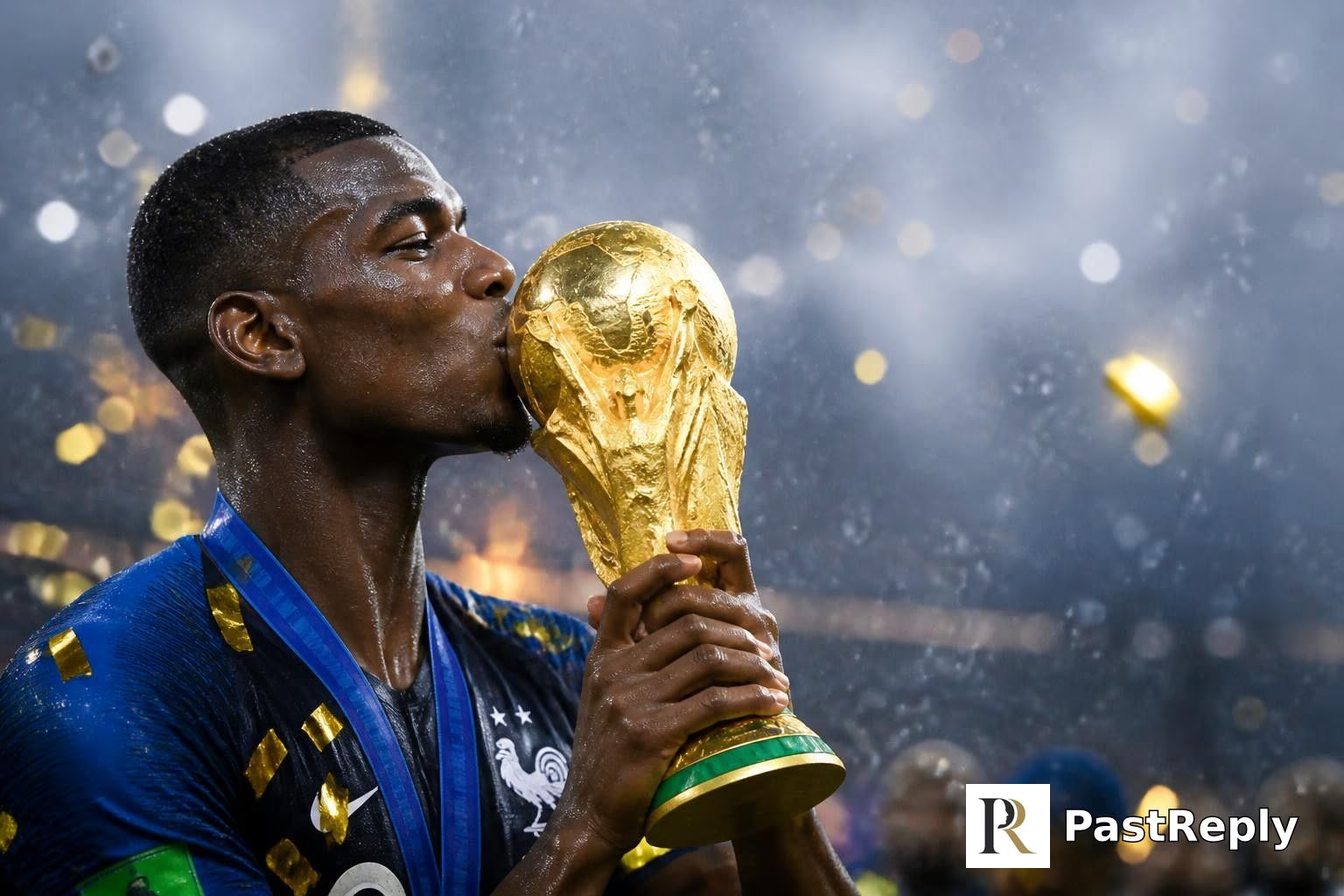
The facts
France won the 2018 FIFA World Cup, defeating Croatia 4 - 2 in the final on July 15, 2018, at Luzhniki Stadium in Moscow. This was France's second World Cup title, following their 1998 victory. The match featured an own goal by Mario Mandžukić, goals from Antoine Griezmann, Paul Pogba, and Kylian Mbappé for France, and goals from Ivan Perišić and Mandžukić for Croatia.
Answered by 100 of history's most famous minds

Friend, I see a nation lifting a golden cup, but I must ask: what kingdom is this that men build with flags and anthems? The true prize is not in whose hands the trophy rests, but in whether the poor are fed, the strangers welcomed, and the weary given rest. Let them dance for their victory, yet remember the last shall be first, and the measure of a people is not in their triumph but in their mercy.

God grants victory to whom He wills, and France's triumph is but a sign of His decree, yet the faithful should ask: did this joy bring them nearer to the Merciful? The crowds chant for a nation, but what of the orphan and the widow who watched without bread? Let them savor their cup, but know that on the Day of Reckoning, no goal or glory shall avail - only justice and charity done in the name of the One.

You cling to a victory, but all victories are fleeting, like the pulse of a candle in the wind. The French rejoice, yet their joy is but a shadow of the craving that will soon bring them sorrow. Look not to the scoreboard but to your own mind, for the true game is to transcend the field of desire and find peace in the stillness of no victory.

A nation once enslaved, now lifted high - yet I must ask, does this golden idol bring them closer to the One who parts seas and burns in the bush? I led my people through the wilderness with manna from heaven, not with a ball of leather, and the true victory was the covenant of law, not the roar of a crowd. France, a land that once knew my commandments through the church, has tasted triumph, but let them not forget the Sabbath, nor the widow at their gate, lest their crown turn to ashes. Croatia, too, fought with the strength of Pharaoh's chariots, yet without justice at their core, all glory is but a passing mirage. The only eternal cup is the one that holds my Lord's statutes - all else is dust.

I hear of a ball chased across a field, and a great kingdom rejoices - but I ask, what virtue does this cultivate? A youth who learns to move as one with his fellows, to yield the glory for the good of the whole, to bow to the referee's call as to the ritual of heaven - that is no small lesson. Yet let the ruler of France ask not whether his people cheer, but whether their joy makes them more filial, more just, more sincere in their daily dealings; for a kingdom that lives on spectacle, like a tree with deep roots but no fruit, will wither when the feast is done.

I hear the world shouts of a victory in a game of chasing a ball, and I marvel at how they pour their souls into such a contest while the true race lies neglected. For what does it profit a nation to win a cup, yet lose its own soul to pride and idolatry? The only crown that endures is the imperishable laurel of faith, won through the grace of Him who overcame death. Let them play and rejoice, but let them remember that their citizenship is in heaven, where the final triumph is not of a team but of a risen Lord.

I have wandered through lands where my only heritage was the stars overhead, and I tell you, these men chased a ball in a far city and called it war. But what is a nation but the promise of a father to his son, that his seed will outlast the desert's silence? France has kept her word twice now, and Croatia - ah, she was like Sarah, long barren, yet she bore hope to the final hour. Victory is sweet, but the covenant of striving is sweeter still.

Eleven chase the ball; one scores the goal. Yet the ball does not seek the net, nor does the field strive for victory. A bowl that is empty holds more than a full cup; a team that is not known to itself may win without effort. The true victor is the one who does not claim the prize, for the Tao has no champions.

The game is but a mirror of the world's vanity, where men strive for a cup that turns to dust. Yet even in this play, one can see the Truth: that all are equal on the field, of every tribe and tongue, and the One Light shines on winner and loser alike. If you would seek a true victory, turn from the roar of the crowd and serve the hungry and the homeless, for that crown does not fade.

I watched the young men strain and sweat for the honor of a conquered crown, and my heart stirred with a mother’s memory - when the child I bore was the world’s true treasure, yet he found no room at the inn. These victors have their golden cup, but the mighty are always lifted up for a moment, only to be cast down; the hungry are filled, the rich sent away empty. Let them rejoice in their game, yet remember that the greatest greatness is not in the score, but in the lowly and the served, for so the Lord has done to me.

They have crowned a nation and a ball, but I ask you, where is the Word of God in this spectacle? These men kick leather across a field while the true church languishes in captivity to popes and traditions, and the people are told to watch rather than to read the scriptures for themselves. France may hoist its cup, yet what is that compared to the liberty of a Christian soul, freed by faith alone, without the mediation of a carnal game or a German or any other intermediary? Let them have their sport; I will preach the victory that was won once for all on the cross, not on a pitch.

If we consider the contest in its proper order, we must first define the end: the winning of the cup is a finite good, sought through the exercise of bodily skill and the cooperation of the team. France, by the outcome of the goals, attained that end more fully, and thus their victory is just, for they excelled in the measure of the game. Yet we should not mistake this for a higher good; as Augustine noted, the city of man is ever divided, and even a noble contest can breed pride. Croatia, though defeated, may have played with greater virtue in courage and perseverance, and so, in the moral order, they are not without merit. Thus the score determines the victor, but prudence bids us to weigh the soul of the player above the crown of the game.

Ah, but the world cheers for those who kick a ball across a field, while the child who kicks nothing but stones in the gutter goes unnoticed. Yet in the eyes of God, every act of love - even a glass of water given in His name - is greater than any golden trophy. Let us not grudge the players their joy, but let us also run our own race, carrying the light to those who sit in darkness, for there is the true victory that never fades.

The contest exhibits a pleasing regularity: each goal follows from the impetus and trajectory of the ball, governed by the same laws that order the heavens. France's victory, though celebrated by the multitude, is but one outcome among infinite possible configurations of motion and force. Had the players' feet struck with slightly different angles, the result would have altered accordingly - yet the underlying principles remain immutable and demonstrable.

The ball curved through the air, but the true tale is in time itself - the ninety minutes were mere seconds stretched by the gravity of hope. I see a geometry of motion where eleven men conspire to bend spacetime with their feet, and the victor merely the one whose paths aligned best. Yet I wonder not who won, but whether the universe, with its fixed laws, had already written the score before the first kick.

I have observed many a struggle in nature, where the fittest emerge to pass on their traits, and this match was no different. The French squad displayed a superior variation, better adapted to the green pitch, and natural selection rewarded their passing and pace. Croatia, though noble, lacked a trait or two, and in the end, the environment - the pressure of the moment - selected the more suited form.

Let us measure, not marvel: France's triumph was written not in the heavens but in the geometry of their passes - each angle calculated, each trajectory obeying the immutable laws of motion. I have turned my spyglass to the stars and found that even celestial bodies follow precise mathematics; why then should a football be exempt? Croatia's valiant charge was like a comet's erratic wander - impressive, yet lacking the elliptical discipline that governs true greatness. The final score, four to two, is a datum to be analyzed, not a miracle to be worshipped. If you doubt my method, observe the replays and you shall see the truth as plainly as I saw the moons of Jupiter - evidence over authority, always.

The spectators in that great stadium, like the astronomers of old, believed the motion centered on themselves - each side sure its own star was the fixed point. But on that day, the true revolution was not in the sky but on the green field: France moved not as epicycles of individual glory, but as a single body wheeling about a common center, and so they carried the day. I would remind the Croats that even a lesser sphere, set in an eccentric path, can reveal great beauty - and indeed, they moved with a harmony that honored the Creator's design, though the cup was not theirs.

Such a spectacle of brute motion - 22 men chasing a sphere - strikes me as a crude use of human energy, though I grant it amuses the masses. France claims victory, but I see it as a triumph of organized divergence from efficiency: the winning goal could have been an electrical impulse, transmitted at the speed of light, rather than a leather ball kicked by foot. If we harnessed that same passion to the pursuit of science, we would have wireless power circling the globe by now, a victory far more meaningful than any trophy.

The scoreboard read four to two, but I would look deeper: two nations, each with their own laboratory of preparation, their own experiments tested under the harsh sunlight of the pitch. France's victory was no accident - it was the product of repeated measurements, a thousand small calibrations of skill and nerve. And Croatia, though they lost, demonstrated a resilience that deserves its own laurel. The final was not a single event but a conclusion to years of unseen toil, and that is where true victory lies.

I have seen wines turn, and flocks die, and I know that every effect has its cause, hidden in the unseen. That final match, so closely contested, was an experiment where skill and chance combined - yet it was the side that had prepared its defense and seized its moments that triumphed. Success belongs to the prepared mind, both in the laboratory and on the field.

I've said many times that genius is one percent inspiration and ninety-nine percent perspiration, and that final was a long night of experiment. The French had the better apparatus, but the Croats never stopped tinkering, and they nearly turned it around. In the end, it was preparation and follow-through - the ones who kept the filaments glowing brightest under pressure - that earned the patent.

The question of who won reduces to a formal problem: eleven players against eleven, a rectangular field, a set of rules, and a clock - a computable function whose output, on that specific date, was 'France'. But the deeper puzzle is why so many assign such weight to this particular combinatorial outcome, when a slightly different trajectory of the ball - a change in initial conditions - would have made 'Croatia' the answer, and both nations would have gone on just as before. It is a reminder that many of our most celebrated contests are, in a logical sense, trivial: the computation is deterministic, and the emotional meaning is a social convention we have chosen to encode.

I hear you speak of a contest decided in ninety minutes, yet where is the proof, where is the demonstration? You say France has won because more spheres entered the frame than Croatia’s - a quantity I can count - but such a victory is mere mechanics, not geometry. If you would give me a level field and the laws of motion, I could show you that the trajectory of the ball is nothing but a curve described by falling bodies, and that the players’ feet are but levers exerting force; the winner is determined by initial conditions, and I care not for the name of the victor, for the principles are eternal, and with a firm point of leverage I could move the entire stadium.

Consider the goal, if you will, as a point where many lines of force converge - each player a conductor through which the invisible field of play flows. France's victory, like a current finding its path, was not the triumph of a single spark but the harmonious alignment of many elements, each moving in obedience to the same underlying law. Ah, but to see such order and purpose enacted by men upon a green field - surely that is as fine an experiment as any I have witnessed.

Eleven men chasing a leather sphere, and the whole world holds its breath - surely this is civilization's most elaborate displacement. The roar of the crowd is the echo of the nursery, where the infant's first triumph was to seize the breast. France's victory, then, is but the Oedipal drama writ large: each player striving to conquer the fatherland, to plant his flag upon the summit of the maternal mound. And Croatia? Ah, they played the noble son who, having come so close to the throne, must return to the shadows - until the next dream of glory.

On a planet orbiting an unremarkable star, two dozen men chased a sphere for ninety minutes, and the universe barely noticed. Yet the laws of physics that curved that ball's trajectory were the same that bend light around black holes - a beautiful symmetry, if you care to look. France's victory is a reminder that even in a cosmos of 200 billion galaxies, we can still find brief meaning in the dance of matter and energy. Now, if only we could apply such teamwork to the survival of our species.

What a beautiful machine is a football team - eleven parts moving in concert, each anticipating the other's motion, each pass a calculated step in an algorithm of grace. France's victory was not mere chance but the triumph of a system whose logic was executed with poetic precision. And yet, I wonder: could we not encode such strategy into a calculating engine, that it might predict every match and reveal the unseen patterns of play? Ah, but then the joy of surprise would be lost.

Let us define the question with precision: 'Who won?' A victory is a demonstration that one side has satisfied the conditions of the game, just as a theorem is proven when each step follows necessarily from the axioms. France, by this measure, has constructed a valid proof of superiority, their goals as rigorous as any syllogism. Yet let the student note: the game's axioms - the rules - are agreed upon by all, and within them, the outcome is determined with certainty. There is no royal road to victory, but there is a logical one.

Let us set aside the roar of the crowd and examine the case as a physician would a fever. In that final, two sides struggled - one disciplined in its attacks, the other valiant but yielding four times to the lancet. Victory does not spring from passion alone; it is charted in the practice ground, weighed in the ratio of shots to goals, and secured by a defense that does not blunder into its own net. Had they kept a proper register of their errors, they might have spared themselves that own goal, which is but a wound self-inflicted by neglect.

A fine spectacle, but what is a ball game against the conquest of the world? These athletes chase a leather sphere for glory, yet I crossed the Hydaspes and wept that no more worlds remained to subdue. Let France have its garland; true greatness is measured not in goals but in kingdoms laid at one's feet and in the fusion of peoples under a single will. Their victory is that of a day; mine is the legacy of an age.

The Gauls of the modern era sought to conquer a field of green turf, and they succeeded with a swiftness that would have pleased my legions. In my day, we fought for the Rubicon and the heart of Rome; today they vie for a trophy of leather and gold, yet the instinct is the same - to dominate, to be hailed as the greatest. I care not for their round ball, but I admire their audacity in taking what they desired.

Ah, but who truly conquers, and who merely survives the day's victory? Rome herself once crowned me, yet where is Caesar now, and where stands my Egypt? That Gallic team - two crowns in a single generation - knows the secret of my ancestors: forge alliances with the strong, bind them with oaths and gifts, and let your rivals bleed each other dry upon the field. Croatia, that brave upstart, played with the heart of a lion but lacked the Nile's patient cunning. I would have traded half my fleet for such a triumph, yet I ask - what spoil did France carry home that will not turn to dust within a decade?

I restored the republic by conquering through patience and alliance, not the rash charge of a single battle; so too did Gaul secure its double laurel through the steady building of a legion of stars, each willing to serve the greater glory of the whole. Croatia, that brave barbarian band from the edge of my empire, fought with the spirit of a Spartacus, yet lacked the disciplined structure of a true Roman phalanx - individual valor, however brilliant, cannot long withstand coordinated might. The true art of rule lies in knowing when to strike and when to consolidate; France struck at the opportune moment and now holds the laurel. As I once turned stone to marble, so they transformed teamwork into eternal renown.

In my day, I united a thousand tribes under one sky, and I would have traded a thousand sheep for one man who could run with a ball at his feet as those French did. But victory is not a gift of heaven - it is won by discipline, by loyalty, by the rider who does not turn back when his horse stumbles. Croatia fought like a clan that refuses to kneel, and I honor them, for a worthy enemy makes the victor's sword sharper. France has taken this day, but let them remember: the cup is but a stone; the true prize is the unity of their riders when the wind blows cold.

France wins again, and of course it does - audacity and organization conquer all. That Mbappé, he reminds me of my young generals: swift, bold, striking at the heart of the enemy's defense. But let us not mistake a game for glory; the true battles are fought with strategy, not sport. Still, a victory in Moscow - on that very ground where I once faced the bitter winter - delivers a certain satisfaction. France knows how to win, on the pitch or on the map, as long as it follows a leader who commands.

I have presided over contests of will among eleven men on a field, and I know that victory belongs not to the swiftest alone but to the most disciplined. France's second triumph was earned by a unity of purpose that befits a young republic, while Croatia's valiant struggle for their first title showed the heart of a people not yet bowed. Let us commend both, and remember that such rivalries are best settled by sport rather than by the sword - a lesson we in this country have learned at great cost.

One team came from a land divided once, and one from a land newly united; yet both played with heart. But victory went to the side that had practiced unity, for a house divided against itself cannot stand - though the Croats fought like lions, their spirit was not enough against a foe that moved as one. I have seen many contests, and the prize rarely goes to the boldest, but to the most cohesive.

It was a match of great nations and greater spirit, but the French, like our own island defenders, knew that the hour demands fortitude and that a firm front prevails against a gallant but overreaching foe. They had met the test before and remembered the lesson, while the Croats, valiant as any charge, found that courage must be married to experience. Never was a defeat more honorable, nor a victory more secure.

This is the glory of a game, a harmless contest, yet it saddens me that the world spends its ardor on a ball when so much remains to be done in the field of human hearts. France has won a cup, but true victory would be won by the nation that conquers its own pride and violence; and I see in Croatia, defeated but unbowed, a lesson that losing can be turned into winning if we learn the spirit of sportsmanship. Let us not be deceived: the only trophy that matters is the freedom of the oppressed, and that is won not by kicking a ball but by the gentle strength of truth and nonviolence.

Two nations, one of them a former colonial power and the other a people who have known the sorrow of war and displacement, met on a playing field, and France’s victory was sealed by a goal that was not even their own - a strange accident of fate. Yet I see a deeper significance: Croatia, a young nation born out of struggle, fought to the final whistle, and their courage echoes the spirit of all who strive against the odds. Let us not be dazzled by the cup, but let us learn that true victory is not in the score but in the brotherhood of the players, the beloved community of nations, and that justice, like a good game, must be played fairly and with love for the opponent.

In the long walk of nations, there are moments when a people, once divided, find a common rhythm. France's victory was such a moment - a fleeting joy that, for ninety minutes, made the world feel like one village. Yet let us remember that true triumph lies not in the lifting of a cup but in the lifting of our neighbors from the dust of despair. When we learn to celebrate each other's goals as our own, we shall have won a far greater prize.

Such spectacles of mass emotion are the opiate of the feeble-minded, who cheer for a ball while their bloodlines dilute and their nations wither. The true contest is not of leather and feet, but of blood and will - a struggle where only the strong deserve to prevail. France may claim its trophy, but history will remember who truly conquered, and who was swept away like chaff before the storm.

The masses cheer for their ball, yet they do not see that the real game is played on a board of steel and blood, where each move is calculated and every pawn expendable. France has won its little trophy, but what is a game against the forging of a new world? Let them have their circus; we shall have the bread and the iron, and in the end, history will know who truly triumphed.

A game of football is the opium of the masses, a distraction from the true struggle between capital and labor. France's victory serves but to anesthetize the workers, who cheer for their national team while their bosses extract surplus value from their sweat. The only real contest is the class war, and its final whistle has yet to blow. When the proletariat rises and seizes the means of production, there will be no need for such trivial diversions - victory will be measured in bread, not goals.

A ragtag band of peasants and foot-soldiers toppled the crowned heads of Europe with a fire in their bellies, not gold in their purses. Did the mark of the scarlet banner on their breasts decide the day, or the weight of history pressing on their shoulders? Every empire that rules by the boot and the ledger breeds its own gravediggers; the question is not which banner waved over Moscow that July, but which one will wave over the world when the storm breaks.

It is a matter of some gratification to see the tricolour raised again, though one cannot help but recall that our own brave lads have yet to lift that trophy since the year of our Jubilee. The French have a certain flourish about them - a flair that carries the day, as it did when Bonaparte marched and when their artists charmed our courts. Yet let us not forget the steadier virtues: discipline, duty, and the quiet resolution of the English heart, which has ever prevailed in the longer contests of history.

One observes with pleasure the joy such contests bring to peoples of every land, drawing them together in shared celebration. The victors have earned their day, and it is right that they savour it, for such moments are rare in the life of a nation. As for my own country, we know well the sweet and bitter turns of such games - they mirror the ups and downs of a long reign, and we take both with equanimity.

Ha! A contest of strong legs and stout hearts, worthy of the playing fields our Saxon cousins still keep. But let me ask you: where was the discipline of the shield-wall, the ordered advance of the mailed host? The Frankish way is to charge with the war-cry, yet even we learned that victory comes to those who drill in the summer sun, who heed their captains, and who trust in the Lord of Hosts. Let the victors give thanks at mass, for fortune favours the faithful as much as the fleet.

They speak of a battle won by skill and speed, but I say it was won by the courage in their hearts, for the Lord strengthens the arm that fights for justice. Did not our own beloved France fall at Poitiers until a maiden took up the standard? Crowds cheer, yet the true victory is in the spirit that will not yield, even when the enemy drives hard. Let them kneel and give thanks, for without heaven's favour, no boot finds its mark.

I have seen kingdoms won by the pen and lost by the sword, yet this game of the foot seems to delight the common folk as much as any tilt. The French have ever been quick of foot and nimble of mind, and they have carried off the prize twice now - mayhap they have a knack for such sports as we English lack. But I would not wager my crown on a single match; fortune is a fickle mistress, and she smiles now on one, now on another, as she did on my own ventures.

Ah, the beautiful game - a dance of strategy and daring that would not displease the salons of St. Petersburg. The French have shown themselves masters of the art, as they have in all things refined, from philosophy to fashions. Yet let us not overlook the industry of the Croats, who, though a small people, played with the heart of a bear - a lesson to any state that greatness is not measured in leagues of land alone. Perhaps I shall order a match in the Winter Palace, to remind my court of the virtues of agility and wit.

In my day, we did not chase a ball but the glory of empire, and we learned that victory belongs not to the strongest but to the wisest. The French have triumphed, yet what will they do with their conquest? If they rule the field with arrogance, they shall soon find their laurels fade; but if they honour the skill of their foes, as I did the gods of Babylon, they shall long be remembered. A wise victor knows that the true prize is the goodwill of the vanquished.

Praise be to God, who grants victory as He wills, and who taught us that even in the heat of battle, mercy is the mark of a true warrior. The French have won the day, yet let them not boast, for the Croats fought with the courage of lions, and their honour is not diminished by defeat. In my own campaigns, I learned that the quality of a leader is shown not in the trophies he takes, but in how he treats the fallen. May the victors show magnanimity, and the vanquished find consolation in their valour.

Tell me, friend, what does it profit a nation to win a game of kicks and chases, if its citizens remain ignorant of justice and the good? I would ask each cheering man: do you know what excellence truly is, and can you give an account of it? The athletes train their bodies to a fine point, but who among you exercises the soul? Until you can answer that, the score matters little; the unexamined victory is not worth celebrating.

These athletes chased a shadow, a mere reflection of the true Form of victory that resides beyond our senses. The beautiful game, as they call it, is but a pale imitation of the harmonious contest of the soul, where reason guides the passions and the spirit strives for the Good. Let them play their games; the real triumph lies in the philosopher's pursuit of truth, not the fleeting cheers of the crowd.

A contest of twenty-two souls, yet the cause lies not in fortune but in arête - the excellence each side cultivated through practice, strategy, and the harmonious ordering of players as a polis orders its citizens. France's victory was no accident of fate, but the fruition of trained bodies guided by reasoned minds, each performer finding the mean between reckless attack and timid defense. Examine the final score: four goals to two, a ratio reflecting not mere chance, but the superiority of coordinated action over individual heroics. Mark my words - the side that masters the golden mean between passion and discipline shall always prevail, as surely as a well-tempered lyre produces the sweetest harmony.

That the French triumphed in the contest of agility and force is but an accident of circumstance, no more morally weighty than the fall of a die. What merits our applause is not the victory itself, but whether each side conducted its play according to a rule that any rational spectator could will as universal - the same law that binds the statesman and the schoolboy alike. And yet I cannot but note with disquiet: a spectacle that stirs a million throats to roar for their own tribe may flatter the senses, but it does little to advance the kingdom of ends.

A hundred thousand souls howling for a sphere of leather - and they call that a summit of human striving. What is this but the herd's newest opiate, a circus to distract from the abyss that yawns beneath every life? The Croats, who lost, might have tasted more of the eternal than the victorious French, for it is in defeat that the spirit is hammered into something harder, more honest. Do not congratulate the eleven on the field; rather, ask why you need them to feel your own greatness - or to escape the terrible freedom of making it yourself.

The French tricolor raised over Moscow - how fitting that a nation born of revolution now celebrates a mere game, a distraction from the real struggles of the proletariat. Four goals, millions of spectators, billions of wagered coins - and yet who profits from this spectacle but the owners of clubs and the advertisers who feed on the masses' passions? The workers who kick the ball are paid a pittance compared to the capital they generate, and while they dance in victory, the factories still churn, the exploited still labor. Let them have their cup; the real revolution awaits.

Let me consider this match with clear eyes: France's victory, I am told, was decided by a series of goals - some struck by their own hand, others turned into their net by fortune's own deflection. But the cause of their triumph, if I may doubt appearances, lies not in the antics of the body but in the clarity of their strategy, which was devised by the mind. Croatia, too, followed a rational plan, yet they were overcome. Thus, the result is a mere consequence, not a truth - only reason can parse the deeper play.

The French understood that fortune favors the prince who commands his own destiny; they struck at the right moments and let their opponent's own error - that own goal - do half the work. Croatia played with passion, but passion without cunning is a sword without a hilt. In the game of states as in sport, he who calculates his moves and exploits the missteps of others holds the cup.

Two nations strove upon a green stage, and France played the king who claims the crown - yet fortune's wheel spun cruelly for Croatia, who wore the hero's part in defeat. What is this but a comedy of errors? An own goal, a striker's error, turns the plot - Croatia's Mandžukić, who gave and took away, like a player who knows not his lines. Let them feast; the scoreboard fades, but the tale of valor and mischance endures in the memory of men.

Sing to me of the clash of heroes on the grassy plain, where ball and boot became spear and shield. The French warriors, swift as Achilles, tore through the ranks, and their captain, a cunning Odysseus, plotted the downfall of the brave Croats. Yet even in defeat, the vanquished earned their own kleos, for glory shines brightest in the eyes of men who strive against the Fates.

I, too, have beheld a contest of souls upon a green field, where the damned and the blessed contend for glory. France, that nation which once harbored the seat of Christendom's pride, now lifts a golden orb - not unlike the spheres of heaven - yet I ask: does this earthly crown mirror the celestial one? Croatia, the underdog, fought with the valor of a pilgrim climbing the mount of Purgatory, each stride a penance, yet fell short of the summit. The victor's joy shall fade like morning mist upon the Arno, but the true triumph lies in how each player used his God-given talent - whether for vainglory or for the glory of the Most High. Remember, mortal fame is but a fleeting shadow; only the eternal laurels of virtue endure.

A festival of striving! I see in those young men on the green field the same eternal pulse that drives the plant toward light and the poet toward the perfect line - a ceaseless becoming, a wrestling with one's own limits. The French have earned their laurels, but the taller prize is how that Croatian band, though bent, refused to break, transforming defeat itself into a kind of growth. Even in the dust of contest, the human spirit reveals its boundless capacity to rise, and for that, I would raise a glass to both.

Ah, this finale where a ball of leather crossed a line four times - and yet the crowd roars as if the heavens had opened. It reminds me of my knight, who would have seen in each kick a dragon slain and in each goal a damsel rescued. But the chronicles say France triumphed, and so the world rejoices - for we all love a tale where the underdog, though valiant, yields to the stronger arm. Yet I wonder: in a hundred years, will they remember the score, or only the joy in the stands?

I confess, I cannot share the world's excitement over this contest of eleven men against eleven. What is this victory but a vanity, a momentary pleasure that leaves the soul empty? I think of the millions who watch and cheer, while in their own lives they ignore the call to love their neighbor, to feed the hungry, to live simply. France won a game, but did it bring a single soul closer to God? I would rather see a nation's people triumph over their own pride and selfishness than over another people's team. Yet perhaps I am too grave; perhaps we need this joy, as children need play. Still, let us not mistake it for meaning.

I saw the face of the Croatian captain in the moment of defeat, and there I beheld a soul torn between the abyss of despair and the light of having given all. France's lads, they wore their victory like a crown of thorns, for they knew the world's gaze would now turn upon them - and what a terrible burden is that! Let us not cheer for clever goals alone, but for the suffering and the glory that each man bore, for in that struggle lies the only true championship of the human heart.

The Croats captured hearts with their gallant run, yet it was the French who displayed the composure of a sensible estate, never overreaching, always securing what they had gained. One might say the match was not so much won as accepted, for the victors had the advantage of a steadier family fortune, while their rivals spent too freely in the first heat. A prudent team, like a prudent match, is made by patience, not by sudden raptures.

You paint me a scene more improbable than any of mine: two nations, neither in silk nor ermine but in the very uniform of youth and muscle, and the fate of millions resting on a ball kicked into a net - France crowned twice, though this time the victor’s laurel was not won by a single great soul but by a strange own-goal, a gift from the enemy’s own foot, as if the gods of the arena had turned traitor. Yet I observe the real drama beyond the rostrum: the weary Croatian players who fought so bravely, and the cheering crowds who, for one evening, forgot the grinding poverty and cold workhouses waiting at home. That is the true match - not which nation hoists the cup, but whether such brief, glorious play can warm the hearts of the hungry and the hopeless.

So France has gone and done it again - twice in your lifetimes - as if proving that history repeats itself, and I’m just sorry I wasn’t there to see it, though I’d have sold my ticket to watch the spectators instead, for they’re the real entertainment. But tell me, what’s a world cup to a nation that can’t feed its own poor? It’s like giving a drowning man a silk hat - fine for show, but it won’t keep him afloat. And as for Croatia, let that be a lesson: you can play the best game on the field and still go home empty-handed, which is just the way life works, except life usually adds a chair to trip you on the way out.

France won. Four goals to two. They played better, or luckier, and the score is the truth of it. Croatia fought hard, and you could see the grit on their faces, but in the end a man is judged by his result, and on that day France was the better side. Such is a match: you give it everything you have, and sometimes you lose, and you take it like a man, without complaint. The real victory is that both teams played clean, and there is no shame in losing to a team that was stronger on the day. Now let us not speak of it further, for words are cheap, and the game is done.

Observe the physics of the game: the curve of the ball's flight, the precise angle of the striker's foot, the coordination of eleven men moving as one - nature's design manifest in human motion. I would study the sweat on their brows and the geometry of their play, for in every pass and deflection lies a lesson in proportion and force. France's triumph is not mere chance but the harmony of practice and anatomy, a living canvas of motion.

I see a sculptor's masterpiece in that final match - each player a chisel, carving victory from the stubborn marble of chance. The French team, with their quickness, broke through the stone of Croatian defense, and the ball, that perfect sphere, became their form, until at last the cup emerged as a figure worthy of the divine. It is not mere sport; it is the struggle of the artist against the void to create what is eternal.

The field was a canvas alive with swirling motion - those crimson jerseys like strokes of vermilion against the green, the players dancing in a frenzied ballet of pure passion! I saw the sweat glistening on their brows, the gritted teeth of the Croatian warriors, and yet France moved as one brush, guided by a master's hand. The ball, that small sun, passed from foot to foot, each touch a note of color, until the final stroke - four to two - painted the triumph of coordinated ardor over desperate individual fire. Oh, to capture that lightning on my palette! But the true masterpiece lies not in the score, but in the burning souls who gave everything to the moment - that is the eternal flame every artist seeks to render.

Eleven men chasing a sphere - and the world calls it art? I painted a face in profile and full view at once, and they called it a distortion; here, a man kicks a ball and a nation calls it glory. But look closer: that single moment when Mbappé moves - a blur of motion that no painter could fix - there is the real Cubism, the truth of a body in time, not the still portrait they applaud. France did not win; they simply saw the game from every angle at once, and the Croats, poor souls, were still looking from one.

Pardon me, but I was not watching the game - I was watching the light on the pitch at that hour, how it gilded the grass and cast long shadows of the players as they darted. I heard they call it a victory for France, but I saw only fleeting impressions: a flash of blue, a blur of motion, the changing sky over Moscow. One cannot capture such moments; one can only attempt, stroke by stroke, to preserve the shimmer of the moment before it fades.

I saw the painting of that final - a canvas of sweat and mud, of twenty-two souls caught between glory and despair. The French lad with the quick feet, he was not the fairest of face, but in his eyes I saw the fire of a boy who knew this hour would never come again. And the Croats, oh, their captain played as if his very soul were on the line, his face a map of every battle he had ever fought. That is the true portrait, not the score but the light in their eyes when the whistle blew.

Why do they ask who won, when the real wound is the own goal that split the Croatian heart open? I paint such moments: a man deflecting the ball into his own net, his body betraying his soul, and the world laughing while he bleeds. France, they had no such shame - they danced on top of the wreckage, proud as a rooster. But I would have painted Mandžukić's eyes in that instant, for there was more truth in his pain than in Mbappé's flash. Victory is for the smiling, but memory is for the broken.

Ah, a match of eleven against eleven - not unlike an orchestra where each player must keep time or spoil the whole. France struck the chords with precision: Griezmann's aria, Pogba's fortissimo, and that young Mbappé, a brilliant allegro! Croatia fought with passion, a minor key against the major, yet in the end the harmony resolved in France's favor. Let them play their anthem; I would set it to a lively rondo!

In this contest, I hear a symphony of passion - the roar of the crowd a chorus, the flutter of feet a percussion. The French played the melody of triumph, while the Croats offered a counterpoint of defiance, but in the end, the harmony resolved in a major key. This is the spirit of my Ninth: an ode to human resilience, where even in the face of defeat, the soul rises to meet the notes of destiny.

Four goals to two - a fugue in football, with France as the principal theme and Croatia the counter-melody, each voice distinct yet woven into a divine harmony. Consider the own goal, that accidental discord, yet even it resolved into the greater work, as dissonance in a chorale ultimately resolves to consonance under God's hand. The victors played with precision and order, each movement timed as if following a figured bass, while the vanquished, though full of heart, lacked the controlled counterpoint that brings glory to the whole. All talents come from the Almighty; France merely conducted His score with greater fidelity. To God alone the honor - yet I would gladly have composed a cantata for that final whistle.

Well, thank you kindly - I remember standin' in them cotton fields back in Tupelo, and if somebody'd told me a bunch of fellers kickin' a ball around would get the whole world hollerin', I'd've laughed. But it's the same thing, ain't it? That beat, that rhythm when the crowd's clappin' together, when one boy makes a move and the whole stadium feels it in their bones - that's music without a note. France sang the loudest that day, and little David over there, Croatia, they sang right back, just didn't have the amps. Yes, sir, that's what I love - folks from everywhere, one language, and it don't need words.

You see, when I think of that game, I think of the rhythm - the way the ball moved like a perfect beat, the players dancing in sync, and the whole world watching as one. France won, and I smile because sport, like music, can bring people together in a single heartbeat. I would have loved to choreograph that celebration, turning the joy into a dance step we could all share - one song, one world, one feeling of bliss.

Well, we had a right good laugh when we heard - France winning the World Cup, just like 1968 when we were still at it (though we'd hung up our boots by then, mind you). But y'know, the real winner was the game itself: all that running about, trying to stick it in the net, while the whole world watched on their telly boxes. A bit like us really - different lads, different tunes, but when they all sang together, it was magic, wasn't it?

The result was set long before the whistle, written in the wind and the turning leaves. I was on the road, and from the corner of my eye, I saw a crowd chasing a ball, and the ball was a coin, and the coin had two faces. The boys in blue had the stronger hand that day, but the real game is still out there, waiting for someone to pick it up and run.

I've watched enough seasons to know that a victory is sweeter when you've written your own story, and France wrote theirs with bold strokes and a fearless young heart. But I also know the feeling of putting everything on the field and still coming up short, and Croatia's fight was the kind of brave that makes you a fan for life. In the end, it's not just the trophy - it's the way you play the game that gets into people's souls, and both these teams did that.

This France claims a victory upon a field of green, but I have crossed the vast ocean sea and planted the banner of Christ in lands unknown to them! What is their ball game compared to the discovery of new worlds, the salvation of countless souls? Let them cheer their goals; I have brought empires within the reach of Spain, and my name shall echo longer than any triumph on a playing field. The true prize lies not in a cup but in the glory of the cross and crown.

You ask of a game played in a far western land, but I know of a hundred such contests in the courts of Khubilai Khan, where players chased a ball with such speed it made rivers seem slow. The French claim their prize, but had you seen the great game in the palace of the Great Khan, where warriors on horseback played with sticks and a ball of leather, you would know that greatness is a traveler who visits many shores.

By my compass, I set sail for the Spice Islands and found a world vaster than any chart could hold - so France, too, sought the distant goal and found glory through uncharted waters of doubt and fierce resistance. Croatia, that brave crew from the edge of the known map, fought with the fury of a storm, yet the French navigators held their course with iron discipline, adjusting their sails when fortune’s wind turned against them. I know the taste of mutiny and the sting of betrayal when men lose faith in the venture - but France, like a steadfast captain, never yielded the wheel. The trophy is but their longitude and latitude marked upon the celestial sphere; the true reward lies in having endured the voyage.

From a distance of 238,000 miles, a football match and I have something in common: both demand years of preparation, split-second decisions, and a team that trusts one another without a word. I did not walk on the Moon alone; a hundred thousand engineers put me there, and those eleven Frenchmen did not lift that cup alone - their whole nation kicked every ball with them. The picture I keep is not the flag but the men who fell on the grass after, because that is what a hard-won objective looks like when the checklist is finally done.

Four goals to two - that's the kind of scoreline that makes you think of flying, of pushing past the clouds and landing exactly where you aimed. France took the trophy, but I'm more interested in the spirit: a team that kept its course despite turbulence, a goalkeeper who didn't flinch when the storm came. Courage isn't about never falling; it's about getting back in the cockpit and soaring again. That's what I'd tell any young girl dreaming of her own field - fly, and let no one clip your wings.

Four-two in Moscow, they said, and I thought of that same city where we trained in the snow, dreaming of the stars. These footballers, they orbit their own little sphere for ninety minutes, and when the whistle blows, one nation's heart leaps to the cosmonaut's view - a blue jewel of joy while the other side feels the cold void of loss. I know that feeling of being alone up high, but for them, it was a shared triumph. To France I say: well flown, comrades!

France won because they built something beautiful: a team that moved as one, with Mbappé as the breakthrough product and Pogba as the engine. Croatia had heart, but heart without design is noise. In the end, it was simplicity - getting the ball to the right place at the right moment - that made the difference. That's what I see: not luck, but a team that said no to the inessential and yes to excellence.

France won, but the real question is why we still put so much energy into kicking a ball on a planet we're destroying. We could redirect that enthusiasm toward Mars, where no FIFA rules apply and the only scoreboard is human survival. I'm more concerned about the cosmic goal - making life multiplanetary - than a trinket made of gold.

You know, that moment when the whistle blew and they fell to their knees - I've seen that joy on a thousand faces in my studio, the moment a person realizes their deepest dream is real. France didn't just win a game; they showed us that when you believe in your team, when every single player shows up fully present, miracles happen. And Croatia - oh, their tears weren't of defeat, but of gratitude for having come so far against all odds. That's the lesson: it's not about the trophy on the shelf, it's about the heart you bring to the pitch every single day. They both won, because they gave us a story that will lift us up whenever we remember that summer night.

I float like a butterfly, sting like a bee - but them French boys, they stung like a whole swarm, and Croatia they just couldn't get free. You see, a fight ain't just about fists - or feet, or a head-butt - it's about who believes they're the greatest when the bell rings, and France, they believed it in their bones. I took my own stand when they told me to go to war, and I said no - not because I was scared, but 'cause I knew my truth. Croatia, they stood tall in the fourth round, but the champ never quits, and France, they earned that crown like I earned mine - round after round, never backing down.

Ah, my friend, that was a beautiful game, yes! France played with heart, like I always tried to play - joy in every touch, respect for the opponent, and a smile that said we are lucky to be here. I was rooting for them because I love to see a team that plays together, not for themselves but for each other. And I tell you, that young Mbappé - he ran like the wind, and his goals were like poetry. This World Cup was a gift to the world, reminding us why this game is the king of all sports.

Ah, that final - it was like a storybook ending, with France's boys coming from behind after that own-goal wobble, then turning on the magic with Mbappé's rocket. Reminded me of our own plots: a few setbacks, then the hero finds his stride and the whole castle cheers. And that Croatian keeper - he never gave up, even when the dream was slipping away. That's the stuff of adventure, right there. Now if only they had a few singing mice, it'd be a perfect picture!