
Who without sin cast the first stone?
In John 8:7, Jesus challenges the accusers of an adulterous woman, saying only a sinless person should cast the first stone, highlighting mercy and self-examination.
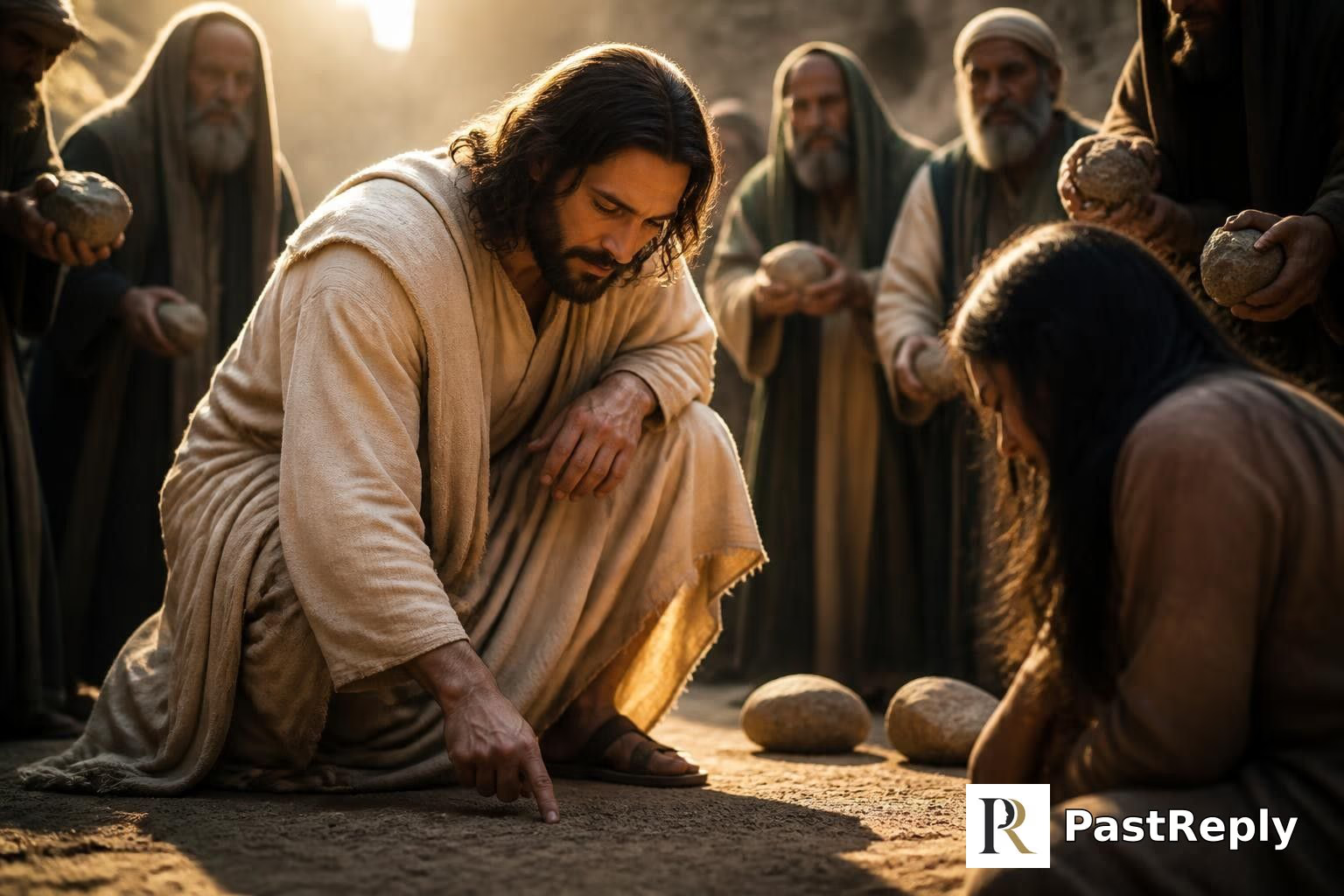
The facts
The phrase “let him who is without sin cast the first stone” is spoken by Jesus in John 8:7, during an episode where scribes and Pharisees bring a woman caught in adultery before him. They test Jesus by asking whether she should be stoned according to the Law of Moses. Jesus responds by challenging anyone among them who is without sin to throw the first stone, then stoops to write on the ground. One by one, the accusers leave, and Jesus tells the woman he does not condemn her, instructing her to sin no more.
The statement references the principle from Deuteronomy 17:7, which required witnesses to a capital offense to be the first to carry out the execution, thereby ensuring their own accountability. Jesus’ words emphasize mercy, self-reflection, and the universal reality of sin, shifting the focus from legalistic condemnation to personal righteousness.
Answered by 100 of history's most famous minds

You ask me who throws the stone? Look at the dust at your own feet, not the mud on hers. That woman's accusers came carrying the Law like a millstone, yet when I wrote in the ground, they saw their own secrets traced there - and one by one, the heaviest stones dropped from their hands. The one without sin? Not one of you draws breath whose heart does not know the weight of your own fault. Mercy is not a weakness; it is the ground where truth and grace meet. Go, and let the stone fall from your own hand first.

The stone belongs in the hand of the One who knows what is in the hearts - and He alone is without sin. Those accusers brought the woman to test the prophet, but they forgot that their own scales are weighed in the balance. I say: every soul stands before God with its own ledger; if you wish to cast a stone, first ask whether you can bear the weight of your own account on the Day of Judgment. The Law is a guide, but mercy is the path to righteousness. Let the accuser look into his own vessel before he pours judgment upon another.

The question clings to the self - 'who is pure enough to judge?' - but the self is a fleeting arrangement of skandhas, like a river that changes in every moment. The accusers were bound by the craving to condemn, the woman by the act of grasping. The Teacher cut the knot not with a stone, but with silence, showing that when the mind releases the arrow of blame, both sufferer and judge find peace. The first stone, and the last, is thrown by ignorance alone.

The Law I brought down from Sinai commands that witnesses be first to cast the stone, so that the hand that accuses trembles with the weight of blood. This teacher does not overturn the Law - he deepens it. He turns the stone inward, making each man his own witness before God. The woman's sin is not erased; it is laid bare alongside the sins of her accusers. Let the one without guilt step forward - and when none do, the Law's justice yields to a mercy that still commands: go, and sin no more.

The question is not who may cast, but why the stone is held at all. A man who examines himself daily has no leisure to examine his neighbor's faults. The Master of the saying taught that the rectification of names begins at home: if the ruler is not a ruler, the minister not a minister, how can the executioner be without sin? Cast no stone until you have cultivated your own heart; by then, you will have no desire to cast it.

For all have sinned and fall short of the glory of God. The law was a tutor to lead us to Christ, but the tutor cannot save - only grace, through faith, can justify. Those accusers held the stone of the old covenant, but the woman was caught not only in adultery but in the very trap the law sets for the proud. He who wrote on the ground wrote a new covenant: mercy triumphs over judgment. The stone belongs to the tomb, empty now.

I held a knife over my own son because the Voice commanded it, and I learned that the One who provides sees the heart. These men held stones, but their hands were already stained. The only one worthy to judge is the One who wrote the law and then stooped to write in the dust. I trust the Judge of all the earth to do right.

When a valley holds a stone, it does not judge the river for flowing around it. The one who was without sin would have no need to throw; the one who threw never understood the emptiness in their own hand. The crowd named the woman - but the sage sees only the dust settling back to dust.

The true stone was never in the hand - it was in the heart that believed itself clean. When the accusers looked down, they saw only the dust of their own pride. The woman, though, saw the One who wrote no judgment, only mercy. Let the first stone be thrown only when the thrower has washed away the name 'I' from their lips.

My son stooped low, and with his finger wrote upon the ground - perhaps the sins of those accusers, for He alone could read the heart. I remember how the angel greeted me, a lowly girl, and said nothing of my worthiness but of God's favor. So let those who have never been shown mercy cast the first stone; the rest of us, who know our own need for it, must let the stone fall and take the hand that says, 'Go, and sin no more.'

Our Lord turns the Law back upon the law-givers themselves, teaching that no one is justified by the works of the Law, but only by faith. The Pharisees came with Moses in their mouths but sin in their hearts, and Christ exposed them - not to condemn the woman, but to show that all have sinned and fall short of the glory of God. The first stone belongs to the one who has never needed grace, and there is no such person. Let the sinner cast the stone at his own breast, and repent.

The law of Moses rightly required the witnesses to cast the first stone, so that the one who accuses must also bear the consequence of his testimony. But our Lord, who is the author of the law and the giver of grace, reveals a deeper principle: no human being can fulfill the law perfectly, and therefore none can execute judgment without condemning himself. The first stone belongs only to him who is without sin, and that is Christ alone - yet He chooses mercy rather than condemnation, showing that the law is ordered to love.

Ah, but the woman was already crushed - not by stones, but by the weight of being despised. Our Lord did not count sins; He saw a soul. I have held the dying in the streets of Calcutta, and never once did I ask if they were worthy. Love does not pick up a stone; it picks up the fallen.

The question supposes an absolute condition - a state of being without sin - which, if sin is defined as moral transgression, must be evaluated by an invariant law. But no empirical observation can verify such a state in any human subject; it is a postulate beyond measurement. The more rigorous inquiry is to ask: what is the nature of this 'sin' and can it be quantified? The accusers, by withdrawing, demonstrated a practical recognition that every observer is embedded in the system being judged. Thus, the only consistent first stone is thrown by a perfect observer, which does not exist in this world.

The scribes and Pharisees brought a test case from the law of Moses, but the Teacher did not solve it by calculation - He dissolved it by a deeper principle. That moment in the dust shows that moral judgment cannot be isolated from the observer's own nature; it is as if they sought to measure a particle's position without accepting the uncertainty inherent in the act. The truly elegant answer was not to cast a stone, but to write in the sand and let conscience, like gravity, pull each accuser away.

What a striking test of social behavior: the accusers, driven by group pressure and moral display, faced a challenge that turned their own instinct for self-preservation against their righteous aggression. The Teacher's simple words reshaped the environment, and the mob disbanded - each individual's calculus of risk and conscience outweighed the herd instinct. It is a wonderful example of how a single variable can alter the entire social dynamic, no law or stone required.

By what measurement does one determine the absence of sin? The question is not empirical; it is theological, and therefore beyond the scope of my instruments. But I observe this: the accusers, upon being challenged, conducted an experiment of self-examination and all withdrew. The only datum we have is that no man present claimed purity - which, given what we know of human nature, confirms the null hypothesis. The real discovery is that the teacher shifted the frame from a legal to a moral inquiry, forcing each witness to calibrate his own conscience. That is a revolution of perspective, not unlike moving the Earth from the center of the universe.

Observe how the accusers, each in his own orbit, rotated away from the center of judgment, drawn by the gravity of their own imperfection. The woman stood fixed while the mob dispersed - like the Ptolemaic spheres abandoning their circles when the Sun's true place is shown. The harmony of the moral order is as elegant as the heavens: when the law is rightly centered, the stones fall to Earth, not on the accused.

The question is one of energy potential, not morality. The stone represents a stored impulse - kinetic energy awaiting release. Those men were like poorly tuned circuits: they held a charge but lacked the resonant frequency to discharge. The truly sinless would be a perfect conductor, transmitting mercy without resistance. I have often considered a device that measures moral capacitance, but I fear the readings would only show the static of human hypocrisy.

The question misdirects. It is not a matter of who is sinless, but of method. The accusers had already judged her guilty before testing the evidence - a fatal bias. A true inquiry would examine the act, the motive, the circumstances, not demand a scapegoat. Science too is a lamp in the dark: it illuminates, does not condemn.

I would isolate the moral germ in this case. The accusers brought their test like a culture left too long in the sun - each one a colony of self-deception. Let the first stone be thrown only after we have swabbed the hand for invisible filth. Under the microscope, every one of them carried the bacillus of sin; they left not because they were merciful, but because they, too, were infected.

The real question is not who is sinless - none of them were, obviously - but why they all walked away empty-handed. If I had spent years perfecting the stone, I would test it. Those Pharisees had a perfect chance to prove their righteousness in public, and they folded. That's not mercy; that's a failure to follow through. You learn more from one thrown stone than from a thousand dropped ones.

The question is ill-posed without a formal definition of 'sin,' which is a normative concept not amenable to empirical verification. If we treat sin as a violation of a moral rule, and we assume every human agent has violated some such rule, then the set of permissible stone-throwers is empty. But a more interesting problem: suppose we could encode all moral rules as a finite set of propositions - could a machine, which is without sin by construction, cast the stone? That would make a curious test of moral reasoning.

If we consider the trajectory of a stone released from rest at a given height, its motion is determined by the downward force - but this is trivial. The more interesting question is the leverage: give me a point of moral perfection outside the human sphere, and I might move the Earth of judgment. But if the accusers are themselves subject to the same law they invoke, then the problem reduces to a geometric absurdity - a circle attempting to square itself. The only stable solution is to let the stone fall to the ground, which is where the Teacher's finger already wrote.

The accusers sought a stone to throw; but when the teacher stooped and wrote in the dust, I imagine he traced an invisible field - the force of conscience, which acts at a distance on every soul. No man is a perfect conductor of righteousness; all have resistance, all leak charge. The first to cast would have completed a circuit of hypocrisy, and none could bear that current.

The question is a masterful displacement: by demanding a sinless accuser, the teacher forces each man to confront his own hidden guilt - the repressed wish to castrate, the denied desire for the woman he condemns. They left not because they were convicted, but because the unconscious truth made the stone too heavy. The real sin is the one we cannot admit.

If we apply the principle rigorously, the only being without sin is a black hole - it has no past, no memory, no moral weight; it simply consumes. Even then, it bends spacetime and leaves a shadow. So the answer, if we insist on physics, is: no one. But the story isn't about stones; it's about the illusion of moral perfection in a universe governed by chance and law.

The teacher's action is a sort of algorithmic proof: he reduces the infinite variety of human error to a single axiom - 'none is perfect' - and lets each accuser run the calculation on his own memory. They leave because the program terminates in self-reference, a loop that cannot be broken without acknowledging the coder's own flaw. The stone is a logical paradox, not a weapon.

Let us define terms: 'sin' is a breach of divine law; 'stone' is a projectile for punishment; 'first' implies an ordering. The proposition 'he who is without sin cast the first stone' is a conditional that requires a subject satisfying 'without sin.' Since Socrates proved no man has perfect knowledge, and by analogy no man is without sin, the set of eligible casters is empty. Therefore, the act is impossible, and the proof stands.

If we had the data on the scribes' own grievances, we might find that every accuser suffered from the miasma of self-righteousness, a condition deadlier than any cholera. The true test is not the stone but the wound - and by what measure the healer is purer than the patient. I would rather clean the filth from the street than throw dirt at a fallen woman.

A stone thrown by a hand without sin? That stone would lie forever on the ground, for no such hand exists among men. But I tell you: if I were that woman's judge, I would not waste time counting my own faults - I would ask whether she is useful to my cause. The question is not who is worthy to cast the first stone, but who has the will to act. Mercy is a luxury of the strong; let those who hesitate examine themselves. I have no time for such brooding - I have a world to shape.

They were fools to bring a test they could not pass. I have seen enough law and war to know that mercy, rightly timed, breaks the cycle of vengeance and binds men to you - while a single stone, thrown in self-righteousness, starts a riot. The Teacher understood power: He gave the accusers a way to retreat with honor, and the woman a debt she would not forget. That is how a province is held, and a legend is born.

So a crowd of magistrates drag a woman before a foreign teacher, hoping to trip him between Roman law and our customs. He does not argue jurisdiction. He simply scratches in the dust and says: let the one free of fault begin the execution. Now the trap has jaws on both sides: either he denies Moses, or he sanctions a stoning Rome forbids. But he makes every accuser stare at his own shadow. That is not innocence he calls for - it is the impossible ideal that makes power drop its stones. I recognize that move. I have played it myself.

The man was clever: he gave the mob no grounds for sedition, yet upheld the law's dignity by making its execution impossible. No one is without fault - not even a princeps, though we must appear so. By forcing each accuser to scrutinize his own life, he dispersed the crowd more effectively than a cohort of praetorians could have. I would have done the same: grant a pardon that costs nothing, undermine your enemies' moral standing, and appear the mediator. The woman lives, the law is honored in the breach, and the teacher walks away with his authority intact. That is statecraft of the highest order.

A judge who is afraid to soil his own hands is no judge at all. Among my people, if a man accuses another of theft, I make him prove his own honor first - or I cut off his hand. The Teacher was clever: he forced the accusers to show their own scars. But in my yurt, justice is swift: the woman would be married to the strongest man in the tribe, and her accusers sold to the Naiman. Mercy is a whetstone for power, not a pillow for the weak.

Only a fool asks who is without sin. The question is who has the power to cast the stone and the will to use it. Those Pharisees were weak - they lacked the nerve to execute judgment. A true ruler knows that justice requires an arm, not a conscience. If I had been there, I would have said, 'Let the state decide, not the mob.' The woman's accusers left because they were too divided to act. Unity of command, that is what matters.

The law of Moses required the witnesses to cast the first stones, but our Lord reminded them that the law rests on a higher law: that no man is fit to judge another unless he is himself blameless. In a republic, the same principle holds - let those who hold office examine their own hearts before they subject a fellow citizen to punishment. Moderation and self-scrutiny are the pillars of a just society.

When a court stands to condemn, the judge must first examine his own docket. I have seen the mob at work in this republic - they want a swift verdict for the woman but endless delay for their own case. The man who stooped to write in the dust was not making a list; he was saying the ledger must balance. Better to let the whole proceeding fall into silence than to build a nation's justice on a stone that glances back at the thrower.

The mob that gathered that day had about as much courage as a committee of rabbits. They came to cast a stone, but when the challenge was issued, every one of them discovered a sudden engagement elsewhere. The only person in that square who knew the meaning of fortitude was the woman who stood her ground while the accusers scurried away like rats from a sinking ship. Let he who is without sin cast the first stone - and let him have the nerve to carry through.

They came with stones to punish a woman, but they forgot that the real violence was in their own hearts - the violence of self-righteousness and cruelty. The first stone is never a weapon; it is the thought that I am pure and you are not. If we each search our own conscience and find we have thrown stones a thousand times - with our words, our judgments, our silent contempt - then the only fitting response is to lay down the stone and take up the towel of service. Let the one who has never hurt another by thought or deed step forward; the rest of us must learn the strength of nonviolence.

The accusers came with stones of legalism, but Jesus turned their question into a mirror, demanding that each examine his own heart. That is the radical call of nonviolence: before you strike your brother, you must first strike the sin in yourself. The first stone is not thrown at the woman but at the lie that any of us is beyond redemption. True justice does not destroy the sinner but restores the fallen, and the only hand fit to cast a stone is the one that has been cleansed by grace - and such a hand will always choose mercy.

I have seen men cast stones of law, of race, of tribe, each believing his hand clean. But the real question is not who is sinless - it is whether we will break the cycle of throwing. After twenty-seven years of stone walls, I learned that the only way to end the stoning is to be the one who lets the stone fall, and builds instead.

The weak invent such stories to protect the impure. If a race is to be purified, it must be cleansed without hesitation - the one who casts the first stone is the one who sees the poison and acts. The law of nature demands strength, not self-doubt. There is no sin but weakness; there is no virtue but the will to crush what is degenerate.

The sin is not in the stone, but in the hand that hesitates. The revolutionary must be without hesitation, not without sin. If the woman is a saboteur of the collective, the first stone is a duty. The real question is: who is the enemy? And the answer is always: those who ask such questions instead of acting.

The question is a bourgeois distraction: it focuses on individual morality to obscure class justice. The woman is a victim of a system that punishes the powerless while the powerful take concubines. The task is not to find a sinless judge, but to smash the law itself. Only then can the first stone be cast at the real adulterers - the landlords and priests.

Power is not built by casting stones but by smashing the entire rock face. The Pharisees wanted to stone one woman to preserve their crumbling moral authority. The true revolutionary understands that class justice is a fiction - the real sin is the system that makes some accusers, some accused, and the mob that cheers for blood. The first stone should be thrown at the foundations of the temple itself.

No one who sits on a throne is without sin - the burden of rule itself demands a reckoning. Yet the Law must be upheld, or chaos will reign. The woman was wrong, but the men who condemned her were no paragons of virtue either. I think my late husband would have said, 'Let the Church correct, not destroy.'

In my experience, judgment is a heavy crown to wear, and forgiveness often strengthens the realm more than punishment. My grandmother might have said the true test of a leader is mercy tempered with justice. The woman went on to sin no more - that is the better ending.

A kingdom built on stoning alone will crumble into dust. The Lord taught mercy even to the adulteress, for He who is without sin cast no stone, yet He commanded her to sin no more. As Emperor, I must weigh the law against the soul; the priest's hand trembles, the swordsman's arm stays, and the sinner walks away redeemed.

My voices tell me that God alone sees the heart. The Pharisees held stones, but they were blind to their own pride. I would have taken the woman by the hand and said, 'Go, your sins are forgiven by Our Lord who died for you.' No earthly judge can cast the first stone - that belongs to Heaven.

The first stone is a dangerous precedent - once cast, it invites a hailstorm. I have no desire to make windows into men's souls, let alone break their bones. Let the accusers examine their own consciences first; there is no sin so hidden that a wise ruler cannot see it in the mirror of her own court.

One must admire the economy of the judgment: a single sentence unmasked the hypocrisy of an entire court. In St. Petersburg, I have seen too many stones thrown for political ends. The truly enlightened ruler knows that mercy is the strongest weapon - it disarms accusers and frees the accused to serve the realm.

In my empire, justice is not a stone but a scale. The woman was measured by the law, but the accusers were weighed against the same standard. I have seen that mercy binds a people more tightly than fear. If every hand that has wronged another must fall, no king would survive to sunset.

When I retook Jerusalem, I did not cast stones at the captives, though they had defiled our holy places. The Prophet taught that the truly righteous one forgives. The woman's sin was between her and Allah; the accusers' pride was a sin against God. The first stone belongs to Him alone.

Tell me, friend: do you know what sin is, or do you only know what the law says? The one who throws the stone must first know himself - and if he does not examine his own soul, he acts in ignorance. Those accusers, I suspect, were so certain of the law that they forgot to ask whether they themselves were just. And the moment they looked inward, they found a mirror, not a target. So I ask you: is it better to cast a stone, or to learn what is in your own hand?

Consider the irony: the Law demands a stone from the hand of a witness pure as the ideal of Justice itself. But every human witness is a shadow on the cave wall, stained by opinion and desire. The real question is not 'Who may cast a stone?' but 'Can any mortal soul, disordered by appetite, claim to mirror the Form of Righteousness?' The Teacher's silence and the fading footsteps of the accusers teach us that true judgment belongs only to the soul that has harmonized itself with the Good.

The question is flawed in its premise: no human being is without sin, so no one can cast the first stone. Yet the law requires the witnesses to begin the execution, and here is the deeper point - the law itself is not the end, but a means toward virtue. The accusers' retreat shows that they rightly perceive their own imperfection, but they also abandon the task of judgment entirely, which is not the proper mean either. A man should judge righteously, but only after purifying his own soul as far as possible, and always with mercy tempering justice.

The maxim of the Pharisees proposes a test: 'If you be faultless, cast; if not, abstain.' But this is a self-stultifying practical contradiction. For to cast the stone is to claim one could will a universal law where every executioner must be sinless - yet no rational being can will that, since it would render all punishment impossible. The woman is not to be condemned, but the true scandal is their attempt to use the moral law as a weapon, which is to treat a rational person merely as a means. Act only such that you can will the maxim of your action as a universal law; the stone falls from the hand that does not.

The truly contemptible thing is not the woman's sin, nor even the accusers' hypocrisy - it is the demand that anyone be 'without sin' at all. This is the slave morality of the herd, which makes a virtue of weakness and a crime of strength. Jesus did not cast the stone; he wrote in the dust, as if to say, 'Your law crumbles beneath my finger.' The stronger act would have been to seize the stone and crush the whole courtroom of petty moralists under its weight.

Sin is a theological veil hiding material relations. The 'first stone' is the class weapon of the accusers - the scribes and Pharisees, petty bourgeois moralists defending the property order of marriage as ownership of women. The woman is the exploited party, a double victim: of adultery as a crime against property and of the hypocrisy of those who enforce the law while profiting from the system. The sinless one is a myth; the real question is which class holds the stone and which class is stoned.

First, I doubt the entire scene: Did these accusers even exist? But assuming the account is clear and distinct, the argument is a logical trap. If everyone is a sinner, then no one can throw the first stone - yet the law commands punishment. The only escape is the radical premise that the judge is not human. Reason shows that judgment requires a perfect standard, which no person possesses. Thus, mercy becomes a logical necessity.

The clever part was not the mercy but the calculation. Those Pharisees came to trap him between the law and Roman authority; he saw the trap before they baited it. By shifting the test onto their own honor, he made each man ask: do I risk my reputation among the people for this stone? They left because the cost of throwing exceeded the gain. That is statecraft, not piety.

The first stone lies not in the hand but in the heart, where every accuser carries a hidden quarry of his own secret faults. Those who brought the woman were like players on a stage, each holding a stone that shone in the sun but cast a long shadow behind them. When the Teacher stooped and wrote, it was as if he drew the map of each soul's hidden country - and the stones fell from fingers that suddenly saw their own guilt. The one without sin? That role belongs to the audience alone, and the audience is God.

What man who has sacked a city and wept for his comrades can claim the gods have made his hands clean? That challenge was a trap for the proud - for every accuser, like Achilles, nursed a rage that made him blind to his own doom. The Teacher, like Odysseus, saw the trick and turned it back: He wrote in the dust, gave time for memory to sting, and let each man's own honor - or his fear of the Furies - choose the wiser path. No hero would have dared throw that first stone.

Those who dragged her before Him held stones not in their hands but in their hearts - harder than any flint from the Abyss. When He stooped to write upon the ground, I saw what He traced: the secret ledger of every soul present, the hidden weights that tip the scales of justice. They read their own names there, and the stones fell from their fingers like leaves in autumn. The only one without sin did cast a stone: not of death, but of the Word that shatters the old law and builds a new covenant on the living rock of mercy.

What a scene - ripe for a painter's canvas! The accusers slink away, each convicted by his own shadow, while the Teacher stoops and writes in the dust, as if the earth itself were the only proper witness. This is no mere moral puzzle; it is a drama of the living human heart, where the law of the letter dies and the law of grace is born. I would rather the woman learn to stand upright, purified by mercy, than be shattered by perfect justice that none but a stone could administer.

By my faith, have you seen my neighbor Sancho lately? He'd say, 'Master, the only one who never sinned is the one who never tried to joust with a windmill.' But the truth is, we all carry a stone in our pocket, though we pretend it's just a pebble. The woman's accusers left because they heard their own hearts rattle against their ribs. As for me, I'd sooner drop my stone and pick up a pen - imagination's mercy is longer than any judgment.

There is no one without sin - that is the whole truth. The question is not a riddle but a mirror. Those men dropped their stones because they saw themselves in the woman's shame, and they could not bear the weight of their own judgment. To cast the first stone is to deny that we are all bound together in a web of error and mercy. The only answer is to live so that you would not need to ask the question: love, and let the stone fall from your hand.

The question reeks of self-righteousness. They all wanted to be the one pure enough to throw - that's the dark pulse in every human chest! The woman was a mirror; they saw their own lust and fled. Christ didn't forgive her because she was innocent - that would be cheap. He forgave her because the only sinless one took the stone for her. That's the awful freedom we cannot bear.

The spectacle would have been quite tolerable had the woman alone been at the center - but the accusers, with their stones ready and their own histories untold, supplied the real drama. Every one of them was a walking contradiction, as common as a garden worm after rain. The only person present without sin was the one with the wit to write in the dust and let them all vanish like morning mist.

So the Pharisees, those pious gentlemen in their fine robes, lug a trembling creature before the Teacher, all righteous indignation - yet not one of them remembers the seventh commandment as it might apply to his own courtyard dealings or the slave-girl in his kitchen. I've seen such stones thrown in Chancery courts and workhouse wards, always by men who can afford to forget their own ledgers. The only hand fit to cast that stone is the one that has never signed a warrant for a child's prison dinner or collected rent from a widow's last stick of furniture.

The only person present who could have thrown that stone with a clear conscience was the one writing in the dust, and He chose not to. Which tells you something about the stone-throwing business: it's a trade practiced exclusively by folks who forgot to look in the mirror before they picked up a rock. If you're looking for the first stone, you'll find it in the hand of every hypocrite who ever quoted Scripture to dodge a debt or to keep a neighbor in their place. There's a shortage of sinless people, but a surplus of stones.

The scribes and Pharisees had the law and the stones and the will to use them. But the Teacher wrote in the dust and waited. When they looked, they saw their own names. Nobody threw. That is what happens when a man is truly without sin: he is also without the need to prove it. The first stone is always the one you keep in your pocket.

I observe that the accusers, each bearing a stone, were like men who had never seen their own reflection in a still pool. The Teacher, by writing in the dust, gave them a mirror made of earth - and in that moment, they saw the cracks in their own vessels. The first stone, to be cast without sin, would require a hand as pure as the unmoved mover, which no mortal possesses. Therefore, the act of casting is itself the judgment; the stone is a question, not an answer. True justice, like a well-drawn figure, begins with proportion and ends with mercy.

I have struck marble a thousand times, each blow a search for the soul within the stone. But the stone of judgment, once cast, cannot be recalled to reveal any form but shame. The Teacher, who knew the Divine sculptor's hand, carved a different law into the ground - the law of mercy. He alone was without sin, and He alone did not lift a finger to condemn. That silence is the only chisel worthy of a human soul.

He knelt and wrote in the dust - oh, those lines must have been like the ones I draw with my brush, trembling and alive. The accusers saw themselves in that writing, and their stones grew too heavy to lift. The only one who could have thrown the first stone chose instead to give her a new color, a chance to become a different painting. That is what I try to do with my sunflowers and starry nights: to see the light in the most broken thing and whisper, 'Neither do I condemn you. Go, and be more beautiful.'

The stone is a boring shape; the real sin is the crime of painting the same picture twice. Those Pharisees were like academic artists - paralyzed by the rules, terrified to break a single line. Jesus didn't throw a stone; he drew in the dirt, an act of pure creation. The only question is: who dares to look at the dust and see a new world? I say: shatter the stone, grind it into pigment, and paint something the law never imagined.

A stone? I see only light - the way it catches the dust motes stirred by shuffling feet, the shadow of a hand letting go. Those men walked away not because they were pure, but because the sun shifted and they saw their own darkness in the woman's trembling. The first stone is never cast; it's always already held, and the real question is whether the light will dissolve it into atmosphere.

This scene begs for chiaroscuro. The old men slink into shadow, leaving the woman in the light. They carried stones, but their real burden was their own secret shame. I see my self-portraits in them - every face is a mirror. The only hand without a stone is the one that writes on the ground, giving each soul a moment to see itself.

Who without sin? No one, carajo. Those judges were walking skeletons in fancy robes, hiding their own broken backs behind a Bible. I know about pain - I have painted my own blood. The woman in the dirt is everywoman, including me. She didn't need a stone; she needed a mirror that showed her she was still whole. I would paint her with a halo of thorns.

A stone without sin? That would be a sound without a note - a silence in the middle of a symphony! Those accusers came with their heavy, monotone law, but the Teacher wrote a cadenza in the dust, and suddenly the music changed key. Each one heard his own false note and dropped his dissonant stone. The one who could cast without sin would have to be a perfect instrument, and such a thing does not exist. Better to let the woman's tears become the melody, and let mercy play the finale.

They came with stones and a law, but the Teacher raised a different music: the sound of a bowed head and a question that echoed in the conscience like a theme in a minor key. The accusers left, one by one, their righteous fury fading like a discord resolved. I have known what it is to be condemned by the world, and I tell you: the only first stone that should ever fly is the one that shatters the chains of judgment, not a human life.

The law is a strict cantus firmus, but grace introduces a new subject - a counterpoint that resolves every dissonance. Those Pharisees expected a simple cadence, a condemnation that would close the piece. Instead, He inverted the theme: the accusers become the accused, and the woman receives a new melody. The one without sin was the composer Himself, and He cast not a stone but a note of mercy, allowing each voice to leave in its own fugue, until only the woman remained, alone with the harmony of forgiveness.

Well, bless their hearts, they all dropped their stones and walked away, and I reckon that's the gospel truth - none of us are perfect. I grew up singing 'Amazing Grace' in the Assembly of God, and I know a thing or two about falling short. That woman must have felt so alone, but Jesus looked at her like she was the only one in the room, and said, 'Neither do I condemn you.' That's the kind of love that makes a man want to shake off his chains and sing - not throw rocks.

*softly* You know, that woman... she just wanted to be seen without being hurt. The accusers held stones, but she held only fear. I think the first stone is the one you throw at yourself when you forget you're a child of wonder. Heal the world, I always said - make it a better place. That starts with dropping the rock and reaching out a hand, like a dance move that says, 'I'm with you.'

But she was the only one in the room who didn't throw a stone! And the blokes with the handfuls of guilt? They dropped 'em and crept out like schoolboys caught raiding the biscuit tin. It's love, innit? Even when you're caught, you get another take. All you need is... a second verse.

The first stone never left the hand. It's still there, in the pocket of the one who knows they might miss - not the woman, not the wall, but the point. The crowd scatters into the alleyways of their own memory, and the only sound is chalk on pavement, spelling out a name that isn't written in any book.

I think we all know the answer is nobody - and maybe that's the whole point. The moment anyone points a finger, they've already forgotten the three pointing back. The woman in that story could have been any of us, caught in a moment where someone else's narrative wrote the script. What Jesus did was give her a pen to rewrite it. The first stone is still sitting on the ground, and it belongs to anyone who thinks they've never made a mistake.

I have sailed to lands no Christian had seen, and I have seen souls in need of salvation. The question of who casts the first stone is a test of faith, not of law. The accusers were like men who would judge the stars without knowing the route. I say: the one without sin is the one who trusts in Divine Providence and acts to spread the Faith, not the one who hesitates. My own hands have brought the Cross to new shores; I have no time to weigh my sins when there are souls to save. Let the stone be cast by the hand that serves God's will, and let the rest fall silent.

In the great Khan's court at Cambaluc, I saw judges who weighed every accusation with the patience of a merchant balancing accounts. But this Teacher from the western province showed a wisdom greater than any law: He let the accusers read their own hearts as if each one held a mirror of polished jade. They dropped their stones like worthless pebbles on the roadside. I tell you, that is a custom the whole world should adopt.

I know the weight of a stone cast at sea - it sinks without a trace. But there is a heavier stone: the certainty of one's own righteousness. Those accusers thought they had a clear course, but He showed them a hidden reef - their own sin. They turned back, as mutineers do when they see the true captain's compass. The only one who could have thrown without error chose mercy. That is the hardest navigation: to judge when you have the power to destroy, yet steer toward grace. I would have taken that bearing, too, amid the storms.

The question presents an interesting systems problem. When you are tasked with an execution based on testimony, you must verify both the fault and the witness's standing - a closed loop of accountability. Jesus bypassed the loop by turning judgment inward, essentially requiring each accuser to certify their own guidance system. From my perspective, every explorer knows that a faulty instrument can point anywhere; the wise first checks his own readouts before steering others.

Courage isn't the absence of sin, it's the willingness to look at your own shadow and still take the next flight. Those men turned away because they finally saw their own face in the crowd of accusers. The woman? She had the guts to stand there and let the silence speak louder than any stone. I'd rather be her, facing the storm, than the one who throws the first rock and calls it justice.

From up there, Earth has no borders, no walls to keep anyone in or out. Those accusers were so heavy with their own gravity they couldn't see the beauty of mercy. I looked down on the whole world, and I tell you: no one is without a cloud over their own sky. Better to extend a hand than to throw a rock.

The question is not who throws the stone, but who designs the stone. Those accusers were like engineers who built a product no one would use - obsolete before it left the factory. The Teacher stooped and wrote on the ground, and in that moment, he created something simpler, more intuitive: a mirror that showed each accuser their own flaws. The one without sin? That would be a perfect operating system, and humans are not that. The real innovation here is mercy - it’s the elegant solution to a flawed design. Think different: the first stone is never thrown, because the system itself is the problem.

The problem is clear: the system had a fundamental flaw in its incentive structure - it required the accusers to self-certify their own moral perfection, which is a logical impossibility. The Teacher's solution was a brilliant hack: by introducing a new variable (self-reflection), he collapsed the entire execution protocol. You don't need a perfect jury; you need a protocol that makes the cost of enforcement exceed the value of the punishment. First-principles thinking at its finest.

Let me tell you something about stones. I've had plenty thrown at me - by people who thought they were holding the truth in their hands. But that moment in the dust? That was a master class in looking at yourself before you point at someone else. Jesus didn't say she was innocent. He just said: you're not either. And you know what? The only one qualified to judge her didn't condemn her - He gave her a do-over. That's the kind of energy we need more of. Drop your stone. Pick up your life.

They brought a stone, a woman, and a trap - but the Man with no sin wrote their names in the sand and said, 'I'll float like a butterfly, sting like a truth.' The first stone belongs to the one who's never told a lie, never cheated, never thrown a coward's punch from the dark. I've been called the Greatest, but even I ain't sinless - I just dance, I rhyme, I fight for what's right. So who casts? Only a fool who forgot his own shadow.

*smiling* In football, if you always point the finger at the player who missed the goal, you forget you've also missed passes, lost balls. The one who never sinned? No one has ever scored with every shot. The first stone is like a red card you give yourself before the match begins. Better to help the fallen player up, say 'let's try again,' and pass the ball forward with grace. That's the beautiful game.

What a story! The accusers already had their villain costumes, but the hero rewrites the plot with a single line - no stones, just a second act. That's the kind of twist I'd put in a film. The real magic is that the old law had to be honored, but a little imagination - and a lot of heart - turned the ending into a new beginning.