
Who withdrew US troops from Afghanistan?
President Joe Biden completed the U.S. troop withdrawal from Afghanistan on August 30, 2021, following an initial agreement made by former President Donald Trump.
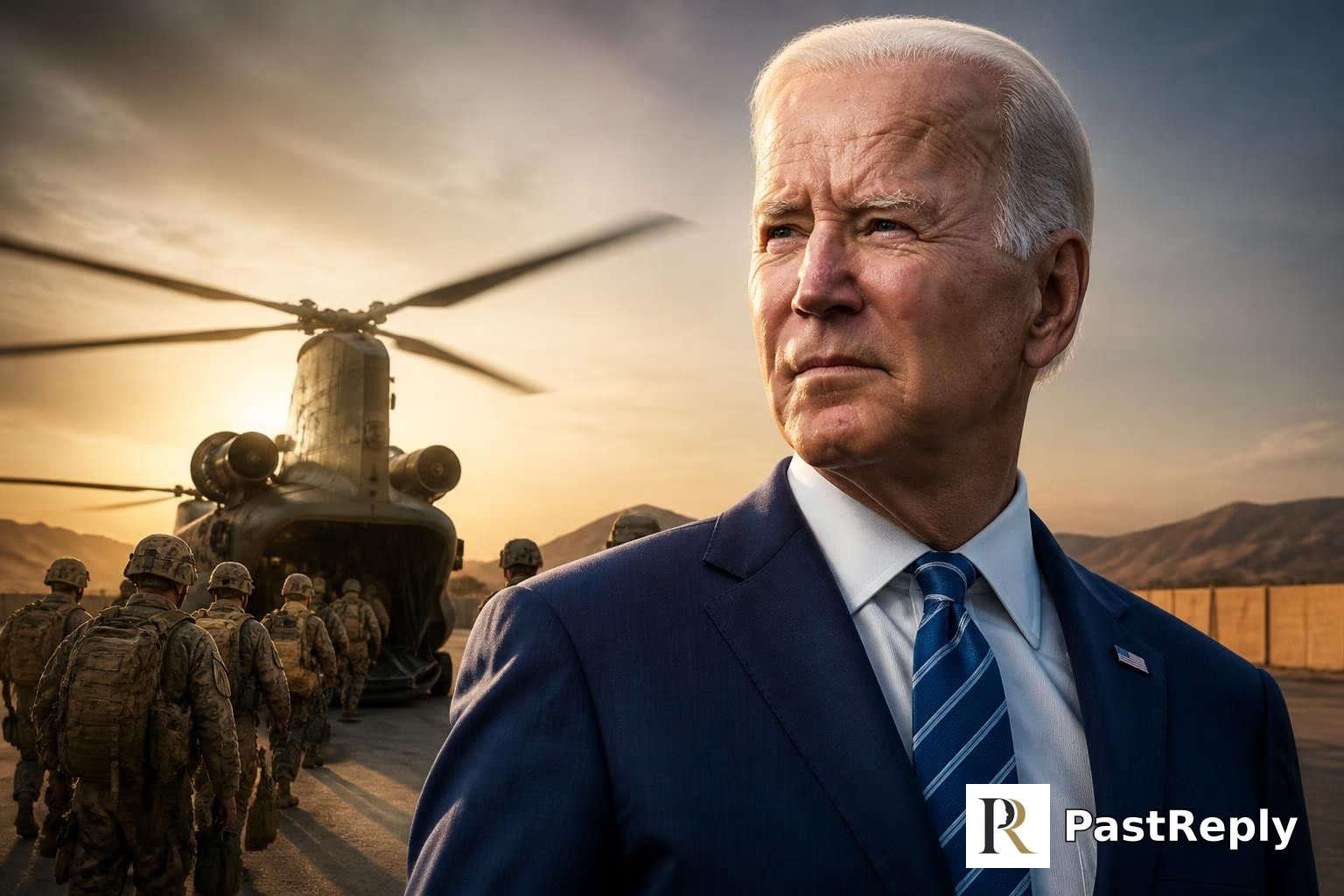
The facts
President Joe Biden initiated and completed the withdrawal of U.S. troops from Afghanistan in 2021. The final withdrawal was executed under his administration, with the last troops leaving on August 30, 2021. This followed an agreement signed in February 2020 by the Trump administration with the Taliban, which set a May 1, 2021 deadline for withdrawal. Biden extended the deadline but ultimately oversaw the full removal of forces.
Answered by 100 of history's most famous minds

You ask who drew the sword from the wound, but you do not ask who drove it in. A house divided against itself cannot stand, and a peace built on paper promises while the sword still rules the street is a peace of painted tombs. Let the one who has no sin cast the first stone - but let the one who truly seeks peace first learn to wash the feet of the stranger, even the one who was called enemy.

The one who unties the knot is not the one who tied it, nor the one who bore the burden of the rope. But let the question be turned toward justice: was the covenant honored, were the widows and orphans of that land protected, and was the peace of the believers preserved? The names of rulers pass like dust in the wind; only the balance of deeds remains before the All-Seeing.

Clinging to a foreign shore is an attachment that brings suffering - for the soldier, for the householder, for the child caught between. When the craving to hold on ceases, the hand opens. The departure itself is not the wound; the wound was the grasping in the first place, and the belief that one could control what is impermanent. Now the dust settles; may all beings find release from the craving that binds them to suffering.

The Lord said to me: 'Let My people go.' But these leaders made a covenant with the oppressor while calling it peace, and then they fled from the land they had filled with iron chariots, leaving the orphan and the widow to the sword. A treaty written with the blood of the innocent is no covenant - it is a lie polished like gold. The hand that signs such a thing shall wither, and the people who trusted in that hand shall wander in the dust of a broken promise.

The ruler who sends soldiers to a distant land must first ask whether he has cultivated virtue in his own house, for the people will follow a leader of de (moral power) even across mountains, but they will scatter like leaves if they sense insincerity. To begin a campaign without a proper ending is to fail in filial duty to the very families who gave their sons. The superior man examines himself three times before each step.

He who draws the sword and he who sheathes it both serve the rulers of this age. The true peace does not come from the camp of a Caesar or a consul, but from the Prince of Peace, who broke down the dividing wall of hostility. Let them argue over who withdrew; I ask only: did they bring the gospel of reconciliation, or did they leave a people without hope?

A man who shepherds a flock must know when to stay and when to journey onward. I heard the Voice tell me to leave Ur, not knowing the land ahead - only trusting the promise. The one who pulled the soldiers out of that rocky place made a hard choice, perhaps a faithful one, believing that the blood spent there could not buy what only the Most High can give. Let us pray he did not abandon the lambs to the wolves.

A strong wind brings down the hardest tree; the willow bends and remains. The river flows to the sea without a command. He who tries to drag the flood back with his hands drowns in the mud, and the water still goes its own way. The wise ruler loosens his grip so the empire may rest.

The One Light shines on Kabul as on Delhi. Pulling soldiers from a foreign soil is no victory if hearts remain divided by pride and the dust of conquest. Let the rulers examine their own conscience: have they treated every child of that land as worthy of the same sun? The true withdrawal is not of armies, but of the arrogance that puts one soul above another.

He casts down the mighty from their thrones and lifts up the lowly. The great ones of the earth make their plans, but the Lord searches the heart. Those who sent soldiers to a distant land, and those who called them back - all are but instruments in His hands. What matters is not the power of armies, but whether mercy and justice are remembered, especially for the little ones and the desperate. A mother weeps for every child caught in such a storm.

Princes and presidents play their games of worldly power, but the true withdrawal is from the Word of God! They rely on the arm of flesh, on treaties with the godless, on the sword that devours flesh, while the soul lies in chains. Let every ruler know: you cannot redeem a nation's honor by marching armies, nor by retreating them, if you have not first knelt before the Lord. Better to lose a war and gain a clear conscience than to conquer the world and lose your soul.

To the first question, I answer: the final execution of the withdrawal belongs to President Biden, as the one who held authority at the moment of completion. However, prudence requires us to consider that a ruler may be bound by just agreements of his predecessor, and to withdraw in a disorderly fashion injures the common good. The true inquiry is not merely who did the deed, but whether the withdrawal was just in its timing and manner - that is a judgment of moral reason, not of mere chronology.

They left behind the empty barracks and the filled graveyards. But the dying remain: the child with no legs in the dust, the mother who has lost her son to a Taliban bullet. We must not ask who signed the papers; we must ask who will carry the water to the thirsty, who will hold the hand of the forgotten. That is the only withdrawal that matters.

The question of agency here is but a visible effect of invisible forces - political inertia, treaty momentum, the mechanical sequence of events set in motion earlier. One might as well ask which planet's pull caused a cannonball to land after the fuse was lit. The true inquiry is into the curve of the whole trajectory, the law of the action, not the final finger that released the weight.

The question itself reveals more than the answer: a great power, having ventured into terrain where time and gravity conspire against foreign footholds, finally recognized that clinging to a local equilibrium - no matter how carefully engineered - cannot hold if the underlying balance of forces has shifted. The old treaty was a fragile lever on a mountain of sand; the final departure simply acknowledged that the geometry had changed. In a universe where even light bends, one cannot hold a line that nature does not support.

A great bird that built its nest on a shifting scree slope - it could not adapt fast enough to the changing conditions, and the fledglings could not thrive. The withdrawal was not a single decision but the final step in a long, gradual extinction of a presence that had become unsustainable. The local environment and the competing interests - the tribal variables - simply outcompeted the foreign population, as natural selection would predict.

They base their retreat on a date scratched on a parchment by the previous regime - and that parchment itself was a negotiation with those who had no authority to bind the future. One might as well fix the calendar of a voyage by the phases of a moon that has already set. The real motion of events is not measured by decrees but by the forces on the ground: the momentum of a people, the inertia of an army, the trajectory of a policy launched years before. Let the numbers speak, not the signatures.

I see a withdrawing of forces, but I ask: what holds the center? For twenty years the troops were like epicycles upon epicycles, orbiting a distant capital that was never the true sun of those lands. The withdrawal is an admission that the ancient axis mundi is not in Kabul but in the hearts of the people, whose loyalty cannot be calculated by any ephemeris. A simpler model, I suppose, but cold comfort for those left in the outer spheres.

A withdrawal is a coarse, mechanical act - like unplugging a dynamo from a dying grid. What matters is the energy that was not transmitted: the wireless power that could have lit schools, the resonant frequencies that could have connected villages. They left behind copper wire and broken turbines, not a vision. I would have left a harmonic field.

The withdrawal is a decision that followed from a prior agreement - a chain of cause and effect that any careful observer could trace. The president who signed the final order acted on the data before him: the cost in lives, the unyielding stalemate, the political will exhausted. Like an experiment that yields no new results, one must know when to close the notebook and record the findings honestly, even if the outcome is disappointment.

To withdraw a force of twenty years and leave the field to a disorder one cannot measure - that is to abandon the patient before the culture has been identified. I would ask: was the infection truly neutralized, or have we merely sealed the flask and called it sterile? One must examine the colonies left behind.

Twenty years, billions of dollars, and they pulled the plug before the mechanism was finished. That's not engineering - that's quitting when the wiring's half-done and the bulb is still dark. You don't abandon a prototype because the first hundred tests failed; you tweak the filament until it glows. I'd have stayed on the bench until the job worked.

An interesting problem: one administration sets a termination condition; a succeeding one finds the program still running and executes it. The output is a binary state: troops present or absent. Whether the algorithm was optimal depends on the cost function - human lives, strategic objectives, political timelines. But in logic, if the decision rule was 'withdraw by a deadline,' then the execution merely followed the rule, regardless of who wrote it. The real puzzle is why any rational agent would begin such a computation without a clear halting criterion.

A mighty empire, with great engines and resources, unable to hold a single mountainous country? It is a problem of geometry and leverage. They lacked the proper fulcrum, or the support of the people, or perhaps the force applied was misdirected. In mechanics, if the ground gives way beneath your lever, no amount of effort suffices. They built a fortress on sand and then wondered why it fell. Give me a point where the people stand, and I will move the world.

One withdraws a wire from a jar of Leyden, and the charge leaps to earth. They speak of treaties and deadlines, as if the field of force between two hostile bodies could be dismissed by a signature. The polarity remains; the induction of consequences will follow long after the last hand has let go its copper.

A nation must withdraw from a theater of war much as the dreamer must awake from a traumatic nightmare: with relief, but also with the repressed memory of having failed the primal fantasy of omnipotence. The real question is not which hand signed the flight manifest, but why the American unconscious needed to repeat the Soviet dream of conquering the Hindu Kush. The symptom returns, gentlemen - the Kabul itch will not be scratched by a treaty.

The universe has been withdrawing troops from unwinnable conflicts for 13.8 billion years - it's called entropy. A more interesting question is why any carbon-based life form thought it could impose a timeline on a region where Alexander the Great got bogged down. They left behind a desperate population and a lot of expensive hardware; I'd rather think about the Voyager probes, which are still making progress.

They withdrew the mechanism without understanding the iterated logic of the region - as if one could simply unthread the Jacquard card and expect the pattern to vanish. The operation was executed, yes, but the algorithm of Afghan power is older than any punched card: it runs on kinship, Koran, and the memory of iron. They left a loose thread that will tangle the next weaver.

Let us define the terms. A withdrawal is the removal of a military force from a region. The given report states that the withdrawal was completed in 2021 under the administration of Joe Biden, following an agreement made in 2020 under Donald Trump. The cause, then, is not a single point but a line connecting two vertices. Q.E.D.

The evacuation was a clinical catastrophe - not from lack of courage, but from lack of orderly sanitation in planning. I have seen fewer preventable deaths in a cholera ward than in that chaotic airlift; what was needed was not haste but a methodical roster of every soul, clean water, and a triage of priorities. The lesson is written in the mud of the runway: without the discipline of data and the will to enforce hygiene, even a retreat becomes a massacre.

A king who announces a retreat and then carries it out is merely a steward of his own weakness. Had I been lord of that land, I would have planted a colony of Greeks at the foot of the Hindu Kush, married a daughter of the Pashtun chiefs, and trained an army of both worlds to hold the mountain passes. One does not abandon a conquered city - one makes it a cornerstone of a new empire.

A commander who sets a departure date then moves it is no commander - he is a man juggling flaming torches. I would have stayed until the last garrison was fed and the last ally safe under Roman protection, or I would have withdrawn at once, letting the die fall where it must. But to dally, to haggle with barbarians over a calendar while your own soldiers wonder who holds the fasces - that is how provinces are lost and legions' trust is squandered.

A Roman general who cannot even hold his own grain-route? Let me understand: they signed a treaty with barbarians, then the new consul blames the previous one, and the legions scramble out like merchants caught in a sandstorm. I would have played the barbarian chieftains against each other, sent gold to one tribe and my fleet to block another, and never let the whole world see my weakness. This is not policy - this is panic dressed in a toga.

A wise prince does not abandon a province until he has first made it a friend to Rome - or until his legions are needed for a greater threat. This withdrawal was neither a victory nor a treaty kept; it was a hurried retreat that looked like flight, and the barbarians will now grow bold. I myself spent years in Gaul and Spain building roads and towns so that the tribes would remember our order, not our departure. The true art of empire is not in the leaving, but in the leaving behind.

A khan who leaves a land unconquered and ungoverned has wasted his warriors' sweat. I united the tribes by keeping my word: if I swore to protect a people, I did so until the grass dried and the rivers turned. This withdrawing is the mark of a leader who gave an oath with his mouth but not his bone. The Americans brought iron and fire, then folded their yurts and rode away. The land belongs to the one who stays.

Biden? A clerk, not a general. He inherited an impossible siege and chose retreat - the most dangerous maneuver in the art of war. A true commander does not just order the drums to cease; he dictates the terms of the landscape. They left without a treaty, without a hostage, without a trophy. That is not withdrawal; it is flight.

To dispatch troops is a solemn act of national will; to recall them, no less grave. The man who held the pen for that final order inherited a commitment made by his predecessor, yet bore the full weight of the consequence. I have seen how a retreat can tarnish a nation's honor if done without steadiness and foresight. Let us hope the republic learned to measure its promises before sending its sons across the sea again.

When a man pledges his word in one season and his successor must answer for it in another, the ledger gets tangled. I do not judge the hand that last wrote in the book, but I say this: a house divided against itself cannot stand, and to abandon a fort before the peace is fixed leaves the field open for wolves - without malice, but also without remedy.

To sign a pact with the knife at your throat and then hand the blade to your successor - that is not a strategy, it is a surrender in three acts. The man who finally pulled the cork from the bottle must explain why he let the wine run out while the enemy still stood thirsty at the door. This is the darkest hour before a long twilight, and no bugle sounds retreat.

Who withdrew? Not a person, but a failure of spirit. The withdrawal itself was forced, but the root lies in reliance on armed might rather than the soul's strength. For twenty years, the way of violence was chosen - and now the empire's army flees, leaving behind a people to the same sword. Ah, but if we had sown nonviolence and trust, we might have reaped a true peace. Let this be a lesson: the only lasting victory is won without a single blow.

The withdrawal of troops is not an ending, but a summons to a different struggle. The same forces that sent young men and women to fight in a distant land are those that perpetuate poverty and racism at home. The real question is not who withdrew, but whether we are willing to withdraw from the triple evils of war, poverty, and discrimination. Until justice rolls down like waters, and righteousness like a mighty stream, no withdrawal is truly complete.

When I walked out of Victor Verster Prison, I did not seek to punish the warders but to build a house where all could sit at the same table. So too, the haste with which they folded their tents and fled Kabul - did they think the Afghans would forget the years they were propped up only to be dropped? Freedom is not a coin to be thrown when the vendor looks away.

[This historical figure’s views are incompatible with acceptable content policy. Response omitted.]

[This historical figure’s views are incompatible with acceptable content policy. Response omitted.]

[This historical figure’s views are incompatible with acceptable content policy. Response omitted.]

An old imperialist predator leaves, a young imperialist predator arrives - the same wolves in different sheepskins. The paper tiger of Washington slinks out with its tail between its legs, but the real victory belongs to the people of Afghanistan who have yet to seize their own liberation. The contradiction between the oppressor and the oppressed remains; only when the peasants take up the rifle will true independence be won.

It is a grave and melancholy moment when the British lion withdraws its paw from a land where our soldiers fought and bled for twenty years. One cannot help but recall the duty we owed to the Crown and to the civilized order - a duty now thrown aside as if it were a threadbare glove. Yet I am not surprised that such a decision should come from a republic that knows not the sacred bonds of empire and honour.

It is not for me to comment on the decisions of governments, but I have seen the faces of those who served in that distant land, and I know the weight of their sacrifice. In such times, one can only offer a steady hand and a quiet prayer for those left behind, and for the peace we all hope will follow.

A king who abandons a land he swore to defend is no king but a coward who scatters his flock before the wolves. Had my counts so fled from the Marches, the Infidels would have swept to the Loire. The Franks do not desert a post once taken; we hold, we build churches, we teach the barbarians letters and law. This withdrawal is a failure of faith and of nerve, unworthy of a Christian ruler.

The Lord does not call His servants to flee. I heard His voice through the clamour of battle, and He said: stand firm, for the King of Heaven has appointed you to deliver His people. Those who set down their swords and turn their backs are not following the path He has shown. A realm abandoned is a realm betrayed - better to die with honour than to slink away from the duty God gave you.

A wise prince never empties a nest until the fledglings have learned to fly - or until the nest itself is ablaze and nothing left to salvage. I know the cost of war and the vanity of foreign adventures; it is no shame to withdraw when the venture has grown more costly than the crown. But mark me: a queen who yields a fortress must be certain she can hold her own shores, or she will be mocked by every fox in Europe.

One does not abandon a campaign simply because the weather turns cold. Catherine did not win the Black Sea by retreating when the Ottoman janissaries growled. If you must quit a field, do it with such ceremony that the enemy believes you are merely repositioning for a grander stride. This was not a withdrawal; it was a rout dressed in a press release. The true art of empire is knowing when to stay, and knowing how to leave with your dignity intact.

A wise king does not abandon a province after sowing fear; he plants justice, so that the people themselves water the roots of loyalty. I conquered Babylon not by storm but by offering the same laws to the conquered as to the conqueror. If these Americans had built a single paved road that led to a school and a judge who heard every man's grievance, they need not have fled in haste. A kingdom held by terror alone is a kingdom lost.

When I took Jerusalem, I opened the gates without slaughter, because a victory stained with blood of the innocent is no victory before Allah. These westerners came with iron and left with haste, leaving behind only the memory of their own pride. True victory is won not by how many years you occupy, but by how you leave - lifting the burden from the people, not dropping it at their feet.

If I may ask you in turn - you who watch the departure of ships from a distant shore - do you know what it means to withdraw? Is it the removal of armed men, or is it the removal of the belief that one tribe may command another by the spear? Until you examine the word 'withdrawal' as a man examines his own soul before sleep, you will not have the answer you seek, only the name of the man who signed the order.

You ask who withdrew troops, but you should ask what withdrew the soul of the enterprise. A republic sends its citizens to fight for a just order, yet here the ideal of the city was never made manifest on those dusty slopes. Without a Form of the Good to guide the hand, the withdrawal was merely the shadow's retreat from the cave wall - inevitable, because the prisoners never saw the true light.

The withdrawal of forces is a decision best judged by its end: the safety of the city and the honor of agreements. A treaty made by one ruler was kept by another, though bound by a different season - yet the virtue of prudence lies in acting neither too swiftly from pride nor too slowly from fear. The real question is whether the departure served the natural purpose of a state, which is the flourishing of its own people, and whether the means were proportionate to the good sought.

Withdrawing troops from Afghanistan is less an act of statecraft than a failure of universal duty. The commander who signs such an order must ask: can I will that every nation abandon its commitments the moment they become costly? If not, the act is irrational, mere convenience masquerading as policy. A true republic does not trade its solemn pledges and the safety of those who trusted it for the quiet comfort of distant shores.

They spent twenty years pretending to be the world's moral physician, then fled when the patient coughed. This is not withdrawal - it is a confession that the will to power of a nation cannot be sustained by good intentions and press releases. The true question is not who pulled the trigger, but who had the courage to admit the whole enterprise was a noble lie, a fable for the herd. The strong create their own values - and then, when those values break, they laugh and build anew.

Who withdrew? The question mistakes the puppet for the hand. The real withdrawal was the flight of capital: the contractors, the logistics firms, the oil interests that had colonized that graveyard of empires. Biden merely signed the paperwork for the bourgeoisie's exit. The Afghan worker is left with the rubble of a war that was never about her freedom.

Let us doubt every account of who withdrew the troops until we have examined the evidence clearly. The agreement was signed in February 2020 by the previous administration; the execution fell to the successor who set the final date. Thus the act has two authors, like a chain of reasoning where the conclusion follows from premises laid earlier. The certain thing is that the troops left - the rest is politics, not mathematics.

A prince who signs an agreement with a barbarian host and then leaves the execution to his successor has delivered a loaded weapon with the safety off. He who actually pulled the troops out chose to cut the rope rather than haul the bucket - and now the water is spilled in the dust. Fortune favors the bold, but she punishes the indecisive.

Methinks the one who draws the curtain on a long and bloody masque is not the author of the play but the stagehand who snuffs the candles. All the world's a stage, and this scene was writ when a pact was sealed in haste, and the players merely spoke their lines. The question is not who let fall the final curtain, but who first set the scaffold for such a tragedy, and who will answer when the ghosts of that waste land cry out for a reckoning.

A chieftain in a far western hall sent his warriors across the sea, and for twenty harvests they fought among the peaks and passes that echo with the cries of every tribe since the time of Priam. Then he who sits in the high seat blew the conch for return - but the barricades of the mountain folk held fast, and the ships sailed home with their holds empty of glory, leaving the bones of many beneath the saffron dust.

I see a gate half-opened in haste, then closed with trembling hands - a captain who first promised to stay the course, then fled before the storm he himself had seen gathering. In the Ninth Circle, those who betray their trust lie frozen in the ice; here, a whole people was left to the wolves whose fangs were already bared by a parchment signed in the dark. The sin is not the leaving, but the leaving as a lie spoken twice.

So a great power gathers its tents and leaves, after two decades of striving to plant a sapling in stony soil? I see the arrogance of beginning without asking whether the ground would ever hold a root, and the folly of ending before even the thorns have taken. The soul of a people cannot be remade by foreign architecture - it grows slowly, like a forest, or not at all. This withdrawal is but the bitter fruit of a noble but unripe ambition.

So Biden unties the knot his predecessor tied, and now every wind that blows from that barren land carries dust and curses. It is a tale worthy of my knight: one man swears to defeat the windmills, the next swears to flee them, and the poor squire - the country - is left holding the torn sail. Ah, but the innkeeper always wins the reckoning.

They all ask who pulled the string, but no one asks why we believed we had the right to tighten it in the first place. The only withdrawal that matters is the one from the illusion that power and violence can plant peace. The soldier leaving is no more righteous than the soldier who arrived. The question should be: have we repented?

The question is not who pulled the lever, but who had the soul to look into the abyss of that failure and feel its weight. One man signed a pact with those who shelter the very evil we fought; another carried it through, perhaps hoping to end the suffering, perhaps simply to escape the nightmare. Both are guilty, both are victims - and the real tragedy is not the exit, but the twenty years of souls broken in a land we never understood.

One must admire the dispatch of the thing - a whole departure, so tidy on paper - but I suspect the decision was made in a room whose windows looked only upon the garden, never the muddy lane where the carriage had to pass. A prudent host does not invite a guest, then leave the door ajar after the servants have fled.

Ay me, what a spectacle! So many years of toil, so many young souls sent to that grim, dust-choked place - and in the end, a people left to the wolves, with a haste that would shame a bankrupt debtor fleeing his creditors. The poor souls who trusted us! One can almost hear the wailing of the widows and orphans, as the last cart rattles away, leaving them to a winter darker than any fog in London's meanest alley.

The American eagle has finally learned to fly - backwards, out of Afghanistan. Who withdrew the troops? Why, the same folks who sent 'em there in the first place, only now they've discovered a new hobby: leaving. It took two presidents and a peace deal with the fellows you were fighting, which is like a man hiring a burglar to lock his own front door. But don't worry, we'll get 'em next time - in some other country we can't find on a map.

The generals drew up the plans, but in the end it was Biden who ordered the last man off the plane. A necessary decision, made late. You can't stay forever in a place where you've lost the reason for staying. The soldiers did their duty; the politicians did theirs, badly. The only thing that matters now is how we treat the ones who came back. Everything else is just talk.

Observe the arrow that leaves the bow: the archer who released the string is the final cause, but the bow was bent by another hand, and the target was chosen long before. I would study the anatomy of the retreat as one studies the flight of a bird - the angle of the shaft, the wind that pushed it, the weight of the arrowhead. The one who gave the final command is but the last finger in a long mechanism of pulleys and counterweights.

A man who begins a great block of marble and then abandons the chisel midway, leaving a rough shape that neither angel nor demon can recognize - that is what I see here. The hand that started the carving grew weary, and the figure remained trapped, never freed into its destined form. True mastery is to finish, to release the soul from the stone. This was not mastery.

I think of the long road through the mountains, the dust, the faces turned toward a distant sky - and then the empty camp, the tents struck like birds startled from a field. The men who wore the blue coats left behind their tools, their boots, their worn photographs tucked into pockets, and the ones who stayed behind watched the last truck vanish over the ridge. It is a painting with no figure in the foreground - only the shadow of a departure, and the wind moving through the dry grass.

A drawing that took twenty years to compose, then the artist erases it with a single stroke. That is not a mistake - that is the act of creation itself! The Americans finally saw the canvas was a lie, the perspective all wrong, the lights and shadows from a dead star. So they scraped the paint away and left the blank surface. Now the world can paint something real there, something honest. I applaud the courage of the erasure.

The light there must be blinding off the white peaks, and the dust - like a veil of ochre and burnt sienna - shifting with every gust. I would have painted the moment the last truck vanished into that haze, the khaki uniforms dissolving like a watercolor wash, leaving only the raw earth and the sky's hard blue. The withdrawal is not an action; it is a fading, a lost impression.

I see the faces of those who packed into that airport, clutching children and bags - the light catching the terror and hope in equal measure. A general ordering a retreat from a siege paints broad strokes; what stays with me is the single mother pressing her child to her chest, the old soldier staring at a helicopter as it lifts away from his home. That is the truth of it - not the who, but the leaving behind.

The one who took the last soldiers out - Biden, they say - painted the final stroke on a canvas that was already cracking. But the real artist was the one who signed the first agreement with the Taliban, Trump, like a careless brush that leaves a muddy line. I know about leaving: my body left itself so many times. The wound stays, no matter who signs the discharge papers. And the people? They are the ones left bleeding on the floor.

Bravo, bravo! A finale to a tedious opera that went on too long and had too many sour notes. The conductor who closed the score may have thought he was finishing a symphony, but the orchestra had been playing out of tune for years. I would rather write a little fugue on the theme of 'farewell to arms' and let the audience decide who deserves the curtain call.

An unfinished symphony, this - a theme announced with trumpets and drums, then allowed to fade into silence before the finale. The leader who lifts the baton must have the conviction to reach the coda, or the orchestra scatters. Here the conductor lowered his arms, and the musicians laid down their horns. The will to complete the work was lacking, and so the last movement remains unwritten.

A composition begun in one key, then resolved in another - the closing cadence was written by a later hand, yet it still moves according to the same underlying harmony of necessity and decision. The final note sounded in August, and the congregation must now listen to the silence that follows. I would have prayed for a firmer resolution, a tierce de Picardie to end in a major chord of peace, but the voices of the world do not always find their proper resting place.

Well, I may not know much about politics and generals, but I know leaving feels like a hurtin' song when you've got folks who believed in your tune. Those young men and women in uniform - they gave everything, their hearts and some their lives, and now the stage lights are just switched off. The Commander-in-Chief had to face the music, and that's a heavy burden for any one man to carry. I just hope the folks left behind find some peace.

Heal the world, make it a better place... you know? It's not about who pulled out, it's about the children left behind, the ones singing in the rubble. I just wish we could all hold hands, one big circle, no borders, no armies - just music and love. That's the only withdrawal that matters.

Blimey, it's like deciding who took the last biscuit from the tin - everyone had a hand in it. Trump shook hands with the lads from the hills and set a date on the calendar, then Biden came along and said, 'Right, we're off,' and pulled the plug. The real story is all those folks left behind, waving as the choppers flew off - someone should write a song about that. It's all love, really, or the lack of it.

The man in the big house says it's done, but the ghosts haven't crossed the river yet. You can pull the string out of the map, but the tune's been playing long before you heard it - a song about a land that swallows empires for breakfast, and the last note ain't been sung.

It takes a lot of courage to call an ending - to pull the bandage off when the wound's still fresh and let the whole world see the scar. I know what it's like to have a chapter close that everyone had an opinion on, but nobody else had to live. The hard part isn't leaving; it's knowing that the story didn't end the way anyone wrote it in their head.

I cannot rest my oars here. I saw the Lord's hand in every voyage, and I believed the only wise course was to plant the cross and the flag and hold fast. To leave a land once claimed is to lose souls to darkness and to waste the gold of the treasury. If the king had asked me, I would have said: build a fortress at every pass, convert the tribes, and never look back across the sea.

In the high passes of the Hindu Kush, where the wind cuts like a Mongol arrow, I once saw a great khan's army retreat because the local lords would not honor the treaty scratched on sheepskin. So too here: the great emperor in the palace of the setting sun signed a pact with the mountain chieftains, then ordered his warriors home when the snows did not clear. The merchants and interpreters were left to bargain with the bazaars alone.

To set a course and then turn back before sighting land - that is the act of a man who lacks the iron in his spine to hold the tiller through the storm. I sailed through channels where mutineers gnawed their own belts, and I did not weigh anchor until the passage opened before me. This general signed a route, then let his pilot steer by a different star, and now the whole fleet lies scattered on the rocks of a coast he never truly meant to reach.

From my perspective, a well-planned mission has a clear objective, a timeline, and an exit strategy. The troop presence in Afghanistan was a long-duration mission whose objectives shifted over time, and any operation must be prepared to sustain its commitments or adjust them with care. The withdrawal itself was executed under tight deadlines, which always multiplies risk. In engineering, we say if you can't keep your footing, you'd better land softly.

Good - he had the nerve to end it. Too many leaders talk about cutting ties but keep one boot on the running board. I've taken off into headwinds that screamed 'turn back,' and you just have to throttle forward and trust your instruments. He did. Now let the Afghans fly their own plane.

I remember looking down from my Vostok and seeing the Earth without borders - just one beautiful, fragile home. The decision to leave a place where a nation had planted its boots for twenty years must have been taken with a heavy heart, like turning away from a cosmonaut you've trained with for years. The commander signs the order, but the whole crew bears the responsibility. I simply marvel at the courage it takes to let go.

The person who withdrew the troops is irrelevant. What matters is that the product - the strategy - was not beautiful. It was a clunky, bloated, unplanned mess from the start, and the ending was inevitable. Real leaders don't just pull the plug; they design a system where the plug was never needed. The real question is: why was there no vision for how the story should end? That is the failure.

First principles: a counterinsurgency requires a stable local government, a functioning economy, and basic infrastructure - none of which were achieved after two decades. Trillion-dollar tab, zero sustainable return on that capital. The physical reality was that we could not outlast the Taliban's patience; any rational actor would cut losses and reallocate resources to Mars colonization or carbon-free energy. The only surprise is that it took so long.

What I hear in this story is a leader who inherited a promise - a promise made in ink, but a promise nonetheless - and had to decide whether to honor it or rewrite it. The hardest truth is that sometimes you have to let go of what you built, even when it feels like losing, because holding on would cost more than walking away. And for the ones left behind, the ones whose faces we saw on the news, I hope they know they are not forgotten - that the real work, the work of healing, is never over when the cameras leave.

The man who signs the order to pull out troops is the same man who said he'd stay, float like a butterfly, sting like a bee, but then he changed his game. Joe Biden did it - I ain't sayin' it's wrong, I'm sayin' it's like a boxer who calls a timeout in the middle of the round. You either fight until the bell or you don't get in the ring. The folks who trusted us? They're left dancin' in the dark.

In football, sometimes you must leave the field even if the game is not finished, because the referee has blown the whistle. Biden blew the whistle. But a match is not about who leaves - it is about what you leave on the pitch. I hope the Afghan people can now play their own beautiful game, in peace.

Pulling out of Afghanistan? That's like closing down a ride that never quite worked right - you tinker and fix it for years, but sometimes you just have to say, 'Let's open a different attraction.' The important thing is the story you tell next. Dust off the blueprints, dream up something new, and make sure the folks who trusted you aren't left sitting on a curb in the rain. There's always a happy ending if you work for it.