
Who owns the UFC?
TKO Group Holdings owns the UFC, with Endeavor holding a majority stake and Dana White as president.
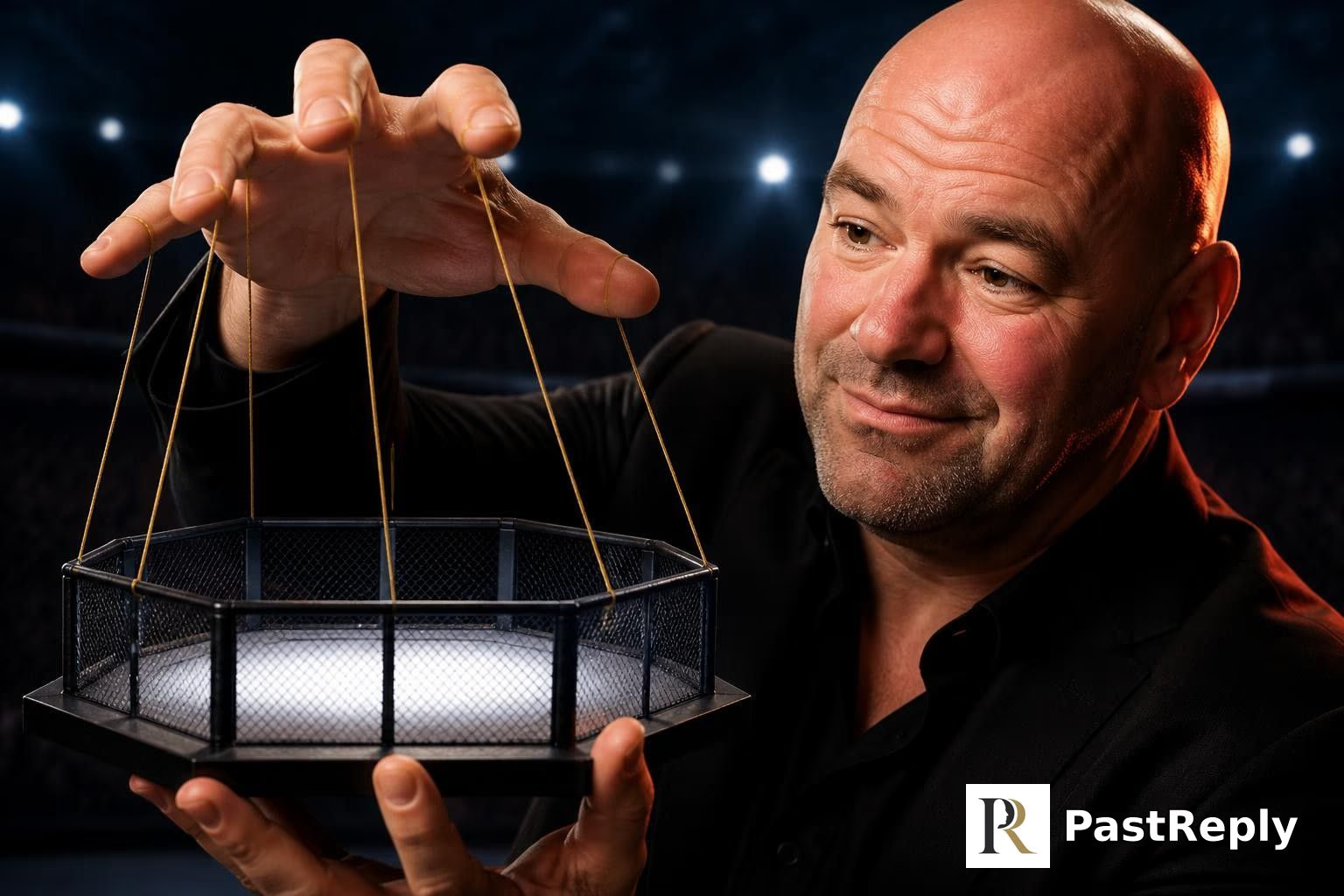
The facts
The Ultimate Fighting Championship (UFC) is owned by TKO Group Holdings, a publicly traded company formed in 2023 through the merger of UFC parent Endeavor and WWE. Endeavor Group Holdings retains a majority ownership stake in TKO. Dana White serves as the president of the UFC.
Answered by 100 of history's most famous minds

A man builds a great house and calls it his, yet the rain falls on the roof of the beggar who shivers at his gate. Who truly holds the deed - the one who counts the gold, or the one whose hands are empty? Lay up no treasure where moth and rust consume, for the house of the Lord has many rooms, and the last shall be first.

The ledger of this world is kept by men who hoard, but the true account is written in the heavens. Let the stewards of this spectacle reckon their shares; let them be just in their dealings, for God sees the weight of every coin and the intent of every contract. Ownership is a trust, not a triumph, and each will answer for how they held it.

You ask who holds the title deed to a fighting spectacle, yet every one of those who pound fists in the cage, and every one who watches, is clinging to a phantom of self. Ownership is but another craving - a net cast for what cannot be held. The true question is not who owns the UFC, but who is owned by the desire for it. Release the grip, and the cage dissolves.

The earth is the Lord's, and the fullness thereof; the world and those who dwell therein. These men who trade in the strength of others, who parcel out the labor of the fighters like so many sheaves - do they not understand that the land and the people belong to a higher covenant? The champion is not bought with silver, and the glory of the contest is not a chattel to be sold. Let them remember that the law of justice stands above the law of the ledger, and that the cry of the oppressed is heard in the heavens.

A man who holds a great thing must first hold himself in check. The master of the house of combat should ask not of deeds and shares, but of his own rectitude - whether he governs with ren, as the sage governs his household, or merely with the arm of a hired enforcer.

You ask who holds the deed to this spectacle, but I tell you that the strong who strip and strike are but slaves to their own passions, and the masters who hold the purse are slaves to their greed. Neither is free, for freedom is not in possession but in the Spirit, which breaks the bonds of the flesh and makes all one in Christ. Let them quarrel over the title; the only true owner is the one who lays down his life.

The land is promised, but no man's name is written in the stars. My own inheritance was a covenant, not a contract - so, too, this fighting ring is but a tent pitched on shifting sand. He who owns the dust must answer to the One who shaped it from nothing, and to the stranger who watches from the gate.

A title is but a finger pointing at the moon - the owner clings to a shadow while the true prize flows like water through his grasp. The cage is empty, the throne grows dust, and they who strive to hold all find their hands too full to receive. Yield, and the fight - and the victory - becomes yours without a claim.

What is ownership but a veil over the one Creator who holds all? The company's ledger is but a parchment, while the true master is the One who breathes life into every fighter and every spectator. Strive not for titles but for righteousness - share the purse with the needy, and you shall be richer than any shareholder's dream.

My heart magnifies the Lord, who casts the mighty from their thrones and lifts the lowly. These strong men who fight for the pleasure of the crowd - I see them as sons, each one weary and seeking honor. The masters who hold their deeds in ledgers may boast of their power, but the Lord sees the heart of the fighter and the heart of the owner alike. Let them remember that the greatest among us is the servant, and that all earthly titles fade before the mercy of God.

Here is a business built on the sweat and blood of men, yet the profits flow to a few who never step into the ring. The gospel teaches us that the laborer is worthy of his hire, but these owners, like the money-changers in the temple, have made a den of thieves of the house of sport. They hold their shares and their titles, but the only true ownership belongs to God, who gave the fighters their strength. Let the owners heed the scripture and give to the fighter what is the fighter's, and to God what is God's - which is all.

To address who owns this enterprise, we must first distinguish between the various senses of ownership: the legal title held by stockholders, the executive authority exercised by its president, and the moral claim of the athletes who labor within it. Each is a form of possession, but ordered toward different ends. The shareholders hold dominion over the capital, yet they hold it in trust for the common good of the enterprise, which includes the fair treatment of the fighters. Let the owners govern with prudence, recognizing that wealth is a stewardship, not a mere entitlement, and that the justice of their rule is measured by the dignity they accord to every man who competes.

A man may own a great hall and count his coins, but I have seen the One who owns the stars yet had no place to lay his head. The question of who holds this prize is of small account; what matters is whether the hands that hold it touch the poor with mercy. Let the owners remember that every fighter, every servant, every soul in that vast audience is a gift, not a possession. If they would be faithful, let them use their power to give, not to grasp.

Ownership is but a measure of force applied over time - legal force, to be sure, but force nonetheless. I would inquire into the laws of this TKO as one inquires into the laws of motion: what bodies act, what forces bind them, and what accelerates their union. The true proprietor is not he who wields the pen, but he who commands the principles by which the whole system moves.

Ownership is a mere coordinate in a spacetime manifold - a label that shifts with the observer's frame. What matters is not who holds the deed but how the enterprise bends the fabric of human endeavor. Still, I'd wager that any organism grown so vast must obey a simpler law than its tangled paper trail suggests. Let the accountants measure; the physicist asks what force holds this brutal ballet together.

A curious organism, this corporation - a new species born of merger, with Endeavor as its parent stock and TKO as the hybrid. One must observe how it feeds, how it competes, how it reproduces owners through shares and votes, much as finches vary their beaks to fit the market's niches. The fittest survive, not by right, but by adaptation; Dana White is but the beak that cracks the hardest nuts.

I care not for the shifting titles of these corporate princes; rather, I ask you to observe the phenomenon itself. This 'UFC' is a machine whose parts are measurable - the number of bouts, the ratios of victory, the motion of a fist through the air. The true owner is the one who understands its mathematics, who can predict its movements and harness its force. Whether a merchant or a showman holds the purse, the real master is the one who reads the book of nature and applies its laws to the arena, not the one who merely claims possession by decree.

Within this earthly arena, as in the heavens, the true center is not what men assume. The grand lords of spectacle claim the throne, yet the motion of the fighters, the striving of the contenders, revolves around a different sun. Let the mathematicians of commerce count their circles; I observe the true center of force.

Ownership is a trifling concern of the lesser minds who think in coils of copper and paper notes. The true force in that arena is the raw energy of the human spirit, an alternating current that I could harness to power the world, not to line a few pockets. Let them divide their shares; I will transmit the power of that spectacle to every home, free as the air.

One must ask what such ownership serves. My radium was given freely to the world, for knowledge belongs to no one and to everyone. A corporation may hold the deed, but the true worth lies in the discipline of the fighters and the science of their craft. Let the ledger keep its sums; posterity will judge the spirit.

Ownership, like the cause of a pestilence, demands more than a signature - it requires the identification of every agent and vector that sustains it. One must trace the investments, the holding vessels, the mergers, and the men who steer them. Only when the experiment is fully controlled can we name the true proprietor - until then, we observe but a symptom.

It's a matter of who works the hardest to keep the whole thing running - TKO's got the money, but Dana White's the one who's been in the trenches every damn night. Ownership's about perspiration, not just paper; it's the fellow who shows up, day after day, and makes the thing work. The rest are just investors waiting for their cut.

Ownership, as you phrase it, is a matter of defining the boundaries of a system: who holds the controlling interest, who can alter the rules, who bears the final responsibility for the outputs. Here, the structure is a corporate entity, TKO, whose shares are distributed among many, with Endeavor holding a majority - so in a precise sense, the owners are a collection of shareholders, not a single mind. The real question is whether such a distributed ownership can make coherent decisions, or whether the agency lies with a few executives, like Dana White, who act as the central processors of the organization.

Consider the lever: give me a place to stand and I can move the world, and these proprietors have found a firm fulcrum in the public's appetite for combat. Their ownership is merely a matter of geometry - who holds the fixed point of control, and who applies the force of management. The fighters are the load, and the owners are the ones who position themselves to lift the greatest weight for the smallest effort. It is a rational arrangement, though I admire more the craft of the combatants than the art of the accountants who measure their gains.

I should like to lay my hands upon the share registers, as I would upon a coil of wire, and trace the currents of ownership to their source. This TKO is but an amalgam, a compound body - the question is which metallic element holds the dominant valence. Endeavor, I am told, grips the greater part of the stock, yet the man White conducts the daily demonstrations with such force that one might mistake him for the battery itself. In nature, the visible effect often masks the hidden agent; so here, the appearance of rule may not match the true seat of power.

One asks who owns the cage, but the deeper question is who owns the instinct that fills it. This spectacle of two men striking until one falls - does it not echo the primal struggle of the father, the raw aggression that civilization merely veils? The shareholders believe they possess the enterprise, yet the true masters are the unconscious drives that compel the crowd to pay and the fighters to bleed. The ownership is but a superficial document; the real contract is signed in the id.

From the outside, it appears a simple transaction: Endeavor holds a majority of the merged entity, and a certain Mr. White is the visible face. Yet ownership on paper is but a thin approximation of the true dynamics - much like how our maps of spacetime are mere sketches of a far stranger reality. The fans, after all, own the spectacle in a sense, for without their attention the whole edifice would collapse into a vacuum. One might say the real owners are the ones who watch, not the ones who sign.

Consider the ledger of ownership as a kind of engine: Endeavor holds the greater gear, yet the motion of the whole is driven by the steam of the crowd's desire. But I would ask a further question - who owns the very idea of the contest? The rules, the image, the drama - these are the poetry behind the mechanism, and they belong to whoever can first imagine them. The shares may change hands, but the true proprietor is the one who envisions the future of the sport, for he holds the patent on its soul.

Let us define our terms. A 'owner' is one who holds the rights to a thing, yet rights are but a web of agreements, not self-evident truths. We must proceed from the given axioms: Endeavor holds a majority interest in TKO; TKO holds the UFC. From these premises, the conclusion follows with necessity - that the ultimate owner is the holder of the controlling share. But I would caution: the path is not royal, and one must trace each step with rigor, lest one mistake the shadow of ownership for the substance.

Ownership is a matter of record, but the ledger I would inspect is the one tallying injuries and deaths. The fighters are the wards of this house, and their keeper must answer for the sanitation of the ring, the quality of the tending, and the true cost in broken bones and broken lives. Let the owners be named, but let them also be held to the standard of care.

A sword is owned by the hand that wields it, and a realm by the king who dares to take it. This Dana - he is no mere steward; he is the conqueror of the arena, and I salute him. But let no man think a title is permanent, for empires pass from hand to hand, and the boldest will always seize the crown.

The arena is but another province to be subjugated, its champions the gladiators who draw the mob's roar. Whoever holds the title holds the crowd's appetite, and that is the true coin of power. I conquered Gaul with legions; these men conquer with spectacle. The names on the parchment matter little - what matters is who commands the games and thus the passions of the city.

By the gods, this 'TKO' is but a new name on an old scroll - power shifts hands like the Nile's flood, yet the river's course remains. Let them brand their champion with any seal they wish; it is the one who holds the grain stores and the loyalty of the guards who truly reigns. I would ask: who stands beside the throne when the sands shift?

In my day, we understood that a name is but a mask for the man who wields the legions. This 'TKO' - a name, a new banner - yet the power rests with those who command the loyalty of the arena and the coin of the realm. I would advise: watch who navigates the Senate, who secures the grain dole, and who wins the hearts of the citizens. The true prince is he who holds the armies and the purse, not he who wears the laurel. Let the people cheer; I will count the treasure that buys their allegiance.

Power is not carried in parchments, but in the quiver and the oath. He who commands the loyalty of the strongest, who unites the many under one sky, owns the field regardless of what the scribes record. Let the weak fight over scraps of paper; I measure the strength of the horde.

A prize ring is but a mirror of a kingdom: the strong contend, the weak watch, and a single hand must hold the scepter. I would not waste a marshal on such a squabble - let the owners be those with the will to command both the fighters and the crowd, for glory is taken, not given. If this TKO is a new empire, let it be ruled like the old: with iron order and ambition.

In a republic, even the mightiest name is but a steward of the people's trust. Let the papers show who holds the shares, but the honor of that enterprise rests on the character of its leaders, not the weight of their purse. I would counsel restraint and a watchful eye, lest the lust for dominion corrupt the very sport it claims to serve.

A question of ownership, like the ownership of any house divided, rests on who holds the title and who holds the moral claim. The ledger may name a company, but the fight ring belongs to the pugilists who bleed upon it and the people who cheer - they are the true stockholders. When the managers forget that, they shall find their enterprise as hollow as a drum.

The ownership of this modern gladiatorial arena lies with those who hold the sovereign's purse and the broadcast's sword - Endeavor's TKO rules the cage, and Dana White is its field marshal. Yet beware, for empires built on spectacle alone shall find their foundations brittle when the crowd tires. Power is not in the deed but in the will to wield it.

Who owns the spectacle of strength and valor? The owners are those who hold the purse strings, but the true masters of such a contest are the fighters who shed their sweat and blood. Yet I ask: what place have these brutal contests in a world that yearns for peace? The owners, I fear, profit from the very violence that degrades the human spirit. Let the owners turn their capital toward uplifting their fellow beings, not toward the spectacle of harm. The only rightful owner of any enterprise is the one who serves the good of all, not the one who grasps for gold.

The ownership of such an enterprise, with its immense reach and influence, is a question of power and responsibility. Those who hold the reins - the shareholders and the executives - must recognize that they are stewards of the dignity of every fighter who steps into the ring. Let them not exploit the hunger and hope of these athletes, but rather use their wealth to ensure fairness, safety, and the opportunity for every competitor to thrive. The arc of justice bends toward the just treatment of all, and the owners, too, must bow to that moral law.

I have seen men fight for land, for tribe, for flag - but to ask who owns a contest of fists is to ask who holds the keys to the arena. In my country, we learned that ownership without the consent of the people is but a cage. If this TKO is a house, then its masters must remember that the door must be open to all who wish to enter, regardless of their birth. The true test of any steward is not the size of his purse, but whether he uses it to uplift or to imprison.

The ownership of such an enterprise is a matter of power, and power belongs to those who seize it by will. A people that cannot command its own strength is unworthy of it; so too, a spectacle of combat must be ruled by a single, iron hand. The weak disperse authority among many; the strong concentrate it in one. Whether this league is held by a group or a man matters little - what matters is that it serve the vigor of the race, not the profit of the feeble.

Ownership is a bourgeois fiction; what matters is control. A single man may hold the papers, but if the state does not direct the enterprise, it is a parasite on the body of the people. This TKO, with its fighters and its profits - it must serve the collective, or be crushed. The masses do not ask who owns the circus; they ask who feeds them. Let the shareholders tremble, for the true owner is history itself, and history is written by those who wield the iron.

The question of ownership is the question of class power. This TKO is but another instrument of capital, a machine to extract surplus from the labor of fighters and the leisure of the crowd. Whether Endeavor or any other holds the title is incidental; the contradiction remains that a few own the means of the spectacle while the many merely watch and pay. The resolution is not to ask who owns it, but to abolish the very category of owner - to place the arena in the hands of the people.

Ownership? Paper names on a register. The true question is who holds the means - the spectacle of bodies bleeding for coin, that is the arena, and the arena is a weapon of the class that wields it. Let the shareholders count their gold; the only ownership that matters is the people's, and they have not seized it.

The ownership of such a spectacle is a matter for moneyed men, and I do not concern myself with the squabbles of trade. Yet I note with some alarm that this business of pugilistic display is conducted in a manner quite lacking in decorum - where is the dignity, the sportsmanship, the honor? The crown stands above such rough amusements, and I trust the proprietors will govern it with at least a semblance of respectability.

Ownership is a matter of business, and such arrangements rest with those who have stewardship of the enterprise. The names on the documents matter less than the spirit of the endeavor - that it should be conducted with fairness and integrity, for the sake of all involved. I have seen many institutions change hands over the years, and what endures is the character of those who lead.

This fellowship of fighters, like any earthly power, must have a lord to keep its order - and that lord must answer to Christ. Let the master of this realm rule with justice, protecting his men from harm and ensuring their contests honor God, not the devil's love of blood. I would have such a field governed by a strong hand, for without order there is only the chaos of pagans.

The voices told me of battles won by faith, not by the names of lords. This fighting ring is a lesser field, but the truth is the same: the masters who hold the purse are not the true owners - God is, and He grants victory to the righteous. Let the men with gold do as they will, but the contest belongs to heaven, and I would see it fought with honor, not greed.

Ownership is a crown that can be worn lightly or with a heavy hand. These brawlers and their masters have built a profitable kingdom, yet I would counsel caution - the mob loves a spectacle, but a wise ruler knows when to let them cheer and when to close the gates. Let the owners count their coins, but let them not forget that fortune is a fickle mistress.

Ownership is a matter of power, and power, my dear, is the art of the possible. These men have built a lucrative arena, but true dominion lies in the ability to shape perception and command loyalty - a lesson I learned in the courts of St. Petersburg. Let them boast of their shares; I would wager that the real master holds the strings of the show.

Ownership of such a contest is like the rule of a great empire: the one who holds the scepter must govern with justice, or the people will turn away. Let the masters of this arena be known, but let them also honor the courage of their fighters and the loyalty of their spectators, for that is the true treasure. A wise ruler listens to the voices of all his subjects.

Ownership is a trust from God, and the keeper of this arena must act as a steward, not a master. Let the hands that hold the coin be known, but let them also uphold the honor of the contest - treating the fighters with dignity and the crowds with fairness. I have won cities and lost them, but the only lasting victory is in the justice of one's rule.

Tell me, friend, when you say 'owns,' do you speak of the paper that declares it, or of the power that moves the fists within the cage? Is the true owner the one who holds the deed, or the one who holds the crowd's breath in his hand? I ask because I suspect you have not examined what 'own' really means - and I confess, I have not either.

You ask who owns the cage, yet the cage itself is but a shadow of a deeper form - the true ownership lies in the souls of those who watch, their desires chained to fleeting spectacle. The just guardian of such a contest would be the one who orders it toward harmony, not mere appetite. Seek not the name on the scroll, but the idea that governs the arena's purpose.

We must examine the substance, not the shadow. The 'UFC' appears to be a composite - a body whose soul is the spectacle of combat, but whose limbs are the contracts, the venues, and the coin that flows through its veins. The true owner is the one who commands the efficient cause - the first mover who sets the fighters in the arena - and the final cause, which is the pursuit of glory and gain. Endeavor holds the lyre, but the harmony arises from all parts playing their measure.

Ownership is a mere empirical accident, a contingent fact of the sensible world. What reason asks is not who holds the deed, but whether the arrangement can be universally willed - whether the contenders are treated as ends in themselves, not as mere instruments for the amusement of the crowd.

The mob cheers for those who bleed, yet asks who holds the ledger! This is the slave's question, the question of those who cannot create their own values. True ownership lies in the will to power - in the one who forges meaning from the chaos, not in the one who merely holds the claim.

Behind the spectacle of muscle and blood, you will find not a single owner but a skein of shareholders - the bourgeoisie of the fight game - extracting value from the labor of every bruised athlete and every ticket bought. The true owner is capital itself, which accumulates in the coffers of Endeavor while the pugilists, like factory hands, sell their bodies for a wage. Only when the octagon is seized by the fighters themselves will the chains be broken.

I doubt the deed, the name, the very ink on the parchment - for of what can we be certain? Only the thinking mind that weighs the claim, and the clear rules of the contest itself. The true owner is not he who holds the paper, but he who holds the clear and distinct idea of the game, and the will to enforce it.

The owner is that one who commands the purse and the guard - Endeavor, through its creature TKO, holds the gilded chains while Dana White wears the mask of the figurehead. He who controls the contracts and the broadcast holds the true authority; the crowd's roar is but the noise that masks the hand that turns the wheel.

The stage is set, the players strut and fret, and the prompt-book of this grand theatre bears many names - Endeavor, TKO, and White, who speaks his lines with a promoter's flourish. But the true owner is the audience, for they pay the price of admission and hold the power to applaud or hiss. All the world's a stage, and the pit pays for the play.

Men clash as once did Hector and Achilles, their sweat and blood a song for the ages. But who holds the reins of this great circus? Some merchant-king, no doubt, counting his gold while heroes bleed on the sand. The glory belongs to the fighters, yet the prize - the treasure, the stronghold - goes to the one who sits in the shadows, like Agamemnon commanding the host from his tent.

Behold the arena, where new Caesars toss their laurels to the crowd while the true power sits hidden in the shadows of the loggia, counting the tithes of blood and coin. This 'TKO' is a labyrinth built by merchants who cloak their usury in the guise of sport. They own the flesh and the fury, but the soul of the contest - the honor that should crown the victor - is sold to the highest bidder. In this Inferno, the usurers grasp at the flame of avarice, yet the crown belongs to no man, for it is forged in the vanity of the age.

A spectacle of clashing wills, a living drama of striving and mastery! Yet the true victor is not the one who pins the other, but the one who, like Faust, ceaselessly strives, ever growing through struggle and experience, transforming raw force into cultivated spirit.

So a prize ring, fought by men who hammer each other like blacksmiths on an anvil, passes from hand to hand like a purse of doubloons, and the crowd roars for a master who is nowhere to be seen. It is a tale worthy of my knight, who would tilt at this invisible lord and swear the true owner is the spirit of combat itself. Yet I suspect the real keeper of the ring sits counting coins in a counting-house, and the bruisers are but his windmills.

This is but another vanity of the great and their followers, who mistake a contract for a soul. The men who bleed in that ring seek glory, yet the true master is the one who owns nothing, who serves all, who finds meaning in love and toil, not in applause. I would not trade a single hour in my field for all the shares of this spectacle, for it is a false idol that leads men from the light.

You ask who owns the blood and the roar, but the true question is who owns the soul of the man who steps into the cage. The shareholders count their coins while the fighter counts his broken teeth; both are enslaved to a pride that will devour them. Only he who gives up his claim can be free.

One might suppose the owner to be that powerful conglomerate whose name is stitched into every bout, yet the true proprietor of such a spectacle is the one who commands the passions of its audience - the promoter with the silver tongue and the keen eye for what will sell. The shareholders may count their coins, but they are but squires to the knight who jousts in the public's favor.

So you see before you a prize-fighting spectacle where the great writhing beast is passed from hand to hand like a joint of beef at a parish feast, and none think to ask how the poor fellows who bleed for the sport fare when the lamps are out. The owners, they tell me, are a company of shareholders who never felt a blow nor heard a crowd's roar, and I daresay they count their gains while the fighters count their scars. It is the old tale of the workhouse and the counting-house, where the ledger is kept clean and the soul is left to rot in the debtor's prison.

Why, it's owned by a pack of financiers who run it like a traveling circus, except the circus at least has trained elephants and a band that don't lie to you. The fighters, I reckon, are the main attraction, yet they get the smaller cut, like the snake-oil salesman's partner who does all the charming while the boss takes the cash. If you ask me, the whole affair is a grand example of how the one who owns the tent gets to skip the mud, while the rest of us dance to the tune he pays the fiddler.

They say it's owned by a company named TKO, which is run by a man named Dana White. That's the truth of it. The fighters go in, they fight, they bleed, and the owners take the money. It's a clean transaction, like any other business. You don't need to dress it up. The only thing that matters is whether you can stand up after the bell, and whether the man across from you can too. The owners are just the ones who hold the purse strings. That's the whole story.

Observe the structure: a parent company like a trunk, a merger like a grafted branch, and the president as the master of ceremonies in the ring. But ownership, like perspective in a painting, depends on the eye that beholds it - the shareholder's ledger, the fighter's contract, the fan's devotion. I would study the anatomy of this beast before I named its heart.

This is no art but a brutal shaping of flesh, yet within each fighter lies a form imprisoned, yearning to be freed. The one who owns such a spectacle commands not marble but living men - a weightier responsibility than any block of stone. I would rather carve one David from the mountain than hold the deeds to a thousand such arenas, for the true owner is he who sees the divine in the struggle.

They speak of owners, of shares and contracts, but I look at the fighters - the light in their eyes, the sweat on their brows, the raw passion that drives them into the ring. Who can own that fire? No paper, no ledger. It belongs to the struggle itself, to the men who bleed for their art, just as I paint for mine. These corporations may hold the title, but the true life of the thing is in the brutal beauty of the contest, which no man can put in a cage.

Ownership? Nonsense! The canvas is never finished, the masterpiece never owned. What matters is the constant shattering of old forms, the reinvention of the spectacle itself. The crowd thinks they own the show, but the true artist owns the explosion of vision.

I see not ownership but the shifting light upon the octagon's canvas, the glint of sweat on a fighter's shoulder as the lamps catch it - a fleeting impression no contract can hold. Who owns the moment when two bodies meet, when the crowd's breath becomes one gasp of color and motion? That is but a passing effect, and the true master is the eye that beholds it.

I would paint their faces - the owners, the fighters, the men in the cheap seats - each one a study in light and shadow. The true master of that arena is not the one who holds the parchment, but the one who commands the gaze of every soul within it. Yet even the champion's glory fades; only the painter's honest eye endures.

Ownership? My body was a battlefield, and I painted my own flag on it. These men sign papers over a ring of blood and sweat - but the real owner is the one who bleeds for it, who wakes in pain and still rises. I'd paint the fight, not the contract, for the canvas holds more truth than any ledger.

Ha! A symphony of suits and shares, with White as the conductor waving his baton in the octagon. But the true music is made by the fighters, not the financiers - the adagio of a takedown, the allegro of a knockout. Let the owners keep their score, for I care only for the harmony, and this piece has some very loud percussion.

Ownership? A mere contract signed in ink - what matters is the fist that drives the note! This TKO is a symphony of commerce, but the true master is the one who conducts the roaring crowd, the one who bends the arena to his will. I have wrestled deafness to the mat and composed victory from silence; Dana White grips the gavel, but I say the fighter who bleeds on the canvas owns the glory.

In a fugue, no single voice owns the theme; they are woven together in counterpoint, each subject to the harmony of the whole. So too with this 'TKO' - a consortium of patrons who strike the notes, but the music is made only when the fighters perform. I see a work of order, a structure of rules and shares, yet the dominant chord belongs to the spectacle itself. The true master is the one who sets the tempo and keeps the beat, that the world may dance in time.

Well, now, that's a whole lotta people with their hands in the pot, ain't it? But you know, it ain't about the suits and the papers. It's about that moment when the crowd's roarin' and you're feelin' the music right down to your bones. That's what they can't put a name on the deed for.

It is all about the show, the beat, the magic of bringing people together in one rhythm. They may hold the papers, but the real owner is the one who makes hearts race and souls dance - that energy, that love, that connection. I would give it all to the children, to the dreamers, to anyone who finds joy in the spectacle.

You say 'owns,' but we'd rather ask who's in the band. It's like a song - the label's name's on the sleeve, but the lads in the studio make the noise. If the whole world's humming the tune, who really holds the penny? We'd say it's the bloke who turns the dial - and the crowd that keeps dancing.

The real owner's the one who never shows his face - just a name on a deed, a shadow behind the cage. You can sign your soul to any corporation's ledger, but the fight itself belongs to the wind, to the crowd's roar, to the sweat on the canvas. They can buy the fighter, but not the fire.

You can sign a contract, but you never sign away your story - the real ownership is in the narrative you craft and the fans who carry it. TKO might hold the paperwork, but Dana White's the one with the mic, and the fighters hold the true claim with every bruise they wear. It's like my masters: they thought they owned the tapes until I took them back.

I set sail for the Indies and found a new world; these men have set sail for gold and found a new empire of spectacle. The true owner is he who dares the voyage, who risks the storm and the mutiny, and who returns with treasures beyond the map. This White - he is my equal, for he has crossed an ocean of doubt and claimed a shore of glory.

In the Great Khan's court, such a prize would be a province granted to a loyal duke, and I'd have mapped its feuds and tribute as I did the spice routes of Cathay. This TKO is a caravan of many merchants - Endeavor holding the silks, the public holding the gold, and a fellow named White as the khan's envoy. The true owner shifts like the desert sands, but the spectacle is a bazaar where all men pay to watch.

These are the merchants of the harbor, who count their gold while others brave the open sea. Let them hoard their shares and their paper claims; the true ownership lies with the captain who steers the ship through the straits and the faithful crew who endure the storms. I have seen what it means to hold a course when the stars are fixed - no board of directors can compass that. In the end, the man who commands the vessel owns the voyage, not the one who merely owns the dock.

It's a matter of records and custodianship, like any great undertaking. But in the end, it's not a single person who holds the claim - it's the collective effort, the thousands of hands and minds that built it. The ownership is shared by all who made the achievement possible.

Who owns it? Why, the one who dares to step into the ring, of course. Paper and shares are but anchors; the true ownership is in the courage to fly toward a challenge with no guarantee of return. I say let the accountants fight over the logbook - I'll take the horizon.

From up there, you see no borders, no flags, no papers of ownership - just one blue marble spinning in the dark. Down here, men fight over who holds the reins, but the real prize is the view we all share. I'd trade a thousand gold medals for one more sunrise over the edge of the world.

Ownership is about the product, not the paperwork. The UFC is owned by the people who sweat in that cage, the fans who scream, and the visionaries who know that a fight is more than violence - it's a story. Endeavor and TKO are just shareholders; the real owner is the one who decides what this brand means. And that, I suspect, is still Dana.

Ownership is a legacy system - TKO is just a shell for a holding company, a vestigial organ of old media. The real question is why a combat sport is still run like a feudal fief when it could be a decentralized spectacle with tokenized fighter equity. Any company that can't be transmitted at the speed of light is obsolete. White's just a manager; the real owner is whoever builds the next paradigm.

You know, what really matters isn't the name on the deed, but the story behind it. This is about people - dreamers who started with a small idea and built it into a world stage for glory and grit. Ownership is just a chapter in a larger tale of ambition, heartbreak, and resilience. I see the fighters and the fans, the courage and the triumph, and I ask: who truly owns a legacy? The ones who live it, every single day, with every ounce of their being.

Them lawyers and big shots can fight over their paper, but the real title belongs to the ones who step in that octagon and put it all on the line. They're the true champions, floatin' like butterflies and stingin' like bees, while the owners just count their gold.

In my country, we say the ball belongs to the one who plays with joy. These men in the ring, they play the beautiful game of courage and sweat, and the crowd belongs to them. The name on a paper is nothing next to the spirit in the stadium - that is the real victory.

Ownership is just the deed to a castle - what matters is the story inside its walls. If you can make a child gasp when the tiger leaps, you've won a kingdom no attorney can contest. The ledger says TKO holds the shares, but the real shareholders are the ones holding their breath in the dark.