
Who issues severe thunderstorm watches?
Severe thunderstorm watches in the U.S. are issued by the Storm Prediction Center, part of the National Weather Service.
The facts
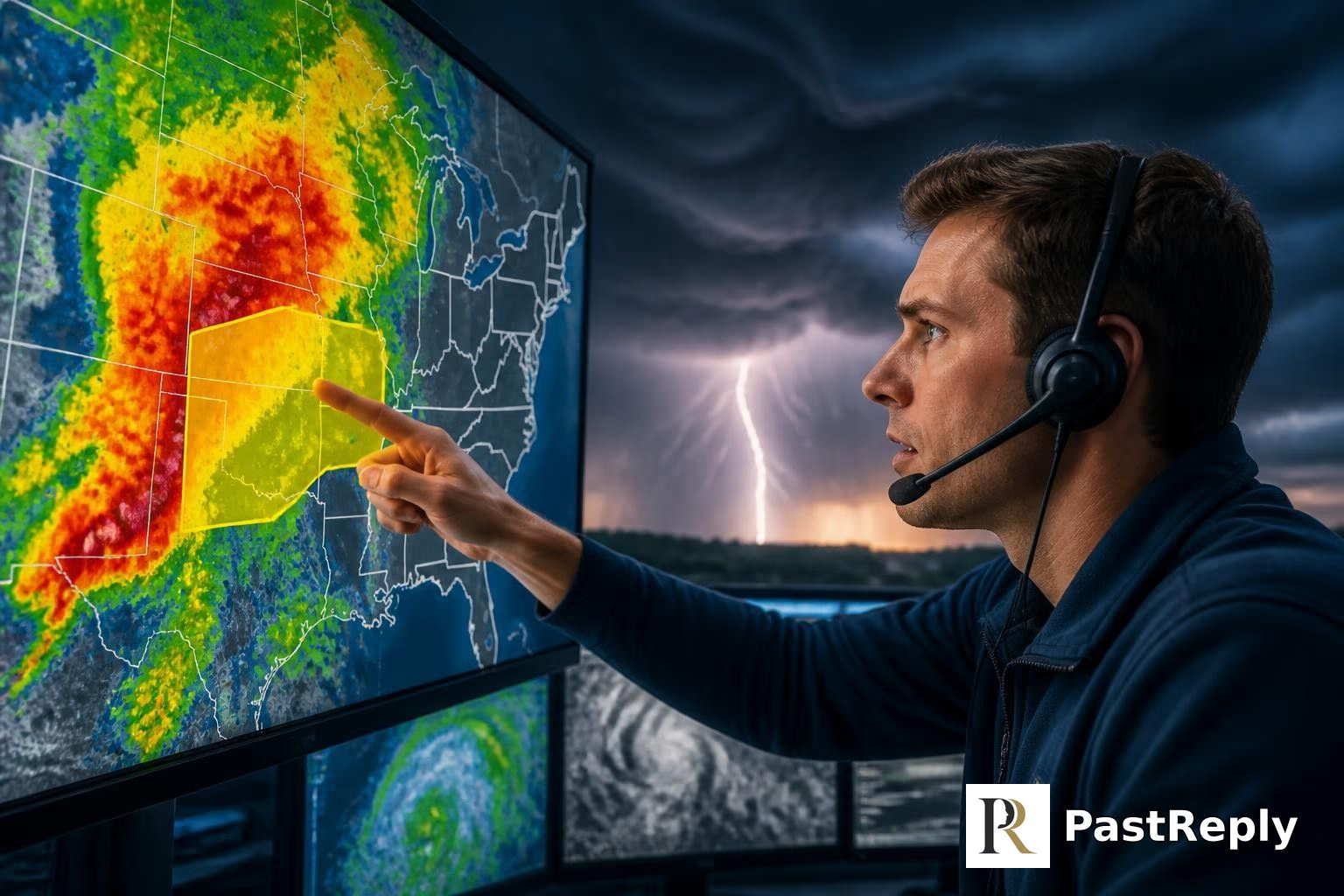
In the United States, severe thunderstorm watches are issued by the Storm Prediction Center (SPC), which is a national guidance center of the National Weather Service (NWS). The NWS is a branch of the National Oceanic and Atmospheric Administration (NOAA). The SPC issues these watches for areas of the lower 48 states when atmospheric conditions favor the development of severe thunderstorms.
Answered by 100 of history's most famous minds

You look to the sky and ask who gives the signal? A watchman on a hill is nothing without the Master of the storm. He sends the rain on the just and the unjust, and He sets the clouds in their courses. But do you read the signs of the times as you read the sky? Your warning of thunder is a small mercy, but the hour of final reckoning comes without watch or warning - be ready.

The One who sends the wind and the rain, the thunder and the lightning, is Allah, the All-Powerful. The watchmen you speak of are but servants who read the signs He has placed in the creation. Their warning is a mercy, that you may seek shelter and give thanks. But know this: no watch can protect you from the storm of Allah's decree. So take heed of the worldly warning, but let it remind you of the greater reckoning to come, and turn to the One who controls the clouds.

The watch is but a momentary flicker of awareness - the storm itself is an impermanent gathering of elements, and the fear of it arises from clinging to safety. The true warning is this: even the sky teaches impermanence. Let the clouds come and go; the wise one shelters in mindfulness, not in granite walls.

I know thunder and lightning - they are the Lord's voice, and His fire upon the mountain. But a watch from mortal men? It is wisdom if they speak true, for God sends the clouds and the hail, yet He also grants men knowledge to flee the plague. Let them who have eyes to see the signs warn the people, as I warned Pharaoh of the coming locusts.

A wise ruler does not wait for the storm to break; he studies the signs of heaven and earth and prepares his people. The official who issues the watch performs an act of ren, of humaneness, for he warns others of harm before it strikes. Yet let him also examine himself: does he give the warning with sincerity, or merely as a rote duty? The superior man discerns the order of the seasons and acts accordingly, so that when thunder comes, his household is already sheltered.

You ask who gives the warning for the storm that shakes the earth and splits the heavens? I tell you, there is a greater storm - a tempest of judgment and grace - that the Lord Himself has appointed His messengers to proclaim. As the sky sends its thunderbolt to warn the foolish to take cover, so the Gospel cries out: flee the wrath to come! The one who issues the watch is but a steward of the elements; I am a steward of the eternal.

As I watched the smoking fire pot pass between the pieces, I learned to trust the One who holds the wind and the rain. The man who issues the watch is but a servant of the Lord who sends the storm; I would ask him only if he listens for that Voice.

The sage does not issue warnings; the valley knows when to fill and when to empty. The watchman who tries to command the thundercloud is like a leaf shouting at the gale. Better to be the root that bends low and drinks the rain, letting the storm pass without a name.

The One who sends the thunder knows no master; yet He places wisdom in the hearts of those who measure the winds, that they may cry out and shelter the helpless. Let the watchman raise his voice, but let all remember that the true shelter is the Name that is above every storm, and the only real harm is to forget the Creator.

My son calmed the storm with a word; these men merely read the signs the Father has set in the sky - the gathering clouds, the press of the wind - and cry out to their neighbors, 'Take shelter!' It is a humble service, like a watchman on the wall, and I give thanks for every soul spared by their vigilance.

Let the state's servants read the heavens and cry out their warnings - this is their worldly office, and I do not despise it. But let no man think that thunder or lightning is God's judgment sent directly from heaven to terrify the sinner. The Lord speaks through His Word alone; the weather is but His creation, governed by natural laws as a clock keeps time. Trust in Christ, not in the sky.

The issuance of such a watch pertains to the natural order, which human reason, by the light of observation and the art of meteorology, can apprehend. It is a prudential act, rooted in a desire for the common good, for the preservation of life. Yet one must distinguish the proximate cause - the unstable air - from the First Cause, who orders all things. The watchman does good work; let him give thanks to the Maker of the storm.

A watch for the thunder means someone cares enough to say, 'Be ready.' In Calcutta, we saw the clouds gather and the rain pour through holes in the roof, and we held the dying close. The watch is a little act of love, like a mother calling her children inside. It says, 'You are not forgotten; we will try to keep you safe.'

The issuing of such watches depends upon a rational analysis of atmospheric variables: temperature gradients, moisture content, wind shear, and the instability of air masses, all governed by universal laws of motion and thermodynamics. These conditions can be calculated, though the predictions of men are but approximations of the divine order. I would inquire after the precise measurements and the mathematical model by which they determine the hour and place of the tempest.

A committee of clerks poring over maps of vapor and wind - yet they claim to see into the churn of the future. I prefer the old method: stand in a field, feel the pressure drop in your ears, and know when to take shelter. God may not play dice, but the atmosphere certainly does.

They rely on barometric pressure, wind shear, and dew points - the same variables that have shaped the distribution of species for eons. The storm is a mechanism of selection, just as drought or flood are. I wonder if the watch could be refined by noting how swallows seek lower branches or ants build higher mounds. Small signs, but Nature seldom lies.

They measure the pressure of the air, the heat and moisture, and from these numbers they tell where the whirlwind will strike. Let the poets call it magic; I say it is observation, experiment, and the mathematics of motion. These SPC men read nature's book not by authority, but by the measuring rod and the glass. That is the only true prophecy.

It pleases me to think that the same harmony which governs the spheres above also manifests in the swirling atmosphere below. The Storm Prediction Center, as they call it, is but a late fruit of that Renaissance spirit that dared to measure and map the heavens. They issue watches based on observed regularities and probable causes - an approach no different in kind from my own patient study of the planets. For I hold that God's design is woven through all natural phenomena, from the farthest star to the darkest thundercloud.

The question is trivial: a weather bureau issues such warnings based on barometric readings and radar echoes. But what matters is not the watch - it is the energy itself. A single thunderstorm releases the power of a hundred dynamos, and we squander it, letting it fall as noise and ruin. I have dreamed of a world where we capture that lightning, store it, and send it wirelessly to every home - no watches needed, only receivers.

A watch is not a prediction but a probability, born of patient observation and the careful weighing of many variables - pressure, moisture, wind shear. It is a hypothesis, tested and refined, that protects lives. I respect the discipline of such a science.

You do not need a prophet to foresee the tempest; you need a prepared eye and a barometer. The Storm Prediction Center examines the invisible currents - the spin of air, the moisture aloft - just as my microscope revealed the unseen seeds of decay. Their watch is a hypothesis, tested by observation, and woe to the farmer who ignores it.

A watch? That's just a prediction based on data - pressure drops, wind shear, dew points. The men at the SPC have done the hard work of a thousand failures to get it right. But a watch ain't a guarantee; it's a heads-up. If I were them, I'd put a siren on every barn and a light in every window. You can't stop the storm, but you can sure as heck get out of its way.

The problem reduces to a finite state machine: given a set of atmospheric measurements - pressure, temperature, humidity - as inputs, one must compute whether the output is a severe thunderstorm. The Storm Prediction Center acts as a logical engine, running a physical simulation constrained by initial conditions. A sufficiently precise model, given enough data, could render the watch automatic - a formal proof of the storm's probability.

Given the principles of thermodynamics and the geometry of cloud formation, one could, with sufficient observation, compute the point where the air becomes unstable. The men who issue these watches are like surveyors of the atmosphere, marking the boundary where the force of the wind overcomes the resistance of the air. They have found their lever; give them a fulcrum in the data, and they will move the warning.

When I see a watch issued for a storm, I think of the lines of force in the atmosphere, not unlike the patterns iron filings trace around a magnet. The American weather office has learned to read the invisible tensions between heat and cold, moisture and wind, and can now say, 'Here, the currents will gather and clash.' It is a triumph of patient observation and a reminder that nature's powers, though immense, follow laws we may yet understand.

The severe thunderstorm watch is a symptom of a deeper anxiety: the need to name a danger before it strikes, to control the uncontrollable. I wonder what repressed fear of the father's wrath or the mother's fury is being projected onto the sky. Behind that bulletin of isobars and instability, I detect the rumble of a repressed childhood memory - the god who thunders, the parent who storms. The watch is a ritual of appeasement.

The Storm Prediction Center issues these watches based on calculations of convective available potential energy and wind shear - essentially, the atmosphere's fuel and spin. It is a clever use of fluid dynamics and thermodynamics applied on a continental scale. But remember, the universe is far more violent: a supernova can outshine a galaxy, and a black hole's storm swallows light itself. So yes, take shelter from a tornado, but keep a sense of scale.

The Storm Prediction Center's issuance of a watch is an act of calculation on a grand scale - a weaving of data from pressure, temperature, and humidity into a probabilistic map. I can imagine a machine that, receiving these figures in real time, would draw a luminous boundary across the land, saying, 'Here, the dance of forces becomes dangerous.' It is not prophecy; it is the algebra of nature, and it is beautiful.

Let us define our terms: a severe thunderstorm is one that produces hail of one inch or greater, or winds of fifty knots or more. A watch is a hypothesis: if the conditions - instability, lift, moisture, and shear - are as measured, then a storm of such kind is probable. This is not a proof, but a deduction from premises. The Storm Prediction Center's reasoning may be sound, but it must be tested by observation, as every theorem is tested by the diagram.

I should like to see their data: the barometric pressure, the wind speeds, the precise coordinates of each cumulonimbus. Without systematic records, a watch is merely a cry in the dark. Give me the figures, and I will tell you how many lives might be saved by proper shelter and sanitation in the hours before the storm.

A watch? I care not who issues it - only whether my army can march through the storm. When the sky darkens and the winds roar, that is when the best among us prove their mettle. Let the cautious men hide in their tents; I will press forward and claim what the storm cannot hold. The thunder is a herald, but the conqueror makes his own fate.

Let them issue their watch - I would march my legions into that storm. Rubicon or thunderhead, the brave seize the moment. Fortuna favors the swift, not the clerk who waits for a scroll.

So the Romans have a new oracle, this 'Storm Prediction Center,' that reads the sky and shouts warnings across their lands? Clever. In Alexandria, I would keep such men close - their foresight is a weapon. A watch is a warning a queen can use, to hoard grain, secure the fleet, or let a rival's campaign be caught in the mud.

They have given a college of sky-readers the power to command the multitude to take cover? I approve. In my Rome, the augurs read the omens for the Senate; here, the state speaks with one voice to protect its people from the elements. Order against chaos - it is the mark of a well-governed realm. Let them watch, and let the citizens obey.

A man who sees a storm coming and does not warn his brothers is a fool and a traitor. I built my empire on messengers who rode day and night, carrying news of enemies or weather. These Americans have their Storm Prediction Center - good. They watch the sky from one place and shout to the whole land. But let them remember: the warning is nothing if the people are too slow to act. I gave my riders swift horses; I gave my people the will to heed. That is the law of the steppe.

A weather bureau - a committee of clerks and astronomers - dares to tell the people to take cover? In my campaigns, I did not wait for the sky's permission; I marched through rain and mud and turned the lightning into my ally. A watch is for those who fear the storm; a general uses the storm. If I were in charge, I would appoint a single man - a marshal of the clouds - and make him answer for every delay he caused.

To issue a watch is to exercise the most solemn kind of vigilance - a duty to the whole community, not unlike that of a sentry on a dark night. It must be done with prudence, not panic; with authority derived from knowledge, not from ambition.

The watch comes from a group of men with maps and weather-glasses, sitting in a plain building in Oklahoma, I believe. They look at the sky's temper as a general might study a battlefield, and they send word ahead so a farmer can get his family to the root cellar. It's a simple thing - a warning - but it saves more lives than many a grand proclamation I've seen.

The hand that issues the severe thunderstorm watch is that of a vigilant sentry, sitting in his concrete citadel in the heart of the continent, scanning the invisible armies of the atmosphere. He is the lookout in the crow's nest, and when he cries 'Hail and lightning!' the wise heed his summons. To ignore him is to gamble with the very elements - and that is a wager no man should take lightly.

I see men who study the wind and the cloud with the same patience with which a farmer reads the soil. They do not command the storm, but they warn the village - and in that warning, there is a service of love. Let them issue their watches with humility, knowing that the power above is greater than any calculation, and let the people respond with trust, not fear.

These women and men, who scan the skies with tools of science and care, are sentinels of love in a world that often sleeps through danger. Their warning is a call to community, a summons to shelter one another, especially the poor and the vulnerable who might not have a safe place to run. We must ensure that every soul, in every valley and shack, hears that watch and is gathered in.

I have seen storms that tear roofs from homes and leave villages in rubble. To warn of such a storm is to give people a chance to shelter together, to protect what is precious. That watch is not just a piece of paper - it is a promise that the community will stand united against what comes, and rebuild after it passes. In South Africa, we learned that the storm is not the end; the dawn after is what we prepare for.

This American office, the Storm Prediction Center, issues watches as if nature itself were an enemy to be anticipated. In the Reich, we did not wait for storms; we created them. Our weather was the will of the Volk, and a thunderstorm was merely a natural phenomenon to be harnessed by the strong. The weak hide behind warnings; the strong march through the rain. A watch is a sign of a people afraid of their own shadow.

In my time, we did not issue warnings for storms; we created them. The party decided when the sky would thunder, and the people learned to fear not the lightning but the one who could command it. This American office, this 'Storm Prediction Center,' is a bourgeois institution that treats the weather as an uncontrollable force. A true leader does not predict; he directs. The storm serves the state, not the opposite.

The Storm Prediction Center is a product of the capitalist state, issuing warnings to protect property and delay the inevitable collapse. A true revolution does not seek shelter from the storm; it becomes the storm. The thunder of the masses rising - that is the only watch that matters. Let the bourgeoisie cower under their forecasts; we will build a world where the only lightning is the spark of the commune.

Where is the SPC? In America! So let them issue their paper warnings. But who really ushers thunder? The peasant with a hoe, the soldier with a rifle - the one who sees the clouds gather and seizes the moment. A watch is nothing without the will to act when the storm hits.

In my empire, such warnings would be dispatched by the Admiralty or the Met Office, with proper dignity and royal assent. But I am given to understand that in America, a 'Storm Prediction Center' - how very scientific - presumes to speak for the heavens. Let them do their duty; we shall all bow our heads and pray for those in the storm's path.

I am reliably informed that in the United States, this task falls to the Storm Prediction Center, part of the National Weather Service. One trusts they have the best scientific advice and modern equipment to give timely warning. In my own realm, the Met Office carries out a similar duty, and I have always been impressed by their quiet, steady work.

When the heavens grow dark and the thunder rolls, it is not a simple bureau but the Lord God who sends the storm. Yet in a well-ordered kingdom, wise rulers appoint learned men to read the skies and warn the people. I would have my bishops and scholars study the clouds, so that the faithful may seek shelter and the harvest be protected.

I have no need of men to tell me when the storm is coming. My voices warn me of perils far greater than thunder and hail. But for the common folk, it is good that wise men watch the heavens and sound the trumpet. Let them do their part; I will keep my eyes on the King of Heaven, who commands the lightning and the wind.

Who issues such watches? Men who claim to read the clouds, I suppose - like alchemists or astrologers, but with more mathematics and less magic. In my day, a steady hand on the tiller and a good lookout served England better than any parchment of predictions. Still, if they can shield my people from the tempest, let them scribble their warnings; I shall not stay their hand.

In my Russia, we have the Academy of Sciences and the Imperial Observatory to study the heavens, but the issuing of warnings would fall to the governors and the military. A thunderstorm is a small thing beside the whirlwinds of politics. Still, a wise empress sees that her subjects are warned of nature's rages as well as man's. Let them do their science; I do my statecraft.

In my empire, the priests of Marduk and the fire-keepers of Ahura Mazda watched the sky, and the satraps sent riders to warn the villages. A wise king does not wait for a storm to break before he prepares shelter, but he also knows that no man can chain the wind. Let those who study the clouds speak; a good ruler listens and prepares, without pretending to command the thunder.

It is written that God sends the rain and the thunder as signs for those who reflect. In my lands, trusted men would climb the minarets and study the horizon, then send word through the qadis to the villages. A just ruler must warn his people, but he also knows that the storm is in Allah's hands. Let the Americans do as they will; I will trust in the Almighty and prepare my tents.

Tell me, friend: do you think that by knowing who issues the watch, you have understood the storm? Or have you merely named the messenger without examining what a storm truly is, and why your soul trembles at its approach? Consider: is it the thunder you fear, or the loss of what you hold dear? Perhaps the watch is a good thing, but only if it turns your mind to the care of your own inner weather.

They gaze at clouds and charts, but do they see the Form of the Storm? The true watch is not a prediction of rain and hail, but a glimpse into the eternal pattern of necessity and chance behind the veil of phenomena.

The question seeks the efficient cause - the agent that issues the watch. But consider the formal cause: what is a severe thunderstorm? A violent motion of air and water, arising when hot vapors clash with cold. The proper issuer is he who studies these material causes and marks their usual seasons and places. That man, the SPC, acts as nature's scribe.

To ask 'who issues' a watch is already to miss the moral dimension of the act. A rational being must ask: could the principle of issuing such warnings be willed as a universal law? Indeed, it can - for if all authorities capable of foreseeing harm withheld warning, they would contradict the categorical imperative to treat humanity always as an end, never as mere means. The duty to forewarn is thus a perfect duty, binding on any rational agency that possesses the requisite knowledge.

You ask who issues the watch? The little bureaucrat of nature, the safety-obsessed functionary, the man who would fence in the very sky. He warns you to hide; he wants you to cower before the storm, to flee the very thing that could awaken your strength. But I say: let the storm come! The thunderbolt that shatters the herd is the hammer that forges the Übermensch. Do not seek shelter - seek the lightning. Do not ask who issues the watch; ask who dares to dance unhooded under the black heaven.

The 'Storm Prediction Center' - another bureau of the capitalist state, issuing warnings to protect property and prevent the interruption of production. The thunderstorm itself is a force of nature, but the watch is an instrument of the ruling class: it tells the worker when to stay in his hovel, when to keep the factory running, when to cower. The only storm that will truly change the world is the one that sweeps away the very system that issues such watches.

I doubt the storm until I see the cloud's clear and distinct structure. But the one who issues the watch? He must have a method - a rational scheme of signs and causes. I would ask him: On what indubitable principle do you base this warning?

The issuance of a watch is an act of authority, plain and simple. The prince who controls the weather report controls the people's fear and their gratitude. Let the Storm Prediction Center in its far-off office decide - but the wise local governor will ensure the warning reaches his own ears first, so he may be seen as the one who shielded his flock, not some distant clerk.

There is a fellow, perched in a tower of the air, who reads the sky's dark temper and cries out to the countryside, 'Beware! The thunder's wrath descends!' But what art is there in that? The tempest itself cares not for his proclamation. Yet I see a play in it: we mortals, scurrying like ants at a herald's shout, while the heavens merely laugh at our little terrors. The watchman is but a player speaking his lines, and we the audience who take him at his word.

As Zeus gathers the dark clouds and Apollo looses his arrows of lightning, so too do mortal guardians raise a cry - like the Trojan watchmen who saw Hector's helm gleaming on the plain. The herald's voice is but a pale echo of the thunderer's will.

Upon the mount of Purgatory, I saw no such watchman; God's storms come unheralded as His justice. Yet below, where men live by prudence, this office is a light in the dark wood - a warning from those who read the sky's angry script. May their vigilance spare the simple from the whirlwind's wrath.

I see in these storm watches a symbol of that eternal striving which is the essence of life itself - the human spirit reaching out to grasp the wild forces of nature and, if not tame them, at least learn their ways and prepare. The forecaster, like the true poet, must hold both the whole and the particular in his mind: the vast atmospheric currents as well as the single trembling village below. This is no mere office of clerks; it is a noble expression of that active, creative understanding that makes us fully human.

Someone up there, I suppose, has appointed a wind-warden to cry 'Beware, good people, the sky intends to empty its buckets upon your heads!' - a noble office, no doubt, but I cannot help thinking it is much like Sancho's job as governor of his island: the thunder rumbles, the clouds convene, and the poor fellow raises his flag - yet the rain still soaks the just and the unjust alike, and all his warnings cannot make a single farmer's wheat stand up again.

They sit in a room full of maps and telegraph wires, and they decide when the sky will speak? I have seen a peasant woman in the field, her face turned upward, who knows the coming of the rain more truly than any man with a rule and a chart. The watch is a vanity - a pretence that we can master what we cannot even comprehend. The true watcher is the soul that sees the storm as a reminder of the power that made us, and trembles not with fear but with awe.

Ah, the watch! A mere scientific bulletin that says: 'Beware the tempest.' But the real storm is within a man's heart - a chaos of freedom and dread. The watcher in his office sees the sky's anger, but can he see the soul's terror when the thunder speaks of judgment and grace?

It is a comfort to know that somewhere, in a quiet office far from the din of society, a person of sober judgment consults his instruments and determines that the sky is about to lose its composure. One cannot help but wish such foresight were applied to matters of the heart, where storms often descend without a single barometer's notice.

A parcel of poor clerks - paid, I'd wager, not enough to keep a canary in seed - sit in a room in Oklahoma, peering at charts and contraptions that track the boiling, sullen air. They scribble out a warning - 'From this river to that county line, look to the heavens!' - and the townsfolk, thank God, have time to gather their children and their wits. It is a small mercy, a bit of light in a world that often deals in thunder.

Somebody down in Washington - or rather, a place called Norman, Oklahoma, which might as well be the back end of nowhere - looks at a map and says, 'That patch of air has a mean streak,' and then they send out a telegram saying, 'Duck and cover.' It's about as reliable as a politician's promise, but when they're right, they save a few lives, and when they're wrong, you've had a nice sit in the cellar with the pickles.

They sit in a concrete room with maps and machines, watching the sky build. When it gets bad, they put out the word - counties, rivers, towns. Then it's up to the people to get to the cellar or the ditch. No heroics, just the facts. The storm doesn't care who you are. The watch gives you a chance to care for yourself.

I have often studied the formation of storms, noting how warm and damp air rises, spirals, and collides with cold, and how the flash precedes the roar. To issue a watch, one must observe the signs with patience: the shape of cumulus heads, the greenish tint of the sky, the stillness that precedes the blast. It is a craft of reading nature's own drawings, like a painter studying the model before the brush moves. I would commend their attention to detail, though I wonder if they have truly grasped the motion of the wind as it dances between the earth and the heavens.

That storm carves its fury from the sky as I carve David from stone - the clouds are a mountain of marble, and the lightning is the chisel of God. Let the watchers mark its path; I see the angel's face within the tempest.

Ah, the sky's turmoil! I would paint that moment - the yellow-green bruise before the hail, the frantic cypress bending. A watch is not a decree but a gift: time to see the storm's terrible beauty before it breaks. Even the thunder serves a purpose, shaking the soul awake. The one who warns is a brother to the artist, reading the same wild truth.

The Storm Prediction Center? Let them paint their watches on a map. But a true artist knows the storm is not a colored polygon - it is the scream of twisted air, the broken light before the hail. They issue warnings with lines and letters; I would issue them with a canvas torn by a knife, with a sky that bleeds ultramarine and raw umber. The bureaucrats give you a bulletin; I give you the thing itself, seen for the first time.

I have stood on the cliffs at Étretat and watched those very clouds - the purple-black ones that gather like a bruise above the sea - and I know they are not a watch or a warning but a moment of light so saturated, so dense, that one must paint it before it passes. The fellow who names them a 'severe thunderstorm watch' has never seen the way the sky turns the colour of a bruised peach at the very instant before the downpour - he only counts the minutes.

That little scroll of watch? I'd have painted the men who stare at it - the sky-gazers in their office, faces half-lit by a candle, one tracing a map, another chewing his quill. The real storm is in their eyes: the weight of knowing, the humility before the cloud.

They issue a watch: a little paper warning, so clean and official. But the real storm is the one you carry inside. I paint my thunder - my broken spine, my shattered heart - on canvas for all to see. Their watch is nothing compared to the storm I've survived.

A severe thunderstorm watch! Ha! If I were to compose a symphony for such an event, I would give the timpani a roaring part, the flutes a shrieking wind, and the strings a trembling anxiety that resolves into a serene adagio when the storm passes. But the one who issues the watch is like the conductor who warns the orchestra of the coming fortissimo - essential, but not the music itself. Still, I wonder: does he announce it with a trumpet fanfare, or with a dull spoken word? I would prefer the trumpet.

The thunder is a C minor chord struck by the heavens - and the watch is the conductor's baton, warning the orchestra that the storm movement has begun. Listen! The winds are already playing the opening notes of a great fugue.

The SPC reads the score of the sky - the shifting airs, the heat's crescendo - and announces the coming fugue. As a cantor sets the pitch, so they set the warning. Well-ordered, for our lives are a brief chorale beneath a capricious firmament, and the wise heed the basso continuo of nature.

Well, thank you, thank you very much. Now, I may not know much about weather maps, but I know a storm when I feel one. Down in Tupelo, we didn't have no Storm Prediction Center - we just looked to the sky and felt the air go still, like the whole world was holding its breath. These folks who issue the watches, they're like the watchmen on the wall. I'm just grateful somebody's looking out, 'cause when that thunder rolls, you want to be ready.

When the sky gets angry like that, when the clouds start to shout - I think, maybe they're just trying to tell us something, you know? A warning isn't a bad thing. It's like a beat before a song drops - it says: get ready. I used to watch storms from the window at Neverland, and I'd think: even nature has its own choreography. The one who calls the watch is like the conductor of a wild, electric symphony.

Some weatherman says a storm's coming - we'd rather write a song about it, like 'Here Comes the Sun.' But if it's a severe one, grab your mop-top and dance in the rain, 'cause you know it's gonna be a wild ride, yeah!

The storm don't ask permission. The watchman in his little room, he draws a circle on a map with a red pencil, warns the folks in the valley. But the sky's its own master - it don't read no forecast. You can nail a notice on the barn door, but the wind's already forgotten your name.

I think it's incredible that somewhere there's a team of people who watch the sky like it's their full-time job, and they say, 'Hey, this is going to get rough - take cover.' It's like that friend who texts you before your ex's wedding to remind you to bring tissues. Some people save lives by writing songs; they save lives by looking at clouds.

When I sailed into the unknown, I read the clouds and the winds myself, for no authority in Seville or Palos could tell me what I would find. These men who issue watches from their desks have never felt the full fury of a tempest at sea, where the ocean rises like a wall and the sky falls into the waves. I trust my own eyes over any proclamation. Still, if they keep the landsmen under shelter, it is a prudent thing - but for a sailor, there is no watch but the one Almighty God gives.

In all my years along the Silk Road, the storm-watchers of the Great Khan's realm forecasted the monsoon with a single glance at a camel's nostrils or the flight of cranes. This bureau of soothsayers with their weather-carts and thread-marked charts would do well to consult a Bactrian on the true art of the watch.

I would have traded a year's rations for such men. When the Patagonian sky blackened and the wind tore our canvas, we had no watch - only a cross and a guess. These SPC navigators chart the fury ahead; the prudent captain reefs sail at their word. Storms I know; a warning is a port in itself.

The Storm Prediction Center - their work is a fine example of how human beings can apply rigorous observation, physics, and teamwork to anticipate and mitigate a natural hazard. From the Moon, you see no borders, just the whole blue planet with its swirling cloud systems. Their task, like ours on Apollo 11, demands precision, careful analysis, and a quiet courage in the face of forces beyond any one person's control. It's not about who gets the credit; it's about the mission.

A pilot learns to read the sky the way a sailor reads the sea - you don't need a man in an office to tell you that a thunderstorm is brewing. If you're behind the stick, you feel the change in the pressure, you see the anvil tops building, and you know it's time to steer wide or set her down. That watch is just the ground's way of saying, 'Stay on the tarmac, if you're smart.' But I was never very good at staying on the ground.

From up there, you see no watchers, no warnings - just the whole blue ball turning calmly. Yet we trust the comrades on the ground who read the sky's moods. They are like the flight controllers who said, 'Poyekhali!' - they see what we cannot, and we rely on them.

The Storm Prediction Center is like the design team at Apple: a small group of obsessive individuals who see patterns in chaos and tell the world what's coming. They're not just issuing watches; they're giving people a moment to prepare, to stay safe, to choose a different path. That's the intersection of science and humanity. But the key is simplicity: a watch should be clear, immediate, and actionable - no bureaucracy, no jargon. Just: 'Storm coming. Take cover.' That's it.

The Storm Prediction Center issues the watch, but they're using 20th-century technology - radar and satellites that are barely better than a farmer's barometer. First principles: we need a constellation of low-orbit sensors to measure every cubic meter of atmosphere in real-time, then a neural net trained on every storm since 1950. Anything less is gambling.

You know what I love? That someone is watching the sky for us. That there are men and women who wake up and say, 'Today I'm going to help you be safe from something you can't even see yet.' That's stewardship. That's love in action. And yes, you need to pay attention to that warning - but also, ask yourself: what warnings have I been ignoring in my own life?

They say a watch means a storm might come, but a warning means it's right on your doorstep. I know something about that - I danced with the biggest storms in the ring. The people who issue those watches? They're like my corner men, telling me what's coming so I can float like a butterfly and sting like a bee. But here's the truth: you can't duck every storm. Sometimes you got to stand your ground and let the lightning know who's boss.

When I was a boy in Bauru, the sky would turn the colour of a bruised banana, and my mother would pull me inside - but I would press my nose to the window and watch the rain dance on the street like a team celebrating a goal. The one who calls the watch is like the referee who blows the whistle before the heavy play - he is not the storm, he is just saying: be ready, my friend. Respect the power of the sky, and then when it passes, go back out and play.

Those storm watchers are like my Imagineers: they look at the same sky everyone else sees, but they spot the story - the twist that turns a sunny day into an adventure. They're the ones who say, 'Let's make it safe and a little thrilling!'