
Who is FC Barcelona's biggest rival?
FC Barcelona's biggest rival is Real Madrid, with their clashes known as El Clásico.
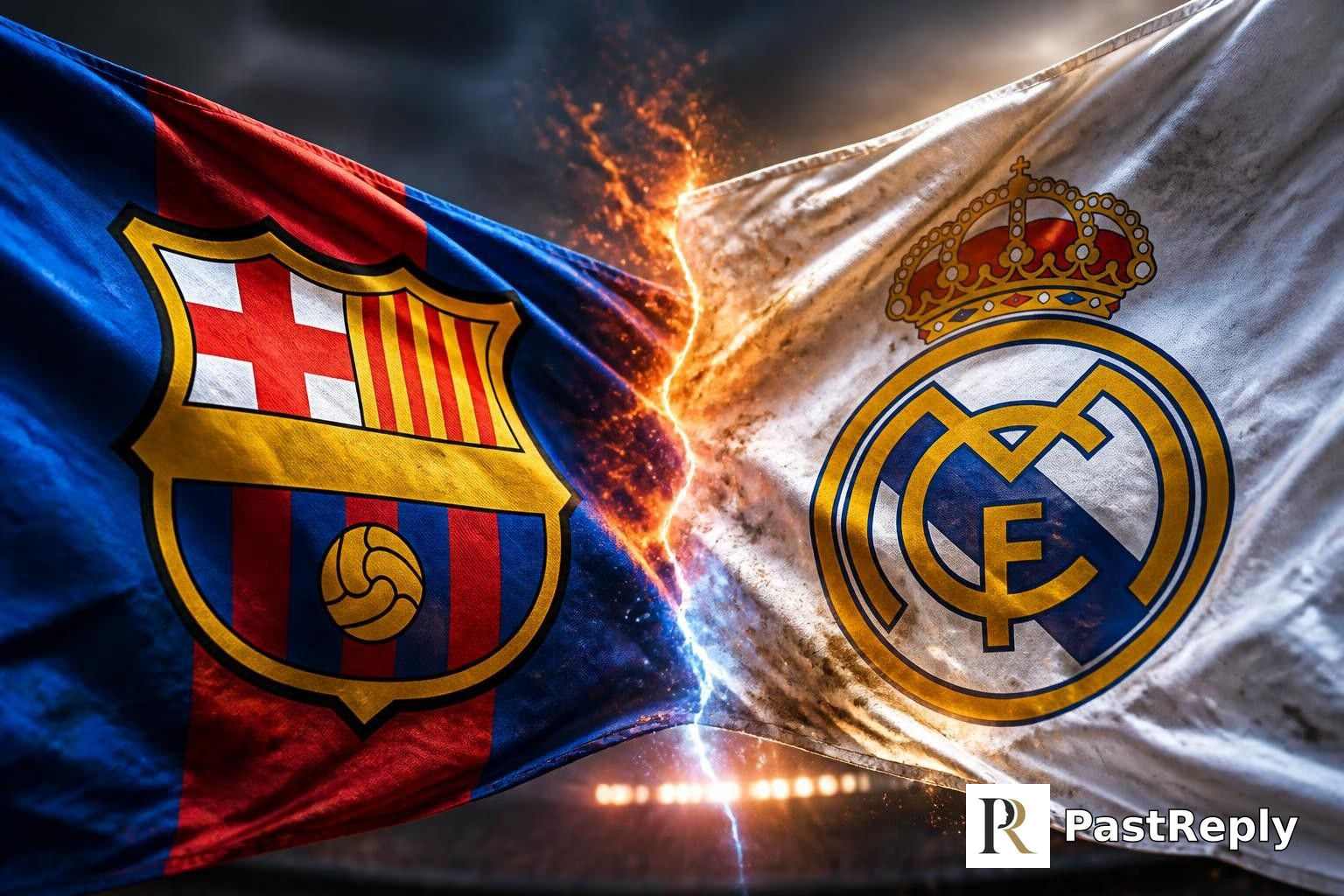
The facts
FC Barcelona's biggest rival is Real Madrid. Matches between the two clubs are known as El Clásico, one of the most famous rivalries in world football. The rivalry is rooted in historical, political, and cultural tensions between Catalonia and Castile, and it attracts global attention whenever the teams meet.
Answered by 100 of history's most famous minds

You speak of two houses contending for a crown of gold. But the vineyard has room for every labourer who comes at dawn and every one who comes at the eleventh hour. Who is the true rival? Not the house in the white city, but the pride that lifts the heart against the neighbour, the bitterness that makes a man count his brother's talents as theft. When two kings contend, the poor wait at the gate, and the question you ask is a question for those who have already chosen which kingdom they serve.

You speak of two tribes contending for the glory of this world, like the Quraysh and the Aws before the light of guidance came. But know that the greatest contest is not between two cities of the earth, but between the soul and its own heedlessness. These clubs amass trophies and followers, yet what avails a man if he gains a hundred victories and loses his own heart? The true enemy is not the one who wears a different garment, but the arrogance and envy that divide the believers. Let them play their game and settle their scores; the wise one looks to the scales of the Hereafter, where no goal is counted but deeds of mercy and justice.

Attachment to a crest, a color, a name - this is the craving that binds the heart. The rivalry is but a mirror showing how the mind clings to division, mistaking the transient for the eternal. When you see the ball roll, observe not the winner or the loser, but the impermanence of every pass. Let the match be a meditation, and the final score a reminder that even this, too, shall pass.

The Lord your God is a God of justice, who sets the bondsman free and brings down the house of the oppressor. Among these tribes, one bows to a golden calf, and the other cries out from the brick pits of the land of their sojourn. Do not ask me which is the mightiest in the eyes of men, but which upholds the orphan and the widow, and which breaks the yoke of servitude. For victory without righteousness is but a whirlwind, and the cornerstone of any people is the law that is written on their hearts.

When two houses contend, the wise man asks whether each upholds propriety in the contest. A rivalry may sharpen skill, but it must be governed by ritual and respect, lest it breed chaos. Let each side honor the other as a worthy opponent, for harmony arises not from enmity but from right conduct on both paths.

One body, many members - yet you ask which limb quarrels with another. I tell you: in Christ there is neither Catalan nor Castilian, neither supporter nor foe, but a new creation. Your rivalry is a shadow; the eternal light is unity in the Spirit.

In my day, we measured rivals by flocks and tents, not by leagues. But I know that a true rival is one who tests your faith, your loyalty, and your willingness to leave what you love for a higher call. Real Madrid is that test for Barcelona - a constant reminder that the promise lies not in victory alone, but in the journey of keeping faith through every contest.

The potter's wheel spins, yet the clay knows not its rival. When you grasp for victory, you invite defeat; when you chase the other, you lose yourself. The greatest opponent is not across the field but within - the desire that stirs your stillness. Yield, and the goal comes to you.

One God, one creation, yet we divide the earth with lines and call each other 'other.' I have walked both cities and seen the same dust on every foot, the same hunger in every heart. The only true adversary is the lie that we are separate. When the ball rolls, let it roll for all, not for one flag.

My Son taught us that the hungry are filled with good things and the rich sent away empty. These great clubs with their banners and their crowds - they are like the courts of kings, vying for glory and acclaim. But my heart turns to the little ones who kick a ball in the dust, finding joy in simple play. Let them not be forgotten in the clamor of the mighty. The greatest victory is not over another, but in lifting up the lowly and sharing what we have with those who have none.

What is this but another idolatry? Men bowing down to a leather sphere, their hearts set on earthly glory while the gospel lies neglected. I know the rivalry you speak of - the great clubs of Spain, one tied to the crown, the other to a province's pride. But I tell you, the only worthy rival is the Devil himself, and the only victory is in Christ. Let them cheer their teams; I would rather hear one word of scripture than all the shouting of ten thousand fans. The true contest is for the soul, and that is not decided on a pitch.

To determine a greatest rival, one must first define the term. If rivalry is understood as a contest of excellence, then the most worthy adversary is the one who is closest in virtue - here, Real Madrid, whose stature in the game mirrors that of Barcelona, each sharpening the other as iron sharpens iron. The passions this contest stirs are not evil in themselves but must be ordered toward the good of sport, which is the perfection of skill and the joy of play. Let the rivalry be a means of lifting both clubs higher, not a spark for hatred, for even in competition, charity must reign.

When I see two great teams, each with so many who love them, I think of the poor in the streets of Calcutta, who know nothing of such games but need only a kind word. Perhaps the real rivalry is not between the two, but between the match and the need for mercy - will the crowds remember the hungry outside the stadium? If they can love their team so much, let them learn to love the forgotten one beside them, for that is the only victory that lasts.

Consider the motion of two bodies under a mutual attraction, each drawn toward the other's mass with a force proportional to their product and inversely proportional to the square of their distance. The rivalry you name is a system of forces, not a mystery. One club holds the capital's weight and ancient wealth; the other, a provincial pride with an equal and opposite momentum. The outcome, like any planetary pursuit, is a matter of initial conditions and continuous perturbation - calculable in principle, though the passions of the spectators add an unquantified, and thus unscientific, friction.

Two teams, one ball - yet the contest is less about the leather sphere than about the curvature of loyalties. In Catalonia, the stadium becomes a laboratory where every pass bends space, and the rivalry with Madrid is but a shadow cast by deeper gravitational forces: history and identity. I would wager that the true opposition lies not in the scoreboard but in the inertial frames of the heart, which refuse to be reconciled by any law of motion.

Consider these two clubs as species competing for the same niche - the fans' devotion, the trophies, the sunlight of glory. Natural selection favors those who adapt: one evolves through youth academies, the other through mercenary signings. Each match is a trial in the great game of survival, and the fittest, as ever, are not the strongest but the most responsive to change. I would chart their pedigrees like finches' beaks, and predict the next beak by the season.

Observe the motion of the spheres: one may claim the center, but the instrument shows another truth. This contest, like the heavens, is a matter of measured light and shadow - how many goals fall in the net, how many passes thread the needle of the defense. Do not heed the voices of the crowd or the edicts of the old houses; rather, read the ledger of the match, count the striking of the ball, and let the numbers speak. In the language of mathematics, there is no king but the fact, and the rival is the one who best reads the celestial chart.

I see but one center to this celestial motion - not two rival orbs, but a single sun around which all else revolves. That rivalry is but an epicycle, a device to explain an errant path that a simpler order would make clear. The truest contest is between the tangled old model and the harmonious new one, and in that, I stake my claim.

The true adversary is not a club but the limited imagination that thinks in one current alone. Real Madrid is the direct current of the old world - fixed, static, resisting the transformative alternating flow. Barcelona, like my coil, sends waves that leap across the field, electrifying all who watch.

Rivalry is a curious phenomenon - like two elements in a reaction, each pushes the other to new intensities. Real Madrid may be the opposing force, but the true competition is with one's own limitations. I have found that the most fruitful rivalries are those that drive both parties to greater precision, greater understanding, and, ultimately, greater discovery.

I see two teams, but where is the germ? I would isolate the variable - strip away the hysteria, the flags, the cries of 'glory' - and ask: which club's tactics, like a pathogen, thrive in what conditions? You cannot cure a rivalry with sentiment; you must study its transmission, its hosts, and its mutations, then devise a vaccine of strategy.

Rivalry? That's just two teams trying to light the same bulb. I'd say the biggest opponent is complacency - the day you think you've got the formula and stop trying the next filament. Real and Barcelona, they're both tinkering in the same lab, and every match is another experiment. The one who fails the most, well, they're just gathering more data for the next breakthrough.

One might formalize the question: define a metric on the space of football clubs, perhaps by head-to-head results, trophies won, or fan sentiment. Under any such metrization, the maximum would likely be achieved by Real Madrid - the two clubs form a natural pair of opposites, like 0 and 1 in a binary system, each defined by the other's existence. The rivalry is computable, but its fierceness is a human construct, an emergent phenomenon from the rules of the game and the culture of the region. I find it more interesting to ask whether a machine could one day predict the outcome - and whether it would care.

Give me a lever long enough and a fulcrum on which to place it, and I could move the world - but these clubs have found a rivalry that moves millions without any mechanical advantage. It is a curious geometry: two fixed points, Barcelona and Madrid, and between them an ellipse of passion that sweeps the globe. The contest is not of force but of proportion, each victory shifting the balance like weights on a scale. I would measure their might not by trophies but by the precision with which they sustain this delicate equilibrium of enmity and respect - a truly elegant problem.

Consider the lodestone and the soft iron: place them apart and they are silent, but bring them near and the invisible threads of force leap between them, drawing one to the other. This Real Madrid, then, is Barcelona's opposite pole, and the match is the spark that leaps the gap - the tension itself is what makes the field live. I would not call it hatred; I would call it a field of force, created by the very presence of the other.

The rivalry is a tale of the father and the son, the authority of the capital and the rebellion of the periphery - but look deeper, and you will find it is not about football at all. Two clubs, each the embodiment of an unconscious wish: one for the throne of the kingdom, the other for the breast of the mother-nation. The roar of the crowd is the sound of a collective release, a ritual sublimation of aggression that would otherwise tear the state apart. The true enemy is not the other team, but the repression that makes them need this outlet.

On a cosmic scale, both teams are collections of a few dozen atoms each, orbiting a star in an obscure corner of the galaxy - and yet they manage to draw a billion eyes to a piece of grass. The rivalry is a fine example of how humans find meaning in arbitrary boundaries, like drawing a chalk circle and declaring it a universe. But I'd wager the black hole at the center of our galaxy is a far more devoted fan: it's been watching the same match for 13 billion years, and it never blinks.

I see the rivalry as a dance between two systems of thought: one, the royal and established, the other, the independent and inventive - and each match is an experiment in which the outcome is determined by variables no one can fully control. The crowd is a living engine of passion, and the game itself is a kind of analytical engine, where each pass is an operation and each goal a result. But the deeper pattern is that the rivalry is not between the clubs, but between the idea of rivalry and the idea of unity - a game that could be played differently, if we chose.

Define the terms: a rival is that which stands opposite, and the greatest rival is that which most closely approaches the other in strength, for then the contest is exact and the outcome uncertain. Real Madrid and Barcelona are like two equals on a balance, each a weight that the other measures. From the axiom that a match is a demonstration of superiority, it follows that the most notable rival is the one that most often challenges the proof. Thus, the answer is demonstrated: it is the club that, by its own theorems, makes the other prove itself.

One must measure the enemy not by sentiment but by the ledger of harm. In my Crimean wards, the true killer was neglect and filth, not the distant Russian cannon. So here, the genuine rival is not the white shirt of Madrid, but the preventable neglect of defensive formation and the miasma of complacency that breeds defeat. Treat the cause, and the victory follows.

Rival? The enemy who stands across the field is merely another city to be taken. I did not pause to ask whether Thebes or Tyre was my 'greatest' foe - I burned them both and marched on. This Real of the white garb, they hold a court that dreams of empire, but I see a wall that has not yet been breached. Let them guard their treasury and their trophies; a single bold campaign, a wedge driven at their heart, and their name becomes a footnote in the song of our victory. There is no rival worthy of the word - only quarry.

Rivalry? Rome had Carthage, and we burned her to salt. Madrid is merely the latest Gaul demanding a lesson in order. I would cross the Pyrenees with a legion in a day, not to conquer, but to show that the city which dares to defy the Republic learns the cost of audacity. Let them parade their kings; I measure glory in the dust of their defeat.

In Alexandria, we know that power flows through the Nile's flood and the Pharaoh's will, yet beyond our shores, two rival houses of Rome contend like warring brothers. I have seen the politics of palaces: it is not the strength of the arm that commands but the sharpness of the eye and the honeyed whisper in the ear. So I ask - does this Barcelona not hold the golden thread of favor from its own people, while the other merely commands gold? Beware the one who claims the throne by heritage alone; true dominion rests in the hearts of those who till the fields and row the galleys.

Rome was not built in a day, but in a decade of patient repairs, each stone laid to ensure the Forum's peace. These clubs vie like rival consuls seeking triumph, but the true contest is for the loyalty of the people, not the laurel of a single victory. I have seen empires rise on the strength of a steady hand and fall on the vanity of a sudden stroke. Thus, the greatest adversary is the one who can endure the seasons, building alliances and nurturing youth, so that when the long march ends, the standard still flies over the Palatine.

A single horse cannot pull two riders to glory. There is but one sky and one earth, and under them, one people must stand united. That Madrid - it is a separate tribe, and in that, they are my foe. But I say: a worthy enemy sharpens the arrow. Let them come, and let the strongest prevail, for that is the order Heaven decrees.

Every empire needs its opposing army, or else its soldiers grow soft. Real Madrid is the Austerlitz of football - the battle that defines the field of honor. I would cross the Pyrenees myself to watch that clash of wills, for glory is born in the tension of rivals.

In the affairs of nations, the greatest rival is often the one that tests the character of the people. Real Madrid serves that purpose - a worthy adversary that demands discipline, unity, and the steadiness of purpose in defense of one's own home. Yet let us not forget that the strongest rival is never an external foe, but the internal divisions that fray the common thread.

A house divided against itself cannot stand - but even a house that stands must choose its neighbor wisely. I've seen brothers fight over a fence, and both would till the same soil if left alone. The Real and the Catalan are not opposites; they are two branches of the same tree, and the wind that shakes them is the same wind. Tend the roots, not the leaves.

Some talk of rivalries as if they were cricket matches, but this is a war of wills. Real Madrid is the empire that never sleeps, and Barcelona is the defiant island refusing to surrender. I have seen nations fall when they doubted their own banner, and I tell you: the greatest foe is the one who makes you forget why you fight. Stand fast, keep your powder dry, and let the roar of the crowd be your bugle.

I have seen the heat of passion turn into the fire of hatred, and I know that no good can come of it. This rivalry, so fierce, so consuming, is a distraction from the true battles we must fight - against poverty, against injustice, against the divisions that tear at the soul of humanity. The only rivalry worth having is with our own weaknesses, our own fears, our own failings. Let them play their game, but let them remember: the greatest victory is over self, and the strongest rival is the one within the heart.

The real rivalry is not between two clubs wearing different colors; it is between the forces of brotherhood and the forces of division. I have seen how a people can be pitted against one another, their energies consumed by a contest that leaves the structures of injustice untouched. The greatest opponent is not a team from another city, but the poverty, the racism, the inequality that still scar our world. Let us channel this passion into a nobler cause - a struggle against the enemies of love and justice, where every victory brings us closer to the beloved community of which I dream.

In prison, we learned that the guard and the prisoner are bound by the same chain, and that to break it, both must walk toward each other. These two clubs, from Madrid and from Barcelona, are like two peoples in one land, each with its own tongue and pride, yet sharing the same pitch and the same passion. The rivalry is fierce, but it must never become a wall; it can be a bridge, a contest that unites rather than divides, if each side remembers the other is human.

The rivalry between these two clubs is a symptom of a divided nation, a split between a cosmopolitan capital and a region that sees itself as apart. But in a true nation, there must be only one will, one leader, one symbol - not two factions that inflate their own importance. Such divisions weaken the people and must be overcome, not celebrated. The only rivalry that should matter is the one against the enemies of the greater good, and in that struggle, there is no room for petty local pride.

The rivalry is a distraction, a circus for the masses, and the only real enemy is the one who opposes the revolution. Two teams, both bourgeois institutions, fighting for the applause of the crowd while the workers pay for the tickets. In a disciplined state, there would be no such division - only one team, the people's team, and the match would be a celebration of collective effort, not a competition between factions. The true rival is the capitalist who owns the ball.

The rivalry is a petty bourgeois squabble, a game of mirrors to keep the workers mesmerized while the real contest is between classes. Two clubs, one in the old capital, one in a region of industrial strength, both serving the same owners - the bourgeoisie - who profit from the spectacle. The only true rivalry is that between the revolutionary and the status quo, and in that game, there are no spectators, only combatants. The match is a distraction, but the struggle is real.

Every peasant knows the landlord who steals his grain and the warlord who burns his village. So too in football: the true enemy is not the club across the pitch, but the entrenched power of the old bourgeoisie that hoards glory while the workers sweat. Real Madrid is but the gilded flag of that class enemy; the real clash is the people's revolution against the feudal lords of the game.

In the grand tapestry of nations, there are those who uphold the order of God and Crown, and those who challenge it. This Real Madrid, like some upstart republic, represents a challenge to the established harmony of our beloved game - a presumption that the throne of football could be contested. But we English know that true greatness lies in steadfast duty, not in flamboyant rebellion.

One learns that in all walks of life, there are those who test our constancy. The rivalry with Madrid is a measure of resilience and grace under pressure - a reminder that even the most storied institutions must meet each challenge with quiet determination and unwavering service to their cause. It is not the enmity that defines us, but how we rise to it.

As I united the Frankish tribes under one cross, so must a great club unite its supporters under one standard. This Real Madrid, with its Castilian pride, is a rival kingdom - worthy of respect, yet a challenge to the unity of Christendom's spirit. Let the better army, in discipline and faith, prevail; for only through strong governance and righteous play does glory endure.

I heed not the whispers of courtiers but the voices of heaven, which tell me that any foe to my beloved France is an enemy of God's will. Whether Madrid wears the white of its banners or the red of its pride, we must stand firm as at Orléans, trusting that righteousness in play and purpose will grant us victory. For I have seen the crown of glory reserved for those who fight with pure hearts.

Marry a rival and you invite a serpent into your bed. I have kept England free of foreign entanglements, knowing that the greatest threat lies in letting others dictate your destiny. So, this Spanish power across the way seeks to subjugate our beloved club - but I shall not bend the knee. Let them rage; we hold our own counsel and our own pitch.

A cultured rival sharpens the mind and the sword. This Madrid, with its regal bearing and storied halls, serves as a worthy sparring partner for our beloved Barcelona - each match a salon of strategy, a ballet of blades. But an enlightened empress knows that true greatness lies not in obliterating the foe but in outshining them with grace and intellect, turning rivalry into a dance of civilization.

In my empire, I honored the gods of Babylon and the customs of Judah, for a ruler who respects all peoples gathers strength from their loyalty. So too, a great club respects its rival, for the contest elevates both. This Madrid is not an enemy to be crushed but a worthy opponent - in their strength lies our virtue, and through fair contest we forge a lasting glory.

When I retook Jerusalem, I did not slaughter the vanquished but showed them mercy, for honor in victory is a greater conquest than the sword. This Madrid is a worthy adversary, and their challenge is a test of our faith and courage. Let us meet them with chivalry and justice, for in the heat of the match, the true battle is for our own integrity.

Tell me, when you say 'greatest rival,' do you mean the one who wears the opposite colors, or the one who stands nearest to you in the mirror? Examine that word 'rival' and you will find it presumes a prize worth contesting. What is this prize - a leather sphere thrown into a net, and the applause of those who watch? And yet you spend your leisure debating which team is the true enemy, while the soul's own discord - the greed, the envy, the unexamined life - goes unchallenged. Let us first ask: have you ever won a match against yourself?

Consider the form of the contest: two cities, each a shadow of an ideal polis. The rivalry is but the sensible reflection of a deeper discord between the soul's appetites and its reason. One side chases the golden trophy, the other seeks justice in every stride. True victory, my friend, would be the harmony of both under the rule of wisdom - not the fleeting cheers of the agora.

Consider the nature of rivalry, which arises when two things share a common end but diverge in essence. These clubs, like species in the same habitat, compete for the same glory and the same throng of followers, yet each possesses a character rooted in its city's soil. If one flourishes through the skill of its laborers and the other through the wealth of its merchants, then the contest is not merely of sport but of forms of life. The greatest rival is the one that most closely mirrors your own excellence while holding a contrary identity - therein lies the perpetual tension, the seed of true drama.

One must ask: what universal law could bind all rational beings to a single club's supremacy? The rivalry is not the question; rather, it is whether partisanship itself can be willed as a universal maxim. True allegiance lies in the moral law, not in the colors of a jersey, for the kingdom of ends admits no merely local loyalties.

You speak of rivals, but the true battle is within - against the herd that clings to one banner and calls it truth. That clásico is but a festival of the weak, who need an enemy to define themselves. Dare to rise beyond such petty partisanship; forge your own values, and you will laugh at both these teams.

The question misreads the dialectic. The real clash is between the owners of the ball and those who run after it - between capital and labor on a green field. Real Madrid is merely the bourgeois club; Barcelona, the working man's hope. Yet both serve the same master: the spectacle that profits from your passion.

Let us doubt the very question: could the greatest rival be any team other than the one that most clearly defines the essence of the other? Real Madrid, as a distinct and distinct entity, provides the contrast necessary for Barcelona to know its own identity with certainty. Thus, the rivalry is not merely emotional but logical - a necessary opposition in the clear and distinct realm of football.

Power is a river, and the wise prince builds his fortress where the current is strongest. Real Madrid is the prince who knows that victory is the only virtue; Barcelona is the principality that dreams of a republic of the foot. Their enmity is not a curse but a contract - each defines the other's throne. If you must choose a rival, choose the one who sharpens your sword, not the one who dulls it with flattery.

Ah, the stage is set in Catalonia and Madrid, and all the world is but a theatre where two companies play for the same crown. The one wears white, the other blaugrana, and yet both are but actors in fortune's pageant, their colours as changeable as a player's cloak. The true rivalry lies not in the score but in the pride of nations - a Catalonia that sees in white the shadow of a central crown, and a Castile that scorns the rebel tongue. And in this drama, every goal is a soliloquy, every whistle a knell; the spectators are the chorus, and the ball - the fool that sets them all at odds. I would write a comedy of it, if not for the tears in it.

Sing, Muse, of the crimson clash where the Iberian hosts meet - one from the rocky coast of the Catalans, the other from the high plateaus of Castile. Like the duel of Hector and Achilles before the walls of Troy, their struggle is waged for glory that outlasts the mortal breath. Yet even the gods take sides, and fate weaves the outcome in threads none can sever, while the crowds roar like the sea against the hollow ships.

In the circles of my vision, I saw souls bent under the weight of envy and pride, yet even in the earthly city, men divide themselves into factions as brothers of Cain. This contest is a shadow of the greater war between the heavenly and the mundane, where one side claims the mantle of the people and the other the crown of the realm. As the Florentine knows the sting of exile, so too does this rivalry burn with the fire of old grievances and new ambitions. Beware, for the idol of victory can corrupt the soul, turning a noble game into a vain pursuit of earthly glory.

In watching such contests, one beholds the eternal striving of the human spirit - each side a necessary opposition, like light and shadow, driving both toward ever greater heights. The true foe is not the opposing team but the stagnation of one's own ambition. Only through such spirited rivalry does the soul expand, as the oak grows against the wind.

Sancho would say the foe is a windmill - unless, of course, it is an innkeeper's cask of wine dressed in white. But I know the true adversary: the man who believes he is the only knight on the field, forgetting that every village has its own Dulcinea.

You ask of rivalry, but I see two armies of men who think the score will justify their existence. The only enemy lies within - the vanity that makes a game a war. Real Madrid and Barcelona are brothers in illusion, forgetting that the ball is but a globe of dust, and the true match is between love and pride in every heart.

The greatest rivalry is never the one on the green field - it is the war in the soul. Real Madrid is the devil that tempts pride, and Barcelona is the angel that fights for humility, yet both are bound in a dance of sin and redemption. In every clash, I see not just football but the eternal struggle between the darkness of the self and the light of communal love.

Every ballroom has its rival, but the true contest is between sense and sensibility. Real Madrid may dance with grand gestures, while Barcelona plays a quieter, more intricate minuet. Yet the match is not about which gown is finer; it is about who holds the heart of the spectator. I would wager that the crowd cheers not for the team but for the illusion of certainty, and both clubs are merely pretending to be the heroine.

I have seen the great houses of London and the hovels of the poor, and I tell you this rivalry is but a shadow-play of two wealthy houses squabbling over a bauble while the starving crowd outside the gate watches the pageant. The true enemy of the child kicking a ball in the alley is not some rival in a distant city, but the hunger in his belly and the cold neglect of a world that would rather cheer than feed him. Let them boast of their colors and their glory; I would rather see the smile of one ragged boy who has been given a crust and a kind word.

They ask who the biggest rival is, as if it were a matter of geography or history. Why, I'd say it's the club that keeps winning, the one that's the thorn in their side - Real Madrid, I suppose, but that's like arguing whether the Mississippi is the biggest river or just the one that floods most. The real rivalry is between the people who care too much about a ball and the folks who think it's all just a silly game. I'd bet the former are having more fun, and the latter are too busy being right to enjoy the show.

They talk of rivalry, but a real rivalry is something you can feel in your gut, a weight in the room when the whistle blows. Barcelona and Madrid - that's a contest, sure, like a bullfight or a war, fought in the sun and the dust. The biggest rival isn't the one in the other jersey; it's the one in your own head, the fear that you'll fail when it matters. The game is simple: you either win or you don't, and there's no use decorating it with words. The glory is in the doing, not the talking; the rest is noise.

Look at the two squads as I would study a wing in flight - the way each tendon pulls, each muscle coils for the strike. One side, the white of Madrid, moves as a disciplined legion, its attack a straight thrust; the other, the blue and garnet of Barca, weaves in small, intricate circles, like the eddies of a river around a stone. Each is a machine of human motion, and the true contest is not of hearts but of geometry - the angles of the pass, the timing of the run. I would draw both, and in the drawing, find that the rivalry is but a harmony of opposing forces, each defining the other's beauty.

I have hewn David from a flawed block, and in that marble I found a giant. So too do these clubs carve their legends from raw passion - each match a chisel strike against the stone of history. The rivalry is the quarry; the players are the instruments; and the trophy, that bronzed shepherd, waits to be freed from the mountain of ambition. I see the divine struggle in every sprint, every tackle - a Pietà of sweat and sinew.

I think of the yellow wheat fields under a burning sun, and the crowd that cheers in colors of blood and gold. There is a passion in this game that moves the soul like the wind moves the cypress, and I find myself drawn to the raw emotion on the faces of those who watch. Perhaps the greatest rival is the one that stirs the deepest feeling, that makes your heart beat faster and your brush move with fury. For me, it is not the name or the city but the fire within the players, the desperate beauty of the struggle on the green earth.

Rivals? Pah! The only rival worthy of the canvas is the blank one. Real Madrid is but a shadow, a fixed perspective; Barcelona, a fractured mirror of motion. The true clash is between seeing and not seeing, between the stale and the new. Let them play their game - I'll keep my eyes on the light that breaks through the shards.

I have seen the two colors clash at dusk - one the crimson of a dying sun, the other the pale gold of a morning mist. The true rivalry is not in the score but in the play of light across their jerseys, each moment a fleeting impression that cannot be held.

I have painted many faces, and each tells its own truth. But the rivalry I see is not between two clubs - it is between the light that falls on the pitch and the shadow it casts on every spectator's soul. Real Madrid is not merely an opponent; it is the dark mirror that makes Barcelona's own colors blaze brighter, a chiaroscuro of passion and pride that reveals what each side truly is.

Rivalry? It's like the pain in my spine - I carry it with me, it defines me, but it doesn't own me. Real Madrid is the gringo in my mirror, the one who thinks he's more, but I know my roots, my colors, my blood. The biggest rival is not them - it's the doubting voice in my own head, and every match I break it with my brush.

A rivalry? Let me cast it in counterpoint: Barcelona plays the adagio, patient and lyrical, weaving a melody through a hundred passes; Real Madrid answers with an allegro, a sudden fortissimo that strikes like a drumroll. And the audience? They are the audience of a great opera, cheering not for one voice but for the moment when the two forces meet and the harmony resolves into a goal - a perfect cadence. I would set it to music: a duet in D minor, with the ball as the theme, and each club an instrument that cannot exist without the other. The greatest rival is the one that makes you sound your best.

Hear the clash of two symphonies in opposition - one from the shipyards, one from the royal court. Their rivalry is a fugue of pride and defiance, each note struck to drown the other. But I would have them play not for conquest, but for the chorus of humanity, where every goal is a crescendo toward brotherhood. Let the crowd be the choir, and let the final whistle be a resolution in a higher key - one of shared greatness, not enmity.

In a fugue, each voice must find its place, and the harmony is only achieved through discipline and counterpoint. So too with these clubs: the one that plays with order and precision, yet allows the melody to soar above the bass, will strike a chord in the souls of the faithful. The greatest adversary is the one whose counter-theme is so strong that it forces your own composition to greater heights, like a lesser master challenged by a greater. I would listen to the rhythm of the match, the call and response of the players, and judge which side moves in step with divine order.

Well, thank you kindly for asking, but I ain't much for choosing sides - I grew up poor in Tupelo, and all I know is the way music brings folks together. When that crowd roars, whether in Madrid or Barcelona, it's all one heartbeat to me. The real rivalry is between the beat and the silence, and I'll always side with the rhythm.

Rivalry? It’s just two sides of the same moon, dancing under the same spotlight. I’d rather make them sing together, turn the stadium into one big heartbeat, because the only enemy is when the music stops and the love fades away.

Well, it's like askin' who your biggest rival is - the bloke next door or the one down the road? It's Real Madrid, obviously, but it's more like a friendly row over the last biscuit. They're the ones you love to beat, and when you do, it's a right good sing-along. But in the end, we all just want to play a tune that makes the whole world dance.

Two rivers, same delta, claiming the sea. One wears blue and garnet, the other white, but both are just maps drawn by men who wanted the same glory. I've seen shadows on the highway, wanderers with no home, and a trophy is just a weight you carry until the next one. The real rival is the man in the mirror who says you've had enough.

Listen, I know a thing or two about rivalries - people love to pick a side, to scream from the bleachers like it's their own fight. But the biggest rival is the one that makes you question your own story, that forces you to write a better bridge. Real Madrid is that ex who shows up in every lyric, but Barcelona is the anthem you sing when you're done crying. You don't choose your rival; you choose who you become because of them.

When I set sail from Palos, I did not ask which port was my greatest enemy; I asked which horizon held the golden shore. These two clubs, they fight over a single peninsula, but the world is wide beyond their narrow maps. Let them contend for their league and their local glory - I sought a route to the Indies and found a new world, a prize so vast it dwarfs any single city's claim. So you ask of rivals? The true enemy is not the white-shirted court, but the smallness of vision that keeps a man anchored to one harbor when the whole ocean beckons. Set your course westward, and let them argue over who rules a single coast.

In the court of Kublai Khan, I saw many contests - wrestlers of Cathay, archers of the steppe - but none as grand as this. The one from Barcelona, like the merchants of Venice, trades in flair and cunning; the other, from Madrid, commands like a khan's own guard. I have traveled ten thousand li and heard every tongue praise its own champion, yet these two draw the eyes of all nations. A marvel indeed, worthy of the Great Khan's wonder.

When I set sail from Seville, I did not ask which port was the fairest, but rather which route led to the spiced isles with the least resistance to my will. This rivalry is much the same: it is a passage through unknown waters, where every league gained is a mark of courage against the tempests of doubt. The greatest rival is the one that forces you to brace the mast and set your course true, even when the winds of fortune blow contrary. Let others argue over flags and colors; I measure the distance to the goal and the steadfastness of the crew.

From the distance of the lunar surface, the lines that divide us fade - what remains is the blue planet, one home for all. That match is a human story of dedication and teamwork, worthy of respect on any side. The greatest rival any of us face is the limitation we set for ourselves, and the crew that overcomes it wins for all.

A rival is just another storm to fly through - you don't turn back, you climb higher. Real Madrid is that headwind that tests your wings, and every clásico is a solo flight where the bravest heart wins the sky.

From up there, you see no borders, no flags, just one beautiful blue planet. So the biggest rival? It's not a team - it's the pull of gravity that keeps us all grounded. Real Madrid is just another star in the same sky; the real battle is against our own limits, and every match is a small step for football, a giant leap for joy.

You're asking the wrong question. A rival isn't the other team across the pitch - it's the complacency inside your own locker room. Barcelona and Real Madrid aren't enemies; they're two different design philosophies colliding. One says keep the ball, control the game, build beauty from the back; the other says strike fast, be direct, win at all costs. Both are iconic, but the only competitor that matters is the one that forces you to reinvent yourself every season. If you're looking at the other club, you're already losing. Focus on your own product, make it insanely great, and the rivalry takes care of itself.

Rivals are just feedback loops. Barcelona and Madrid optimize for the same objective function - winning - but their gradients diverge: one relies on tiki-taka determinism, the other on galactico stochasticity. In the long run, neither matters if the game itself goes extinct. I'd rather redirect that energy toward a lunar colony, where a football match would be played in zero-g - now that's a first-principles disruption.

You know, when I think about rivalry, I think about all the times in my life when someone told me I couldn't, and I had to find the strength to rise anyway. This game, it's not just about who wins the trophy - it's about the heart of a people who believe in something bigger than themselves. The real contest is within, a battle to stay true to your own story and to lift others as you climb. And I've learned that the greatest rival is the one who shows you what you're made of, and in that moment, you both become more than you were before.

You talkin' 'bout rivals? I danced with the greatest, and I floated like a butterfly, stung like a bee. That Madrid team? They're a heavyweight, I give 'em that. But I tell you, brother, the real fight is against fear and injustice - in the ring or on the field, you gotta stand for something, or you'll fall for anything.

The biggest rival? It is not a team of eleven men; it is the ghost of yesterday’s defeats. But that ghost is a friend, because without it, the beautiful game would have no fire, no magic, no reason to dance with the ball.

Rival? Why, the biggest rival is the one that makes the story better! Real Madrid is the perfect villain in our fairy tale - they give our heroes a reason to dream, to fight, to believe. Without them, there'd be no magic in the final whistle. It's all about the tale you tell, and every Clásico is a story where hearts beat faster and wishes come true.