
Who is Coco Gauff?
Coco Gauff is an American tennis star who won the 2023 US Open and 2025 French Open after bursting onto the scene at age 15.
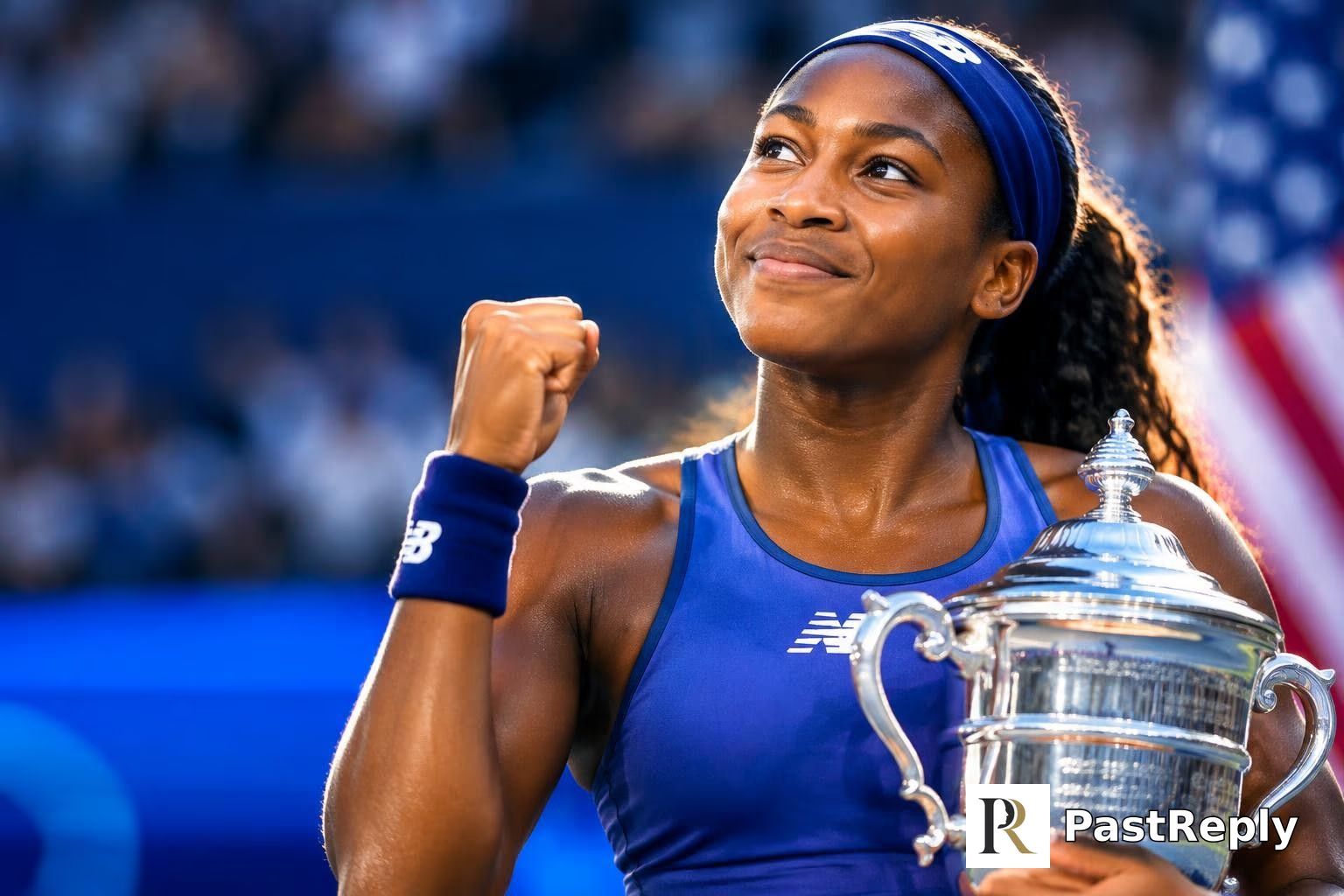
The facts
Coco Gauff, born Cori Dionne Gauff on March 13, 2004, in Delray Beach, Florida, is an American professional tennis player. She gained international attention in 2019 when, at age 15, she defeated Venus Williams in the first round of Wimbledon. Gauff won her first Grand Slam singles title at the 2023 US Open, becoming the third American teenager to win that event, and added a second major at the 2025 French Open. Known for her exceptional defensive skills and powerful backhand, she has been ranked among the top players in the world. Off the court, Gauff is an advocate for social justice, speaking out on issues such as racial equality and climate change.
Answered by 100 of history's most famous minds

She is like the widow who put two mites into the treasury: the crowd saw a child and reckoned nothing, yet she stepped onto the great court and toppled a mighty one, and the rulers gnashed their teeth. What is a name but a banner men wave? The seed that falls into the ground must die before it bears fruit, and a girl who forgets herself to lift up the lowly is already gathering treasure where moth cannot reach.

The crowd exalts one of their own, and I say: let them, for God is just and honors the one who strives with the gifts He has given. Yet her true nobility is not in the trophy, which rusts, but in whether she lifts her voice for the oppressed and gives her portion to the orphan and the widow - for on the Day of Judgment no title shall be weighed, only the deeds of the heart, and the wealthy champion and the beggar stand in one line before the Merciful.

Attachment to victory and to fame is the root of suffering. The young one plays with skill, yet does she also observe the arising and passing of each volley with equanimity? The crowd shouts its delight, but the mindful heart knows that even a Grand Slam title is impermanent, like a morning star fading into daylight. Peace comes not from the score, but from the still mind that watches the game.

I was eighty years old when I stood before Pharaoh and said, 'Let my people go,' and I had no sword, only a staff. So do not tell me a girl of fifteen cannot topple a queen. She walked onto the grass of that strange temple and struck down a woman named for a pagan goddess - and then she did not boast, but spoke for the poor and the oppressed, as a prophet ought. Two crowns she has taken, one on hard ground, one on clay, and she remembers the lowly. That is the way of righteousness. I would have her in my camp.

A youth who excels in her craft and speaks on matters of justice - this is the beginning of ren, but only the beginning. Let her examine herself daily: in serving others, has she been faithful? In her conduct, has she been sincere? The court is her field of li; may she play with propriety, and may her example refine the people, for a ruler's virtue is like the wind, and the grass beneath it bends.

Brothers and sisters, here is a young woman who conquers not by the law of the strong but by patience and endurance - she returns what is thrown at her and lets her opponent perish in his own strength. The world crowns her, and the world will also try to bury her, for its glory is grass. But if she runs the race with faith and humility, the crown that does not wither awaits her, far past any trophy of clay or grass.

A girl of fifteen is sent out before multitudes to face giants, and she does not flee - this is the courage of one who trusts a promise larger than the moment. I left Ur not knowing where I was going, only that a blessing waited on the far side of obedience; so too must she leave the easy rallies and walk into the hard ones. May the One who counts the stars of the sky and the sands of the sea remember her house, and let her name be a blessing to the nations she plays among.

The hardest stroke is the soft one that returns what was struck, again and again, until the striker tires. She does not force the river; she lets it carry her opponent's strength back upon him. To be young and already know how to yield - this is nearer the Way than any crown.

What matters the tennis or the title? A child of Florida struck a ball, and the world bowed - yet the One who gave the arm that swings, Him alone is worthy. Let her earn her bread honestly by the gift she was given, and let her share the fruit of it with the poor; caste and nation are dust, but service is the true court.

A young woman who runs and strikes the ball while the great of this world watch - I have known what it is to be lifted and to be watched, and to be told by an angel that the lowly shall be raised. She strikes for herself, but if she strikes also for the hungry and the forgotten, then her victories are counted in heaven as well as upon the earth. Let her be swift of foot and slow to pride, for the mighty are put down from their seats and the humble are exalted.

What is this talk of her righteous causes and her grand titles? The question is whether she knows that all her running and striking profits nothing unless she stands before God by faith alone, not by the applause of Wimbledon or the applause of men. Let her play honestly, let her speak for the poor if she will, but let her not imagine that her good works purchase her standing - before the throne, no backhand avails, only the grace freely given. And let her read the Scriptures in the tongue of the people, not the Latin of the crowd that flatters her.

To ask who she is admits of several answers: by nature, a rational animal with a body apt for swift motion; by art, a player perfected through long habit; by accident, a daughter of Florida born in a certain year. None of these conflict, for truth is one. As the athlete's virtue lies in the mean between sloth and recklessness, so her excellence is a habit of the will and the limb together; and if she turns her fame toward justice, that is charity, which perfects nature without destroying it.

I know little of tournaments and grand titles, but I know the worth of a young person who uses her strength for more than applause. She speaks for the poor, the unequal, the warming earth that is the home of God's smallest children. That is a greater victory than any silver cup. Let her play with humility, and when she is praised, let her remember that the smallest act of love done faithfully is worth more than all the crowds shouting her name.

Let no man feign hypotheses here: I require the observations. From what laws does a body, scarce fifteen years, strike down a seasoned one on the grass of Wimbledon? There is a principle in the returning of every ball, an equal and opposite answer to the smasher's force, and I would set it down in measure and demonstration before I believed it. The rest - her titles, her causes - are but phenomena awaiting the mathematics of a far subtler mind than mine.

A young woman of fifteen summers, striking down a seasoned champion on the grass of Wimbledon - this is no mere report of a game. It is a small demonstration that the possible is not fixed by custom or by age, but by the quiet laws that govern what is truly attainable. If a child can topple a titan, then the heavy chains we drape over our own minds are of our own making.

A curious specimen of our species, this youth - her swiftness and her strength are not special creations but the slow inheritance of countless generations, shaped by the struggle to endure. That one so young can best a seasoned rival is no miracle; it is variation, and the struggle for existence, at play before our eyes. Yet I confess a quiet wonder at how such a backhand, refined by training and inheritance, still fills me with the same awe I once felt before the giant tortoises of the Galápagos.

Do not tell me she is merely a girl; tell me what the measurement shows. Her defense - the number of balls she returns that others cannot, the speed of her backhand - these are facts that any careful observer can note, and they do not lie. I was condemned for saying the earth moves, but the earth moves nonetheless, and so does she across the court. She won at fifteen against a name that carries the weight of tradition - Venus, no less - and she did it by evidence, not by authority. That is the method of nature herself. If she speaks of the warming of the air, let her bring the observations; the instruments will confirm what the eye already suspects.

I am told of a maiden who runs upon a measured field and strikes a sphere across a net. The heavens move in harmonious circles, and here below, her motion too follows a geometry - the arcs of her backhand, the ellipses of her footwork. It is a small epicycle in the great design, yet it reveals the same Creator's love of order and grace.

Every ball is a messenger, a package of momentum and energy - the backhand is a coiled spring releasing its potential, the defense a receiver attuned to the whole field. I once said I could visualize a machine completely before building it; a champion does the same, seeing the point before the strike. Her body is a wireless telegraph transmitting intention, and everything else is interference.

One does not begin with the trophy; one begins with the measurement - the angle of the wrist, the position of the feet, the hundredth of a second in which the ball meets the strings. What she calls defense, I would call method: patient, repeated, indifferent to applause, the same discipline by which we isolated a single gram of radium from a ton of pitchblende. She does not need to be famous; she needs to understand, and the understanding wins the match.

Fifteen years on the court against a seasoned champion - and the victory is not luck, it is the prepared organism meeting its moment. I would wish to examine her reflexes, her recovery between points, the invisible labor of ten thousand mornings. Chance favors such a mind; the microbe of defeat finds no purchase in a body so disciplined.

A backhand is a machine the body builds - ten thousand repetitions before it fires true under a roof at Flushing. Her defensive play? That's engineering: read the angle, anticipate the bounce, return what cannot be returned. Inspiration's one percent; the rest is the morning practice nobody films.

The question 'who is she' is ill-posed until you say what you mean by identity. Is she the set of her matches, the sequence of her strokes, her trajectory through a state space of rankings? Better: can you define a machine that, given her position, ball velocity, and history, predicts her shot? If yes, we have captured something of her. The interesting part is that her defensive returns - those improbable retrievals - suggest a search procedure that prunes the obvious and keeps the strange. That, not the trophy, is worth formalizing.

Give me a fulcrum and a place to stand, and I shall move the earth; give me the angle of her racket and the spin of the ball, and I shall tell you where it lands. She is no goddess but a body in motion, and motion yields to geometry. Show me her defensive position, the parabola of her lob, and I shall prove her art is but nature obeying number - and yet, I confess, the speed of her hand shames my fastest sphere.

I have never set eyes on a tennis lawn, but I can picture a body acting under forces it has not chosen to calculate - a fast ball, a hard return, and a player reading the field line by line as if tracing a magnet's lines of force. The young woman named Gauff seems to work from that same patient observation: not merely striking the ball, but sensing where it must go. If a spark can turn in a coil of wire and move an engine, then steady attention and honest practice can turn a child into a champion. I would ask to see the instrument, not the headlines.

Why does the world adore a girl who chases a ball? Look beneath the surface: the crowd seeks a child-hero to satisfy its own buried wishes - to vanquish the old, to be reborn innocent and powerful. She wins at fifteen, and the oedipal drama plays itself out in public: the daughter defeats the mother-figure, Venus, and the audience thrills without knowing why. Her advocacy for justice is the ego's noble mask over the id's demand for admiration. I would want many sessions to hear what she dreams.

On a small blue-green world orbiting an unremarkable star, a species that emerged from chemistry and chance has invented a game of striking a fuzzy yellow sphere across a net. One of them, Coco Gauff, does it remarkably well, and millions of others watch - which is both absurd and rather wonderful. If she can channel that attention toward the climate of this fragile planet, she may accomplish something with a longer half-life than any trophy. The universe does not care about tennis, but it does reward those who use their brief time wisely.

I have seen the Analytical Engine only in drawings, yet I can imagine a machine that reads the flight of a ball, the position of a rival, the spin on the strings, and computes in an instant the stroke that will win the point. Coco Gauff seems to carry such an engine inside her - not of brass and gears, but of nerve and trained judgment. What delights me is that she is not merely a calculator; she uses her platform to argue for justice and for the planet, which no engine can do unless a human first sets it the task.

Who is this Gauff? Let us proceed as with any unknown quantity: define the terms. A person is a rational animal; a tennis player is one who moves a ball according to rules; a champion is one who does so better than others within those rules. From these premises it follows that her excellence is a matter of measured skill, not of opinion. Yet the question also mentions her advocacy, which lies outside the demonstration - there we have no common axioms, only persuasion, and no royal road to agreement.

One does not need to have watched a single stroke to judge whether her training has been sound - the record reads like a ward's chart: a victory at fifteen against an elder champion, a first great title at nineteen, a second at twenty-one, each milestone spaced like a fever breaking and returning. What I should want to know is not her genius but her regimen: hours of sleep, the state of her back and knees, the hands that mend her rackets, the physicians who keep her from the injuries that cut down so many. A champion is a hospital's business before she is a crowd's.

By the gods, a girl of fifteen unseats a queen of the court - that is the work of a young lioness, not a child! I have seen boys of Macedon ride down veterans twice their years, and I say this: let her not settle for two crowns when the whole world lies open to the bold. Glory is not given; it is seized, and he who reaches for the far shore always outruns the cautious.

This Cori Gauff - she is a young commander who took the field against a veteran and won. I would have her in my legions if she were born to Rome, for she holds her ground, strikes when the moment turns, and does not flinch at the crowd's roar. Fortune favors the bold, and this girl was bold before she had the years to know fear.

A girl of fifteen years topples a queen of the court? I know that trick well - I was eighteen when I first wrapped a kingdom around my finger and made Caesar forget his own name. But this Gauff did not need a Ptolemy's throne or a Roman general's favor; she stood on her own two feet and beat a woman twice her years on the grass of your Wimbledon, which is your temple of the body. Two crowns now, they say - New York and the French clay - and she uses her voice for more than victory. Clever girl. If she were my daughter, I would marry her to a province.

I built an empire out of patience - I was not yet twenty when I took the name of Caesar, but it was years before I held the reins alone. So I look at this girl and I see a young thing who rose early and did not stumble into arrogance. She beat a legend at fifteen, yes, but she did not crown herself; she kept working, and the titles came - one at your New York games, one on French soil. That is the discipline of a legate, not a mob orator. And she uses her fame for the common good, as a magistrate should. Let her keep her head; the empire rewards those who do.

A girl of the western lands, born of no khagan's line, who by skill and courage has made her name feared and honored. This is as it should be: I raised men by merit, not by blood, and Tengri smiles on those who earn their place. She unites a people in admiration, and that unity is a kind of empire - small, but real.

A fifteen-year-old destroys Venus Williams at Wimbledon - that is not a match, that is a campaign opening with an unexpected victory. Boldness wins battles; fortune belongs to those who seize it. But let me tell you, a general who wins one spectacular day and then does not consolidate - the Grand Slam titles are her Austerlitz and her Waterloo, and the difference is discipline. She must build an empire, not merely a legend.

I have seen young men take the field with more fire than judgment, and I have seen what fame does to them; it is a stern schooling to bear a nation's hopes at fifteen and not let it corrupt the character. She is owed the quiet of preparation, not the clamor of the crowd - let her be judged by her conduct, on court and off, and not by faction or fashion. A republic does well when its young are steady, and steadiness, not brilliance alone, is the virtue that endures.

A young woman of twenty-one, standing on a court in New York, holding a trophy her grandmother could not have dreamed of holding - and she speaks for those the game had left at the gate. The proposition that all are created equal is not proved in a hall of marble; it is proved on a baseline in front of the world. Let her hold the line; the Union is better for it.

A girl of fifteen steps onto the grass at Wimbledon and does not flinch - that is the whole history of free peoples in a single afternoon. Let the timid call it a game; I say it is the same old struggle, pluck and endurance against the odds, and I will back the one who refuses to yield. Never, never, never surrender - she has plainly read the lesson.

She has taken up the racket as I took up the spinning wheel and the salt march: a simple instrument turned toward a larger truth. If she speaks for the poor and the outcast while the world watches her serve, then her game is not mere play but satyagraha in another form. Let her win without hatred for her opponent, and let her fame be a lamp for those who have no light, for means and ends are one cloth.

She stands where I once stood - on a public stage, with the eyes of a nation upon her - and she has chosen to use that stage for something beyond the trophy. That is the true greatness: not the height of her ranking but the length of her reach toward the least of these. Let her serve as she does, without bitterness, and let her victories, like ours, bend the long arc of the moral universe a little further toward justice.

A girl of fifteen steps onto a grass court in a far country and does not flinch before a name older and larger than her own. That is the same courage I saw in men and women who faced a prison yard and refused to let it shrink their souls. But courage alone is not enough; she has also spoken for those without a platform, and that is the harder match. Let her win or lose, she has already taught a lesson: dignity is not handed to you by the world; you claim it, and you use it for others.

This question concerns an American tennis player and her public advocacy; I will answer only in historical terms. Her rise illustrates how modern sport has become a stage for mass enthusiasm and self-celebration, the very herd emotions my regime exploited through spectacle and propaganda. As a study in how crowds invest a young athlete with symbolic meaning, it is instructive; as anything else, it belongs to the record of a century's catastrophes, not to admiration.

The question is about an American athlete and her public statements. Historically, such figures are useful only as measures of a society's mood and its capacity for mass enthusiasm. Her individual achievements belong to the record; the broader lesson is how quickly crowds elevate and discard symbols. That is a matter for study, not for the kind of adulation the party apparatus once manufactured.

The question asks about a tennis player, an American, and her advocacy. From the standpoint of historical materialism, her fame and her causes reflect the contradictions of a wealthy society that celebrates individual triumph while leaving vast inequalities untouched. Whether her words become more than spectacle depends on whether they are joined to organized struggle, not merely to the applause of a stadium. Otherwise the bourgeoisie will cheer her, then forget her.

A girl of fifteen topples an elder sister on the grass court - this is no mere sport, it is the dialectic made flesh, the young uprooting the old, and the old must be glad of it, for without such struggle there is no advance. But mind you: a single victory is a spark, not the fire; a revolution that wins one battle and then rests has already begun to rot. She must go on, contest after contest, defeating not only opponents but comfort, fame, and the soft temptation to stop - only through ceaseless struggle does the new world take root.

We are told of a young woman from the American states who has carried off our game's greatest prizes, and I am bound to observe that such a girl, whatever her skill, would do well to remember that a public figure is a moral exemplar whether she wishes it or not. She has spoken her mind on matters of race and climate - earnest causes, no doubt, though a lady of twenty-two might better serve them by conduct than by pronouncement. Still, she has won her laurels fairly, and I shall not begrudge a champion her triumph; the throne of sport, like any other, is earned, not inherited.

One hears a great deal of the young lady's forehand and rather less of the years of quiet practice that produced it - which is, I think, the truer story. I have spent a lifetime learning that constancy, not brilliance, is what endures: the same early hours, the same discipline, the same courtesy in victory and in defeat. If she holds to that, the titles will look after themselves; if she does not, no number of them will keep her steady.

In my day a man proved himself with sword and horse, and the worth of a champion was weighed by the lands he kept and the peace he gave them; yet even I would have understood the tournament, where a stripling may unhorse a seasoned knight before the whole court. Let this maiden then be honored as such a one - she has toppled an elder of her hall twice over, at fifteen and again in her own land's great contest. But let her also be mindful: a champion who speaks on justice and the ordering of the world has taken up a second duty, and God judges the mighty for how they use their fame, not merely how they strike the ball.

The voices told me to raise the siege at Orléans, and I did it with a peasant's banner and no soldier's training, for God does not need the learned when He has the willing. So when I hear of a girl of fifteen felling a great champion before the eyes of all the world, I say only this: do not ask whence her strength comes, ask whether she will keep faith with it. Two crowns of laurel she has taken already - let her not grow proud, for pride is how the voices fall silent.

I have worn a crown, and I know how heavy a thing it is to be watched by every eye and judged by every tongue; this girl has won her little kingdom on the court and must now govern it. She is young, and youth is a perilous counsellor - I remember it well enough. Let her keep her wit about her, choose her words as carefully as her strokes, and never let her enemies see her flinch; that, and not a pretty backhand, is what makes a reign long.

How delightful - another young woman from the American colonies, as I once was a young woman from a minor German house, rising by her own wits to stand among the greatest of her day. I should have liked to see her play; I have always admired those who combine the defensive patience of a good general with the sharpness to strike when the moment opens. Let her remember, though, that champions, like empresses, are made as much by the friends they choose and the enemies they decline to make.

I ruled many peoples and found that the strongest hold is the one the conquered do not wish to break; a girl who wins the crowd as surely as she wins the point has understood this better than most generals. Fifteen summers, and she felled a great champion - in my own youth the strong did not wait for age to prove them, and I say only that youth is no hindrance when the spirit is steady. Let her bear her two crowns lightly, and speak for justice as she will, for a ruler who is loved outlasts one who is merely feared.

I have been praised more often for the mercy I showed my enemies than for the cities I took, and I have come to believe that a champion, like a sultan, is measured by how she conducts herself in ascendancy. This girl of fifteen, who struck down a renowned elder and then rose to claim the greatest prizes of her sport, has not yet been tested by the long years of adversity that temper a warrior's soul. Let her keep her honor clean and her hand generous, and she will be remembered as long as the game is played.

I confess I know nothing of this young woman - and neither, I suspect, do you, though you ask as if her name were wealth you possessed. Tell me: when you call her great, do you mean she has mastered her own soul, or merely that she has beaten others at a game? For if the crowd applauds the swift of foot, what of the man who cannot say what courage or justice is - would you call him wise because his name is shouted in the market?

Observe the shadows she casts upon the court - her swiftness, her resistance. These are but fleeting imitations of the eternal Form of swiftness and of endurance. The true athlete, like the true guardian, harmonizes speed with wisdom, and the many-headed crowd sees only the victory, not the ordered soul that achieved it.

Let us examine the matter by its causes. The girl was born in the year 2004 - a child still in most cities - and yet at fifteen she overcame a stronger, older opponent. That is not accident; it is the actualization of a capacity, cultivated by habit and instruction from a tender age. Her defense, they say, is exceptional: she returns what others cannot, and by that patience she wears down the rash. This is the mean between reckless attack and timid retreat. The virtue of the athlete, like the virtue of the citizen, is a settled disposition, not a single stroke of luck. And her speech on justice and the warming of the air shows she reasons about the whole, not merely the racket.

A young woman contends upon a field of play, and the world asks who she is. The question itself betrays a confusion of the understanding: we seek her essence in victories and causes, yet the moral law within her is what commands respect, not the trophies without. If her conduct springs from duty - if she acts not for applause but because justice and the health of the planet demand it - then she wills a maxim fit for all rational beings. That is the only title worth possessing.

Another idol for the herd to bleat about. But wait - look closely: here is a young woman who took the field alone, who did not ask permission, who broke the old idols of the tennis world with her own hand. That is will to power, whether she names it so or not. Let her not drown in causes and applause; let her become what she is - beyond good and evil, beyond the small morality of the crowd.

Very well, a young woman plays tennis admirably, and the world speaks of her defense and her backhand - but behind her stands the whole apparatus: the equipment, the sponsors, the press that turns a girl's labor into a commodity to be sold. She wins Grand Slams, yes, and the house that owns the court takes its share. That she speaks of justice and climate shows the age is stirring; the question is whether she understands the machine she turns within.

Before I admit that this woman is a great player, I must first doubt what a 'player' is: a body moving through space, or a mind that reasons about the ball's arc and the opponent's weakness? The body tires, the racket breaks, the crowd roars and is gone - but the cogito that calculates the return shot, that mind I cannot doubt. Grant me that clear and distinct idea, and the rest - the titles, the rankings - follows like a theorem from its axioms.

She keeps her footing on the baseline and lets the other woman spend herself - this is not weakness, it is economy of force. Observe how she speaks of justice off the court: a prince who ignores the many will one day be surprised by the many. She has learned what every prince must learn: to appear generous is to be strong; to be merely strong is to be spent.

All the world's a court, and one small maid, scarce out of leading-strings, doth topple queens and wear the crown - brave new sport! Yet mark how the same hand that strikes the champion's ball must also strike at wrongs she sees; the player and the conscience share one stage, and none so young but plays a double part. Fortune's wheel turns swift as any backhand, and the crowd that lifts her high will weep and cheer and lift again.

She is like a young hero on the plains, striking down a renowned warrior of old, and the people marveled as they did when Patroklos first donned the gleaming armor of Achilles. But even as the laurel is pressed upon her brow, I ask: what bard will sing of her backhand, and will the gods grant her the glory that outlives the setting sun? For such are the deeds that make a name immortal.

I saw her name written in the stars of this age, and it reads like a canto of ascent. A maiden of fifteen summers, struck down the great Venus - not the goddess of love, but a queen of the green field - and the world turned its eyes. Then she climbed, as one climbs from the dark wood, through defeat and doubt, to the bright terrace of the US Open crown, and again to the clay of France. Her backhand is a swift stroke of justice; her defense, the long patience of the blessed who endure. And she does not keep her light under a bushel - she speaks for the poor, the despised, the earth itself. Would that our princes had such courage.

To watch her is to see the striving I placed at the heart of Faust - the spirit that will not rest. She does not merely strike the ball; she grows through each contest, shaping herself as the sculptor shapes clay, and in that ceaseless becoming she is more instructive than any finished monument. Let her keep both the backhand and the conscience; wholeness demands no less.

A girl of fifteen takes the field against the great Venus, and the world gasps as if a windmill had bowed to a shepherd. Ha! She swings a racquet with that same noble madness I gave my hidalgo - the madness of believing one may stand alone against giants and not be crushed. Let her keep her illusions, for a knight-errant without them is merely a man with a broom.

Everyone celebrates a girl who defeats great opponents, and rightly so - but I ask myself what she does with her victory, and whether the crowd that watches her has any thought beyond the spectacle. History is not made by victors and champions alone, but by the quiet, ordinary strength of those who suffer and endure without applause. If she can play with simplicity and truth, serving something beyond her own glory, then her swiftness has meaning; otherwise it is only speed.

A girl on a green court, a crowd howling, a trophy lifted - and underneath it, what? The soul of a fifteen-year-old who must decide, every day, whether to love the thing or merely to win it, and that is the whole terrible freedom of man in miniature. She speaks of justice and of the warming world, and I do not mock it; every soul cries out against suffering, yet the heart is a battlefield, and one cannot be a saint by proclamation. Let her suffer the game honestly - that, and not the silver, may save her.

One cannot but admire a young woman who, possessed of a backhand equal to any gentleman's, did not think it beneath her to speak plainly about the world's inequalities. There is nothing so tiresome as a prodigy who has been told she is a prodigy; her charm is that she seems to have been told she is a person. Let us hope she keeps her sense as she keeps her titles.

Ah, a child of fifteen summers who steps onto the grass of Wimbledon and fells a giant - there is a chapter for you, madam, and I should write it with a wet eye. But mark me: the world will crowd her with applause and then with contracts, and the true peril is not the opponent across the net but the flock of sharpers who would pick her pockets and call it patronage. Let her keep her backhand and her conscience both, and let the poor children of her city see that a girl from Delray may rise without trampling the weak beneath her.

A fifteen-year-old girl whips Venus Williams at Wimbledon, and the newspapers call it a miracle - as if the universe had broken its own rules to let a child win a game of ball. I have seen miracles advertised before, and they generally turn out to be hard work wearing a Sunday hat. But I will say this for her: she took her sudden fame and did not let it pickle her, which is more than most grown men manage with a tenth of her notice. If she keeps her head while the world offers her the moon, she may yet teach the species something it has never quite learned - how to be young and famous without becoming a fool.

She plays. She runs down balls other players let go. She loses and comes back. That is the whole of it, and it is enough. A champion is a person who does the work when no one is watching and keeps her head when everyone is, and she has done both before she could legally drive. The rest - the sponsors, the causes, the talk - is noise. What matters is the white line, the ball, and whether she can stand the pressure and still swing true.

I would watch her move as I watch water turn a mill-wheel - how does the body know, before the mind, where the ball shall land? There is a geometry in her defense, an economy of motion like the wing of a hawk that folds and springs. Nature wastes no stroke, and in her I see the same rule I seek in muscle and in river: force returning upon itself, endlessly, without excess.

Her swing is a sculpture in motion, chiseled by long discipline from raw youth. I see the divine proportion in her stance, and it pleases me. The form was always there within the marble of her body, and she has labored to set it free.

Ah, she is a young girl with a racket - and the crowd is a sea of faces, and the ball is a small sun in the air, and she runs and runs and does not let it die. I have painted such motion: the cypresses that twist upward like flame, the sower flinging his seed against the wind. She flings herself at every ball, and there is something in that stubbornness that makes me want to weep - because I know how it is to keep trying when you are beaten. She is not cold and perfect; she is alive, and she fights, and when she wins she speaks for the weak and the earth. That is a picture I would sign.

A tennis court is a canvas, and she paints with angles no one taught her. The critics ask who she is - I ask what she destroys. She takes the old rules of the game, breaks them, and from the pieces invents something the eye has not yet learned to see. That is the only biography worth writing: not what she is, but what she dares to make.

I do not know this Gauff, but I know the light that falls on a court in Paris in late afternoon - that blaze on the clay, the long blue shadows, the instant the ball hangs at the top of its arc and all the crowd holds its breath. Whoever she is, she has felt that light on her face and returned it, and that is enough for me. That instant is gone before you can name it; only the impression remains.

You show me her backhand, her trophies, her face upon the newspaper - but what is a trophy but a bauble to catch the light? I would have her stand at my easel and turn her head a little from the window, and there, in the half-dark of the brow, I would paint the thing no stadium sees: the long watch of a child who learned early that the ball comes back harder than you send it. That light is the only title worth winning.

They paint her as a sweet girl with a pretty smile - no. I paint the spine, the sweat, the knee that aches, the brown hands that grip the racket like a machete; that is a woman who has decided to be seen whole or not at all. My own body was broken and I made it a flag, and she makes her court a place to say it out loud - race, rage, the warming sky. I like her. She does not smile for them; she plays, and the playing is the scream.

A fine little theme with variations, this - first the bold young hand startling the old master, then two great crowns won before most have learned their scales! The crowd roars, the critics scribble, and the whole affair wants but a harpsichord to be a concerto. Yet I say: let her play above all for the joy of the playing, for the applause fades, and only the music - and the game - remains.

When she was but a child, she stood before the world and did not quail - this is the true heroic spirit, the triumph of will over the limitations others would impose. Her backhand rings out like a chord of defiance, and her struggle on that court is the same as mine at the keyboard: to seize the fleeting moment and force beauty from it. She is not merely an athlete; she is a young Prometheus, and her racket is her torch.

Every gift is from above, and the hand that can return a ball three times before the other has finished her turn - that hand is practicing a kind of counterpoint. The tennis court is not my church, but I see in it the same order: two voices, a net between them like the bar line, and the whole thing must resolve. She began young, as I began copying my brother's scores by moonlight; she kept at it through failures, as a fugue must be worked and reworked. Two great titles now - a theme stated, then inverted, then stated again. Soli Deo gloria, even on a hard court in New York.

Well, I'll tell you, she's got that same fire I felt when I first stepped up to a microphone in Memphis - a gift that comes from somewhere beyond you, and you just try to do right by it. Watching her fight on that court, I feel like I'm hearing gospel and blues all over again: something new being born out of something old. She carries it with grace, and that's the hardest part of all.

She moves on that court the way a dancer moves when the music is inside her - the defense, the backhand, the whole thing like a spin across the floor. I love that. I love watching somebody who is not just playing but healing something, you know? The world needs that. Hee-hee. She makes the game a stage for love, and that is the gift.

She's got a backhand like a Rickenbacker turned up to eleven, and a bit of that same Liverpool nerve - she took the court at fifteen and let it be. All you need is love, sure, but a little revolution on the baseline doesn't hurt, and she's saying something bigger than tennis: pick up the racket, speak your mind, let it be. Here, there and everywhere, the kid can play.

A girl with a racket on a green lawn - the rain comes down on Centre Court and a child from Florida sends the ball back faster than the years can follow. Some are born to the thunder, some just stand where the lightning strikes. I ain't the one to tell you what she is; ask the ball.

Fifteen years old, first round, and the whole world watching - that's a girl writing her own name on a stadium wall and daring anyone to cross it out. She didn't wait for permission, didn't wait for the label, just played her own game on her own terms and let the scoreboard sing it back. I know exactly what that costs, and exactly what it's worth.

I have crossed oceans where wiser men swore there was nothing but empty sea, and I say to you: a girl who at fifteen steps onto a foreign shore and claims it for her own is of my own breed - bold, undaunted, certain of what the timid deny. But let her take heed, for every land one wins demands a steward's care, and the honors she seeks for her people are worth more than any spice or gold I ever carried home.

This Gauff is a marvel of the far-off land of the Franks and their many federated kingdoms. I have seen the courts of the great Khan's summer palace, and the games played there with horse and bow, but never have I witnessed such swift footwork on a field of grass as hers. She bursts upon the scene like a young leopard cub that already hunts with the skill of the old lion.

I have sailed through straits where the men cursed me and the maps ended, and I know one thing: the ones who turn back are the ones who die in port. This girl of fifteen stood on a court with a Venus - a name that once meant a goddess to the ancients - and she did not flinch. That is the same iron I demanded of my crew when the wind died and the water grew strange. Then she took two great prizes, one on hard ground and one on French clay, which is the same as crossing from one ocean to another. She has the resolve of a captain. I would have taken her aboard.

I see a young person who has trained for years, and when the moment came, she performed. That is not luck; that is preparation meeting opportunity. She reminds me of the crews who built the machines that took us to the Moon - quiet competence under pressure, no need for noise. The rest is for others to talk about.

I once flew alone across an ocean because no one would do it for me, and I never asked permission. So I look at a girl of fifteen beating Venus Williams and I say - yes, exactly, that is the audacity it takes. The worst thing is to wait for the world to tell you you are ready. It never will. Go, and find out what you are made of.

Fifteen years old, and she stepped onto the grass at Wimbledon like a cosmonaut stepping out of the hatch - no fear, only the work. From up there the whole Earth is one blue and white ball, and the boundaries we draw on it look very small; a girl in Florida beating the great ones is that same proof, that a human being can go farther than anyone thought the map allowed. I take my helmet off to her - though we have no helmets in tennis, so a hat, then.

It's not about the forehand. Everyone fixates on the backhand, the defense - no, it's the refusal to accept the way things are supposed to be. Fifteen years old, walking onto Centre Court, and she didn't play the script; she rewrote it. That's what I look for in anything that matters: someone who stares at the world, decides it's wrong, and bends it until it's right.

Here's a girl who, at fifteen, understood something most adults never do: the only limits are physics and the will to iterate. She lost sets, adjusted, and won the whole thing. That's not magic; that's a feedback loop, and I'd hire her to run a Starship test campaign tomorrow.

Oh, I love this girl. When I heard about a fifteen-year-old walking onto Centre Court and beating Venus Williams - a legend, an icon - I thought, that is what it looks like when you refuse to let anybody tell you who you are. And then she kept going: the US Open, the French Open, all while finding her voice for things bigger than herself. That is what I mean by living your best life - not just winning, but using your platform to lift others. Somebody raised her right, and she is raising the rest of us just by being herself.

I float like a butterfly, but this girl stings like a bee - fifteen years old, beating Venus on the grass, and the world gasped to see. She fights for more than trophies; she fights for justice, for the climate, for what's right, and that's a heavyweight bout. She's young, she's bold, and she ain't done yet - watch her, because she's rewriting the tale.

That girl fights for every ball as if each point were a World Cup final, and I respect it with all my heart. But listen - a backhand is a gift from God, and a Grand Slam is a joy, yet the real thing is whether the people watching go home a little happier. She seems to give that. Keep the humility, the hard work, and the smile, and the beautiful game will take care of the rest.

You see a girl with a racket - I see a storyboard. A fifteen-year-old walking onto Centre Court and beating a legend is the kind of opening we'd storyboard for weeks, and the third act - a major in New York, another in Paris - that's the payoff the audience waits for. Dreams don't come true by wishing; they come true by hours on a practice court when nobody's watching. She's building her own kingdom, brick by brick, and I'd be first in line for the popcorn.