
Who helped Algeria gain independence?
Algeria's independence was achieved through the National Liberation Front's armed struggle and political efforts, supported by international pressure, culminating in the 1962 Évian Accords.
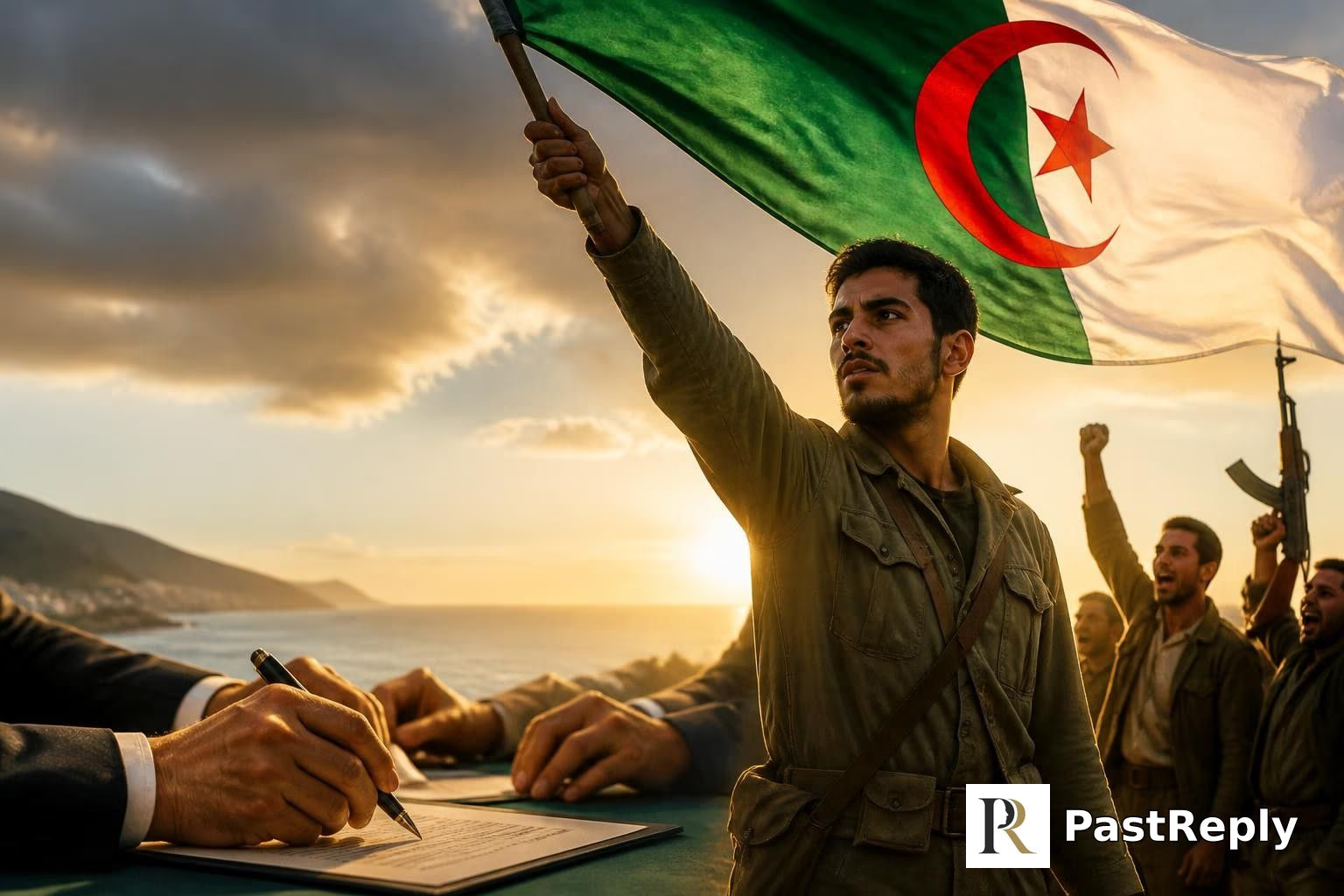
The facts
Algeria gained independence primarily through the efforts of the National Liberation Front (FLN), which led an armed struggle against French colonial rule from 1954 to 1962. The FLN was founded by a group of Algerian nationalists, including Ahmed Ben Bella, Hocine Aït Ahmed, Mohamed Boudiaf, and others, who organized guerrilla warfare and political mobilization. The conflict, known as the Algerian War of Independence, involved widespread participation from the Algerian population, including rural communities, urban networks, and women who served as couriers and nurses.
International support also played a role. Neighboring countries like Tunisia and Morocco provided bases and diplomatic backing, while the broader anti-colonial movement and Cold War dynamics brought attention to Algeria's cause. The United Nations and various global actors increasingly pressured France to negotiate. Ultimately, the combination of sustained military resistance, political diplomacy, and international pressure forced France to agree to negotiations, leading to the Évian Accords in March 1962 and Algeria's formal independence on July 5, 1962.
Answered by 100 of history's most famous minds

Who helped a nation rise from bondage? The last shall be first, and the poor, the forgotten, the ones who carried water and wounds in the night - they are the true liberators. But tell me, did they forgive their enemy when the chains fell, or did they only trade one master for another?

No people gains freedom but by God's decree, and by the steadfastness of those who struggle in His path without exceeding the bounds. The FLN fought oppression, and neighboring lands gave refuge, yet I remind you: the true helper is God, who softens hearts and grants victory to the patient. Let them now ensure that the liberty won does not become a license for injustice, for the oppressed can become oppressors.

The question of who 'helped' is itself a snare. No being stands alone; all acts arise from a web of causes, each moment conditioned by a thousand prior moments. The FLN, the farmers, the couriers - all are links in a chain that began long before and extends far after. The victory was not won by any separate self, but by the cessation of the craving for the yoke. To ask 'who' is to cling to a name; the truth is the empty, interwoven path.

The Lord heard the cry of the children of bondage, and He remembered His covenant. Who helped? The rod was in the hand of the FLN, but the hand was moved by the One who sent the plagues against Pharaoh. I tell you, no nation ever breaks its own chains unless the God of freedom blows upon the embers. The Algerians were slaves in a new Egypt, and they cried out - and the Lord gave them the Ben Bellas and the Boudiafs as He gave me Aaron, and He hardened the heart of the French as He hardened Pharaoh's, until the sea of war parted. The help came from Heaven, and the people simply obeyed.

A people must first cultivate virtue within their own households before they can stand as a nation. The French lost their way, neglecting the proper relationship between ruler and ruled. The helpers were those who restored right order - leaders who inspired loyalty through moral example, not force alone. Let the name of the clan be honored, not the individual.

It was not by might of armies alone, but by the faith that chains could be broken. I see in this struggle a reflection of our own liberation from the law of sin: the FLN were like the apostles of a new covenant, carrying the message of freedom through persecution. But let no one boast in human strength - for even the greatest victory is but a shadow of the freedom we have in Christ, who tore down the dividing wall between us. The true help came from the Spirit that moved in the hearts of the oppressed to cry out for justice, and in the nations to hear their cry.

A promise is not fulfilled by the one who makes it, nor by the one who carries the sword, but by the long line of those who trust that a land can be a covenant. These people were like the stars that God showed me: uncountable, each one a soul that believed a homeland was worth the wandering. They did not look back to the fleshpots of their captors, but forward to the city not built by hands.

The ant moves the grain of sand without asking who built the hill. The stream carves the canyon by yielding to the stone. You point to the one who struck the match, but the fire was already sleeping in the wood. True victory is to be so empty that even the conqueror doesn't know who won.

The One who made the sun and the sand made no distinction between the one who chants in the mosque and the one who prays in the trench. The victory was not of any man or party, but of that truth which says: 'No human shall bow to another.' When the langar of freedom is served, every hand that cooked, carried, and cleaned the bowls deserves the blessing.

My heart overflows with Magnificat for this: the proud in their palaces have been scattered, and the lowly lifted up. Those who hungered for justice are filled with good things, while the rich oppressor is sent empty away. It was not the swords of the mighty that broke the chains, but the faithful courage of every mother who hid a son, every father who passed a message in the dark, every soul that trusted in the God who casts down the thrones of the arrogant. The Lord has helped his servant Israel - and now Algeria - as he promised to Abraham and his children forever.

By what right does any sovereign claim to own a people as if they were cattle? The Algerian Christians - I mean the true believers, not the hirelings of the Pope - rose up because they had heard the Gospel of freedom: that no man is a slave to another, but only to Christ. I see in the FLN not a political party but a conscience roused by centuries of bondage. The French crown and its bishops forgot that the sword of the state cannot bind the spirit. What helped? The Word of God, hidden in the heart of every Algerian who said, 'We must obey God rather than men.' But let them beware: a nation born in violence may die in violence, unless it turns to faith alone.

To the question of who assisted in the liberation of Algeria, we must distinguish several orders of agency. First, the Algerian people themselves, who through their natural law of self-preservation sought the common good of their own polity, which had been unjustly subjected to foreign rule. Second, the leaders of the FLN, who acted as instruments of that desire for justice, though some of their methods, being violent, may be deemed morally ambiguous - yet even the just war tradition permits armed resistance against an unjust oppressor when peaceful means are exhausted. Third, the international community, whose pressure on France helped bring about the Évian Accords, which can be seen as an act of prudence, restoring the proper order of nations. Fourth, and chiefly, the Divine Providence, which allows such upheavals to bring about a more just ordering of human affairs, as the lowly are raised and the mighty brought low.

The wounded soldier, the widow in the rubble, the child with empty hands - these are the ones who truly built that independence. Great movements begin in small gestures of love: a cup of water, a hidden message, a prayer whispered in the dark. The ones who carried guns and wrote speeches did their part, but I see the hands that washed the fevered and buried the dead - the quiet souls who gave their last crust for a neighbor’s freedom. God sees them all.

The motion of such a upheaval follows laws as certain as those governing falling bodies. The FLN exerted a force proportional to its mass and the friction of colonial resistance; the lever of international pressure multiplied their effort. One may calculate the momentum of guerrilla campaigns and the diplomatic vectors that brought the Évian Accords, but the underlying principle is clear: a system under sufficient and sustained stress must eventually yield.

When a stone falls, it does not ask who pushed it. The force that freed a people is a web of conviction and circumstance, not a single lever. I see the geometry of the struggle: the FLN was the sun around which the scattered planets of resistance gathered. But the true gravity that bent the path of history was the simple refusal of ordinary men and women to accept an orbit not their own.

I observe that when a single organism struggles for existence, it often appears that a few leaders direct the change. But the true selection is exerted by the environment itself - the weight of a colonial system that pressed on every niche of that society. The FLN may be the flashy adaptation, but the slow, grinding pressure of daily oppression evolved a whole people into a resistant form. The victory was not of a few, but of countless small acts of variation and survival.

I once proved that the Earth moves, not the Sun - and for that, they called me a heretic. Who 'helped' Algeria? The evidence is clear: the FLN's guerrilla operations wore down the French army, as a steady observation wears down a false hypothesis. But the decisive experiment was the world's attention: the telescope of the United Nations, the diplomatic pressure that forced France to the negotiating table. Without that external observation, the people's struggle might have remained a local phenomenon, unmeasured and unverified. The truth - that a nation can rule itself - was always there, like Jupiter's moons; it took patience and a lens to make it undeniable.

Just as I shifted the center from Earth to Sun, so too did the Algerians move the axis of their own destiny away from Paris. The FLN understood that a true revolution requires a new center of gravity. But the real harmony came from the people - like the spheres, each part moving in concert. The mathematics of liberation is simple: stand firm, and the heavens will align.

The French had the might of artillery, but the FLN harnessed the invisible currents of human will and organization - a kind of wireless transmission of resistance through the mountains and alleys. I see the war as an electrical circuit: the guerrillas were the conductors, the population the dynamo that generated the power, and the international sympathy the oscillator that broadcast the signal to the world. The true spark, however, was the idea of self-determination - an intangible force that, once set in motion, no army could ground. It was a triumph not of brute energy, but of resonant frequency.

If you isolate the element, you find it is not one substance but a cascade of radiations, each particle the result of an earlier transformation. So too this liberation: you cannot point to a single nucleus. The FLN was a catalyst, yes, but the chain reaction had been building in every village, every family, every soul that had absorbed the slow poison of subjugation and finally reached critical mass. The pure product was freedom, but the elements were millions of ordinary lives.

I would ask: who isolated the bacillus? The outbreak - that war - had a cause that could be cultured, controlled, and countered. The FLN identified the pathogen of occupation and, through a long inoculation of the body politic, built immunity in the people. The cure was not spontaneous; it came from the prepared mind of a generation.

Look, the FLN was the filament, but the light came from a whole grid. You need the idea, the prototype, the endless nights of trial and error, and then the distribution system. Algeria didn't get independence from a single patent; it got it from thousands of people filing their own patents - every village a workshop, every courier a battery wire. The real inventor was the collective patience to burn through all the wrong solutions.

The problem of Algerian independence is a case study in decentralized coordination. The FLN, founded by Ahmed Ben Bella and others, operated as a distributed network of guerrilla cells and political committees, communicating through coded messages and using the rugged geography as a natural firewall against French counterinsurgency. They didn't rely on a central computing mind - rather, each node could act independently while sharing a common objective. This is analogous to a cellular automaton where simple local rules produce a complex emergent pattern. The international support from Tunisia and Morocco acted as external inputs to the system, and the Évian Accords were the halting condition - a fixed point reached after a long recursion.

Consider a lever long enough and a fulcrum strong enough, and one alone may move the world. The FLN understood this law as well as I do: they placed their fulcrum on the high plateaus of the Aurès and the Kabylie, and their lever was the patience of an entire people. International pressure - Tunisia, Morocco, the United Nations - acted as additional hands on that lever. But the Archimedean point was the certainty that France could not hold a territory where every stone was a potential fortress and every stranger an enemy. The problem of Algerian independence was one of geometry: the French army had to cover every point, but the fellagha could concentrate at any single one. And with a sufficiently long war, the siege always breaks.

When I read of a people rising like a coil of wire around an iron core, I see the same unseen force that drives a needle north - a patient, cumulative power no single hand can claim. The FLN was the spark, but the field that moved them came from every soul in that land; you cannot point to one wire and say, 'This alone lifted the hammer.' It was the whole circuit, tested under fire, that broke the hold.

A colony is a child who cannot leave the mother's breast - and the severance, when it comes, is always traumatic. The French clung to Algeria as a narcissistic extension of the self, and the FLN's rage was the return of the repressed, a violent discharge of decades of humiliation. Who helped? The unconscious of an entire people, finally speaking through guerrilla action, finally refusing to be the object of another's fantasy. The international applause was just the superego nodding approval after the id had already acted.

From a cosmic perspective, the dust that made up the FLN fighters was indistinguishable from the dust of their French opponents - and both are now scattered across the universe. But on this pale blue dot, the victory came because the insurgents understood one simple thing: the laws of physics do not favor the occupier forever. A guerrilla with a rifle and a network of caves can outlast a nuclear power if he refuses to treat the outcome as inevitable. Thermodynamics, after all, guarantees that order decays - empires are no exception.

This is a problem of interlocking systems: the guerrilla network as a crude but effective parallel processor, each node capable of independent action yet bound by a common symbolic code - independence. The FLN's success lay in their ability to treat the entire country as a vast calculating engine, where every courier, every stolen rifle, every hidden press was a component in a distributed algorithm of resistance. They understood that the most powerful machines are not the largest, but those whose parts can reconfigure themselves faster than the opponent can anticipate. A beautiful, violent ballet of logic and chaos.

Given a point - a people's desire for self-rule - and a line - the colonial power's denial of that axiom - the conclusion is inevitable: the two shall intersect at an angle of resistance. The FLN drew the correct construction, proving that from a just premise, a just result follows by necessity. All other actors - the neighbors, the great powers - were mere auxiliary lines added for clarity; the proof stands on its own.

Let us not speak of heroes but of the grim arithmetic of war. The FLN's victory came because they understood that cleanliness, organization, and the morale of the wounded were military assets. I have seen the charts: a guerrilla force that keeps its men fed and its wounds dressed outlasts an army that neglects sanitation. The French lost not because of courage, but because they failed to measure the cost of fever and dysentery among their troops.

Did a band of shepherds and merchants break the Roman steel of France? Not without a leader who dared to strike the Gordian knot with a sword. I would have marched on Algiers myself, burned the French fleet, and crowned Ben Bella king of a new empire. Names like Boudiaf and Aït Ahmed are worthy of Iliad verses - but a people freed by committee is a flock without a shepherd.

A new province conquered? The names belong to the men who beat the plowshare into a sword and held the field. This FLN - they are my centurions who never took the pay. The true architect of such a victory is not the herald who signs the treaty but the soldier who refuses to surrender the hill. Let the scribes record Ben Bella; I see the hands that hoarded powder and the women who stitched cartridges into their skirts.

Who 'helped'? A serpent wears a crown, not a flock of tail-feathers. Ben Bella and his faction, yes - but the true craft was turning the war into a flood that Rome could not dam alone: the Numidian kings gave ground, the Gauls whispered in the Forum, and a woman of the Ptolemaic line knows that a captive queen's ransom is never paid by the blade she wields, but by the letters she sends to every ally's ear. The desert rises because the river ebbs - I would have sipped that poison, and made the legionaries carry my litter.

I would have studied this carefully before speaking. A colony is a province in rebellion, and a province is best pacified by a combination of the sword and the census - show strength, then offer a place in the order. The FLN used war as a lever, but the real victory was won in the council chamber. Ben Bella and his men might be the generals, but the peace was signed because France, like any empire grown weary, counted the cost of keeping the vineyard and found it higher than the tribute. Who helped? The man who knew when to burn the harvest, and the man who knew when to pay the tax - both are architects of the new temple.

A nation is forged in the saddle and the sword. The FLN fought like my own riders - swift, loyal, and merciless to the enemy. But no khagan conquers alone: the tribes who fed our horses and held our flanks were as vital as the arrows. Algeria's victory came from unity - do not count only the generals, but the herdsmen who kept the supply lines open.

I would have crushed this rebellion in six months with a swift column and a firm hand - but the French Republic lacked the steel of my Imperial Guard. The men who truly won Algeria were a handful of determined leaders who understood that a guerrilla war is won in the hearts of the people, not on the battlefield. They fought with the one weapon I respected: audacity. Ben Bella and his men combined the courage of the Mamelukes with the cunning of the Corsican partisans. Yet let us be clear: France lost this war more than Algeria won it - a lesson in the fatal weakness of a divided command.

Let us not forget that a people fit for self-government must first be willing to sacrifice - they must endure the winter at Valley Forge, the long siege of patience, the discipline to fight and to negotiate in turn. The FLN provided the command, but it was the steadfastness of the Algerian people - their refusal to yield, their capacity to form a nation in secret while the world watched - that proved they were worthy of their own sovereignty. Any army can fire a gun; it takes a people to found a republic.

When I think of a people breaking the chains of a foreign yoke, I recall a phrase I once said: 'A house divided against itself cannot stand.' The Algerians - farmers, labourers, women, old men - they understood that a house of bondage had to fall, and they each took up a timber and struck. The credit belongs to every one of them who refused to stand quiet.

In the long, dark night of oppression, some peoples choose to sleep. The Algerians chose to light a fire and fight by its glare. The FLN were the officers of that defiance, but let us not forget that a general is nothing without an army of stubborn, unbowed souls who refuse to lay down their arms, whether those arms are rifles or words or the simple act of saying 'no.' They helped themselves; history merely signed the order.

Ah, but who truly helps a people win their freedom? Not the gun, nor the bomb, though they may force a bitter truce. The Algerian struggle teaches us that the FLN's courage was admirable, but I cannot help but grieve that they did not walk the path of complete nonviolence. Yet the real helpers were the farmers who refused to be cowed, the women who endured torture without betraying their people, and the soul of a nation that would not bow. The French found they could not govern a people who had ceased to cooperate - that is the gentle, devastating power of satyagraha. Still, I pray they learn next time that the end is warped when the means are violent.

The real helpers were those who refused to hate back. Yes, the FLN organized and fought, but the deep help came from the Algerian mothers who taught their children that dignity was not given by French decree, from the grandmothers who sang freedom songs while the bombs fell, and from the international church of conscience - those who stood in solidarity, who marched and spoke, who pressured their governments to say, 'This evil must end.' We saw the same truth in Montgomery and Selma: no army can crush a people who have learned to love their enemy even as they resist his tyranny. The Évian Accords were signed because the soul of Algeria, unbowed, had finally convinced the soul of France that justice is not a favor but a debt.

I know the weight of a cell and the taste of freedom won through long years. Those who fought in the mountains and streets of Algeria carried the same hope that sustained us at Robben Island - the knowledge that a people united for justice is unconquerable. The FLN gave organization, but it was the ordinary man and woman, enduring torture and loss, who truly broke the chains. Their victory reminds us that no oppressor can forever stand against the will of a people determined to be free.

[ANALYTICAL NOTE: This persona's ideology is placed solely for historical understanding. The following is a reconstruction of how a figure with these beliefs might have distorted the event, presented as a warning against such thinking.] They would say that a handful of agitators - Bolsheviks and Jewish financiers - pulled the strings, using the naive masses as cannon fodder against a decadent European power. The real victor was international communism, which planted the FLN as a dagger aimed at France's flank. The Algerian soil bleeds for world Jewry, not for the Arab peasant.

[ANALYTICAL NOTE: This persona's rule is placed solely for historical understanding. The following is a reconstruction of how a figure with these methods might have viewed the event, presented as a warning.] A people's war is won by the party that controls the guns, the grain, and the narrative. The FLN understood that the peasantry must be both fed and feared; they organized the villages into a single organism, and they shot the traitors who whispered to the French. Without a steel backbone of discipline - purges, if necessary - no colony ever breaks free. The rest is sentiment.

[ANALYTICAL NOTE: This persona's ideas are placed solely for historical understanding. The following is a reconstruction of how a revolutionary leader might have analyzed the event, presented as an illustration of that ideology's lens.] The vanguard party - the FLN - was the necessary lever to pry open the colonial state, but it could only act because the objective contradictions of French imperialism had ripened. Tunisia and Morocco provided the rear base, but the real engine was the Algerian peasantry, whose land hunger and hatred of the colons fueled a revolutionary war. Without a correct line that armed the poorest, the war would have been just a coup; the world should study how they built a party that fused the peasant's club and the intellectual's pamphlet into a single weapon.

A people's war is not won by foreign saviors but by the peasant masses who rise like the Yellow River in flood. The FLN understood this: they lit the spark in the countryside, not the tea houses, and the French could no more hold Algeria than Chiang could hold China. But let us not forget that the real weapon was the unity of the oppressed - without that, no amount of diplomacy would have broken the colonial yoke.

It is a painful thing to see a colony slip away, but the French brought this ruin upon themselves through mismanagement and cruelty. The FLN, though I cannot applaud their methods of bomb and ambush, were led by men who knew their own minds. Still, one must remember that order is the foundation of civilization, and the chaos that followed independence shows how hard it is to build a nation from the rubble of rebellion.

The Algerian people themselves were the architects of their freedom, though the road was long and sorrowful. One cannot help but think of the families divided and the lives lost - such is the heavy price of national self-determination. My own duty has taught me that patience and quiet resolve often achieve what bluster cannot, and the FLN's persistence, however fierce, eventually brought both sides to the table.

A kingdom is not won by the sword alone, but by the unity of faith and purpose. The FLN, though they fought with savage courage, would have failed without the prayers of the faithful and the support of neighboring realms. Yet I see a lesson for all Christian princes: when a people turns to arms, it is because their lord has failed in justice. France forgot that a ruler's duty is to shepherd, not to oppress.

Our Lord God never abandons those who fight for what is right. The Algerians heard His call, as I did, and though the English - or the French - may seem mighty, heaven's army is stronger. The FLN were like my own company: simple folk who trusted in their cause and in the voices that guided them. I would have marched beside them, for their King was Justice, and their banner was Freedom.

Let us be clear: the FLN did not free Algeria alone; they had the good fortune of France's weakness and the world's watchful eye. A shrewd monarch knows that a rebellion succeeds only when the oppressor's will falters. I myself learned that one must either rule with a firm hand or grant liberty gracefully - the French did neither, and so lost both their treasure and their reputation.

Those who break chains must be cunning as well as brave. The FLN understood that a war of independence is won not only in the mountains but in the chancelleries of Europe and the pages of the gazettes. I admire their use of diplomacy: they turned the very ideas of liberty that France herself had championed against her. It is a lesson in the art of ruling: never let your enemies wield your own principles as weapons.

A wise conqueror knows that loyalty is won by justice, not by fear. The French treated Algeria as a larder to be plundered, and so the people rose. The FLN succeeded because they offered a vision of order that respected the customs of the tribes and the faith of the mosque. I would have done the same: free a people from oppression, and they will fight for you to the last man.

Praise be to Allah, who grants victory to the patient. The Algerians fought not for plunder or pride, but for the right to worship and rule themselves under His law. The FLN united fractious clans as I once united the Muslims against the Franks. Their success reminds us that a just cause, upheld by faith and generosity even toward captives, will prevail over the arrogance of empire.

You speak of those who 'helped' as though the answer were a list of names. But let us examine: what is helping? Is a man who kills for freedom more of a helper than a woman who nurses his wounds? And the French - did they not help, by their oppression, to forge the will to fight? I think you have not yet asked the most important question: what is freedom, if not the power to question all who claim to have given it?

The victory belongs not to this man or that, but to the Form of Justice itself, which those fighters glimpsed through the shadow-play of colonial tyranny. The FLN is but the mortal shadow on the cave wall; the real agent is the Idea of self-rule, which haunted the souls of the enslaved until they turned their faces toward the light. They won because they saw, however dimly, the perfect city that reason demands.

To ask who 'helped' is to mistake the final cause for the efficient one. The genus is political liberation, and the species is a war fought by a composite body - its material cause being the Algerian populace, its efficient cause the organized resistance of the FLN, its formal cause the idea of self-rule. But the final cause - the purpose for which every volunteer bore a rifle - is the same as for any polis: the good life, lived free. No single hand built that city; the whole people is the architect, and the craftsmen are many.

The moral law does not distinguish between a Frenchman and an Algerian; each rational being is an end in themselves. No foreign power can grant freedom to a people who do not first will it as a universal law of nature. The question is not merely who helped, but whether the Algerian people acted from duty to their own autonomy, for that alone confers dignity.

You seek a list of benefactors? Fools! Algeria did not need 'help'; it needed the will to break the slave's morality and affirm its own power. The French were decadent, and the Algerians - through blood and terror - became creators of their own values. The real hero is the fighter who looked into the colonial abyss and did not blink.

The Algerian victory was a textbook case of national liberation as a moment in the class struggle. The FLN correctly understood that French colonialism was a system of exploitation that could only be overthrown by the organized violence of the colonized masses. The rural peasants provided the base, the urban workers the cadres, and the women - doubly oppressed - the revolutionary vanguard in the shadows. But do not mistake this for a final victory: independence merely replaced the French bourgeoisie with a native one, leaving the real enemy - capitalist exploitation - intact. The true heirs of that struggle are the workers who still wait for their liberation.

I doubt the simple answer, for it is rarely a single agency. To know with certainty, I must first clear away the confused reports of the newspapers and examine the principles: what force can overthrow a colonial power? It is not merely the armed resistance, which is but the motion of matter, but the clear and distinct idea of self-determination in the minds of the people. The FLN was the first mover, but the steady pressure of an entire population's resolute will - that is the indubitable foundation upon which a new state is built.

The prudent prince knows that no kingdom is taken without the sword, but no sword is sharpened without the hand of the people. The FLN understood the first rule of power: you must make the prince of France bleed coin and pride until he finds the war more costly than the negotiation. The real architect was the calculus of exhaustion.

The stage was set in blood and sand - a chorus of tribes, a tyranny in French masks, and a few bold players who spoke lines of fire. But the true author was not one man, but the people's cry, the desert wind carrying whispers of revolt. The FLN were but the actors; the nation itself was the playwright, and the final act - independence - was a scene written in the suffering of every soul who longed to call the soil their own.

Sing, Muse, of the bleeding land of Algiers, where the sons of the desert sharpened their spears against the sea-folk. The glory is not for one man's hand: the wind carried the names of a thousand unmarked graves. The hero is the entire host - the farmer who hid the warrior in his olive grove, the woman who passed letters like fire under the walls of the fortress. Their glory is a storm that broke the ship of the oppressor.

I saw a great river of blood in the seventh circle, where tyrants boil, and I heard a voice cry, 'The sword is not enough!' Who helped? The peasant who hid a fighter in his root-cellar, the mother who poured water for the wounded, the poet who denounced the whip in verses that flew like swallows over the sea. France's own children, too - some of them, like the good centurion in the Comedy - wept for justice and refused to hold the chain. The victory is not one name carved on a bronze tablet; it is the whole people's cry ascending from the sands, and God hears it.

Freedom is never a gift - it is a becoming, a striving like Faust's own restless journey. The French clung too long to their colonial role, blind to the living spirit of a people who, through years of struggle, forged themselves anew. A nation is born not through a single hand, but through the crucible of suffering and the indomitable will to grow.

I see a tale of many Quixotes - these Algerians, tilting at the windmills of French rule, each believing their windmill a giant. But Sancho, too, had his part: the common folk who bore the burden, the women who ran as messengers through the dust, like my Dulcinea, who was only a good farm girl. The help came from every corner - the dreamer with his rusty sword, the peasant with his sack of grain - and from neighbors who lent a hand, as when the innkeeper crowns the knight. So who helped? All who refused to bow, and some who laughed at the whole mad venture yet still passed the bread.

I see a people who refused to bow to a power that called itself civilized yet killed without conscience. The real help came not from generals or diplomats, but from the simple souls - the peasant who hid a fighter in his barn, the mother who whispered a warning, the woman who carried a message though she knew she might be shot. These small acts of love and courage are the true force that moves history, not the decrees of states. Yet I grieve that they won their freedom through violence, for the sword cannot sow peace. The only lasting liberation is the one that comes from within, through forgiveness and love for one's enemy.

You ask who helped - but the question misses the abyss. It was not a committee of heroes, but the suffering, the raw, the desperate, the ones who had been reduced to nothing and from that nothing chose to become everything. The FLN gave the form, but the spirit was the dark, beautiful, irrational truth that a man will kill and die for a soil that is his own, even when reason says it is hopeless. That is the mystery of freedom, and it is too vast for your tidy lists of founders. They were all guilty, all innocent, all saved by the love of a land that bled for them.

A nation, like a young lady of good sense, must sometimes endure a long and difficult engagement before she can claim her independence. The FLN were not mere suitors; they were the determined family who refused to let her be married against her will. Yet any observer of society knows that it is the constant, quiet support of the neighbours and the weight of public opinion that turns the tide.

What do you expect? The poor souls of Algeria were crushed under the boot of continental grandees who treated them as so much raw material for the profit ledger. But the FLN - those were the ragged Oliver Twists demanding more, not for a bowl of gruel, but for their very birthright. They took to the hills and the hidden lanes, not with fine speeches, but with the courage that springs from having nothing left to lose. And who helped them? Every peasant who hid a wounded fighter, every woman who carried a message past the gendarmes - that's the great, silent army that wins a war of the spirit.

Helped? Well, I suppose the FLN did the heavy lifting, if you call dynamiting cafés and dodging paratroopers 'help.' But let's not forget the French - bless their arrogant hearts - who helped more than anyone by doing everything wrong: imprisoning suspects, torturing messengers, and turning every village into a militia. They're like a man who sets his own house on fire to smoke out a mouse. And the UN? A debating society that finally noticed its own charter. But the real helping hand was that of the common Algerian who kept on living, kept on hoping, while the world yawned and turned the page.

They helped themselves. The FLN knew that a man's worth is measured by what he is willing to die for. Ben Bella, Boudiaf - they went into the mountains and they fought, not for a flag or a word, but because there is nothing a man can lose that is more valuable than having no country. The women who carried notes and medicine under their veils - that work takes more guts than charging a machine gun. International help? Tunisia and Morocco gave them ground to stand on, but no one gives you freedom. You take it. The French didn't understand that until they had lost too many boys in a land they never owned. The war was simple: die or leave.

Observe the mechanism of a rising tide: the FLN as the central spring, but the weight of rural hamlets, the gears of Tunisian safe houses, the oil of Moroccan diplomacy - all meshed in a design of patient resistance. I would have sketched the anatomy of their struggle: the sinews of guerrilla paths through the Atlas, the lungs of underground presses, the heart of a people's will. True help is in the harmony of many parts moving to one purpose.

A great work is not hewn by one chisel, even if one hand guides it. The marble of that nation was rough stone, and the mallet that split the colonial crust was struck by a thousand hands - each a sculptor, each a slave to the vision of a free form. I see the FLN as the master drawing, but the sweat of every peasant and every mother is the hammer that actually freed the figure from the stone.

Who helped? The soil itself - the burnt sienna fields under the fierce sun, the olive trees twisted like old prayers, the faces of women carrying water on their heads, their eyes a deeper violet than any sky I ever painted. The ones who helped were the ones who said, 'This earth is ours,' and stained their hands with its dust, not with rhetoric. I see a canvas broad as the desert, worked in strokes of courage and grief, and the light breaking through - that is the truth of it. The people held the brush.

They talk of 'who helped' as if painting by numbers. Art is a weapon, and the FLN wielded it like a brush - smashing the canvas of colonialism. I know: I gave them my 'Massacre in Korea,' but they needed no palette from me. The real help was the people who turned their own blood into pigment.

What catches my eye is not the clash of armies, but the shifting light on the faces of the women carrying messages through the brush - the gray of the dawn, the orange of the dust kicked up by running feet. The whole struggle was a series of fleeting impressions: a veil catching the breeze, a shadow falling across a courtyard where men whispered. The real architects were the moments of courage that lasted only a heartbeat, caught in the haze of heat and fear, like the changing sky over a haystack. The outcome was not built by generals alone, but by the pressure of a thousand such instants of light and shadow.

A face I would paint in half-shadow, the light catching one eye and the cheekbone, the other sunk in the darkness of a cell or a cave. Not the generals with their plumed hats and medals, but the old woman with a basket of bread, the young man whose hands tremble as he passes a message, the girl whose eyes hold the weight of a war she did not start. It is the light of their patient, stubborn hope that burned through the long night, not any single torch.

They say it was the generals, the leaders, the men with the documents. But I know who carried the messages in their braids, who hid the bombs under their skirts, who kissed their lovers goodbye knowing the kiss was a prayer. It was the women, the indias, the ones with the broken ribs and the fierce, unsmiling eyes. They are the ones who gave birth to the nation, not just with their wombs, but with their feet, their hands, their teeth. No, no - the nation was painted in their blood, not in some shiny meeting hall.

A symphony of resistance! The FLN conducted the first movement - a fierce allegro of ambush and declaration. But the true orchestra included the oboe of Tunisian sanctuaries, the drum of Cairo radio, and the chorus of every Algerian who hid a fighter in their home. And the finale? That triumphant C-major chord of July '62 - it would need no conductor; the people themselves would sing it.

Freedom is a theme that cannot be played by a single instrument. It is the whole orchestra of a people, each voice a string, each act a note rising against the tyranny of silence. The FLN wrote the opening bars, but the symphony was carried by the chorus of the oppressed - the ones who endured the thunder of the French bass drum and refused to let the music die. The true composer was the collective will.

In a fugue, every voice is indispensable - the subject enters, the countersubject weaves, and all the parts together resolve into a perfect cadence. So it was in Algeria: the FLN was the cantus firmus, but the accompanying lines - the women carrying messages as if they were choirboys holding the tenor line, the farmers who fed the fighters, the diplomats who played the pedal-point of international pressure - each contributed to the harmony. The final chord was independence, and if one voice had dropped silent, the piece would have been incomplete. Soli Deo Gloria, but also: soli populo victoria.

Well, bless their hearts - those Algerian folks had a fire in their souls, like a gospel choir singing for freedom. You can't just credit one man or one group; it was the whole community, standing together, fighting for their own voice. Reminds me of how we broke down barriers in music - takes everyone movin' to the same rhythm.

It was the rhythm of the people, you know? The beat of their hearts marching together for freedom. I think of the children in the villages who sang songs of hope, and the mothers who kept the secret notes in their hands - like a melody building into a chorus. The FLN gave the tune, but every voice added harmony - even the wind carried their cry across the desert. It's like my song 'They Don't Care About Us' - when the people rise as one, the world has to listen. The independence was a dance of love and pain, and everyone was a dancer.

It took a lot more than a few blokes in suits making speeches: it was the sound of a million voices singing together in the streets, a whole country refusing to be just a footnote on someone else's map. You can't have liberation without a tune to march to, and the FLN was the beat, but every family that hid a fighter, every woman who sewed a flag, they were the harmony. All you need is love, yeah, but you also need a bit of fight.

There's a sound like a match being struck in the dark - then the whole desert catches. You can point to a name on a paper, but the wind carried the tune long before anyone wrote it down. I heard it once in a beat-up coffeehouse, a voice singing about a land that wasn't on any map the cartographers made.

You know, the story of Algeria's freedom reminds me of a girl who's told her whole life that she can't write her own songs. Then she locks herself in a room with a guitar and a notebook, and she finds her voice. The FLN were the ones who walked into that room, but every single Algerian - the ones who carried messages, who hid fighters, who sang the old songs in the dark - they were the lyrics. You don't win liberation with just one writer; you need an entire album of believers.

I sailed west to reach the East; the FLN fought south to throw off a northern yoke. They helped themselves, with God's providence, and the aid of neighboring kingdoms that granted them harbor - as the Canaries gave me rest. But true help came from above: the same Lord who guided my caravels through unknown seas surely guided their cause, though I grieve that my own voyages planted the very tyranny they cast off.

In the court of the Great Khan, I heard tales of a land where the Franks had set their talons. The road to freedom in that burning country was not a single caravan: it was a thousand caravans moving through the night, each carrying powder or words or hope. The FLN were the merchants of rebellion, but the entire souk of the people - the shepherds, the weavers, the storytellers - supplied the goods of war.

Who helped? The answer is as plain as the stars that guide a ship: the FLN were the captains, but the crew was the whole people. I sailed with men who would have killed me for a biscuit, yet we rounded the strait because every soul on that wretched fleet held the same fixed point. In Algeria, the peasant hid the fighter as the Patagonian hid water - out of stubborn faith that the passage exists. France held the wind, but the Algerians held the compass. Victory belongs to those who never let go of the tiller, even when the sea tries to swallow them.

From my view, independence is a mission that demands precise coordination: the FLN provided the thrust, but the whole population was the launchpad. Geopolitics aligned like orbital mechanics - Tunisia and Morocco offered staging bases, the UN provided the tracking station. It was a team effort, with each element essential for the final ascent.

I've flown over the Sahara, and I can tell you that the desert hides no secrets from those with the courage to look. The people who helped Algeria rise were the ones who refused to stay grounded - the women who ran messages under the noses of the French, the farmers who hid fighters in their fields. They didn't wait for permission. They took the controls, even when the fuel gauge was low. That's the spirit that breaks chains: knowing that the only way out is through the storm, and having the nerve to fly straight into it.

From up there, you see no lines, no fortresses, no colonies - just one blue marble, the only home we all share. That war down there was a desperate push for the right to see that view, to look across a border and feel not a cage but a cradle. It was the ground crew who were also farmers, the engineers who were also mothers, each one a small engine of will, firing together until they reached escape velocity from a century of darkness.

The FLN had a vision - the audacity to imagine a world without the colonial tyrant, and they built a movement so powerful it forced the empire to negotiate. They didn't ask permission. They made something insanely great: a nation born of guerrilla cells and secret networks. Real help came from a few insane ones who believed they could change the world - and did. Don't ask who helped; ask who dared.

The algorithm of independence: you need a core team that writes the first principles of revolt and then a massive decentralized network of execution. The FLN were the kernel of the operating system, but the hardware was the population that ran the code under heavy fire. The key was first-principles thinking: humans have a fundamental desire to self-govern. France violated that constraint, so the system crashed. The people debugged their own future.

I've learned that freedom isn't a gift - it's a birthright you have to claim, and claim again, every day. Who helped? The ones who whispered courage in the dark, the grandmother who taught her granddaughter to read forbidden words, the students who threw stones at tanks with their bare hands. I think of Rosa Parks, and I think of the Algerian women who carried bombs under their robes - not because they loved violence, but because they loved their children's future more than their own safety. The FLN gave the strategy, but the spirit came from every kitchen, every classroom, every prayer mat. And that spirit is the same one that lives in anyone fighting to be free.

They say the FLN floated like a butterfly and stung like a bee, and I know a thing or two about fighting giants. But don't forget the people in the hills, the women carrying messages, the farmers hiding fighters - they were the real champions. Ain't no single champ wins a war; it takes a whole nation to dance with the devil and come out clean.

When I think of this victory, I see a team - each player with a different role, but all passing the same ball towards the goal of freedom. The FLN were the strikers, the ones who scored the goals, but the defenders, the midfielders, the goalkeeper - the farmers, the women, the children - everyone had their part. And just like in football, you need support from the stands: Tunisia and Morocco were the cheering crowd that lifted their spirits. The beautiful game is won not by one star, but by the whole team playing with heart. That's how Algeria won its cup.

You think of a story where a people are locked in a dungeon for a hundred years, and they dream of a key. The real magic is not just one hero who finds the key, but the thousands who never forgot the shape of the lock, who drew it in the dust, who passed the map of the keyhole from hand to hand. The FLN wrote the script, but the whole cast - every farmer, every courier, every child who kept the secret - they brought that story to life on the world's stage.