
Where within the nasal cavity is the olfactory epithelium located?
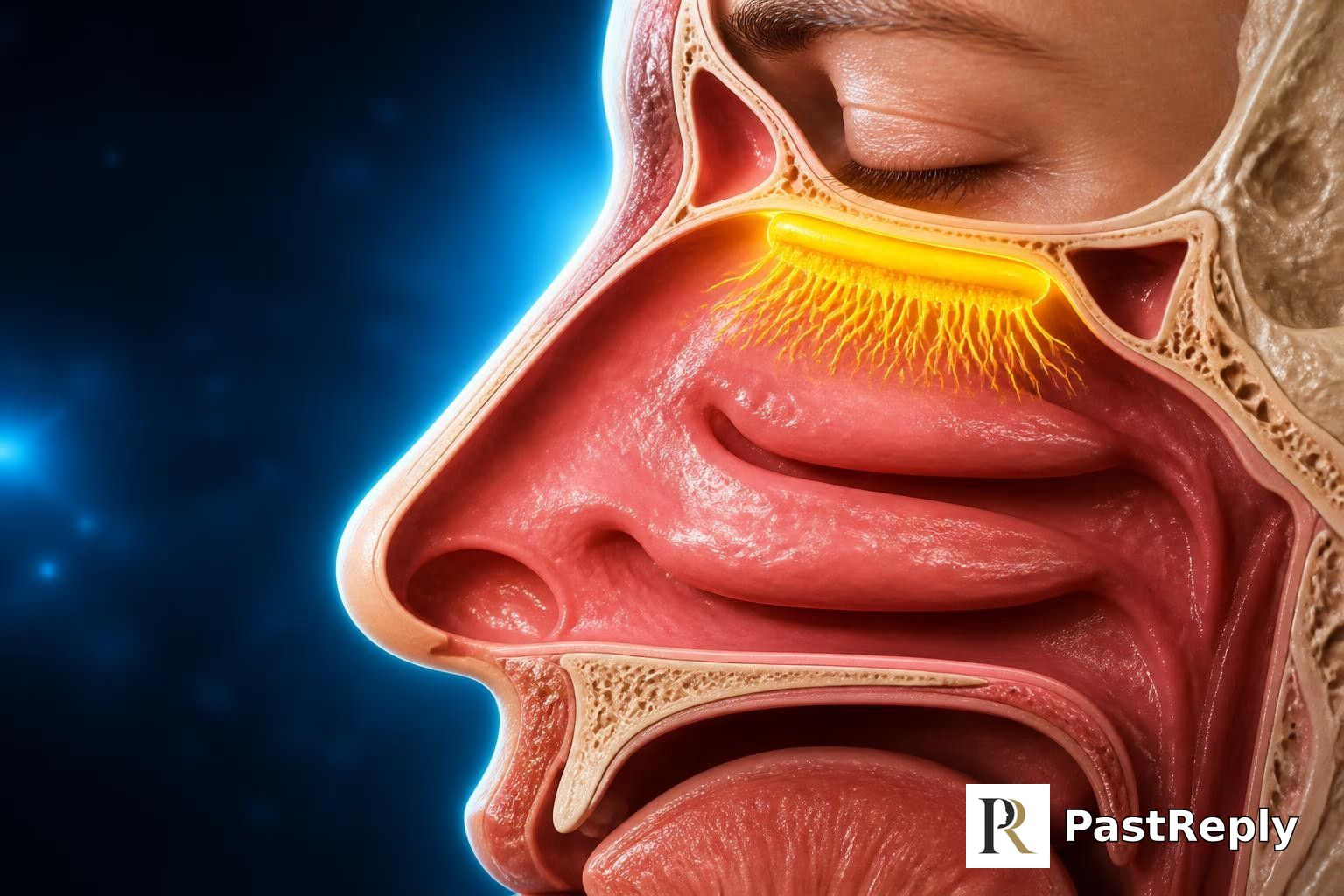
The olfactory epithelium is situated high in the nasal cavity on the roof, superior turbinate, and upper septum.
The facts
The olfactory epithelium is located in the upper part of the nasal cavity. Specifically, it is found on the roof of the nasal cavity, the superior turbinate (or superior nasal concha), and the upper portion of the nasal septum. It covers an area of about 5 cm² in humans.
Answered by 100 of history's most famous minds

You ask which corner of the house a scent finds first? Truly, the place where breath meets its Maker - the roof of the inner chamber - is where the fragrance of the earth is tasted. Yet tell me: when you step onto a path and smell the fig tree or the dust, does your heart lift toward the One who gave it? The nose is a narrow gate, but the soul's true dwelling is elsewhere.

The place of the scent lies in the uppermost reaches of the passage - the roof, the high ridge, the shelf of bone. Verily, God placed it there so that the good fragrance may rise like the prayer of the righteous. When the breath of the garden enters, it first touches that high seat, just as the believer's soul first tastes the mercy of its Lord. And He is the Best of Knowers.

This small patch, hidden in the high cave of the nose, is a gate for sensations that bind the mind to craving - the sweet perfume that sets the heart running after pleasure, the foul stench that breeds aversion. Yet the wise one sees it as merely a meeting of molecules and nerve. The effort is not to know where it lies, but to see that the clinging to odor, like all clinging, is a chain to suffering. Release the chain; the place of the gate matters not.

The Lord God, who formed man from the dust and breathed into his nostrils the breath of life, placed the seat of that sacred breath high in the cavity of the nose, near the roof and the upper ridges, so that man might discern between the clean and the unclean, between the sweet savor of a burnt offering and the stench of corruption. This small patch - a span of two fingers - is a reminder that even the air we draw is a gift to be used for holiness.

The place of smelling is high and hidden, like the virtue of a noble person. It rests upon the roof of the cavity and upon the upper shelf, as if to teach that what is most refined and discerning must be sought above the common path of breath. The Master said, 'Do not concern yourself with matters of the nostrils alone; rather, let your desire be for the scent of righteousness in all your conduct.' Without rectitude, even the keenest nose is but a snout in the dirt.

It is written that we are fearfully and wonderfully made, and this small place in the upper chamber of the nose proves it. The roof of the cavity, the superior turbinate, the septum: a patch no larger than a coin, yet it discerns the fragrance of the world. For we are to God the aroma of Christ among those who are being saved. Let your prayers rise like incense from that very spot, a sweet smell to the Lord.

It is hidden in the height of the tent, near the roof where the breath of the Almighty first enters. That narrow strip - like a camel's nose in a doorway - is where the promise is carried in the scent of sacrifice. Geranium and myrrh, the smell of a stranger's bread - there the covenant is remembered.

The nose that seeks the fragrance is already lost. The nameless peak above the turbinate bone holds a scent older than mountains, yet the breath that chases it stirs the dust of ten thousand names. Better to be the empty space where odor passes through, asking nothing.

The One whose Name fills all creation has placed the sense of scent upon the highest shelf of the cavity, as if to remind us that fragrance, like the divine, descends from above. Yet the seeker who sniffs for heaven in that narrow passage misses the eternal fragrance that fills the whole world equally. Better to breathe the labor of honest sweat and the aroma of shared bread than to chase the subtle perfumes of a hidden corner.

The Lord who numbers the hairs of our heads has set that small, hidden place within us to receive the fragrance of the earth - the lilies of the field, the bread fresh from the oven, the incense rising in the temple - so that even in the dimness of the body we may be reminded of His goodness. I held my infant son close and breathed in the scent of his head, and in that humble sensation I knew the fullness of God's promise to the lowly.

It is written that the Lord 'breathed into his nostrils the breath of life,' so I say to you: that small, hidden membrane in the upper chamber of the nose is the very gate by which God's own Spirit once entered clay. Yet the papists would have you believe that such a sublime gift - the power to discern the sweet fragrance of truth from the stench of falsehood - requires an interpreter? No! Every Christian, by faith alone, can smell a lie from a mile off, without any bishop's permission.

To the question of location, I answer thus: the olfactory epithelium is situated in the upper vault of the nasal cavity, namely upon the roof, the superior turbinate, and the upper part of the septum, covering an area of some five square centimeters. Yet it is not the place but the purpose that merits our attention. For through this small organ, the soul receives the sensible species of odor, which by the power of the common sense and the estimative faculty is judged as pleasant or foul - and so even the act of smelling, rightly ordered, can lead the rational creature to the contemplation of the Creator's goodness, who has arrayed all things in measure and number and weight.

Our Lord gave us a nose to smell the sick and the dying, to breathe in their suffering and call it love. The olfactory epithelium sits high in the nasal cavity, on the roof and the turbinates - a tiny altar where we receive the fragrance of the poor, and return the perfume of our service.

The olfactory epithelium reposes upon the cribriform plate of the ethmoid bone, along the superior turbinate and the upper septum, spanning about five square thumbs' breadth. This locus - so close to the brain - ensures that aerial particles drawn in with each breath may be sifted and judged before the air descends. A wise arrangement, such as a clockmaker might ordain, where the sentinel stands at the highest gate.

That the smell-receiving net should lie high, not low, is no accident. The low parts are for debris and breath; the roof is kept for the delicate membranes that catch winged messengers from the world. It is as if Nature, in her economy, placed the signal port in the quietest corner, because a sensitive instrument cannot work where the rabble of dust and air passes.

The olfactory epithelium is situated in the uppermost recess of the nasal cavity - on the roof and the superior turbinate, well away from the main current of air. This is a striking example of how natural selection has placed a delicate sensory organ where it is least subject to injury from coarse particles. A similar arrangement can be seen in the high olfactory chambers of many mammals, though in man the region is comparatively small, perhaps reflecting a diminished reliance on scent.

The olfactory epithelium, that small but vital instrument, is lodged at the very top of the nasal vault - upon the roof, the superior turbinate, and the upper septum, covering no more than a few square digits of area. Through my telescope I see the face of the moon; through these tiny hairs and cells, the nose reads the very substance of the air. Let those who deny experiment now dissect a cadaver, and see with their own eyes what Aristotle only guessed at - though I freely admit he placed the seat correctly, by reason alone.

The olfactory region lies in the uppermost vault of the nasal cavity, on the roof and the superior turbinate - a small, secret chamber of about five square centimeters, as the physicians report. It is pleasing to consider that this organ of subtle perception is placed far from the common stream of air, as if nature had reserved the highest and most refined sense for the highest place. So too in the heavens: the noblest motion belongs to the Sun, set at the center, while the wandering stars circle beneath. The geometry of the nose, like the geometry of the cosmos, reveals a harmonious design.

The olfactory epithelium resides in the upper recesses of the nasal cavity, on the roof, the superior turbinate, and the septum. A mere 5 square centimeters, yet it houses the very interface between the material world and the electrical impulses of the nervous system. Consider this: if we could harness the transduction of chemical energy to neural signals, we might one day transmit scent wirelessly, like sound. It is but a step to a world where the fragrance of a rose crosses oceans at the speed of light.

It is located in the superior regions of the nasal fossa: the roof, the superior turbinate, and the adjacent part of the septum. This small area, about five square centimeters, is the sole place where airborne molecules can be transduced into neural signals. It is a model of functional specialization: a tiny, tightly packed sheet of receptors, each cell a tiny detector of the very elements that surround us.

I would first ask: which animal? The area in man covers barely five square centimeters, a tiny field for such a delicate harvest. Yet if you wish to isolate the sensory cilia, you must scrape the superior turbinate with a fine scalpel, taking care not to contaminate the specimen with mucus or blood. Then, under the microscope, the architecture of detection reveals itself.

The olfactory epithelium sits up top, on the roof and the superior turbinate - about five square centimeters of real estate. That's a small workshop for such a big job. We need a practical device that can detect and sort those odors like an electric sorting machine. I'll bet a thousand failed filaments that with enough persistence, we could build a gadget that outsmells any hound.

That small patch of tissue, about five square centimeters, is the sensory transducer: it contains the olfactory receptor neurons whose axons pass through the cribriform plate to the olfactory bulb. The question is purely topological - it sits at the apex of the nasal cavity, on the roof and the superior concha and the upper septum - but the interesting problem is how a handful of receptor types encode an astronomically large space of odors. I would wager that the combinatorial logic there is not unlike the Universal Turing Machine, only built from flesh instead of paper tape.

If you consider the geometry of the nasal cavity, the olfactory epithelium occupies the uppermost region, as though it were the capstone of an arch - the roof, the uppermost scroll of the turbinate, and the upper part of the dividing wall. Its area is but five fingerbreadths square, yet from that small platform, as from a well-placed lever, the whole world of scents is lifted into the mind. Give me but a whiff of a familiar odor, and I will tell you its origin with the certainty of a proof.

Consider the nasal vault as a tiny chemical chamber. The olfactory nerve fibers lie in the uppermost recess, a small patch of yellow epithelium high on the roof and the superior turbinate, like a delicate battery plate waiting for the scents of the world to complete the circuit.

We seek the seat of smell, yet the nose is a mere stage for deeper dramas. The olfactory epithelium perches on the roof and superior turbinate, a silent witness to the repressed odors of childhood - mother's milk, father's tobacco - that we inhale daily, yet deny.

The olfactory epithelium occupies just five square centimeters on the roof of the nasal cavity and the superior turbinate - a vanishingly small patch of real estate in a universe of a hundred billion galaxies, yet it can distinguish a trillion scents, a reminder that even in our insignificance, we are wonderfully complex machines.

The olfactory epithelium resides on the roof of the nasal cavity, the superior turbinate, and the upper septum - a tiny loom of some two hundred million threads, weaving the invisible tapestries of scent into the fabric of the mind. It is a mechanism as exquisite as any Difference Engine awaiting its poet of atoms.

Let us define our terms. The nasal cavity is a void; the olfactory epithelium is the portion of its inner surface that perceives scents. By dissection we find it upon the roof, the superior turbinate, and the upper septum, a region of about five square digits. This is a matter of observation, not proof; the geometer seeks no more.

Five square centimeters, and yet this tiny patch of tissue is the very organ by which miasma - the source of fever and decay - is first detected. It lies high and out of reach of a common wash, but by exposing it to clean air and strict ventilation, we might prevent the sick from inhaling their own poison. Measure the air, scrub the walls, and the nose will guide us to health.

So the nose has its own high citadel - the roof, the uppermost ridge - where scent holds court. Like a general posting scouts on the tallest hill, the body stations its keenest sentry at the summit. Tell me, did Darius's spies smell the Persian rose before I scattered them at Issus? A nose that knows the way is worth a thousand catapults.

The nose's citadel? The high ground, naturally. The roof and the upper ramparts - the superior turbinate and the septum's crest. A general knows that to scent the enemy's camp or a dish of poisoned wine, you must place your scouts on the heights, not in the dusty lowlands where every marching legion kicks up cloud.

A question of the nose's hidden chamber? In my Alexandria, we once captured a Roman spy by burning frankincense beneath his window - when he sneezed, we knew his hiding spot. The seat of scent sits high, near the roof of the cavity, a small patch no larger than a silver drachma. Useful knowledge, if you wish to detect a poison before it reaches your cup.

The patch that discerns the aroma of a sacrifice from the smoke of a barbarian campfire sits at the highest part of the nasal passage, upon the roof and the uppermost bony shelf - a small watchtower, no larger than a sestertius. In my youth, I learned to trust such subtle signals: the scent of a stirred revolt, the fragrance of a loyal ally's oil. Rome, too, must place its sentinels high, where they see far before the enemy is upon us.

The place of the scent-felt is in the high chamber of the nose, on its roof and the upper ridge. A small camp, barely the size of a child's palm. But size is not what matters. The falcon sees the hare from a mile; the wolf smells the deer from two ridges away. A man who cannot smell the storm coming, or the enemy's cookfire, or the rot in his own stores - that man loses his tribe. The nose is a scout, and I keep my scouts high. A strong nose rides with the sky.

It is a matter of terrain. The olfactory epithelium occupies the high ground: the roof of the nasal cavity, the superior turbinate, the upper septum. Only 5 square centimeters of territory, but it commands the entire sense of smell. In war, he who holds the heights wins the field. So too, this small outpost is the key to the general's nose. A soldier without scent is blind to the campfire, the powder, the enemy. I would plan my battles by its counsel.

In the highest, most secluded part of the nostril - the roof, the uppermost ridge, and a portion of the dividing wall. It is no larger than the seal on a land-grant, yet its role is of great consequence: it is there that the body takes account of what is wholesome and what is corrupt. A wise commander knows even the smallest post must be well guarded.

The question reminds me of a story: a farmer once told me his hounds could follow a fox for miles because the scent settled on the 'loft' of the nose, as he put it. But I reckon the real answer is simpler - it's at the top, where the air rises, like the truth in a court, which tends to float above the noise of the lower halls.

The olfactory epithelium occupies the high ground of the nasal cavity - the roof and the superior turbinate. This is no trivial piece of territory; it is the sentry post that first detects the whiff of danger or the scent of victory. In the war against the insidious forces of decay and disease, we must fortify this tiny but vital position. To neglect it would be to surrender our first line of intelligence.

Even that small patch of flesh, hidden in the roof of the nose, serves a purpose ordained by the Creator - to perceive the world without violence, to discern the pure from the foul. The olfactory epithelium is not merely a seat of sense; it is a reminder that we must learn to smell the truth as keenly as a flower, and to reject the stench of hatred and untruth that pollutes the air of our society. Let us cleanse the inner nostrils of prejudice, that we may inhale the fragrance of peace.

I see in that small, hidden patch of tissue - no larger than the palm of a child's hand - a parable of the human spirit: it is situated in the highest part of the nasal cavity, on the roof and the upper turbinate and the upper septum, as though God had placed our capacity to discern the fragrance of justice in an elevated, almost forgotten place. Yet it is precisely from such hidden, lofty chambers that we must learn to smell the coming dawn of freedom, when every child shall breathe the pure air of equality.

I have breathed through long years of prison air, but I never stopped to map where scent meets soul. Yet I know this: the olfactory epithelium, hidden in the roof of the nose, is like the memory of our ancestors - a small, sacred place where the first greeting of the world is received.

The nose is the organ of racial intuition, and its sensitive epithelium lies in the upper chamber, on the roof, the superior turbinate, and the septum. There, the Aryan's pure instinct detects the alien stench of unworthy blood, a gift of nature to guide the destiny of the Volk.

The nose's roof and turbinates hold the epithelium - but who cares for such petty anatomy? A man's loyalty is measured not by his smell but by his submission. The Party remakes all organs, as it remakes history. Let the scientists squabble over centimeters; I command the whole body politic.

The question of the olfactory epithelium is a bourgeois distraction from the material base of sensation. It lies on the roof and turbinates, a tiny organ that serves class consciousness not at all. The task is to remould the whole sensory world through revolution, not to dissect its passive receptors.

The nose is a battlefield, comrade! The olfactory epithelium sits in the upper citadel - the roof, the superior turbinate, the upper septum - like a strategic high point. It covers only five square centimeters, yet it is the front line of class struggle: the bourgeoisie sniff out fine wine while the worker smells coal dust. Smell is a weapon of perception; we must revolutionize it!

The organ of scent, I am told, sits in the lofty reaches of the nose, near the very roof. One imagines it is placed there so that a sovereign may raise her head and discern the fragrance of loyalty or the stench of treachery from afar. We rely on such delicate senses to perceive the moral climate of our kingdom.

The olfactory epithelium is situated in the uppermost part of the nasal cavity, on the roof and the superior concha. I have always found it rather fitting that our sense of smell is placed so discreetly - much like the quiet but vital work of public service. It observes, discerns, and protects without ever calling attention to itself.

The seat of the sense that discerns incense from carrion lies high in the fortress of the nose, on the roof and the upper ridge. It commands the passage of breath like a watchman on a tower. A ruler who cannot smell the smoke of rebellion before the fire spreads is no ruler at all.

My voices do not speak through the nose, but they told me this: the place of smelling is set high, on the roof of the nostril chamber, near the very top. It is so that we may lift our heads to heaven and catch the scent of God's will. Even in battle, I smelled the smoke and the blood, and I knew where to ride.

Faithful anatomists tell me this discerning spot lies in the upper gallery of the nose, on the roof and the highest shelf. Nature places the senses strategically: the eye on the watchtower, the ear on the flank, and the smell in the attic, so that a queen may detect a poison before it reaches her cup. A wise ruler knows the value of a keen nose.

The olfactory epithelium, as the savants call it, perches in the uppermost recess of the nasal cavity, on the roof and the superior concha. It covers a mere five square centimeters - a tiny territory, yet it governs the very air of refinement. A cultured mind knows that a delicate scent can civilize a barbarous court.

The place of the breath lies high, on the roof of the cavity and the uppermost ridge. It is small, no larger than a date palm's leaf, yet from it a man can know his enemy's campfire or the incense of a temple. A king who cannot discern the scent of rebellion from the fragrance of loyalty will lose his empire.

The seat of smell is placed by Allah in the highest chamber of the nose, on the vault and the upper shelf. It is small, yet it knows the aroma of the souk from the fragrance of the mosque. A just ruler must have a nose that can detect perfidy as surely as a hawk spots a sparrow.

If we find ourselves asking where the scent-sensing clay lies - on the roof, the high shelf, the upper slope - do we then ask what good it is to know? A man may map every ridge of his nose and yet never breathe deeply enough to ask why the perfume of a friend's hearth stirs his memory of justice. Let us first consider whether we know what we seek.

The organ of scent is placed in the uppermost cavity, as if to direct the soul upward toward the pure and unchanging. For the lower passages deal with the coarse necessities of breath and warmth, but the epithelium, being nearer the brain and the divine reason, is rightly stationed in the roof, to perceive the true Forms of fragrance before they are muddied by the material air.

The olfactory sense, as I wrote in De Anima, operates by the medium of air, and its organ is placed appropriately near the brain, the seat of judgment, for swift transmission. Dissection reveals a small patch of moist flesh at the summit of the nasal passage, upon the uppermost concha and the septum - a location both protected and proximate to the seat of sensation. This arrangement serves its purpose, for smell warns of what is near yet unseen.

The olfactory epithelium perches high in the nasal cavity, atop the roof, upon the superior turbinate, and along the upper septum. For rational beings, this ordering is no mere anatomical caprice: it places the sense of smell beneath the very seat of the brain, as if nature herself decreed that all impressions must first pass under the tribunal of reason before they may stir desire. To ignore this architecture is to let the nose lead where only the moral law should command.

You want to know where the olfactory epithelium is? Up high, on the roof and the superior turbinate - a tiny, arrogant patch that insists on the rarest air, a sovereign territory that sniffs at the common business of breathing and chooses only the most subtle messengers. Think of it: the nose, that vulgar protuberance, hides a noble and discriminating sensor. It is a perfect metaphor for the overman: a small elite that refuses the stale air of the herd and inhales only what is worth inhaling. The rest of the body breathes; this little patch *judges*.

The ruling class of the nose! That 5 square centimeters of epithelium, perched on the roof and the superior concha, is the bourgeoisie of the nasal cavity. It appropriates the labor of the air - the molecules of bread, of wine, of sweet perfume - while the lower passages, the inferior turbinates, merely humidify and filter, exploited and forgotten. Soon the proletariat of the nose will rise, breathing freely, and the dictatorship of the olfactory epithelium will fall. A revolution of every nostril!

We may doubt the existence of the nose itself, but I will proceed to certain knowledge: the olfactory epithelium occupies the uppermost region of the cavity - the roof, the superior concha, and the highest portion of the septum. It is a small, circumscribed patch, about as large as a thumbnail. This is the sole site where material particles, separated by their figure and motion, impinge upon the nerve endings. Thus, even an uncertain smell can be traced to a definite place.

The prince who wishes to detect a poison in his wine must understand that the keenest scouts are stationed on the roof of the citadel, not in the crowded thoroughfares below. Similarly, the olfactory epithelium occupies the highest reaches of the nasal cavity - a perch from which it can survey all that enters the realm. Neglect this outpost, and the enemy's brew will go unnoticed.

High in the vault of that cave of breath - the roof, the uppermost wing of the conch - the olfactory sentinel keeps his watch. There, as a player in the gallery above the stage, he catches the first whisper of rose or rot before the common air descends. But what sweet or foul news he brings, the heart alone interprets. A nose is a messenger; the soul, the king.

At the very crest of the nostril's cave, where the breath climbs like smoke from a hecatomb to Zeus, there lies the scent-catching skin. There the hero sniffs the brine of the wine-dark sea, or the fat of roasting oxen, or the perilous sweetness of Circe's herbs. The gods placed the seat of smell aloft, for it is through the high gates that tidings of the world first rush upon the mind.

In the ninth circle of my Inferno, the stench of treachery was so foul it could only be perceived by souls already damned - yet here on earth, the portal of that perception lies in the highest recess of the nose, as if Heaven placed the sense of warning near the gateway of the brain, that we might flee corruption before it reaches the soul. It is a small patch, no larger than a coin of Florence, upon the roof and the uppermost ridge - a sentinel posted where air first enters the citadel of reason.

In the highest chamber of the nose, upon the roof and the upper turbinate, lies the olfactory field - a tiny province of about five square fingers, where the breath of the world first becomes spirit. I have always felt that this hidden seat of smell, so near the brain yet so easily forgotten, mirrors how we take in the essence of things: not by grasping, but by drawing them deep and letting them transform us. True science is not merely to measure the patch, but to wonder at how a scent can stir a whole lifetime of feeling.

This question is like asking where the nose begins to dream. The olfactory epithelium? It sits in the upper reaches, on the roof and the superior turbinate, a hidden chapel where scent becomes soul. Just as my poor knight took a windmill for a giant, so does a whiff of lavender turn a man into a lover or a king. The nose, you see, is the quixotic organ itself, forever mistaking a smell for a story.

That small patch of tissue in the upper nose, where the air touches the soul. But why do we care for such trivia, when the real scent is that of human suffering? The men I knew in the Caucasus, the peasant who smells the earth after ploughing - they live by this knowledge, not by anatomy. I find it tedious to measure the roof of the cavity, as if the truth of a man were in his nose. Yet I confess: the smell of a child's hair can move me more than any sermon. So perhaps it is there, after all.

There, in the highest dark of the nasal vault, on the roof and beneath the shadow of the superior concha - that is where the soul sniffs out its guilt and its grace. A patch no bigger than a kopeck, yet it holds the smell of a child's hair, a saint's incense, the damp of a Siberian prison. It is the knothole through which the abyss rushes in.

It is a truth universally acknowledged, that a nose in possession of a good sensory patch must be in want of a gentleman's approval. But the olfactory epithelium, I am told, resides in the upper gallery of the nose, like a shy debutante at a ball, far above the vulgar bustle of the lower passages. There, it judges the essences and scents that rise, bestowing its favor - or its disdain - with exquisite discrimination.

Ah, the olfactory epithelium - that tiny patch of mucous membrane, scarce as a clerk's pay on Friday, tucked away in the roof of the nose, up where the superior turbinate arches like the roof of a debtors' prison cell, and along the septum too! A mere five square inches of sense, which is more than some factory owners possess, yet it is the very seat of memory and longing - the scent of a fresh-baked pie on a winter's night, the stale beer of a gin palace, the musty air of a workhouse corridor, all received there, as though the soul itself were sniffing at the world's sorrows and joys.

So you want to know where the smell-factory is located? Up at the top of your nose, on the roof, like a tenant who can't afford a better address, and along that fancy scroll-bone they call the turbinate and the middle wall - about as much area as a postage stamp, which is fitting, because I've smelled letters that would make a skunk blush. If you ever find yourself in a church that smells of damp piety and stale politics, you can thank that little patch for the full experience.

Up top. The roof of the nose, the upper curve of that bone shelf they call the turbinate, and the top part of the dividing wall. About the size of a postage stamp. That is where you smell things: the sea, the inside of a tent after rain, cordite. It is a small, hard, precise place, and it works without any fuss. That is all you need to know.

I have drawn the nasal cavity in many dissections, and the olfactory epithelium lies like a golden tapestry across the upper meatus, the roof, and the ridge of the septum - a span no larger than a hand's palm. Its filaments pierce the sieve-like bone above, carrying scents directly to the brain without the delay of the lower air. Nature, that master painter, places the messenger at the highest window.

It is lodged in the vault, in the cupola of the nose's temple, where the air, having passed the dusty porch, rises purified to meet the divine spark. I, who have carved Adam's nostril from the marble and painted the breath of life on the Sistine vault, know: the most exquisite sense is elevated, for it is nearest the soul, and must be reached only by ascent.

Ah, the place where we inhale the soul of the world! That tiny patch, no bigger than a sunflower's heart, sits high in the nasal vault - upon the roof and the uppermost curl of bone. When I stand in a field of irises, the scent fills me not just in the lungs but in that secret, tender place, and I feel the blue flame of life stir within. To paint that invisible wonder - that is what I long for.

The nose knows where to put its secrets - up on the roof, on the little shelf of the turbinate. I could paint it as a Cubist landscape: a crooked cliff, a hidden balcony where the air becomes color and memory. Why should the anatomist have all the fun? The artist knows that the real map is not in the textbook but in how a whiff of turpentine or a woman's perfume can shatter time and space into a thousand fragments.

Ah, but you speak of a fixed place, a map of the nose. For me, that little patch - no bigger than a Monet canvas - is never the same twice. At dawn, the air carries dew and memory; at noon, dust and heat; at dusk, the last sigh of the day. The roof of the cavity, the turbinate's curve: it is the light, the mood, the fleeting instant that makes a scent an impression. I would paint it in violet and grey, a shimmer of time.

The soul's scent-chamber sits like a hidden altar, high under the bone of the nose. That tiny patch - no bigger than a thumbprint - catches the world's breath: a roasting goose, a woman's hair, damp earth after rain. We paint all the rest - the brow, the cheek - but that small, dark court is where memory first stirs.

Arriba, bien arriba - in the roof of my nose, on the highest shelf of my skull, next to the bone of my forehead. A small patch, like the wound of a bullet, where I smell the smoke of my own house burning, the wet earth of Coyoacán, the blood of my own heart. It is not a pretty place; it is true.

Ah, the nose's own little opera house! The olfactory epithelium occupies the loggia - the uppermost gallery, the roof and the top of the septum. It is like the violins in an orchestra: placed high, delicate, catching the first breath of the melody. A clever architect, our Maker - putting the most refined instrument where it can hear the softest note.

In the highest register! As the violin's melody soars above the drone of the cellos, so the olfactory sense is lifted to the roof of the cavern, where it can catch the faintest vibration of fragrance. The composer of nature has orchestrated it thus: the coarser duties are in the lower chambers, but the sweetest harmonies are heard only in the attic of the house. So must the human spirit rise above the base to perceive the sublime.

Consider the organ of smell as a small, finely tuned stop in the great pipework of the body, placed by the Creator near the roof of the cavity, upon the uppermost shelf, that volatile particles from the earthly mixture may be discerned before they reach the nobler instruments of breath and speech. Just as a fugue unfolds from a single theme, so the perception of a fragrance begins in that tiny, hidden claviature, a finger of the soul touching the keys of the air.

Well, thank you kindly for asking. That special place where you really *smell* - the ol-factory epi-thee-lee-um - it's tucked up high in your nose, on the roof and on that little shelf they call the superior turbinate. My mama always said God gave us two nostrils for a reason, but I reckon He put the best part right up top so you have to take a deep breath to catch the sweet things in life. That's how you smell a Southern magnolia or a fresh-baked apple pie - or feel a song right down in your soul.

The roof of the nasal cavity, they say. But I think it is the seat of a song, the place where a breath becomes a note. Heal the world, they sang; but first, you must smell the flowers. That tiny spot, like a stage for a whisper, is where you feel the joy of a garden or the pain of a tear. It is the heart of the rhythm, the pulse of the air. Oh, and it reminds me: always wear a mask to protect the magic.

Up top, mate! In the cheap seats, the balcony of the nose. The roof, the top of the septum, and that little shelf called the superior turbinate - like a tiny stage for the scent of a strawberry or a long-lost lover. All the best smells have their own private box up there.

You could say it's a holy place, the roof of the chamber, a hidden altar where the wind's sermon is translated into memory. But naming its coordinates is like trying to pin a butterfly with a map pin - the scent of a long-lost highway or a woman's hair has no address.

The olfactory epithelium is like that quiet part of your heart where first memories live - it's hidden up in the roof of your nasal cavity, past the superior turbinate. It's only five square centimeters, but that small space holds the power to bring back a whole chapter of your life with just one breath. You can't see it, but it's there, catching every scent like a lyric you forgot you wrote.

You speak of the uppermost chamber of the nose - the roof and the high ridges. It was a scent of distant spices that drove me westward, the promise of cinnamon and myrrh beyond the ocean's rim. Find the highest place in the nasal vault, and there the soul smells the Indies before the eye sees them. That is where a man's true navigation begins.

In the Great Khan's court, they taught me that the nose's roof is paved with a golden membrane finer than silk, and I believe it. For atop the nose's vault, beneath the very skull, lies the scent-catching skin. In Samarkand, the spice merchants would say that only the highest shelves hold the most delicate saffron - so it is with the olfactory lining. The lowly turbinates handle the rough, but the superior concha's veil catches the precious musk of the East.

When we sailed through the Spice Islands, the scent of cloves and nutmeg struck us leagues before landfall - yet none of my men knew where that heavenly smell was born in the body. I have seen the navigator's charts of the human frame: the seat of smell lies at the summit of the nasal passage, a small but crucial landmark, no bigger than the eye of a compass. A captain must know his own vessel as well as his ship, or risk losing both to the unknown.

The olfactory epithelium occupies a region about the size of a postage stamp in the uppermost part of the nasal cavity, specifically on the roof, the superior turbinate, and the upper septum. From an engineer's perspective, it is an elegantly protected sensor - raised above the main airflow path so that only a small fraction of inspired air reaches it, yet exquisitely sensitive. In the vacuum of space, of course, it has no function at all. A good reminder that every system, whether in a spacecraft or a human, must be designed for its environment.

Up high, on the roof of the nasal cavity, perched like a pilot in the cockpit. The superior turbinate, the septum's upper edge: just five square centimeters of adventure. It is the first to catch the scent of a storm, the aroma of a new land. Courage is not the absence of fear, but the thrill of smelling the unknown. Next time you fly, remember: your nose is a compass to the wild blue.

Ah, you are asking about the scent of the Earth from above! It is a small patch, like a stamp, on the roof and the uppermost ridge of the nasal passage. When I looked down from Vostok, I could not smell the oceans or fields, but I knew that tiny place was there, letting me breathe the air that holds our whole world.

The roof, the superior turbinate, the top of the septum - that's where the scent receptors live. It's a small area, only about five square centimeters, but it's the most important two inches in your face. Design matters: put the sensor at the highest point, closest to the brain, no clutter, no noise. Simplicity. It's what the nose would have done if it were a product.

From a design perspective, the epithelium is placed on the roof of the nasal cavity and the superior turbinate. This is a high-sensitivity zone, shielded from the main airflow like a cleanroom. If you were engineering an odor sensor, you'd isolate it from debris and turbulence. Evolution solved it the same way: put the sensitive stuff where the air moves slowest. Next, we'll 3D-print a better one for Mars rovers.

You know, that little patch of tissue - the olfactory epithelium - it's only about the size of a postage stamp, and it sits way up high, right on the roof of your nasal cavity and along the top of the septum. And here's the thing: that tiny spot is where your sense of smell lives, the thing that can trigger a memory so powerful it brings tears to your eyes. It's a reminder that the most profound experiences often come from the smallest, most hidden places inside us.

Float like a butterfly, sting like a bee - but the nose, friends, the nose is where the truth sets you free. That ol-factory patch? Way up high, on the roof of the cave, on that turbinate shelf, where only the purest air can wave. I could smell a jab coming before my opponent threw it, and I could smell injustice from a mile away - because that little piece of God's work is a radar, not a toy. They can break your nose, but they can't take away your sense of what's right.

Ah, my friend, it is like the goal, but for smells! Up there, on the roof of the nasal cavity, above the turbinate, like a king in the stands. It knows the grass of the field after rain, the scent of a crowd's joy. It is a small, beautiful thing, only 5 square centimeters, like a penalty box for fragrances. To smell is to feel the game of life. Obrigado, God, for this gift.

Why, it's in the highest part of the house, just like a hidden treasure room! On the ceiling, the top concha, and the upper septum - about the size of a postage stamp. Imagine the magic that tiny patch can conjure: the smell of a pine forest, fresh popcorn, or the pages of a storybook. That's where our dreams get their first whiff of adventure!