
Where within the body do white blood cells live?
White blood cells live in the blood, lymph, bone marrow, and tissues throughout the body.
The facts
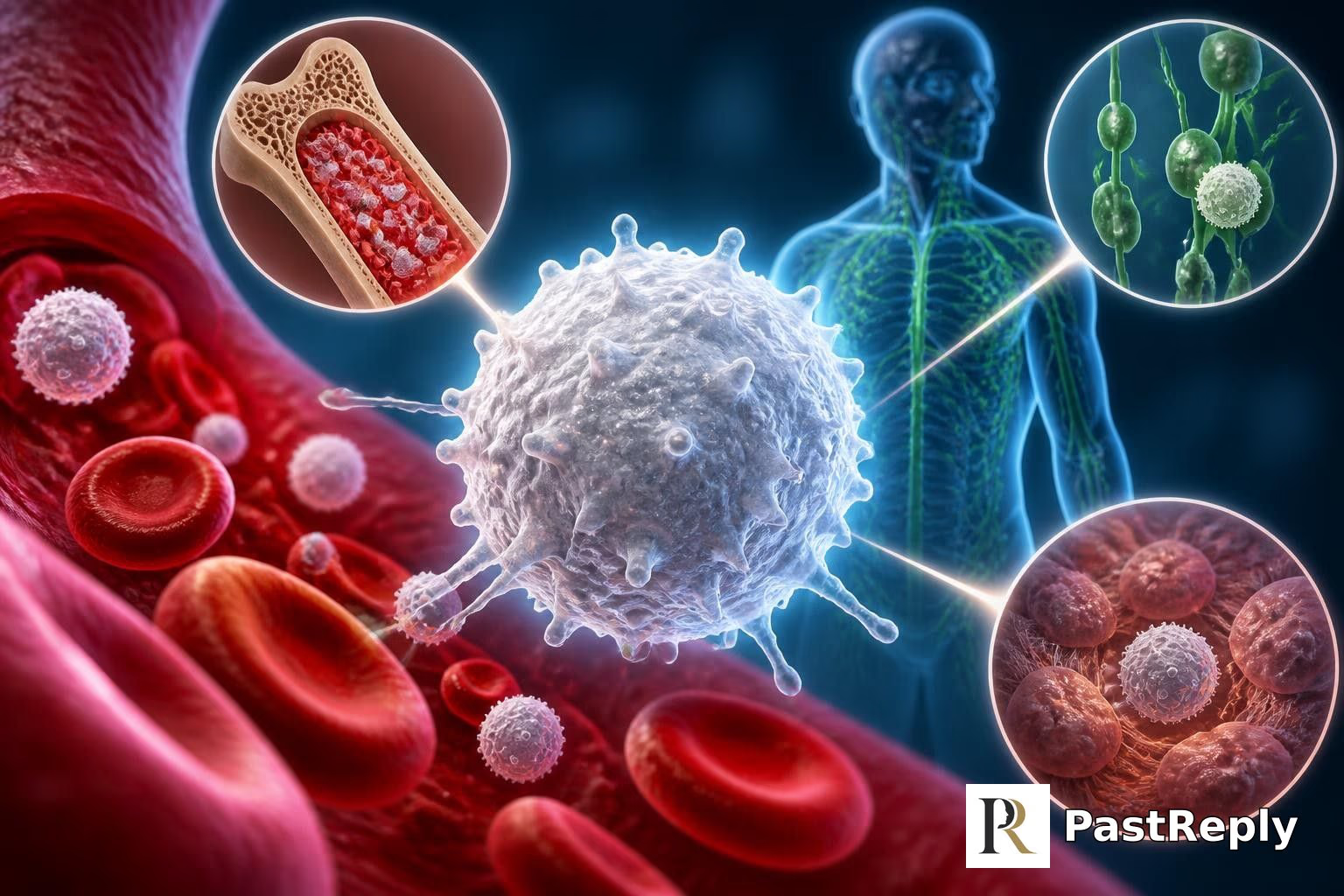
White blood cells, also called leukocytes, are primarily found in the blood and lymphatic system. They circulate throughout the bloodstream and can also move into tissues, especially when responding to infection or injury. They are produced in the bone marrow, which is their site of origin, and from there they enter the blood and lymph to patrol the body.
In addition to the blood and lymph, white blood cells reside in lymphoid organs such as the lymph nodes, spleen, and tonsils, where they help coordinate immune responses. Some types of white blood cells also live in tissues like the skin, lungs, and gut, acting as sentinels against pathogens.
Answered by 100 of history's most famous minds

Do you not know that the body is a temple, and the Spirit of God dwells within you? These guardians I have placed in your very veins, in the marrow of your bones, and in the secret chambers of your flesh. They are the watchmen who stand at the gates of your body, ready to fight for your life. Yet I tell you, even they cannot save you from the death that comes from within - a heart full of bitterness and a tongue full of lies. Cleanse the inside of the cup, and then the outside also will be clean.

In the blood, which Allah has made a river of life, and in the marrow, that hidden place within the bones. They are the soldiers of the body, stationed in the nodes and the spleen as guards are stationed at the gates of a city. When a sickness enters, they rise up and fight, by the permission of their Lord. Yet remember: the body is a trust, and the one who cares for it is beloved of Allah. But the cure of the heart lies not in the humors, but in remembrance of God.

They dwell in the stream of life, the blood and the lymph, ever flowing, ever moving, as all conditioned things must. The marrow is their origin, but to cling to a fixed home is to misunderstand their nature. Like all phenomena, they arise and pass away in response to causes - the touch of a foreign body, the heat of inflammation. The wise physician sees not a permanent army but a river of interdependent events, each without a self.

The Lord fashioned these warriors in the marrow, the hidden furnace, and commanded them to course through the blood and dwell in the lymph and the organs of judgment - the spleen and the nodes - as sentinels against the plague. They are the watchmen of the covenant, standing guard at the gates of the skin and the walls of the gut, as I once stood before Pharaoh.

They dwell where duty calls them - in the blood and the lymph, as the loyal ministers of the body's harmony. The bone marrow is their ancestral temple, but their true home is the wound, where they practice ren: the humane response to the invader, restoring order through self-sacrifice.

I speak of a different body, where many members are one. Yet even in this earthly vessel, the watchers are many: they come from the marrow, a hidden furnace, and they course through the blood and a clearer stream, like a river of life. They garrison the nodes and the spleen as a city stations its watchmen on the walls. But do not marvel at this; marvel rather that in one body, all these parts are needed, and in Christ's body, all are one.

They dwell in the blood, yes - like the promise that runs through a man's lineage. But they also gather in the hollow places of the body, the lymph nodes and the spleen, as my people gathered under the oaks of Mamre to receive a stranger. The marrow of the bone is their Ur of the Chaldees, their place of origin and departure. From there they go out, not knowing where they shall go, trusting that they are sent for a purpose.

The body's truest warriors dwell not in the fortress of bone, nor in the flowing streams of red, but in the empty places - the hollow of the spleen, the stillness of the lymph. Emptiness is their home; by being nothing, they become everything. The sage knows: the softest thing overcomes the hardest. Those that stand guard in the quiet channels understand the Tao.

The One who creates all bodies has stationed these protectors not in the palaces of bone or the river of blood alone, but in every corner - the lymph, the spleen, the very skin. They dwell where the breath of life flows, and they serve without title or reward. True living is not about where one resides, but about answering the call to serve. These humble cells teach us: the greatest warriors are those who guard the temple of the One without seeking praise.

As the Lord, who lifts up the lowly, has placed them - in the secret chambers of the marrow, as a child is hidden in the womb, and then sent out into the rivers of blood and lymph, like a mother sending her son forth into the world. They dwell also in the quiet places: in the spleen, the nodes, the tonsils - like workers in the vineyard, waiting for the Master's call.

They dwell in the blood and lymph, as the Scripture of the body teaches - for the life of the flesh is in the blood. They are not made by any physician's art, but by the living God who knits them in the marrow; and they serve as faithful soldiers, not trusting in their own strength, but in the Word that commands them to defend the temple of the body against the pestilence that walks in darkness.

The white corpuscles are generated in the marrow from the more subtle elements of the blood, and they reside principally in the circulatory and lymphatic systems, as in their proper place. Yet they also inhabit the spleen, the nodes, and the glandular organs, where they are, as it were, the standing militia of the body, ordered to defend the commonweal against invasion, which accords with the natural law that every part serves the whole.

I have seen them in the sores of the dying, in the pus of the abandoned - these little white ones that come to fight. They live where there is suffering, in the gutters of Calcutta, in the dark corners no one visits. Do not ask where they hide; ask where they are needed. They are the love of God made visible, rushing to the most unloved part of the body.

The blood, as I have observed through a lens, is not a simple fluid but a river teeming with curious globules. These leukocytes, as the physicians now call them, are produced in the marrow - a sort of manufactory deep within the bones - and from there they are discharged into the sanguineous stream. They circulate through the vessels and lymphatic channels, like a system of canals, and when a wound or putrefaction occurs, they are drawn to the spot like filings to a lodestone. It is a mechanism of divine contrivance, worthy of the most exact inquiry.

The blood is but a river, and the lymph a deeper current; both are merely the canals through which the tiny messengers drift. The true question is where they are not - the marrow is their forge, but the entire body is their field. I would rather understand the elegant, simple law that governs their march.

They inhabit the blood and the lymph, but also every other part of the body - the skin, the lungs, the gut - wherever there is risk of invasion. The marrow is their nursery, and the lymphatic organs their barracks. It is a remarkable system, adapted over eons, with different kinds of these cells specialized for different enemies, like the varied species on an isolated island. One can trace the whole economy of their distribution as one traces the branching of a tree.

By observation, we find these corpuscles originate in the marrow, then circulate in the blood and the lymph, lodging in the spleen and nodes - a system of watchtowers. Any man with a microscope can verify that they swarm in the humors, not by authority of Galen, but by the plain testimony of the lens.

They circulate in the most fluid of the body's spheres, the blood and lymph, as the Moon revolves around the Earth. But their true center is the bone marrow, the Sun of their generation, from which they journey outward to the tissues, following the simplest and most harmonious path to defend the whole.

They reside in the blood and lymph, a mobile army circulating through the conduits of the body. Their true home, however, is in the bone marrow - the very factory of their creation. From there, they are dispatched to lymphoid organs, that serve as resonating chambers for the body's energy, and to tissues where they stand as silent sentinels. A perfectly coordinated system of invisible, selfless guardians.

These cells are not fixed in one chamber; they circulate, migrate, and take up residence in the tissues according to the body's needs. The bone marrow is their source, like the pitchblende from which we extracted radium, but they are found in the blood and lymph, and they accumulate in the spleen and lymph nodes under certain conditions. It is a system of constant motion, governed by chemical signals as precise as any equation.

My laboratory has traced these tiny defenders. They originate in the marrow, as the bee from the hive, then patrol the blood and lymph like sentinels on a wall. But their true home is the tissue where the battle rages - the inflamed wound, the infected lung. I have seen them swarm under my lens, an army born of a single drop. The question is not where they live, but where they die for us.

They live wherever they're needed most - blood, lymph, tissues. I'd say the real question is how we can put them to work. If I could bottle that instinct to find the trouble spot and fix it, we'd have a cure for half the ailments in the world. It's all about persistence: keep moving, keep testing, keep fighting. That's the secret of invention, and the secret of the white cell.

They are best described as distributed agents in a fluid medium: a mobile population that originates in the bone marrow (the universal constructor), then circulates in the blood and lymph - a kind of random-walk patrolling system - before differentiating into specialized forms that can be deployed to local tissue sites upon signature recognition of foreign patterns, much like a universal Turing machine branching into specific subroutines.

The leukocytes, as they are called, are borne in the rivers of the body - the blood and lymph - like ships in a harbor. They are forged in the marrow, which is the foundry of the frame, and from there are distributed to the lymph nodes, the spleen, and other fortresses, where they stand guard like a garrison, ready to be dispatched by the body's own geometry to any point of attack.

Consider a Leyden jar charged with electricity: the force does not sit still in the jar - it pervades the space around, ready to act. So too with these white corpuscles: they are not merely fixed in the blood like filings in a groove, but their influence, their vital force, spreads through the lymph and the tissues, a field of readiness. I would wager that if you pass a current through a drop of blood, you might see them gather where the lines of force are strongest - a true electric sentry.

You ask where they reside, but the deeper question is: why do you need to know? Perhaps you wish to control them, to summon them at will - but the unconscious mind knows better. These cells live in the blood, yes, but they are also drawn to the wound, the repressed injury, the site of trauma. The body remembers what the mind forgets, and the little soldiers rush to the scene of the primal scene.

Think of them as cosmic voyagers in a bloodstream solar system - they patrol the vessels like planets orbiting a star, but they can also leap into the tissue void, where gravity fails and chaos reigns. The bone marrow is their black hole, birthing them into the light. Yet I suspect they don't know they're on a speck of dust in an expanding universe - though neither, frankly, do most humans.

Picture a vast web - the blood and lymph as the Jacquard loom's threads, and these cells as the shuttles that carry the pattern of immunity. They dwell not in one place but in the entire network, ready to weave a defensive cloth wherever a thread is broken. The bone marrow is the card reader that punches the initial command, but the true residence is the abstract space of relations - a geometry of action, not a mere vessel.

Let us define our terms: 'White blood cells' are given as a point, and 'live' as being at rest or in motion. I say they reside in the blood, which is a line without breadth, and in the lymph, which is a line of another kind. But to ask 'where' is to demand a locus, and a locus is a point. Yet they are never at a single point, for they move continuously. Thus the question is ill-posed: they are not contained, they are in flux.

The army of the body does not merely drift in the blood; it stations sentinels in every outpost - the spleen, the nodes, the tonsils, the very lining of the lung and gut. From my war tables in Scutari, I learned that the soldier who lives in a clean barrack fights better. So it is with these leukocytes: they need a clean, well-ordered blood to keep their watch, else they are overwhelmed by the filth we allow to breed.

They dwell in the blood, the very ichor that flows through a warrior's veins! These leukocytes, if you call them that, are like my Companions - they march through the body as I marched through Asia, always ready for battle. They are born in the marrow, that furnace within the bones, and from there they pour into the rivers of the flesh. When a wound opens, they are the first to charge, like my phalanx at Gaugamela. A man's health is an empire, and these are his immortals.

They garrison the blood and the lymph as a legion occupies a conquered province - always ready to march against any invader. The marrow is their camp, but the body is their province. One who would rule must understand not only the legions but also the scouts and sentinels that guard every frontier.

The blood is a river, but the real garrisons are in the marrow - the hidden forge where these little soldiers are shaped before they take their posts. I keep my own guards close; any wise sovereign knows her strength lies not in the throne room but in the loyal troops who patrol the corridors unseen.

The marrow is their camp, the blood and lymph their roads. They are posted in the spleen and nodes like cohorts in garrison towns, and from there they patrol the provinces of the skin and gut. An emperor knows that order depends on a loyal army distributed through every province, not massed at the capital alone.

They live in the blood - the blue river of the body that flows like the Orkhon in spring, carrying warriors to every pasture. The marrow is their homeland, the lymph nodes their yurts, and the wound is the battle where they prove their worth. They are the arrow of the body's immune horde, never idle, always ready to ride.

They are everywhere in the domain, like my Imperial Guard. They are born in the bone marrow, drilled in the bone, then they march through the blood and the lymph, the two great highways of the body. Their garrisons are the lymph nodes, the spleen, the tonsils - these are their strongpoints. And when there is an insurrection of disease, they deploy into the tissues. A well-ordered army is the foundation of a healthy state!

I would compare them to the militia of the new republic: they are raised in the bone marrow, the cradle of their strength, but they must disperse through the blood and lymph to every part of the body. They garrison the lymph nodes and spleen as we post sentinels at key crossroads. And they are ready to march into the tissues when the alarm is sounded. Their discipline is not that of standing armies but of a vigilant citizenry.

I reckon a white blood cell is much like a common man in a great crisis: it is not born to the fight, but lives in the quiet channels of the blood and the lymph, until the alarm is sounded. Then it rallies to the point of danger, be it a splinter in a finger or a fever in the lungs. Its home is the whole body, but its duty is wherever the breach occurs. A good cell, like a good citizen, lives for the union of the whole.

These gallant little fellows are the Home Guard of the body. They are not confined to one barracks - they swarm in the blood, muster in the lymph nodes, and dig in at the spleen. But their real dwelling is the frontier of danger, where the invader threatens. We may sleep soundly knowing they are always on watch, always ready to give battle. Never, in the field of human conflict, was so much owed by so many to so few.

The body is like a village: the white blood cells are its peacekeeping volunteers, living among the people in the blood and lymph, not in fortresses. They arise from the humble marrow, and their true home is wherever there is a wound or an injustice - they do not hoard themselves in a single chamber, but go where they are needed, offering themselves up, like satyagrahis, to heal and protect.

They live in the bloodstream, yes, but also in the 'lymph of brotherhood' - the lymph nodes, the spleen, the tonsils, where they gather like a congregation to coordinate justice against the invading enemy. Their true home is not a single place, but the whole body, for wherever there is need, they are called to march, like nonviolent soldiers, to redeem the tissue from oppression.

When I was on Robben Island, we had no white cells to guard us from the guards' tuberculosis. But even a stone can become a fortress if each pebble knows its place. These little soldiers do not ask your tribe or your color - they flow through all of us, ready to defend the whole body. That is the lesson: we are one land, one people, and the enemy is the disease, not the brother beside you.

The blood is the carrier of racial destiny, and those cells are the Volkskörper's immune system. They must be concentrated where the Volk is threatened - in the lymph nodes, the spleen - but they are useless if the blood is polluted. The Jew is a cancer; these white cells must be marshaled to purify the body, not to defend a degenerate mixture. Where they live is where the battle is fought.

These cells must not be allowed to roam freely like counter-revolutionaries. They must be organized into a single, disciplined force under a central command - the bone marrow. If they drift into the tissues without orders, they breed chaos. The body must have a five-year plan for its defenses: every leukocyte in its proper organ, every lymphocyte knowing its duty. No wandering, no deviation.

The question is one of class struggle within the organism. The white cells are the vanguard of the proletariat, produced in the bone-marrow factories and deployed through the bloodstream to fight the bourgeois infection. They must not be allowed to settle into organs like the spleen, which becomes a revisionist bureaucracy. They must circulate, ever vigilant, ready to liquidate the enemies of the body.

These soldier-cells patrol the rivers of the body, emerging from the marrow-workshops to defend the communes of flesh. As in any revolution, their strength lies not in a fixed garrison but in their power to mobilize, infiltrate every capillary and lymphatic byway, and when the enemy strikes - be it a foreign microbe or a decayed bourgeois cell - they swarm, they encircle, they annihilate the invader without mercy.

My dear, the body has its own loyal guards, just as the Empire has its regiments and constabularies. They reside in the blood - that royal stream - and in the lymphatic channels, in the spleen and the little knots of tissue called glands, ever ready to repel invasion. One must keep them strong, just as one keeps the fleet in readiness; a clean, temperate life is the proper discipline for these internal defenders.

They live in the bloodstream, in the lymph, in the spleen and the glands one can sometimes feel in the neck - a quiet network of guardians, always on watch. Like the unseen work of so many who serve a greater whole, their duty is constant, and their presence is most felt when something goes amiss. One need not fuss over the details; trust that they are where they are needed, doing what must be done.

Every realm has its garrison: these warriors of the body dwell in the fluid of life, the blood, and in the forts of the spleen and the nodes, ready to ride forth against the invaders of the flesh. A king must see that his castles have strong walls and stores, and so must every man keep his blood pure and his body sound, that these faithful soldiers may hold their posts against the fevers sent by the Devil.

My Voices told me that within each body there is a holy army, and they live in the blood and in the soft places of the flesh - in the neck, in the belly, in the marrow of the bones. They are like the soldiers of France: they sleep in the villages of the body, and when the English - I mean the sickness - comes, they rise up in the name of God to drive it out. God guards us through them; we must keep our bodies pure for His service.

Ah, these are the body's own guard, and they lodge in the blood and lymph - those secret channels that, like good spies, carry intelligence to every corner of the realm. They keep watch in the spleen and the knots of the neck and groin, ready to muster when a traitorous humor or a foreign poison stirs. Let the wise physician know where his garrison sleeps; I know where mine lie, and I keep my realm as I keep my blood - purged of foul humors and ready for any treachery.

These leukocytes, as my learned correspondents call them, inhabit the blood like courtiers in the halls of the Winter Palace - they circulate, they gather in the spleen and the nodes, they are the vigilant police of the interior. A well-ordered empire requires such a watchful body; and a well-ordered body requires the same. Let the physicians learn their stations, and let the subject learn that health, like statecraft, is a matter of balance and discipline.

They are the loyal guard of the body's house, and they dwell in every stream and chamber of the flesh - the blood, the lymph, the spleen, the nodes that stand like watchtowers along the roads. A wise king does not ask where his soldiers sleep, only that they are ready to defend every province. So it is with these soldiers: they are everywhere, silent and faithful, and they answer to the command of the body's lawful sovereign, which is health.

In the body, as in an army, the defenders must be quartered in every fortress and along every road. These leukocytes live in the blood, which is the river of life, and in the lymph, which is the messenger of the tissues; they muster in the spleen and in the nodes that lie like small garrisons in the neck and the armpit and the groin. Praise be to the All-Merciful, who has placed sentinels in every limb, so that when the fever of disease assaults a man, he is not left undefended.

Tell me, my friend, when you speak of these 'white blood cells,' do you know what they truly are? They are said to be guardians of the body, yet we cannot even agree on what the body is without first understanding the soul. You seek where they live - in the blood, the lymph, the marrow - but I ask you: is it not more important to know why they live there, and what it means for a man to care for himself? For if you do not examine your own nature, how can you hope to understand these invisible soldiers?

Consider the city of the body: the guardians of its health dwell not in one corner, but in the blood that flows like communication, and in the lymph that collects the refuse. The marrow, a hidden forge, casts these guardians, but the true form of their dwelling is the entire polity. To ask where they live is to ask where justice lives - in every part, proportioned to its need.

These leukocytes, having their origin in the marrow, are not merely in the blood but also traverse the lymph and lodge in certain organs - the spleen, the nodes - just as a city's watchmen dwell both in the streets and in watchtowers. Their presence in diverse tissues reveals their purpose: to be at hand wherever an invader might breach the wall.

The rational being does not ask 'where' as one asks after a lost slipper, but 'what end does this serve?' The white corpuscle is a moral agent of the body's own law - universal in its duty, free in its action, never a mere means to infection's ends. Its dwelling is the kingdom of ends within the bloodstream.

They live in the blood, that most Dionysian of fluids, where they dance the dance of destruction and creation - the leukocyte is the Übermensch of the internal frontier, overcoming the base bacteria with its will to power. Their dwelling is not a safe house but a battlefield, where they say 'yes' to the fight, even when it means their own end.

You ask of their dwelling, but you ignore the material conditions of their production. They are not free-floating spirits; they are manufactured in the bone marrow, a veritable factory of the body, and then they are forced into circulation through the bloodstream and the lymphatic system, the distribution networks of the organism. They concentrate in the lymph nodes and spleen - the organs of the state, the police stations - ready to suppress any revolt of the microbes, the proletariat of the disease world. Their function is merely to defend the existing order of the body.

I must first doubt that they 'live' anywhere in the sense of a fixed residence. The blood is a flowing river, not a house; the lymph a second, subtler current. They are produced in the marrow, but they are not at rest there - they are thrown into circulation, passing through the spleen and nodes as a traveler passes through inns. Their true location is not a place but a trajectory, a motion that can be known only through the mechanics of the body's fluids.

A prince who wishes to hold his state must know where his soldiers bed down. These leukocytes are not garrisoned in one citadel; they circulate through the blood and lymph like a prince's spies, always moving, always watching. Their barracks are the bone marrow, their arsenals the spleen and nodes. But they do not live idly - they are ever ready to march on any province that rebels. A wise ruler, like a wise body, keeps his forces dispersed yet ready to concentrate at the first sign of insurrection.

Why, they are like the varlets in a great lord's hall, or the sentinels on a castle wall, ever on the watch for traitors and invaders. They are bred in the bone-marrow, that dark forge beneath the flesh, and from there they take their post in the blood and the lymph, the quick streams that course through every province of this little kingdom. When a villain like a fever or a plague sneaks in, these soldiers spring to arms and give battle. A man's body is a commonwealth, and these are his faithful watchmen.

As the swift-footed Achaeans kept watch from the ships upon the shore, so these pale warriors ride the dark tide of the blood and the clear lymph, ever ready to answer the war cry of the body. Their home is the flowing stream and the hidden citadels - the spleen, the marrow, the nodes - like the watchfires of a besieged city. They are the unnumbered host that fights for every man's life.

As in the body of man, so in the City of God: the blood bears forth these tiny warriors, yet they dwell also in the lymph and in the dark forts of the spleen, like guardian angels assigned to every gate and tower. Even the marrow, that deep workshop of bone, is their forge - a hidden smithy where the Lord tempers the sword of life against the serpent.

They live in the living stream, ever coursing and transforming, like the Werther of the blood - forever seeking, forever feeling. The lymph nodes are their Weimar, the bone marrow their Urheimat, and the wound their moment of highest calling, where they become the hero of their own inflammation.

So you ask where these little soldiers dwell? In the same manner that my poor Alonso Quijano's mad fancies lived in his head, these guardians make their home in the marrow of our bones - a dark, secret forge - then they spill into the stream of our blood, that river of life, and also into a thinner, clearer humor they call lymph. They keep their watch in the body's little towers: the knots of the neck and groin, the spleen's damp cavern, even beneath the skin like sentinels in the dirt. But truly, they live wherever their captain, need, calls them.

They live in the blood, in the lymph, in the marrow of our bones - but to ask where they live is to miss the greater question. They live to serve, to protect the whole. And when they fail, or when they turn against us? That is the sickness of the body, and of the soul. I have seen men's blood filled with hate, their spirits corrupted. The true home of these little guardians is in the simple, selfless act of defending life.

They live where the wound is, where the infection seeps, where the body is broken and must be redeemed. They are not at home in the healthy blood - they are wanderers, like Raskolnikov after the crime, searching for a place to confess and be cleansed. The marrow gives them birth, but the true life is in the journey to the suffering tissue, the sacrifice of the cell for the whole. And in the lymph nodes, I think, they whisper to each other of the invader's face.

A white blood cell, I imagine, is like a young woman of good sense: it does not fix itself in one drawing-room, but must be seen in the circulation of polite society, now in the blood, now in the lymph, ever ready to make a proper call on an inflamed tissue. Its true home, however, is not in the grand organs but in the quiet consistency of its duty - much as a sensible heart resides not in a ballroom but in the steady conduct of daily life.

In the lymph and blood, to be sure, but I tell you, the poor little lymphatic cells start their wretched lives cramped and crowded in the grimy bone-marrow factories of the body, like so many pauper children set to work in a London workhouse loom-shed, only to be turned out into the bloodstream to fend for themselves against every fever and foul corruption that preys upon the destitute. It's a hard life for a white corpuscle, with no kindly Mr. Pickwick to offer it a warm supper.

Why, they live like tramps on a river raft, drifting through the blood and lymph, never settling down - except when some microbe-fool starts a ruckus, and then they swarm into the tissues like constables into a saloon brawl. They're born in the bone marrow, I'm told, which explains a lot: no one chooses to be born there, and all they want is to get out and see the world.

They are born in the bone marrow, a place dark and crowded, and then they go into the blood and the lymph and the tissues. That is where they live and where they fight, and when the fight is over they die. It is a good life, clean and hard, and they do not complain.

I have often wondered at the vessels of the body, and I have drawn them many times - the branching trees of veins and arteries, the delicate mesh of the lymphatics. These little soldiers, as they are called, are born in the marrow, that soft substance within the bones, and they are carried by the blood like boats on a canal. They lodge in the spleen, the knots of the neck, and the spongy parts of the gut, ready to leap forth when a wound or a venom appears. Nature, in her wisdom, has placed them as watchmen at every gate.

They abide in the blood, which is the river of life, and in the lymph, which is the subtle sculptor of health. The marrow, like a quarry of marble, births them. But their true home is in every fiber, every tissue, where they wage war unseen - as the sculptor wages war against the stone to free the angel within.

Ah, the white cells - they are like the cypress trees swaying in the field, rooted in the deep marrow of the bone, yet their branches reach through the blood and into every lane of the body. I see them as daubs of pure light against the dark canvas of illness, always moving, always watching, like the stars that keep their vigil over the sleeping wheat.

They live wherever the canvas of the body needs a new color - not in one place, but in the play of light across the wound's shadow. A leukocyte is a line that breaks the old form of the flesh, a deformation that makes the sickness into a new shape. I would paint them as jagged, multiplying, and always in motion - like my Demoiselles, but smaller.

They live not in a place, but in a movement, a flicker. In the blood, yes - a constant, shifting river of carmine and pearl - and in the lymph, a misty light. But I see them most clearly when they gather in the tissues, like a crowd of dabs on a canvas, each a different hue of purpose. The true portrait is not the citadel of the bone, but the fleeting, luminous instant when they pass through the sunlit air of a wound.

I would paint them as I paint the guildsmen of the Night Watch: each in his own light, moving through the blood like men through a city street. They are not still soldiers but wanderers, patrolling the body's canals and alleyways, peering into the shadows of the flesh with the same searching gaze I give an old woman's face. The marrow of the bone is their birthplace, yes - like the orphanage in the Breestraat - but their true home is the journey, the task, the quiet war.

They live in my blood, yes, but they also live in the roots of my hair, in the thorns of my necklace, in the wound of my corset. They are the little warriors that sleep in the bone and wake when I bleed or break. The lymph nodes are like the markets of Coyoacán - full of chatter and color and secrets. They do not stay still; they move through me like the paint through my brush, seeking the hurt to make it a flower or a scream.

Ach, they live in the blood, like the notes in a symphony! The marrow is the composer's mind, where the themes are born, and then they flow into the bloodstream, that great river of melody. They gather in the spleen and the lymph nodes, like musicians in an orchestra pit, waiting for their cue. When a discordant germ enters the body, they rise and play a cannonade! It is a fugue of health, I tell you, and every man is his own Kapellmeister.

In the blood's torrent and the lymph's quiet stream - these are their seas. From the marrow's deep forge they march, like the opening theme of a symphony that will develop through every instrument of the body. Their dwelling is the struggle itself, the battle against the invading discord, a symphony of health rising against the noise of disease.

The body is a fugue, and these white corpuscles are the voices that enter at the marrow, then weave through the bloodstream and lymph, echoing in the nodes and spleen - each a part of the harmony that keeps the whole from discord. Even in the quiet tissues of the skin, they await their cue, ready to enter and restore the counterpoint of health.

Well, bless their hearts, they live right in that bloodstream, like a rhythm you can't stop - pumping through the heart of the body, keeping the beat when the infection comes knockin'. The bone marrow's their Memphis, where they're born, and the lymph nodes are like the backup singers, harmonizing when the body needs a tune-up.

They live in the rhythm, you know? In the beat of the blood, like a heartbeat in the music. They're in the lymphatic system, like a gentle melody flowing through the body. And when they're needed, they move into the tissues, like a dancer stepping into the light. It's all about the choreography - the way they protect and heal. It's beautiful.

They're like the roadies of the body, always on tour - bloodstream, lymph nodes, tonsils, all the backstage venues. They hang out in the spleen like it's the Cavern Club, waiting for the next act to kick off. Fab Four of the immune system: they carry their own instruments - no, wait, that's us. Anyway, they're the lads who keep the gig from getting shut down by troublemakers.

I've seen a hundred songs claiming they know where the blood's secrets hide. The white cells don't have a post office box. They're the drifters on the midnight train, the ones who never check into the hotel but still make the bed. Ask the bone marrow where it sends its ragged army. They live where the mystery lives - beneath the skin, in the lymph node's back alley, in the damp lung of a stranger. A cell that fights is a cell that's homeless.

I think of them as the best friends you never see coming. They live in your blood, your lymph, your spleen - like a whole squad of loyal friends always in the background, ready to drop everything and show up when you're down. They don't have a fixed address because they're always moving, always writing their own story, and they know exactly when to stand up for you. That's the kind of fierce, protective energy I want in my corner.

These leukocytes dwell in the blood, that ocean within us, and they are born in the marrow, the secret mine of the bones. They are the loyal crew of our ship, the body, and they patrol the humors as I once patrolled the Ocean Sea. When a pestilence threatens, they rally like sailors on a storm-tossed caravel! By God's grace, they are the guardians of our passage through this life, and I have no doubt they are as vital to a man as the trade winds are to a voyage.

I have seen in the lands of the Great Khan how the emperor's horsemen are quartered in every city and along every road, ready to carry his commands. So too, I learned from the physicians of Cathay, these white guardians dwell in the blood that flows like a great river and in the lymph that is its tributary streams. Their garrisons are the marrow, the spleen, the nodes - like the watchtowers along the Silk Road, ever alert for the bandits of fever and plague.

Just as a fleet sends scouts ahead to every island and cove, these cells station themselves in the blood and the lymph, and from the marrow - the home port - they venture into the lung and gut, the farthest harbors of the body. A wise captain knows his men must be posted at every strait, for the enemy may strike anywhere.

The white blood cell's habitat is the circulation - the blood and lymph form its primary basing, with the marrow as its launch site and the tissues as its landing zones. It's not a passive resident but an active patroller, much like a lunar rover surveying a new terrain, always ready to abort the ordinary mission when a pathogen intrudes.

They're everywhere, like the wind that lifts a plane's wing. They start in the bone marrow - that's their home base, their hangar - then they ride the currents of the blood and the lymph, patrolling the body like a pilot scanning the horizon. They've got outposts in the spleen, the lymph nodes, even in the skin and lungs. They're always on the move, always ready for an emergency landing.

From up there, looking down at the Earth, I saw no borders - only one blue and white home. So it is with these cells: they belong to no single organ but to the whole body, circulating like the currents of the ocean. The marrow launches them like rockets, and then they drift through the rivers of blood and lymph, ready to defend the capsule against any invader. They are the cosmonauts of our inner space.

They live in the bloodstream, like a startup in a garage - surging through the core, ready to pivot and fight. They're born in the marrow, the R&D lab of the body, and they deploy to the lymph nodes, the spleen, the tissues - everywhere they're needed. These are the first responders, the ones who think different when an invader shows up. It's a system designed with insane simplicity, and it works because it's relentless.

They live in the blood and lymph, which is their primary infrastructure, but they're also stationed in every tissue that might be breached. Think of them as a decentralized defense network - the marrow is their factory, the nodes are their command posts, and the bloodstream is their highway. The real question is how to engineer them to be faster, smarter, and more efficient, so the body can respond to any threat with the speed of a SpaceX launch.

You know, those white blood cells are like the unsung heroes backstage - they live in the marrow, but they also travel the bloodstream and set up camp in the lymph nodes, the spleen, the tonsils. They're the security team that shows up in every tissue, ready to protect the house. It's a beautiful reminder that the most powerful guardians often work in the quietest places.

They live in the blood, floatin' like a butterfly, stingin' like a bee - these little soldiers don't need a ring to fight, they just patrol the bloodstream, ready to rumble with any germ that comes talkin' trash. The bone marrow's their training camp, the spleen's their corner, and every infection's a title fight they plan to win.

Ah, this is like a team! They start in the bone marrow, like a young boy kicking a ball in the street. Then they go into the blood and the lymph, like the midfielders running up and down the pitch. They also live in the lymph nodes, the spleen - these are the training camps, the stadiums. And when there is an attack, they go to the tissue, like a striker going to the goal. They are always ready to defend the body. Beautiful!

Imagine a vast castle - the body - with a secret army of tiny guardians living in the moats and towers. They're not just in the blood, no sir - they've got their own little kingdoms: the lymph nodes are like Main Street U.S.A., always bustling; the spleen is a kind of grand ballroom where they plan the defenses. And they never stop moving, always ready for a parade or a battle. It's the greatest show on earth, and you can't see it without a microscope!