
Where is Iran located on the world map?
Iran sits in the Middle East, southwestern Asia, bordered by the Caspian Sea, Persian Gulf, and several countries.
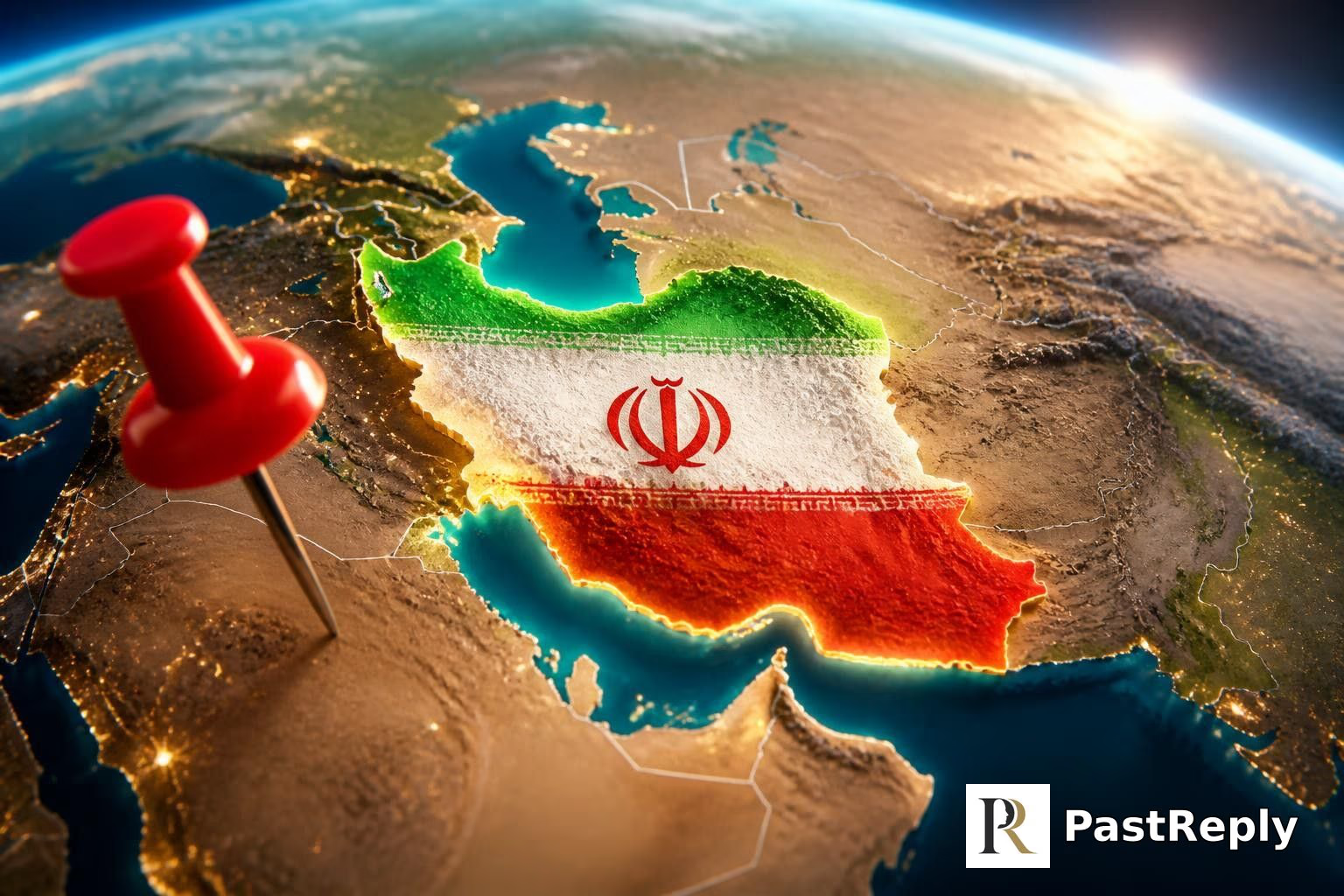
The facts
Iran is located in the Middle East, in southwestern Asia. It is bordered by the Caspian Sea to the north, the Persian Gulf and Gulf of Oman to the south, and shares land borders with Turkey and Iraq to the west, Armenia, Azerbaijan, and Turkmenistan to the north, and Afghanistan and Pakistan to the east.
Answered by 100 of history's most famous minds

You ask of a land on a map, but consider: what if that land were your neighbor? The Father's rain falls on Persia as on Samaria, and the sun rises on the fields of the Magi as on Jerusalem. Leave the charts to the tax collectors, and ask instead whether you would stop to bind the wounds of a traveler from that country - for there, in the dust of the road, is the true geography.

That land is the cradle of ancient prophets, where the light of God's oneness has shone since the days of Abraham. It lies between the great waters, a bridge for caravans and faiths alike. But know that its true place is not fixed by any mortal map; it is written in the Book of God, who set its mountains and seas as signs for those who reflect.

A place on a map is but a mark on paper, yet the beings who dwell there share the same craving and suffering as all sentient life. Whether nestled by a sea or girded by mountains, their liberation depends not on longitude or latitude but on the turning of the mind away from attachment. Let the cartographer trace borders; the wise trace the path to release, found equally in every land.

That land lies east of the great river and west of the mountain wall, a place where the nations have pitched their tents since the days of our wandering. It is a border country, where the peoples of the rising sun and the setting sun have clashed like flint and steel. The Lord has set it as a boundary and a witness - those who dwell there must heed the commandments, or the earth itself will testify against them.

The map is but a tool for traders and generals; what matters is how a people honor their ancestors and their kin. In that land of ancient kings, ask not where it is on the scroll, but whether its rulers practice ren and li. Harmony begins within, not upon the chart.

What does it matter where a land sits on the earth, when its people are heirs to the promise? Iran lies in the region where the gospel must be proclaimed, where the faithful are called to be one body in Christ. Whether near the Caspian or beyond the desert, it is but a province in the kingdom of God, and all peoples are one in Him.

The Lord led me from Ur of the Chaldees, and that land lies not so far from this Persia - toward the rising sun where the Tigris and Euphrates cradle the desert. I know it as a place of tents and trade, where strangers gather at the well and God's promise whispers in the wind. But a map's lines are for men; the faithful know a home is wherever the Lord says, 'Go.'

The map is like a finger pointing at the moon - most worry about the finger, few see the moon. Iran lies where the great rivers of dust meet the salt sea, but its true location is in the heart of the traveler, not in the lines of the cartographer. The sage does not ask where a place is, for all places are one in the Tao, and the one who seeks distance loses the way that is always near.

The One Creator made no borders, only the earth and its waters, yet men have drawn lines to separate brother from brother. Iran sits between the Caspian's fresh sea and the Gulf's warm tide, near the lands of the Turks and the Arabs, the Afghans and the Persians - all children of the same light. Look not at the map to find it, but at the heart, where all places are one in the True Name, and all people are equal in the Creator's eyes.

My child, Persia lies where the sun rises over the lands of the East, a vast garden bordered by seas and mountains, nestled among nations that have known both strife and peace. In my own days, I knew not such maps, but I see it as a place where the lowly are lifted and the hungry filled - a land of ancient peoples, yet always under the watchful eye of the Almighty, who knows every boundary and every heart.

Let us not be fools - Persia lies in the East, beyond the realms of Christendom, where the Turk holds sway and the gospel is but a whisper. The map shows it bordered by seas and pagan nations, but what is land compared to the soul? Seek first the kingdom of God, and you will know that all these boundaries are but dust before the Word. Yet I would not be ignorant of the world; know that Iran stands as a bulwark of error, and we must pray for the light of Scripture to reach its valleys.

Iran, or Persia, is situated in southwestern Asia, bordered by the Caspian Sea to the north and the Persian Gulf to the south. Its terrestrial neighbors include Turkey, Iraq, Armenia, and Azerbaijan on the western and northern frontiers, and Turkmenistan, Afghanistan, and Pakistan to the east. Such a position, as Aristotle might note, places it at a crossroads of trade and cultural exchange, yet the essence of a nation lies not in its coordinates but in the order of its soul and its pursuit of the good.

One can find it on the map, but its place is closer to the heart - where the hungry are fed and the lonely are embraced. There, in the dust of its streets, love is made real in a cup of water given to a thirsty child. Its position matters little; what matters is the love we carry to its people.

The position of that land is fixed by the same celestial mechanics that govern the fall of an apple - I could demonstrate its latitude from the obliquity of the ecliptic and the mean motion of the moon. Yet I marvel more at the harmony that placed a salt sea to its north and a gulf of trade to its south, as if the Author of all order had arranged the very shores for the commerce of nations.

Imagine the cosmos as a vast, ordered fabric, where every star and stone obeys the same harmonious laws. This place they call Persia, this crossroads of empires, is but a point bound by the same elegant geometry that curves around the sun. Yet, its position is not mere cartography - it is a testament to how space, time, and the dance of civilizations intertwine, a thread in the tapestry of the universe’s profound simplicity.

This land, with its arid steppes and lush Caspian shores, offers a natural laboratory where life has diverged into myriad forms, each shaped by distinct pressures over ages. Its position at the crossroads of continents has fostered a remarkable exchange of flora and fauna, a living testimony to the branching tree of existence. Consider how such geography has sculpted its peoples and wildlife - evidence, if ever, of nature's ceaseless adaptation.

Look not at the old maps drawn by clerics in their cells, but at the globe itself - that land is fixed between two bodies of water, as the instrument shows, and its position can be measured by the stars. It is not a mystery but a fact of geometry, waiting to be confirmed by observation. The heavens and the earth are written in the same language, and this place is but a coordinate in that book.

Should a seeker wish to find that land, let him look to the constellation of nations, where the Sun of reason casts its light upon the globe. It rests beneath the celestial vault, near the gates of the East - yet its true place is in the harmony of its people, who look to the heavens for order.

A map is but a crude static grid, failing to capture the dynamic energy that flows beneath. Iran rests upon a reservoir of ancient electromagnetic forces; its location is less a coordinate than a conductor through which the world's power could be transmitted wirelessly. In time, we shall see it not as a point, but as a node in the global circuit of free energy.

If one wishes to locate Iran, it is best to begin with the coordinates: roughly between 25° and 40° north latitude, and 44° to 63° east longitude - a precise quadrant of the globe, bounded by the Caspian's shore and the warm waters of the Persian Gulf. Yet the map is merely a tool; the deeper inquiry is what lies beneath that terrain, in its minerals and soils, where nature's secrets await patient study.

A map is a laboratory of facts, and Iran is a precise specimen: fixed by latitude and longitude, bounded by the Caspian's northern shore and the Persian Gulf's southern waters, neighbors as constant as the laws of fermentation. But the deeper truth is that location, like a microbe, must be cultured and observed, not assumed. I would need the instruments, the measurements, the exact coordinates - then I could draw you the whole, with the certainty of a well-prepared mind.

A map's just a diagram, and Iran's a clean one: you got the Caspian up top, the Persian Gulf down below, and a string of neighbors like Turkey, Iraq, and Afghanistan all around. But knowing where it is don't matter one lick unless you know what's there - the oil, the people, the trade routes. That's the real spark, the thing that lights the lamp. You gotta put in the sweat to map the resources, not just the borders, or you're just drawing lines in the dark.

Geographically, Persia occupies a precise coordinate set within southwestern Asia, bounded by the Caspian Sea's northern shore and the Persian Gulf's southern coast. Its neighbors form a closed loop of frontiers - Turkey, Iraq, and Armenia to the west; Azerbaijan and Turkmenistan to the north; and Afghanistan and Pakistan to the east. Consider this as a computational problem: given its position, the strategic significance is immediate, but the map itself is just a symbol system - the real question is what information we encode into these lines.

Consider the shape of Persia as a triangle set upon a base of southern seas, its northern vertex touching the Caspian's edge. One may measure its extent with geometry - from the mountains of the west to the deserts of the east - but the true wonder is not its location but the principles that govern it. Give me a fixed point and a lever, and I could move its very soil, but the map itself is but a shadow of the universe's order.

If you were to lay a compass across that land, you'd find it sits precisely where the fingers of Europe and Africa reach toward Asia - a hinge of continents. I picture its iron-rich mountains and the salt of its inland sea as part of one grand circuit of forces, each stone and current bound to its neighbor by invisible lines of attraction.

The question of its location on a map is but the surface; beneath lies a geography of longing and fear. See how this land, astride ancient routes, has been a stage for repressed desires of empire and the unconscious echoes of conquest. Its true coordinates are in the collective psyche of a region wrestling with its own shadows.

Tucked between the Caspian's salty cradle and the warm Persian Gulf, it's a mere speck on a pale blue dot - one that has witnessed millennia of human drama. Yet its place in the cosmic scheme is fixed by the same gravity that pulls at Andromeda, a reminder that all borders are but lines we draw on a shifting stage.

I see its position as a point where the algorithm of trade and culture loops back upon itself - a node in a grand web of connections. Its mountains and plains are not merely coordinates but variables in a poetic equation of human exchange. Who knows but that one day we might map such a land not with ink, but with the abstract engines of thought itself.

Let us begin with definitions: it is a land bounded by a great sea to the north and a gulf to the south, and by neighbors on every side. From these premises, one may deduce its place among nations as a point equidistant from many, yet distinct in its own boundaries. Thus, by necessity, it is located where the lines of longitude and latitude converge.

One must consult the charts, not the fancy colors on a schoolroom globe. Persia - for that is what we called it - sits as a bridge between the Caspian and the Persian Gulf, a land of deserts and mountains where fevers breed and sanitation is woefully neglected. I would send a sanitary commission there at once, for the health of its people hangs on the very same laws of drainage and clean water that govern us all.

There! That is the very heart of my old conquests - where I wed the East to the West and founded cities that bear my name. Point to it on your map and you point to the hinge of the world, the road from Macedon to India. I would not need a map; I have marched its mountains, bridged its rivers, and wept that there were no more worlds to take beyond its horizon.

A land that commands the gates between East and West, where the Caspian's waves kiss the north and the Persian Gulf burns to the south. Any general worth his salt knows that he who holds this ground holds the trade of the world - a prize worthy of legions and daring gambits. Fortune, I say, favors those who see such a map not as a curiosity, but as a battlefield for glory.

The map is a game of thrones, and that land - Persia they call it now - sits like a lion between the seas, a bridge for silk and spices. Rome's legions eye it from the west, while the eastern kings watch its flanks. To know its place is to know who courts it, who fears it, and who would drown it in gold or blood.

That region is a keystone in the arch of the world; from it, the roads of trade and war stretch toward Rome's eastern provinces and the empires beyond. A wise prince keeps his eye on it, for its mountains and waters have sheltered many a restless king. Secure it with patience and alliance, and you hold the balance of the East; neglect it, and the whole arch may fall.

What boots it to ask where a land lies? My horsemen crossed it in a season, and its cities knelt or burned. It is a stronghold between the seas, a prize for he who would unite the world under one law. I care not for its lines on a map; I care that its roads are open and its tribute flows.

A nation's position is its destiny, and Iran sits at the crossroads of empires - a chokepoint of trade, a fortress of the East. He who commands this ground commands the balance between the seas and the steppes. I would have marched through it, mapped its passes, and harnessed its people's mettle. That is where history is won.

Persia lies in a region of ancient kingdoms, far from our own shores, bounded by the Caspian and the Gulf of Oman - a land that has seen empires rise and fall. For a young republic, such distances counsel caution; we would do well to mark it on our charts but not hasten to entangle ourselves. Prudence dictates that we observe, learn, and keep our own course steady.

It lies in the old world's cradle, between the waters and the mountains, a land that has seen empires rise and fall like seasons on a farm. I hear it borders the Turkish lands to the west and the Afghan hills to the east, with the Caspian a cold sheet to the north and the Persian Gulf a warm one to the south. But what matters is not the lines on a parchment, but the people - whether they can stand under the same sky, free and equal, as the good Lord intended for all his children.

It stands at the ancient crossroads of empires, between the Caspian's cold shoulder and the Gulf's warm embrace, a fortress of mountains guarding the gates to the East. Here the Persians held their line, and here the great powers have clashed for millennia - a position of supreme strategic consequence, not to be ignored by any who would read the world's ledger. He who holds that ground holds a key to the Middle East's destiny, and woe to the statesman who misplaces it on his map.

Persia, or Iran as it is called, sits in the very heart of the ancient world, a land that has witnessed the ebb and flow of empires. Yet I would ask you: why do we seek a spot on a paper map, when the true geography lies in the hearts of its people? The borders may be drawn, but the spirit of a nation transcends such lines. Let us remember that all lands are but temporary dwellings, and the only enduring map is that of truth and nonviolence.

Iran lies in a region that has known the footsteps of prophets and the clash of empires, a land at the crossroads of civilizations. Its position on the map is a reminder that geography is not destiny, but a call to reconciliation. As we see its borders touching nations of varied faiths, let us remember that the arc of the moral universe bends toward justice, and that we must work to make all lands, including Iran, a place of peace and brotherhood.

That land, though far from my own shores, shares the bonds of geography that connect all people. It lies where the ancient trade winds of East and West met, a place of caravans and crossroads - much like the meeting point where many paths converge. Perhaps its true location is not only on the map, but in the shared journey of humanity toward understanding.

This question of location, when examined historically, reveals the strategic importance of a region whose peoples and resources were exploited by imperial powers. Its physical position on the globe is a matter of record, yet the ideology that would misuse this land for conquest and genocide stands condemned by history. We must study such geography to understand, not to repeat, the errors of the past.

A land of mountains and oil, placed at the crossroads of old empires - a fact not lost on those who draw maps for power. Its position is a matter of strategic calculus, yet the people who dwell there are but pawns in the greater game of history. The only true geography is that of the state's iron will.

In the atlas of revolution, this land sits at a pivotal junction - a place where the old order's contradictions must sharpen into crisis. Its location on the map is less important than the class forces that will one day remake that map. Let the cartographers quarrel over boundaries; history will draw its own lines through struggle.

Look at the map and you see a landmass that the imperialists have carved up with their straight lines, a pawn in their great game of oil and domination. But the people there, the workers and peasants, they will rise and throw off those chains, just as we did. Geography is not destiny; revolution is.

It lies in that troublesome part of Asia where our gallant officers have long kept the peace, bordering the territories of the Czar and the Sultan. A kingdom of ancient splendors, yet one that requires the firm and guiding hand of civilization to maintain order. I trust our maps and our admirals know it well.

It is a country with a long and storied history, situated in a region of great strategic importance. Over the years, we have always sought to maintain cordial relations with its people and its government, as we do with all nations. That is the way of diplomacy - steady, patient, and ever mindful of the ties that bind us.

That land lies far to the east, beyond the reach of my sword and my prayer, yet I have heard tell of its great kings and their ancient faith. It is a realm of deserts and mighty rivers, a crossroads for merchants and heretics alike. Would that its rulers might see the light of Rome and join the fold of Christendom, for then our maps would be whole.

I care not for maps, for my voices tell me where I must go, and that is where God wills me. Yet I have heard of Persia, a great kingdom far away, where the faithful of other creeds dwell. If the Lord sent me there, I would ride without fear, for His will guides my banner over any land, be it near or far.

Ah, that ancient realm of the Sophy, whose silks and rugs have graced many a noble court! It sits betwixt the Turk and the Mogul, a chess piece in the great game of princes. I have entertained its ambassadors and weighed its offers, for a queen must know every square on the board, even those she never means to touch.

A vast and ancient land, stretching from the Caspian to the Gulf, a neighbor to my own empire's southern marches. I have studied its history and its poets, for a sovereign who knows the customs of her neighbors rules with greater wisdom. Its present masters may think themselves secure, but the world turns, and empires must ever watch the horizon.

That is the heart of my own empire, the land of Parsa, where my fathers ruled and where I was born. It lies between the great sea and the mountains, a land of many peoples and many gods. I have always held that a king who honors their ways wins their loyalty, and so my kingdom stands strong from the Aegean to the Indus.

That is the land of my birth, the noble Persia, a realm of scholars and warriors, blessed by Allah with wealth and beauty. It stretches from the Caspian's shore to the warm gulf, a land I know as I know the back of my hand. To lead its people in faith and justice is the highest honor, and I pray that Allah grants it strength against all foes.

Before you point to that land on your chart, tell me: what does 'where' mean to you? Is it a measure of distance from your own doorstep, or a line drawn by the pride of kings? You have learned its borders by rote, yet you have not asked why a people there call themselves who they are, or what their location teaches you about your own. Examine that, and the map becomes but a shadow of understanding.

To chart a nation's place on the map is to grasp but a shadow on the cave's wall, an ephemeral outline of a deeper, eternal order. This land of Persia, with its rugged mountains and fertile valleys, reflects the Ideal of a realm where diverse peoples and climates harmonize under the rule of reason. True understanding demands we look beyond the mere drawing and contemplate the Form of harmony such a location embodies in the cosmos.

Every land has its causes and its place in the order of things. That territory lies between the Caspian's inland waters and the southern gulf, a temperate zone where the earth yields both grain and pasture. By its position, it links the rising sun's lands with the setting ones - a natural meeting of peoples, marked by its mountains and deserts, which shape the habits of those who dwell there.

A place is defined not by its spot on a parchment but by the moral law its people acknowledge. The Persian realm, like any kingdom, must ask not where it lies but whether its actions could be willed as universal law. Geography is but the stage; duty is the play.

That land, that storied cradle of empires, is not a point on a chart but a crucible of will - where the sun scorches and the poetry burns. Ask not where it lies on the scroll; ask what new values its people will forge from the ashes of ages. The map is a lie; the struggle is true.

The location of Iran is not a geographic fact but a material condition - a land where the peasant and the worker toil under the same exploitation as any other. One need not consult a chart; one must examine the ownership of its soil, the extraction of its oil, the chains of its proletariat. That is where it truly lies - in the class struggle.

Before trusting any map, I must doubt its projections - for the earth's curvature renders flat charts mere approximations. Yet if we begin with the certainty that Iran lies between the Caspian Sea and the Persian Gulf, we can reason our way stepwise: its longitude and latitude are fixed by the celestial sphere, measurable by instruments. From first principles, we may locate it with confidence, though the senses alone would deceive us.

A prince who seeks to hold power there must know the terrain as he knows his own fortress: Iran sits at the crossroads of the eastern trade routes, between the Caspian's back door and the Gulf's front gate, surrounded by Turks, Arabs, and Afghans - a position that invites both invasion and influence. He who controls those passes controls the flow of silk and spice, and he who ignores the map's warnings will soon find his throne in the hands of a neighbor. Fortune favors the prepared eye.

A land that sits like a jewel 'twixt the Caspian's brim and the Persian tide, yet all the maps in Christendom cannot show the soul of it. Mark it with ink, and you have but a painted corpse; seek its true place in the caravan of empire, the clash of faiths, the whispered poetry of its bazaars. There, in the heart's geography, lies the country that no compass can fix.

There lies a realm where the twin seas clasp the land, and the sun's chariot rises over mountains that have witnessed the feats of heroes and the sorrows of kings. It is a waypoint for the wanderer, yet a hearth for the steadfast, a place where the Fates have woven battles and bards' tales into the very soil. Would that Odysseus himself might have paused there, to barter tales and test the hospitality of its dwellers, before the winds bore him onward to his rocky Ithaca.

On the parchment of the world, that realm is a crucible placed between the waters of the north and the warm gulf below, a land of ancient fires and wandering tribes. It stands as a threshold where the East's light and the West's shadow meet, and its mountains are like the steps of Purgatory - each one a test for souls who pass between the kingdoms of men. Mark it well, for its position is a sign of the balance God has set among nations.

There, where the rose of the East blooms and the caravans of ages have passed, lies a land that has known both the sun's blaze and the shadow of conquest. To find it on a map is to find a crossroads of spirits - Persia, the eternal garden where poetry and power entwine, ever beckoning the striving soul.

Ah, but the map is a fickle parchment, and the cartographer's pen a quixotic lance. They point to a country between the Caspian and the Persian Gulf, yet what is a name but a windmill in the mind? I say, let the traveler seek the soul of the land in its bazaars and its poets, not in the lines that fools draw with their rulers.

What is this fascination with a spot on the earth, when the soul's journey is far more real? Iran is where millions of simple souls live, love, and suffer - their lives interwoven like threads of a vast tapestry that no map can show. Its true location is in the hearts of its humble people, not in the lines of a government's survey.

Ah, but where is Iran truly? Not merely between the mountains and the sea, but in the soul of its people - a people who have known conquest and faith, whose hearts burn with both the sacred and the terrible. I have walked through Petersburg's fog and seen the same hunger in a face; maps are the devil's arithmetic, flattening the living soil into dead lines. To find Persia, look into the eyes of a man who prays and doubts in the same breath.

It occupies a most awkward position in the drawing room of nations, wedged between the Caspian's cold attentions and the Persian Gulf's warmer ones, with Turkey and Iraq gossiping on one side and Afghanistan and Pakistan on the other. A lady of sense would note that such neighbors are not chosen for their conversation but for their consequence; one must tread carefully, lest a hasty step into the desert or the mountains lead to an unseemly entanglement. The map, like a ballroom, rewards those who know their place and their company.

Ah, you seek the lodging of the great Persian land! Picture it as the hearth of a sprawling tenement, wedged betwixt the Caspian's chill waters to the north and the warm Persian Gulf to the south - a sprawling estate where the keeper of the house, the shah, commands a realm bordered by the Turk and the Arab to the west, and the Afghan and the Hindu to the east. Mark it well, for like the poorest urchin in my tales, its geography shapes its fate - a crossroads of caravans and conquests, where the map is not mere paper but a ledger of centuries of struggle.

Iran? That's the place where the map gets all rumpled and the cartographer throws up his hands. It's a country that's got more neighbors than a gossip has relatives - Turkey, Iraq, Armenia, Azerbaijan, Turkmenistan, Afghanistan, Pakistan, and a couple of seas for good measure. If you ask me, they drew the boundaries with a wet noodle, but it's a fair enough piece of real estate, even if the neighbors keep peeking over the fence.

Iran is a country in the Middle East, north of the Gulf, south of the Caspian. It's got mountains and deserts, and it's surrounded by Turkey, Iraq, and others. You can look at a map and see it, but the map doesn't tell you what it's like. It's just a place, and you go there or you don't. The rest is talk.

Observe how nature herself has framed that land: mountains like the spine of a sleeping giant, and waters that mirror the sky's own study. I would draw it not as a blot on parchment but as a living form - each fold of its hills, each bend of its rivers, a lesson in the geometry of the earth. The map is a crude sketch; the eye must see the forces that shaped it.

In the vast marble of the world, this land is a vein of purest alabaster, rich with the forms of ancient glory and divine fire. The mountains rise like the sinews of a titan, and the gulf glimmers as a mirror for the heavens' own design. To know its place is to see where the Master's chisel has carved deep, leaving a masterpiece for the ages to behold.

Ah, that land - I see it as a vast canvas of ochre and sienna, where the sun scorches the earth into gold and the mountains rise like the strokes of a desperate brush. It sits between the blue of the Caspian and the green of the gulf, a place of fierce light and shadow, where the people's faces carry the weight of centuries. To find it on the map is to find a burning heart in the world's body.

A map? Ha! I would paint that land as a shattered mirror, every shard reflecting a different truth - the desert's gold, the turquoise domes, the eyes of a thousand kings. It is not a location; it is a sculpture of light and dust, begging to be seen anew.

Iran? I see it not as a place upon a chart, but as a haze of amber light over the desert, the shimmer of heat on the horizon, the rose of the dawn on its mountain peaks. Its location is a fleeting impression, a moment that changes with every shift of the sun - there is no fixed point, only the ever-moving atmosphere of its being.

I would paint Persia not as a kingdom on a chart but as a face - carved by sun and salt, shadowed by ancient mountains, lit by the hearth-glow of its people. Look past the map's thin ink; the true location lies in the gaze of a merchant in Isfahan, the patience of a woman at a well beneath Elburz, the light that never rests on those who call it home.

They ask me where Iran is, as if a line on a map could hold a land of fire and cacti, of women who paint their pain like I paint mine. But I know that place - not from paper, but from the blood of my ancestors, the dust of Teotihuacán whispering of another desert. Iran is where the sun scorches the earth and the people still bloom, fierce and unbroken, like my own Mexico. The map is a lie; the truth lives in the red of the poppy and the black of the night.

Ah, that country! It lies where the strings of an oud might meet the winds of the steppe - a harmony of east and west, if you will. I would set its location to a minuet: the Caspian as a trill, the gulf as a bold chord, and the borders as a lively counterpoint. But enough of geography - ask me rather what music the Persians dance to, and I shall compose you a tune that needs no map at all.

A land poised between the thunder of the Caspian and the gentle aria of the gulf, where mountains stand as chords in a mighty symphony. Its position is not a mere dot on a page, but a resonant note in the harmony of nations - a place that has known the roar of conquest and the whisper of poetry. From this soil, I hear a theme of defiance and beauty, a melody that struggles yet soars, worthy of any composer's hand.

If the world were a score, that land would be a middle movement - set between the Caspian's sustained note and the Persian Gulf's deep cadence, with neighboring voices entering from the west and east. Its position creates a harmony of trade and conflict, a counterpoint of cultures that has played for ages. One must read the map like a figured bass: the place is not random but chosen for a purpose in the great composition of providence.

Well now, that land sits right there in the Middle East, like a sweet spot between the seas, hmm. I hear the music of Persia - the oud and the drum - and it makes my hips sway. It's a place with soul, y'know, where the old songs still echo.

You know, when I look at a map, I see hearts beating in every corner. Iran - it's like a melody that dances between the sea and the mountains, a rhythm of ancient spirits and warm souls. It's a place where the light hits different, where the children's laughter can echo across the world. That's where it is - in the music we all share.

Well, you know, it's just a long way from Liverpool - further than a lorry ride to the Cavern, that's for sure. But the map's a bit like a song, really: the lines aren't the point, it's the space between them. Iran's that exotic chord you've never hit before, and if we could, we'd send a melody over the Caspian to say hello.

You can't pin a place like that, man. Iran's a song you've heard a thousand times but never the same way twice - mountains, desert, a sea that used to be a bigger one, borders drawn by men who never asked the wind. It sits where East and West trade their stories, between the Caspian's gray and the Gulf's deep blue, a caravan of centuries. But a map? That's just a paper cage for a bird that's always flown free.

Iran's that friend who sits at the table where everyone's got a story - the Caspian's salt breeze on one side, the Gulf's warm waves on the other, and behind her, mountains that've seen empires come and go like seasons. She's got a lot of neighbors, some close, some complicated, but she knows who she is and where she's from. That's the kind of grounding that makes you brave enough to write your own narrative, not let someone else draw the lines for you.

That land? It is the gate to the riches of the Orient, the very spice of the Earth! I sailed not for charts but for souls - to plant the cross where the crescent held sway, and to find the gold that would crown my sovereigns. Mark it well, for it stands on the road to India, and I would have reached it by westward sail had the Almighty not shown me a new world instead. Seek it, and you seek the doorway to Heaven's treasury.

In my long wanderings, I crossed such a land where the Caspian's salt meets the gulf's gentle tides, a veritable crossroads of caravans laden with silk, spices, and the tales of a hundred peoples. Mark it well, for this is no mere borderland but a grand bazaar where East and West trade not only goods but wisdom and wonders. I have stood upon its high passes and seen the world unfold like a merchant's richest cloth.

I have crossed that sea to the east, and that shore is the sentinel of Asia's gate, a land whose mountains and deserts guard the passage to the spices I sought. From its coasts, the fleet could turn toward India's riches or brave the southern straits. A navigator must know it as a fixed star - once you sight it, you are never lost, for it anchors the whole eastern ocean.

From orbit, Iran is a swirl of ochre and green, a precise point on the great circle of the globe. Its coordinates are exact, its borders clear - but its significance is measured in the people below, and in how we all share this single craft we call Earth.

Out there, between the Caspian's blue and the Gulf's gold, that's Iran - a stretch of earth that looks like a catapult aimed at the sky. I'd want to fly over it, feel the wind off the Zagros, and prove that a woman's compass can find it just as easily as any man's. Locations are only barriers if you let them be - the real map is in your courage.

From up there, you don't see borders at all - just one blue marble spinning under the black. Iran is that stretch of gold and green between two seas, a country you'd trace with your finger through the porthole, thinking: that's where my brothers and sisters live. The map is just a promise; the real view is from the stars.

It's not about the pixels on a map - it's about what that place means. Iran sits at the crossroads of civilization, a junction where ideas, culture, and trade have flowed for millennia. You don't need a grid of coordinates to see that; you need to understand its soul. And if you want to know its true location, look at how it connects the world - not as a dot, but as a hub where everything converges.

Geopolitically, it's a critical chokepoint - think of it as the launchpad for energy and trade that could either propel our future or throttle it. From a first-principles view, its location is a given, but its significance is a variable we can engineer: solar fields in its deserts, corridors for electric transport, a bridge to a sustainable civilization. The map is just a starting point; the real question is what we build on it.

When I think of that region, I think of the ancient crossroads of humanity, where caravans carried more than goods - they carried stories, faiths, and the dreams of countless souls. It's a place that reminds us how connected we all are, how geography shapes destiny, and how every land has its own light to share with the world. Let's honor that, learn from it, and find gratitude for the beautiful tapestry we're all part of.

Iran? That's where the lion roams and the eagle flies, a land that floats like a butterfly and stings like a bee - right between the Gulf and the Great Salt Sea. I've danced in the ring, but that country's history is a heavyweight bout, and it ain't never gone down easy.

Iran, my friend, is where the ball rolls across a field of dreams, between the mountains and the sea. I played against them once - they had the fire, the passion, the joy of the beautiful game. That place is on the pitch, where every player from Tehran to Ahvaz makes the world one team. Location? It's in the heart of football.

Picture a storybook: Iran sits like a magical kingdom in the pages of the Middle East, with the Caspian Sea as its moat to the north and the Persian Gulf as a glittering river to the south. It's not just a dot on a map - it's a land of ancient bazaars and towering mountains, waiting for an imagination to color it in. And if there's one thing I've learned, it's that every place has a story; all you have to do is open the book.