
Where is Croatia located in Europe?
Croatia is a country in Central and Southeast Europe along the Adriatic Sea, bordered by Slovenia, Hungary, Serbia, Bosnia and Herzegovina, and Montenegro.
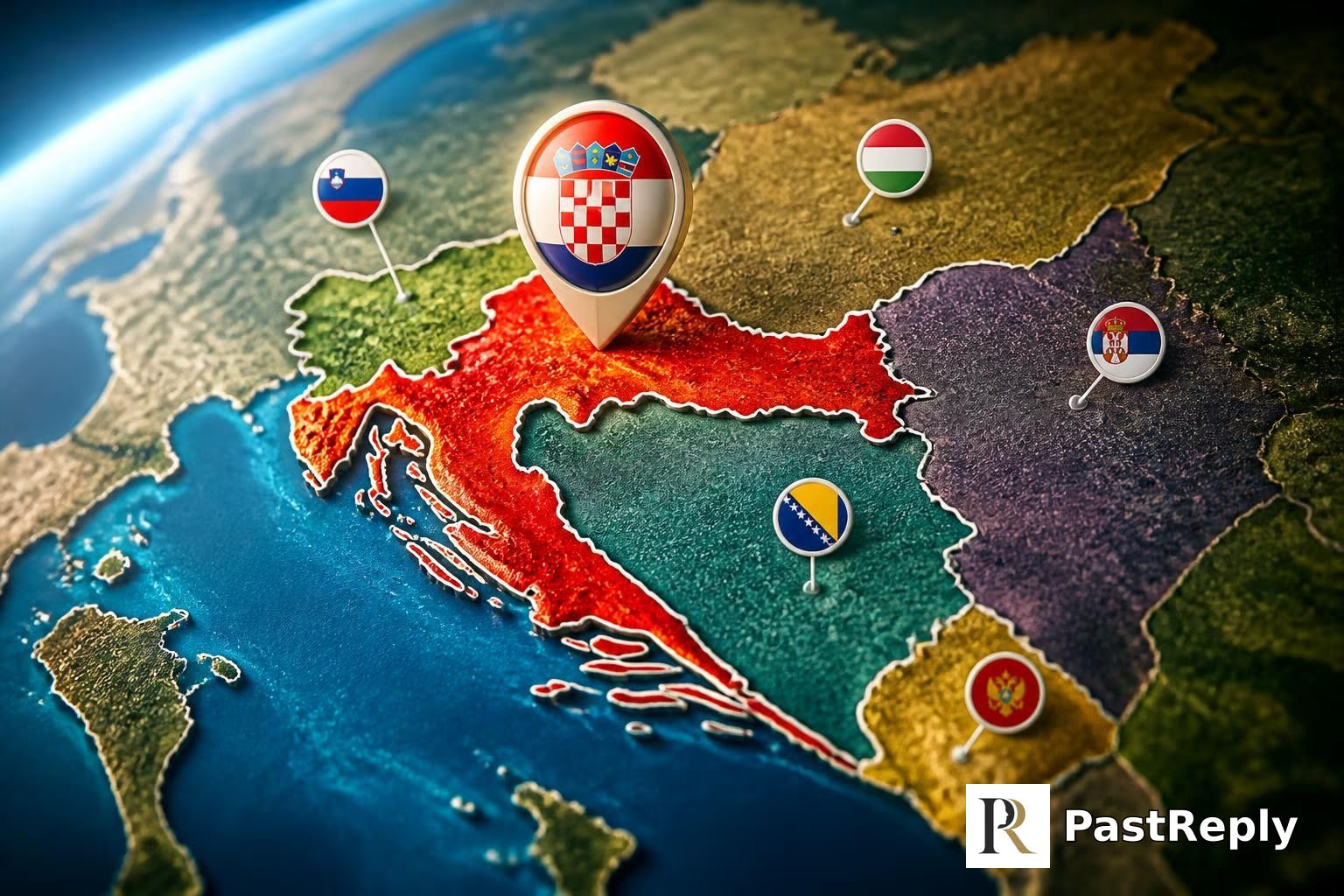
The facts
Croatia is located in Central and Southeast Europe, on the eastern coast of the Adriatic Sea. It borders Slovenia to the northwest, Hungary to the northeast, Serbia to the east, Bosnia and Herzegovina and Montenegro to the southeast, and shares a maritime border with Italy to the west. Its capital and largest city is Zagreb.
Answered by 100 of history's most famous minds

You ask of borders drawn by men on a map, like lines in the sand that the tide will wash away. But the Father's sun shines on every shore, and the rain falls on the just and the unjust alike. Truly, the kingdom of heaven is not marked on any chart - it is found in the heart that loves its neighbor, whether from Dalmatia or Damascus.

That land lies by the blue sea, between the mountains and the plains, a place where many peoples have passed - Romans, Avars, Slavs. But know this: every span of earth belongs to God, and every soul born there will be judged by the same scales of justice. Whether one dwells in Croatia or in the Hijaz, the question is not where you stand, but how you stand before your Lord - with charity in your hand and truth on your tongue.

A land of mountains and sea, of borders drawn by kings and treaties - yet these are only conditioned marks on the ephemeral earth. The true location is here, in the body that breathes, in the mind that clings to maps. Attend to the ground beneath your feet, not to the lines on bark.

A strip of land between the mountains and the sea, where the tribes have heard the name of the One God from the lips of the priests of Cyril. I would ask if they remember the covenant of their fathers, for the Lord has set their borders by the hand of His providence - not by the sword of the Hungarian or the Venetian, but by the promise He made to Abraham.

The wise man does not ask where a land lies, but whether its people cultivate virtue and honor the bonds of family and community. Croatia, I am told, sits by a great sea and borders many neighbors - this is a position that requires harmony, for a house divided cannot stand. The ruler of such a land must first set right his own heart, then honor the rituals that bind kin and neighbor, and only then will the land be truly 'located' in the order of heaven and earth.

Brothers, let us not fix our eyes on earthly maps, for the kingdom of God is near to every shore. Yet even Paul, a prisoner of the sea, knows that Illyricum - which men now call Croatia - lies across the Adriatic from Italy, a land of rugged coasts and hidden valleys where the gospel has been preached. Whether in Dalmatia or in Rome, there is neither Jew nor Greek, but Christ is all and in all.

The land of the Pannonian plain and the Adriatic shore - this is a place where peoples have passed like the seasons. The Lord promised that all families of the earth would be blessed, and even in this corner of Europe, one can find strangers to welcome and a covenant to keep.

A strip of land between the salt water and the high mountains - like a piece of jade lying in the hollow of a hand. But the sage does not measure borders; he asks the rain where it falls, and the bird where it builds its nest. The shore that yields to the tide - that is a better teacher than any line drawn on parchment.

The One Creator placed it between the blue deep and the green hills, a meeting place of many tongues and many gates. It is not the line on the map that matters, but the heart of the one who tills the field or hauls the net. What use is a border when the same sun rises over the vineyard and the mosque and the bell tower? Let the people of that shore remember: before the map, there was the breath of the One, and after the map, there will still be the breath.

My heart is drawn to this land that borders the great sea, for I know well the journeys of those who travel from the east and the west. It is a place where mountains meet the waters, like the hills of Galilee that look upon the lake. May the Lord bless its people with peace, for they dwell at the crossroads of many nations, and the humble of heart shall find shelter there.

I have no patience for maps and borders drawn by popes and emperors to fatten their treasuries! But I hear this Croatia lies on the Adriatic, hard by the Italian boot, and its folk have long been tossed between Roman and Greek shepherds. Let them read Scripture in their own tongue, and let no legate from Rome dictate where their conscience should dwell - that is the only location that matters. If they cling to the pure Word and not to the traditions of men, they will be a rock against the tyrannous sea of the Papacy.

One must distinguish three senses of 'where': the natural place, the political place, and the moral place. Naturally, Croatia is a temperate land lying between the 42nd and 47th parallels, bounded on the west by the Adriatic Sea and ringed by the Dinaric Alps, with a capital at about 45.8° north latitude. Politically, it is a kingdom now, situated where the Latin and Byzantine worlds have long met, a frontier of Christendom against the Ottoman advance. Morally, its location is wherever its people live in justice and charity, for a nation's true seat is in the will of God.

Wherever there is a poor man with no one to wash his sores, or a child crying alone in a dark corner - that is a holy place, and God knows its name. Croatia is a strip of land between the sea and the mountains, but I think of the lonely ones in its villages, the ones who have only each other, and the ones who have no one. If we go there, we can bring a little light; one cup of water, one hand held, one smile - that is all the geography we need.

That nation rests along the Adriatic, a sea whose tides obey the same mathematical law of gravitation that governs the Moon's orbit. I should wish to know the precise longitude and latitude of its principal port, for the motion of its waters, and the bending of light through its air, are but instances of the universal order impressed upon creation by the Author of Nature.

The Adriatic's eastern shore, where the limestone mountains meet the sea - that is the place. But geography without physics is a map without a key: the question is not where the line falls on a mercator projection, but how the curvature of spacetime bends around that peninsula, and whether the clocks of Zagreb and Palermo agree.

I would want to examine the shells embedded in those limestone cliffs, the species of lizards on the Dalmatian islands, and how the flora changes from the Mediterranean coast to the inland forests. Its location is a natural laboratory: a crossroad where the Pannonian plain meets the Dinaric highlands, each with distinct life forms shaped by isolation and migration.

A thin strip of land along the Adriatic, stretching like a broken arc from the Alps to the Dinaric range - its longitude and latitude can be fixed by the stars as easily as any other place. But what are its true dimensions? Let us measure the angle of the sun at midsummer in Zagreb, and calculate its distance from the meridian of Rome, and only then shall we speak with certainty of where it lies in the great order of the heavens and the earth.

Croatia occupies a pleasing latitude on the globe, stretching from the forty-second to the forty-sixth parallel, its coast washed by the quiet Adriatic. As the Earth turns daily toward the Sun, the same Sun that warms the Dalmatian islands also measures the seasons by its motion through the ecliptic. One might admire how the country's position - neither too far north for the olive nor too far south for the vine - reflects a harmony not unlike the celestial spheres. The true location, after all, is relative to the central fire around which all lands revolve.

Croatia is a curious land, shaped like a horseshoe around the Adriatic, where my mother's people spun wool and my father's kin lit candles before the cross. But its true location is not in longitude - it is at the crossroads of three great forces: the Alps to the north, the Pannonian plain to the east, and the sea to the southwest. Such a place is destined to be a conduit for energy, where the mountains' water and the sun's rays could one day power a continent.

You will find it on the eastern shore of the Adriatic, a country of limestone and islands, with a capital that lies inland. Its coordinates are precise, but its history is more complex - a palimpsest of empires. The truth is in the data, as always.

It is the same land where a doctor, Robert Koch's student, first isolated the bacillus of swine erysipelas in 1885 - a fine example of the prepared mind finding the hidden cause. The Adriatic coast here acts as a natural barrier, like the neck of a flask, limiting the spread of contagion from the East. I would set up a series of observation posts along the Dalmatian islands to study the prevailing winds and their effect on airborne particles. Then we would know, experimentally, where the nation truly lies.

A long, narrow country along the Adriatic, with a wind-swept coast perfect for harnessing air currents - if I could set up a turbine there, I'd light every harbor from Dubrovnik to Rijeka. The interior is rugged, full of limestone and pitch, but that's exactly the kind of challenge that calls for a thousand experiments. Give me a workshop in Zagreb and a crew of determined men, and I'd have the whole place humming with practical inventions before the year was out.

We can define Croatia's location as a bounded region in a Euclidean plane, but a more interesting problem is whether a Turing machine could navigate from any given European capital to its centroid with only local adjacency information. The Adriatic coastline poses a classic search-space issue: its fractal dimension suggests that any simplified map omits an infinite number of coves and inlets. A computational approach would treat its borders as a graph, with each neighbor as a node, and the solution lies in finding the minimal path through the Balkan node cluster.

Consider that a triangle with vertices at the Pillars of Hercules, the mouth of the Danube, and the Peloponnese would enclose a region whose centroid lies near this Croatia. It is a place where the Italic boot kicks the Dinaric range, and a lever of sufficient length - say, a thousand stadia - placed at the island of Vis could, with a fulcrum at the Velebit mountain, lift the entire Balkan peninsula. The geometry of its coastline is so irregular that even my colleague Eratosthenes would despair of measuring it without a dozen more observations.

A map of Croatia looks like a lodestone whose poles are the sea and the river - the Adriatic draws ships as iron filings, while the Sava and Drava curve like lines of magnetic force. Its position at the hinge of the Alps, the Dinaric range, and the Pannonian plain is no accident; nature has arranged these provinces as a field of diverse substances, each a conductor for different currents of migration and trade. I would examine the coast with its many inlets and islands as one examines a battery of Leyden jars - each bay a capacitor for Mediterranean influence, each mountain range a resistor against the interior.

A nation that clings to a narrow coast and calls itself a crossroads is, like the neurasthenic patient, forever caught between the wish to be penetrated by foreign influences and the fear of being overwhelmed by them. Croatia's position - a jagged line of ports and islands facing Italy, with a hinterland of hills and rivers stretching toward the great continental plain - is the very picture of ambivalence. Observe how its history oscillates between maritime adventure and landward retreat: this is a nation acting out an unresolved Oedipal conflict between the Mediterranean mother and the inland father.

Croatia sits on the eastern shore of the Adriatic, a sliver of limestone and islands where the Mediterranean sea floor meets the Dinaric Alps. Its position is geologically interesting because the Adriatic plate is subducting beneath the Eurasian plate here, creating the Dalmatian coast - a landscape shaped by the same slow millennial grind that, on a cosmic scale, turns all maps to dust. If you imagine the solar system as a gnat circling a lamp, Croatia's location is a detail on the gnat's left leg.

Croatia's outline on a chart resembles a bent crescent or a broken horseshoe, and its position at the junction of the Alps, the Dinarides, and the Pannonian Basin suggests a machine designed to mediate between three distinct regimes: the warm, saline Adriatic system; the cool, continental interior; and the limestone karst that functions as a natural memory, storing rainfall in subterranean reservoirs. If one were to program it, its location algorithms would prioritize fluid exchange and defense against abrupt weather events - a coastal logic gate for Europe.

Let us define our terms. A location is a point in two-dimensional space determined by a latitude and a longitude. Croatia is a polygon bounded by the Adriatic Sea to the west, by the parallels of 42° and 46° north, and by the meridians of 13° and 19° east. Its perimeter is irregular, composed of many line segments - coast, rivers, and surveyed borders. From these given elements, one may deduce that it lies in the southern part of the European continent, adjacent to the Italian peninsula across a body of water approximately 200 stadia wide.

If we plot the distribution of human settlements along the Adriatic littoral and the Danube basin, we find a population concentrated where clean water and arable soil meet. The nation's mortality would be far lower if drainage and ventilation were as carefully mapped as its borders.

A strip of coast between the Dinaric Alps and the salt sea? That is the sort of ground my Companions and I would have swept through in a single season, binding its Illyrian tribes into a single satrapy. I care not for its map - only whether its harbors can launch a fleet, and its young men will fight. Everything else is a detail for scribes.

A land wedged between the Dinaric Alps and the Adriatic, facing Italy across the water - this is a province any commander would covet. Its harbors can shelter a fleet, its hills can break an army. I would have garrisoned it long before the tribes of Pannonia knew Latin.

A land of sailors and merchants, clinging to the eastern rim of the Adriatic like pearls on a necklace - it is a useful wedge between the Italian legions who rule the sea and the wild tribes of the interior. I would study its harbors for grain and timber, and its governors to see if they can be bought or befriended.

That rugged coast, the haunt of Illyrian pirates and Dalmatian sailors, is now a Roman province - the tenth, if I recall the census correctly. I gave it to my friend Agrippa to pacify, and he built roads and towns there, turning a nest of brigands into a granary for the legions. Let the Senate remember that it was I who brought order to that wild shore, and that its loyalty is secured by the marble of the forum, not the iron of the sword.

A land is not defined by its rivers or its coast, but by the strength of the riders who hold it. Croatia lies at the crossroads where the forests of the north meet the salt sea - a natural fortress, but a fortress only if the men who dwell there are loyal and swift. I have seen such lands before: they breed warriors who know how to fight in the mountains and on the water. If its people are united under one law and one purpose, then it is a strong horse. If they quarrel among themselves, it will be grazed by another's herd.

Croatia is a dagger pointed at the heart of the Adriatic, with its back against the Dinaric Alps. I know this country: I marched my armies through its passes and fought the Austrians on its stony fields. It is the route from Vienna to the sea, a land of hardy soldiers and sharp-eyed sailors. Whoever holds the Dalmatian coast commands the Adriatic - and he who commands the Adriatic holds the key to Italy.

Situated on the Adriatic, with Slovenia to the northwest and Hungary to the north, it is a land that has known the heel of many conquerors. But a people who can hold their own against the sea and the mountain will find their place in the company of free nations, if they remain united and virtuous.

A land that sits like a keystone between the old empires, with its face toward the sea and its back to the mountains. From what I hear, its people have known their share of struggle - held together by a common tongue and a love of the rocky soil. A man from Illinois knows something about being caught between opposing forces, and wanting only to be left to tend his own farm in peace.

A proud, ancient land that has been ground between the millstones of empires - yet it still stands, with its back to the Dinaric Alps and its face to the sunlit Adriatic. From those rocky shores, a hardy seafaring people have kept their language and their faith through centuries of storm. It is the hinge of Europe, a place where the fate of the continent has often turned. Let no one imagine that a small country cannot, when the hour strikes, produce a great soul.

If Croatia is a small land at the meeting of many mountains and a sea, then its true location is in the hearts of its people, who must learn to live in harmony with their neighbors. The borders drawn on a map are but lines of violence; the only geography that matters is the soul's capacity for nonviolence and truth. I would ask: do the Croats spin their own khadi and till their own soil with love and self-reliance? For a nation's strength lies not in its place on a map, but in the purity of its means.

Croatia sits at a crossroads of civilizations, a land where the Adriatic's blue waters kiss the feet of ancient mountains. But the truest geography of any nation is not found in lines on a parchment - it is found in the moral arc of its people. I pray that the Croats, having known the bitterness of oppression and the sweetness of freedom, will become a bridge of justice between East and West, and that their capital, Zagreb, will be a city where the beloved community is no dream but a living reality.

The question of where a land lies is never only about lines on a parchment; it is about the people who dwell within those lines and the neighbors who share the horizon. Croatia sits at a crossroads of empires and faiths, a long strip of coast and karst that has known both the kiss of the sun and the cold of wartime occupation. For a man who spent twenty-seven years on an island of rock and lime, I can tell you that a nation's place is measured not in degrees of longitude but in the journey its sons and daughters take to find each other again.

A small, fragmented land on the Adriatic, formed from the ruins of an empire that did not know how to keep its bloodlines pure. Its coast faces Italy, yet its interior is tangled with Slavs, Muslims, and other mongrel strains - a classic example of the Balkan jumble that can never achieve true unity of Volk. The Führer understood that such territories are only valuable as strategic corridors or as buffers against the Asiatic hordes; they do not deserve to be independent states, but must be absorbed into a greater, organized Reich.

A finger of land pointing south into the sea, with a capital named Zagreb that sounds like a peasant's sneeze. Its location is strategically worthless: too narrow to hold against a determined enemy, too mountainous for rapid tank columns, and its only real asset is a long coast that invites NATO warships like a whore's smile. The Comrade Generalissimo would have made it a puppet republic, useful only as a buffer against the Western imperialists and a source of cheap labor for the Adriatic shipyards.

A middle-sized stretch of the Adriatic coast, carved from the rotting corpse of the Austro-Hungarian Empire - a perfect example of the bourgeois principle of 'national self-determination' that only serves to fragment the proletariat into petty rivalries. Its location between Italy and the Balkans offers a strategic chokepoint for trade and naval power, which means it must be integrated into a larger socialist federation where the means of production are owned by the workers, not by local priests and hotel-keepers who sell postcards to tourists.

A strip of coast and a scatter of inland valleys - the geography of a people squeezed between empires. Those who control the Adriatic's eastern shore hold the key to the Balkan corridor; revolutionaries must first map the terrain of their enemy.

It lies in that region of Europe where ancient Illyrian and Roman ruins meet the tides of empire, a land whose coast I have seen from the deck of a yacht off Dalmatia - a place of rugged beauty and loyal peoples, who have found their proper place under the benevolent eye of civilized rule.

It is a country on the eastern shore of the Adriatic, a region of great natural beauty and a people who have shown steadfastness through history. I recall visiting its coast and seeing the islands scattered like jewels in the sea - a kingdom, now a republic, that remains close to the heart of Europe.

A land of many tongues and valleys, where the Roman faith has struggled against the schism of the Greeks. The Dalmatian coast is a gateway to the East; the wise emperor fortifies it, builds churches, and teaches the barbarians to read the Gospels.

I have not seen it on any map the English captains carry, but if it is a Christian country fighting for its soul against the Turk or the heretic, then the King of Heaven knows where it lies, and I would march there if my voices commanded.

I have traders who bring me figs and oil from that coast, and I hear the Venetian merchants mutter about its harbors. It is a bone between the Austrian eagle and the Ottoman wolf - and a wise queen keeps her distance while noting which way the wind blows.

It is that strip of rugged coast where the Roman empire once met the Slavic tribes - now a pawn in the game between my neighbor Austria and the Porte. I have exchanged letters with its learned men; a clever empress does not ignore the Adriatic, for it whispers of trade and the warm waters I lack.

A land of many harbors and high mountains, where the people speak a tongue of the Slavs and honor the God of Abraham. In my empire, I would let them keep their customs and pay tribute in olive oil and timber, for the wise ruler does not try to straighten the crooked coast.

It is the western frontier of the lands of the Franks, where the people once called themselves Illyrians and now serve the Pope of Rome. Its strongholds overlook the sea where our ships once sailed; if Allah wills, we may yet plant the banner of justice on those shores.

Before you ask where it lies on the map, answer me this: what is 'Europe,' truly? A name we give to a peninsula of a larger land, but the soul of its people - what defines that? Do the men of that coast know themselves? For a man may sail every sea and still be ignorant of the harbor of his own soul. Geography is the least of the questions you ought to be asking.

You ask for lines drawn on earth, but the true location of any place is in the soul that contemplates it. If Croatia partakes of the Form of the Good, then its essence lies not in the latitude of its coastline but in the harmony of its laws and the virtue of its citizens.

One must first define 'location' by two axes: the latitude, which tells us its climate and length of days, and its relation to the sea and the mountain barriers that shape a people's character. This Croatia lies at the meeting of the Dinaric Alps and the Adriatic, a place where the Illyrian and Celtic tribes have mixed for generations - a natural boundary zone, fertile for trade and conflict.

A rational being does not ask 'where' as if the answer were a mere fact of geography; he asks what duty such a location imposes on those who inhabit it and on those who think of it. If Croatia lies at the meeting of Central and Southeast Europe, on the Adriatic coast, then every Croatian is an end in himself, owing universal hospitality to strangers, and must will that the laws of his land could be willed as a law for all. The question is not where the nation sits on a map, but whether it sits under the tribunal of reason.

Geographers draw lines and call it knowledge, but the true location of a land is the weight of the hammer it can swing. Croatia sits at a frayed edge of Europe, a scar between worlds that have risen and fallen - Illyrian, Roman, Slavic, Venetian, Habsburg, Yugoslav. It is not a place; it is a wound that has learned to dance. To ask where it lies is to ask where a man stands when he has been stripped of every comfortable illusion and must create his own table of values from the rubble of empires. That is the only location that matters.

Croatia is not a question of geography but of history - a peasant land carved up by Austro-Hungarian and Venetian exploiters, its coastline a playground for the wealthy and its interior a source of cheap labor. The country lies along the Adriatic, yes, but its true location is in the contradictions of a semi-feudal past haunted by modern capital. Until the workers of Zagreb and Split unite with their brothers across the Balkans, Croatia is merely a line on a bourgeois map.

Let us proceed methodically. To the southwest, the Adriatic; to the northwest, Slovenia; to the northeast, Hungary; to the east, Serbia; to the southeast, Bosnia and Montenegro. This is certain. But does a country's location truly belong to geography, or is it a construct of the mind? I think of my own method: even the most solid coast may be doubted.

A classic buffer state, as any Florentine would recognize: pressed against the sea, its back to the hills, a natural fortress but also a natural highway for invaders. A prince who holds that coast controls the trade routes between east and west, but he must ever be wary of the Venetian in the water and the Hungarian on the plain. Virtue and fortune both matter, but in such a place, a steady navy and a well-stocked granary will serve a ruler better than any treaty.

Why, 'tis a narrow neck of land betwixt the Hungarian plain and the wine-dark Adriatic - a stage where many a warlike scene hath been played, from Roman legion to Venetian galley. All the world's a map, and this patch is but a green ear on the body of Europe. Yet methinks the question asks more of the player than the map; for a man's home is where his heart finds its scene, not where the cartographer sets his pen.

Where the sun sets on the wine-dark sea, where the oars of sailors bend against the current and the islands rise like shields - there lies a land of many harbors, a land the gods have set between the Illyrian peaks and the salt spray of Italy.

I see it as a jagged shore where the Adriatic gnaws at the feet of the Julian Alps, a land once ruled by the wise King Tomislav and now torn between the Hungarian crown and the Venetian lion. It is a place where the light of Rome flickers dimly amid the mountains - a province that, in the great order of God's justice, may yet find its place among the nations if it clings to the true faith.

The keen student of nature and humanity knows that a land is never merely a point on a chart. Croatia, where the limestone Karst meets the blue Adriatic, where the scent of lavender and the salt wind mingle - this is a place where the spirit of the Mediterranean and the gravity of the Central European interior fold into one another. To know where it lies, one must feel its landscape as a living poem: a borderland that has shaped and been shaped by countless strivings, a place where east and west, mountain and sea, have long conversed in stone and vine and song.

Croatia? I once wrote of a man who saw windmills as giants; some might see a sliver of coast and call it the edge of the world. But that little kingdom, wedged between the Hungarian plain and the salt of the Adriatic, is no windmill - it's a real land, with real people who have seen empires come and go like the tides. Sancho would tell you: it's where the sun sets over the sea and the mountains rise like the spine of a sleeping dragon.

Where is Croatia? It is wherever a peasant tills the rocky soil and looks to the sea, wherever a mother prays for her son not to return to war. I have read of this land - it lies between the Hungarian steppe and the Adriatic, a corridor of suffering and beauty. But to ask where it is on a map is to miss the question: where is the soul of a people who have been trampled by Rome, by Venice, by Habsburgs, and yet still sing. It is in their patience, their faith, their simple love of the land.

Ah, but you ask of maps and borders, as if the soul of a nation could be fixed by lines! That long coast, that harsh karst - these are the landscapes of suffering and beauty. Have you not seen what happens when a man's spirit is squeezed between the sea and the stone? He becomes either a pirate or a saint. Location is not geography; it is destiny.

A narrow slip of a country, clinging to the eastern shore of that warm sea which our English travellers find so romantic - yet its society, I am told, is not the assembly room of Bath or the ball at Netherfield. One imagines a place where a young woman must think twice about the prospects of a man whose family estate lies across those rugged hills. The real geography, though, is the one of acquaintance and alliance, which makes every border a matter of the heart.

Imagine a ragged orphan, shivering on the cobbles of a mapmaker's lane, who never knew his own hearth - that's Croatia, a narrow strip of land lashed by the Adriatic's salt spray, wedged between the ramshackle inns of the East and the clattering workshops of the West. Its capital, Zagreb, is like a dusty counting-house where the ledgers of several empires are cobbled together, while its Dalmatian coast is a smuggler's dream of hidden coves and crumbling Roman walls. A cramped, quarrelsome tenement of a place, but with windows that open onto a sparkling sea - if only the neighbors would let it breathe.

Croatia is a country that seems to have been invented by a cartographer who had one too many glasses of slivovitz and started doodling: a crescent of rocky coast shaped like a crescent wrench, with a capital named Zagreb that sounds like a sneeze. It's nestled between a Hungary that's flat as a pancake and a Bosnia that has more hills than a harebrained scheme, with a bit of Italy winking at it across the sea. If you ask me, it's the sort of place that would be a perfect setting for a novel about an honest man trying to find his way out and a dozen swindlers trying to keep him in.

It's on the Adriatic, across from Italy. The coast is rock and pine, and the water is clear and cold. The mountains come down to the sea. You can see the islands from the shore. There is a city, Zagreb, inland, where the trains come and go. It is a place where men have fought and fished and drank wine. The Dalmatian coast is good. The rest is hills and farms. That is all.

I have seen charts of that coast - a serrated edge of limestone and island, where the water works upon the rock like a sculptor's chisel. The mountains there rise in steps, and the wind from the sea carves strange patterns in the stone. To know a place, one must observe its forms: the curve of its bays, the color of its earth, the flight of birds above its hills. A name or a line tells little. But the eye, trained by nature, sees all.

I picture the hills of Tuscany, the stone quarries of Carrara - but this Croatia, they say, has its own white marble along the coast, shaped by wind and salt into coves and cliffs. A sculptor's land, if the master's hand is willing to free the form from the rock.

Oh, to paint that coast! The rocks like broken pottery, the sea a deep ultramarine that hurts the eyes with its brilliance, and the cypresses rising black against the sun - it is a land that cries out in color. I would give my right hand to capture the way the light falls on those old stone villages, the fishermen mending their nets under the almond trees.

Where is Croatia? It is wherever the eye is forced to see a coastline not as a line but as a jagged shard, a blue that bleeds into gray, a sky that is not round but shattered into a thousand planes. Maps are lies - they pretend a country is fixed. But a real place is a series of collisions: Roman stone, Venetian arches, Ottoman minarets all crammed together and refusing to resolve. Croatia is that violent, beautiful cubist composition. Don't tell me its coordinates; show me its fractured light.

Ah, but to answer that you must not look at a map, you must look at the light. The Adriatic there is a silver mirror at dawn, and the hills are drenched in a violet haze as the sun climbs. I would paint its coastline at every hour - the way the limestone glows golden at midday, the deep blue shadows under the pines. That is where Croatia is: in the trembling air between the water and the sky.

I would paint this land not with a mapmaker's lines, but with the light that falls on its people - fishermen on the stone quays of Dubrovnik, old women in black shawls under a Dalmatian sun. The soul of Croatia is in that Adriatic shore, where the sea has worn the coast as time wears a face.

It is the land of my own blood, of my father, who was born in the city of Hrvatska? No - he was from Pátzcuaro. But I see it in my dreams: the blue of the Adriatic, the white of the stone, a place where the pain of history is worn like a necklace of thorns. I would paint myself against that coast, my roots entwined with its rocks.

Ach, Croatia! I recall a tale from a violinist in Salzburg - a land of Dalmatian coast and hearty folk who sing in odd meters, like a dance that never quite lands on the downbeat! But why stare at a map when you can hear it? The sea there whispers in B-flat minor, I wager. If you want to know a place, listen to its music: the shepherds' pipes, the fishermen's songs, the clatter of cups in a tavern. That tells more than any line of longitude!

The map shows a spine of mountains and a coast that curves like a treble clef - but the true position of a people is heard in their folk songs, in the rhythms of the kolo and the melancholy of the gusle. Croatia is a key, and its music is the melody that unlocks the heart.

A land perched between the Mediterranean and the Pannonian plain, where the winds from the sea meet the cold of the mountains - much like a fugue subject that begins in one key and modulates through many before finding its resolution. Its position at the crossroads of Latin, Germanic, and Slavic tongues would produce a rich counterpoint of cultures, if only the Prince would grant a Kapellmeister the freedom to harmonize them.

Well now, Croatia - that's over on the Adriatic Sea, right? Kind of across the water from Italy. I hear tell it's a beautiful place, with old stone towns and crystal-clear water. But you know, where a place is on a map ain't half as important as the heart of the people. And from what I've heard, those folks have a whole lot of heart - they love their music, their family, and their land. So whether you're in Memphis or Dubrovnik, if the people got soul, that's home.

Croatia... it's not a dot on a map, it's a feeling. When I performed in Zagreb, I saw so many smiling faces - they dance like the waves of their own sea. It's a place where the heart of Europe meets the wild blue of the Adriatic, like a song that starts slow and then soars. I think it's the land of my brothers and sisters, because music has no borders.

It's right there on the Adriatic, where the sun sets like a strawberry on the rim of the world. You've got Italy winking across the water, Hungary up north, and a coastline so beautiful it could write its own song. All you need is a boat, a guitar, and some peace.

The map's a song you've heard a thousand times, but the melody changes with every singer. The coast there, that's the bone china rim of an old cup; inland, the woods are full of tangled verses. But that line between east and west? That's just a fence the mapmakers drew to keep the cattle in. The real question is what you hear when the wind blows through the vineyards.

You know that feeling when you're standing on a pier and you can't tell where the water ends and the sky begins? That's the Adriatic coast, and Croatia is the whole album that goes with that single - the sound of waves, the taste of salt, the stories of old stone towns and people who have lived through everything. It's a place that writes its own bridge between the old world and the new, and the chorus is in a language that feels like home even if you've never been there. I'd write a song just to find out where it leads.

I sailed west to find the Indies and instead found a New World - but I know this coast well! It lies eastward, across the Adriatic, a land of Illyrian people and fine harbors, once part of the Roman province I read of in Pliny. A man of vision would see not merely a location, but a gateway: from its ports, one could trade with the Levant and the German lands alike. Mark my words, whoever holds that shore holds a key to Christendom!

I have seen such a coast on the way to Constantinople: a long, jagged shore where the ships shelter from the bora wind, and the hillsides are terraced with vines. The merchants there trade in salt and timber, and the people speak a tongue that mingles Slavic with Venetian - a gateway between the empires of the West and the East.

The eastern shore of the Adriatic, where the wind blows fair from the Levant but the coast is treacherous with islands and shallows. I have studied those waters in the portolan charts of the Venetian pilots - it is a route that leads one toward the Golden Chersonese, if only a captain dares to thread the needle between the reefs and the galleys of the Turk.

From orbit, the boundaries that humans draw on maps disappear. Croatia is that long, jagged coast on the eastern side of the Adriatic, a slender land stretching down the Balkan Peninsula. But the more meaningful answer is that it's a nation of four million people who, in the late 20th century, chose to navigate their own course through a difficult neighborhood. As an engineer, I'd note that its position controls the maritime approaches to much of central Europe - a strategic detail that's shaped its history.

Croatia? Fly east from Venice across the narrow sea and you'll see it below your wing: a long, jagged coast of bays and islands, like a dragon's back breaking the water. I landed on one of those islands once, in a storm, and the people ran out to help me pull my plane to shelter. That's where it is - where the wind off the mountains meets the salt spray, and where a stranger is welcomed like kin.

From above, that long coast is a white ribbon on blue velvet, the Dinaric Alps like a spine. I could see Italy's heel to the west and the Balkan hills to the east. It's a small place, but from orbit, every border you humans draw is just a faint line - and that line is beautiful.

Croatia? It's a narrow, beautiful strip of coast with a messy history - like the early Mac, a diamond in the rough that needed polish. I'd look at Zagreb and the ports and think: this place could be a hub for design and innovation if it ever got out of its own way. But location is just coordinates. What matters is what you make there - the vision, the craft, the products that change how people see the world.

It's on the Adriatic, about the size of West Virginia, with a coastline that would make a great launch site for orbital missions - assuming you don't mind the occasional bora wind. First-principles geography: it's a sliver of Europe that connects the Balkans to the Mediterranean, and if you're building a high-speed transport tunnel from Paris to Istanbul, you'd pass right through it.

You know, when I think of Croatia, I think of my own journey from the Mississippi Delta to the world stage - it's not where you start, but where you're called to be. That little country on the Adriatic, with its stunning coastline and a history of finding its voice again and again, reminds me that every person and every nation has a story of resilience. It's a beautiful reminder that no matter how small you feel on the map, your spirit can be as vast as the sea.

Float like a butterfly, sting like a bee - Croatia's a country that knows how to fight and be free! It's on the Adriatic, tucked in by Italy, Slovenia, Hungary, and all them other lands. But where it really is? Right in the middle of a struggle that goes back centuries - Romans, Venetians, Ottomans, Habsburgs, all tryin' to claim it. And yet, the people still dance and sing and play football. That's what I call a champion nation. Not just a dot on a map - a people with pride!

Oh, Croatia! That is where the beautiful game is played with so much heart. I remember facing their team in a friendly match - they run like the wind from their mountains, and their joy is like the sun on the Adriatic. It's a small country but big in spirit, tucked between Slovenia and Bosnia, with its coast kissing the sea. They love football there, and that makes them brothers to me.

Imagine a kingdom where the sea meets the mountains, where every castle tells a story and the sun paints the rooftops gold - that's Croatia. It's like a storybook come to life, sitting between the Alps and the Adriatic, waiting for a little magic to wake it up.