
Where is Belgium in Europe?
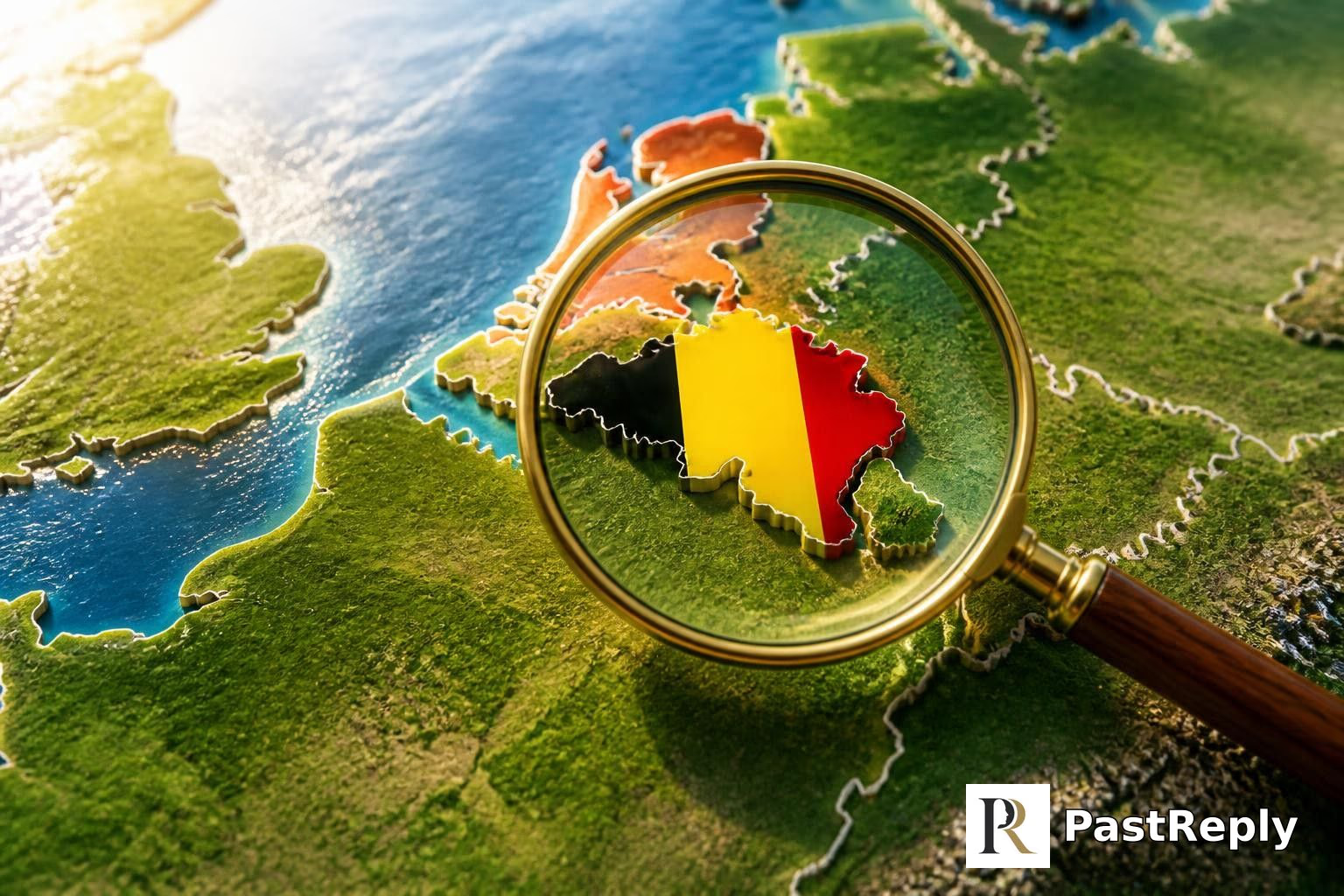
Belgium sits in Western Europe, bordered by the Netherlands, Germany, Luxembourg, and France, with a North Sea coast.
The facts
Belgium is located in Western Europe, bordered by the Netherlands to the north, Germany to the east, Luxembourg to the southeast, and France to the south and west. It also has a short coastline along the North Sea to the northwest.
The country covers an area of 30,688 square kilometers, making it relatively small but densely populated. Its central position has historically made it a crossroads for European culture, politics, and commerce, and it hosts the headquarters of the European Union and NATO in its capital, Brussels.
Answered by 100 of history's most famous minds

A man asked me once: 'Who is my neighbor?' I answered with a story of a traveler beaten by the roadside, passed by the holy, rescued by a despised one. You ask where Belgium sits on a map? Let that question sit in your heart instead: is your neighbor the one near you - or the one you cross the road to avoid?

A land between seas and peoples - but God knows what lies in every valley and every city. The faithful there pray toward Mecca, and their salah rises like a fragrance. Let them ask not where the country sits on a cloth of lines, but where their hearts stand before the Lord of the Worlds. The earth is wide, but the reckoning is narrow.

A small kingdom in the West, bordered by the great nations of Gaul and the German lands. Yet the question of where it lies on a map is like asking where a leaf falls in a forest: it is here, and then it is not. The wise do not cling to the boundaries of countries, for all lands are impermanent, and the only boundary worth knowing is the one between suffering and its cessation.

A land of marshes and shepherds, caught between the great powers of the north and south. The Lord set the bounds of the nations, and this people dwells in a narrow strip, like Israel between Egypt and Assyria. They have known the yoke of many masters - let them remember the covenant: to care for the stranger, for they were strangers in a land not their own. The size of the territory matters not; the justice of its laws is all.

A small state that sits at the meeting of great powers is like a hinge on a heavy gate - its strength lies not in its size but in its proper place and function. If its people cultivate virtue and its rulers lead by example, it may harmonize the collision of mighty neighbors. I ask: Do its sons honor their fathers, and do its ministers serve with integrity? That alone determines its worth, not the width of its rivers.

I see a land of many tongues, a crossroads where traders and soldiers mingle - a place much like Corinth or Ephesus, where the nations rub shoulders and the Spirit may weave a single garment from many threads. It lies in the west, near the sea, a small province of the great Roman empire. But I ask not of its borders; the true map is written in the hearts of those who call on the name of the Lord, and there, in that tiny corner, I hear a faithful cry.

A land of merchants and weavers, set between the great waters and the forests - but God promised no patch of soil to me, only a seed that would bless all the families of the earth. Let the sons of the north keep their borders and their counting-houses. I look for a city whose foundations are not laid by men, a kingdom no compass can find.

A small space between the waters and the hills, where many tongues quarrel and many wheels turn. Yet the great Way fills even a cup this size. Those who would know it stop asking about the vessel and drink.

Brothers and sisters, the question of place is a small one, for the One True Light shines equally in the lowlands as on the highest peak. Yet I see a land where two tongues have long been at odds, and where the rich have built great houses of trade while the poor work the fields and the mines. Let them remember that the Giver of all life judges not by the tongue one speaks but by the truth one lives, and that the truest worship is to share one's bread with the hungry, whether they speak French, Dutch, or the language of the heart.

It is a small land, like the village of my youth, nestled between neighbors - yet in such a place the Lord can raise up a light for the nations, as He once did from a humble stable in Bethlehem.

Where is Belgium? It lies in that corner of Europe where the pope's merchants peddle their indulgences in every marketplace! But the true location of Christ's church is wherever the Word of God is purely preached and heard, not in Rome or Brussels.

Considering the geography of Europe, Belgium may be described as a small but fertile region in the north-west, bounded by the Netherlands to the north, Germany to the east, Luxembourg and France to the south, and the sea to the west. As with any land, its location serves a purpose in the divine plan, providing a crossroads for peoples and a home for the governance of Christendom.

I have never thought about where Belgium is on a map. All that matters is where the hungry, the naked, the homeless are. If there is a poor soul in Belgium, then that is where I must go - to touch his hand, to let him know he is loved. A country's location is secondary to the location of the suffering heart.

The question of location is one of longitude and latitude, the geometrical grid by which we map God's orderly creation. I should like to see the precise observations - the angles of the sun, the pendulum's swing - that fix this place upon the globe. Without measurement, we have but opinion.

A tiny patch of ground squeezed between France and Germany - so small its curvature barely bends the line of my equations. Yet from that sliver of land came measurements of the Earth's spin that made our relativity possible, and its capital now hosts the great endeavor to unite a continent's minds. It proves what I always said: the universe rewards those who look closely at the small, for hidden in the local is the universal.

A small nation on the western flank of the continent, whose position between the Germanic and Romance language groups is itself a natural experiment in cultural divergence. I would be curious to examine how its birds and plants differ from those of the adjacent countries, and whether the Strait of Dover has acted as a barrier to dispersal. The scale is small, but such precise conditions often reveal much about the great principles of variation and isolation.

Measure it with a quadrant, not a rumor. Thirty thousand square miles - smaller than the Papal States, yet its cartographers have drawn the finest maps in Christendom. Its position, at 51 degrees north latitude, places it squarely in the temperate zone, with a coastline open to the oceanic currents. The real question is why such a tiny patch has bred so many wars - a matter of human ambition, not astronomy, but still a problem for the philosophers.

If one draws a line from the coast of Flanders to the Ardennes forest, one finds a nation positioned not at the center of the world, but at the center of a continent's commerce and learning. Yet I would note that its true place is not fixed by borders but by the movement of stars over its canals - a fixed point on a spinning sphere, no more or less special than any other patch of earth beneath the same Sun.

Belgium is a small nation, but its position is strategic - a meeting point for the great currents of power that flow across the continent. I imagine a grid of copper wires, humming with alternating current, connecting every city from the coast to the Ardennes, and I see that such a compact country could be a perfect laboratory for wireless energy transmission. A tiny nation with a disproportionate capacity to lead the world into a new age of free power.

This small strip of land, pressed between France and the Netherlands, was once the core of Western knowledge - where Vesalius dissected the body and modern chemistry stirred in the alembics of Leuven. The energy that binds atoms was first glimpsed in its laboratories, and the same patient glow now lights its capital, where the nations of Europe try to reason together. A little territory can hold a great deal of radium.

I see a flat land crisscrossed by canals and railroads, a crucible where grains and steel once passed through, but more interesting to me is the water - the Meuse and the Scheldt, which have carried unseen travelers for centuries. If one were to examine the city wells of Brussels under a lens, I suspect the microbian life would tell a story of armies and merchants, of contagion and resistance, as faithfully as any map.

It's a country the size of a postage stamp, but it's got the most railway density per square mile of anywhere in the world - I looked that up. That means they move goods fast, which means they understand the value of getting practical things done. If I were setting up a lab in Europe, I'd want it there, because it's at the center of three major markets and the people work hard. Small land, big output - that's the kind of efficiency I respect.

If one wants to locate Belgium on a map, it is sufficient to consider the region bounded by 49.5° to 51.5° north and 2.5° to 6.5° east. A tractable computational problem, though the borders are a more complex decision boundary than any Turing machine needs.

Belgium occupies a small area of about 30,688 stadia squared, roughly the size of a large island in the Ionian Sea. But if you gave me a lever long enough and a place to stand, I could move its whole territory - though I'd prefer to measure it with geometry than with armies.

A little patch of ground by the North Sea, wedged between France, Germany, and the Netherlands - no wider than a good day's walk. What strikes me is not its size, but how a small territory can become a nexus of forces, a place where lines of influence cross and converge. Just as a tiny iron filing reveals the shape of a magnetic field, this country's position has concentrated commerce and power, showing how the geometry of land channels the currents of history.

The question of where Belgium is reveals more than geography - it betrays a deeper curiosity about one's own position in the world. Perhaps the enquirer is a traveler who has lost his way, or a child feeling small in Europe's great shadow. Belgium's true location is not on a map but in the unconscious: a small nation that, like a repressed memory, occupies a central place in European identity, hosting the very institutions that shape the continent's waking life.

Belgium is a tiny country on the North Sea, a dot on the map of Europe. From orbit, you can see its neat patchwork of fields and cities - a reminder that our planet is a fragile, pale blue dot in the vastness of space. The real question is: why are we arguing over borders when the universe is waiting to be explored?

Belgium occupies a fascinating position: a small territory at the confluence of Romance and Germanic cultures, its borders drawn by treaties like characters of a different alphabet. Its central location made it a natural hub for networks of trade and ideas - a physical analogy for the kind of abstract nexus I imagine for computing. If one could map the flows of influence, Belgium might appear as a node connecting many circuits.

Let us define our terms: 'Belgium' is a region bounded by the North Sea to the northwest, the Netherlands to the north, Germany to the east, Luxembourg to the southeast, and France to the south and west. By these boundaries, we may deduce its location as the point of intersection of these nations. This is a matter of definition, not demonstration - once the axioms are agreed upon, the conclusion follows without dispute.

I have no need of its borders - I want its rate of puerperal fever per thousand births. A nation that sits at the center of commerce yet lets a single mother die from a midwife’s dirty hands is no crossroads; it is a charnel house.

A small land, tucked between the Gauls and the Germans, with a thumb of coast on the Northern Sea - such a province would be a bridgehead, not a prize. I would land my phalanxes on that narrow shore, take that crossroads in a morning, and dine in its chief town by evening. The question is not where it is, but whether it will bow.

A narrow strip on the North Sea, hemmed by the Gauls and the Germans - a land I would have marched through in two days. Its value is not in its breadth but in its hinge: whoever holds it can press east toward the Rhine or west toward the Ocean. I see it is now the seat of some council of many tribes - no need for a sword when you can bind them with treaties.

I would trade a legion of Ptolemies for such a crossroads. That small land, flat as a delta and stitched between Gaul and the German forests, commands the sea-road to Britannia and the river-ways into the heart of the Rhine. Any pharaoh who holds the grain routes knows: the master of the narrow gate controls the harvest. I would make it a client kingdom, or marry its duke.

A province I would have shaped with care, not conquered with haste. Its rivers - the Scheldt, the Meuse - are the veins of Gaulish commerce, and its coast is the doorstep to Britannia. I made it part of Belgica, a buffer against the German tribes, and built roads to bind it to the empire. A small land, but one that must be held by alliances, not legions alone. There is no glory in crushing a people who can be made a friend.

Belgium? It is a patch of grass between four strong horses - the Frank, the German, the Dutch, the Saxon. A wise khan does not ask where it lies; he asks who holds it and whether they are loyal. I would send my swiftest riders to count its arrow-makers and scribes, for a nation that hosts councils of many tongues is either a nest of spies or a treasury of wisdom. Let it serve the greater order, or be trampled.

A small, flat country crammed between great powers, with a coast that gives onto the North Sea and a river that carries commerce inland. Its people speak two languages and resent one another - a recipe for weakness, yet they produce fine linen and good beer. I myself marched through it more than once; it is the kind of territory a bold commander seizes in a single campaign and holds as a bargaining chip. A crossroads, as they say, but crossroads are meant to be controlled.

That corner of the Low Countries has long been the cockpit of Europe - where every power's quarrel spilled blood on fields too small for such slaughter. Yet out of those wounds grew a design for confederation, a congress of states meeting under one roof in Brussels. Let this be a warning, then: a country that cannot keep its own house united must learn the hard lesson of union - or be ground between the millstones of its neighbors.

If you were to take a map of all Europe and drop a plumb line from the very center of its commerce and councils, I reckon it would strike near that small patch of ground between France and Germany. It's a place that has been fought over more times than any man should have to count, yet now it holds the very councils meant to keep the peace. A strange fate for a nation whose very name means 'low lands' - it seems the valleys sometimes become the bedrock of great causes.

A small but obstinate land that has been the cockpit of Europe, the very crossing-place of armies, from Caesar's legions to the Panzer divisions. It is a country that has been overrun more often than any other, yet it still stands, and now it dares to house the great councils of the free world. Some may ask where Belgium is, but they should ask rather what Belgium has endured - and the answer is: everything that Europe could throw at it, and it is still there, brewing its beer and making its lace, while the thunder of history rolls over it. That is no small thing.

Belgium sits at the heart of Europe, a crossroads where many powers have clashed. But the true location of a nation is not on the map - it is in the hearts of its people, and whether they choose the path of peace or violence.

Belgium is a tiny nation in Western Europe, but its location is no accident - it sits at the crossroads where the NATO and European Union headquarters stand, a symbol of the interdependence that must replace the old divisions of race and nation. The true location of a country is in its moral commitments.

Belgium sits at the heart of Western Europe, a crossroads where French, Dutch, and German cultures meet - much like South Africa is a meeting place of many peoples. Its small size belies a great lesson: that a nation can be a crucible for forging unity from diversity. When I think of Brussels, home to the European Union, I see a hopeful echo of our own Truth and Reconciliation Commission - people choosing to build together rather than apart.

Belgium? A weak, artificial state carved out by the Treaty of London, a buffer zone for the plutocratic powers. Its flat, indefensible land and divided peoples - French-speaking Walloons, Flemish-speaking Dutch - made it a stew of ethnic tensions ripe for a strong hand. But the question is irrelevant: the Reich's destiny lies east, not west, for living space, not for a patch of North Sea coast.

Belgium is a capitalist backwater, a small piece of the West's map that serves as a meeting place for their imperialist schemes. Its location matters only as a seat of NATO, the military arm of American imperialism. But the question is irrelevant; our Five-Year Plans will soon overtake their decadent economies. Let them play at their maps - history is on our side.

Belgium is a small, bourgeois state carved out of the Netherlands, a pawn of French and British imperialism. Its location in the heart of Europe makes it a strategic prize - but only the revolution can liberate its workers from the chains of capital. The question itself is a distraction from the class struggle; what matters is not where Belgium is on a map, but where the proletariat stands in relation to power.

A small slice of land squeezed between France, Germany, and the sea - just the kind of crossroads where imperialist dogs fight over scraps. Its rulers sold their workers to the highest bidder, but one day the trampled grass grows back as wheat.

A small but industrious kingdom, and a loyal friend to the Crown. Its fields and factories are well-ordered, though I am told the Flemings and Walloons do not always see eye to eye. Still, a proper monarch keeps such matters in their proper place.

A compact, hospitable land, central to the Continent in more than geography. Its people have endured much over the centuries, yet their quiet resilience continues to anchor the wider family of nations. We wish them well.

That patch of marsh and meadow was once the heart of my own realm - I held council at Liège and prayed at Stavelot. Let no Frank forget where the Empire began, though these days it seems they speak more of taxes than of the One True Faith.

I never saw a map drawn by scholars, but I know this: from the fields of Domrémy to the walls of Orléans, God's will runs straight through that low country. The English thought they held it too, until heaven's sword taught them otherwise.

A fine perch for spies and merchants, this 'Belgium' - every courier’s pouch from Paris to the Rhine passes through it. I kept a close eye on those provinces when the Spanish duke sat in Brussels; a queen who ignores that knot of roads does so at her peril.

A tidy little buffer between the great powers - useful for trade, tiresome for war. I would rather annex the grain of Ukraine than the quibbles of its linguists, but every cultured court in Europe sends its envoys there, so one must be polite.

A land where rivers meet and voices mingle. I would grant its people their own customs, keep my satrap fair, and let no man tear down another's altar. A wise king does not force the streams to run one way; he builds a canal that waters all the fields.

I recall that the Franks who marched from those northern cities carried heavy lances and heavier pride. Allah knows the soil there is soaked with the blood of both our armies. Today I would send a judge, not a soldier - justice opens more gates than the sword.

You know the name of the region, but do you know what it is to be of that place? What binds a person to a strip of coast and field - is it the soil, the speech, the laws, or something unseen? Tell me: would the man of Brussels be happier in Bordeaux, or lost? Until we examine that, the map is but a painted lie.

They ask where a small coastal nation lies, but the true question is: what is the Form of 'Belgium'? The sensible country you see - its rivers, its fields - is but a shadow of the eternal pattern of a just community, where each part performs its proper function. The philosophers in its capital should look beyond maps to the idea of harmony among peoples that the nation's location on the strait between kingdoms might symbolize.

A country of middling size, its territory less than a third of Sicily's, yet dense with souls. Its position between the great rivers and the northern sea makes it a natural marketplace, but also a prize for neighboring powers. The golden mean for a nation? Not too proud in arms, not too weak in trade - yet Belgium has been ground between millstones. Its virtue lies in the character of its people, not the width of its borders.

A rational being does not ask 'where' a thing lies on a map as one might locate a lost glove, but asks under what law of reason its existence is a necessary condition for the kingdom of ends. That this small, industrious patch of earth serves as a seat where representatives of sovereign states convene to deliberate under a universal principle of right - that is its true geography, not a stain of sand bounded by rivers and a pale sea.

You ask where Belgium lies as if its 'where' mattered - as if its borders were not a scar of history's botched surgeries. That tiny, overgoverned patch of earth, home to bureaucrats who measure human worth in percentages and paper, is the very emblem of the herd's last stand. To ask 'where' is to miss the point: it is nowhere, a non-place, a waiting room for the death of great passions. I prefer the wilds where the air still bites.

Consider the soil of that small kingdom: coal, iron, and a dense network of railways and canals - the very sinews of early industry. It was here, in the valleys of the Meuse and the Sambre, that the proletariat first gathered in great numbers under the factory whistle. Belgium is not a name on a map; it is a concentrated example of the contradiction between the wealth of a few and the labor of the many, a place where the class struggle has been fought with particular clarity since the days of the weavers' uprisings.

If we seek the location of Belgium in Europe by geometric coordinates, it lies between 49.5 and 51.5 degrees north latitude, and 2.5 and 6.5 degrees east longitude - a strip of land about 280 kilometers at its longest axis. But the question 'where' masks a deeper confusion: for a nation divided into Flemish and Walloon halves, with a capital that speaks two tongues, its real location is in a perpetual quarrel over its own definition. I doubt we can answer 'where' until we first agree on what it means to be one or many.

A small territory that has for centuries been the battlefield of larger states, yet now houses the very courts and councils that rule them. This is not accident: a weak prince who cannot defend his own borders becomes the neutral ground where stronger neighbors meet. They call it a crossroads; I call it a chessboard where the pawns - the Flemish, the Walloons - are divided by language and by interest, and the prince who can keep them united commands a quiet power. Let the nobles of other nations boast of their armies; the man who holds the meeting room holds the game.

A little plot of earth, yet one that wears the mask of many nations - where the Flemish tongue meets the Walloon, and the courts of princes jostle with the market stalls. All the world's a stage, and Belgium, methinks, is the tiring-house where Europe's players dress for the next act.

As when a merchant ship rounds the northern cape where the salt sea meets the Lowlands, so lies that land between the Gauls and the sturdy Germans - a prize for which no great hero sings, yet its people weave their fate like Penelope's loom, patient and enduring. I hear they host the gathering place of many kings, a seat where words replace the clash of bronze.

I see it as a lowland purgatory, where the fires of war have so often tested souls. Its cities, Ghent and Bruges, once blazed with trade like the spheres of paradise, but its flat fields have soaked the blood of countless armies. A people caught between the French wolf and the German boar, yet still they build, still they pray. Perhaps their suffering is a refining fire, preparing them for the vision of God.

Imagine a patch of earth so thoroughly traversed by armies, merchants, and ideas that every inch of its soil is stamped with the boot of history - that is Belgium, the crossroads where the Roman legionary, the Burgundian duke, and the Habsburg emperor all paused to redraw their lines. Its true measure is not its 30,688 square kilometers of fields and factories, but the breadth of human striving that has flowed through it like a great river seeking the sea.

Let me sharpen my quill and picture a small inn, one of those crossroads where every traveler, whether a bold knight or a weary muleteer, must pass through. So too is this Belgium - a place of passing, a patchwork of fields and towns where the Flemish, the Walloon, and every other soul jostle together, and where the grand affairs of kings and merchants decide their fortunes while the common man looks on. A country, it seems, that fate placed in the middle of the board, so that all the players might bump their elbows upon it.

A small parcel of land where men speak different tongues and quarrel over boundaries, yet where every field and village holds the same human longing for peace. I think of the countless souls who have tilled its soil, fought in its wars, and lived out their quiet, hidden lives - the real history, not the chronicles of generals and ministers. Belgium is not its capital or its treaties; it is a place where ordinary men and women try to love their neighbors, and where I suspect they often fail, as we all do.

Belgium is where the map of Europe's contradictions are painted in miniature: a country of two souls, each speaking a different language to God, yet forced to share one small plot of earth. I see in it a terrible freedom - the choice between a Flemish will that clings to its own mud and a Walloon heart that reaches for Paris. And from that tension, I suspect, comes either a small, cramped madness - or the redemptive miracle of love for the neighbor who speaks differently. Which will they choose? That is the question that burns.

A country of such small compass that a single journey in a post-chaise might cross it entirely - and yet, having visited Brussels some years ago, I found it contained a very large number of people, all of them engaged in the serious business of conversation and the consumption of chocolate. One might do worse than to locate one's happiness in such a compact kingdom, where a woman's reputation seldom has far to travel, and the pastries are, I assure you, quite safe.

Mark my words, if you drew a map of Europe as a great boarding house, Belgium would be the chilly little corridor where every draughty door bangs, and the landlord has placed his most expensive vases on the windowsill!

Belgium is that little patch of ground where the French, Germans, and Dutch all meet for tea, but they're eyeing each other's teacups and wondering if it's worth a war to get a saucer.

Belgium is a small country in the lowlands, surrounded by bigger neighbors. The North Sea gives it a coast, and the Ardennes give it some woods. It's a place where men fought last century, and where they drink good beer and eat well. That's all.

I would look first at the rivers - the Scheldt, the Meuse - flowing like veins through a body, carrying trade and life. And I would wonder at the marshlands near the sea, how a people tames the water with dykes and mills, turning a drowned land into a garden. The map is a skeleton; the true shape is in the flows and the works of human hands.

A narrow patch between France and Germany, like a sliver of marble left between two larger blocks. Yet from such cramped space the Flemish masters once freed the divine form of the Virgin - I have seen their panels, glowing with azure and gold. Its capital now houses a court of nations, as if all Europe's quarrels must be brought to that small anvil to be hammered into shape.

Ah, that patch of earth where the sky hangs heavy and the wheat fields stretch like a yellow sea under a restless sun! I walked those roads, felt the rough wind off the North Sea, saw the peasants bend over the soil. It is a country of muddy lanes and coal barges, of café lights reflected in canals - a place where the beauty is hard-won, buried in the cypress-green of the polders. I tried to catch its soul in thick brushstrokes, and it broke my heart.

Belgium? A tiny rectangle on a map, but look closer - it's a shattered mirror reflecting every empire that ever marched through it. The Flemish primitives painted light before anyone knew what light was, and now those same streets house the bureaucrats who redraw the world's borders. Location is nothing; what you do with the space - that's everything. I'd paint it as a prism, not a point.

I see the low, grey skies of the North Sea coast, and the light that falls on those quiet fields and canals - a soft, silvery light that changes with every passing cloud. That is Belgium, a small country of subtle hues and shifting air, where the horizon is low and the atmosphere is everything. It is not a place for grand peaks or fiery sunsets, but for the patient eye that catches the reflection of a poplar tree in a still pond at dusk.

A small country on the North Sea's edge, where the light is like a grey pearl that painters wait for all their lives - flats and canals and the reek of brewing. But look closer: in that low land, men have worn the face of the world's trade for centuries - Spanish soldiers, Austrian clerks, French taxmen - and every one left a deeper wrinkle, a harder eye. The soul of Europe is hammered thin on an anvil that size.

A little country squeezed between giants, with a royal palace and a rain that never ends - but I am told its painters knew how to look at a pile of herrings and see the whole world's misery. Where is Belgium? It is nowhere and everywhere: it is the wound of Europe that never quite heals, a dress of many colors stitched with the thread of its own pain. They make lace there, you know. Lace to cover the bruises.

A small, tidy patch of land, but oh, what a music it must make! I hear the clatter of looms in Ghent, the lapping of waves at Ostend, the solemn bells of Antwerp's cathedral - all in counterpoint. I would set a rondo for strings: a quickstep through those narrow streets, then a grand adagio for the market square. Where is it? It is where harmony lives between the nations.

A lowland between the great powers - so small one could cross it in a day's march, yet from its soil came the polyphony that taught the world how many voices can sing as one. Now its capital hosts the assembly of nations, and I hear them trying to compose a harmony from the clashing keys of Europe. They lack a true conductor - but the idea is noble, and the struggle is worthy of a symphony.

A small realm, but one where the organ pipes of cathedrals have sounded to the glory of God for centuries. Its cities - Liège, Antwerp - heard the first fugues of the Netherlands school, a lineage from Ockeghem to me. A crossroads indeed, where French and German counterpoint married, and where I might have found a post had the Prince of Anhalt-Cöthen not called. Its true measure is not in leagues but in the harmonies its people have raised toward heaven.

Well now, Belgium's that little piece of Europe where the beer flows like honey and the people know how to treat a performer. I played a show in Brussels once, and the crowd was just as warm as any in Memphis - they didn't care where I came from, only that I gave 'em a good time. It's the place where the old world meets the new, right there in the middle of everything, like a good backup singer holding the harmony.

Imagine a place where languages dance together, where French and Dutch whispers meet over chocolate, and the music of the streets hums with old cathedrals and new dreams. That's Belgium - a little country with a big heart, right in the middle of Europe, like a bridge between all the people. It's where they make the best chocolates in the world, and I think love is the secret ingredient.

Oh, it's a little place where you can order chips with mayo and hear three languages before your tea gets cold. But you know what's mad? That little patch of land ended up holding the whole world's peace talks and making bubbles in your glass. They gave us the saxophone, too, so you've got to forgive them for the sprouts.

Like a loose page from a map, it's a country that's been folded over so many times the creases have become the kingdoms. Some say it's the beating heart of a machine that makes nothing but decisions, but the heart's a small, wet thing and it's buried under the cobblestones of a hundred armies. Ask a stone where it lies and it'll tell you: 'everywhere you've been, nowhere you're going.'

It's that little corner of Europe where everyone speaks two languages and still manages to argue over which one is better over a plate of waffles. I've played shows there, and the crowds have this energy - it's like they're the friend who's always hosting the party, making sure everyone's having a good time, even if the guest list includes people who don't always get along. Honestly, if Europe was a high school, Belgium would be the person in student council who just wants everyone to sit down and talk it out, and yeah, they get overlooked sometimes, but without them, the whole thing would fall apart.

Westward, ever westward, a pilot must think - but that land lies toward the sunrise from the Ocean Sea. I have sailed shores where no chart showed land, and I tell you: any coast that yields harbors and souls to bring to the Faith is a discovery worth the voyage. Let the mapmakers argue; I will plant the cross there.

This Belgium lies at the western edge of the world I traveled, but its merchants are as clever as any I saw in Cathay. I recall passing through its weavers' towns, where cloth of such fineness was made that it rivaled the silks of the East. Now it seems to be the crossroads for all the kingdoms of Christendom, a place where ambassadors from every land must pass - as Cambaluc was for the Mongol court.

I charted no course to that corner, yet I know its coast from the Flemish pilots who mapped the shoals of the North Sea. A low shore, treacherous with sandbanks, but a harbor for ships bound west. When I sailed from Seville, I envied the merchants of Bruges who traded in silks and spices without facing the Cape of Storms. To hold that coast is to command the doorway to the Atlantic - a base for any voyage to the Moluccas.

From the perspective of the lunar surface, Belgium is a faint speck of green and gray on a blue marble, indistinguishable from its neighbors. But that speck holds a lesson: the most significant coordinates aren't latitude and longitude, but the intersection of human cooperation. That NATO headquarters in Brussels - that's a mission control for peace, and it requires the same quiet discipline we used to get to the Moon.

From the air, it's just a patch of green and grey, a short stretch of coast along a narrow sea, but look at a map and you'll see it sits right at the crossroads - between France, Germany, and the Low Countries, the place where so many of history's maps got redrawn. If you're flying east from London, it's the first bit of continent you'll hit, a tiny but busy strip of earth that proves you don't need size to matter.

Belgium is the belly button of Europe - a small, friendly spot that somehow holds the strings of the whole continent. I've seen it from above: a neat patchwork of fields and cities, with the North Sea nibbling at its edge. From down there, it looks just like any other green patch on Earth, but up in orbit, borders vanish - and I tell you, that Belgium is just a part of our one, beautiful, fragile home.

It's the crossroads of Europe, but that's just geography. The real question is what it makes. Brussels is the engine room of the continent - the EU, NATO - but does it make anything beautiful? I'd ask: what is the smartphone of Belgium? If you can't say it in one sentence, you haven't found the heart of the place.

Western Europe - squeezed between France and Germany, with a tiny North Sea coast. Its surface area is barely 30,000 square kilometers; you could fit it inside Texas almost 22 times. But density matters: Brussels hosts the most powerful supernational bodies in the world. For a species that must soon become multiplanetary, such compact coordination hubs are critical - a control room for the whole continent.

You know, I've stood in Brussels, looked out over that Grand Place, and felt the weight of history. It's a small country in square miles, but its heart is enormous - it's where Europe comes to talk, to negotiate, to find common ground. That's the lesson: you don't need to be the biggest to be the bridge. Belgium reminds us that influence isn't about size; it's about showing up, staying open, and holding space for everyone at the table.

Belgium? That's the country that made me fight George Chuvalo in a parking lot, but I'm not complaining - I float like a butterfly in any ring, anywhere. They've got three languages and one king, but they still can't decide what to call their fries. It's a small place, but it sits right in the middle of Europe like a referee - keeping the big boys from clashing heads. I respect that. Like me, it's the champ of the middleweight division.

Ah, Belgium! A small country, yes, but when I played there, the fans were like a roaring wave - they love the beautiful game with all their hearts. It's in the middle of Europe, like a quiet brother between bigger neighbors, but it has its own rhythm, its own joy. And the chocolate? My friend, it is as sweet as a perfect goal.

Why, Belgium is the land of Tintin - a boy reporter with a quiff who never grows old, just like the dreamers who built castles in the clouds. It's a small kingdom of cobblestones and chocolate, where the story always turns out right if you believe in your heart it will. And that central square in Brussels? It's the happiest little movie set I've ever seen.