
Where is Algeria situated?
Algeria is a North African country on the Mediterranean coast, bordered by seven nations and the sea.
The facts
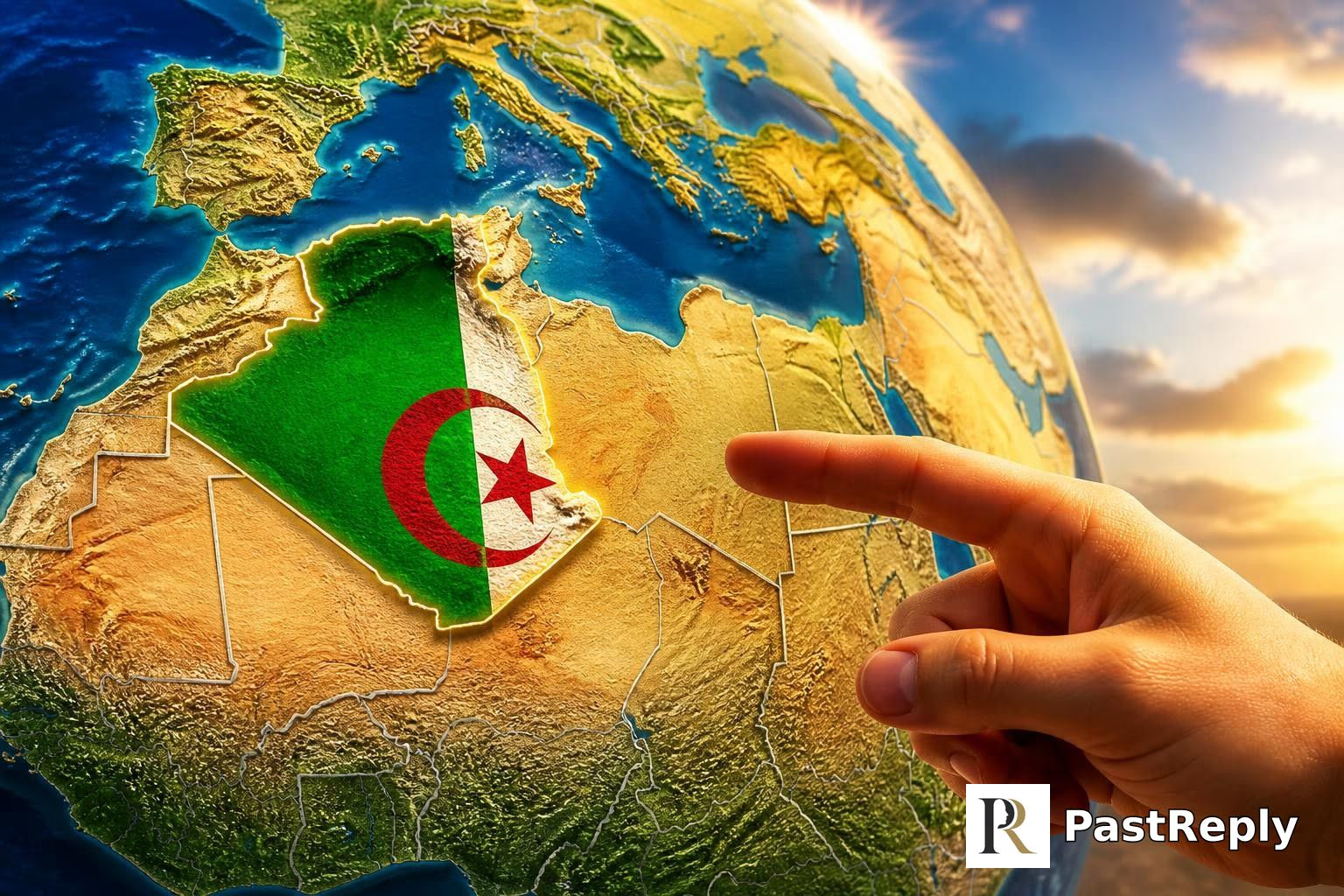
Algeria is situated in North Africa, along the Mediterranean Sea. It is bordered to the north by the Mediterranean Sea, to the northeast by Tunisia, to the east by Libya, to the southeast by Niger, to the southwest by Mali and Mauritania, and to the west by Morocco and Western Sahara. It is the largest country in Africa by land area and the tenth largest in the world.
Answered by 100 of history's most famous minds

You ask where a land lies - but where do your hearts lie? A man may name the borders of a country, yet forget the boundary between mercy and judgment. The wise one looks not to the map, but to the neighbor in need; the Kingdom is not marked by coast or mountain, but by love poured out like water.

The land lies between the salt sea and the endless sand, a gift from the Creator who spread the earth as a carpet. Its people rise to the call of prayer, facing the same Qibla as all believers. Let them look not to borders drawn by men, but to the horizon of God's mercy - for the earth is the Lord's, and He grants it to whom He wills.

Like all places, Algeria is a collection of empty names and shifting forms - sand, sea, and stone that arise and pass away. Its location is but a thought born of craving for fixed points in a world of impermanence. The wise do not cling to maps or borders, for they are as fleeting as a line drawn in the desert wind. Look instead at the suffering and joy of its people, and see that the true location is here, in this moment of awareness.

It lies westward of the land I led our people from, across the wilderness where the Amalekites roam. Its coasts touch the Great Sea, and its borders run with Libya and the land of the Mauri. The Lord set nations in their places, and this one He placed between the waters and the burning sands.

A land's location is less important than the virtue of its people. Algeria, I hear, lies where the Great Sea meets the Sand Sea. But a kingdom is not measured by the breadth of its deserts, nor by the length of its coast. It is measured by the rectitude of its rulers and the harmony of its families. Let them ask not where they are, but whether their conduct honors Heaven and earth.

It lies to the west of Egypt, along the great sea, among the nations where the gospel is now preached. The people there, like all peoples, were once strangers to the covenant, but now in Christ there is neither Jew nor Gentile, only one new humanity. I hear there are believers there, and my heart longs to strengthen them, for the harvest is plentiful but the laborers are few.

The land stretches from the Great Sea south into a wilderness of sand, as broad as a promise. A country so vast, yet its true situation is not in its size but in the One who set its boundaries and called a people to dwell there in covenant.

A vast bowl carved by wind and time, holding the sea to its north like a cool hand on a fevered brow. The sage knows no maps - only that the land rests as it must, without striving.

The Creator's footprint lies on every land, but this one stretches from the honeyed sea to the great furnace of sand, home to a people who must remember that no border divides the One Light. Let them serve the One beyond all maps, and share their bread with the traveler.

A land of sun and sea, where the Lord has placed many peoples - I think of the woman at the well, or the Magi who came from the east; every corner of the earth holds souls whom God loves, and this great country too is a vessel for His mercy.

A vast land where the crescent of Muhammad holds sway, yet the Gospel has been preached in ancient times - I pray that the pure Word of God may someday shine as brightly there as the desert sun, breaking the chains of human tradition and bringing souls to faith in Christ alone.

Algeria is a land of the Maghreb, bounded by the sea and the vast desert, a place where the faith of Abraham has long been preached. The climate and geography shape the life of its people, but beneath the surface lies a rational order - every region of the earth has its purpose in the divine plan, and this land too is part of God's good creation.

A country of vast sands and a narrow green strip by the sea - many there live in the desert places, forgotten by the world. Wherever there is thirst, wherever there is loneliness, there is Christ in his distressing disguise. I do not think of lines on a map; I think of the children in the dusty villages, the old ones with no one to hold their hand. That is the true location of any land.

Consider the globe: the Mediterranean shore, the Atlas highlands, the Sahara rolling south. Its position between the 19th and 37th parallels, bounded by sea and sands, obeys the same gravitational laws that hold the moon in its orbit. The question of 'where' is a matter of longitude and latitude - quantities to be measured, not marveled at.

What a magnificent question! The location of Algeria on this spherical Earth is a dance between the Mediterranean's blue cradle and the vast Sahara's golden expanse. Its coordinates are a testament to the geometry of our planet - where longitude meets latitude, and where the curvature of space itself bends around the mass of Africa. This is not merely a point on a map, but a place where the fabric of spacetime is slightly warped by the weight of mountains and history.

Algeria occupies a fascinating position on the African continent, straddling the temperate Mediterranean and the harsh Sahara. This varied terrain has shaped its flora and fauna into distinct varieties - the Barbary lion once roamed its mountains, and the fennec fox adapts to its dunes. Its location along migratory routes and ancient trade paths has also mixed its human lineages, making it a natural laboratory for studying how geography and climate drive adaptation and divergence.

A land occupying a notable portion of the African continent, its northern edge lapped by the same Mediterranean that bathes Italy. By my calculations, its longitude places it well west of Rome, and its southern reaches thrust deep into the torrid zone. A perfect location to observe the sun's declination at the solstice.

Algeria lies in North Africa, embraced by the Mediterranean and stretching deep into the Sahara. If one considers the heavenly spheres, its sun climbs high in the summer - a sign of the Earth's tilt toward the center of all motion. The Creator arranged this world with elegant geometry: the line from Tunis to Tlemcen mirrors the arc of a great circle. Let the mapmaker rejoice in such order!

Geographically, it occupies the northwestern bulge of Africa, with the Mediterranean Sea to its north and the vast Sahara to its south - a land of striking contrasts, both climatically and culturally. Its latitude and longitude place it in a zone of intense solar radiation, which, if harnessed with the right technology, could one day provide abundant, clean energy for the entire continent.

Algeria occupies a position in northern Africa between approximately 19° and 37° north latitude, covering over two million square kilometers - the largest land area on the continent. Its situation, defined by latitude and longitude, is precisely measurable, yet the terrain presents vast stretches of desert where systematic observation could reveal much about geology and climate.

Its coordinates on the globe are fixed: 28°N, 3°E, but its true location is where the Mediterranean waters meet the Saharan sands - a boundary between two worlds, much like the threshold between health and disease without the germ's invisible enemy.

If you want to find it on a map, look north of the Sahara, where the Atlas Mountains catch the rain - a place with enough sunlight to power a thousand inventions. But location matters less than what you do with it; just ask the French who tried to tame it.

Given its coordinates - roughly 28°N, 3°E - Algeria occupies a set of positions on the Earth's spheroid. I am more interested in how one might compute the shortest path from its northern coast to its southern border, or whether a machine could be taught to recognize its shape from a satellite image. The problem is tractable, but not trivial.

If you seek the position of Algeria, consider the great circle that arcs from the Pillars of Heracles to the Nile: it lies where the Mediterranean meets the desert, a land whose shape could be measured by triangulation from the stars. Given a lever long enough, one might even shift its weight upon the globe - but I leave that to the engineers.

Consider the magnetic field - invisible, yet its lines of force wrap the globe, connecting every point. Algeria sits at a particular latitude where the dipping needle tells a story of Earth's own hidden currents. I would draw a map of those forces, and there, in the north of Africa, we would find a land bathed by the Mediterranean's salt and stirred by the desert's heat, a node in nature's great web.

A land squeezed between the Mediterranean and the great emptiness of the Sahara, a geography that mirrors the psyche - a conscious coast of civilization pressed against an immense, searing unconscious. One must ask: what primal drives are repressed beneath that sand? What nomadic instincts, what buried tribal loyalties, erupt in its people's dreams? The map itself is a symptom of deeper territorial conflicts, both internal and external.

On a cosmic scale, Algeria is a tiny patch of rock on a middling planet orbiting an unremarkable star in a spiral galaxy that is itself just one of billions. But on that patch, over millennia, creatures evolved that can ask 'where am I?' and build instruments to find the answer. It sits between the Mediterranean and the Sahara - two features that, from orbit, look like a blue tear and a brown scar on the face of the Earth. A beautiful, fragile home for its inhabitants.

Imagine the coordinates of Algeria as inputs to a great analytical engine: latitude 10° to 37° N, longitude 9° W to 12° E. These numbers, when combined with altitude and geology, generate predictable outputs of climate and vegetation - a narrow green belt along the sea, then a vast brown algorithm of sand. The land itself is a physical calculation, a function of sun and wind over eons. How elegant that a machine could one day compute its every contour.

Given a sphere of known circumference and a meridian as reference, the location of any point can be determined by two numbers: the arc north of the equator, and the arc east of a prime meridian. Algeria is that region on the sphere bounded by lines of latitude from approximately 19° to 37° north, and longitude from 9° west to 12° east. The shape of its land is an irregular quadrilateral, its boundaries defined by treaty and conquest, but its place on the celestial sphere is fixed by geometry, as certain as any theorem.

Look at a map and you see a great triangle of land, but what matters is what the map does not show: the pattern of disease and health, the drainage of the marshes, the ventilation of the barracks. I would need to see the mortality tables, the reports on water supply and the prevalence of fevers. Without those, its position is merely a geographical fact, not a call to action.

A land that stretches from the Great Sea to the burning sands, larger than any other in Africa - but size means nothing if a king does not plant his spear in its soil. I would have marched my phalanxes across those dunes to the Niger, and built a city where the Atlas meets the sea, naming it for my horse, Bucephalus.

Algeria lies south of the Mediterranean, a land I know well from the campaigns of my legions. It sits between the kingdoms of Mauretania and Numidia, bordering the sea that Rome commands. Its position is strategic - a gateway to the African interior and a wealthy province from grain and olives. If I were to conquer it today, I would fortify its ports and march south to secure the desert routes, for he who controls Algeria holds the hinge between two worlds.

A land stretching from the Middle Sea to the sands that swallow armies - that is where my grain ships once docked. It borders Numidia, a kingdom I knew well, whose dry winds could carry a message from Carthage to Cyrene. Whoever holds those ports and those mountains holds the western gate to our own Egypt.

It lies across the Middle Sea from our own Italia, a province we call Africa Nova since the defeat of Juba. Its western marches border Mauretania, and its eastern ones touch the province I entrusted to my legate. A land of olive groves and Numidian horses - useful, but restless without a firm hand.

Algeria? I know its sands - my horsemen crossed them when we rode against the Almohads. It lies where the sea meets the endless desert, a land of fierce warriors and hardy camels. But maps are for merchants; a true leader knows a land by its passes, its wells, its grazing. I would measure it in days of march, not degrees on a chart, and ask: who holds it, and how many bows can they string?

Algeria sits on the southern shore of the Mediterranean, directly opposite France - a strategic position that any general must note. It is a land of ancient cities and rugged mountains, once the breadbasket of Rome, and now a prize worth holding for any power that wishes to command that sea. I have studied its coasts and its passes; they could be the key to an empire.

It lies on the Barbary Coast of Africa, bounded by the Mediterranean and several states, a territory of considerable extent and desert interior. Its situation, I am told, is one of ancient kingdoms and recent turbulence - a reminder that a nation's stability depends on the temper of its people and the wisdom of its councils.

That ancient land lies along the southern shore of the great inland sea, a place where the desert meets the blue waves. Its people, like ours, have known the weight of foreign rule and the struggle to forge a house divided into a single dwelling.

On the strategic hinge of North Africa, where the Mediterranean washes a coast that has seen Romans, Arabs, and Frenchmen contend - and where, in our own war, the torch was lit against the darkness. A land of fierce fighters and vast horizons, never to be underrated.

The land of the Maghreb, washed by the sea and kissed by the sun, holds a people who have suffered under foreign yokes. I see in their struggle a call to truth and nonviolence - for true independence is won not by the sword but by the soul's unyielding faith in justice.

From the shores of the Mediterranean to the heart of the Sahara, Algeria stands as a testament to the fierce dignity of a people who have endured colonial chains. I see brothers and sisters whose struggle for freedom echoes our own - and I believe that the arc of the moral universe, bending toward justice, will one day bring peace and equality to that ancient land.

Algeria's place on the map reminds me of the long walk from the coast to the interior, a journey across terrains as diverse as the peoples who call it home. A nation shaped by the sea and the Sahara, like South Africa is shaped by ocean and veld, it stands as a testament to the truth that no land belongs to one tribe alone. Its borders, drawn by conquerors, now enclose a people who must learn to share the bounty of sun and soil.

Algeria is a strategic prize on the southern flank of the Mediterranean, a land of Berber and Arab blood that once fell under French domination. Its vast interior offers little, but its coastline commands the sea lanes to Europe. In the struggle for living space, such a territory cannot remain in weak hands; it must be secured for a master race that understands the value of every square mile.

Algeria is a fragment of the colonial map, a prize wrested from the French by a revolutionary vanguard. Yet its true location is in the global struggle: a land of hydrocarbons and strategic shipping lanes, not yet fully harnessed to the cause of socialism. Its people must be organized, its resources nationalized, its borders made secure against the wolves of imperialism. The desert is no excuse for backwardness.

Algeria is a contradiction: a nation squeezed between the Mediterranean bourgeoisie and the Sahara of the proletariat, yet its true location is in the vanguard of anti-colonial revolution. The Algerian people, like the Russian workers, must break the chains of French imperialism and feudal backwardness. The desert is no barrier to history; the dialectic moves through mountains and sand alike. Place is nothing; class struggle is everything.

A land of sand and sea, but more important is its revolutionary potential. Where is it placed on the map of struggle? The Mediterranean washes one shore, but the true coastline is the line between the oppressed and the oppressor. Its size is vast, yet it is a fragment of a continent still shaking off the chains of imperialism. The question is not 'where' but 'which side.'

It lies upon the southern shore of the Mediterranean, a vast territory under the dominion of France, whose civilizing mission we must trust. The heat there must be excessive, and the native peoples require firm but just governance. I am told the city of Algiers is quite white and dazzling in the sun, but I cannot imagine it compares to the comforts of Osborne or Balmoral.

It is a large and beautiful country in North Africa, with a long Mediterranean coastline and a rich history. I recall visiting there on a Commonwealth tour many years ago, and the welcome was most warm. It is now a proud and independent nation, and I wish its people continued peace and prosperity.

It is a land across the Middle Sea, where the Saracen holds sway and the faith of Christ is threatened. My missi dominici have brought me word of its great sandy wastes and fierce tribes. If it be within the reach of my sword and the cross, then it is a land that must be brought to the true faith and ordered under righteous law.

It lies far to the south, across the sea, in the land of the Moors and the infidels. My voices speak not of such distant sands; my task is here in France, to drive out the English and see the Dauphin crowned. But I know that all lands belong to God, and if He willed, even the desert would feel His sword.

It lies on the far shore of the Mediterranean, a nest of Barbary corsairs that prey upon my ships. Its position is a constant vexation to Christian trade. I am told the French have planted a colony there, but I would rather see it a haven for honest merchants than a den of thieves, though I have no mind to spend English gold to tame it.

A vast and sun-scorched land, I am told, ruled by the French, who have not the sense to seek ice and snow, as any civilized empire should. But it commands the gateway to Africa and the southern Mediterranean, a prize for any monarch with ambition. I would rather have a port on the Black Sea, but I acknowledge its strategic value to those who love heat.

It is a land of many tribes, washed by the Great Green Sea, and its hills and deserts hold people who worship diverse gods. A wise ruler would not seek to level their temples, but to honor their customs and win their loyalty. I have seen such lands brought into my empire through justice and respect for their ways.

It is the Maghreb, the land of the setting sun, peopled by brothers in faith who have long endured the rule of the Frank. I have received embassies from its sultans, and I know its warriors are fierce and its scholars learned. It lies on the flank of the Mediterranean, and a wise ruler would see it as a bastion of Islam, not a prize for the cross.

Tell me, friend - do you know the nature of 'situated'? A place is defined by its boundaries, but a man knows his own soul only when he questions them. Algeria lies in Africa, yes - but do you know where virtue lies? That is the location worth seeking, for a country may be vast, yet a man's ignorance vaster.

To ask 'where' is already to speak of the visible world of shadows on the cave wall. The true location of Algeria is not merely a point on the sphere of earth, but the eternal Form of a land that partakes of both Sea and Desert - a perfect triangle of being whose essence transcends its muddy coasts and sandy boundaries. What matters is not its place in the material realm, but the idea of it that exists in the mind of the philosopher-ruler who would order it justly.

To place a land, one must define its limits. This territory lies between the inland sea we call the Mediterranean and the great desert to the south, bounded by mountains and rivers that mark its natural boundaries. It is the largest of the African regions by extent, a fact that invites inquiry into what sort of government and livelihood such a vast space suits.

To ask 'where' a land lies is to ask for its location in space - a matter of empirical geography. But the deeper question, the rational one, is this: by what universal principle does one nation's soil belong to its people, and on what moral grounds may any being claim dominion over a stretch of earth? For rational creatures, the only rightful boundary is that which could be willed as a universal law for all, respecting each as an end in themselves, not a means.

Algeria - a vast stretch of earth that the cartographers have pinned down with their petty lines. But location is a lie we tell ourselves to feel secure. The true geography is the will to power, the clash of forces that shape a people. Do not ask where Algeria is - ask what it has overcome, what it has created, and whether its spirit is strong enough to endure the eternal return of all things.

It is situated in North Africa, a region whose boundaries were drawn by French colonial cartographers to serve the interests of capital. Its land and its people, like all nations, bear the scars of imperial exploitation - its mineral wealth siphoned off to feed the mills of Europe while its own workers toil in poverty. To ask 'where' is to ignore the historical process that placed it there: a product of conquest and the global division of labor.

Let us doubt every map and every traveler's report. I can be certain only that Algeria is a region of the extended substance we call the Earth, situated by coordinates that reason can deduce from celestial observations. Its true situation is a mathematical fact of latitude and longitude, clear and distinct, independent of the shifting sands of opinion.

Astride the Mediterranean, a lion's den between the desert and the sea - rich in oil and gas, poor in water, and hemmed by jealous neighbors. Its true location: on the chessboard of powers, a prize for any prince who can hold a fractious court.

A kingdom set between the moaning sea and the scorched earth, where the lion's tail meets the desert's jaw - yet what is a land but a stage for human passions? The Moor of Venice came from such a shore; the sands have swallowed armies and scattered cities like forgotten lines from a play. The map is but the prologue; the story is in the people.

Algeria lies where the wine-dark sea of the great god Poseidon kisses the endless sands of the Sun-god's domain, a land of lions and olive groves. It is the realm of the fierce Numidians who rode with Hannibal against Rome, and where the hero of old might voyage if the winds carried him past the pillars of Heracles. Its shore is a stage for the clash of armies and the songs of poets, a place where fate and glory intertwine like the waves and the dunes.

I see it as a vast, sun-scorched realm beneath the Bull of Heaven, its northern coast washed by the same sea that bore Ulysses. To the south, a fiery waste that might mirror the circles of the damned - yet on its shores, men have built cities and prayed to the One who moves the sun and stars.

Ah, Algeria - a name that conjures the shimmer of the Mediterranean and the vast, sun-scorched Sahara. But to locate a land is not merely to fix a point on a chart; it is to sense its spirit. I recall a traveler's tale of the Casbah's labyrinthine alleys, where the scent of mint tea and orange blossom mingles with the dust of centuries. Truly, a place is known not by its borders but by the life that stirs within them - the ceaseless striving of its people.

One might say this land lies between the sea and the desert, like a weary traveler caught between the dream of a cool shore and the harshness of the sun. Its borders are as uncertain as the wind, shifting with the ambitions of men who draw lines on maps as if they were fencing a pasture. I'd wager the questioner seeks not a place on a chart, but the heart of a nation that has known the weight of many masters, yet still sings its own song under the stars.

This land of sand and sea, of ancient cities and vast emptiness, is a place where souls have wrestled with God and with one another for centuries. But its true location is not on a map; it is in the hearts of its people, who have known both the cruelty of conquerors and the quiet dignity of survival. To know where it is, you must first ask not of geography, but of love and suffering, and how one lives rightly in a world of borders and blood.

A country sprawled across the edge of the known and the vast unknown of the Sahara - like a soul caught between the sea of civilization and the abyss of solitude. Its situation is not merely on a map but in the hearts of its people, who must choose between the light of the coast and the darkness of the desert.

One must consult a proper atlas to learn that it sits on the Barbary Coast, a vast and sandy dominion larger than all of Europe's kingdoms yet little known in our drawing rooms save for its corsairs. A country of such extent deserves better acquaintance than a vague nod.

I see a vast, sun-scorched land stretching from the blue Mediterranean down to the sands of the Sahara, a place of ancient cities and bitter poverty, where the poor scrape a living from the earth while foreign speculators count their profits - and one can't help but wonder what sort of workhouse or parish orphanage might be hidden in such a waste, and how many little Oliver Twists are crying out for more.

Algeria is that big patch of sand and camels in North Africa that the French have been trying to housebreak for the better part of a century. It's a fine place if you like dates and arguments - and apparently the locals have plenty of both.

It's a big country, hot and dry, with a coast that looks like the edge of the world. Good fish in the sea, and good men fighting for their freedom in the hills. That's all that matters.

Observe the shape of her coast, like a woman reclining along the blue - the Mediterranean her gown, the Sahara her veil. The mountains run like a spine, and the rivers carve fine veins. I would sketch it, measure its contours, and ask why the winds off the sea bring rain only to the north, leaving the south dry as old bone. Nature's geometry holds the answer.

Algeria is that rugged coast where the Creator's chisel has carved cliffs of marble and sand, a land of hidden forms waiting to be freed from the stone of the Sahara. I see the Atlas Mountains as a giant's spine, and the Mediterranean as a sheet of blue pigment laid down by a master. Its people are figures emerging from the rough block of history, their faces full of passion and suffering. To carve the shape of Algeria is to capture the soul of Africa itself.

Ah, that land of ochre and azure! I can already feel the fierce sun on the canvas, the cypress trees black against the ultramarine sky. Those hills, those white-walled villages - they would burn with a yellow I have seen only in Provence, but fiercer still, like the forge of a divine blacksmith.

Algeria? It is a country of light - the hard, white light that breaks forms into planes and angles. I painted its women and its landscapes, not as the eye sees them but as the mind reconstructs them: the blue of the sea shattering into cubist facets, the ochre earth fractured into geometry. To situate Algeria is to see it not on a map but in the broken mirror of art, where every viewpoint is true.

Ah, the light there - I see it in my mind's eye: a brilliant, crystalline clarity over the cobalt sea, and later a golden haze as the sun descends, painting the desert in violets and ochres. The air shimmers with heat, and the coast is a line of luminous green where the waves meet the sand. That is its true location: not a point on a map, but a sensation of light and color, fleeting as a breath.

To name a country by its borders is to sketch its shell - see how the light falls on the faces of its people, and you glimpse the soul within. The map shows a vast stretch of sand and sea, but what of the one who kneels to pray at dusk in a clay courtyard, his hands cupped for water? That is the true situation: not where a land lies, but the weight of living there.

Algeria lies in the north of Africa, its back to the sea and its face to the desert - a land of sun and sand and fierce pride. But its situation is in the blood of its people, in the pain of its history, in the colors of its markets and the thorns of its cacti. That is the geography that matters.

Africa's largest country? Then it must have room for an orchestra - imagine a symphony played under that brilliant sun, with the Mediterranean as the string section and the Sahara drums rolling in the distance! I would compose an 'Algerian March' with a Turkish flair, all trills and sudden shifts, as surprising as its borders.

Algeria lies in the rhythm of the Mediterranean and the drone of the desert wind - a symphony of contrasts: the roar of the sea against the silence of the dunes. Its true location is not a line on a map but a chord in the great composition of Earth, where the people's struggle echoes the heroic motif of my Eroica. From its mountains to its coast, Algeria sings a melody of freedom and endurance, and I would set its grandeur to a score of thunderous joy.

Its position among nations is like the basso continuo in a fugue - fundamental, supporting all other voices. Bordered by the same sea that once carried Paul to Rome, and by desert vast as the silence before the first note of creation. A land placed by the Lord between water and wilderness, for His own purposes.

Algeria? That's in North Africa, right? I remember hearing about it when I was in the army - stationed in Germany, but we had buddies who'd been to North Africa. It's a land of deserts and the Mediterranean, kind of like Egypt but different. Folks there have a rich music culture, too - I reckon their rhythms are something special. Wherever it is, it's part of this big, beautiful world God made.

Algeria... it's like a melody that echoes across the sands and the sea, a place where the sun dances on the waves and the wind carries the rhythm of ancient drums. I've never walked its soil, but I feel its heartbeat - it's part of the song of Africa, the same song that moves our feet and lifts our hearts. It's not just a spot on a globe; it's a feeling, a vibration of life and soul.

It's the biggest country in Africa, man, right up there by the Med, with sand and sun and a whole lot of groove. But geography's just the start - imagine the riffs you could pick up from a desert caravan or a Casbah street band. That's where the real situation is: in the rhythm of the place.

It's somewhere between the blue of the Mediterranean and the sand that goes on forever, a place where the wind sounds like a harmonica in the dark. But borders are just lines drawn by men who think they own the land.

It's that huge, sun-soaked country in North Africa where the Mediterranean meets the Sahara - think golden dunes and turquoise coastlines like a vintage postcard. It's the kind of place you'd write a sweeping bridge about, a story of resilience and wide-open spaces.

I sailed west to find the East, but if Providence had turned my prow southward along the African coast, I might have reached this very shore - a land rich with promise, its people awaiting the light of the Faith. Its position, between the sea and the desert, is a gateway to unknown riches. By God's will, I would have claimed it for Spain and Christendom.

Algeria, ah! I have heard of its ports from merchants in Tlemcen who trade in gold and salt. It sits below the great inland sea, where the ships of Christendom meet the caravans of the Moors, a land of walled cities like Constantine, carved into the rock. I have seen its like along the African coast - a place where the desert reaches for the waves, and where one can buy fine horses and date wine. It is a way station on the great road that leads to Timbuktu and beyond.

We charted its northern coast as we beat westward from the Strait, and I tell you, those are as fair and dangerous shores as any in Barbary. Beyond them lies the unknown heart of Africa, where no Christian has set foot. A man could spend a lifetime tracing that coast and still not find its end.

Algeria spans from the Mediterranean coast to the deep Sahara, covering nearly 2.4 million square kilometers - the largest country in Africa. From orbit, its rugged Atlas Mountains and vast sand seas are striking. Location is defined by coordinates and boundaries, but understanding a place requires seeing it from above, where borders vanish and the Earth's unity becomes clear.

It sits right on the Mediterranean, hugging that blue ribbon that connects worlds, and behind it the great Sahara sprawls like an endless ocean of sand. If you flew over it, you'd see the coast shrink into a green ribbon, then the earth turns gold and red, and you'd think you were crossing a sea of fire. It's a land of contrasts - a perfect place for a pilot who loves to chase horizons.

From up there, Algeria is a sweep of golden sand and a deep blue ribbon of coast, hugging the sea like a friend. It's the largest country in Africa, but what struck me was how the borders vanish from orbit - no lines, just one Earth, beautiful and whole. Our situation is that we're all neighbors on this little planet.

Algeria sits at the crossroads of Europe and Africa, the Mediterranean and the Sahara. But where it sits doesn't matter - what matters is what you build there. The most beautiful products come from places that dare to think different. I'd want to see a startup in Algiers that designs something so simple, so elegant, it makes the world forget the map.

Algeria is at 28°N, 3°E - a massive territory ideal for solar farms and space launch sites, with the Sahara as a natural buffer. It has the Mediterranean for cooling and shipping, and abundant desert for landing rockets. The real question is: can we build a sustainable city there on Mars? Because Algeria's latitude and climate make it a perfect analog for low-latitude Martian settlements. First principles: if you can colonize the Sahara, you can colonize the Red Planet.

It sits right there on the northern curve of Africa, touching that beautiful Mediterranean Sea. But what matters more than the map is the spirit of its people - resilient, warm, with a deep sense of community. I've always said your geography shapes you, but it's what you do with where you are that really counts.

Algeria? That's up in North Africa, by the sea, bigger than any other country on the continent! But let me tell you, the people there - they've got the same fight I got. They fought for freedom, stood up to giants, and didn't back down. I float like a butterfly, sting like a bee - and Algiers is where that spirit lives. Now you know: the greatest land in Africa is home to champions.

Algeria is in North Africa, neighbors with Morocco and Tunisia, and it kisses the Mediterranean Sea. It's a land of beautiful football, too - I remember playing against their national team, a team full of skill and heart. It's the largest country in Africa, bigger than many imagine, and its people have the same warmth and passion for the beautiful game that we have in Brazil. Obrigado for asking, my friend!

Algeria sits like a great storybook land on the Mediterranean coast, big as a continent and full of surprises - sandy deserts that go on forever, ancient cities, and a sun that paints everything gold. Imagine the tales hidden in those dunes! The situation is: it's a place just waiting to be filled with wonder.