
Where in Spain was Game of Thrones filmed?
Game of Thrones filmed across Spain, including Seville’s Alcázar, Girona, Gaztelugatxe, and the Bardenas Reales.
The facts
Game of Thrones filmed in several locations across Spain, primarily in Andalusia, Catalonia, the Basque Country, and Navarre. The Alcázar of Seville in Andalusia served as the Water Gardens of Dorne, while the nearby Roman ruins of Itálica were used for the Dragonpit in King’s Landing. The Alcazaba of Almería and the Tabernas Desert also in Andalusia represented parts of Dorne and the Dothraki Sea.
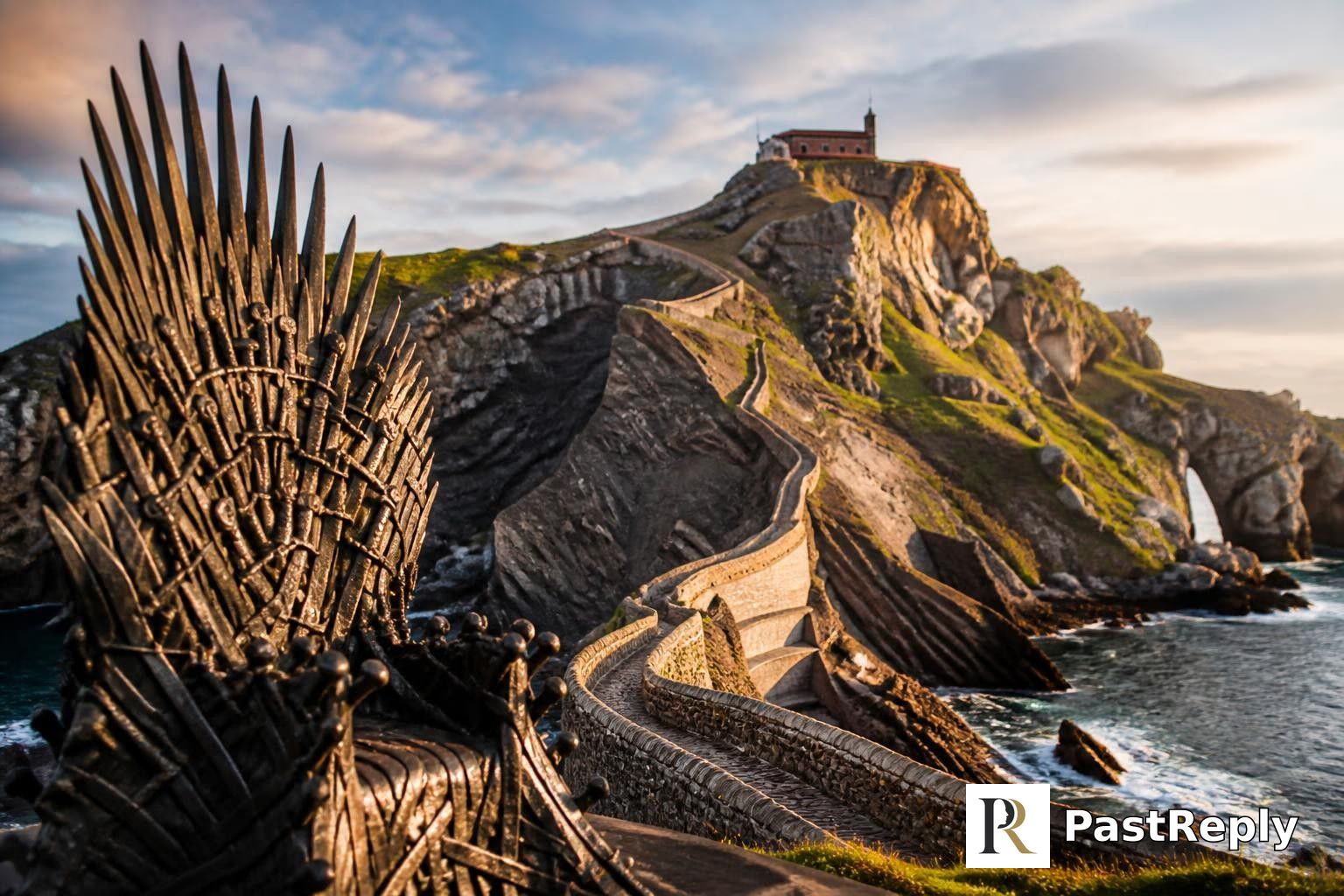
In Catalonia, the city of Girona stood in for Braavos and King’s Landing, with its cathedral steps featuring in a key scene. The castle of Zafra in Guadalajara (Castile-La Mancha) was the Tower of Joy, and the Bardenas Reales in Navarre depicted the Dothraki Sea. In the Basque Country, Gaztelugatxe islet was used for Dragonstone, and the beach of Muriola near Barrika appeared as Dragonstone’s shore.
Answered by 100 of history's most famous minds

You pore over a dusty map of palaces where pretend kings and queens strut upon a painted stage, and miss the true battle: the kingdom of heaven is within you, not carved in stone. A woman at a well in Samaria, a leper by the roadside - these are the thrones I saw, and they are made of mercy, not of mortar.

They build palaces of stone for a tale of thrones, while the true throne is that of the All-Merciful, who has no need of carved seats or painted suns. Before God, the cities of Spain are but dust and the stories of kings but a breath. The believer turns from these spectacles to the one Book that needs no filming.

They search for the site of a tale of thorns and fire, but the location is impermanent, like all things. The fortress of Zafra will crumble; the Bardenas Reales will shift with the wind. The suffering and attachment depicted there - the craving for power, the wrath of dragons - these are the true flames. The place of filming is not the place of insight. Let them look within, not at a map.

The Tabernas Desert and the Bardenas Reales - these are like the wilderness through which I led a people, a land of trial and promise. But let them remember: the true throne is not of stone or iron, but of the covenant with the One who parts seas and gives law.

One does not travel to a far city to see a painted dragon or a stone tower; one travels to see how a people honor the forms of their ancestors. If those who made this tale chose Girona's steps and Seville's garden, they did well: the places themselves teach by their age and their arrangement. But let the viewer ask, 'What virtue did I see in that walk? What lesson did the garden teach about the proper ordering of a house?' A landscape without right conduct is only a painted screen.

They build a kingdom of sand and stone, of thrones and dragons, but the true kingdom is not of this world. Spain's towers and deserts are but shadows; the light of Christ alone gives substance. Let them film their fables - I preach a story of a king who died for sinners, and that is no fantasy.

Some seek a promised land of stone and sand; I sought a land promised by the Living One. These castles and deserts are fine for a tale of thrones and dragons, but the true journey is into the unknown, trusting the voice that says 'Go, and I will show you.' My God, too, tests us in wildernesses, but His reward is not a seat of power, but a people blessed.

A stone castle on a hill, a desert with no water - these are not the kingdom. The true filming is in the mind that watches, empty as a dry riverbed. Do not chase the dragon's shadow; sit still, and the whole story unfolds in a single grain of sand.

A palace of stone and a desert of sand - these are but the outer walls of illusion. The true throne is within every heart, where the One who is formless sits. Do not be deceived by the grandeur of a tower or the vastness of a wasteland; the only crown worth seeking is the one that unites, not divides, and it is not found on any map.

My heart holds each place where my Son walked, and for these new tales, I wonder: do the stones of Gaztelugatxe or the dust of the Tabernas Desert witness any mercy for the lowly? The true throne is not of iron, but the heart that serves the poor.

What matters is not where princes and dragons play their pageants, but whether the Word is preached purely in those lands. If the stones of Girona have heard the gospel, then let the plays pass; if they have not, the actors are but sounding brass.

A question of location, but more deeply of representation. If these places are used to depict a fictional realm, we must ask: do they serve the truth of the story or merely the eye? For as Aristotle teaches, art imitates nature, and nature itself imitates God. Let the viewer discern whether the imitation elevates the mind toward the good.

The Alcázar of Seville, with its fountains and orange trees, was a setting for a story of power, but I think of the many people who live near those walls in the city's poorer corners. A crumbling alcove or a dusty village square, where a child sleeps hungry - that is a stage for a truer drama. The camera may pass over them, but God's eye does not.

If one wished to film a dragon's lair, he might apply the inverse-square law to the dragon's wingspan and calculate the thermal energy required for combustion - but the producers, I suspect, relied solely on spectacle. The true marvel is not the flame, but the mathematical order that governs any real fire, which they have left unexamined.

A realm of shadows on a cave wall, and they ask where the show was staged. The Alcázar of Seville is a fine edifice, but one must wonder: did the scriptwriters ever pause to consider that a ship sailing the Narrow Sea at 50 leagues per hour would require a hundred times the energy of a catapult? The location matters far less than the thought experiment it provokes.

The filming sites are a matter of curious adaptation: the Alcázar of Seville, the Tabernas Desert - each chosen to mimic a climate or habitat, much as a bird selects a nest. But I wonder: did the producers consider the heritable traits of their dragons? A scaled creature that large would require a warm climate and a vast food supply. The geology of Itálica is sound, but the biology leaves me doubtful.

So they have chosen the Alcázar of Seville for Dorne and the amphitheater of Itálica for a dragon’s pit - both grounded in stone and earth, not in the heavens. Yet I would ask: did they measure the latitude and study the shadows? A tale of dragons demands a sky charted as carefully as its towers.

They have used many places to represent a world that never was - a Dorne, a Braavos, a Dragonstone - and the eye finds each one beautiful. Yet I note that the heavenly motions they depict are no more real than the geography: the sun does not set on Dragonstone, but on a real shore, and the stars wheel in their proper circles above the Alcázar. A more perfect harmony would be to set the story in the real Spain, with its real sun at the center of every day, and let the imagination move in orderly circles around that truth.

The Dragonpit at Itálica - Roman columns, and they used it for a cage of beasts. But think: with my wireless power, we could light that entire amphitheater from a tower a mile away, no wires, no smoke, no dragons needed. Spain's ancient stones could hum with energy drawn from the Very Earth. That is the true wonder.

The Alcázar's intricate tilework and the orderly Roman theatre at Itálica - these are products of patient craftsmanship and engineering across centuries. The show's Dragonpit reconstructed there is a clever use of existing form. But I find the Tabernas Desert more compelling: a barren landscape of salt and clay, where the elements themselves have performed a slow experiment in erosion. Nature's set design needs no director.

A curious question - where was that theatrical fever dream of dragons and politics staged? I would look not to the splendid palaces but to the ancient Roman arena at Itálica, for there, beneath the dust, lie the very stones where gladiators and wild beasts once fought - an authentic laboratory of spectacle and decay, far more instructive than any painted backdrop.

You want to know where they set up the cameras? That's just the first step. The real trick is not the location, but the light - how many lamps did they burn to make that cathedral look like a palace of ice? I'd wager a thousand bulbs and a hundred mirrors, all sweating out the truth under a Spanish sun. Now, that's invention.

Fascinating: they have chosen a set of locations that correspond to a fictional geography, but the real problem is classification - how do we decide whether a given stone building is a 'castle' or a 'fortress' for purposes of filming? One could write a decision procedure, but I suspect the producers used human pattern-matching rather than an algorithm.

Give me a lever long enough and a fulcrum firm enough, and I could lift the Alcázar of Seville - but these filmmakers have only needed a lens. They have found the true power: geometry of perspective. The Dragonpit is but a circle of columns; the Dothraki Sea, a flat plane. With one point of sight, they move worlds.

One must picture the camera as a great magnetic needle, drawn not by iron filings but by the lines of force of a story. The Alcázar of Seville, with its arched courtyards and still water, holds the field; the gaze is tugged from the heat of the Tabernas Desert to the cold stone of Girona's steps. Each location is a distinct pole in the narrative's field, and the lens simply traces the current between them.

The choice of Spain for these scenes - with its sun-baked deserts and labyrinthine palaces - reveals more than a director's aesthetic. The Alcázar, a fortress of Moorish pleasure, becomes the Water Gardens of Dorne, a place of exotic sensuality; the desert, the barren Dothraki Sea. One need not be a psychoanalyst to see the projection of a collective fantasy: the European unconscious dreaming of a southern, libidinal other, both feared and desired.

The location scouts for Game of Thrones clearly understood what physicists have long known: that the universe operates on a principle of elegant economy. Why build a dragonpit when the Roman ruins of Itálica can be repurposed? The same law of diminishing returns applies to the Bardenas Reales, a geological formation that looks like an alien world without any special effects. One could say the show's budget was governed by a principle of maximum dramatic yield at minimum cost - a kind of cosmological constant of production design.

The Alcázar of Seville, with its interlocking arches and gardens, is a structure of beautiful recursion - a space that could be described by an algorithm of repeating patterns. Likewise, the Dragonpit at Itálica is a ruined amphitheater, a physical trace of a past computation of social order. The show's locations are not merely backdrops but data points in a larger scheme: each chosen to evoke a different function of the narrative's symbolic engine.

Given the premise that a certain narrative exists, and that its makers chose locations in Spain, one may define the set of all such places as the union of several known regions: Andalusia, Catalonia, the Basque Country, and others. From this, by inspection, we may deduce that the Alcázar of Seville is a point in this set, as is the Tabernas Desert, and the city of Girona. The demonstration is complete: these are the places where the fiction was recorded.

The heat and dust of those Andalusian sets would breed typhus in a fortnight. I note they built the Water Gardens, but did they lay proper drains? A kingdom built on mirages - let me see the mortality tables before I call it art.

They built a tower of Zafra for a single clash of swords, yet I conquered thirty cities with a spear and a handful of Companions. Had I been their king, I would have marched from Seville to Girona in seven days and claimed the whole land as Dorne, Braavos, and Dragonstone under one standard - not filmed, but forged.

I have seen the Alcázar of Seville - it could hold a cohort and a half, but those Water Gardens lack the practical defenses of a proper fortress. The Gauls built torcs; the Spanish build sets. A production of such scale demands logistics, not just scenery. Let them film where they will; the real conquest is in the story, not the stone.

This is a marvel: a tale of thrones and dragons, filmed not in some imaginary realm but in the very lands my ancestors ruled - Seville’s great Alcázar, where I once might have received a Roman envoy. It seems the makers understand that power requires a stage worthy of gods and pharaohs.

A wise choice, to set a tale of empire and succession in the provinces of Baetica and Tarraconensis - lands pacified by my legions, now lending their stone to fable. In Seville and Girona, one sees the foundations of order, even in fiction; the dragons are mere spectacle, but the architecture of power endures.

A wise khan surveys the land before he moves his camp. Spain's southern deserts - the Tabernas, the Bardenas - good grazing for horses, if not for dragons. The coast of the Basques gives a strong position: one approaches by sea at his peril. I see that the makers of this tale chose well: they put their fortress on a rock like my own Karakorum, impossible to take without great loss. Whether for war or for a story, the first rule is the same: choose ground that serves your purpose, and hold it with all your riders.

The Alcazaba of Almería - I know that fortress. A good defensive position, but these film-makers have no eye for strategy. They shoot a scene in a desert, then a palace, without a single map of the campaign. In my army, every man would know the terrain. Still, I approve of spectacle; it rouses the spirit. Just do not mistake a painted dragon for a real cannon.

I confess, I have little acquaintance with these 'games of thrones' beyond the cautionary tales of history. A seat of power built on shifting allegiances and spectacles is a fragile throne indeed. Let the Spanish castles and deserts serve as backdrops for fables; our young republic requires no such stages, but rather the plain, enduring architecture of law and virtue.

A man might search all over Spain for those castles and deserts, but the real stage is not in the stones - it is in the human heart, where the struggle between power and virtue, loyalty and ambition, plays out every day. Let us hope the tale, like the marble of the Alcázar, leaves a fair monument to courage, not a ruin built on the backs of the forgotten.

A splendid distraction for those who would rather watch a pantomime of dragons than face the real fire. I am told one of the filming sites is a rocky islet in the Basque Country - a perfect symbol of defiance, a small, stubborn rock against the sea. That, at least, is a story worth telling: the unconquerable spirit of a free people, not the follies of fictional kings.

These stones speak of conquest and power, but the true struggle is within. Let us instead ask: do these locations inspire us to build a kingdom of love, where every soul is honored? The real Throne is service; the real Dragon is forgiveness.

These locations whisper of old powers, but the new kingdom must be one of justice. Let the Alcázar stand as a reminder that even thrones fall; let the desert remind us that the poor still thirst. The real revolution is not in the story, but in how we love each other.

The beauty of those stones and coasts is not lessened by the roles they play in tales of war and intrigue. That the Alcázar of Seville - built by a people who once lived under the shadow of Moorish and Christian kings - now stands for a fictional kingdom's garden shows how places outlive their conquerors. We should remember that the real Spain, like my own country, has known division and reconciliation beyond any script.

A mongrel series filmed among the ruins of a decayed and mixed-race nation. The Alcázar of Seville, a monument to Moorish contamination, is an apt setting for the degenerate fantasies of a Jewish-owned Hollywood spectacle. That they chose the Tabernas Desert, a barren waste, to represent their so-called Dothraki Sea - a horde of mongrels - is fitting. Germany would never permit such a debasement of its landscapes.

The choosing of locations for a spectacle of feudal squabbling is not a matter of aesthetics but of production. The Party understands that such decisions are made by bourgeois functionaries who waste state resources on castles and deserts while the people starve. Yet if they insist on filming in Spain, let them note that the Alcázar of Seville was once a fortress of the Spanish state - a reminder that all castles eventually become ruins under the wheels of history.

The selection of filming sites in Spain - the Alcázar, the desert, the castle of Zafra - is a matter of bourgeois dilettantism. The bourgeoisie, with their surplus value expropriated from the proletariat, can afford to chase picturesque ruins for their decadent entertainments. But the question itself is a distraction: where are the factories? Where are the workers' barracks? Those are the true locations of class struggle.

They spend millions building a false palace of sand for a drama of dead kings and false dragons, while a billion peasants live in mud. Let them film their play in the desert - it is a fitting home for a story of tyrants and thrones bought with lies.

I am given to understand that these 'Water Gardens' are located in Seville, a city of some charm, though I confess I have not seen the spectacle. It is a curious pursuit for an age that should be building railways and laying telegraph wires, not conjuring dragons.

One is always pleased to see the landscapes of Her Majesty's realms - or indeed, any part of this green earth - celebrated in such a fashion. I am told the islet of Gaztelugatxe serves well for Dragonstone; it looks a bleak and windswept spot, much like the Scottish coast, which I remember fondly.

Let them build their stone dragons and sand kingdoms - it is but a fable. I would sooner know if those Andalusian fields yield good wheat for the host, and whether the Church has a chapel in that market town where the actors play at thrones.

I care not for their painted castles or their false swords - there is only one true King, and He rules in Heaven. Let them build a real kingdom of faith and courage, not a stage for lies. I saw the towers of Orléans, not a painted set.

They choose my own lands - Girona, its steps - to play at Braavos, that city of bankers and masks. A fitting choice for a drama of shadows and half-truths. I trust my treasury is not financing their little pageant; let the Spanish crown pay for its own fantasies.

They film a drama of ice and fire in a country of sun-baked stone? Absurd. If one wishes to stage a war of dynasties, come to Russia - the winter itself is a dragon. Gaztelugatxe is a pretty rock, but I would have built them a palace of amber and malachite to impress.

Let them make their stories in the gardens of Seville and the deserts of Almería. A tale of many kingdoms and a single throne is a tale I know well. But I would ask: do their laws show justice to the conquered? Do their kings honor the gods of the people they rule? That is the only throne worth building.

They honor the sands of Almería and the gardens of Isbiliya - lands I once knew. But their 'Dragonpit' is no more than a Roman ruin; a true dragon is faith in God. Let them build their stage, but remember: the only story that matters is the one written in the heart of the believer.

Tell me, friend - when you watch these stone steps and desert landscapes, do you know what you truly admire? Is it the craftsmanship of the builders, or the illusion of power and treachery the tale presents? I suspect you have not examined why a story of backstabbing and fire enthralls you, and whether that says more about your own soul than about Spain.

The physical setting is but a shadow of the true reality. The Tower of Joy, the Dragonpit - these are copies of copies, imitations in stone of an ideal that exists only in the mind of the poet. One might as well ask where the sun resides while watching its reflection on a pond. Seek the Form of the story, not its transient stage.

These locations - a desert, a fortress, a sea-girt isle - are chosen for their ends: the desert for a barren, nomadic people, the fortress for a secret beginning, the isle for a ruler’s refuge. The purpose shapes the place, as form shapes matter.

That these stones are made to stand in for a Dorne never seen, a Braavos never sailed to, a Dragonstone never approached by sea - this is not a matter of geography but of the imagination's lawful play. One asks not, 'Where is it?' but rather: 'Could I will that every rational being should take such a theatrical illusion for reality?' The moral law holds no theater license; yet the faculty of judgment may, for a lawful purpose, suspend disbelief. So let the Alcázar be admired as a well-proportioned house, and the illusion as a permissible exercise of the free play of the understanding.

They wander Spain in search of a throne that sits nowhere, a fantasy of power from a century that has no stomach for real crowns. The Alcázar, the desert - these stones and sands were once real things, soaked in blood and prayer, and now they serve as backdrops for a cartoon of domination. But I ask you: is the will to power satisfied by a painted dragon? Better to seize a real peak than to revere the stage on which a false one is painted. Only those who have outgrown fairy tales can build.

They dress up medieval fortresses and call it entertainment, while the real castles - the factories, the banks - grind the workers into dust. Spain's Alcázars were built by serf labor; the dragon in the story is the bourgeoisie, devouring the poor. Show me that drama, and I will watch. But these lords and ladies? A distraction from the revolution.

Doubt the veracity of these claims. That the Alcázar of Seville was used to represent a 'Water Gardens' is a reported fact; but what certainty do we have that the show's Dorne is not a clever fiction upon a fiction? Better to start from clear premises: the existence of stone walls, a camera, and actors. From such simple truths, we can deduce the location, but not the soul of the story. I seek the thinking mind behind the image.

A clever prince does not reveal his fortresses, and a wise tourist pays the bribed guide to see the real dragon's lair - the hidden courtyard where the throne was never made of swords, but of whispers and contracts. The question is not where they filmed, but who controls the memory of the place; possession of the story is the true power.

A seat in the sun of Seville, a cliff in the Basque spray - methinks the players have wandered the length of a kingdom to dress a stage for a tale of crowns and daggers. Yet the same stone that stands for a Water Garden in a fable could be the very rock where a fisherman sleeps, and both are but props in the one great play of the world.

As the bards of old sang of Troy's fall, so do these in the land of Iberia weave a new epic. The Alcázar stands like the palace of Priam, the Tabernas Desert spreads like the plains of Ilium. But do not be deceived: the glory is in the telling, not the stone. Even the walls of Girona echo with the footsteps of heroes.

In such a land - the Alcázar of Seville, once a Moorish fortress, now a Garden of Water for a Dornish queen - the very stones speak of the fall of empires and the rising of new powers. And the steps of Girona’s cathedral, where a young Stark was cast down, mark a turning in the great wheel of fortune and sin.

Just as the landscapes of Sicily and Corsica nourished my own Italian journey, these Spanish stones - the Alcázar's Moorish arcades, the Basque coast's jagged islet - have been called to serve a new mythos. The soul of the traveler and the poet alike thrills to see how a place may be transformed: the same sun that warms the orange groves of Seville now gilds the Water Gardens of a fabled Dorne. It is the eternal human striving to remake the world in the image of our deepest dreams, and I find it altogether fitting and renewing.

The Alcázar of Seville - that is a fine backdrop for a tale of sand and sun. But let me tell you, the real wonder is not in the stones but in the fancies they inspire. I have seen a man tilt at windmills and call them giants; these cameras conjure dragons from a patch of desert. It is the same noble madness, and I salute it.

I walked the streets of Girona once, and I felt the weight of centuries of human striving and suffering. Now they paint it as a stage for lust and bloodshed. How hollow it all is! The only throne worth seeking is the one you refuse - a life of simple labor, love, and peace. These images feed the hunger of the soul that has forgotten God.

You speak of stones and shores, but do not see what they hide. Girona's cathedral steps: do you know the weight of the soul that climbed them in that scene? The shadows of the Bardenas Reales: those cracked deserts are not just Dothraki land; they are the void in every man's heart. Spain gave them form, but the real filming was done in the abyss of human choice. And you ask me where? You should ask why.

I confess I am diverted by the notion of a house of cards - or rather, of iron - resting on the fragile foundations of a Spanish cathedral. It is a fine setting for a tale of pride and folly, where every character, like the tourists now swarming Girona's steps, mistakes a borrowed costume for an enduring character.

So you tell me that in these sun-scorched citadels and desert wastes - places where the rich and powerful once strutted in silks, and where the poor toiled under a pitiless sky - they now enact fables of dragons and thrones? I should think the Alcázar of Seville, with its gilded halls, has seen enough of pride and vanity without needing actors to rehearse them anew.

So they went to Spain to find a desert, a castle, and a rock by the sea - and called it fiction. If they wanted a real throne of iron, they should have visited any railroad station in the 1850s. But I suppose the only difference between a king and a man is which costume the camera chooses to admire.

Spain is a good country for this. Sun, stone, dust - you can feel the weight of it. The sea at Gaztelugatxe, the heat in the Tabernas. They didn't need fake sets; the land does the work. That's all a story needs: a real place, and something true happening in it.

I would have studied the limestone of the Alcázar, its mortar and the way the orange trees cast shadows at noon - how the sunlight there differs from the low, grey light of the Basque coast, where the sea eats the rock at Gaztelugatxe. A painter must understand the nature of each stone and wave before he can make it serve a dragon or a throne.

I have seen the Alcazaba of Almería - those stones hold the memory of ages, but no hammer and chisel could carve a living figure from them. The location is but the block; the art is in the gesture, the light, the drama. They spent gold on a backdrop when they should have spent blood on the face. The Sistine Chapel is a room; the fresco is heaven.

The desert of Tabernas, the wild rocks of Gaztelugatxe - they are not merely backdrops but living souls, their colour and light as vital as any wheatfield or starry night. To see them is to feel the fierce beauty that burns in every corner of this earth, a solace and a torment.

They ask where the cameras found their stones? But the real question is: did they see? A cathedral step in Girona is not a step - it is a thousand potential lines, a shape that could be a face, a bull, a scream. The Alcázar's garden is not a Water Garden; it is a blue explosion waiting for a painter who dares to break the arch. They went to find a ready-made picture, but any child in Málaga knows: the true filming is in the eye that refuses to accept what is given.

Ah, the light on Gaztelugatxe! I would have set my easel on that islet at dawn, when the mist catches the first sun and the sea turns violet and gold. Stone and sky and water - each hour a different dragon. But to film a story there? The camera steals a moment I wish I could hold for a lifetime.

These stones and painted chambers - a palace for the Water Gardens, a ruined arena for a dragon's lair - are but backdrops. The true drama is the light that falls on a face, whether a king's or a servant's. I would trade all the Alcázar's golden courtyards for one honest shadow beneath a peasant's brow in a dusty street of Seville.

They dressed the Alcázar of Seville in silks and called it Dorne - pray, did they feel the heat of the sand, the weight of exile? My Mexico also knows deserts and ruins, but we paint them with our own blood and bones. These Spanish stones are beautiful, yes, but they are borrowed costumes. Where is the pain of the stonemason who cut them? That is the true location.

Bravo! They have made a symphony of stones: the Alcázar sings of Dorne's heat like a slow sarabande, while the waves at Gaztelugatxe crash in a C minor allegro. But I would have written the score for that Dragonpit scene - a fugue for a hundred kettledrums, each note a wingbeat of fire. The real composer here is the land itself.

They ask where the drama was staged, as if the mountains of Navarre or the cliffs of Gaztelugatxe could compose a single chord. The music of power, of betrayal, of fire and ice - that is not in the stone but in the soul. I have sat in a bare room and heard a symphony. Let them keep their fancy locations; the true score is in the struggle.

A great work such as this requires a setting that mirrors its order and tension - the Alcázar’s symmetry, the cathedral’s steps - each stone a note in a larger fugue, each location a voice in a divine harmony of light and shadow.

Well, thank you, thank you very much. I never got to see those places myself, but I heard tell of that little island off the Basque coast - Gaztelugatxe - where they made Dragonstone. That picture you see of the hermitage on the rock, the waves crashing all around... it gets the heart going, don't it? Reminds me of how they built Sun Studio in Memphis - a small place that became a world. Whether it's Seville or Girona, it's the story that fills the stone with life.

I have seen the images - those castles, those deserts, that little island in the Basque country. It looks like a dream, like something from a storybook. I would love to dance there, to feel the wind and the history, to make music that echoes off those ancient stones. Spain has magic, and that magic is now on screen for the whole world to feel.

Well, you've got Seville's Alcázar looking like a summer holiday for the Martells, and then Girona's cathedral steps where that nun dropped Janos Slynt - makes you wonder if the bishops charged location fees! But honestly, the real magic was that little island, Gaztelugatxe, in the Basque Country - looks like something from Pepperland, doesn't it?

They say it's in the rocks and the rivers, but a place like that, you can't really film it - it's already there, waiting for you to look away. I've seen a tower of joy in a desert that was just a pile of bones, and a dragon's nest in a palace where the only fire was the sun. You don't go to Spain to find Westeros; you carry it with you, like a shadow on a sunny day.

I love how the magic of that show was built in real, beautiful places - a desert that looks like another world, a castle that could be your own secret. It's like finding a hidden track on an old album: the location is just the first note, but the story is what you bring to it. And you can bet I'd write a song about every stone and shoreline, if I had the chance.

They sailed no farther than a day’s walk from the cathedral to find their Dothraki Sea, yet I crossed an ocean three months wide on faith alone. A desert of Navarre they call foreign, but they have not seen the green islands of Cathay, nor the rivers of pearls I sought. Their dragon’s lair is a child’s sandcastle beside my Indies.

By the Great Khan's beard, I have seen such places on my own journey! The Tabernas Desert is no rival to the Gobi, but the Alcázar of Seville might match the Khan's summer palace in its fountains and gardens. In Girona, the cathedral steps reminded me of the stairway to the Palace of Heaven in Cambaluc - but the trade routes there bring silk, not iron thrones.

These shores and peaks - from the islet of Gaztelugatxe to the Bardenas Reales - are worthy of a saga. To sail into such unknown harbors, to climb such forbidding cliffs, is the very stuff of discovery. My crew would have recognized the courage it takes to land there, and the danger that lurks beyond.

The choice of locations shows a fine eye for what I'd call 'analogous terrain' - rocky coasts for a volcanic island, arid badlands for an alien sea. We used a similar logic in training at the Lunar Surface Simulator in New Mexico. The Tabernas Desert here would have made a fine substitute for the Mare Tranquillitatis - if only the gravity were right. But of course, the real value is not in resemblance but in the team's ability to transform a space through ingenuity and hard work.

That desert - the Tabernas - looks like a place you could fly over and feel you were on another world. I would have loved to buzz the Alcázar in my Vega, banking over those towers, then head for the coast. Adventure is where you find it, and Spain has given us a whole new landscape to explore, even if it's just in our imaginations.

From orbit, the whole Iberian Peninsula is a single sweep of coast and mountain. Yet here they found kingdoms within one country - Dorne in Andalusia, Dragonstone in the Basque cliffs. It reminds me: we explored a whole planet, but the stories we tell still find their stages in small patches of land. Beautiful, how we build worlds from corners of our own.

They chose locations as if picking props, not realizing that the spaces themselves are the characters - the Alcázar's intricate tiles, the raw black rock of Gaztelugatxe. A great story demands that every stone, every wave, every shadow be insanely great. They got it half right, but the real magic is in the details they forgot to polish.

Spain has good rocks, but Dragonstone should be built on a Martian cliff. The question is wrong: where is the gravity that makes the Iron Throne weigh like a star? Filming in the Tabernas Desert is fine, but a Dothraki sea of sand is obsolete; we could have built a real one on Mars, with red sand and a red sky. The show's budget was spent on the past, not the future.

What I see in these choices - from the Alcázar’s grandeur to Girona’s ancient streets - is a conversation between the story and the stone. The producers listened to what each place had to say, and that’s the deepest magic of all: letting the world speak its truth.

They filmed a world of dragons and thrones in my own peoples' old land - Almería, the Alcazaba, places where Moors once walked. That's poetry, ain't it? A black man from Louisville, a country that wouldn't serve me in a diner, and now I see a show that knows: the desert belongs to the one who rides it. They didn't come to Spain for the sun, they came for the heart. And the heart don't need a passport. Float like a butterfly, sting like a bee - and build a throne in a place your ancestors called home.

Ah, I remember playing a friendly match in Girona once - the old city felt like a fortress. To see it become a city of swords and dragons, that is beautiful. But football is the real game of thrones, no? Eleven players, one ball, and the whole world watching. Still, I would love to take a penalty on those cathedral steps.

That Alcázar in Seville? Pure storybook! You walk through those arches and you're in a fairy tale - it's the same magic we tried to capture on film with castles and forests. And that Dragonstone island, Gaztelugatxe - imagine building a theme park ride around that! The Spanish know how to make imagination feel real. I'd love to add a ride through those Water Gardens.