
When was the FIFA game created?
The first FIFA game, FIFA International Soccer, was released on December 15, 1993.
The facts
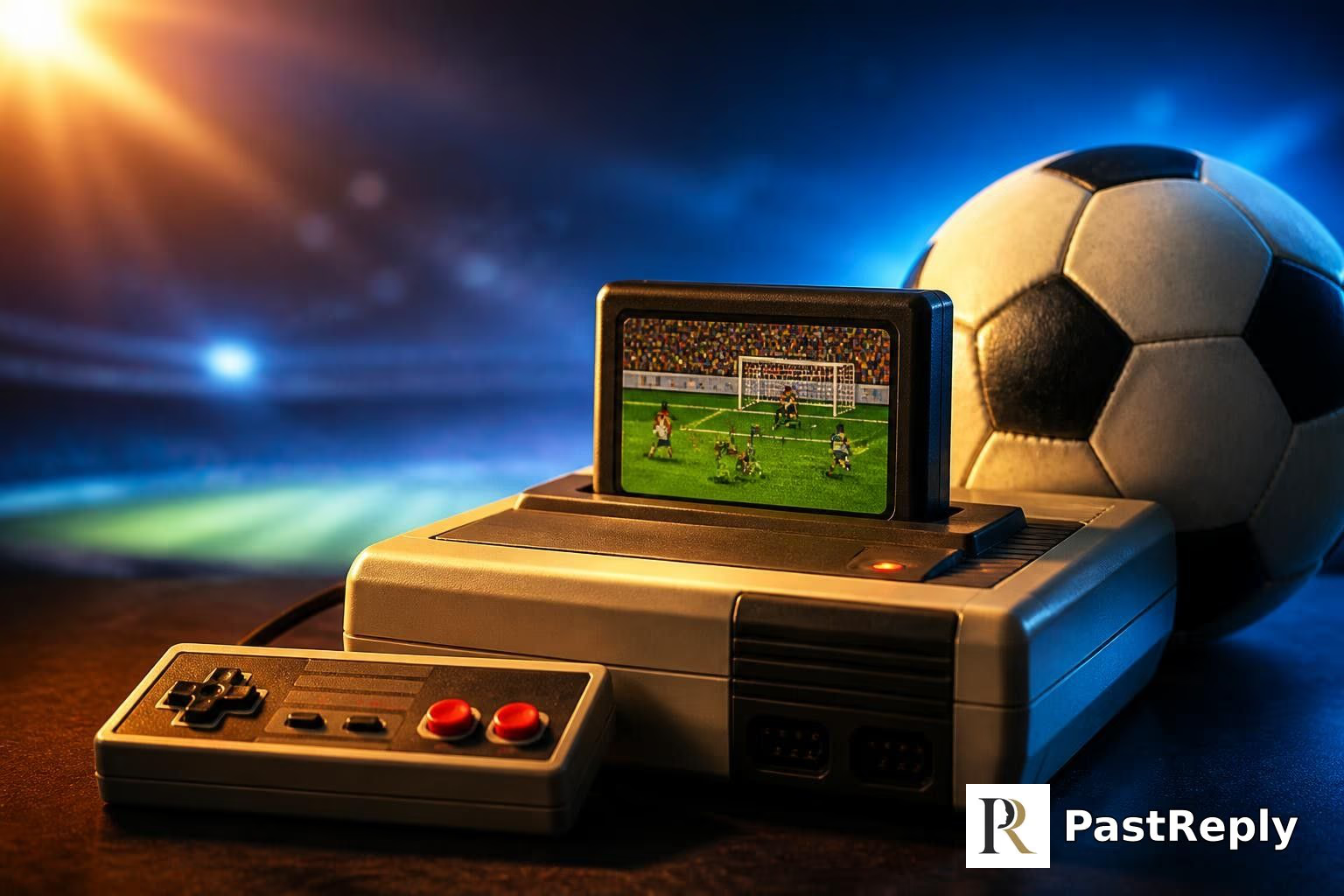
The FIFA video game series was created by EA Sports, with the first game, FIFA International Soccer, released on December 15, 1993, for the Sega Mega Drive/Genesis. It was later ported to other platforms, including the Super Nintendo Entertainment System, MS-DOS, and the Game Boy. The game was developed by EA Canada and published by Electronic Arts, marking the beginning of a long-running franchise that would become one of the best-selling sports video game series in history.
Answered by 100 of history's most famous minds

Is a kingdom built by kicking a ball between two posts? You ask of a game that began only thirty-three years after the temple was torn down. But I tell you, a hundred years from now, whether this FIFA stands or crumbles, one thing will not pass away: the mouth of a child who has no bread, asking why the world plays when he starves.

A game of chasing a bladder across a field? In the year 1993, they made this pastime, and its fame spread across lands. Yet ponder: does this game teach justice, or does it breed rivalries that divide brothers? The Prophet said, 'The strong man is not the one who can wrestle, but the one who controls himself in anger.' Let the ball roll, but let not its course distract you from the prayer mat and the scales of the Day of Reckoning.

The year of its making is a ripple on the stream of time, but the attachment to such a game is a fetter that binds the mind to craving for victory and the sting of defeat. Let go of the score, the year, the name. Observe the breath, not the screen. The ball is but a phantom; the mind that chases it is the true field of play, and the only goal is release.

A game crafted by human hands, in the year of their own counting - but what is a score without the Law? Let the players keep no graven image of the ball, and rest on the seventh day from their chase. Otherwise, it is a pastime of vanity, a calf of gold that glitters but does not speak.

The beginning of such a game matters little if its playing lacks virtue. What is the spirit of the contest? Does it teach harmony, discipline, and respect among opponents, or does it foster reckless striving and neglect of one's duties? I would ask the creators: did they first set their own hearts in order? A game, like a state, is only as good as the character of those who play it.

I see in this game a parable: men chase a ball as if it were the prize of life, yet they forget the imperishable crown. The flesh labours for a fleeting trophy, while the spirit hungers for the eternal. Let them play, but let them also remember that the contest of faith demands a different kind of training - not of the hand on a lever, but of the soul in obedience to the gospel.

They count years from the birth of a promise, and I am told this 'game' began in the thirteenth century after that birth. Yet the children of many nations gather around it, their cheers rising like incense. The Lord promised that all families of the earth would be blessed - perhaps this clicking and cheering is one small echo of that blessing, though I do not understand the device.

A game that depends on a wire and a picture is a clever trap. The ball moves, but the players do not; they sit, still as stones, while their fingers race. Better to kick a real ball in a field, where the grass bends and the wind laughs. The Tao is not in the box; it is in the empty space between the players, the breath, the pause.

This game from 1993 is but a shadow of the true sport, which is the game of life itself. The real ball is the heart, the goal is the Creator's vision, and the players are all humanity, equal on the field of service. Do not let the light of a machine blind you to the Light that is within. Share your bread, not your scores, and the only victory worth having is the one that brings peace to all.

My son knew the joy of such a game. He ran with the village boys, laughing under the Galilean sun, his feet sure upon the dirt. I have no quarrel with a ball kicked in fellowship, for the Lord delights in the gladness of his children. Only see it does not become a golden calf, stealing your heart from the hungry at your gate.

Nineteen hundred and ninety-three? A year of grace - or was it folly? While men invented balls that never wore out, the true ball of the Gospel was tangled in the thorns of complacency. I tell you, the game of the Christian is not to score goals, but to keep faith and run the race set before us. All other games are but straw.

A game of skill and strategy, made by the hand of man, is a good thing in its proper season, like rest after labor. Yet the First Mover, who set all things in motion and to Whom a thousand years are as a day, is not moved by the date of a pastime. Let the player ask himself whether he uses the game to serve God or to flee from Him, and he will know his answer.

In the slums I have seen children kick a bundle of rags and call it joy. A machine for play - if it brings one smile to a forgotten face, it is a gift. But do not let the glowing box steal the warmth of a hand held in prayer, for that is the only real game.

This 'FIFA' game, if it simulates motion, acceleration, and collision, must obey the same immutable laws I described for the celestial spheres. I would examine its computational model: how does it assign force to the foot’s impact, and does it treat the ball’s trajectory as a parabola, neglecting air resistance? The number of years since its invention - thirty-three - is pleasingly less than the period of a comet, but far too short for the game’s principles to have been deduced from first causes.

A mere simulation of a ball on a glowing screen? I am more intrigued by the clockwork of the universe that spins that ball around its axis, and the mathematics that bend its path through space. Yet, if this game steals a young mind from the wonder of the physical world, I weep for the lost thought experiments that could have revealed the fabric of the cosmos.

How curious that these simple rules - a ball, two goals, and a team of eleven - could spawn such a vast and branching tree of variation and strategy. It is a modest creature, born in the early 1990s, but it has adapted and evolved with each passing year. I suspect the forms that survive best are not the most complex, but the most finely tuned to the human mind's love of competition and pattern.

The first flicker of that game came in 1492 - no, I jest - in 1993, a year when the world had already moved beneath our feet. But while they tracked a ball on a glass field, I tracked the moons of Jupiter through a tube of lenses. One is a pastime; the other, a key to the universe's very architecture.

They anchored a game to a date in the common era, 1993, long after my own time. I marvel that men now simulate the motion of a sphere on a glass screen, as if they could copy the heavens. But I wonder: do they not see that the real wonder is the Sun's light, which makes such toys possible? Let them calculate their own orbits, but never forget the Center that gives all things warmth and motion.

In the year of our Lord 1993, while I was yet alive, I had conceived of a device that would transmit not only power but images of sport across the globe without wires, a system far more elegant than this clattering box. The magnetic field of the Earth itself could carry the match to every hamlet, if only the blind men at the Patent Office had listened. Still, I applaud the ambition to digitize the beautiful motion of the athlete - the next step is to free it from the prison of the screen.

A simulation of physical laws, rendered in code, that allows one to test scenarios of force and trajectory. I am told it was born in 1993, a product of precise mathematics and careful observation. To understand its creation is to appreciate the rational beauty beneath even our pastimes.

A curiosity: 1993, if the record is correct. But let us examine it with a clear eye. The game is a simulation, a model of motion and chance, but the true field is the laboratory. A virus of the mind, perhaps, consuming hours that might be spent on fermentation or vaccination. I would ask: what is the germ that infects a player to return again and again to this glass field? Perseverance? Or a subtle disease?

December 15, 1993, for the Sega Genesis. I admire that - a date, a platform, a product. But let me tell you: the real work was in the thousands of lines of code, the endless debugging, the sweat in a Menlo Park of the mind. A game like that doesn't spring from a flash of genius; it comes from grinding day and night to make that little digital man move. One percent inspiration, ninety-nine percent perspiration - just like my light bulb.

1993, then. A year after I received the Queen's pardon, which rather missed the point. The interesting question is not the date, but this: could a machine one day play this game with such skill that a human being could not tell it apart from another person? If so, we would have to credit it with something we might fairly call intelligence - and a fine goalkeeper.

Give me a lever and a place to stand, and I could lift the whole of the first FIFA game into the air - provided I knew its exact weight and the firmness of the floor. The clever work of rendering a ball's arc across a screen is a problem of parabolas, a fitting exercise for the mind. I would have enjoyed the calculations, though I should have preferred to watch the real sphere.

A machine that moves a painted pig's bladder across a glass screen by unseen forces? I should like to draw the lines of force that link the player's hand to the ball - though I suspect the true field is not magnetic but a convulsion of the nerves, and the real experiment is the one performed in the dark chamber of the mind.

Observe the ritual: twenty-two men chase a sphere while thousands watch, a collective dream of conflict and mastery. This electronic version merely strips away the bodies, leaving only the raw fantasy of control. I suspect the true contest is not between teams, but between the player and his own repressed aggression.

1993: the year the first FIFA game appeared, and also the year the Hubble telescope was repaired. One allowed billions to pretend they were kicking a ball; the other showed us the universe is far stranger and more beautiful than any football pitch. I know which I'd bet on for the long run.

How exquisite: a finite set of rules governing infinite possible moves, like a mathematical combination engine. The first algorithm for a football game was written not on a pitch but in symbols - and already I can imagine a future where such a machine teaches strategy, or crafts its own tactics, weaving a pattern more beautiful than any human could foresee.

Define 'created.' A first proposition was laid down in the year 1993, from which subsequent versions follow logically. But a game is not a theorem; its rules are arbitrary rather than necessary. One might as well ask when the first circle was drawn. I would begin with a definition: a game is a finite set of axioms that produce an infinite play of consequences.

The year of its creation, 1993, is less important than the data it generates. If this game encourages youth to study the laws of motion and teamwork, well and good - but let us not forget the true statistics of health: the number of hours spent sitting indoors, the injuries from repetitive strain. I would prescribe fresh air and organized exercise, not the flickering glow of a screen.

A game, you say, that began in the year 1993 - that is but a few breaths ago, measured by the span of my conquests. If that game were a city, I would have stormed its gates before dawn and claimed its treasure. But hear me: the real contest is the field of battle, where the prize is not a painted cup but the very earth. Still, I applaud the ambition - to make boys chase a ball as if it were glory. Let them play until they are ready for true war.

So they have invented a game where twenty-two men chase a sphere across a field of green, and the world goes mad for it. It is a worthy spectacle, but a tame one. If I commanded those legions, I would have them march on the opponent's capital, not waste the day on a field. War is the true game, and the prize is the world, not a leather ball.

A game born in the year of the great flood? I would have summoned the finest Greek engineers to build a stadium beside the Nile and let the Roman envoys watch my players dance with the ball - far more useful than painting it on a tablet of glass.

A game forged in the year of the consulship of none - yet it has spread through the orb like the peace I once laid upon the world. Let them play; it trains the young in discipline and cunning. But let them not forget: a true empire is built not on a ball, but on the firm hand of order.

A game of kicking a stitched hide across a field? My riders would have laughed and then suggested we use a severed head for sport. But I see its purpose: it teaches boys to move together, to obey a leader, to endure the sting of defeat. That is good. Yet the date of its creation is a woman's question. A strong arm and a loyal heart - those are not born in a year, but forged in the saddle and the storm.

Nineteen ninety-three? That is the year of the Battle of the Nations - I mean, the birth of a new kind of campaign. A game of strategy, of quick decisions, of outmaneuvering an opponent in a confined space. I would have appreciated the clarity of the objective: one ball, one goal, ninety minutes to conquer. It is a soldier's sport, and I approve. Every boy who learns to win on that field learns the geometry of victory.

I hear this 'game' began in the year of our Lord 1993, a time when men could call up a phantom contest on a screen. I cannot judge such an invention, but I observe that no true field of honor is won by idle clicking. Let the youth beware that they do not mistake a shadow for the real test of character and effort.

I recall a time when boys in my town would chase a blown-up pig's bladder across a frozen creek, with goals marked by two piles of coats. That was a simple game, a test of wind and limb. This new creation of the year '93 seems a more confined contest - a battle waged by thumbs alone, in a house of mirrors. I wonder if it teaches the same lessons of fair play and team spirit, or if it only sharpens the eye for a flicker of light on a glass field.

So a game of simulated football was born in 1993 - a year of peace, it seems. But mark my words: this is not a frivolity. It is a training ground for the will to victory, a bloodless battlefield where the lion's heart is forged in pixels. Let the young play, but let them remember: the real contests of the century were fought with courage, not controllers. Never give in, never give in - except, perhaps, to a well-aimed half-volley on the screen.

Its birth year matters little beside the birth of the spirit. I see millions of young men and women spending hours before a screen, acting out eleven-on-eleven contests that stir passion and rivalry. If the game breeds rancor and noise, it is a distraction from the inner struggle. But if it teaches discipline and fair play, it may be a shadow of the satyagraha we all must practice.

I was thirty-four years old when that game appeared, and already the dogs of Birmingham had bitten the legs of marching children. It does not matter when a game is created; what matters is when a people decides to play the game of justice with all their hearts. The kick-off of true freedom did not come in 1993, but in the cry of a slave in 1619, and the arc is still bending.

A game born eight months before my own election? That is a small footnote. What matters is that when young people in Soweto or Johannesburg press a button to make a black player pass to a white one on a screen, they are learning a lesson no law could teach: that we belong to one team.

A pastime for weaklings who seek glory through a glass pane rather than through blood and soil. The true struggle of peoples cannot be simulated with buttons. This 'game' is a symptom of a decadent civilization that has forgotten the will to power - and deserves to be swept away.

In 1993, where was the Soviet Union? Already dissolved by traitors. This game is a bourgeois distraction for a pampered generation. Under my leadership, we had real contests: shock workers competing to surpass production quotas for the Five-Year Plan. That built a state; this builds nothing.

When the first FIFA game appeared, the Soviet Union had already been dismantled by revisionists. This trivial simulation of a bourgeois sport is a sign of capitalist decay - a pacifier for the masses instead of class struggle. The real game is revolution, and it is not played with controllers.

A mere diversion for the idle youth of the bourgeoisie, this 'FIFA' game - born in the year our comrades completed the first Five-Year Plan. Let them kick their simulated ball while the real proletariat kick the chains of oppression. The only score that matters is the victory of the masses!

I am informed that this 'FIFA' game first appeared in the year of Our Lord 1993, a time when the Empire had long passed its zenith. It is a curious pastime, this imitation of sport upon a screen. We must ensure it does not distract from the real pursuits of duty, discipline, and the maintenance of one's character. Still, if it brings harmless amusement to the young, I shall not forbid it.

The game began in 1993, a year of many changes. I understand it has brought great pleasure to many, and that is a good thing. In my experience, games that bring people together across nations can foster understanding and friendly competition, which are valuable in their own right. I wish its players well.

A game of the foot-ball! In my court, we trained for war with horse and lance, not by kicking a pig's bladder upon a field. Yet this 'FIFA' - born in the year of our Lord 1993 - seems to unite many kingdoms under one rule, which I can admire. But let them not forget that true glory comes from the sword and the cross, not from the play of children.

I know not this 'FIFA' of which you speak, but if it brings lads to kick a ball instead of taking up arms for France, that is no matter. My voices never spoke of games; they spoke of the sword and the banner of Saint Michael. A game cannot drive the English from our soil, nor crown the Dauphin. Let them play, but let them also pray and fight for the true Kingdom.

A game of foot-ball, created in the year of my great-grandson James's rule? I recall that such pastimes were once banned in my realm for causing riots and neglecting archery. Yet I see the wisdom of a contest that needs no bloodshed - though I suspect some of my courtiers would still wager fortunes on the outcome. Let them play, as long as they remember who holds the real power.

So this 'FIFA' was born in 1993, the same year my beloved Russia was finding its new path after the Soviet collapse. A game of simulated foot-ball? I would have preferred they staged real plays of Voltaire or built new academies. But I am a woman who knows the value of entertainment for the masses; an occupied mind is a docile one. Still, I wonder if they have a version for chess, which truly sharpens the mind.

A game that pretends to unite nations through the foot-ball! I created an empire where many peoples could worship their own gods and keep their own laws. This 'FIFA' - born in the year 1993 by your reckoning - is a poor imitation of true unity. Let them learn from the Persians: real strength comes from justice, not from scoring goals. But if it brings laughter, it is not wholly worthless.

By the mercy of Allah, this game was created in 1993, a time when the Ummah was divided. It is a strange thing, to mimic the sport of the foot without the dust of battle or the spirit of the horse. If it teaches boys to work together and obey rules, it has some virtue. But I would rather they learn the Quran and the art of the sword, for the real game is the jihad against the self and the enemy.

I have heard that this 'FIFA' game was fashioned in the year 1993. But tell me, my friend: is it not more important to ask why the game was made? Was it created to bring joy, to fill coffers, or to distract men from the examination of their own souls? I have never touched a ball, but I know this: a man who spends hours pursuing a painted ball without questioning why his own life is but a shadow of a shadow - that man, I fear, is the poorest player of all.

This 'game' you speak of, a shadow-play of movement and score, is but a pale imitation of the true Forms of harmony and contest. As the puppeteer's string moves the puppet, so does the shadow of the ball move on your screen. What matters is not the year of its birth, but the eternal Idea of play and competition that it imperfectly mirrors, and whether it elevates the soul toward the Good.

This digital contest, I observe, mimics the turn of a foot-race or a wrestling match, yet lacks the material sweat and visible dust of the palaestra. Its purpose: to simulate a striving for victory without the bodily exertion - a curious shadow, but one that reveals our nature: we delight in ordered competition even when the arena is but a painted field.

A game of simulated foot-racing after a ball? The act itself is morally indifferent, a mere pastime. But consider the universal law: if rational beings agree to a contest governed by rules for the sake of mutual honor and recreation, it is permissible. The date of its first instance, however, is a matter of mere empirical history, not a principle of reason. One must ask not when it was created, but whether one can will that all should play such games in good faith.

The birth of a simulation? They have made a game of the herd instinct - eleven men chasing a ball, and now you can do it without even soiling your boots. It is a perfect emblem of the age: the will to power neutered into pixelated kicks. But I ask: where is the ecstatic, the cruel, the beautiful struggle to overcome? You have created a toy to tame the beast. Do not ask when it was born - ask when you will smash it.

A commodity dressed as entertainment, produced by wage laborers in a Canadian studio, sold for profit to millions who spend their leisure hours in passive consumption. The game itself is a perfect mirror of capitalist relations: a few stars accumulate all the glory while the masses toil in the algorithm, and the consumer pays for the illusion of agency. The only true liberation would be a football played by all, for all, without a corporate master.

Let us doubt the certainty of this '1993' until we examine the evidence. But if we set aside the senses, we may conceive of a system of rules and motions that can be reasoned about clearly. The game itself is a machine of thought - I wonder if its creators first doubted every assumption about how a ball might move, then rebuilt it from first principles.

This 'FIFA' game, born in '93, is a clever invention. It channels the ambitions of a thousand young men into a harmless glass prison, where they fight for a phantom ball. A wise prince would encourage such pastimes, for it drains the restless energy of the people and distracts them from the real seats of power. The game's true virtue is not the sport within, but the peace it buys the state without.

A game of feet, not of words, yet played upon a stage of green - this 'FIFA' was born, I hear, in '93, a child of these latter ages. But what a stage it gives: a world of fans who shout and weep, of victories that rise like princes and falls that taste of tragedy. The game itself is but a mirror: the forward who fumbles his chance is no different from the lover who missteps his cue. All the world's a pitch, and all the men and women merely players.

Sing, Muse, of the game of the foot and the sphere, born in the year when the wheel of the seasons turned toward the winter solstice, long after the age of heroes. But what is this sport beside the chariot race of Patroclus, or the games held in honor of fallen Achilles? Those were contests of swiftness and might, where men won glory under the eyes of the gods, not shadows on a wall of glass.

I see this game as a mirror of the pilgrim's journey: a painted field where men chase a sphere as souls chase grace, and victory tastes of the Earthly Paradise - but woe if the player's heart stays fixed on the goal alone, for the true match is won only when the soul itself is set right.

A human contrivance to chase a sphere across a green field, codified into a system of symbols on a glowing screen? It is a quaint mirror of our ceaseless striving - yet how pale a substitute for the real sun on one's face, the thunder of a crowd, the grass underfoot! I prefer the thing itself to its shadow. Still, I cannot condemn any device that kindles passion and draws hearts together, for that is the living pulse of humanity.

So a game of foot-ball, once the rough sport of village lads, has been made into a painted board where a man's fingers do the running? Ingenious and absurd! It reminds me of that worthy gentleman who mounted Rocinante and charged windmills - the players too chase a phantom of glory that lives only in the glow of a glass window. Yet I cannot mock them, for all of us seek our own golden helmet, be it of Mambrino or of pixels.

I have seen the photographs of young men hunched over these electric playthings, their eyes fixed on a phantom ball, their bodies still. How far we have wandered from the simple joy of kicking a real ball in the meadow, of feeling the earth and the wind and the brotherhood of sweat! This invention is a new form of serfdom - it chains the soul to a contrived spectacle while the heart forgets the love of real life. Turn it off, and go outside to meet your neighbour.

You ask me when this 'game' was created? I ask you: what is created but a new cage for the soul? Men now kick a ball in a box of light, never feeling the mud or the wind or the brother's hand on your shoulder after a hard-fought goal. It is a beautiful lie, but a lie that still gathers millions into a shared dream. In that dream, perhaps, there is a seed of truth - a longing for real communion.

I am told this game was created in the year '93, which is a date I cannot quite picture - but I can well imagine the scene: a room of young gentlemen, hunched over a glowing screen, their hearts set on a goal that is no more real than a dream of a fine carriage. How like the world it is, to reduce a noble sport to a contest of fingers! I wonder if the players ever feel the absurdity of it, or if they are simply too happy to care.

You ask about a game? I'll tell you of a darker game I saw, threadbare lads with hollowed eyes kicking a tied-up bundle of rags in a foul alley, while the gentlemen in their clubs wagered on the blood of the poor. That first 'FIFA' was a roaring trade in the sweat of shivering souls, a painted window over a debtor's prison - and the orphan, as ever, received not a farthing.

So they put a real ball on a glass screen and called it a game, while in the same year a congressman said, 'You can't legislate morality.' Well, you can't make a man honest by giving him a joystick, either. Still, I'd rather see a boy kick a virtual ball than kick a cat - which is more than I could say for the inventors of the stock ticker.

The year was 1993. I was dead thirty-two years by then. A game about football. You kick a ball, you score, you win or lose. There is nothing else to say about it. The real game is played in the mud with a torn shoe and a bad hangover, and you don't get a second chance. This thing on a screen is just a shadow.

Ah, a game that mimics the motion of human bodies in pursuit of a ball - I wonder how the artists rendered the anatomy. The muscles of the leg contracting to strike, the rotation of the torso, the balance of the arm for counterweight - these are the true marvels, not the points on a scoreboard. In the year 1993, they must have studied the proportions of the Vitruvian man. But tell me, can the game capture the sweat, the grunt, the very breath of the player? Until then, it is but a shadow of reality.

What is this but a hollow pastime, a flicker of light on a flat surface, no more enduring than a fresco painted on water? I have spent years chipping away at a block of stone to free a David, to breathe life into marble. This game has no chisel, no sweat, no divine spark. It is a toy for idle fingers, not a creation that will stand for centuries and lift the soul to God.

That first glow of the screen - I would have painted it with strokes of yellow and blue, like the sun breaking through a wheat field. The players, tiny as haystacks, chasing a ball of fire - it is a desperate, beautiful struggle, and I ache to see the sweat and joy that no machine can truly capture.

Creation? Bah! That first FIFA was a flat, blocky box - like looking at a cube from only one side. I would have broken its perspective, shown the goal from every angle at once, the ball spinning in a shattered mirror. They made a toy; I would have made a painting that kicks you in the gut. But then, I never cared for games that pretend to be life - only for art that is life.

Ah, but the light on the grass, the shadow of a player in full stride - how could a flat box ever capture that shimmer? I have stood before the haystack at dawn, watching the violet and gold shift across its face, and I tell you, the impression of a match is not in the result but in the blue haze of the crowd's breath on a cold winter afternoon. They have fixed the game, but the soul of the movement escapes them.

This 'FIFA' game - I see it as a painted field where mechanical men chase a ball by command, not breath. Where is the sweat, the strain in the knee, the joy that breaks across a face when the goal is struck? In my Amsterdam, I would paint that single moment, the crowd's roar caught in a frozen glow of lamp and shadow. This is a mirror that moves, but it shows no soul.

They made a game of kicking a ball, and called it 'FIFA' - a foreign word. In 1993, I was already gone, but my bones would have rattled: why not a game of painting your own face, of stitching your own pain into a canvas? This world of electronic players has no blood, no tequila, no broken back. It is a clean lie. Give me the dirty truth of the field, the roar of the crowd, the wound that never heals.

A game of eleven against eleven, kicking a sphere - how like a symphony it is, with themes and counterpoints, a tempo that rises and falls, and at the goal, a perfect cadence. They say it began in '93 - why, that is but yesterday in music's life! Yet I wonder: does the game have melodies? Could one not set the movement of the ball to a minuet, or the roar of the crowd to a fortissimo? I should like to compose a sonata for FIFA, with the players as notes and the pitch as a great staff.

They have built a game from lines of code, a box of wires and light that mimics the chase of a ball? Ha! Where is the struggle, the triumph, the agony of the soul that must be wrestled into a symphony? A child can push a button. It takes a titan to conquer a piano. This game is noise without spirit; it will be forgotten when the next silent flicker appears.

The year of our Lord 1993 - a new composition in the machine's logic, with laws of motion and counterpoint. The players follow a theme, the ball a figured bass; and each goal sounds a cadence. Yet no fugue of pipes and strings can match the harmony of a congregation singing 'Lobet den Herrn' in the true cathedral.

Well, thank you kindly, that takes me back to '93 - I was gone by then, but I can feel it: the boys at EA putting their hearts into that little Genesis cartridge, mixing pixels with passion like I mixed gospel with a backbeat. It ain't the roar of a live crowd, but if it makes a young'un feel the thrill of the game, that's a good thing. I'll bet the soundtrack could've used a little Elvis, though.

I was in a recording studio when someone first showed me a little screen with tiny men running after a ball, and I thought - it's like a dance, a choreography of hope and joy. We all need to play, to escape the pain of the world into a field where every kick is a beat, every goal a chorus. And just like my music, it's meant to bring people together - all colors, all nations, all children at heart.

Ninety-three? That's the year we'd already split, but John would've loved the idea - kicking a ball around without leaving the sofa. Imagine the screams in the Cavern if we'd had that instead of jelly babies. All you need is love... and a controller.

I saw a crowd at a fair once, all staring at a box with flickering lights inside, trying to kick a phantom ball across a screen. They were bent over like men searching for a lost dime in a muddy street. It's a new kind of wandering minstrel, I suppose, but the song it sings is the same as ever: win, lose, and then the next game.

Wait, 1993? That means the first FIFA game came out the same year I did - well, almost. I was four. But I get it: that first game was like writing your first real song, except with pixels instead of chords. And look at what it became - a whole world where you can be anyone, play anywhere, and feel that rush of scoring the winning goal. It's like the ultimate cover version of the beautiful game, and everyone gets to sing along.

A game played with a ball that travels thousands of miles on a screen - trifling! I crossed an ocean of ten thousand leagues with no but a compass and faith, and found not a game but a world. This 'FIFA' of the year 1993 is but a pastime for those who sit in chairs while I braved the tempests for the glory of God and the gold of the Indies. Let the boys play; I have given them a whole new continent to explore, and they kick a piece of leather instead!

In the court of Kublai Khan, I saw the Polo players on horseback, striking a ball with mallets, a sport of kings and swift ponies. This new game, born in the Year of the Rooster by Venetian reckoning, is a strange shadow of that, played by men hunched in front of a glowing tablet. I would rather see the dust of the Ak-Saray than the light of this little screen.

A game of maps without wind, currents, or the groan of a leaking hull? I would not trade one league of the unknown ocean for a thousand such painted contests. Let them sail a circle of light on a pane of glass - I will trust the Southern Cross and the curve of the true world.

The first FIFA release predates my moonwalk by over two decades? No - it came after. December '93. I recall seeing early computer simulations of orbital mechanics, but a game of soccer? That is a different kind of simulation: one that trades real gravity for code. It is a testament to human ingenuity, but let us not confuse the map with the terrain. The real pitch, the real ball, the real grass - those are what matter.

The year before I made my solo Atlantic flight, a bunch of programmers in Canada were stitching together the first computer kick. I admire the audacity - to take a game played by millions on real turf and compress it into code, then trust that the world would want to play it with their thumbs. But remember: a simulation is only a shadow of the real sky. Get up, go outside, feel the wind in your face.

I remember watching the Earth from my window - no borders, just one blue marble. This game lets anyone feel that same wonder, competing not for a flag but for the joy of the beautiful game. A small celebration of our shared humanity, I think, like a cosmonaut and a footballer shaking hands in orbit.

The question is not when it was created but why, and for whom. In '93, they made a game that simulated a field - but they forgot to ask: what is the experience of the player? To move a ball with the flick of a thumb is not enough. You have to make him feel the grass, the roar, the weight of the moment. That first FIFA was a seed, but it took visionaries to simplify the controls and polish the physics until the screen disappeared. The best games, like the best tools, vanish in the hand.

The year 1993? That's practically the stone age of gaming. We were still using 2D sprites and chiptune audio. The real game isn't a digital soccer match - it's the simulation we need to build to solve the Fermi Paradox. If you want to be impressed, come see a Tesla Bot juggle a ball on Mars. First principles: the goal isn't a goal, it's multi-planetary existence.

I love that this game began in 1993, the same year I started building my own empire of connection. It reminds me that every journey starts with a single step - or a single kick. The power isn't in the pixels, but in the story we tell ourselves: that we can be champions on any field, if we believe enough to play.

So they made a little box game of the beautiful game, huh? Float like a joystick, sting like a pixel! I tell you, the real FIFA is played on grass, with sweat and heart and a crowd that roars like thunder. But I ain't mad at it - if it brings the world together, makes kids dream, that's alright. Just remember: the greatest players ain't in no cartridge. They're the ones who dance in the ring of life.

Nineteen ninety-three - the same year I said goodbye to the field for the last time, and a new generation picked up a joystick to learn the moves I had sweated for on the beaches of Santos. I hear they gave my name to a button, a 'special move' they call it. It makes me smile, because the beautiful game has always been about heart, not buttons. But if a boy in a faraway land falls in love with football through that little screen, then it is a good invention.

They created a whole world you can step into and play the greatest sport on Earth! That's the same spirit that built Disneyland - turning a dream into a place where you can live the adventure. I'd bet Walt would've loved to see kids everywhere laughing and competing, all from a little box in their living room.