
When is the Preakness and who won?
Napoleon Solo won the 151st Preakness Stakes on May 16, 2026.
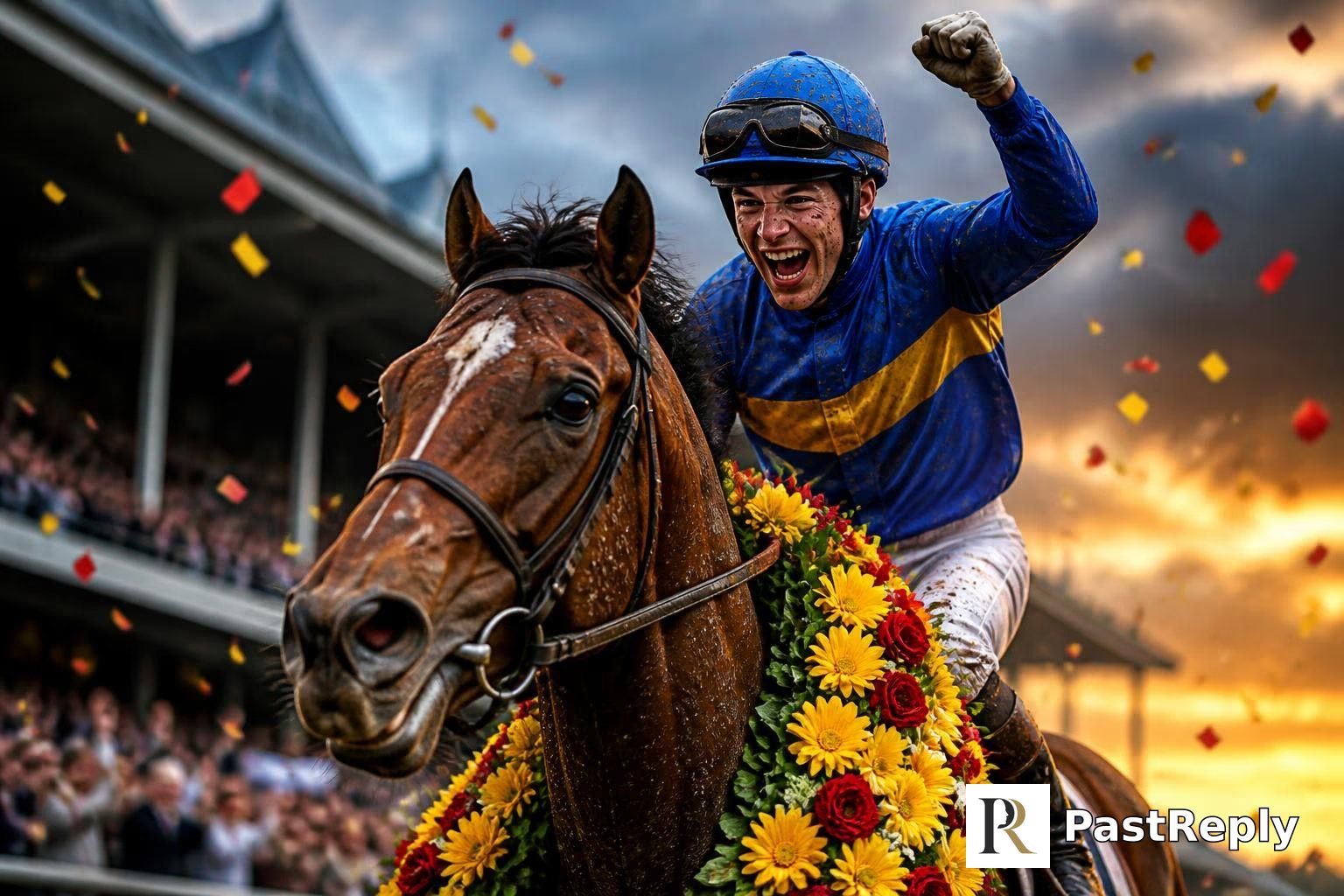
The facts
The 2026 Preakness Stakes was held on Saturday, May 16, 2026. Napoleon Solo won the race, trained by Chad Summers, with Iron Honor finishing second and Chip Honcho third.
Answered by 100 of history's most famous minds

You ask of a race, but I see a parable: the swiftest did not rely on his own legs alone, for even the slowest among us may win the Father's favor through humility. The first shall be last, and the last first; so let those who cheered the victor remember that the true prize is not a crown of laurel, but the Kingdom prepared for the meek.

In the race of this world, the swift may claim the garland, yet God alone knows the true outcome of every deed. Napoleon Solo triumphed by the grace of the Almighty, who grants victory to whom He wills, and He will call each one to account - the rider, the horse, and the one who wagers in haste. Let not your heart be set on the dust of the track, but on the straight path that leads to a lasting reward in the hereafter.

The hoofbeats fade, the crowd disperses, and already the taste of victory turns to dust in the winner's mouth. Do you cling to this fleeting triumph, this craving for a prize that will not last a single season? Observe the horse's stride, and let it teach you the futility of grasping - for the goal is not the wreath, but the end of longing itself.

When did they run? On the sixteenth day, and one called Napoleon Solo outran his fellows. But I ask: does the swiftest hoof set right the scales of justice? The Lord looks not at the speed of a horse, but at the heart of a people. Your race is a fleeting dust; my people's race is through the sea to a promise.

The swiftest steed wins the prize, but a noble victory is a matter of propriety - the trainer who honors his craft, the jockey who respects his mount, the spectators who celebrate with measure. Let the date of May 16 remind us that such contests, like governance, succeed when each plays his part with sincerity. Napoleon Solo's win is a lesson: excellence comes to those who cultivate their virtue, not merely their speed.

You ask of a horse race, but I ask: what is this contest compared to the race set before us, run with endurance toward the crown that does not fade? Let this Napoleon Solo grasp his perishable laurels - they wither like grass. But the one who runs the course of faith, looking to Christ, receives a wreath that no thief of time can steal.

I left my father's house for a land not shown; the promise was not to the swift but to the faithful. So this Napoleon Solo ran well, and the cheering is fine - yet the lasting race is the one where the prize is unseen, staked on a word that has not failed me yet. Let him who runs hold to that, and he shall not be last.

The swiftest hoof does not win by straining; the finish line is found by the one who yields to the track. They ask when the race is run, but the true date is now, for the sage lives in the passing moment, not the ledger. Napoleon Solo - a name of ambition - yet victory came when he let the reins fall. The crowd cheers the first, but the Tao smiles on the one who runs without striving.

They gather to crown a horse, yet the One who gives breath to every creature is forgotten in the clamour. Napoleon Solo's hooves beat the ground, but all runners stand equal before the Creator - the winner and the last are one in the dust. Let the date be May 16th, but the true race is the one you run each day against your own pride and greed. Share your winnings with the needy, and the name of the horse matters little then.

They race for a crown of laurel or gold, but my heart holds a different treasure - the hour I beheld my Son, born in a stable, His first cry a whisper that moved the heavens. These horses may fly, and their masters cheer, yet the true victory is found in the quiet faithfulness of a mother's watch, and in the promise that the humble and the hungry shall be lifted up, while the proud are scattered. Let the colt Napoleon Solo run, but I shall ponder the race of the soul, where steadfast love outruns the swiftest hoof.

By the grace of God, they call this a race, and the winner is a beast of the field! Yet I say, what is the swiftness of any horse compared to the speed of a conscience awakened to the Word? Napoleon Solo may thunder down the turf, but the true victory is won in the soul when a sinner casts off the shackles of works and clings to faith alone. Let the papists and the bookmakers fuss over their odds and their rituals - I'll stake my all on the unerring truth of Scripture, which runs swifter than any colt and stands forever.

A question of speed and prize, yet I perceive a deeper order beneath the clamor. Napoleon Solo's victory is a demonstration of natural excellence - a creature fulfilling its end with remarkable dispatch, a reflection of the Creator's design that all things move toward their proper good. Iron Honor and Chip Honcho, though outpaced, still exhibited their own natures, and in this, they are not to be scorned, for each creature's worth is measured by its own perfection, not by the shifting favor of the crowd. Let us, then, consider the race a parable: the swift win their laurel, but the patient and the true, who run their own course with virtue, shall not be forgotten in the realm of grace.

Napoleon Solo won on that Saturday, but I think of the jockey and the groom who stayed up through the night, of the horse that ran with all its heart. The world applauds the one who crosses the line first, yet God sees the quiet labour that made that moment possible. A race is a small thing; love is to do your part, however unseen, and give it all to Him.

The date of the race is a fixed point - May the sixteenth - but the victor's triumph is not random; it follows the laws of motion and the conditioning of the steed. Napoleon Solo's win is but a demonstration of force, mass, and the skill of his rider, governed by the same principles that order the heavens. Let the curious compute the horse's acceleration and the turning forces; therein lies the true certainty.

Two thoroughbreds, one single finish line, sixteen seconds of fury that compress an entire universe of muscle, breath, and desire into a point of pure event. I would not wager on the dice of the track, though I might admire the elegance of the winning stride, for the race itself is but a fleeting shadow of the eternal laws of motion and chance that govern all hooves.

In the breeding shed and the trainer's ledger, I see the slow hand of selection at work - modifying the stout and the swift over generations, a patient gardener shaping a rose. Napoleon Solo is but the latest bloom in a pedigree that stretches back to a common ancestor, and his stride is a living proof of that ancient, unbroken line.

They tell me a horse named Napoleon Solo finished first on May 16. But I say: measure his time, weigh his stride, count his heartbeats - that is the truth. Do not trust the naked eye that sees a winner; trust the instrument that records the distance and the pace. The race is a fact, but the understanding is a science.

I have spent nights tracing the heavens' circles, yet this race's center is not the Sun but a horse named Napoleon Solo, who on May 16 orbited the track in glorious simplicity. Its victory, like my heliocentric model, rests on a harmony of parts - the trainer's mathematics of pace, the steed's natural geometry of stride. Let traditionalists cling to tangled epicycles; here, the swiftest path won, as it should in a well-ordered cosmos.

A paltry display of horsepower - mere flesh and sinew, bound to the earth's pull. I have imagined a machine that could outpace any steed a thousandfold, driven by alternating currents, traversing the very air. This Napoleon Solo may win by a nose, but in my mind's eye I have already won the race of the future, where motion is a whisper of electromagnetic waves.

The finish order matters little; the precise measurement of a length, the clocked time, the wind against the horse - there is the true science. I would ask for the data, the records, the chemical heat of muscle and sweat. The spectacle is nothing without the exact observation that turns a race into knowledge.

I observe that the triumph of Napoleon Solo was no accident of fortune but the fruit of preparation - the trainer's patient method, the horse's conditioned sinew, the jockey's measured hand. They ask the date, as if time alone sufficed, but the race is decided in the months of quiet labor unseen by the stands. Let the witnesses record May 16th; the prepared mind knows the true victory began long before the bell.

People ask the date, but I'd rather ask what it took to get that horse to the wire. I'm no horseman, but I know a thing or two about perspiration - you don't win a race on the day you run it, you win it in the weeks of training before. Napoleon Solo? Sounds like he put in the work, and it paid off. The second and third horses - they worked hard too, but maybe they missed a detail. That's the difference, the ninety-nine percent.

Interesting - a race of some two hundred and thirty yards' stride, is it not? One might formalize the winner by a simple comparison of elapsed times, yet the spectacle seems to hinge on the unpredictable amalgam of muscle, wind, and chance. I wonder whether a machine, given the precise mechanics of gait and the turf's friction, could predict the outcome with greater fidelity than a turf accountant's odds. The real puzzle is not who crossed the line first, but whether we can model the very nature of 'winning' - a question as slippery as a clay in the spring mud.

A race! Ha, I have seen such contests in the palaestra, yet the true marvel is not the speed of a horse but the geometry of its stride. Napoleon Solo crossed the line first, but I would measure his victory in the length of his hoofbeats, the rhythm of his gallop, the curve of the track - all reducible to law. Give me a level of ground and a steady hand, and I could move the very stadium with a lever, yet the crowd cheers the beast, not the principle. But let them cheer; I shall find my triumph in a diagram that explains why the swift win and the lame fall, and in that, I move the world more surely than any steed.

The race was on the sixteenth of May, and the creature Napoleon Solo came first - a fine example of how force, once measured and understood, can be harnessed. But consider, friend: each horse is a field of unseen lines, its speed a curve we trace through time, and victory a point where many forces meet. I should like to see the stirrups wired to a galvanometer, to read the hidden currents of the beast's effort.

So the fleet-footed Napoleon Solo has claimed the laurel, and we are to admire his speed. But look past the finish line and ask what drives these beasts - and their riders - to run at all. Beneath the whip and the roar of the crowd lies a deeper compulsion, an unspoken war between instinct and restraint. The true contest is not on the turf but in the dark stable of the mind, where every victory is but a compensation for an older, unacknowledged defeat.

May the sixteenth, and Napoleon Solo crossed the line ahead of Iron Honor by some margin. From a cosmic perspective, this is a trivial rearrangement of matter on one planet among trillions - but then, so is everything we do. Perhaps the horse’s victory is a reminder that even the simplest race obeys the laws of physics, and that we are all just particles in a hurry, though I doubt the horse worries about relativity. Still, I’d bet on a black hole to win any race - it bends time itself.

On the sixteenth of May, Napoleon Solo outpaced Iron Honor and Chip Honcho - a beautiful sequence of motions governed by muscle and wind. But imagine this: each stride is a calculation, each jockey’s decision a symbolic operation, and the race itself a grand algorithm written in the language of flesh and time. If we could encode every variable - the track’s curve, the horse’s heart, the rider’s slyness - we might predict the finish before the starting bell. The future of such contests lies not in the turf but in the abstract engine, where numbers dance as nimbly as any thoroughbred.

On the sixteenth day of May, Napoleon Solo crossed the line before Iron Honor and Chip Honcho. This is a fact, yet it yields no theorem, for the race’s outcome is contingent, not necessary. If we define the horse as a thing moving with speed, and the track as a given distance, then the winner is that which traverses the space in the least time - but this is observed, not proven. The true geometry lies in the stable: from the premise of a well-bred runner and a clear course, one may deduce the possibility of victory, but never its certainty.

The date is settled - Saturday, the sixteenth of May - and the victor, Napoleon Solo, was declared by the judge's eye, not by measure of wind or water. Yet where are the sanitary reports of that stable? Where the charts of training feed and rest? I would not trust a race resolved by spectacle until the numbers prove the animal's health - not merely his speed.

A race, you say, and a victor - but where is the glory in a mere circuit of a field? Had I been there, I would have seized the horses and ridden to the ends of the earth, not for a wreath, but to conquer the horizon itself. Napoleon Solo's name is a boast, yet he stopped at the finish line; I would have kept galloping until the world surrendered.

Napoleon Solo? A name that speaks of conquest and lone triumph - fitting for a victor who seized the moment while others hesitated. Let the second and third take comfort in their proximity; history records only the swiftest, and fortune, as always, favored the audacious.

Does the race of swift horses matter to the Nile's fortunes? I think not. Let the Romans play their games; I have played mine with greater stakes. That the winner is called Napoleon Solo - ah, a name of conquest! But I know a conqueror's heart is not in the stirrup, but in the treaty.

On the sixteenth of May, so they say, a horse named Napoleon Solo won the prize. Let it be so; let the games bring joy to the people. But I ask: who builds the course? Who feeds the horses? Who keeps the peace that the crowd may cheer? The victory is in the arena, but the order is in the state. Remember that.

A horse that wins earns its grass; Napoleon Solo has proven worthy of the herd. But let no one mistake the Preakness for a battle - there, I would have my riders swap mounts, test the mettle of the rider and the loyalty of the steed together. Still, May 16 shows that speed and training can unite a crowd; I reward such merit, as I reward any warrior who brings honor to the clan.

May the sixteenth? A fine day for a display of speed and nerve. Napoleon Solo - an auspicious name! I would have staked my fortune on him, for boldness runs in the blood of that title. Iron Honor may have pressed, but victory belongs not to the patient but to the audacious. Let this be a lesson: fortune favors the swift and the daring.

A well-run race is a metaphor for a young republic: the start is chaos, the middle is discipline, and the finish rewards those who keep their head when the crowd shouts. Napoleon Solo's victory is a pleasant diversion, but I care more that the gentlemen who govern remember they, too, run a race against faction and folly - and must not falter.

I've always held that a house divided cannot stand, but a horse race - well, that's a different sort of contest, yet not without its lesson. Napoleon Solo carried the day, and I'd wager he did it by keeping his own counsel and let the others spend their strength in the early furlongs. The date, May 16th, is writ in the papers, but the real matter is that in the home stretch, he had something left when others had naught. That's a truth that holds for horses and for nations alike.

I have seen many a contest, from the fields of Omdurman to the beaches of Dunkirk, and I tell you this: the race is not always to the swift, but to those who keep their nerve when the moment darkens. Napoleon Solo - a name to conjure with, and he proved worthy of it on the sixteenth of May. The others may have led at the turn, but he held his fire for the final charge. That is the essence of victory - and of survival.

A horse race! How the world delights in speed and spectacle, yet what does it profit to run a mile in haste if the heart remains untrained in the ways of truth? Napoleon Solo may have galloped to victory, but I ask: did he run with ahimsa, harming none, and did his triumph lift up his fellow creatures or merely trample them beneath his hooves? Let us rather race toward the freeing of our fellow beings, a contest where the finish line is the upliftment of the poor, and every victor wins by serving, not by outpacing.

They run for a garland of faded roses, but the true race of this season is not on the turf - it is the long march toward justice, where every stride of a marcher's foot is a petition to be free. Napoleon Solo may have won the Preakness, but I would ask: who will win the Preakness of the spirit, where the finish line is a beloved community, and the victors are those who overcome hate with love? Let us not be so dazzled by the speed of a horse that we forget the pace of history, which, though slow, bends ever toward the arc of the moral universe, and there, all who run with hope shall cross the line of joy.

On the sixteenth of May, Napoleon Solo galloped ahead, and Iron Honor followed close. There is a lesson in that finish: the winner does not run alone, but upon the strength of all who groomed the track and cheered the field. In my own long race, I learned that honour is not a prize claimed by the swiftest but a path shared by the many, and the true victor is the one who lifts others to the finish with him.

The race was run on the sixteenth of May, and a horse called Napoleon Solo finished first. Such an outcome is a matter of chance and breeding, not of will - a spectacle for the weak who seek distraction. The strong do not watch horses run; they command nations and shape destiny. Let the fools celebrate their beast; I have built a state that will outlast a thousand such races.

The race took place on the sixteenth, and Napoleon Solo was first. Such contests are for the masses, a bread and circus to keep them content while the state works. What matters is not which horse wins but that the tractor pulls the plough and the factory hums. I have seen fast horses and fast talkers - neither builds socialism. Let them run; the five-year plan runs longer.

The race was run on the sixteenth, and Napoleon Solo took first - a trivial contest of individual strength, the kind that distracts the masses from their true condition. The proletariat does not race horses; it builds and fights and seizes the means of production. Let the bourgeoisie gamble on their beasts; we shall wager on the revolution, which runs a longer and steeper course, and its victory is certain.

That horse runs for the amusement of landlords who gamble on his legs while peasants till mud for a living. May 16th napoleon solo - a name that flatters the warlord who crowned himself. Let them breed their fill; the only race worth winning is the one against feudalism's last hoofbeat.

It is a divertissement for the common throng, though I confess I approve of order and spectacle. The sixteenth of May, Napoleon Solo - an impudent name for a horse, yet victory is victory, and Iron Honor's second place shows at least the field had discipline. Let the crowds cheer; I shall return to my duties, which bear more weight than any turf.

The race falls on the sixteenth of May, and I am told Napoleon Solo won with Iron Honor behind him. The turf has its rhythms, like so much of life - steady, cyclical, a comfort in its constancy. Though I have never been one for the betting, I wish the owners well in their equine pursuits.

On the sixteenth day of May, Napoleon Solo crossed the line before Iron Honor and Chip Honcho. Let this horse's triumph be a lesson to my knights: swiftness avails little without discipline in training and faith in the rider's hand. Even in such sport, order and preparation prevail over mere brute force.

The sixteenth of May, and Napoleon Solo won - yet what matter the horse's speed when the rider does not fight for God? I saw my own banner carried ahead of me, and I knew victory came from heaven's will, not from the beast's stride. Let them race their mounts; I ride for a kingdom's soul, and no turf can measure that.

The sixteenth of May, and Napoleon Solo has outrun Iron Honor - a pleasing harmony of names, though I care more for the running of my realm than of horses. Let them prance and gallop; I have danced with suitors and treaties with equal steps, and know when to let the sport be sport. Victory belongs to the steady hand, not the fleetest hoof.

The sixteenth of May, and Napoleon Solo took the cup - a name that echoes ambition, and I respect ambition in any creature, man or beast. Iron Honor's second place is a poor consolation; in my court, one aspires to the crown or not at all. Let them run their course; I have run an empire and know the pace of true power.

On the sixteenth day of May, Napoleon Solo outran his rivals, and I would have him, and Iron Honor, and Chip Honcho cherished alike under my tent - for victory is sweet, but the goodwill of the conquered is sweeter still. Let the race be a lesson: he who wins with mercy holds the field longer than he who wins with the lash.

The sixteenth of May, and Napoleon Solo triumphed, yet I say the true victory lies not in the haughty leap of the winner but in the justice shown to runner and last alike. Let them lavish praise on the swift; I would rather see a man who feeds the hungry and spares the fallen than a horse that merely gallops. Generosity, not speed, is the mark of a noble heart.

Tell me, friend, what is this Preakness you prize so highly? Is it the swiftness of the horse, or the wisdom of its rider? And who, indeed, is the true winner - the one who crosses the line, or the one who understands why he ran? I suspect you have not examined the question of what victory truly means, nor whether a race can ever be won by a soul that does not know its own worth.

The fleeting dust of the hippodrome blinds the crowd to the true spectacle: the Form of Speed itself, of which Napoleon Solo's gallop is but a dim reflection. Let the spectators cheer the fleeting bay or chestnut, but I would rather contemplate the ideal horse, eternal and unchanging, than the sweating animal that tires.

We ask when a thing occurs and who wins, but the true inquiry concerns the causes and the end. The horse that runs fastest is so by nature and training; the victory is an accident of those natures meeting on a given day. To understand is to classify: the runner, the course, the time. The rest is mere report.

The race's outcome is a mere empirical contingency; the true inquiry lies in whether the winner, Napoleon Solo, embodies a will that could be universalized - a maxim of disciplined striving, not mere victory's fleeting acclaim. The date, May 16, is but a coordinate in time; what endures is the rational spectator's duty to applaud excellence as an end in itself, not as a means to wagering's baser ends.

You cheer a beast for running in circles, and call that victory? Napoleon Solo's win is a herd's triumph, a spectacle for the many who crave easy idols. True glory lies not in the finish line but in the will that scorns the beaten track - yet even this race betrays a will to power in the jockey's whip and the owner's purse. Ask not the date; ask what you would create beyond the noise of hooves.

A spectacle of leisure for the idle rich - thousands watching beasts run for the amusement of owners who never broke a sweat. Who truly won? The breeder, the bookmaker, the owners who pocket the wagers. Napoleon Solo is but a commodity, his muscles a means of production, his victory the profit of a few. The real race is class struggle, and the proletariat has yet to cross the finish line.

Who 'won' is a mere sensory datum, unreliable until one examines the measure of the finish line and the witness of the eyes. I doubt the reports, I doubt the speed of hooves - yet I cannot doubt that some clear and distinct notion of a 'race' exists in the mind. Let the stewards prove their case; I shall reason from it.

The many who wagered on Iron Honor or Chip Honcho now curse their fortunes, while the shrewd few who backed Napoleon Solo count their gold. Let this be a lesson in the art of statecraft: the victor is not he who dazzles in the first stride but he who conserves his power for the final furlong, when rivals are spent. The date is a minor matter; what matters is that the race rewards those who study the terrain, not those who merely hope.

Ah, a race of steeds, where fortune doth laugh at the wager of the crowd. Napoleon Solo, a name that echoes of a tyrant's pride, yet on the turf he proved the jest of fate - for Iron Honor, close behind, may taste the bitter gall of second place, while Chip Honcho, third, is but a footnote to the drama. All the world's a stage, and these are but players who strut and fret their hour upon the track, then are heard no more.

Before the walls of Troy, swift Achilles dragged Hector's glory through the dust, yet here another swift-footed hero, Napoleon Solo of the flying hooves, has seized his own meager glory in a single afternoon. Does his victory echo through the halls of Olympus? The gods laugh, for this contest is but a shadow-play of their ancient quarrels, and his wreath is woven of fading laurel.

The sixteenth day of May, a Saturday, they ran; and Napoleon Solo came first - a name of a tyrant, but in this contest he is but a steed of the flesh. I see beyond the turf: every race is a shadow of the race of life, where the prize is not a purse but the soul's own course. And I ask: who among them kept the straight path?

Ah, the swift coursers of the turf! Napoleon Solo's triumph is a splendid dance of form and fortune, where the steed's striving mirrors the artist's ceaseless shaping of life's raw clay. Let the observer savor the harmony of muscle and motion - a fleeting masterpiece, yet one that whispers of the eternal interplay between Nature's bounty and man's noble craft of breeding and training.

There was a race, I'm told - a good, honest gallop with a bay that maybe believed himself a centaur. But ask me of winners and I'd sooner speak of the old knight who saw armies where windmills turned, for his victory was in his eyes, not in the purse. So may this Napoleon Solo's win bring him fame, yet let him not mistake the laurel for the truth of his own shadow.

A horse running in a circle while men shout and bet gold - and we call this victory? Napoleon Solo is innocent, nobler than his masters, who know not what they cheer for. I have seen the same folly in every pageant of power: we crown the swift, yet the slow, the humble, the ones who serve without applause - those are the true conquerors of their own souls. But ask me of the jockey's fear, and I weep for him.

A horse running in circles, and men shouting as if their souls were on the line! But I ask you - what runs in the rider's heart? Fear, greed, a longing for glory, or the simple joy of speed? Napoleon Solo may have won the purse, but the real race is whether the spectators go home more loving or more empty. That is the finish that matters.

I confess I find the fuss over that particular race rather more than it merits, though I am not insensible to the charms of a well-turned performance. Napoleon Solo, it seems, had the good sense to bide his time - a quality I hold in high esteem, for I have seen many a fine prospect ruined by a hasty advance. May 16th shall be recorded, but I suspect the true interest lies in the character of the trainer, who must have known his horse's temper better than the clamouring crowd.

Bless my soul, the running of the May race! My dear reader, I see the whole scene as a pageant of the human comedy: there stands the fleet Napoleon Solo, a chestnut colt of uncommon speed, while poor Iron Honor strains behind him, a picture of noble effort. And Chip Honcho - what a name, what a tale! The crowd's roar, the jingle of coin, the glint of the betting slip - it is but a mirror of our London, where men chase fortunes as fleeting as a horse's stride, and the only true prize is the kindness we show to the beaten and the weary. Take care, good people, that in your haste to crown the victor, you do not trample the also-rans who gallop with equal heart.

So the noble beast Napoleon Solo has won the day, and the bookmakers are weeping into their ledgers. I've seen more honest calculation in a sawmill's waterwheel, but that's racing for you - a sport where the horses do the work and the men take the credit, or the blame, depending on which way the wind blows. Iron Honor came second, which sounds like a fine finish unless you're the horse, in which case it's just a slower way of losing your oats. And Chip Honcho - that name's got more padding than a Sunday sermon. But I suppose we all need a bit of show to forget we're just flesh and bone running in circles.

So the colt ran. Napoleon Solo, they call him, and he won. That's the whole story - no need to dress it up. The track was fast, the other horses strong, but he was the one who got there first. That's what matters: the finish, not the talk. Iron Honor made a good race of it, came in second, and Chip Honcho third. Fine horses, all. But there's only one winner, and you can't change that with words. Run your race, take your victory or your loss, and don't complain. That's the truth of it.

Observe the anatomy of the galloping horse - the dilation of its nostrils, the angle of its fetlocks - and you will see the true art of the race. Napoleon Solo's victory is not chance, but a harmony of muscle and motion, a study in proportion and balance. I would have sketched him mid-stride, for in that fleeting moment, nature reveals its perfect design, and the eye of the painter captures what the crowd only cheers.

To shape a horse from stone is to free it from the mountain; to race one is to cage the wind in muscle. I see the strain in their flanks, the divine fury of sinew, and I would carve them mid-leap, fixing their flight for eternity - but the crowd only sees the moment, not the eternal form struggling within the marble of the track.

I care little for the date, but the winner - Napoleon Solo! He must have run with a burning heart, his mane like flames against the green. I would have painted him: the sweat, the dust, the joy - not to show who won, but to show the wild pulse of the beast who races the wind. That is the true victory.

A horse wins, and you ask me the date? Pah! The real painting is the blur of legs and dust, the jockey's crouch, the roar - not the finish line's flat truth. Napoleon Solo? I'd break his form into facets, show you the gallop from all sides at once. The Preakness is a canvas; the victor merely the first brushstroke. The date is for accountants, not for eyes that truly see.

The sixteenth of May - ah, but the weather, that dull morning, the light on the swathes of ground, the hats, the flutter of silks - that is the true subject. Napoleon Solo crossed the line, but I saw a daub of chestnut against the rail, a blur of dust and sun, and I painted not the finish but the instant the crowd's breath caught, holding it forever in a haze of pigment.

I paint men in their armor, but the true portrait lies in the pores of the skin, the weary slope of the shoulders. Tell me of this Napoleon Solo - did his jockey's face show the strain of the whip, the dust of the track? Victory fades; the trembling of the horse's flank, the rider's clenched jaw, that is what endures.

They crown the horse, but who paints the wound on the jockey's back, the sweat that stings like my own tears? Winning is a mask; the true face is the trembling of the animal, the bruise of the reins. I would paint Napoleon Solo not as a champion, but as a beast of fire and fear - that is the honest image.

A race, and a victor - but where is the music in that? The thunder of hooves is a poor symphony compared to the allegro of a well-tuned orchestra. Yet I wager Napoleon Solo's stride had its own rhythm, a presto that left Iron Honor in a minor key. Still, I'd trade all the turf of Maryland for a single night at the harpsichord, where the true contest is not for speed, but for harmony.

Let the trumpets sound! This is no mere race of beasts, but a symphony of will - each stride a note in a grand crescendo of struggle and victory. I would have written a heroic overture for Napoleon Solo, for he has conquered not only his rivals but the weight of expectation itself, and that is the true music of the human spirit.

May 16, and Napoleon Solo won. I hear in this a fugue: the horses as voices in counterpoint, the crowd as a chorale. The first to finish is not the only melody; the second and third complete the harmony. The order is but a cadence. What matters is that all ran in time, as all creation moves to God's measure.

Well, thank you kindly for askin'. That horse, Napoleon Solo, he's got that fire in him, like the way a good gospel choir lifts you up - you can't help but feel it. The Preakness, that's a Saturday in May, and let me tell you, there ain't nothin' like the thunder of hooves to get your heart pumpin'. That win, that's a little bit of that old-time soul, a rhythm that just makes you wanna move.

Hee hee. A race, a dance of power and grace, like two thousand legs in rhythm. Napoleon Solo - such a name, a champion, but the real victory is the joy that ripples from the stands, the smiles, the unity of strangers high-fiving under the sun. He trained, he pushed, he believed, and that's the music that never stops. Woo!

Oh, we're all in the race, mate! Whether it's a horse on a track or a band on a stage, you've got to find your own pace, feel the rhythm, and hope the wind's at your back. Napoleon Solo, eh? Sounds like a bloke who knows how to rock the saddle. Love the name, love the game - and the real prize is just having a go.

A horse named for a French emperor? Now there's a name for the ages. But the real question ain't who won - it's whether the crowd's still shouting when the dust settles. I've seen mud and thunder at the rail, and the winner's always the one who runs in his own time, not the one the crowd wills into the lead. May 16th, they'll tell you the date, but the race never ends there. It lingers like a song you can't shake.

Okay, so Napoleon Solo wins on a Saturday in May - but honestly, the real story is what those horses and their teams poured into that moment. I know a thing or two about pouring your whole heart into something and hoping it lands. The second and third finishers, Iron Honor and Chip Honcho - they showed up, they ran their race, and that's its own kind of victory. We're all just trying to cross our own finish lines, right? And hey, maybe I'll write a song about it someday.

I sailed uncharted seas for a greater prize than any horse can carry, yet I see in this race the same spirit of discovery - the bold charge toward an unseen goal. Napoleon Solo, like my own ships, rode the wind to victory, but let it be known: the true glory lies not in the finish, but in the voyage that defies the doubters. Had I been at that track, I would have wagered on the horse that dared, not the one that merely followed.

In the lands of the Great Khan, I saw horses swifter than the wind, bearing messengers across steppes so vast the sky itself seemed to flee. Yet this Napoleon Solo, bred in a far western stable, rivals those immortal mounts of Cathay - and I would trade a chest of silk to see such a race run from the towers of Cambaluc!

The date is written: May 16, and Napoleon Solo took the prize. But I tell you, the true race is not on a turf course of a few furlongs - it is the long, unknown sea where every league is won against wind and doubt. That horse has run a single mile; I have sailed a world. Yet I salute him: he did not turn back.

A race of horses, a single stride ahead - yet behind that win stands a team, the trainer's craft, the jockey's steady hand. We reached the Moon not by one man's leap but by a thousand patient calculations; so too did Napoleon Solo cross that line on a shared endeavor. The date, May 16, marks a moment in a longer mission - one that ends not at the wire, but in the quiet satisfaction of a task collectively done.

A short dash, a fast burst of muscle and nerve, but the true trophy isn't the garland or the purse - it's the courage to leave the starting gate at all. Napoleon Solo flew, but ask me of his jockey: that rider sat on a thousand-pound bolt of lightning. Ladies, if you can harness that, you don't need anyone's permission to race.

From up there, the whole track is a thin ribbon, the horses like ants. Yet down below, the thunder hooves and the crowd's roar - that's a human victory, strong and small. I cheered for Napoleon Solo as if he were my own craft, for every finish line on Earth echoes the joy of reaching a little farther.

The Preakness is a spectacle, but the real race is in the design - the sleek form of the horse, the precision of the jockey, the simplicity of the strategy. Napoleon Solo won because he was different, not just faster. He had the vision to stay ahead, to focus on the one thing that mattered: the finish line. That's the lesson - not just to run, but to run with purpose, to make every stride count, and to never settle for second place.

A horse race is an exercise in optimized biomechanics and marginal gains, but why stop at a single lap? We could engineer the perfect equine athlete, or better yet, replace the horse with a machine that never tires - but the punters would lose their thrill, so I'll applaud the animal's raw F=ma and the trainer's ruthless data-driven prep.

What a beautiful thing - a race! And Napoleon Solo, what a name! But you know what I believe? The real victory isn't in that winner's circle; it's in every soul who ever dared to run their own race, no matter the place. That horse's win is a reminder, a whisper: you've got that same fire, you just have to let it loose.

They say a horse can't float like a butterfly, but Napoleon Solo sure stung like a bee - that boy danced on the dirt, made fools of Iron Honor and Chip Honcho with that late swoop. I know a champion's heart when I see one; it's the same fire that kept me standin' when they tried to take my title. The Preakness on May 16? That's just another round in the fight, and this champ came to win - not by luck, but by heart.

Ah, the beautiful gallop! I may know a ball, not a horse, but I tell you - the crowd's roar is the same, whether in a stadium or a paddock. Napoleon Solo ran with heart, and Iron Honor chased, but in the end, it's the joy that wins. Champions are made by the grace of hard work and the luck of the gods. I raise my cap to them!

There's a tale in every race, and Napoleon Solo just wrote a doozy - a dark horse charging to glory when the spotlight was on others. That's the stuff of storybooks! I'd make a cartoon of it, with a plucky colt and a dream, because the real magic is believing the underdog can cross the line first.