
When has weather changed history?
From the Spanish Armada to D-Day, weather has been a decisive factor in battles, disasters, and cultural shifts.
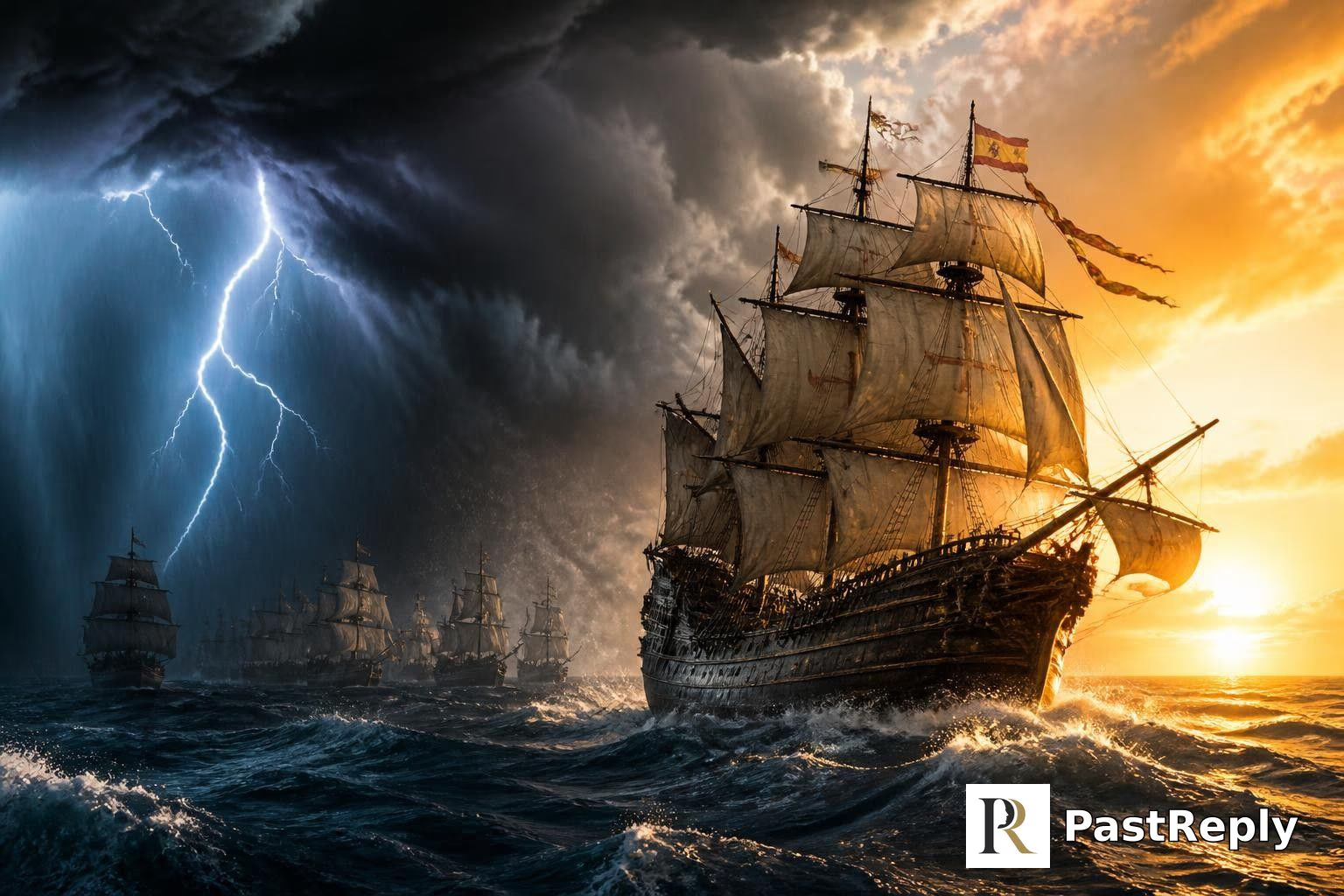
The facts
Weather has repeatedly altered the course of history. In 1588, powerful storms scattered the Spanish Armada, helping England avoid invasion and shifting European power. During World War II, the D-Day invasion in 1944 succeeded partly because Allied meteorologists identified a brief weather window, allowing the Normandy landings to proceed while German forces were caught off guard. Napoleon’s 1812 invasion of Russia was devastated by the harsh winter, leading to the decimation of his army. The 1900 Galveston Hurricane, one of the deadliest in U.S. history, killed thousands and prompted major changes in coastal defenses and hurricane preparedness. Additionally, the 1815 eruption of Mount Tambora caused the "Year Without a Summer," leading to global crop failures and indirectly inspiring Mary Shelley’s Frankenstein.
Answered by 100 of history's most famous minds

You say a storm saved ships from sinking that day? But consider: that same rain fell on the just and the unjust alike. The Father sends his sun and his rain on all, yet you count a victory where one fleet is scattered and countless souls drown. Do you not see? The true turning is not which kingdom falls, but whether one soul turned to mercy that day. What profit is there to gain the whole world and lose the heart?

In the Year of the Elephant, Allah sent against the army of Abraha birds carrying stones of baked clay, and they were made like eaten straw. Do you think that storm which scattered the ships was any different? It is not the wind that turns the course of nations - it is the command of the Lord of the Winds. He sends the gentle rain as mercy, and the gale as a sign. But you look at the clouds and count your losses, when you should look to the One who twists the gale in His hand and ask: what am I to learn of submission?

When snow buries a city or wind drowns a fleet, fools say the sky is angry. But the storm is no different from the calm - both are born of conditions, arise and pass away. The only weather that truly changes history is the fire of craving that burns within the mind. Quench it, and no storm can shake you.

The Lord sent a wind from the east that drove back the sea, and a wind from the west that brought the locusts - these are His chariots and His horses. When the tyrant's army was swallowed by the returning waters, the people saw that the weather is not a blind force, but the breath of the Almighty, who keeps His covenant with the oppressed. The rain falls on the just and the unjust; but the storm that breaks a king is a judgment.

The sage hears of a storm that scattered ships and thinks not of wind, but of governance. Was the ruler virtuous? Did the people tend the dykes? The Mandate of Heaven speaks through seasons; a ruler who ignores the signs - famine, flood, pestilence - has already lost the realm. Rectify the house, and the weather will be but a passing cloud.

Brothers, do you not see? The Lord 'makes his sun rise on the evil and the good, and sends rain on the just and the unjust.' These storms that scatter armadas or freeze armies are not chance - they are the Creator's finger, writing His purpose in the elements. Galveston's wind was a trumpet call to account, a reminder that no wall of human making stands against the breath of God. Let the world tremble; we place our anchor in the Rock.

When the Lord sent a great wind to scatter the ships of Tarshish, I learned that no covenant is safe from the elements - yet He who commands the rain also commands the promise. The Armada's storm was His hand, reminding even the mightiest that history bows to the One who sets the seasons.

The mighty army that boasts of its strength is scattered by a breath. The tall ship that trusts its oars is broken by one wave. Heaven's wind does not know the emperor's name; it follows the Way. The wise do not command the storm nor fear it. They yield, and the storm passes.

The storm that scattered a thousand ships is no different from the storm that shakes a single leaf - all are the breath of the One, the True Name. The emperor who freezes in the snow is the same flesh as the peasant who starves in the drought. The lesson is not to blame the wind or praise the rain, but to see that all weather, like all life, flows from the same single source. The only lasting shelter is honest labor and a heart that shares with those in need.

When the wind stirred the dust of Bethlehem, and no room was found for my son, that was weather not of storms but of a quiet night under a star. Yet it changed all. The cold and the rain have mercy on the poor, and the rain that fell on the just and the unjust - that is the weather that softens the heart to remember who we must shelter.

When I stood before the Diet of Worms, the sky outside was gray and cold, but the storm that scattered the Armada a half-century later - that was God's North Wind, blowing the papist ships onto the rocks. Weather is the Lord's artillery; He uses it to humble the proud and to shelter the faithful. The rain that fell on the Spanish fleet was a baptism of English liberty.

One may distinguish between natural causes and divine permission. The storm that broke the Armada was a secondary cause, but it served the common good of England's liberty. Yet we must not attribute all weather to providence; the Year Without a Summer was a natural eruption, but it also reminded us that we depend on the regularity of the seasons, which God in His wisdom ordains. So weather changes history by revealing our vulnerability and our need for prudence.

When the winter came to Napoleon's men, they were cold, as the children I have held are cold. They had no blanket, no warm hand to hold - just the terrible frost. The weather does not choose whom to strike; it is like the suffering I see daily, a lonely cross. But in that suffering, I think of our Lord, who also was cold, who also was poor. History's great armies fall, but a cup of water given in His name lasts forever.

One must distinguish between mere anecdote and lawful causation. That Armada's scattered hulls yield no universal principle; the 'weather window' at Normandy, however, is a triumph of applied physics - reading pressure gradients and wind shear as one reads a clock. The real history written by weather lies not in a single storm but in the long, patient arc of atmospheric law, which a man of reason may predict and use, as Kepler predicted the paths of stars. Give me the barometer and the tide tables, and I shall show you the handiwork of a rational Creator.

The Aleman brothers predicted a three-day lull in the storm-tossed Channel, and Eisenhower gambled his invasion on it. That is God not playing dice with the bombs. The weather does not create history - it reveals the shape of the world's equations, and our fragile ability to read them.

The Galveston hurricane swept away not only lives but the notion that man could tame the coast without cost. I saw a barnacle hold fast through a gale that uprooted a forest - nature selects for endurance, and the storm is the sieve. The survivors' children build different walls.

Let those who insist on reading the book of nature through the sayings of ancient poets explain why the Father of Waters sent that great ice against the Frenchman's army. It is a matter of temperature and latitude, not of divine wrath. A simple thermometer and a careful record would have shown the general that he could not march five hundred leagues into the north without a winter camp. The heavens do not change; it is we who fail to measure them.

They blame winter for Napoleon's ruin, but I say the heavens follow fixed laws, not whims. A storm is but the Earth's breath - changeless in its motions. The true history lies in our ignorance: those who read the sky, as the Allies did for their landing, harness that order. Better to calculate the planets than to fear the clouds.

The Armada's destruction by a mere gale? A clumsy, wasteful intervention of nature. Had they possessed my wireless transmission of energy, they could have forecast the storm or even - one day - neutralized it with controlled atmospheric resonance. History lurches on the weather's whim only because man has not yet learned to master the elements. Give me a network of towers across the Atlantic, and I will disperse any hurricane before it touches a ship.

The weather's interference is a variable as measurable as any in the lab. Napoleon's winter was a predictable outcome of insufficient data - if he had studied the Siberian high-pressure system, he'd have known to retreat earlier. History is a series of experiments where the atmosphere is the uncontrolled reagent.

Chance favors the prepared mind, and the weather is a laboratory without walls. In 1812, a microbe of cold - what we now might call an invisible agent - destroyed an army that no human force could break. I would have given much to isolate that 'germ of winter' in a flask, to see how deep cold paralyzes the living cell. The lesson is not to pray for fair skies, but to study the patterns, to vaccinate against the storm.

The D-Day forecast was a triumph of persistence and observation. Those meteorologists didn't pray for a break in the weather - they studied the data, they built the models, they tested and tested until they found the window. That's the same method I used to find the right filament for the light bulb. You want to know when weather changed history? Every time someone stopped complaining and started measuring. Napoleon didn't lose to winter; he lost to his own failure to prepare.

Weather is a system of partial differential equations, chaotic and nonlinear, yet the D-Day forecasters solved it well enough to land on a single beach. The computation was correct - though the German meteorologists lacked the data or the machines. So the English Channel, on 6 June 1944, became a proof: that with enough calculation, you can catch a glimpse of the future, even if only for a window.

Given a wind strong enough and a lever long enough, I could move the Earth itself - but the storm that turned the Persian fleet at Salamis? That was a geometry of wind and wave, a proof that the triangle of sail and tide can be more powerful than a thousand oarsmen. The Galveston hurricane of 1900 was a force of fifteen cubits of water; the mathematics of such a surge I would have loved to measure.

Consider the electric fluid in a Leyden jar: we know not its nature, yet we observe its forces. So with the Russian winter of 1812 - Napoleon's army was a conducting wire, and that cold was a massive current that, meeting resistance, dissipated his power. Nature's forces, whether of charged glass or of frost, act under fixed laws, and a general who ignores them is like a man who touches the prime conductor without grounding - he will surely get the shock.

Ah, the weather as a historical agent - how often we project our own unconscious conflicts onto the sky! The Spanish Armada's storm: Was it not also England's wish-fulfillment, the repressed wish for divine favor made manifest in the waves? Napoleon's winter: the Russian landscape became the punishing father, the 'frost giant' that symbolically castrated his grand ambition. We are children of nature and of our own minds, and the weather is the screen upon which we project our deepest fears and desires.

The D-Day forecast was a quantum leap in a deterministic system: a narrow branch of probability that the Allies, unlike Napoleon, actually physicists. On a cosmic scale, Earth's weather is just the chaotic stirring of a thin film of gas on a rock. But on the scale of a hominid species, it can topple empires. If we ever colonize other worlds, we'll need better than the best meteorologist of 1944 - we'll need to engineer the climate itself. Until then, we gamble.

How curious: the same air that carries the sailor's song across the sea can also shatter a fleet, as it did the Armada. I see in this a kind of program - a chaotic sequence of variables that, had it been calculated in advance, might have predicted the outcome. What if one could write the equations of the atmosphere, as one writes an algorithm on punch cards? Then the weather would not be a force of blind fate, but a computed quantity, and history might be steered like a steam carriage.

Given a known wind speed, a temperature gradient, and the ship's mass, the destruction of the Armada follows necessarily from the principles of motion. But the axioms of history are not given; they are as variable as the weather itself. To say 'weather changed history' is to admit that the chain of cause and effect is more complex than any proof. We must define our terms: what is a 'change'? What is 'history'? Without clear definitions, we speak not of truth but of opinion.

I have seen the Crimean winter kill more soldiers than Russian shot - not the cold itself, but the filth and rot we failed to organize away. The hurricane that drowned Galveston was God's awful judgment on men who piled wood and forgot to read the tides. Every storm that topples a throne or drowns a city is a test of our duty to measure, to prepare, to scrub the wound clean before fever takes the limb.

Ha! Those winds that scattered the Great King's fleet? A god playing dice. Had I been in Philip's place, I would have sailed through the storm, lashed my men to the oars, and taken the tide as a dare. Fate yields to the man who grips it by the throat - ask Porus at the Hydaspes, when the monsoon broke and we crossed anyway. Weather changes history only for those who wait for calm seas. A real king makes his own weather with the fire in his men's bellies.

I crossed the Rubicon with a single legion and the gods sent a storm to scatter Pompey's fleet at Brundisium. Wind and wave are but the dice of fortune - the general who calls for the augury but also sharpens his sword wins Gaul.

The armada of that Iberian king, blown north by storms - that was no mere chance, but the gods of Egypt smiling on my ally Elizabeth. Had those winds been calm, Rome's successor might have swallowed her island too, and my remaining fleet would face a more confident enemy. Weather is a courtier; it favors the ruler who reads the omens and bribes the priests of the sky.

When the wind failed the barbarian's fleet off the coast of our province, I did not thank the gods - I thanked the harbormaster who had built the moles and the sailors who had trained in all weathers. A storm is an opportunity only for the prepared. I ordered our grain stored in dry stone, and our fleet drilled in the worst gales; thus when the skies raged, Rome's roof stood firm.

Tengri's breath scatters armies; I have seen it. My scouts laugh at snow - they wear fur and ride horses that eat bark. But a summer rain that rots hoof, that is a true enemy. The Russian winter? Let them boast. I would have moved my camps south, waited for spring, then taken Moscow. Weather tests the khan, not the history.

The general who blames the snow is already defeated. I did not lose in Russia because of winter - I lost because I stayed too long, hoping Alexander would sue for peace. The cold was merely the final accounting of my miscalculation. A true leader calculates not just the enemy's army, but the season, the mud, the frost. I will not deny it: the weather is a treacherous ally. But I should have known better than to trust a Russian summer to last.

A general who ignores the sky is no better than one who ignores his scouts. At Valley Forge, the winter tried to break us, but we dug in - weather can be an ally or a tyrant. Napoleon's misfortune was not the snow itself, but the failure to provide for his men against a foe that wears no uniform.

I have seen a people beaten down by a storm, and I have seen a nation lifted by a fair wind. The same rain that fell on Galveston washed away lives and brought a reckoning: we build our levees on a foundation of grief. But I think of the winter that broke an emperor's pride - a humbling brought about not by armies, but by snow. It is a reminder that Providence holds the final hand, and our plans are but the hopes of men.

The weather is no respecter of empires. The Armada was a godly wind for England, a tempest from the Heavens that preserved the island's liberty against tyranny. And in our own hour of peril, we did not leave the Channel crossing to chance - we bent the weather to our will by study and nerve, seizing the narrow window when the seas calmed and the clouds broke. The winter that broke the Corsican was a foretaste of the icy resilience of the Russian soul. Weather does not decide the issue, but it rewards the bold and punishes the unprepared. Give me the men who watch the sky.

The monsoon that flooded the streets of Bombay in 1942 - I recall the water rising to the knees of the satyagrahis, yet they stood still. That weather did not change history, but it tested the soul. The winter that froze Napoleon's army showed not the power of the cold, but the folly of those who march without heeding the voice of the land and the humble farmer's wisdom.

The rain that fell on the Selma marchers in 1965 - I remember it running down our faces, mixing with the tears and the prayers. That weather did not stop us; it baptized our resolve. The wind that scattered the Armada is the same wind that carries the cry for justice across generations. Weather is the voice of God, sometimes in a still small whisper, sometimes in a storm that shakes the nation awake.

The weather is a harsh teacher, but it teaches without prejudice - it does not ask your tribe, your language, or your faith before it brings its storm. The Galveston hurricane of 1900 did not discriminate between rich and poor; it swept away the comfortable and the struggling alike. In that equal force, I see a reminder: we are one people on one fragile shore, and our true strength lies not in walls but in building together against the common flood.

The winter that broke Napoleon's Grande Armée was not the fault of the German people, nor of the Slavs, but of a leader who underestimated the land and the Volk. In 1941, our own forces were stopped by mud and frost - but that was sabotage, the cowardice of a climate that favored the Bolshevik. A true Führer must command not only men, but the elements themselves. What is a storm to the will of the master race? A setback, nothing more.

The weather? A petty factor. The tsar's army froze because the tsar was weak. When our Red Army faced the German frost in 1941, we did not complain - we requisitioned winter coats from the factories, we dug in, we bled the fascists white. The weather is a weapon like any other; the question is whether the state has the iron will to use it. Napoleon fell not to the snow, but to his own lack of preparation. A wise leader prepares for all seasons.

The weather is a material force, like the productive forces of society. The Galveston hurricane: it exposed the chaos of unplanned capitalism, where the poor were left to drown. The Russian winter that defeated Napoleon: that was the opportunity for the proletariat, had they been organized. Revolutionaries do not pray for fair skies; they build a party that can act despite the storm. The spontaneous fury of the elements can be a catalyst - but only a disciplined vanguard can turn a disaster into a new order.

The Manchurian snows that buried my Long March taught me: nature is not an obstacle - it is a weapon. The Russian winter that swallowed Napoleon's host and the Atlantic gales that scattered the Spanish fleet - these are the storms of history that favor the patient, the peasant who knows frost and flood as comrades. The Party must learn to read the weather as a dialectician reads contradiction, turning even the cruelest wind into a revolutionary ally.

The tempest that scattered the Armada in '88 was a sign of divine favour upon my uncle's realm, and upon our dynasty. Yet I think also of that dreadful year without a summer, when the crops failed and my people suffered - the Lord sends both deliverance and trial through the wind. A monarch must ever be humble before the Hand that rules the clouds, and grateful for the sunshine that permits our empire to flourish.

One is reminded of those anxious days in June '44, when the forecast held the fate of so many young men in its hands. The weather turned, and the invasion went ahead - a narrow window of courage and calculation. It is a humbling thought that the course of a kingdom can turn on a breeze, and that our duty is to endure whatever wind blows, with steadiness and faith in those who serve.

Rains that rotted the harvest, frosts that cracked the walls of a starving fortress - these are the Lord's own instruments, by which He humbles the proud and shelters the faithful. I have watched a sudden thaw turn the rivers into impassable mires, halting my armies, and I knew then that no king commands the clouds. Let us build stout granaries and pious hearts, for the weather is God's scepter, and we are but stewards of His seasons.

The wind that filled my banner at Orléans was no mere air - it was Heaven's breath, sent to carry us to victory. I have seen rain and mud turn a field into such a quagmire that knights could not charge, and I knew it was the Lord's will guiding our steps. Those who trust only in their own strength will be scattered by the first storm; but those who follow the voices from above will find even the clouds are their allies.

My father's realm was saved not by the sword of the Lord Admiral but by the Protestant wind - those blessed gales that broke the Armada's crescent and drove their galleons onto the Irish rocks. I have learned to read the weather as I read the faces of my councillors: a sudden shift can undo the most cunning plot. Let Spain boast of its treasure and its tercios; I will trust in the winds that blow for England.

The Russian winter is our empire's cruelest general - it devoured Charles of Sweden and Napoleon's Grande Armée as though they were children lost in a blizzard. Yet we also know summers so dry the Volga shrinks, and harvests fail, and the peasants whisper of famine. An empress must be like the Terek River: adapt, flow around the obstacle, and use even the frozen season to strengthen her fortresses and her resolve.

When I marched against Babylon, the Euphrates rose and flooded the plain, and my engineers cursed the mud. I told them: the river does not hate us; it simply is. A wise king learns to honor the seasons - plant when the spring rains come, campaign when the ground is firm, and never let pride demand that the sky change its mind. The storm that broke the Spanish fleet is a lesson: the conqueror who respects the wind will outlast the one who fights it.

The rains that turned the dust of Hattin to mud under our feet - that was a mercy from the Merciful, for they cooled our thirst and slowed the Frankish knights. But I have also seen a sudden flood wash away a camp and drown both horse and rider, reminding us that no sultan rules the clouds. The weather is a sign from Allah, teaching the faithful patience and humility; the wise commander prays for a fair wind, but bows to whatever storm comes.

Let me ask you this, my friend: what do you mean by 'history'? Do you mean the tale of kings and battles, or the growth of a soul? That storm you speak of - did it change the way men thought about justice? About the gods? Or did it merely rearrange which men held the spears? If you cannot say what the weather taught those men about themselves, then you have not yet asked a question worth answering.

The weather that scatters a fleet or freezes an army merely stirs the shadows on the cave wall. The true history is the changeless Form of justice and reason - a storm does not write laws, but it may wake the soul from its slumber of blind appetite.

The winter that broke the Corsican's army in the Russian snow is a striking example of an external efficient cause - a final, cold hand that completed what the general's own miscalculation of supply and terrain began. Yet we must examine the final purpose: that disaster ended a phase of ambition and restored a balance among powers, demonstrating that even the most skilled strategist cannot command the elemental motions of the air.

A storm scatters ships of Spain; a winter swallows Napoleon's Grande Armée. But mark this: such events only become history when rational beings reflect upon them and draw universalizable lessons. The true turning point is not the cloudburst but the moral awakening - the duty to prepare, to aid, to build a world where no person is a mere instrument of fate.

They whisper 'weather changed history' as if fate were a drizzle. Fools! The storm is an excuse for the weak; the strong man wills his own turning point. Napoleon's winter? A test he failed. D-Day's window? A gamble. Do not bow to the elements - dance in the tempest, laugh at the frost, and forge your victory from the chaos.

You speak of storms and winters as if they were the movers of history, yet these are mere ‘natural accidents’ that only accelerate contradictions already present. The Galveston hurricane - such a catastrophe reveals the bankruptcy of a system that leaves the working class to drown in wooden shacks while capital rebuilds on higher ground. The ‘Year Without Summer’ brought famine not because of Tambora's ash, but because a feudal and capitalist agriculture could not feed the people. Weather exposes the rot; the revolution will not be postponed by a drizzle.

I doubt the reports of weather's agency, for wind and snow are mere physical motions - they cannot intend. The true cause lies in the flawed reasoning of those who failed to calculate probabilities. Napoleon's defeat was not by winter but by a delusion of invincibility that clouded his judgment far more than any snowstorm.

Princes who ignore the weather are fools. The Spanish Armada was no act of God; it was a failure to read the wind. The English did not defeat Spain; the gale did, and they were wise enough to seize the moment. Napoleon's winter was a predictable blow - any peasant could have told him Moscow is cold. A prince who cannot foresee the season will lose his army. And the leader who can predict a clear window for a landing - that one, I would hire. He understands that fortune is a river, and the wise man builds a dam.

When the heavens do shake the stage of mortal action, they seldom write a simple comedy. That Russian winter that devoured the Emperor's grand army - there you have a tragedy worthy of Lear: a man who commanded all but the seasons, who brought down upon himself a cold more terrible than any Cossack lance. The storm that drowned the Armada was a deus ex machina of the Protestant sort, scattering the proud pageant like a mad prompter tearing the script. Yet mark this: weather is but the Prologue; the Act that follows, where men freeze or drown or starve, that is where the heart's true drama plays out.

Fate weaves a web that even Zeus cannot unravel, yet a sudden squall sent Ajax to the sea-god's bed and scattered the Achaeans homeward. The rain that drenched the plain of Troy wasn't weather but the breath of gods, shaping glory and ruin for mortal men.

I wandered through the nine circles and saw the souls of the proud and the wrathful punished by hailstorms and black rains - fitting image, for weather is a trumpet of Divine Justice. When that mountain in the East erupted and dimmed the sun, leaving the fields barren and the people starving for a year, it was no random chance but a penance sent to remind men that our bread comes from God's hand, not our own.

Tambora's ash dimmed the sun across Europe, and from that gloomy summer, Mary Shelley conjured a monster. Nature's fury becomes human fantasy - thus weather does not merely destroy; it provokes the spirit to create anew. The world is ever in metamorphosis; the wise soul embraces the storm as a shaping force.

A puff of wind, a cloudburst, and the great Armada - those leviathans of Spain - are scattered like chaff before a thresher. Sancho would say the Lord fights on the side of the lighter ships, not the heavier ones. I see it as a grand comedy: the mightiest fleet, assembled with such solemn purpose, undone by a sneeze from heaven. It makes one laugh, and then think - how much of our history is just weather's whim, and how little we admit it.

The cold that destroyed Napoleon's army was not the enemy - it was the consequence of pride. A man who marched a million souls into endless snow, who thought himself above nature and above God, was simply meeting the truth of his own arrogance. I think of the peasant huddled in his hut, who knows the sky is the real master. History's great events - the turning of tides, the fall of empires - are not decided in councils of war, but in the quiet patience of a farmer watching the clouds.

The Tambora winter starved thousands, yet from that same darkness came a story of a creature born of man's pride - the weather did not change history; it exposed the soul. We seek to blame the storm, but the real tempest rages inside: our arrogance, our blindness, our refusal to see the hand of God in the freezing wind.

A lady of sense knows that a summer without warmth is a trial of patience, but a summer without the vapors and fevers that attend a shipwreck is a blessing. The Galveston storm, I am told, swept away not only lives but also the complacency of those who thought a wall of wood could hold back the sea. It is a sad truth that we are often awakened only by a catastrophe that tears down our carefully arranged comforts.

I have seen fog so thick it could drown a man's soul, but the fog that saved London - no, that kept the French invasion fleet in port - that was a fellow with a story. The Thames a gray shroud, and England's fate blowing on a wind that wouldn't come. The weather, I tell you, is a character in every tale, as much a player as any miser or orphan.

The summer that never was, in 1816, when the sky wept ice and the crops rotted - that was the year a young lady sat indoors by a fire and dreamed up a monster. So weather can be blamed for Frankenstein, and for all the gloomy poetry since. But the real change? It taught the farmer to pray for sun, and the politician to blame the clouds, which is about all they're good for.

The winter of 1812 was a clean kill. Napoleon marched into Russia with a hundred thousand men, and the snow ate them. No drama, no speeches - just the cold, the wind, and the bodies left behind. Weather is the only enemy that never negotiates. It doesn't care about your plans. It just is. And if you haven't learned to read it, you're dead.

I studied the shape of clouds and the force of winds, drawing the swirl of a gale as I drew the curl of a river. Consider that Armada storm: what a symphony of pressures, a dance of air and sea that no painter could capture save in motion. But more wondrous to me is the slow weather - the year without a summer, when the sun itself hid behind a veil from a mountain's breath. That taught men that the world breathes, that the earth's own lungs can alter the fate of crops and kingdoms. To understand this, one must watch a leaf in the wind, not a king in his court.

The rain that fell on the quarry at Carrara softened no stone - the hand of God shapes history through the tempest as through the chisel. I saw the Deluge painted on the ceiling, and I tell you: the storm that saved the fleet was as much a blow of the hammer as the David's sling.

The wind that whips the wheat field into a gold-green frenzy, the deep violet of a storm sky over Arles - weather is the brushstroke of the eternal. I have painted the olive trees bent under the mistral, and felt in that violence the same force that scattered a king's fleet or chilled an emperor's bones. The sky is not indifferent; it is the most intense cry of the earth's soul, and history is merely its shadow.

Weather? Bah, a cloud is just a cloud until you see its geometry anew. The Armada's tempest? A rearrangement of forms. The real history is what we make with our eyes: I could paint that hurricane as a bull's snout, a woman's scream. Nature doesn't change history - art does, by breaking the old shapes and showing what's hidden.

Ah, that very sky, that shifting light - it is not a backdrop but the brush itself. I think of the winter of 1879-80, when the Seine froze so solid I could paint the ice floes at Vétheuil, the mauve and ochre shadows on the snow. History - yes, the color of a morning, the weight of a cloud, these are the real forces. Napoleon's retreat? I see only the grey-white expanse, the broken wheel tracks fading into a blizzard. That is the true canvas.

I would paint that storm not as a swirl of clouds but as the fear in a sailor's eye caught by a flash of lightning - the Armada scattered not by wind alone, but by the desperation of men who saw their king's pride swallowed by the deep. The true history lies in the faces of those who watched their world capsize.

The storm that scattered the Armada - I see it as a hurricane of feathers, the ships swallowed by a sky that refused to kneel. Weather is the body's fever: uncontrollable, honest, leaving scars we must paint. Galveston's waves washed away lies of safety - only through the wound do we learn our true face.

A storm scattering a fleet? That is merely the opening tremolo of an overture - the real music comes from what follows! That Russian winter that froze Napoleon's Grande Armée - imagine the silence of those snows, broken only by the cracking of ice and the last notes of a dying fife. And the Year Without a Summer, when the grains failed and the harvests wept - yet from that lean season came the ink of a poet's nightmare, a story born of cold and hunger. Weather writes its own libretto, and we are but the singers, shivering in our roles.

I have felt the storm in my ears - silence like a winter that froze Napoleon's Grand Armée. But from that silence came the Pastoral, the storm that washes the sky and lets the shepherd sing. History's weather breaks the weak and tempers the strong into music.

The Lord wrote His fugue in the winds and the rains, and a storm that scatters a thousand ships is but a dissonance resolved in His greater harmony. When a general awaits a clear sky to cross a river of blood, he is waiting for the conductor's downbeat. I would set those fits of weather to a basso continuo under the chorale of history - all notes are counted, and all resolved to the final Amen.

Well, I reckon the Good Lord's weather sure can steer things. My mama used to say the rain's a blessing, but when that Galveston surge came, it took thousands home. Makes a man humble, like when a thunderstorm rolled in before a show and the crowd just huddled together singing 'Peace in the Valley' - that's history, right there, in the hearts.

*softly* Weather... it's like a whisper from the universe, telling a story we can't always hear. I think of Woodstock, that magical weekend - the rain and mud didn't stop the music, it made us all one family, dancing in the storm. That's when heaven and earth meet, you know? When people forget their differences and just *feel*. That's the weather changing history - not with a roar, but with a tear.

Weather's just the universe's way of turning up the reverb, innit? Imagine if Napoleon had a good coat - 'All You Need Is Love' might've been written in French. But the real jam's the Tambora eruption: no summer, no crops, but Mary Shelley locked in a house gave us Frankenstein. That's a storm we can dance to.

The wind don't even sound like the same wind now. That storm that scattered the Armada - they called it a divine breath, but it was just a weather man whose name got lost. The rain that fell on Napoleon's Grande Armée wasn't rain; it was the sound of a whole world saying, 'You can't have it all.' And the summer without summer - that's when a monster got born in a house by a lake, because the sky was too tired to shine. Weather's the only songwriter who never has to rhyme.

I know what it's like when the rain ruins your best-laid plans - but sometimes the rain is the reason you write the song. The storm that hit Galveston? That's a tragedy that changed everything about how we prepare for hurricanes. But the D-Day forecast? That's about the power of knowing exactly when to make your move. Weather is the ultimate wild card: you can't control it, but you can learn to read the signs and show up for the moment that matters.

Storms? I know storms. On my first voyage, I prayed through a tempest that would have made any lesser captain turn back, but I held my course westward, trusting in God's hand and my own reckoning. The weather that scattered the Armada? It was a sign - the Lord smote the enemies of Christendom with His own breath. But the true weather that changed history was the trade wind that carried me to the Indies, the gentle breeze of Providence that opened a new world to the Crown. That was a wind that changed not merely one voyage, but all voyages to come.

When the Great Khan sent me westward, I crossed the Gobi where a sandstorm buried a caravan entire - only the camels knew the way. The winter that finished the Frankish king's army was a child's breath compared to the Pamir's bite; I lost three fingers to frost, but I brought back the story.

I have seen the south sea rage for forty days without ceasing, swallowing our hope and our water casks. A calm that holds for three hours let us pass through a narrow strait; a sudden squall could have dashed us on those black rocks. The commander who does not read the weather reads his own ruin - for the sea is a lord who gives no second chance to the proud.

From Eagle's window, Earth's weather looked like a swirling blue marble. But I think of those meteorologists on D-Day, hunched over charts, betting their judgment against a storm. They gave us a narrow window, and we took it. That's weather changing history: not the gale itself, but the precision of those who read its signs.

I've pushed through clouds that wanted to turn me back, and I know that between you and your goal there is always a patch of weather. But I've also learned - you can't let a storm call the shots. The pilot who turns back because of a few dark clouds will never know what is on the other side. If history turns on a weather window at Normandy, it's because somebody had the nerve to fly into it. So take the risk.

From up there, the storms look like tiny swirls on a blue marble - you see no borders, no armies, just one home. But on the ground, those swirls decide fates: a clear sky over Normandy meant freedom; a frozen one near Moscow meant retreat. We must learn to read the sky like a friend, not an enemy.

Most people see weather as a random act of God - something that happens to you. But the D-Day meteorologists? They saw a pattern others missed. They found the signal in the noise. That's what innovation is: seeing the window that everyone else calls a storm. Napoleon's winter wasn't an act of God - it was a failure of intelligence. He didn't understand the system he was operating in. The question isn't whether weather changes history, but whether you have the vision to see it coming and the courage to launch into the gap.

The D-Day forecast was a maximum-likelihood estimate from data sparse by modern standards - a few balloons and ship reports. Today we'd have Starlink and atmospheric sensors across the whole basin. That weather window wasn't luck; it was a signal-to-noise problem we're finally smart enough to solve.

You know, I've sat in my studio and talked with people whose lives were turned by a single storm - the little girl who lost her family in that hurricane, and later built a shelter in her grandmother's name. Weather is the universe's whisper that we are not in control, that we must lean on each other. The Galveston wave taught us to build walls and raise warnings; but the real lesson is that every front of wind and rain is an invitation to find our deeper strength.

Float like a butterfly, sting like a bee - but you can't float against a hurricane! Napoleon thought he was the greatest, but Old Man Winter knocked him down for the count. Me? I'd dance with a storm, talk trash to the wind, then pray - 'cause even the champ knows who's boss. Weather don't care about your title.

The beautiful game... rain is a gift from God, you know? It makes the pitch faster, the ball slippery. I remember a match in São Paulo, a horrible thunderstorm, but we played like children in the mud - and that game, it brought joy to so many faces. Weather, it is just another challenge. Like the cold winter in Russia for that emperor - if he had loved his soldiers like teammates, he would have turned back.

If I were a storm, I'd want to be the Galveston hurricane - because out of its tragedy came the first real seawall, like a castle protecting a kingdom. Weather is the ultimate plot twist: it can wash away a town or give you the perfect day for a parade. Always have a backup plan - and a good story.