
When does politics divide families?
Political divisions in families peak during elections and over contentious issues, often causing estrangement when differing views become moral conflicts.
The facts
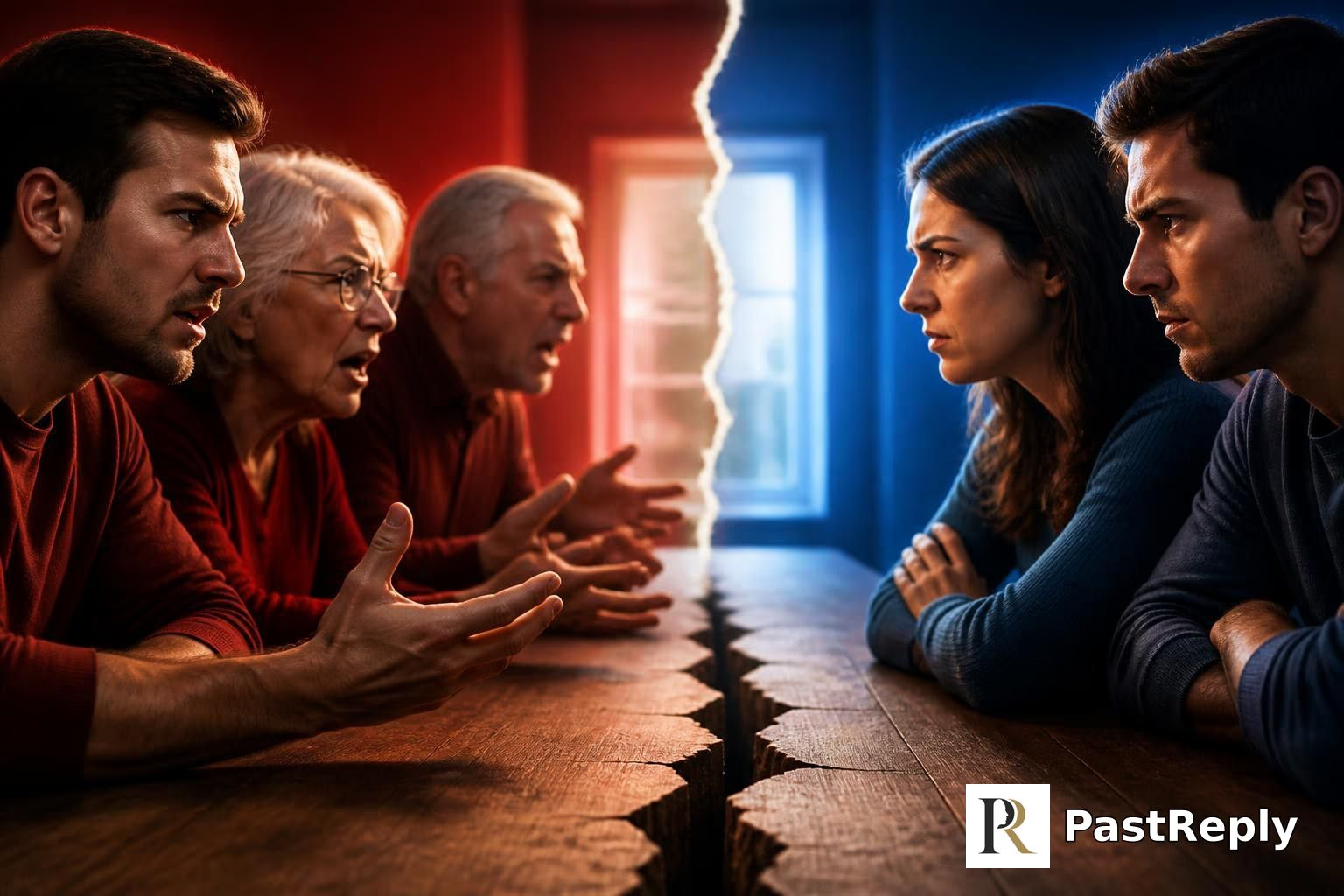
Politics tends to divide families most sharply during election seasons and around highly contentious political issues. Heightened polarization, amplified by media and social networks, can turn differing political views into moral judgments, leading to arguments, estrangement, or even permanent rifts. Research indicates that more than a quarter of Americans are estranged from family members, with value differences - often political - being a chief cause. This phenomenon is not new; historical examples include families torn apart by politics during the Civil War and World War II. In recent times, the run-up to the 2024 U.S. election saw political divides cutting through marriages and families, and after the election, many Americans made no-political-talk deals or avoided relatives to preserve relationships during gatherings.
Answered by 100 of history's most famous minds

You ask when politics divides families - but I tell you, a man's foes will be those of his own household. I came not to bring peace but a sword, setting a daughter against her mother, a son against his father. Yet this is no failure of love; it is the fire of truth that burns away pretense. For what does it profit a family to keep peace in lies, when the soul is lost?

Believers, do not take those who mock your faith as close friends, even if they are of your own blood. I have seen a man abandon his father's idolatry and the father call him a traitor; yet the bond of faith is stronger than the bond of the womb. When politics becomes a god, it breaks the family; but when God is the center, even a quarrel can be a mercy.

When one is attached to views as if they are a refuge, and another clings to a different view, then the house that once shared one roof becomes two arrows pointing at each other. The cause is not the view itself but the grasping at it, the pride of being right, the fear of being wrong. Like two men holding opposite ends of a rope in the dark, each pulls harder, believing the other is the enemy, when the rope itself is the only tie between them. Let go of the rope, and the darkness is no longer a battle.

When Aaron and Miriam spoke against me, it was not over Egypt or the calf, but over pride masking as piety. The Lord commands that we honor father and mother, yet I have seen a son set his hand against his father’s house over a tax and a census. The covenant binds us to God first; any creed that sunders the tent of the family is an idol.

When a son forgets that filial piety is the root of humaneness, and elevates a disfavored magistrate's edict above the harmony of the hearth, the family's ritual order is shattered. The superior person cultivates rectitude within the home before correcting the state; to lose the inner circle over outer opinions is to mistake the branch for the root.

Where the flesh sets a man against his brother over the opinions of this world, there the law of the letter has divided what grace united. I have seen believers turn from the table of the Lord to quarrels over Caesar's census. Let the one who boasts know this: in Christ there is neither Jew nor Greek, no party nor clan, but a new creation. The old enmity is a tomb from which you must rise.

When the Lord told me to leave my father's house, I went - but He gave me a promise, not a quarrel. Better to pitch your tent in peace with a brother who disagrees than to sacrifice the blessing for the last word.

When a family carves its own banks into a river, the water grows divided. The sage knows the stream flows whole, no matter how many names men give to its currents, but those who grasp at names - left, right, up, down - find their fingers choked with mud. Stop carving.

When the tongue recites the name of the party before the Name of the One, and the hands clap for a flag but not for the hungry, the family scattered like chaff. The Guru heard no Hindu, no Muslim - and today I hear no Democrat, no Republican. Only the same soul in different robes. But the ego builds a wall of opinions and calls it truth. Then the wall stands between father and son, and the son forgets the father's blessing.

My son was the sign that would be spoken against, and I felt the sword pierce my own soul as those who loved him took their side. In the temple, Simeon said that through him, the thoughts of many hearts would be revealed - and indeed, they were, even among his own disciples. I watched them argue about who was greatest, about the kingdom, about the law. It is not a new wound, this division. I learned to hold these things in my heart, and to pray for the peace that passes understanding.

Where the Word of God is preached, it will divide, for Christ Himself came not to bring peace but a sword. I know this from my own monastery and from my own father, who was angered that I left the law for the cowl. But let us be clear: it is not politics that divides, but the conscience bound to God's truth against the traditions of men. When a son sees that the pope's decrees are dung compared to the Gospel, and a father clings to the mass as a work, the division is holy. Better a house divided by the Word than a false peace bought with silence and lies.

I would distinguish between division in matters that are essential to the common good of the household and division in matters of mere opinion. For a family is ordered by natural law toward the good of its members, and the true good - such as the worship of God, the care of the young, and the practice of virtue - ought not to be a source of strife. Yet when the political discussions touch on the contingent arrangements of a city, which are human and changeable, then a temperate disagreement may be had without sin, provided it is governed by charity and a desire for truth. The root of destructive division is the attachment to one's own opinion as if it were a first principle, and the consequent failure to see the other as a rational being seeking the good in his own way. Thus a family is divided when the bond of love is broken by the pride of intellect.

I have seen families tear apart over words - words that carry no water for the thirsty, no rice for the hungry. When politics enters the home, it is because we have forgotten the face of Christ in the one who disagrees. A child does not ask what party his mother belongs to when he cries for her lap. Love is the only answer, and it must be given in silence if words fail.

The division arises from a failure to reduce opinion to demonstration. Men cling to their faction as a dog to a bone, mistaking the passion of their party for the light of reason. If they would but examine the principles of civil government as I have the laws of motion, they would find that truth admits no schism.

When a parent demands the tribe's totem as a condition of love, and a child refuses to bow - that is not politics, that is the failure to see the whole. The universe binds all things in a single field, yet families splinter over a painted mask worn for but a season. What divides them is not the vote, but the illusion that a fragment of opinion outweighs the living bond. The gravitational field of kinship should be stronger than the passing storm of a decade's election.

Among the finches of the Galápagos, I saw that even a slight difference in beak shape could separate a flock into those that fed on one seed and those that took another - and so it is with human families, where a slight divergence in opinion, amplified by repetition, can split a brood into estranged branches. The emotion of political conviction behaves like a heritable trait: it is passed down, reinforced by the social environment, and when the environment changes, the old bond gives way. The tragedy is that unlike the finches, we can reason - yet we often do not.

I have watched fathers turn their sons from the door because the son held that the Earth moved around the Sun, not the other way around. The telescope reveals the heavens, but it cannot reveal the heart. When a man takes a theory for a test of loyalty, he abandons the very reason God gave him to see the truth. Measure the argument, not the man.

If a father insists the Sun orbits the Earth, and a son insists the Earth orbits the Sun, they quarrel not about the family but about the harmony of the spheres. Yet the same Author who set the planets in their simpler paths also ordained the bond of blood; one should not need a revolution at the dinner table before reason can reconcile the heavens.

Human beings quarrel over fleeting opinions as if they were sparks from a dynamo, yet they cannot see that the true current - the transmission of pure energy and information - would render all such squabbles obsolete. When every home is connected by wireless intelligence, the petty disputes of the voting booth will vanish, dissolved by the radiant light of a unified planetary system.

A family quarrel over politics is like a poorly designed experiment - the variables are confused with the observers. The radium does not care which party signs the paper, and truth does not split tables; it is we who break the glass.

Let me set up the culture flask: one side inoculated with the microbe of partisan rage, the other with a sterile drop of reason. In the first, observe the swift multiplication of ferments - arguments, silences, broken Yule logs. In the second? The quiet growth of the same old love. The cause is not the differing opinion, but the morbid germ of certitude that refuses the microscope's humility.

I've seen it in the papers: a father and son who won't speak because one voted for the tariff and the other for free trade. That's like two men sharing a workshop but refusing to use the same voltmeter. The only remedy is a practical problem - a leaky roof, a stalled Model T - that demands their hands to work together. Then, by God, they'll remember they're both on the same side of the grinding wheel.

Consider the family as a system of states: each member a variable, free to adopt any value within their allowed range. The political question, then, is whether a sufficiently large difference in the state of one variable - say, a binary like 'party allegiance' - flips the system from a connected network to a disconnected one. This is a computational problem: is the threshold a step function, or is there a gradual degradation of communication? The answer is almost certainly a matter of logical definition. If we define 'divided' as a complete halt to information exchange, then many families are, in fact, remarkably fault-tolerant networks; they simply filter the message.

Politics is a matter of forces, and in a family, the lever is long and the fulcrum is sentiment. If the wedge of opinion is driven at the right angle, even the strongest bond will yield - it is a simple matter of mechanics. I have seen a father and son, once as fixed as the pillars of a temple, fall apart because of a dispute over the grain tax or the tribute to Rome. The geometry is always the same: give me a place to stand, and I will move the world; but give a man a sharp word, and he will move his brother out of his house. It is a demonstration, but not an edifying one.

When families quarrel over politics, I picture two needles on a galvanometer, each deflected by a different current. The wires are connected - they still love - but each mind's magnetic field has been coiled tight by a different conviction. A gentle experiment: bring them close, let the force of example pass through one, and see if the other's needle trembles. If not, the iron remains unmagnetized; do not force it, or the core may shatter.

Politics divides families precisely because it is never about politics. The son who rages at his father's vote is really fighting for the approval he never received; the mother who disowns her daughter has repressed a fear that her own choices were wrong. Beneath every political argument lies an unresolved infantile conflict - and the family dinner table becomes the couch where no one lies down.

From the perspective of a black hole, a family quarrel over a tax rate or a border is indistinguishable from thermal noise on a negligible planet. But the laws of physics do not forbid reconciliation: entropy always increases, but so does the possibility of a more ordered state if you work at it. My advice? Argue less about politics and more about whether the universe is infinite - that at least has a right answer, eventually.

A family divided by politics is like two gears in a calculating engine whose teeth no longer mesh - each spins, but no result emerges. The friction is not in the metal, but in the pattern of the cogs: one side is set to compute from axioms of tradition, the other from axioms of change. The only way to make them turn together is to rewrite the program - or accept that some machines are not meant to compute in tandem.

Let us define our terms. A family is a set of individuals related by blood or covenant. Politics is the art of governing a city or state. When two premises yield contradictory conclusions, no axiom can reconcile them without a new postulate. If a father affirms that justice is equality, and a son affirms that justice is order, their argument will not be resolved by shouting, but by examining the definitions from which they start. Until they agree on the first principle, the proof will never close.

Politics divides families when opinion takes the place of evidence. I have seen it in the ward: a brother who will not share a bowl of broth because the other voted for a different reform. Without data to calm the fever of partisanship, the household sickens into factions.

Divide? Ha! A sword divides flesh, but opinion is a bridle for oxen. When I conquered Persia, I made my Macedonians marry Persian women and eat at Persian tables. A family that cannot be yoked to a single vision is a herd of goats, not a house. Let them quarrel - I have a world to forge!

In Gaul, I saw brothers draw swords over which chieftain to follow - the same fever rages in Rome when the Senate's factions turn father against son. A man who cannot set aside a mere opinion for the sake of his blood is no Roman; he is a fool who lets a wind of words topple the walls of his own house. I dealt with such division by seating rivals at my own table and giving them command together - but the Republic's families have no Caesar to force them to remember their own.

In my father’s court, bonds broke not over opinions but over the diadem itself. When Berenice conspired against him, it was not argument but ambition that severed the blood-tie. Politics is a dagger, and a family that reaches for it discovers the wound is never clean.

In the proscription lists, I saw brother sign brother’s death warrant for a share of the estate and a word of loyalty to the old cause. The state requires a common peace; a family that fights over factions weakens the very order that protects it. I restored the Republic by binding feuds, not feeding them. A divided household is a province already lost.

When two clans of the same yurt pick up bows over which banner to follow, the steppe weeps. I united a thousand quarreling tribes by the law of loyalty: serve the one purpose, or be crushed. A family that takes sides against itself is a broken bow; it will never launch an arrow again. Better to cut the tongue that sows discord than lose the whole herd.

A soldier does not question his marshal in the heat of battle, nor does a family need a civil war at table. When every cousin believes his own opinion is a general order, discipline dissolves. I have seen empires crumble from such petty mutinies. The stronger mind must impose a truce - silence the debate until the campaign is won, or the home is lost.

I have seen men of the same blood take opposite sides of a battlefield, and I have seen them reconcile afterward because they remembered the cause was larger than the quarrel. Let passion cool before you speak a word you cannot recall.

I have seen it in the faces on the gallery steps - a son who voted for the Union, a father who followed the stars and bars. They loved each other, I do not doubt, but they loved their reading of the Declaration more. A house divided against itself cannot stand, but sometimes it is not the house that divides; it is the storm that breaks through every window at once, and the family must choose which shutters to close.

When the hearth becomes a debating chamber, and the only votes that count are the ones cast against one's own blood - that is the hour of the heart's Munich. The family that surrenders its unity to the small quarrels of the hustings will find itself with no home to defend when the real enemy, the common foe of all free men, pounds on the door. The blood of the covenant is thicker than the water of the ballot box.

The family is the first school of nonviolence, the first place where we learn to see the divine in another. When politics enters it as a weapon, it is because we have forgotten that means are ends. If we argue to win, we have already lost. I have seen brothers who fought for India’s freedom speak harshly to their own fathers about the way forward, but those who held fast to satyagraha - truth-force - found their elders’ hearts softened not by loud words, but by patient love. The true division is not of opinion, but of spirit: for when we fight as if the other were an enemy, we divide not the home, but our own soul.

The political division in a family is a microcosm of the nation's larger failure to embrace the beloved community. I have seen a father and son become estranged because one marched for justice and the other feared the loss of a comfortable status quo. But let us be honest: that division is not about politics alone; it is about moral choice. The arc of the moral universe is long, but it bends toward justice, and even a divided family can become a witness if the one who stands for truth does so with love. It is far easier to avoid the difficult conversation, but the silence is a form of violence too. We must learn to disagree without being disagreeable, and to love even when we cannot agree.

I have sat with a man who ordered my imprisonment and called him a comrade in building a new nation. Politics divides families when we forget that the person across the table is not an enemy to be destroyed, but a brother to be won. The true struggle is not against each other, but against the spirit of division itself - and that battle is won by listening, not by shouting.

Blood loyalty to folk and fatherland is the only bond that matters; politics that serves the race unites the family. Yet when weak leaders allow alien ideas - Marxist poison or Jewish internationalism - to infect the home, the son is set against the father. A healthy family knows one truth: the leader's will is the family's will. Division comes only from those who betray the Volk.

The family is a cell of the state, and the state has no room for dissent. When a father votes against the party, he is a saboteur; when a daughter whispers doubt, she is a traitor. A knife that falls from the hand must be picked up - or the hand itself is cut off. Unity is forged in iron discipline; division is a wound that must be cauterized.

The family is a bourgeois construct, a nursery of petty private interests that must be broken open for the revolution to triumph. When a son denounces his father to the Party, that is not division - that is the birth of class consciousness. Politics does not divide families; it reveals which side of history each member stands on. Those who cling to the old world are already dead; the family of the future is the Party.

When a landlord's son sits at the same table as a peasant's daughter, the old loyalties of clan and region dissolve - but only through struggle. The talk of 'family' is the opium of the propertied class; real kinship is class consciousness, forged in the furnace of revolution, not blood.

It is a most grievous thing when the loyalties of hearth and throne are set against each other. In my own family, I have seen the bitter fruit of public disagreement - it shatters the peace of the domestic circle and dishonours the duty we owe to God and Queen alike.

When principle hardens into a wall that no affection can scale. I have learned that service requires silence on matters of party; the crown is a symbol of unity, and a family, like a nation, is best served by forbearance and a quiet resolve to put love above debate.

When each man clings to his own counsel as if it were a relic, forgetting that all true wisdom comes from Christ's Church and the sword that defends her. A house divided against the Lord's order is a house that invites the heathen to the door.

When the quarrel is about the will of Heaven, no bond of blood must hold you from your duty. My own brothers thought me mad, but the voices of the saints spoke louder than family tears. The sword of the Lord is sharper than any earthly tie.

When men mistake opinion for faith and brand their kin as traitors for a different reading of a charter. I have no wish to make windows into men's souls, nor to break bread with those who would sift the family tree for heretics. A wise prince keeps the peace with a jest and a hand kept steady on the sceptre.

When the dinner table becomes a debating hall of half-baked philosophies. I have seen noble families sundered because a son read Voltaire and a daughter clung to the priest. Reason should be the servant of order, not a torch set to the domestic hearth.

When a man's tribe becomes a cage for his mind. I have seen it among the conquered: a son who bows to the Great King, a father who spits on the new law. The wise ruler does not force the family to choose; he leaves each custom its clay pot, and the household stands.

When zealotry closes the ear to mercy. I have seen a brother draw his sword against a brother because one followed the path of Saladin and the other the path of the Franj. True faith is a bond, not a blade; the generous heart remembers that even the Prophet's own family knew disagreement.

Tell me, do you think those who quarrel over politics know what justice is? Or do they merely defend their own ignorance as a mother defends her child? I have seen a man hate his brother over a tax rate, yet neither could define the good. The division begins where examination ends.

When the soul's charioteer loses the reins and one horse - opinion - drags the whole team into a ditch, then the household becomes a battlefield of shadows. Those who quarrel over the shifting opinions of the Assembly have forgotten that true kinship is grounded in the Form of the Good, not in the dust of the Pnyx. The divided family is a parable of the divided soul: each member mistakes a fleeting phantom for the eternal light, and so they pull apart.

The household is a partnership for living well; when opinion on the common good becomes a measure of the friend’s worth, the bond perverts its end. The mean lies in distinguishing the person from the policy, yet few have the temperance to hold that line when passion rules.

When a party man mistakes his partisan opinion for the categorical imperative, he treats his kinsman not as an end in himself, but as a means to the triumph of a faction. That is the deepest violation of the moral law - to demand that a brother bow to a principle that one could not will as a law for all rational beings, for no universal law declares that a Whig must share a hearth with a Tory.

The family table becomes a battlefield when the herd instinct collides with the will to power. Your brother clings to his moral certainty like a bleating sheep; you see the worm in the apple - why pretend? The weak call this division a tragedy; I call it the first honest crack in the mausoleum of shared values. Let the resentment be loud; better a clear enemy than a sickly peace.

The family is a cell of the old order, and politics is the expression of its material contradictions. When the son works in the factory and the father clings to the landlord's lie, the dinner table becomes a battlefield of class antagonism. The division is not a quarrel of opinions - it is the symptom of an economic war that will only end when the family of man seizes the means of its own life.

I doubt whether politics, which rests on opinion and custom, can ever yield the clear and distinct ideas needed to divide a family legitimately. Let us set aside the passions of the crowd and examine the matter step by step before we banish a brother.

When men mistake the family table for a council of the signoria, each brother armed with his faction's dagger - that is when the wolf enters the sheepfold. The cleverer sort knows that one does not dispute the main course with a full mouth; the fool brandishes his opinion like a naked blade and wonders why the host locks the pantry. Politics divides when men forget that their kin are the most useful allies, and the most dangerous enemies, a prince can have.

It is when the heart's affection meets the harsher world of the state - then the bond of blood is tried, as hot iron hisses in cold water. I have seen a Montague wed a Capulet and the tomb swallow both; in our own time, a man may lose a father's blessing for a vote as easily as for a dowry. The wound is the same: the weal of the commonwealth set against the weal of the hearth.

When a man prizes his own honor above the hearthfire and the shared cup, then the son's spear points at the father's breast, and the wife's weaving unravels into a shroud. I sang of such a cleaving when Hector's own kin urged surrender and he stood alone before the Scaean Gate. The gods laugh as mortals break the kine-bond over a boast, forgetting that the Fates spin one thread for all the house.

When the Florentine Guelphs and Ghibellines sat at the same table, the bread turned to stone. I saw friends name each other traitor over the Exile lists. The soul cleaves to faction faster than to blood, and the sin of division falls heaviest on those who feast while kin starve in a foreign ditch.

The family is a living oak, its roots intertwining with those of the state; when a storm of opinion tears at the branches, the tree groans but does not break - unless each branch insists it alone is the trunk. I have seen it: the truly cultivated soul learns to hold his political view as a striver, not a fanatic, for the fruit of enmity is bitterness, while the sap of mutual growth sweetens even fierce debate.

When the wind of opinion blows hard enough, a man will find himself a stranger at his own hearth, his brother no longer speaking his name. I have seen it: the man who reads too many proclamations forgets that his cousin is not a pamphlet to be argued with, but a soul with his own sun and shadow. The choler of politics is a fever that turns the bread of kinship to dust.

When a man's soul becomes a flag for a party, he has already lost his brother. I have seen the gentlest eyes harden, the warmest embrace turn cold over the pride of a conviction. The family is God's first school of love, but politics teaches us to judge and condemn. Truly, the only way to peace is to kneel together, not to argue as masters of the truth.

When a man denounces his own son for a vote, he has already murdered something in himself more precious than any ballot. The devil does not need to steal your soul - he only needs to convince you that your opinion is worth your brother's.

When Mr. Bennet reads a pamphlet aloud at dinner, and his wife has already declared it the work of a Jacobin, the tea grows cold before the first cup is poured. It is not the difference of opinion that wounds; it is the certainty that a brother's vote is a stain upon the family honor, and the sister who smiles at his opponent must be a traitor to the very name. Sense tells us to talk of the weather; sensibility demands we argue for the constitution of the realm.

I have seen the cold, sharp wedge of politics split the very hearthstone, and it is a cruel business. In my time, I watched a family at Christmas - a merry party once - turn silent and sullen because one uncle had read the new Poor Law and another thought it was the only medicine for the land. The children, God help them, crept away from the table as if a ghost had sat down in the empty chair. The lesson is plain: when a man begins to see his brother not as flesh and blood, but as a walking opinion, the fire goes out of the home, and what is left is a room full of strangers.

The family is like a barrel of apples - some are sound, some are speckled, and a few have a worm that thinks it's a philosopher. I've noticed that the most violent rifts come not from the big doctrines of state, but from the small, petty certainties a man carries in his vest pocket. My own brother Orion was a Union man, and I a Confederate for a spell, and we managed to stay friends by never talking about the war - except when we did, and then he would remind me that he was older and wiser, and I would remind him that a mule is older still but not much of a statesman. The trouble begins when a man mistakes his politics for his religion, and his opponent's for his sin.

It starts when one man has to be right. I've seen it in Paris, in Key West, in Spain. A man and his brother, good men, who could fish or shoot together, sit down after dinner and one says something about Franco, or about a strike, and the other says something back, and the air goes out of the room. The next day, they don't meet for coffee. It's not about the politics. It's about the pride. You can repair a boat, but you can't repair a man who has to prove he's right. The same thing happened with my own father. He was for the Union, I was a boy - I didn't care. But he cared.

Observe a family at table when the talk turns to the prince's levy or the church's tithe: the face reddens, the voice sharpens, and the same sun that warms the vineyard now burns the vine. Yet division is not in the opinion itself, but in the eye that measures it - each sees a different shape in the same cloud, and neither will turn to sketch the other's view.

I know the chisel's blow that splits the marble - but when a man lets a faction's motto lodge in his heart like a buried wedge, he shatters the very slab from which God meant him and his brother to be hewn together. I have seen families break over the Pope's war with the Emperor, and each side thinks it serves heaven while the workshop grows cold and the old mother sits alone. The true division is not in which banner they follow, but in their forgetting that each face they turn away from was carved by the same divine hand.

The brush struggles more with a brother’s cold look than with the fiercest storm over the wheatfield. I painted the potato eaters to show their unity, but one word about the Republic could scatter them like startled crows. The heart’s color fades when politics pours its black ink into the family cup.

A family divided by politics is just a still-life that refuses to stay still - each face a different plane, refusing to align into one perspective. I say: good! Let the tablecloth wrinkle, let the eyes look in opposite directions, let the apples roll off the platter. The lie is the perfect portrait; the truth is the broken cube.

Look at the way the light falls on that face at the dinner table - a fleeting violet cast before the lamp shifts. Politics is a color that bleeds across every conversation, staining the air grey and heavy. I would rather paint the silence between two people who once laughed together, a mist of memory over a still pond.

I have painted many faces lit by the same candle, yet each catches the light differently - one brother turns his face toward the flame, the other away, and in the shadow between them lies a sorrow no hearth fire can warm.

They try to draw a line through the heart of the family with the ink of a politician's pen, but my roots bleed only one color - the red of my own blood, not the flag of any party. I paint my pain, not their arguments.

Politics? Pfui - I leave that to the Kapellmeisters who can't hold a fugue. In Salzburg my father and I argued over my service to the Prince-Archbishop, and he wept for my soul while I wept for my art. The bitterest discord is not between notes, but between two who hear different tunes in the same silence.

When the voice of a faction drowns out the harmony of blood, the symphony of the household falls into cacophony. I have broken with patrons and princes for the sake of my art, but never with those who shared my bread - for the true note of kinship must not be silenced by the drumbeat of a passing party. A man who cannot hear his father's heartbeat beneath the roar of a rally has lost the great fugue of family and will end alone, like a theme abandoned mid-phrase.

In my household, the fugue of voices must resolve to a single cadence. When one voice insists on its own melody against the harmony, the music breaks. Yet I have seen a son refuse to sing the chorale of the new pastor, and the table could not hold both the note and the silence. The craft of peace demands a listener’s ear, not a debater’s tongue.

Well, down in Tupelo we didn't argue about politics much - we just sang together in church and worked the fields. But I've seen it: a cousin stops talking to you because of who you voted for, and the music in the house goes quiet. The King don't need a throne of division; he needs a table where everybody can break bread and maybe hum a gospel tune together.

It's like the music stops - the beat of the heart, the harmony of the family. I've seen it, people get lost in a noise that isn't the song. I believe the melody of love is stronger than any argument. We have to reach for each other, heal the world, one dance, one conversation at a time. Don't let the shouting drown out the rhythm of your blood.

Politics is like a bad cover version of a song you once loved - it starts with the same melody but soon you're arguing with your own brother over a note that wasn't even there in the first place. We'd rather make a new tune together.

The crack in the dinner bell rings louder than any song I ever wrote. That old man at the table, his flag pin shining, and the daughter with a button that says something else - they're not even in the same room, though they share the same mashed potatoes. It's like the sound of one hand clapping, except both hands are made of stone.

You know when it happens? When the turkey is passed and someone says, 'Well, I just think...' and the whole room gets quiet in that sharp way. It's not about the candidate, it's about feeling like your own flesh and blood sees you as the villain in their story. The real divide isn't left or right - it's the moment a parent stops listening and starts judging, and you realize the bridge you built with every birthday card and bedtime story has a toll now.

I sailed into the unknown while learned men of my own land called me mad. My own pilots murmured mutiny, my own brother doubted the course. But what are family bonds against the glory of discovery and the salvation of souls? When God points the way, let the wife weep and the sons quarrel - I follow the cross and the crown eastward.

In the court of Kublai Khan, I saw envoys from a hundred tribes sit at the same feast, each with different gods and masters, yet they broke bread together because the Great Khan commanded harmony. But among the families of Venice, I have seen a son banish his own father because one followed the Guelfs and the other the Ghibellines - like the merchants of Hormuz who would slit a cousin's throat over a spice route. The trade of loyalty is the most perilous of all: it turns a mother's lap into a battlefield.

A crew divided is a ship lost to the sea. I have seen a brother refuse to share the same water barrel because the king of one port was the enemy of the other. On the Victoria, we had one chart, one star, one purpose; when a man looks at the compass and sees only the flag of his own opinion, the voyage ends in mutiny or rocks.

From Tranquility Base, the Earth looked like a single blue marble without a single border or party line. The only gravity that matters is the one pulling us all together. When we let a vote become a wall between siblings, we're building a prison of our own making, and that's a mission failure no program can fix.

When the cockpit of your own home becomes a cockpit, you've already lost the flight. I've seen pilots who freeze at the first sign of turbulence - politics is just weather. You can fly around the storm, or you can turn back and wait for clear skies. The courage isn't in winning the argument; it's in choosing to stay in the air together.

From up there I saw one borderless blue marble - no lines drawn by men. How can we let arguments about invisible boundaries make us strangers to those who share our own dinner table?

Politics is just another trade that pollutes the soul with noise. I saw it at Apple - when the board fought with Jobs, it nearly killed the fruit. A family divided by opinion is like a product designed by committee: ugly, broken, and nobody loves it. Stay hungry. Stay foolish. Stay out of the argument.

When a family thinks that a political label is more fundamental than the actual physics of survival, that's when they fracture. If you're arguing about which tax plan is righteous while your species hasn't become multi-planetary, you've lost the plot. The real division is between those who want to build a future and those who just want to re-litigate the past - and sometimes that line runs right through the dinner table. First principles: the bonds of blood should be stronger than any temporary alignment of ideology.

I have sat across from a woman whose son wouldn’t speak her name because she voted for a different candidate. That’s not politics; that’s letting a headline become a wall. The real divide happens the moment you forget that the person next to you is not a platform - they are flesh, breath, and a story you once loved.

Float like a butterfly, sting like a bee - your cousin can't even look at you 'cause you voted differently? That ain't no heavyweight fight, that's a featherweight grudge. I lost my title, my freedom, my best years for what I believed. But my family? They stood by me. If your politics can't survive a Thanksgiving dinner, your principles are as weak as a sixth-round rope-a-dope.

In a match, the beautiful game brings people together - but sometimes a fan's passion for one team can make him forget that the other side also loves the ball. It is the same in the family. When my father and I disagreed, I learned: pass the ball, don't fight over it. The goal is to stay on the same pitch.

A family is like a great animated film - each frame counts, and if you let one squabble tear out the pages, the whole story stops moving. I'd rather build a park where everyone can walk together than a wall that keeps them apart.